ISSN(Online): 2319-8753 ISSN (Print): 2347-6710
I
nternational
J
ournal of
I
nnovative
R
esearch in
S
cience,
E
ngineering and
T
echnology
(An ISO 3297: 2007 Certified Organization)
Website: www.ijirset.com
Vol. 6, Issue 7, July 2017
Fingerprint Liveness Detection using Deep
Stacking Network
Akshata Satish Shet1
ME Student, Department of Electronics and Telecommunication Engineering, MIT College of Engineering, Kothrud, Pune, India1
ABSTRACT:Fingerprints have beenmost generally utilized for diverse security systems because of the high-level accuracy and user’s convenience. Since fingerprints begin to be broadly used in the smart mobile phones and tablets for payment as well as security, high-performed algorithms have been explored in the literature. At the same time, such mobile systems are highly required to detect spoofing attacks by fabricated fingerprints with malicious intends. This system implemented by using MATLAB software. In this paper, we used combination Speeded-Up Robust Features (SURF), Histograms of Oriented Gradient (HOG) and texture features from Gabor filter and deep stacking network as a classifier of the system. Nowadays deep learning adapting success in object recognition area for its ability in deep feature extraction and representations. In this study, we performed experiment analysis on the database from livdet2015.
KEYWORDS:fingerprint liveness; Gabor filter; Deep stacking network.
I.INTRODUCTION
Fingerprint liveness detection is the goal to detect a fingerprint image, capture by an electronic device, belongs to an alive fingertip or to be an artificial of it. Biometric systems are an emerging technology that refers to the identity identification based on their physiological and behavioral characteristic. Therefore, biometric recognition systems are commonly used for authentication in various security applications. Biometric technology presents several advantages than traditional security methods based on either some information (PIN, Password, etc.) or physical devices (key, card, etc.) The ability of fingerprint authentication system to determine whether or not the fingerprint samples presented are really from a live fingertip or fake one, which is called liveness detection.To prevent an attack, many different kinds of detection methods have been proposed in recently.
During the previousdecade, the large growth in biometric analysis resulting in the advancement of innovative sensors, novel feature extraction and matching algorithms. Fingerprints are most generally used for numerous security systems because of the high-level accuracy and user’s convenience.
ISSN(Online): 2319-8753 ISSN (Print): 2347-6710
I
nternational
J
ournal of
I
nnovative
R
esearch in
S
cience,
E
ngineering and
T
echnology
(An ISO 3297: 2007 Certified Organization)
Website: www.ijirset.com
Vol. 6, Issue 7, July 2017
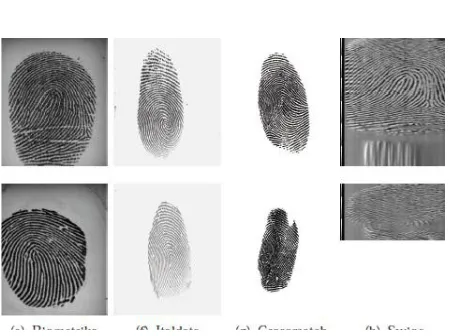
Fig. 1. Example of live (above) and fake (below) fingerprints acquired with 4 sensors.
As illustrated in Fig. 1, we observe that it is very difficult to visually differentiate between live and fake fingerprints. The fingerprint based authentication system creates the need to develop a method which can distinguish between live and fake fingerprint images.
In this paper, to analyse the detection performance we employ dataset from livDet2015 which consist various fake fingerprints generated by silicone, gelatin, and playdoh have been captured from fingerprint sensors.
II.RELATEDWORK
In this section, we tend to discuss the literature in the field of software based fingerprint liveness detection. D. Yambay et. al. [2] “Liveness detection”, a system used to decide the authentication of a submitted biometric, has been implemented in fingerprint scanners in recent years. The main principle for the LivDet 2013[2] and LivDet 2015[3] competition is to check software-based fingerprint liveness detection strategies as well as fingerprint frameworks which incorporate liveness detection capabilities utilizing a standardized testing protocol and huge quantities of spoof and live fingerprint images. LivDet is the worldwide public competition for programming-based fingerprint liveness recognition and first public assessment of framework based fingerprint liveness recognition.
Rodrigo [4] proposed a method based on convolutional neural networks (CNNs) for fingerprint liveness detection. In this systemexperimental analysis was done on the data sets used in the liveness detection competition of the years 2009, and 2011 which comprises almost 50000 live and fake fingerprints images. The system consist comparison of four different algorithm models: two CNNs pretrained on natural images and fine-tuned with the fingerprint images, CNN with random weights, and a classical local binary pattern approach.
ISSN(Online): 2319-8753 ISSN (Print): 2347-6710
I
nternational
J
ournal of
I
nnovative
R
esearch in
S
cience,
E
ngineering and
T
echnology
(An ISO 3297: 2007 Certified Organization)
Website: www.ijirset.com
Vol. 6, Issue 7, July 2017
Sweat pores: The sweat pores are very small circular structures present in the fingerprint ridges of the living fingers that are the endings of internal skin structures called sweat glands.
The sweat glands are responsible for production of sweating fluid. The liveness detection methods based on the analysis of the sweat pores usually expect that such small structures would be very difficult to reproduce with sufficient quality when the fake finger is produced.
III.PROPOSEDSYSETEM
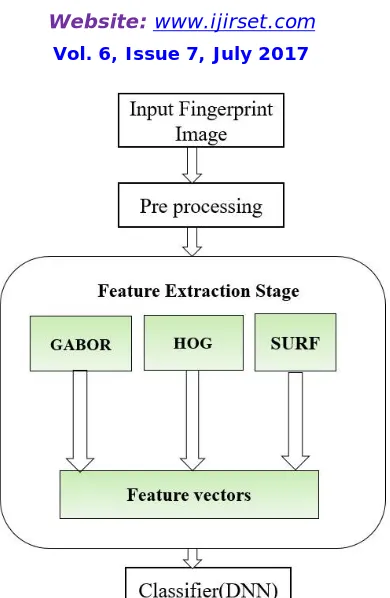
In this work, we divide the system into three main sequential blocks: • Image Pre-processing Stage
• Feature Extraction Stage • Image Classification Stage
A. Image pre-processing stage
This is initial stage of system. A low quality fingerprint image is usually noisy and has low contrasts between valleys and ridges. These effects will happen throughout image acquisition, as result of dry or wet skin. Since the image acquisition stage is not always monitored for accepting only high quality images, fingerprint image enhancement and noise reduction are, therefore, important pre-processing factors in accurately detecting fingerprint liveness.
Fig. 3. (a) Original Image (b) Canny Image (c) Cropped Image (d) after median filtering (e) after histogram equalization (f) Resized
Canny edge detector is first applied for the purpose of to detect wide range of edges in the images as shown in fig. 3(b). We can enhanced the quality of the image by cropping the fingerprint region in the image and then performing histogram equalization expand the discernment dataas shown in Fig. 3(e).To remove noise during image acquisition, median filtering is then applied on the cropped images as shown in Fig. 3(d).
B. Feature Extraction stage:
ISSN(Online): 2319-8753 ISSN (Print): 2347-6710
I
nternational
J
ournal of
I
nnovative
R
esearch in
S
cience,
E
ngineering and
T
echnology
(An ISO 3297: 2007 Certified Organization)
Website: www.ijirset.com
Vol. 6, Issue 7, July 2017
Fig. 3. Block diagram of System
a) SURF
In this paper we choose to use SURF (Speed Up Robust Feature) as it is invariant to illumination, scale and rotation. The detector locates the key points in the image and the descriptor describes the features of the key points to build the feature vectors of the key points. The determinant of the approximate Hessian-matrix uses by SURF on the integral image to locate the key feature points. For the key point descriptor, SURF uses the sum of the Haar wavelet responses to describe the feature of a key point [8]. SURF descriptors have been used to locate and recognize objects, people or faces, to track objects and to extract points of interest.
b) HOG
The histogram of oriented gradients (HOG) is anelement descriptor used in image processing for the purpose of object detection. The histogram of oriented gradients descriptor can be described by the distribution of intensity gradients or edge directions. The technique counts occurrences of gradient orientation in localized portions of an image. This technique is same to that of edge orientation histogramsscale-invariant feature transform descriptors, and shape contexts. The features of the gradient are sustained into the neural network classifiers that give increasingly extra exactness in the classification comparing with other classifiers.
Following steps are to calculate Histogram of gradients.
i. To calculate a HOG descriptor, first calculate the horizontal (x) and vertical (y) gradients then calculate the histogram of gradients. The output of this as shown in following fig.5.This is easily achieved by filtering the image with the [-1 0 1] kernels.
ii. To find magnitude and direction of gradient using the following formula.
ISSN(Online): 2319-8753 ISSN (Print): 2347-6710
I
nternational
J
ournal of
I
nnovative
R
esearch in
S
cience,
E
ngineering and
T
echnology
(An ISO 3297: 2007 Certified Organization)
Website: www.ijirset.com
Vol. 6, Issue 7, July 2017
=
iii.Sincedifferent images may have differentcontrast, contrast normalization can be very useful. Normalization is done on the histogram vector within a block. One of the following norms could be used.
1 ∶ =
‖ ‖ +
Fig.5(a) x gradient (b) y gradient
c) Gabor filter
Gabor filter is used to extract features from fingerprint images for texture analysis. Gabor filters have optimal localization properties in both the frequency domain and spatial domain.A Gabor filter is obtained by modulating a sinusoid with a Gaussian. For the case of one dimensional (1D) signals, a 1D sinusoid is modulated with a Gaussian.
Let g(x, y, Ѳ, ф ) be the function defining a Gabor filter centered at the origin with Ѳ as the spatial frequency and
фas the orientation. We can view Gabor filters as:
( , ,Ѳ,ф) = exp(− +
σ ) exp(2 Ѳ ( ф+ sinѲ)))
It has been shown that, σ the standard deviation of the Gaussian kernel depends upon the spatial frequency to measured. i.e. Ѳ. In our case σ = 0.65Ѳ.
C.Classification:
ISSN(Online): 2319-8753 ISSN (Print): 2347-6710
I
nternational
J
ournal of
I
nnovative
R
esearch in
S
cience,
E
ngineering and
T
echnology
(An ISO 3297: 2007 Certified Organization)
Website: www.ijirset.com
Vol. 6, Issue 7, July 2017
DSN Architecture:
Fig.6. A typical DSN architecture Basic learning algorithm:
The input feature vector is denoted
= [ , … , … ]( = [ , … , … ] ) Where D is the dimension of each input vector and N is the number of the training samples.
Let L be the number of hidden units, and C be the dimension of the output vector. Then the output of the DSN module is
= ℎ
Where hi =σ(WT xi) is the output of hidden layer,
U is the upperweight matrix of dimension LxC Wis the lower weightmatrix dimension DxL[10]
IV.EXPERIMENTAL RESULTS
IN THIS SECTION, WE DONE EXPERIMENTAL ANALYSIS OF LIVENESS OF FINGERPRINT.
A.DATASETS
Our analyses were completed on openly accessible fingerprint liveness database for LivDet 2015 competitions from Clarkson University - University of Cagliari. For the LivDet 2015 database, four optical sensors, Biometrika, Digital Persona, Greenbit, and Crossmatch were used to collect the fingerprints. The corresponding spoof materials were chosen from body double, latex, PlayDoh, wood glue, gelatine, latex.
B. Result
ISSN(Online): 2319-8753 ISSN (Print): 2347-6710
I
nternational
J
ournal of
I
nnovative
R
esearch in
S
cience,
E
ngineering and
T
echnology
(An ISO 3297: 2007 Certified Organization)
Website: www.ijirset.com
Vol. 6, Issue 7, July 2017
FIG.7.GUI OF THE SYSTEM
AFTER PERFORMING ALL STAGES OF THE SYSTEM WILL CLASSIFY THE FINGERPRINT IMAGE IS REAL OR FAKE.
FIG.8.OUTPUT OF THE SYSTEM C. Confusion matrix
We have total 2000 sample images with 1500 real n 500 are fake. In the following confusion matrix positive means real fingerprint and negative means fake fingerprint.
N=2000
Positive
Negative
Positive
1470
30
Negative
480
20
ISSN(Online): 2319-8753 ISSN (Print): 2347-6710
I
nternational
J
ournal of
I
nnovative
R
esearch in
S
cience,
E
ngineering and
T
echnology
(An ISO 3297: 2007 Certified Organization)
Website: www.ijirset.com
Vol. 6, Issue 7, July 2017
TABLE I : Comparison of ACE with LivDet 2011 competition database
Methods ACE
WLD+LPQ 7.87
MBLTP 9.77
multiresolution LBP 10.22
Tans method 14.24
Power Spectrum 33
Curvelet Energy 35.87
Our Method 3
To determine accuracy we use following equation
= +
Here TP as true positive value and TN true negative value.
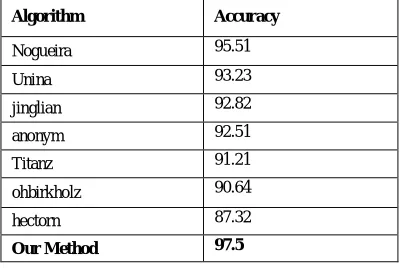
Table II provides the comparison of accuracy with algorithm used in livDet2015 competition.
TABLE II: Comparison of accuracy with algorithm used in livDet2015 competition
Algorithm Accuracy
Nogueira 95.51
Unina 93.23
jinglian 92.82
anonym 92.51
Titanz 91.21
ohbirkholz 90.64
hectorn 87.32
Our Method 97.5
VI.CONCLUSION
In this paper we have tendency to implement unique technique for liveness detection of fingerprint. To keep a decent level of security, reliable spoofing detection tools or device are necessary, preferably implemented as software modules. In this paper we used SURF, Gabor filter and HOG for texture feature and in addition Deep Stacking Network as classifier which have owns advantages to other deep models for its simplicity. We carried out experiments on used databases from LivDet2015. The proposed method scored consistently low EER and high accuracy compare to other used methods.
REFERENCES
[1] Rohit Kumar Dubey,Jonathan Goh,and Vrizlynn L L Thing “Fingerprint liveness detection from single image using Low level feture and shape analysis” IEEE Transactions on, Information Forensics and Security DOI 10.1109/TIFS.2016.
[2] L. Ghiani, D. Yambay, V. Mura, S. Tocco, G.L. Marcialis, F. Roli, and S. Schuckcrs, “Livdet 2013 fingerprint liveness detection competition 2013,” in Biometrics (ICB), 2013 International Conference on, June 2013, pp. 1–6.
ISSN(Online): 2319-8753 ISSN (Print): 2347-6710
I
nternational
J
ournal of
I
nnovative
R
esearch in
S
cience,
E
ngineering and
T
echnology
(An ISO 3297: 2007 Certified Organization)
Website: www.ijirset.com
Vol. 6, Issue 7, July 2017
[5] Tan, B., Schuckers, S.: ‘Liveness detection for fingerprint scanners based on the statistics of wavelet signal processing’. Proc. ComputerVision and Pattern Recognition Workshop (CVPRW ‘06), 2006, pp. 26.
[6] Tan, B., Schuckers, S.: ‘Spoofing protection for fingerprint scanner byfusing ridge signal and valley noise’, Pattern Recognit., 2010, 43, (8),pp. 2845–2857.
[7] Espinoza, M., Champod, C.: ‘Using the number of pores on fingerprint images to detect spoofing attacks’. Proc. Int. Conf. on Hand-Based Biometrics (ICHB), 2011, pp. 1–5.
[8] Herbert Bay , Andreas Ess “Speeded-Up Robust Features (SURF)”Science Direct Computer Vision and Image Understanding 110 (2008) 346–359.
[9] V. Shiv Naga Prasad_University of Maryland “Gabor Filter Visualization”