Design and Development of ARM Cortex
LPC1768 Based Water Level Management
System
B.Bilvika1, Dr. M.V.Lakshmaiah2, U.Meenakshi3
ResearchScholar, Department of Electronics, Sri Krishnadevaraya University, Anantapur, India
Head, Department of Electronics and Physics, Sri Krishnadevaraya University, Anantapur, India
Research Scholar, Department of Electronics, Sri Krishnadevaraya University, Anantapur, India
ABSTRACT: Now a day’s water and energy resources are becoming scarcity and therefore more valuable. In conjunction with the population growth over last century especially in India, the need for finding new and sustainable methods with high efficiency for agricultural cultivation and food production is very much essential. To facilitate this process, we are designing, building, and evaluating a system to utilize the minimum usage of water and energy for agriculture fields which is most useful for farmers to manage water and energy respectively. Our system aims to make cultivation and irrigation with more efficient as the farmer is able to make better informed decisions and thus save time and resources.ARM CORTEX based system is developed to know the level of water and control the flow of water in the field of plants or crops. This system monitors the water level in the field and automatically switches ON the motor when water level goes below the prescribed level in the field of plants or crops.The motor is switched OFF when the field is full of water level. Here the water level of the field is indicated on LCD (Liquid crystal Display). Using this system, the wastage of water and energy can be avoided. The ARM Cortex LPC1768 based system is developed for water level management and energy management which is useful for farmers to reduce power consumption.
KEYWORDS:ARM CORTEX M3 (LPC1768), 2X16 LCD, Relay, Pump Motor.
I. INTRODUCTION
II. GENERALDESCRIPTIONOFTHEHARDWAREANDSOFTWARE
A.HARDWARE:
The system performs the sensing level and control activities without the manual observation and attention .Since it is an automated system, it provides enough information to the farmers and water usages for such a long period.
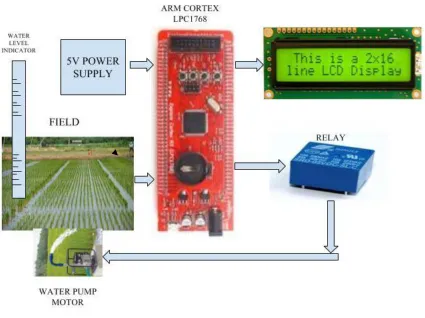
Block Diagram: The block diagram of the hardware is shown in the below figure1 which consists of ARM CORTEX LPC1768, 16x2 LCD, Relay and Pump Motor.
Figure 1: Block Diagram
A1. ARM Cortex LPC1768:
12-bit ADC, 10-12-bit DAC, motor control PWM, Quadrature Encoder interface, four general purpose timers, 6-output general purpose PWM, ultra-low power Real-Time Clock (RTC) with separate battery supply, and up to 70 general purpose I/O pins.
A2. Liquid Crystal Display (LCD):
LCD stands for Liquid Crystal Display. LCD is finding wide spread use replacing by LEDs (seven segment LEDs or other multi segment LEDs) because of the following reasons. These components are “specialized” for being used with the microcontrollers, which means that they cannot be activated by standard IC circuits. They are used for writing different messages on a miniature LCD.
A3. Relay (5V SPDT):
Relay is an electromagnetic device which is used to isolate two circuits electrically and connect them magnetically. They are very useful devices and allow one circuit to switch another one while they are completely separate. They are often used to interface an electronic circuit (working at a low voltage) to an electrical circuit which works at very high voltage. For example, a relay can make a 5V DC battery circuit to switch a 230V AC mains circuit.
A4.Pump Motor:
A pump is a device that moves fluids by mechanical action. Pumps can be classified into three major groups according to the method they use to move the fluid. Pumps operate by some mechanism and consume energy to perform mechanical work by moving the fluid. Pumps operate via many energy sources, including manual operation, electricity engines or wind power, come in many sizes, from microscopic for use in medical applications to large industrial pumps. Mechanical pumps serve in a wide range of applications such as pumping water from wells, aquarium filtering, pond filtering and aeration, in the car industry for water-cooling and fuel injection, in the energy industry for pumping oil and natural gas or for operating cooling towers. In the medical industry, pumps are used for biochemical processes in developing and manufacturing medicine, and as artificial replacements for body parts, in particular the artificial heart and penile prosthesis.
B. SOFTWARE DESCRIPTION:
KEIL μ VISION (IDE):
Keil, you want to develop or debug the project without any hardware setup. You must compile the code for generating HEX/BIN files. In debugging Mode, you want to check the port output without LPC1768 Primer Board.
Proteus:
The Proteus Design Suite is a proprietary software tool suite used primarily for electronic design. The software is used mainly by electronic design engineers and electronic technicians to create electronic schematics and electronic prints for manufacturing printed circuit boards. The Proteus Design Suite is a windows application for schematic capture, simulation and PCB layout design.
Figure 3: Schematic Design in Proteus
Flowchart:
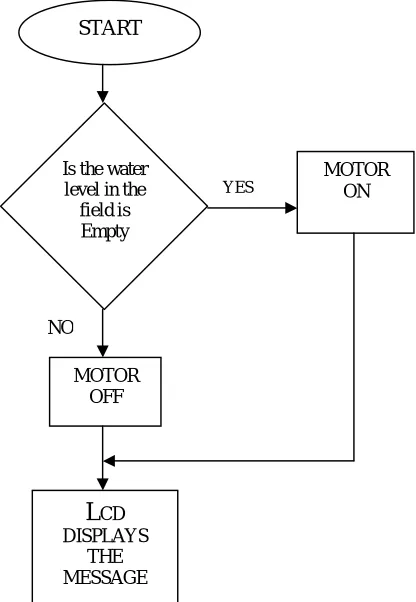
Figure 4: Flowchart of Water Level Management System
START
Is the water level in the
field is Empty
MOTOR ON
MOTOR OFF
L
CD DISPLAYSTHE MESSAGE
YES
III.WORKING PRINCIPLE
This water management system works on the principle that water conducts electricity. An electric wire is connected
to VCC and the second electric wire which will act as a sensor is dipped into the field of water. The wire sensor detects the water level and indicates the water level whether the field is full of water or empty. If the water is full in the field of plants, the motor automatically turn OFF otherwise turn ON and this output is taken on pin P0.0 via a transistor BC547. Port P1 is connected to data pins of LCD and P2.0, P2.1, P2.2 are connected to RS, RW, and EN pins of LCD respectively.
Initially when the water level in the field is empty LCD will show the message EMPTY. Then the motor turns ON and pump the water to the field filled with sufficient water level, water touches the sensor which gives the positive voltage because water acts partially conducting media. This voltage is then fed to their corresponding pins on controller. When water level reaches to FULL the LCD displays the message as FULL. Then automatically motor turns OFF through a relay.
IV.EXPERIMENTAL RESULTS
Figure 5: LCD displays the message “EMPTY” Figure 6: LCD displays the message “FULL”
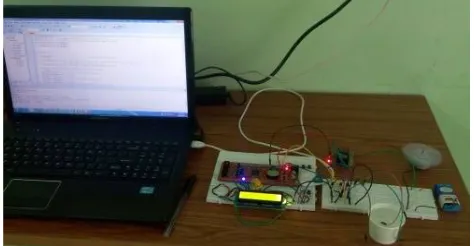
Figure 7: Screenshot of Total Experimental Set up Figure 8: Screenshot of Total Experimental Set up with code
V.CONCLUSION
resources. If used on a large scale, it can provide a major contribution in the conservation of water for us and the future generations. In these days, when the Earth's reserve of consumable water is decreasing every moment, every drop has its value. Water level controller is a simple and effective and implemented to prevent wastage of water and to protect the plants from the damage. In future the system to be upgraded by using Zigbee and GSM technology. This Zigbee and GSM technology is going to use to switch ON/OFF the motor and monitor the water level in the field.
REFERENCES
1. https://www.exploreembedded.com/wiki/images/f/f1/LPC1769_68_67_66_65_64_63_ARM.pdf 2. Zhang Jian Min, “Automatic Water level Control System” IJSR Volume 4 Issue 12, December 2015.
3. Mr K.Sreenivasa Rao “Automatic Crop Monitoring System Using Embedded System” IRJET ISO9001:2008 Certified Journal.
4. M.V.N.R. Pavankumar “Automated Town Water Management System”International Journal of Research in Advent Technology, Vol.2, No.4, April 2014 E-ISSN: 2321-9637
5. N.Suresh,”Real-Time Atomization Of Agricultural Environment For Social Modernization Of Indian Agricultural System”,IJSEAT, Vol 3, Issue 3,March - 2015
6. https://www.exploreembedded.com/wiki/Category:LPC1768_Tutorials
7. S. M. Khaled Reza, “Microcontroller Based Automated Water Level Sensing and Controlling: Design and Implementation Issue” Proceedings of the World Congress on Engineering and Computer Science 2010 Vol I WCECS 2010, October 20-22, 2010, San Francisco, USA.
8. Dayanand Purbhaji Tibe, “AUTOMATIC PUBLIC TAP CONTROL USING IR SENSOR AND WATER LEVEL INDICATION USING GSM” International Journal of Advance Engineering and Research Development Volume 3, Issue 5, May -2016
9. Ajith Kumar T, “Microcontroller Based Automated Water Level Sensing and Controlling” International Journal of Advanced Research in Electrical, Electronics and Instrumentation Engineering An ISO 3297: 2007 Certified Organization Volume 5, Special Issue 1, March 2016. 10. P. Dietz, W. Yerazunis, D. Leigh, Very Low-Cost Sensing and Communication Using Bidirectional LEDs, UbiComp 2003: Proceedings, vol.
2864, pp. 175-191, 2003.
11. M. Javanmard, K.A. Abbas and F. Arvin, “A Microcontroller-Based Monitoring System for Batch Tea Dryer”, CCSE Journal of Agricultural Science, Vol. 1, No. 2, December 2009
12. Roderick L. Shepherd, William S. Yerazunis and Senior Member, “Low-Cost Surface Mount LED Gas Sensor”, IEEE King Tong Lau and Dermot Diamond, Sensors-00997, 2005
13. T. S. Aye, and Z M. Lwin, “Microcontroller Based Electric Expansion Valve Controller for Air Conditioning System”, World Academy of Science, Engineering and Technology, 2008
14. L. Byrne, K.T. Lau, and D. Diamond, Monitoring of headspace total volatile basic nitrogen from selected fish species using reflectance spectroscopic measurements of pH sensitive filmsî, The Analyst, vol. 127, pp. 1338-1341, 2002.
15. Milenkovic, A., Milenkovic, M., Jovanov, E., Hite, D., and Raskovic, D.: An environment for runtime power monitoring of wireless sensor network platforms, Proc. of SSST’ 05, 406–410, 2005.
16. E.J. Cho and F.V. Bright, Integrated chemical sensor array platform based on light emitting diode, xerogel-derived sensor elements, and highspeed pin printing, Analytica Chimica Acta, vol. 470, pp. 101-110, 2002.
17. A.K. Saxena and V. Dutta, “A versatile microprocessor based controller for solar tracking,” in proc. IEEE, 1990, pp.1105-1109.
18. R.E. Shaffer, S.L. Rose-Pehrsson, R.A. McGill, A comparison study of chemical sensor array pattern recognition algorithms, Anal. Chim. Acta 384 (1999) 305–317.
19. Milenkovic, A., Milenkovic, M., Jovanov, E., Hite, D., and Raskovic, D.: An environment for runtime power monitoring of wireless sensor network platforms, Proc. of SSST’ 05, 406–410, 2005.
20. N. Usha, Dr.T. Menakadevi; “Design of Smart Irrigation System Using Raspberry Pi for Agriculture “, International Journal of Innovative Research in Science, Engineering and Technology , Volume 6, Special Issue 3, March 2017
21. Ms. Monali B. Ghodke, Prof.N.S. Narkhede; “Design and Implementation of DAS for soil Monitoring and Controlling System “, International Journal of Engineering Trends and Technology (IJETT) – Volume-42 Number-5 - December 2016.
22. Ruchi Taneja ,; “ Smart Agriculture Monitoring Through IOT “ , International Journal for Scientific Research & Development| Vol. 3, Issue 05, 2015 | ISSN (online): 2321-0613.
23. Bhagyashree K. Chate, Prof.J.G. Rana, “SMART IRRIGATION SYSTEM USING RASPBERRY PI “, International Research Journal of Engineering and Technology (IRJET), Volume: 03 Issue: 05 | May-2016.
24. Water use efficiency in Indian agriculture sector “, http://governancetoday.co.in/water-use-efficiency-indian-agriculture-sector/
25. Alexandros Zografos, “Wireless Sensor-based Agricultural Monitoring System “, School of Information and Communication Technology (ICT), KTH Royal Institute of Technology, Stockholm, Sweden
26. Nikesh Gondchawar , Prof. Dr. R.S.Kawitkar “IOT based Smart Agriculture “,
International Journal of Advanced Research in Computer and Communication Engineering, Volume 5, Issue 6,June 2016.
27. Navnath B. Jadhav , Chanakya Kumar Jha “ Web Based Automation of Farming Irrigation System Using Embedded Linux Board “, Asian Journal of Convergence in technology , Volume III , Issue II , ISSN NO : 2350-1146.
28. K.Bhaskara Rao, Mahesh babu Marneni, “WEB Design Irrrigation in wireless Sensor Network using Raspberry Pi “, International journal for Modern Trends in Science and Technology , Volume : 02,Issue No: 11, November 2016.
30. Dr.Sarika Tale1 , Sowmya P2 , “Intelligent Automatic Irrigation”(IJCSIT) International Journal of Computer Science and Information Technologies, Vol. 7 (1) , 2016, 141-143
31. Joaquín Gutiérrez, Juan Francisco Villa-Medina, Alejandra NietoGaribay, and Miguel Ángel Porta- Gándara “Automated Irrigation System Using a Wireless Sensor Network and GPRS Module ” IEEE 2013
32. Samy Sadeky, Ayoub Al-Hamadiy, Bernd Michaelisy, Usama Sayedz,“ An Acoustic Method for Soil Moisture Measurement ”, IEEE 2004 33. Thomas J. Jackson, Fellow, IEEE, Michael H. Cosh, Rajat Bindlish, Senior Member, IEEE, Patric J. Starks, David D. Bosch, Mark Seyfried,
David C. Goodrich, Mary Susan Moran, Senior Member, IEEE, and Jinyang Du ,“Validation of Advanced Microwave Scanning Radiometer Soil Moisture Products”, IEEE 2010