Fine Mapping of Complex Trait Genes Combining Pedigree and Linkage
Disequilibrium Information: A Bayesian Unified Framework
Miguel Pe´rez-Enciso
1Institut National de la Recherche Agronomique, Station d’Ame´lioration Ge´ne´tique des Animaux, 31326 Castanet-Tolosan, France Manuscript received September 4, 2002
Accepted for publication December 19, 2002
ABSTRACT
We present a Bayesian method that combines linkage and linkage disequilibrium (LDL) information for quantitative trait locus (QTL) mapping. This method uses jointly all marker information (haplotypes) and all available pedigree information;i.e., it is not restricted to any specific experimental design and it is not required that phases are known. Infinitesimal genetic effects or environmental noise (“fixed”) effects can equally be fitted. A diallelic QTL is assumed and both additive and dominant effects can be estimated. We have implemented a combined Gibbs/Metropolis-Hastings sampling to obtain the marginal posterior distributions of the parameters of interest. We have also implemented a Bayesian variant of usual disequilib-rium measures likeD⬘andr2between QTL and markers. We illustrate the method with simulated data
in “simple” (two-generation full-sib families) and “complex” (four-generation) pedigrees. We compared the estimates with and without using linkage disequilibrium information. In general, using LDL resulted in estimates of QTL position that were much better than linkage-only estimates when there was complete disequilibrium between the mutant QTL allele and the marker. This advantage, however, decreased when the association was only partial. In all cases, additive and dominant effects were estimated accurately either with or without disequilibrium information.
A
N ultimate goal of quantitative trait loci (QTL) stud- ligerand Weiss 1998). In fact, a pure LD analysis is likely to result in a large number of false positives as ies is to clone the gene(s) responsible for thege-illustrated recently, e.g., in Alzheimer’s disease ( Ema-netic differences between individuals and, eventually,
hazionet al.2001). identify the causal mutation(s). Certainly, this is a
daunt-A promising approach is thus to combine both link-ing task that will be accomplished only gradually. One
age and linkage disequilibrium (LDL) methods to add of the most severe limitations, at the moment, is that
their advantages in a single unified theoretical frame-the QTL position is estimated with too large an error
work. More specifically, there is an urgent need for to allow positional cloning when a classical linkage
anal-robust methods that provide accurate estimation of the ysis is employed. The 95% confidence interval for the
QTL position. Consider for the sake of illustration a QTL position usually spans over 5–20 cM, at a minimum.
simple design where a number of nuclear families are The wide confidence interval occurs because the
num-typed,i.e., parents and offspring. The theoretical advan-ber of meioses in the genotyped pedigree is usually
tages of combining linkage disequilibrium and pedigree very small; only between two and three generations are
(linkage) information in QTL analysis are manifold: (i) generally employed. Linkage disequilibrium (LD)-based
A marker for which a parent is homozygous does not methods, in contrast, capitalize on the number of
gener-contribute information in a linkage analysis, yet it does ations that occurred since the appearance of mutation
in LD analysis; (ii) conversely, two parents may share and can produce extremely accurate estimates of the
the same haplotype but not necessarily the same QTL gene position, within kilobases in some instances (
Hast-genotypes, and a pure LD analysis would be misleading backaet al.1994). Nevertheless, the chance of success
but the phenotype of offspring together with the ascer-of the LD strategy depends on a number ascer-of population
tainment of alleles transmitted can be used to determine parameters, such as the degree of admixture in the
which are the most likely QTL genotypes of the parents; sampled population, the actual level of association
be-(iii) an individual without relatives but with phenotype tween the causal mutation and the polymorphisms, or
records can be included in the LD analysis, in contrast the correct ascertainment of phases and of genotypes
to a pure linkage study; and (iv) a comparison of the at the QTL. Of course these parameters are usually
analyses including or not the LD information can assess unknown but do dramatically affect the results (
Terwil-the validity of Terwil-the LD model assumptions (i.e., one muta-tion tgenerations ago).
Several authors have addressed the problem of
com-1Address for correspondence:INRA, Station d’Ame´lioration Ge´ne´tique
bining LD and linkage mapping for quantitative trait
des Animaux, BP 27, Cedex 31326 Castanet-Tolosan, France.
E-mail: [email protected] loci (Zhao et al. 1998;Allison et al. 1999;Almasy et
al.1999;Fulkeret al.1999;WuandZeng2001;Farnir (2001), intended for natural populations, is also difficult to apply to complex pedigrees.
et al.2002;Meuwissenet al.2002), whereasXiongand
Here we present a Bayesian method that combines Jin(2000) proposed a method suited to disease
suscepti-linkage and LD information for QTL mapping within bility genes. Zhao et al.(1998) developed a
semipara-a unified theoreticsemipara-al frsemipara-amework. Our LDL method uses metric procedure based on the score-estimating
equa-jointly all marker information, as well as all available tion approach and that addressed the particular case of
pedigree information; i.e., it is not restricted to any single-nucleotide polymorphisms. This is one of the first
specific experimental design and it is not required that articles to provide a theoretical framework for LDL
map-phases be known. If desired, infinitesimal genetic effects ping but the estimating equation approaches are
diffi-or environmental noise (fixed) effects can also be fitted. cult to implement in practice; they require complex
A diallelic QTL is assumed and both additive and domi-computations adapted to each family structure. For
in-nant effects can be estimated. We have implemented a stance, the method sums over all possible phases and
combined Gibbs/Metropolis-Hastings sampling to ob-computes their probabilities, which is extremely
com-tain the marginal posterior distributions of the parame-plex to do in practice beyond a few markers. The
statisti-ters of interest. We illustrate the method with simulated cal properties of these estimators are also unknown.
data. Fulkeret al.(1999) developed a sib-pair analysis in
a likelihood framework. The approach followed by Alli-sonet al.(1999) is a generalization of the transmission
THEORY disequilibrium test (TDT) for quantitative traits (
Alli-son1997), where a between- and within-family associa- We assume that the goal of the analysis is to fine map tion parameter is modeled via a mixed model. Neither a QTL that has been previously located within a given theFulkeret al.(1999) norAllisonet al.(1999) meth- genome region. The genetic model presupposes that a ods are very suited to analyzing complex pedigrees as single mutation occurredt generations ago on a gene affecting the trait studied. Thus, initially, a single ances-they consider sib pairs (Fulkeret al.1999) or
parent-tral (founder) haplotype harbored the mutation. The offspring trios (Allisonet al.1999) and their theoretical
number of haplotypes carrying the mutation increases framework is difficult to generalize to more complex
in successive generations provided that the mutation is settings. TDT in particular is not an optimum choice to
not lost and, due to recombination, the initial allele deal with very polymorphic markers like microsatellites
combination is eroded. The amount of disequilibrium and makes use of only a limited amount of the total
between markers and QTL decreases proportionally to information contained in a typical pedigree.
Meuwis-genetic distance and to the number of generations senet al.(2002), in turn, proposed to model the QTL
elapsed since mutation. Here we use the population alleles as a random variable, where the covariance
be-model for linkage disequilibrium decay described in tween base population haplotypes allows the inclusion
Morris et al.(2000), with modifications described be-of the LD information (Meuwissen and Goddard
low. Briefly, a binary variableSkiis defined such that, at
2000), and the covariance between non-base population
any kth marker locus andith individual, the locus will haplotypes was computed as inFernandoand
Gross-be either identical by descent (IBD) with the original man(1989) andGoddard(1992). They estimated the
haplotype carrying the mutation (Ski⫽ ⫺) or not (Ski⫽
position via maximum likelihood. The model followed
⫹), with minus and plus signs standing for the mutant by these authors is different from the usual LD, where
and wild haplotype alleles, respectively. By convention a diallelic QTL is assumed. The key issue in their method
we denote the QTL by locus 0. A Markov chain Monte is to compute the identity-by-descent probabilities
be-Carlo (MCMC) method was provided by Morriset al. tween the base population haplotypes, and this was done
(2000) to obtain the transition probabilities of a locus by considering the number of identity-by-state alleles
being IBD or not at locusk⫹ 1 conditional on being shared by any two haplotypes, along the lines also
sug-IBD or not at locusk. gested byMcPeek andStrahs (1999). They assumed
Now suppose that the QTL additive and dominance that phases are known, which is a reasonable assumption
effects areaandd, respectively;i.e., the mean phenotype only if families are very large, e.g., as in dairy cattle.
of the individuals homozygous for the wild allele (⫹/⫹) Otherwise, QTL positioning can be dramatically
af-minus that of individuals homozygous for the mutant fected if a phase is incorrectly specified. Farnir et al.
allele (⫺/⫺) is 2a, whereas the mean phenotype of (2002) developed an analytical approach for combining
heterozygous individuals, (⫹/⫺) or (⫺/⫹), is d. Sup-linkage and LD in half-sib families, where the
disequilib-pose further that a numbermof individuals have been rium information is incorporated via Terwilliger’s
typed for DNA markers, contained in matrix M, and (1995) approach. Their method would be very
cumber-that phenotypic measurements (y) are available on a some to generalize to more complex populations; in
subset ofnindividuals. The linear explicative model is addition, phases are assumed to be known and it is not
TABLE 1
Main symbols used
n Number of phenotypic records m Number of individuals in the pedigree
y Phenotypic records, dimensionn
M Marker information, contains the alleles for each individual and marker; dimensionm⫻no. of markers⫻2
S0 Identity-by-descent status of the QTL allele of the base generation individuals with the causative mutation; it can take valueswild(⫹) ormutant(⫺) allele, dimension 2⫻no. of base generation individuals
a Additive QTL effect; the average value of individuals with genotype (⫹/⫹)⫺(⫺/⫺) is 2a d Dominance effect; phenotypic value of individuals with genotype (⫹/⫺) or (⫺/⫹)
u Infinitesimal genetic value; it contains all genetic effects except the QTL under study, dimensionm
 Fixed (noise environmental) effects, dimension the sum of levels for each fixed effect
2
u Infinitesimal genetic variance 2
e Residual variance
␦ QTL position, in morgans
t Time (no. of generations) since mutation
T 2⫻ m matrix with QTL segregation indicators. The genotype of all individuals is unambiguously determined byT
andS0
H Marker phases; contains indicator variable to identify whether the allele in vectorMis of paternal or maternal origin; dimensionm⫻no. of markers
where  is a fixed-effects (environmental/nongenetic p(|y,M)⬀p(y,M|)p()⫽p(y|)p(M|)p(), (2) effects) vector; wa is a vector with indicator variables
wherep(y,M|) is the likelihood (in the Bayesian sense), taking values 1 or ⫺1 if the QTL genotype of each
andp() is thea prioridistribution for the parameters. individual is⫹/⫹ or ⫺/⫺, respectively, and zero for
Note that phenotypes and markers are conditionally heterozygous individuals;wdcontains values 1 if
individ-independent. Ideally, inferences about each of the pa-ual QTL genotype is ⫹/⫺ or ⫺/⫹, zero otherwise;
rameters in, sayl, should be based on the marginal
and u and e contain the infinitesimal genetic values
posterior distribution,i.e., (polygenic effects) and residuals, respectively, whereas
XandZare incidence matrices. The matrixX*contains p(l|y,M)⫽
冮
⫺lp(l,⫺l|y,M)⫺l, (3)
Xplus two additional columns forwaandwd; similarly
vector* isplus elementsaandd. where⫺
lindicates the vector of parameters except the
The goal of the analysis is to obtain estimates of the set lth unknown. Typically this multidimensional integral of parameters,⫽{S0,a,d,u,,2
u,2e,␦,t,T,H}, where is unfeasible and we need to resort to stochastic
proce-S0is a matrix containing the IBD status of the two indi- dures like Gibbs or Metropolis-Hastings sampling vidual QTL alleles with the causal mutation, taking val- schemes (SorensenandGianola2002). In the follow-ues ⫹ or ⫺; 2
u is the infinitesimal genetic variance; ing, we describe all conditional distributions that we
2
e, the residual variance; and␦is the QTL position. T need to sample from. Unless otherwise stated, we make
is a QTL segregation indicator vector containing, for the usual assumptions of flat priors for all parameters, each individual and haplotype, a binary variable speci- except forp(u)⫽ Normal(0,A2
u), where Ais the
addi-fying whether the QTL allele is IBD with the paternal tive relationship matrix between individuals (Lynchand or maternal parental allele (Thompson1994). Note that Walsh1998).
S0 needs to be specified only for the base population The rest of this section is devoted to presenting the
individuals (those without known parents) and that the main conditional distributions to sample from to obtain QTL genotypes for the whole population are unambigu- the posterior distribution of the parameters of interest. ously determined onceS0andT are specified. Finally, For the reader less interested in the mathematical
information, the QTL IBD status of theith base popula-tion individual can be sampled from the fully condi-tional distribution,
p(S0i1,S0i2|y,M,⫺) ⬀p(y|)p(Mi|)p()
⫽
冤
兿
j僆⌿i
p(yj|S0i1,S0i2,S0⫺,a,d,ui,,2e,T)
冥
⫻p(Mi|S0i1,S0i2,t,Hi,␦)⫻p(S0i1,S0i2)
Figure1.—Representation of a pedigree via the
transmis-⫽p(yj僆⌿i|)⫻p(Mi|)⫻p(S0i1,S0i2),
sion coefficientsT. Each small circle represents an allele of the QTL, identical-by-descent alleles are connected with a
(4)
where yjis the phenotype of the jth individual having
solid line, and individual genotypes, 1–8, are boxed with
received at least one allele from individual i, andS0⫺ dashed lines.
denotes the rest of IBD status not sampled. We now show which are the distributions involved in (4). The first term is a product of Normal densitiesN(ej,2e), with
population parameters, like the age of the mutation.
ej ⫽yj⫺xⴕj ⫺uj⫺waja⫺ wdjd,
We assume a star-shaped genealogy. We suppose that
base population individuals are genotyped for most of where, x⬘j is the column vector of X corresponding to the markers but not that phases are known; they are thejth individual’s observation.
inferred from the offspring genotypes. LD or allele fre- The distribution p(Mi|) in (4) is the probability of
quency priors do not contribute any information to having marker alleles linked in haplotype 1 or 2 (say obtain the genotypes of the descendant individuals Mi1 or Mi2) conditional on a given QTL genotype, its (conditionally on the genotypes of the base population) position relative to DNA markers, and the parameter and are sampled following the most likely recombinants governing the LD decay (t). Both haplotypes are condi-as inferred from marker information. Once the QTL tionally independent; thusp(Mi|)⫽p(Mi1, Mi2|S0i1,S0i2, alleles are sampled, most of the remaining parameters t, Hi,␦)⫽ p(Mi1|S0i1,t,Hi, ␦)p(Mi2|S0i2,t, Hi, ␦), where are obtained via a classical Gibbs sampling within the Mi1contains the marker alleles received from the father mixed-model context (Sorensen andGianola 2002). andMi2, those of mother’s origin. Consider the marker In contrast, Metropolis-Hastings is required for the QTL alleles of a given individual i at haplotype h (Mih); in position; here we identify where recombinants have oc- our notation Lmarkers are to the left and Rmarkers curred at two alternative positions and the resulting to the right of the current QTL position. Then, likelihoods using available phenotypic information are
p(Mih|S0ih,t,Hi,␦)
compared (UimariandSillanpa¨a¨2001).
Base population QTL genotypes (S0):In the absence ⫽p(Mih,⫺L, . . . ,Mih,⫺2,Mih,⫺1,Mih1,Mih2, . . . ,MihR|S0ih,t,Hi,␦) of LD information, only the phenotypes of the
individu-⫽p(Mih,⫺L, . . . ,Mih,⫺2,Mih,⫺1|S0ih,t,Hi,␦)
als that have received a given base population allele
provide information about the likely value of that allele. ⫻p(Mih1,Mih2, . . . ,MihR|S0ih,t,Hi,␦) ⫽QihLQihR, This is illustrated in the simple pedigree of Figure 1;
whereMihkdenotes the allele at markerk(starting from
the solid lines represent the transmitted alleles, stored
the QTL) of haplotype h, ith individual. Note that k in T. Suppose that we are sampling the IBD status of
takes negative values for markers to the left of the QTL. first individual and first allele (S011), conditional on all
Dropping subscriptsiandhand the conditioning ont, other parameters including the S0 of the remaining
H,and on␦ for clarity, we find individuals (denoted by_). The phenotypes of
individ-uals 1, 5, 6, and 7 influence the probabilityp(S011|_,y, QR⫽ p(M1,M2, . . . ,MR|S0)
M). In contrast,p(S012|_, y,M), corresponding to the
⫽
兺
S1
p(M2, . . . ,MR|S1)p(M1|S1)p(S1|S0).
second QTL allele, involves only the phenotype of indi-vidual 1, as this allele was not transmitted. If that
individ-This process is repeated sequentially from the QTL posi-ual does not have phenotype recorded,p(S012|_,y,M)
tion toward the extremes of the interval, is strictly proportional to the prior frequencies for each
QTL allele, when LD information is not being used. We
QR⫽
兺
S1兺
S2
p(M3, . . . ,MR|S2)p(M2|S2)p(S2|S1)p(M1|S1)p(S1|S0)
denote byithe set of individuals that have received at
least one allele for individual i and have phenotypes,
⫽
兺
S1
兺
S2
. . .
兺
SR
兿
Rk⫽1
p(Mk|Sk)p(Sk|Sk⫺1), (5)
i.e.,1⫽{1, 5, 6, 7},2⫽{5, 6}, and3⫽ 4⫽{3, 4, 8}.
Note that the setmay vary from iteration to iteration
as a newTis sampled. If LD information is being used, whereSkis the IBD state of marker allelekof individual
p(S0|_, y, M) also depends on the marker alleles of iwith the original mutant haplotype.
the original haplotype carrying the mutation (Sk⫽ ⫺) or with the number of markers, especially for highly
poly-morphic markers like microsatellites. However, since not (Sk⫽ ⫹). The term p(Mk|Sk) contains the marker
the relevant statistic is the ratioQ(S0⫽ ⫹)/Q(S0⫽ ⫺),
allele probabilities conditional on Sk; p(Mk|Sk ⫽ ⫹) is
qRandqLcan be initialized to a very large number.
simply given by the population allele frequencies. In
Finally,p(S0i1,S0i2) in Equation 4 is thea priori
proba-contrast,p(Mk|Sk⫽ ⫺) will be 1 for the allele that carried
bility of the IBD state of the two QTL alleles with the the mutant haplotype and 0 for the remaining alleles.
original mutant haplotype. When the individual is not The vector p(M|SL ⫽ . . . S⫺1 ⫽ S1 ⫽ SR ⫽ ⫺) is the
inbred,p(S0i1,S0i2)⫽p(S0i1)p(S0i2), where the prior
prob-original haplotype that carried the mutation. Of course
abilities are the same for any base population allele. If this haplotype is unknown but can be inferred as shown
theith individual is known to be inbred from the avail-byMorriset al.(2000). Here we have preferred to
con-able pedigree with inbreeding coefficientfi,p(S0i1,S0i2)⫽
sider bothSkandp(Mk|Sk) as nuisance parameters;i.e., we
(1⫺fi)p(S0i1)p(S0i2) ⫹ fip(S0i2)(S0i1|S0i2), with being
are not usually interested directly in them, and thus we
an indicator 1/0 function that makesS0i1take the same
integrate them out in (5). As a result,p(Mk|Sk⫽ ⫺) is no
value as S0i2. The prior probability of an allele being
longer 0’s and 1’s but can take any value between the two
identical by descent with the original mutant haplotype extremes. Theappendixshows howp(Mk|Sk) is updated.
is␣ if the base population individuals have been sam-The transition probabilitiesp(Sk|Sk⫺1) can be obtained
pled at random from the population,i.e.,p(S0i⫽ ⫺)⫽
as detailed inMorriset al.(2000) and depend on the
␣andp(S0i⫽ ⫹)⫽1⫺ ␣for every individual. Otherwise,
effective size and time since mutation. Four transition
e.g., case/control study or selective genotyping, the probabilities need to be specified, which are
probabilities have to be modified accordingly (Morriset
p(Sk⫽ ⫺|Sk⫺1⫽ ⫺)⫽exp(⫺φt␦k,k⫹1)⫹[1⫺exp(⫺φt␦k,k⫹1)]␣, al.2000).
In summary, to sample the IBD states at the QTL
p(Sk⫽ ⫹|Sk⫺1⫽ ⫺)⫽[1⫺exp(⫺φt␦k,k⫹1)](1⫺ ␣),
position we evaluate Equation 4 at all four possible QTL
p(Sk⫽ ⫺|Sk⫺1⫽ ⫹)⫽[1⫺exp(⫺φt␦k,k⫹1)]␣, genotypes, i.e., (⫹/⫹), (⫹/⫺), (⫺/⫹), (⫺/⫺), for each base population individual in turn, and we take a and random number according to the genotype
probabili-ties. Both alleles are thus sampled simultaneously.
Nev-p(Sk⫽ ⫹|Sk⫺1⫽ ⫹)⫽exp(⫺φt␦k,k⫹1)⫹[1⫺exp(⫺φt␦k,k⫹1)](1⫺ ␣)
ertheless, this strategy can be ameliorated by sampling larger blocks of base population IBD states. Suppose (Morriset al.2000), whereφis the ratio of 1 M/1 Mb
IBD states of base population individuals 1 throughc DNA (typically 1/100),␦k,k⫹1is the distance (morgans)
are sampled; then between loci kand k⫹ 1, and ␣ is the probability of
recombining with a haplotype carrying the mutation.
p(S0i1,S0i2, . . . ,S0c2|y,M,⫺)⬀
兿
j僆⌿p(yj|S0,a,d,ui,,2e,T)
This parameter is in fact highly confounded with t (Kaplan et al.1995) and we did not try to estimate it;
⫻
兿
c i⫽1p(Mi|S0i1,S0i2,t,Hi,␦)
rather, we set␣ ⫽0.001. This had a negligible impact on the results.
Expression (5) is extremely difficult to compute. How- ⫻
兿
c i⫽1p(S0i1,S0i2), (6a)
ever, we can rearrange as
where j 僆 means any individual having received at QR⫽
兺
S1
p(M1|S1)p(S1|S0) . . .
兺
SR⫺1p(MR⫺1|SR⫺1)p(SR⫺1|SR⫺2) least one allele from any of individuals 1 throughc. An
issue of interest is to determine whichS0elements are to
⫻
兺
SR
p(MR|SR)p(SR|SR⫺1). be sampled together to minimize the risk of reducibility.
Here we sampled jointly those origins that coincided in the maximum number of individuals. For instance, if Thus, starting from the outermost marker,R, it is
feasi-only four origins were to be sampled together in the ble to computeQRusing the recursive formula
pedigree of Figure 1, two blocks with the IBD status of qk⫽
兺
Sk
p(Mk|Sk)p(Sk|Sk⫺1)qk⫹1 individuals (1, 2) and (3, 4) rather than (1, 3) and (2,
4) would be chosen. Note that a pure linkage approach can be easily implemented sampling from
with initial valuesq⫺L⫽qR⫽1;QR⫽ 兺1k⫽Rqk, and
simi-larly QL⫽ 兺1k⫽⫺Lqk. Note that each coefficient qk is a
p(S0i1,S0i2, . . . ,S0c2|y,M,⫺)⬀
兿
j僆⌿p(yk|S0,a,d,ui,,
2 e,T)
vector with two elements corresponding to statesSk⫽ ⫹
andSk⫽ ⫺. At the end of the computations we obtain
⫻
兿
c i⫽1p(S0i1,s0i2) (6b)
the probabilities of individual haplotypes givenS0 ⫽ ⫹
andS0 ⫽ ⫺. There can be numerical problems in
ob-tainingQR orQLfor a large number of markers as the instead of from (6a).
detailed in theappendix. Once all variables are initial- frequencies were 0.3 and 0.7, whereas there were six alleles at equal frequencies for each microsatellite. The ized, the Markov chain Monte Carlo (MCMC) chain
consists of iterating successively via Equations 4 or 6 QTL was located in position 18 cM, its additive effect was a ⫽ 1, there was no dominance (d ⫽ 0), and the and A2–A7a plus updating the phases (H),p(M|S), and
the transmission indicators (T). Obviously, in a linkage- residual variance was2
e ⫽1. Phenotypic records were
simulated for generation 2 in the simple population only approach,(6b), the sampling is simplified by not
samplingp(M|S) and time since mutation (t). The pro- and for all individuals in the complex pedigree. All individuals were genotyped. The mutant QTL allele fre-cedure is otherwise identical.
Two-marker disequilibrium measures: LD measure- quency in the population studied was 0.3. Two situations
were considered: The mutant QTL allele was either ments likeD⬘(Hedrick1987;Lewontin1988) rely on
the possibility of ascertaining the linkage phases and the completely associated with SNP allele “2” (frequency⫽ 0.3) in position 18 cM or partially associated with the alleles themselves, which is not possible with quantitative
traits because the QTL genotypes are not known. Never- SNP allele “1” (frequency ⫽ 0.7). In the former case, all haplotypes with the SNP allele 2 in position 18 cM theless, phases and QTL alleles are generated each
itera-carried the mutant QTL allele; in the latter case, initially tion so we can define a Bayesian estimate ofD⬘between
ⵑ42% (0.3/0.7) of haplotypes with SNP allele 1 har-any marker and the QTL, computingD⬘at the current
bored the QTL mutant allele. The original haplotype configuration using the formula D⬘ ⫽ 兺n1
i⫽1兺2j⫽1piqj|D⬘ij,
carrying the mutation was 1111111111211111 with com-where iis the ith allele of the marker, with frequency
plete association and 1111111111111111 in the second pi, the marker has n1 alleles, index j refers to the jth
case. It was assumed that the mutant allele appeared QTL allele, with frequencyqj, andD⬘ij ⫽Dij/DMAXis the
100 generations ago, and the decay in disequilibrium usual measure for diallelic markers. Here we provided
was simulated following the model in Morris et al. the mean of the posterior distribution, obtained asD⬘
(2000). We compared the results using the LDL method averaged over iterations. We also computed the
recom-(Equation 6a) with those when only linkage information mended measure byPritchardandPrzeworski(2001)
was used (Equation 6b). denoted byr2(or⌬2inDevlinandRisch1995), which
Three replicates of each case were run, resulting in is defined asr2⫽ 兺n1
i⫽1兺2j⫽1D2ij/piqj. One of the interesting
12 analyses in total. The only fixed effect included in the properties ofr2is thatr2times the number of haplotypes
analyses was the general mean. The maximum change in is distributed as a chi square with n1 ⫺ 1 d.f. (Weir
QTL position was set to 0.5 cM in each direction. We 1996), although this is an approximation and does not
ran 50,000 iterations of the MCMC chain, discarding hold for larger(Hudson1985). Nevertheless that
prop-the first 4000 iterations. Eight origins were sampled erty is not needed here as we are able to derive the full
jointly; thusp(S0i1,S0i2, . . . ,S0c2|y,M,⫺) can take 28⫽
posterior distribution ofr2between any marker and the
256 values because the QTL is assumed to be diallelic. QTL and assess the relevant highest density region that
Phases were updated in blocks of six. Each complete covers the point 0 (no disequilibrium). Here we report
iteration took ⵑ3.5 sec on an alpha workstation with that r⫽
√
r2 to make it comparable with D⬘. Both D⬘processor 21164A. The computing time per iteration is and rwere calculated using only the base population
highly dependent on the number of paths and phases individuals.
updated simultaneously.
SIMULATION RESULTS
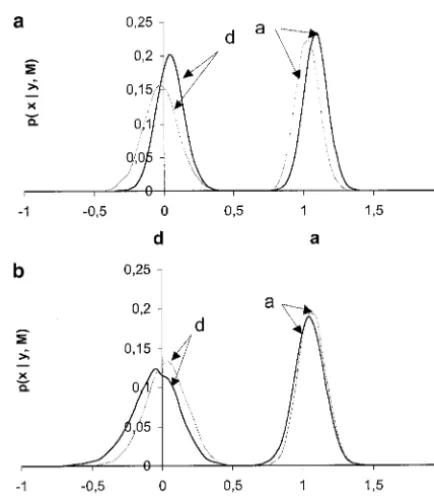
Two population types that can typically be found in Table 2 presents the mean and SD of the marginal livestock, with “simple” and “complex” pedigrees, were posterior distributions for the main parameters in the simulated. The simple population consisted of 40 unre- case of complete association. The posterior distributions lated full-sib families, 10 offspring per family. The com- for the additive and dominant effects in the first repli-plex population was a four-generation pedigree, with a cate are plotted in Figure 2a and provide a whole picture base population of 80 unrelated parents that produced about the uncertainty regarding these parameters. Re-40 full-sib families of size 5 (generation 2), whereas sults were very similar for all replicates so only one is generations 3 and 4 consisted of 20 full-sib families (5 presented. The estimates of the genetic effects and the offspring per family). Parents were chosen at random residual variance were quite accurate, and the SDs of except in generation 1, where all parents had an equal their posterior distributions were small, indicating that number of offspring. Both simple and complex pedi- there is enough information in the data to estimate grees had a total of 480 individuals. The explored region these parameters. The 95% highest density region con-spanned 25 cM and contained six microsatellites at posi- tained the true values of a, d, and 2
e in all cases. In
TABLE 2
Posterior distribution statistics: complete association
Parametersc
Pedigreea Replicate Analysisb a/e d/e 2
e Position (M) t
Simple 1 LDL 1.06 (0.08) 0.02 (0.10) 0.96 (0.07) 0.169 (0.031) 73 (14) L 1.00 (0.09) ⫺0.05 (0.13) 1.00 (0.07) 0.148 (0.044) — 2 LDL 1.07 (0.08) 0.08 (0.13) 0.99 (0.07) 0.183 (0.027) 79 (20)
L 1.07 (0.10) 0.14 (0.15) 0.99 (0.08) 0.144 (0.062) — 3 LDL 1.08 (0.10) 0.08 (0.10) 0.88 (0.07) 0.180 (0.014) 90 (18)
L 1.02 (0.11) ⫺0.01 (0.12) 0.92 (0.08) 0.192 (0.028) — Complex 1 LDL 0.94 (0.08) ⫺0.05 (0.09) 1.13 (0.08) 0.182 (0.024) 71 (16)
L 0.88 (0.09) 0.01 (0.10) 1.18 (0.09) 0.197 (0.033) — 2 LDL 0.99 (0.08) ⫺0.01 (0.10) 1.03 (0.07) 0.187 (0.020) 101 (21)
L 0.95 (0.09) 0.01 (0.12) 1.07 (0.08) 0.168 (0.042) — 3 LDL 0.96 (0.08) 0.05 (0.09) 1.09 (0.08) 0.169 (0.017) 141 (15)
L 0.91 (0.09) 0.05 (0.10) 1.11 (0.08) 0.160 (0.031) —
All haplotypes with SNP allele 2 carried the QTL mutant allele.
aSimple pedigree populations consist of independent full-sib families; complex population is a
four-genera-tion pedigree with random mating.
bLDL analysis combines both linkage disequilibrium and pedigree information; L analysis uses only linkage. cMean of the marginal posterior distribution (SD of the marginal posterior distribution).
two competing models. Interestingly, there was little (note that the scales of they-axes are different in Figures 3 and 4). It is also apparent that the mode of the poste-difference between using or not using the linkage
dis-equilibrium information. This means that most, if not rior distribution coincided with the true position only all, information to estimate the QTL genetic effects
comes from classical linkage analysis. The effect of popu-lation structure was also negligible. However, including LD does affect the estimate of the QTL position (Table 2, Figure 3) with complete association between the SNP and the QTL alleles: (1) The mode of the posterior distribution always coincided with the true position and this was not necessarily the case in the linkage-only ap-proach; (2) LDL estimates were always less biased; and (3) the SDs of the posterior distributions were always smaller in the LDL than in the linkage-only method. In general, the relative advantage of LDL over linkage-only was larger in the two-generation than in the complex pedigrees. This can occur because more meioses are available for mapping in the four- than in the two-gener-ation pedigree but also because in the complex pedigree there were fewer offspring per family, making it less accurate for estimating the QTL genotype and the marker phases of the base population individuals, and this has a much larger effect on LDL than in linkage-only analysis.
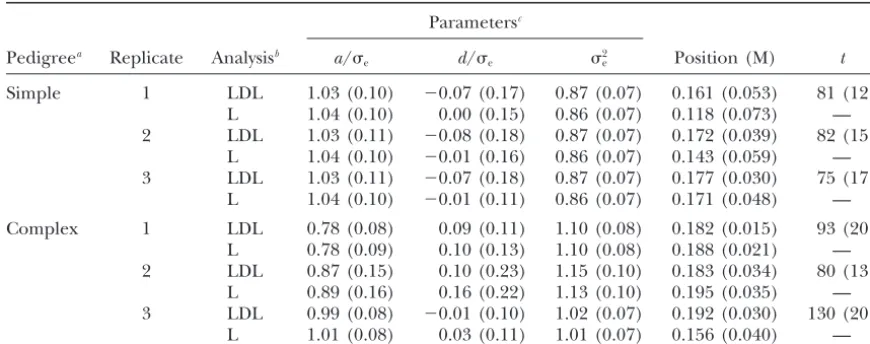
Results concerning the incomplete association sce-nario are presented in Table 3 and Figure 4. As ex-pected, the estimates of the QTL effects were similar to
those in Table 2, albeit the SDs were somewhat larger Figure2.—Marginal posterior probabilities of additive (a) and dominant effects (d), expressed in residual standard devi-in particular for the domdevi-inance effect. Replicate 2 of
ation units. The thick line corresponds to the LDL estimate the complex pedigree had unusually large SD of the
and the thin shaded line, to the linkage-only estimate. (a) posterior distributions ofaandd. But more importantly, First replicate of the simple pedigree, complete association; the accuracy of the QTL position was generally much (b) first replicate of the simple pedigree, incomplete
Figure3.—Marginal posterior proba-bilities of QTL location with complete association between QTL and SNP geno-type. (Left) Simple population graphs; (right) complex population graphs. The three replicates are shown below each other. The solid thick lines refer to esti-mates obtained using linkage and link-age disequilibrium, and the thin shaded lines refer to estimates obtained using linkage information only. The QTL was located in position 18 cM (indicated by the arrowhead).
once (replicate 1, complex pedigree) although it was affect the final results to a large extent, as we found similar output when we fitted these parameters to a close, positions 0.16–0.17 M, in the remaining replicates
with the LDL approach. In some instances (replicate 1, variety of values, in agreement with previous results (MeuwissenandGoddard2000).
simple pedigree) the posterior density was very flat and
covered almost the whole region under study. In princi- Finally, Figure 5 draws a plot of the simple disequilib-rium measures between each marker and the QTL,D⬘ ple, linkage-only estimates should not be greatly affected
by either complete or incomplete association, because andr, for the three simple pedigrees.D⬘andrmeasures obtained under both statistical methods LDL and link-the accuracy depends mainly on link-the informativity of
markers to identify recombinant haplotypes. This seems age-only are plotted. The two top and bottom plots correspond to the complete and incomplete LD scenar-to be the case if we exclude the rather outlying replicate
1 (simple pedigree, Figure 4). The average SD of the QTL ios, respectively. The most striking feature is, perhaps, the extreme differences in behavior betweenD⬘andr. position posterior density was 4 cM in the linkage-only
approach for both complete and incomplete association Under complete LD, the pattern of rwas much more stable behavior than that ofD⬘, as there was very little scenarios. In contrast, it was 2.2 and 3 cM using LDL in
the complete and incomplete scenarios, respectively. variation between replicates andrpeaked clearly at the QTL position (18 cM). In contrast,D⬘had a much larger Contrary to the estimates of QTL genetic effects or
position, the LD decay parametertwas loosely estimated variability between replicates and was clearly multi-modal in several instances. Nevertheless, these two mea-(Tables 2 and 3). This means that there is little
informa-tion in the data to estimate them. In fact, we observed sures showed clear maxima at or close to the true QTL position under complete disequilibrium. The picture that p(M|) was quite flat for different values of t. A
TABLE 3
Posterior distribution statistics: incomplete association
Parametersc
Pedigreea Replicate Analysisb a/e d/e 2
e Position (M) t
Simple 1 LDL 1.03 (0.10) ⫺0.07 (0.17) 0.87 (0.07) 0.161 (0.053) 81 (12) L 1.04 (0.10) 0.00 (0.15) 0.86 (0.07) 0.118 (0.073) — 2 LDL 1.03 (0.11) ⫺0.08 (0.18) 0.87 (0.07) 0.172 (0.039) 82 (15)
L 1.04 (0.10) ⫺0.01 (0.16) 0.86 (0.07) 0.143 (0.059) — 3 LDL 1.03 (0.11) ⫺0.07 (0.18) 0.87 (0.07) 0.177 (0.030) 75 (17)
L 1.04 (0.10) ⫺0.01 (0.11) 0.86 (0.07) 0.171 (0.048) —
Complex 1 LDL 0.78 (0.08) 0.09 (0.11) 1.10 (0.08) 0.182 (0.015) 93 (20) L 0.78 (0.09) 0.10 (0.13) 1.10 (0.08) 0.188 (0.021) — 2 LDL 0.87 (0.15) 0.10 (0.23) 1.15 (0.10) 0.183 (0.034) 80 (13)
L 0.89 (0.16) 0.16 (0.22) 1.13 (0.10) 0.195 (0.035) — 3 LDL 0.99 (0.08) ⫺0.01 (0.10) 1.02 (0.07) 0.192 (0.030) 130 (20)
L 1.01 (0.08) 0.03 (0.11) 1.01 (0.07) 0.156 (0.040) —
Initially, 43% of haplotypes with SNP allele 1 carried the QTL mutant allele.
aSimple pedigree population consists of independent full-sib families; complex population is a
four-genera-tion pedigree with random mating.
bLDL analysis combines both linkage disequilibrium and pedigree information; L analysis uses only linkage. cMean of the posterior distribution (SD of the posterior distribution).
Hererhad maxima only at the nearest microsatellites P(M1|S0)⫽
兺
S1p(M1|S1)p(S1|S0)
(15 and 20 cM) but a very flat curve was apparent in
clear contrast with the complete LD case. The pattern and forD⬘was not as affected by incomplete LD (Figure 5,
bottom left) although the profile was somewhat flatter P(M2|S0)⫽
兺
S2
兺
S1p(M2|S2)p(S2|S1)p(S1|S0)
than that with complete LD. Again, we observed a large
variability between replicates. It is apparent that the LD ⫽
兺
S2
p(M2|S2)
兺
S1p(S2|S1)p(S1|S0) .
statistics D⬘ and r were higher when using LDL than when using linkage-only methods, although the general
In contrast, we used the actual joint distribution, which pattern was comparable (compare thick solid linesvs.
is thin shaded lines in Figure 5).
P(M1,M2|S0)⫽
兺
S2兺
S1p(M2|S2)p(S2|S1)p(M1|S1)p(S1|S0)
DISCUSSION
⫽
兺
S2
p(M2|S2)
兺
S1p(S2|S1)p(M1|S1)p(S1|S0) .
We have provided a coherent and unified theoretical framework to combine linkage and LD information, as
(Equation 5). Unless complete independence exists exemplified in Equations 4, 6a, and 6b. The method
(which does not make sense in a haplotype analysis), a worked well with simulated data. Here we have used the
joint distribution is not equal to the product of the exponential growth model as described by Morris et
marginals, and our approach should provide more al.(2000) but the Bayesian framework is flexible and
power, even in a LD-only analysis, than that ofMorris other population models can be incorporated by
modi-fyingp(M|) appropriately in Equation 4 or 6. An impor- et al.(2000).
tant feature of the method presented here is that it Our results show that it is indeed possible to go be-provides the joint haplotype probability conditional on yond the 20-cM confidence interval to locate QTL in the QTL genotype,i.e.,p(M⫺L, . . .MR, |S0,⫺), whereas populations of reasonable size with moderate family
Morris et al. (2000) wrote the likelihood as p(M|S0, sizes and without an extremely dense genotyping. But _) ⫽
兿
kp(Mk|), which differs from that used here, they also point out that the advantages of combiningEquation 5. Take, without loss of generality, two mark- LD information into the usual linkage framework ers.Morris et al.(2000, p. 162, bottom) used should not be overemphasized and that its impact may vary dramatically depending on a number of factors. P(M1,M2|S0)⫽ P(M1|S0)P(M2|S0),
Figure4.—Marginal posterior proba-bilities of QTL location with incomplete association between QTL and SNP geno-type. (Left) Simple population graphs; (right) complex population graphs. The three replicates are shown below each other. The solid thick lines refer to esti-mates obtained using linkage and link-age disequilibrium, and the thin shaded lines refer to estimates obtained using linkage information only. The QTL was located in position 18 cM (indicated by the arrowhead).
e.g., on whether there is complete LD between the by the method of computing the posterior distribution from the MCMC samples (Hotiet al.2002). However, marker and the QTL allele. Second, in the population
structure, for accurate LD mapping it is extremely im- the dairy cattle population structure is ideally suited for LD mapping; very large families and small effective portant to determine correctly the phases and the QTL
genotypes. Having a small number of base population population sizes make it possible to accurately estimate phases and QTL genotypes and reduce genetic hetero-individuals with large families seems a better option
than having a complex pedigree spanning several gener- geneity. This is not the case for most livestock species and certainly not the case in humans. Results from the ations, although the optimum structure will depend on
the strength of LD;e.g., if LD is extreme, a large number group of M. Georges are very illustrative (Riquetet al. 1999;Farniret al.2002). Initially,Riquetet al. (1999) of base populations animals will be better because we
will have more “independent” haplotypes. Finally, located a QTL using only LD information, but that posi-tion was shifted to a significantly different posiposi-tion in chance will affect the results: Mendelian transmission,
recombination, and environmental noise are stochastic a later analysis that combined LD and linkage. The primary reason was that sires had different genotypes processes that may result in very different data sets
start-ing from identical initial conditions. A sample of this assigned in each analysis. The population sizes that we used here prevented us from an accurate estimation of variability is in Figures 3 and 4, and very interesting
experimental results are presented,e.g., inEmahazion both the QTL genotypes of base populations and of some of the phases; these two facts together make it et al.(2001).
Our relatively pessimistic conclusions contrast with that no one-to-one correspondence between haplotype and QTL genotype can be established unequivocally. much more optimistic views of the advantages of LDL
mapping in livestock, more specifically in dairy cattle As a result, linkage-only methods do not compare too badly with the LDL strategy. MCMC methods take care (Farniret al.2002;Meuwissenet al. 2002). Of course
parts of the discrepancies are due to the different meth- of the uncertainty but at the price of increasing the variance of the posterior density and thus the accuracy. odological approaches. It should also be mentioned that
equiva-Figure5.—Plots of disequilibrium measures D⬘ and r between each marker and the QTL. The top (bot-tom) row corresponds to the three replicates with complete (incomplete) association in the simple pedigree. Estimates obtained with the LDL method are shown as thick solid lines and those with linkage only, as thin shaded lines. The QTL was located in position 18 cM (indicated by the arrowhead).
tative trait loci mapping. In this case there will be a lents for the classical LD measuresD⬘andr⫽
√
r2.In-numbernfof original haplotypes carrying a distinct or
terestingly, r and D⬘ exhibited distinct behaviors
de-the same mutation affecting de-the trait. In our model, this pending on whether there was a complete association
amounts to considering more than either⫹or⫺IBD between the QTL and the SNP (Figure 5);rdecreased
states; an IBD indicator variable should be included and more markedly thanD⬘as we moved away from the QTL
probabilitiesp(M|S0⫽k,k⫽1,nf) should be estimated.
with complete association, but the reverse was true with
In the likely case thatnfis not known, a reversible-jump
incomplete association.NordborgandTavare´(2002)
MCMC strategy could be used. Liu et al. (2001) and have shown that theD⬘measure fluctuates more widely
Morriset al.(2002) have recently presented an alterna-than r, which is in agreement with our results. It is
tive approach to allow for multiple mutations in a pure important to note that there may be a large variability
LD-mapping strategy. Missing markers are dealt with by in disequilibrium decay, as has been evidenced by
simu-using only available information for computing phases lation (e.g.,Nordborg andTavare´ 2002;Pritchard
and segregation indicators. This is a reasonable approxi-andPrzeworski2001) or with experimental data (Reich
mation if the percentage of missing genotypes and the et al.2001). In particular, it is difficult to compare LD
pedigree’s complexity are not large; otherwise the trans-measures of SNPs with those of microsatellites.
Disequi-mission coefficientsTare not properly calculated. This librium measures depend necessarily on allele
frequen-should not be too much of a concern in the special case cies and, as argued (Nordborg and Tavare´ 2002),
of fine mapping, where one is usually analyzing a few they should because gene history and frequency are
generations and very dense genotyping. However, this inextricably linked. Here disequilibrium measures
de-is a much more important limitation in marker-assde-isted creased much more rapidly with SNPs than with
multial-selection or in linkage analysis of complex populations. lelic markers. It is also important to bear in mind that
Here we have implicitly assumed a star-shaped geneal-the pattern in disequilibrium decay between QTL and
ogy, which is not realistic in many instances. The depen-marker does not necessarily parallel the posterior
distri-dence among sampled base population haplotypes,i.e., bution of the QTL position, as is evident from
compar-the fact that recombination histories are correlated, can ing the graphs in Figures 3 and 4 (simple pedigree)
be included in the model via,e.g., coalescent techniques with those in Figure 5.
assuming a given effective size (Meuwissenand God-Certainly, further extensions and testing of this
ap-dard2001). A simple strategy is to consider that prior proach are warranted, particularly to overcome some
allele states in any two haplotypes are not independent, of the potential risks of using LD. First of all,
stratifica-i.e.,p(S0i,S0i⬘)⬆p(S0i)p(S0i⬘), but rather use the additive
tion may cause spurious disequilibrium. In principle, a
relationship coefficient (i,i⬘), computed using all
avail-LDL methodology should be more robust than a pure
able pedigrees as a measure of association; thenp(S0i,
LD strategy but this remains to be tested and it is
uncer-S0i⬘)⫽(1 ⫺ ii⬘)p(S0i)p(S0i⬘)⫹ ii⬘ p(S0i)(S0i|S0i⬘), as
ex-tain whether stratification has such a large impact on
plained in thetheorysection. Much more complicated quantitative traits mapping as it does with binary traits.
pedi-Janss, L. L. G., R.Thompsonand J. A.Van Arendonk, 1995
Applica-gree previous to the first genotyped individuals and
tion of Gibbs sampling for inference in a mixed major
gene-their observed marker alleles. polygenic inheritance model in animal populations. Theor. Appl. To conclude, fine mapping complex trait genes is a Genet.91:1137–1147.
Kaplan, N., W. G. HillandB. S. Weir, 1995 Likelihood methods
topic of very active research and a major challenge in
for locating disease genes in nonequilibrium populations. Am.
both human and animal genetics. Given the diversity J. Hum. Genet.56:18–32.
of genetic architectures and population histories, it is Lewontin, R. C., 1988 On measures of gametic disequilibrium. Ge-netics120:849–852.
unlikely that a single statistical approach will be valid
Liu, J. S., C. Sabatti, J. Teng, B. J. KeatsandN. Risch, 2001
Bayes-for all cases. One of the advantages of the Bayesian ian analysis of haplotypes for linkage disequilibrium mapping. approach presented here is that the different sources Genome Res.11:1716–1724.
Lynch, M., andB. Walsh, 1998 Genetic Analysis of Quantitative Traits.
of knowledge are conditionally independent (Equations
Sinauer, Sunderland, MA.
4 and 6) so that we can consider,e.g., different popula- McPeek, M. S., andA. Strahs, 1999 Assessement of linkage disequi-tion genetic models to model LD simply by changing librium by the decay of haplotype sharing, with application to fine scale genetic mapping. Am. J. Hum. Genet.65:858–875.
equationp(M|) appropriately. Additionally, the degree
Meuwissen, T. H. E., andM. E. Goddard, 2000 Fine mapping of
of uncertainty about the parameters can be fully
de-quantitative trait loci using linkage disequilibria with closely
scribed via the marginal posterior distribution. linked marker loci. Genetics155:421–430.
Meuwissen, T. H., andM. E. Goddard, 2001 Prediction of identity We are thankful for helpful discussions with M. Sillanpa¨a¨, D. Milan, by descent probabilities from marker-haplotypes. Genet. Sel. Evol. J. M. Elsen, B. Goffinet, and L. L. G. Janss. A referee is thanked for 33:605–634.
the suggestions. This work was funded by the Bureau des Ressources Meuwissen, T. H., A. Karlsen, S. Lien, I. OlsakerandM. E. God-Ge´ne´tiques, project no. 20, and Action en Bioinformatique (France). dard, 2002 Fine mapping of a quantitative trait locus for twin-ning rate using combined linkage and linkage disequilibrium mapping. Genetics161:373–379.
Morris, A. P., J. C. WhitakerandD. J. Balding, 2000 Bayesian fine-scale mapping of disease loci, by hidden Markov models.
LITERATURE CITED
Am. J. Hum. Genet.67:155–169.
Allison, D. B., 1997 Transmission-disequilibrium tests for quantita- Morris, A. P., J. C. WhittakerandD. J. Balding, 2002 Fine-scale tive traits. Am. J. Hum. Genet.60:676–690. mapping of disease loci via shattered coalescent modeling of
Allison, D. B., M. Heo, N. KaplanandE. R. Martin, 1999 Sibling- genealogies. Am. J. Hum. Genet.70:686–707.
based tests of linkage and association for quantitative traits. Am. Nordborg, M., andS. Tavare´, 2002 Linkage disequilibrium: what
J. Hum. Genet.64:1754–1763. history has to tell us. Trends Genet.18:83–90.
Almasy, L., J. T. Williams, T. D. DyerandJ. Blangero, 1999 Quan- Pritchard, J. K., andM. Przeworski, 2001 Linkage disequilibrium titative trait locus detection using combined linkage, disequilib- in humans: models and data. Am. J. Hum. Genet.69:1–14. rium analysis. Genet. Epidemiol.17(Suppl. 1): S31–S36. Reich, D. E., M. Cargill, S. Bolk, J. Ireland, P. C. Sabetiet al.,
Devlin, B., andN. Risch, 1995 A comparison of linkage disequilib- 2001 Linkage disequilibrium in the human genome. Nature rium measures for fine-scale mapping. Genomics29:311–322. 411:199–204.
Emahazion, T., L. Feuk, M. Jobs, S. L. Sawyer, D. Fredmanet al., Riquet, J., W. Coppieters, N. Cambisano, J. J. Arranz, P. Berziet 2001 SNP association studies in Alzheimer’s disease highlight
al., 1999 Fine-mapping of quantitative trait loci by identity by problems for complex disease analysis. Trends Genet.17:407– descent in outbred populations: application to milk production 413.
in dairy cattle. Proc. Natl. Acad. Sci. USA96:9252–9257.
Farnir, F., B. Grisart, W. Coppieters, J. Riquet, P. Berziet al., Satagopan, J. M., B. S. Yandell, M. A. NewtonandT. C. Osborn, 2002 Simultaneous mining of linkage and linkage
disequilib-1996 A Bayesian approach to detect quantitative trait loci using rium to fine map quantitative trait loci in outbred half-sib pedi- Markov chain Monte Carlo. Genetics
144:805–816. grees: revisiting the location of a quantitative trait locus with
Sillanpaa, M. J., andE. Arjas, 1998 Bayesian mapping of multiple major effect on milk production on bovine chromosome 14.
quantitative trait loci from incomplete inbred line cross data. Genetics161:275–287.
Genetics148:1373–1388.
Fernando, R. L., andM. Grossman, 1989 Marker assisted selection
Sorensen, D., andD. Gianola, 2002 Likelihood, Bayesian, and McMc
using best linear unbiased prediction. Genet. Sel. Evol.21:467–
Methods in Quantitative Genetics. Springer Verlag, New York. 477.
Terwilliger, J. D., 1995 A powerful likelihood method for the
Fulker, D. W., S. S.Cherny, P. C.Shamand J. K.Hewitt, 1999
analysis of linkage disequilibrium between trait loci and one or Combined linkage and association sib pair analysis for
quantita-more polymorphic marker loci. Am. J. Hum. Genet.56:777–787. tive traits. Am. J. Hum. Genet.64:259–267.
Terwilliger, J. D., andK. M. Weiss, 1998 Linkage disequilibrium
Goddard, M. E., 1992 A mixed model analysis of data on multiple
mapping of complex disease: Fantasy or reality? Curr. Opin. Bio-genetic markers. Theor. Appl. Genet.83:878–886.
technol.9:578–594.
Hastbacka, J., A. de la Chapelle, M. M. Mahtani, G. Clines,
Thompson, E. A., 1994 Monte Carlo likelihood in genetic mapping.
M. P. Reeve-Dalyet al., 1994 The diastrophic dysplasia gene
Stat. Sci.9:355–366. encodes a novel sulfate transporter: positional cloning by
fine-Uimari, P., and I. Hoeschele, 1997 Mapping-linked quantitative structure linkage disequilibrium mapping. Cell78:1073–1087.
trait loci using Bayesian analysis and Markov chain Monte Carlo
Heath, S. C., 1997 Markov Chain Monte Carlo segregation and
algorithms. Genetics146:735–743. linkage analysis for oligogenic models. Am. J. Hum. Genet.61:
Uimari, P., andM. J. Sillanpa¨a¨, 2001 Bayesian oligogenic analysis 748–760.
of quantitative and qualitative traits in general pedigrees. Genet.
Hedrick, P. W., 1987 Gametic disequilibrium measures: proceed
Epidemiol.21:224–242. with caution. Genetics117:331–341.
Wang, C. S., J. J. RutledgeandD. Gianola, 1993 Marginal
infer-Henderson, C. R., 1984 Applications of Linear Models in Animal
Breed-ences about variance components in a mixed linear model using
ing. University of Guelph, Guelph, ON, Canada.
Gibbs sampling. Genet. Sel. Evol.25:41–62.
Hoti, F. J., M. J. SillanpaaandL. Holmstrom, 2002 A note on
Weir, B. S., 1996 Genetic Data Analysis II. Sinauer, Sunderland, MA. estimating the posterior density of a quantitative trait locus from
Wu, R., andZ-B. Zeng, 2001 Joint linkage and linkage disequilibrium a Markov chain Monte Carlo sample. Genet. Epidemiol.22:369–
mapping in natural populations. Genetics157:899–909. 376.
Xiong, M., andL. Jin, 2000 Combined linkage and linkage
disequi-Hudson, R. R., 1985 The sampling distribution of linkage
disequilib-librium mapping for genome screens. Genet. Epidemiol.19:211– rium under an infinite alleles model without selection. Genetics
Zhao, L. P., C. Aragaki, L. HsuandF. Quiaoit, 1998 Mapping of at markerkthe alleles are IBD with the mutant haplo-complex traits by single nucleotide polymorphisms. Am. J. Hum.
type are calculated given the IBD state at the QTL
posi-Genet.63:225–240.
tion,S0equaling either⫹or⫺. The original frequencies Communicating editor: C.Haley
of allelejat markerkin the nonmutant population are obtained from
APPENDIX: SAMPLING DISTRIBUTIONS
p(Mkj|Sk⫽ ⫹,_)⫽
兺
Fi⫽1
兺
2
h⫽1
p(Skih⫽ ⫹|S0ih)ihjk/(2F) ,
Mixed-model effects (a, d, u, and ): The
mixed-model equations (Henderson1984) are, conditional whereFis the number of base population haplotypes, onwa,wd,2
u, and2e,
ihjkis an indicator variable taking value⫽1 if the
individ-ualihas allelejat markerkand haplotypeh, and zero
冤
X*ⴕX* ZⴕX*X*ⴕZ ZⴕZ⫹ A⫺1
冥 冤
*
u
冥
⫽冤
X*ⴕy
Zy
冥
, (A1) otherwise. Similarly, we compute p(Mkj|Sk⫽ ⫺,_)⫽兺
F
i⫽1
兺
2
h⫽1
p(Skih⫽ ⫺|S0ih)ihjk/(2F) ,
orCb⫽d, whereCis the left-hand-side matrix in (A1) above, d is the right-hand-side vector, and b contains
which is the probability that the original mutant
haplo-*andu, with ⫽ 2
e/2u.Wanget al.(1993) showed
type contains allelejat markerk. An alternative option that the fully conditional distribution of any elementbi
is to sample the original mutant haplotype as inMorris ofb⫽[*,u] is
et al.(2000). However, and unless we are interested in reconstructing the original haplotype, we prefer the biⵑNormal(di⫺
兺
N
j⫽1,j⬆i
cijdj,2e/cii), (A2)
approach here, whereby the founder haplotype, that where QTL mutation occurred, is treated as a nuisance wherediis theith element of the right-hand-side vector,
parameter and integrated out. andcijis element (i,j) ofC, which has dimensionN.
Phase sampling (H):Phases that could not be
deter-Variance components (2
uand2e): The fully
condi-mined unambiguously were sampled using a block tional distributions are
Gibbs sampling algorithm. A parameterizable number of marker phases were sampled jointly for each individ-p(2
u|S0,a,d,u,,2e,y)⫽ (uⴕA⫺1u)⫺m2 (A3)
ual in turn. The algorithm works as follows. First, un-known phases for a given individual are identified, say and
nh unknown phases. Second, an indicator variable is
constructed taking all possible values (2nh). For instance,
p(2
e|S0,a,d,u,,2u,y)⫽(y⫺X**⫺Zu)⬘
suppose that there are four markers and that the phases
⫻(y⫺X**⫺Zu)⫺2
n (A4) of first and last markers are known or not sampled (i.e.,
missing marker), then the indicator variable may take (Wang et al. 1993), where ⫺2
q stands for an inverted
values ⫺00⫺, ⫺01⫺, ⫺10⫺, and ⫺11⫺, where “⫺” chi-square distribution withqd.f. Equations A3 and A4
stands for not sampled, “0” for paternal, and “1” for assume a naı¨ve ignorance prior. Conjugate informative
maternal origin. Finally, the probability associated with priors with prior varianceO2andd.f., respectively,
re-each value is calculated using all available marker infor-sult in posteriori conditional distributions of the type
mation and current phases in parents and offspring and (QF⫹O2)⫺2
q⫹, where QF is the quadratic form in (A3)
a new phase block is sampled. Here a maximum of six or (A4) (Wang et al. 1993; Sorensen and Gianola
phases were sampled jointly. 2002).
Segregation indicators (T): Twas usually updated
to-Linkage disequilibrium parameters [t, p(Mk,j|Sk)]:The
gether with the QTL position, as explained below. A fully conditional distribution oftis not a known
distribu-new proposal forTwas sampled conditioning on marker tion and, thus, we resort to Metropolis-Hastings
sam-and phase information using Mendelian rules. pling. A new proposed age of mutationtnewis accepted
with probability QTL position (␦): This is one of the most critical steps of the Bayesian procedure. A variety of strategies have been proposed in the literature (Satagopan et min
冦
1,p(M|S0,tnew,H,␦)
p(M|S0,t,H,␦)
冧
. (A5)
al.1996; Heath 1997; Uimari and Hoeschele 1997; Sillanpaa and Arjas 1998). In a typical sampling scheme, individualS0would be updated conditional on
The probabilitiesp(Mkj|Sk) contain the allele
probabili-the oprobabili-ther genotypes, but this is a risky option as probabili-the ties for each allelejof markerkconditional on the IBD
chain will get stuck easily (Jansset al. 1995).Uimariand state of the marker with the original mutant haplotype.
Sillanpa¨a¨(2001) proposed a dual sampling scheme. In This variable is updated each iteration as follows. For
as described using a new position,␦new, and both Tnew
min
冦
1,p(T|␦new,H)
p(T|␦,H)
冧
. (A6) and␦newwere accepted with probability min冦
1,p(y|Tnew,S
0,a,d,u,,2e)
p(y|T,S0,a,d,u,,2e)
冧
(A6⬘) However, using (A6) may prevent ␦ from “jumping”
between adjacent marker intervals because the above
acceptance ratio is very sensitive to the percentage of (UimariandSillanpa¨a¨2001). OtherwiseT and␦ re-QTL recombinant haplotypes, which in turn depends mained unchanged. Here, sampling was normally per-on the marker interval. In other iteratiper-ons T and ␦ formed via (A6⬘), except every five iterations when (A6)