20th International Conference on Structural Mechanics in Reactor Technology (SMiRT 20) Espoo, Finland, August 9-14, 2009 SMiRT 20- Division 10, Paper 1887
Preliminary analysis of the structural effects due to dynamic loads of the
isolated next generation lead cooled reactor
Rosa Lo Frano, Giuseppe Forasassi
Department of Mechanical, Nuclear and Production Engineering, University of PISA,
via Diotisalvi, n°2-56126 Pisa (Italy). e-mail: [email protected]
Keywords: Generation IV reactors, Seismic loads, Isolators, Sloshing phenomenon.
1
ABSTRACT
The main purpose of this preliminary study deals with the evaluation of the structural effects due to the dynamic loads exerted and propagated through the lead coolant during a safety shut down earthquake with reference, as an example, to the isolated ELSY system configuration (CEE-7 Framework Project).
Seismic base isolation is increasingly used to protect structures and their contents against dangerous ground motions as well as mitigate the structural effects, on the internals walls and reactor components of the induced dynamic load and of the coupling between coolant and vessel.
An adequate predictive numerical modelling, by means a 3-D finite element model, was set up and a non-linear approach was used for the foreseen structural preliminary analyses and simulations of the plant and internals behaviours, in order to describe the interactions among the different subsystems. Moreover the fluid-structure interaction problem, due to the high density of the primary coolant has received a particular attention in relation to the possible hydrodynamic interaction, between lead and the surrounding internals, as well as the sloshing wave motion that may significantly influence the stress level in the reactor pressure vessel. As for the seismic analysis, isolation systems may influence the seismic capacity of as-built structure to reduce the intensity of the propagated seismic loads.
Numerical results are presented and discussed highlighting the importance of the fluid-structure interaction effects as well as the isolation technique effectiveness, which is expected to be effective in raising the reliability of internals and vessel structures, during an earthquake event.
2
INTRODUCTION
Generally the fluid sloshing in a partially filled tank with a free surface is of interest in a variety of engineering fields.
It is known that partially filled tanks may be subjected to free surface fluid motion or sloshing under certain motions that in any case may become severe enough to determine relevant structural damage, from an engineering point of view.
The liquid movement, that can be considered as the composition of several different wave modes such as standing, travelling and hydraulic jump, should create highly localized impact on tank walls which may in turn cause structural damage, Chen et al. (2009). Therefore, sloshing phenomenon must be particularly investigated in the design of those types of nuclear reactor that are characterized by a heavy metal primary coolant.
Studies have been conducted on the effect of in-vessel structures on the sloshing characteristics even if some aspects related to the in-vessel forced flow on the sloshing characteristics have not been clarified yet, Chang (1989), Hagiwara (1991).
Nuclear power plant (NPP) design is strictly dependent on the seismic hazards, like the sloshing one, and safety aspects related to the external events of the site.
Because the seismic loading could result in severe accidents, such as the failure of the containment structures with possible leakage and contamination of the surrounding area, to increase the strength of nuclear reactor isolation systems, that are one of the most significant engineering developments in recent years were adopted.
It is important to highlight that several examples of isolation application to bridges, non-nuclear plants and structures already exist in highly seismic areas, like Japan, California or European countries, Micheli, (2001).
Therefore the aim of this paper is to preliminary evaluate the effects of seismic loads propagation in a Generation IV nuclear reactor, like the ELSY project one, considering the influence of the isolation main effects on the building response under a reference design basis earthquake (Safe Shutdown Earthquake-SSE) excitation.
3
SEISMIC ANALYSIS APPROACH
The design philosophy adopted for the evaluation of the seismic capability of the considered nuclear power plant is a deterministic approach, based upon the guidance of the seismic design guidelines, that allows to establish relationship between the earthquake ground motion and its propagation effects on the mainly relevant structure (in term of seismic demand parameter).
Depending on the ELSY metal primary coolant nature, characterised by an high mass density, and on the mechanical aspects (and structural configurations) the reactor vessel behaves as any liquid storage container under the dynamic excitation, such as that of the earthquake, and shall be able to bear the inertia forces generated in the structure itself, besides the dynamic liquid loads, which may accelerate the fluid contained within the vessel itself (fluid-structure interaction problems).
The dynamic forces developed during the seismic event might cause a great concern to structural integrity, as a consequence also of sloshing phenomenon.
The carried out preliminary analysis is intended to evaluate firstly the influence of the dynamic loads inside a possible ELSY next generation isolated containment building and then the determined structural effects on the RV and its main internal components. Moreover because seismic load entails with possible structural effects as well as any consequent damages and economic losses, decreasing this intensity can result in a safely and better ELSY reactor design.
The proposed methodological approach is based on the main idea to adopt isolation devices in order to increase the dissipation of the total energy of NPP buildings and structures.
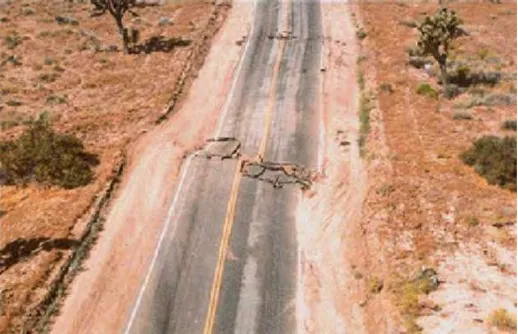
In order to understand the dynamic response of the building and internal structures and to evaluate its dynamic response under the occurrence of a severe earthquake like the Landers one (in Fig.1 it is represented one of the registered effects on the soil) the Time History and Substructure approaches were applied.
3.1 Description Of Isolated ELSY Structure
ELSY pool-type reactor is characterized, from a mechanical point of view, by the relevant lead coolant weight, by the reduction and simplification of the primary system that is contained within the main vessel and by a simple secondary loop.
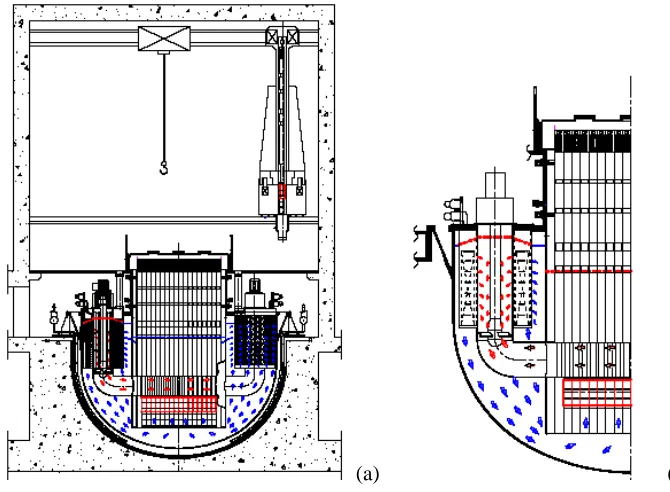
The ELSY primary system arrangement (Fig. 2) is characterized by several important design improvements resulting in a compact arrangement that features an inner cylindrical vessel, 8 innovative spiral-tube Steam Generating (SG) units, 8 Primary Pumps (PP) and 4 Decay Heat Dip Coolers installed in a vessel that is less than 9 m height, Cinotti (2008). The RV is also jointed and surrounded by a safety vessel (SV) which support and bear the reactor its attached components.
The main objective of the ELSY project is to design an innovative pure lead-cooled fast reactor based on the existing knowledge base in the field of lead-alloy (LBE) coolants that is extrapolated to pure lead.
The use of lead strongly also reduces the production of the highly radioactive, and hence decay-heat generating polonium in the coolant with respect to LBE; that is the main reason to chose lead as primary coolant for ELSY coupled to its low vapour pressure.
(a) (b)
Figure 2. ELSY primary system arrangement (a) and a detail of the lead flow path (b)
3.2 Seismic Isolation System
The demand for higher structural integrity performance, increased in many scientific and industrial fields like the nuclear one, is attained by means of isolation systems that allowed to decrease the seismic response spectra at each floor along the height of the structure. Therefore, the use of innovative anti-seismic techniques, such as seismic isolation and passive energy dissipation, may adequately reduce the vibrations of an isolated object, when the excitation frequency is far from the critical one, ensuring the full integrity and operability of important structures also in very severe seismic conditions.
Moreover rubber isolation bearings must ensure their efficiency as regards both filtering and dissipation functions for a mean lifetime of not less than 60 years corresponding to the NPP operation design.
Figure 3. Isolation system action
A preliminary seismic response evaluation of the isolated ELSY containment building and structures was carried out in order to determine the reduced seismic forces and the in-structure input motion effects for systems and components in presence of isolator under the foundations.
To perform the mentioned analyses a simplified passive isolation system, constituted by a suitable spring and dashpot, was used. Adequate type and number of isolation devices (rubber bearing) were determined noting that the performance of these systems depends on the capacity of shifting the system fundamental frequency (as indicated in the previous Fig. 3) to a lower value and on the energy dissipation of the isolator, Ibrahim (2008).
4
SEISMIC ANALYSES
To ensure adequate treatment of interaction effects and account for an adequate representation of the favourable isolation effects, the seismic analysis was carried out by means of separated structures (the substructure approach (Halbritter et al. 1998) has been also validated considering the influence of the mesh size and time history approach.
To attain the mentioned intent, a detailed as accurate as possible 3D finite element model (Fig.4) representing ELSY containment building and its main relevant structures, was set up and analyzed to provide the in-structure response spectra at the same reference location or subsystem supports in the case of isolated foundation base. Moreover in Fig.4, isolators are indicated as red line under the containment building foundation.
To simulated the seismic behaviour of ELSY reactor building, the recorded Acceleration Time Histories (U.S. Geological Survey) (Fig. 5) of severe Landers Earthquake excitation were used as input, applied at the base of the foundation of the mentioned building structure.
-3,0 -2,0 -1,0 0,0 1,0 2,0 3,0
0 5 10 15 20
Time (s) A c c e le ra ti o n ( m /s 2 )
Ax Ay Az
Figure 5. Landers Earthquake input Acceleration Time Histories
Afterwards the propagation of dynamic seismic loads for isolated nuclear plants and the structural performance, usually specified in terms of structural response quantities, such as strains and displacements, stresses and forces were studied.
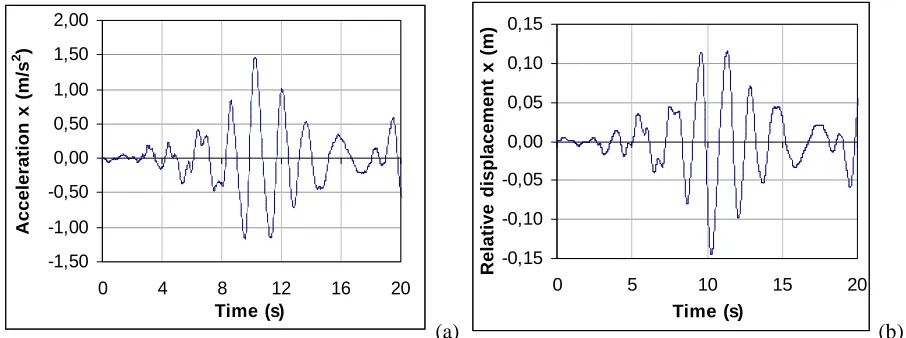
Overviews of the obtained numerical results in term of acceleration and displacements time histories (Figs.6a and 6b) (even if all three acceleration component were set up as input in the ELSY reactor building seismic analysis, in this paper only the propagated horizontal component is reported) and of response spectra comparison (Fig.7), calculated at chosen reference points as e.g. the SV anchorage restraints, are shown in the following diagrams. Moreover the response spectra inside the building were elaborated according to the US NRC Regulatory Guide 1.60.
The obtained results highlighted the positive effects of isolation system in mitigating the propagation seismic acceleration components which was decreased about 30%, while the relative displacement were increased. It is important to note that these reduction and amplification factors are related to the isolation system frequency.
Moreover it is evident that the acceleration reduction, already significant at the safety vessel anchorage, becomes dramatic at the roof level, being almost 5 - 6 times lower than in the mentioned case.
Furthermore the FEM codes results demonstrated that the dynamic behaviour of the ELSY building, subjected to the three-directional SSE load, is a rigid body motion, a pure translation in the horizontal direction over the isolation system.
-1,50 -1,00 -0,50 0,00 0,50 1,00 1,50 2,00
0 4 8 12 16 20
Time (s) A c c e le ra ti o n x ( m /s 2 ) (a) -0,15 -0,10 -0,05 0,00 0,05 0,10 0,15
0 5 10 15 20
Time (s) R e la ti v e d is p la c e m e n t x ( m ) (b)
0,0 0,3 0,6 0,9 1,2
0,1 1 10 100
Frequency (Hz)
A
c
c
e
le
ra
ti
o
n
(
g
)
input spectra
Response spectra at SV anchorage
Figure 7. Response Spectra Comparison
4.1 Seismic Effects on ELSY RV
The second aspect treated in this study deals with the numerical evaluation of sloshing phenomenon and all related hydrodynamic effects.
Since available analytical theories are not able to describe the real nonlinear fluid problem; accurate numerical simulation seemed of great importance to analyze sloshing problem. Therefore, a methodology able to accurately predict and analyse the fluid sloshing in the considered ELSY reactor vessel with internals, estimate the pressure loads acting on RV walls as well as simulate the free surface motion configuration was to develop.
As aforementioned the fluid motion, induced by a safe shutdown earthquake (SSE), may become so severe to impair the integrity of reactor vessel structures. Therefore the RV boundary walls should be exposed on impact loads (impulsive phenomenon with strong non linearity) due to the arisen breaking and splash of lead waves. Due to the complex geometry of RV with its internal structures as well as to the strong non linearity of sloshing phenomenon deriving also from the fluid-structures interaction, a finite element simulation was performed.
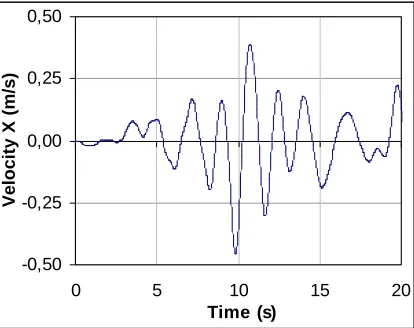
Adopting the numerical approach the equation of motion was solved on a time basis by using the time history of velocity (Fig.8) (consistent and calculated from the acceleration values propagated inside the reactor building) in the entire liquid region determining the response of structures and the fluid wave height.
-0,50 -0,25 0,00 0,25 0,50
0 5 10 15 20
Time (s)
V
e
lo
c
it
y
X
(
m
/s
)
Figure 8. Velocity Time History at the SV support
Adopting the Substructures approach it was possible to analyze and implement separately the ELSY main relevant reactor vessel components, as :
• Primary coolant: pure lead; • Cover gas: argon.
To perform seismic analyses, fluid coupled to the reactor vessel structures were modelled by means of the FEM code [MSC.Marc, 2003; MSC.Dytran, 2002] with adequate refined mesh in order to ensure accurate results.
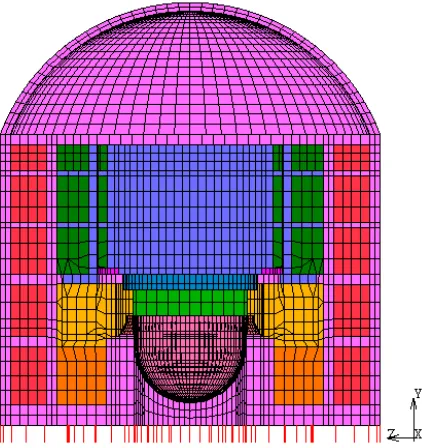
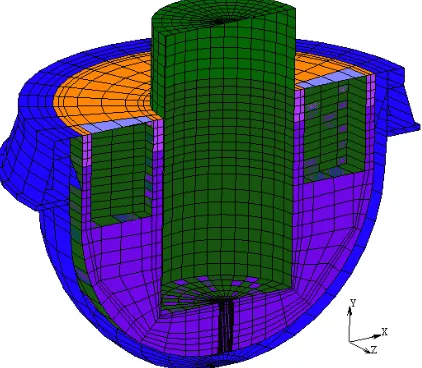
As for a dynamic structural response, the first task has been the setting up suitable FEM model of the above mentioned reactor vessel (Fig. 9), with some simplified assumptions to represent the fluid and structures behaviour.
In the adopted hypotheses the material behaviour of all structures was assumed to be isotropic and linear elastic perfectly plastic; the fluids were assumed characterized by an Eulerian hydrodynamic behaviour for lead and by an ideal gas behaviour for the argon.
Fluid and structure were implemented in order to exchange mechanical energy at the fluid-structure interface. Moreover the input motion (the first 15 seconds), obtained as a result of previously discussed seismic analysis applied at the isolated ELSY reactor building, was applied at the safety vessel anchorage supports.
Figure 9. Preliminary ELSY FEM model (vertical section)
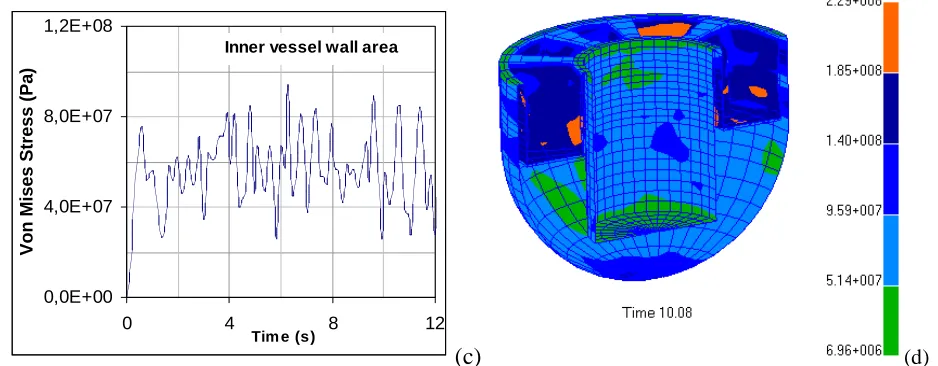
Sloshing analyses preliminary results are presented in the following figures and discussed in order to highlight the importance of the fluid-structure interaction effects in terms of stress intensity distribution in the RV and internal components (Figs.10a, 10b, 10c and 10d) and of the fluid movement along/inside the vessel (Fig. 11).
RV wall area
0,0E+00 5,0E+07 1,0E+08 1,5E+08 2,0E+08 2,5E+08
0 4 8 12
Tim e (s)
V
o
n
M
is
e
s
S
tr
e
s
s
(
P
a
)
(a)
SGs wall area
0,0E+00 5,0E+07 1,0E+08 1,5E+08 2,0E+08 2,5E+08
0 4 8 12
Time (s)
V
o
n
M
is
e
s
S
tr
e
s
s
(
P
a
)
Inner vessel wall area
0,0E+00 4,0E+07 8,0E+07 1,2E+08
0 4 8 12
Tim e (s)
V
o
n
M
is
e
s
S
tr
e
s
s
(
P
a
)
(c)
(d)Figures 10. Von Mises stress intensity distribution on the RV(a), SG (b) and inner vessel (c) walls and general overview (d)
The progressive lead motion, coupled with possible waves impact may cause localized high stresses on the RV and its internals walls that could impair the structures capability to withstand the related dynamic loads the RV and internal components.The maximum Von Mises stress intensity value resulted to be located in correspondence of SG walls and seemed to be due to the hydrodynamic pressure as well as to the fluid movement characteristics.
Moreover the response wave height of the retained fluid was evaluated (Fig.11). It was observed that the lead displacement, of about 6 cm, is not sufficient to impact the RV roof.
0,00 0,01 0,02 0,03 0,04 0,05 0,06
0 2 4 6 8 10 12
Time (s)
V
e
rt
ic
a
l
d
is
p
la
c
e
m
e
n
t
(m
)
Figure 11.Fluid wave height displacement
Analyzing the obtained results, it was observed that the presence of inner structures seems to influence the fluid waves motion; in fact these ones, acting as baffles, avoid the impact of a more extensive lead mass with the roof or internals components induced by the seismic excitation.
Moreover, as a consequence of the larger contact area with the liquid, in-vessel structures may determine an increase of the friction at the boundary layer and hence of the fluid damping.
It is important also to note that the overall obtained preliminary results, in terms of structural effects, referred to an isolated input seismic excitation and, therefore, were lower in intensity in respect to those ones which should derive adopting a not isolated seismic load.
5
CONCLUSION
In this paper the effects of seismic loading, deriving from a design base earthquake, of a Gen IV reactor, like the ELY project, were investigated adopting the Time History and Substructure approaches.
The propagation of seismic waves along and inside a possible ELSY reactor containment with the adoption of isolation system was investigated in order to reduce the seismic induced residual risk.
Preliminary dynamic analyses were performed by means of a widely used FEM code, assuming a simplified isolation system scheme, based on springs and dashpots. The main benefit, given by the seismic isolation that allowed to attain a significantly reduction of the accelerations in the building were indicated.
Sloshing phenomenon, related to the fluid-structures interaction, was also analyzed by means of an accurate numerical simulation. A suitable refined 3-D FEM model was used to gain useful information for a possible upgrading design of the considered reactor vessel example. The performed preliminary analyses showed the importance of the interaction between the fluid and the RV both in terms of the stress level and their distribution.
Moreover the effects of a safe shut down earthquake on the whole considered nuclear building has been presented and analysed in order to check the possible reference system criticalities and feed back on the critical design features (if any).
REFERENCES
Chen, Y.G. Djidjeli, K. Price, W.G., “Numerical simulation of liquid sloshing phenomena in partially filled containers”, Computers & Fluids 38 (2009) 830-842.
Cinotti, L., Locatelli, G., Aït Abderrahim H., et al.,“The ELSY Project”, Intl. Conference on the Physics of Reactors, Interlaken, Switzerland, September 14-19, 2008.
Halbritter, A.L., et al. “Dynamic analysis of VVER type nuclear power plants using different procedures for consideration of soil-structure interaction effects“, Nuclear Engineering and Design 182 (1998) 73-92.
Ibrahim, R.A. (2008) Recent advances in nonlinear passive vibration isolators Journal of Sound and Vibration 314 (2008) 371-452
Micheli I., Colaiuda A.,“A Sensitivity Investigation upon the Dynamic Structural Response of a Nuclear Plant on Aseismic Isolating Devices”, Transactions, SMIRT August 2001.
MSC. Software, 2003. MSC. MARC User’s Guide.
MSC. Software, 2002. MSC. Dytran User’s Guide
Hongling, Sun et alii, “Improved Active Vibration Isolation Systems”, Tsinghua Science and Technology, pp. 533-539 Volume 12, Number 5, October 2007