The Protein 4.1, Ezrin, Radixin, Moesin (FERM) Domain of Drosophila Coracle,
a Cytoplasmic Component of the Septate Junction, Provides
Functions Essential for Embryonic Development and
Imaginal Cell Proliferation
Robert E. Ward, IV,
1Liang Schweizer,
2Rebecca S. Lamb
3and Richard G. Fehon
Developmental, Cell and Molecular Biology Group, Department of Biology, Duke University, Durham, North Carolina 27708-1000 Manuscript received March 29, 2001
Accepted for publication June 25, 2001
ABSTRACT
Coracle is a member of the Protein 4.1 superfamily of proteins, whose members include Protein 4.1, the Neurofibromatosis 2 tumor suppressor Merlin, Expanded, the ERM proteins, protein tyrosine phosphatases, and unconventional myosins. Recent evidence suggests that members of this family partici-pate in cell signaling events, including those that regulate cell proliferation and the cytoskeleton. Previously, we demonstrated that Coracle protein is localized to the septate junction in epithelial cells and is required for septate junction integrity. Loss ofcoraclefunction leads to defects in embryonic development, including failure in dorsal closure, and to proliferation defects. In addition, we determined that the N-terminal 383 amino acids define an essential functional domain possessing membrane-organizing properties. Here we investigate the full range of functions provided by this highly conserved domain and find that it is sufficient to rescue all embryonic defects associated with loss ofcoraclefunction. In addition, this domain is sufficient to rescue the reduced cell proliferation defect in imaginal discs, although it is incapable of rescuing null mutants to the adult stage. This result suggests the presence of a second functional domain within Coracle, a notion supported by molecular characterization of a series ofcoraclealleles.
T
HE Protein 4.1 superfamily is composed of a large tional domains, one in the N-terminal region and a second near the C terminus. The conserved N-terminal group of diverse proteins that share an evolutionaryconserved protein domain ofⵑ300 amino acids. Mem- domain, also known as the Protein 4.1, ezrin, radixin, moesin (FERM) domain (Chishtiet al.1998), binds to bers of this family include Protein 4.1, the ezrin, radixin,
moesin (ERM) proteins, Talin, the NF2 tumor suppres- the cytoplasmic tail of several transmembrane proteins. For example, Protein 4.1 binds the transmembrane pro-sor Merlin, several protein tyrosine phosphatases,
sev-eral unconventional myosins, Drosophila Expanded, and teins glycophorin C and the band 3 anion exchanger (AndersonandLovrien1984;Pasternacket al.1985), Drosophila Coracle (reviewed in Bretscher 1999;
Tsukita and Yonemura 1999; Hoover and Bryant whereas ERM proteins bind CD44, CD43, and ICAM-2 (Tsukitaet al.1994;Yonemuraet al.1998). Erythrocyte 2000). Interest in this superfamily has increased
dramat-ically in recent years with the discovery that theNeurofi- Protein 4.1 contains a second functional domain near the C-terminal region of the protein that interacts with
bromatosis 2 (NF2) tumor suppressor gene encodes a
member of the family (Rouleauet al.1993;Trofatter the spectrin/actin cytoskeleton (Correas et al.1986). Similarly, ERM proteins contain a second functional
et al.1993) and that other family members also regulate
proliferation (Boedigheimer and Laughon 1993; domain near the C terminus that can bind actin directly (Turunenet al.1994). Studies of these proteins
demon-McCartneyet al.2000;Morrisonet al.2001).
Studies of Erythrocyte Protein 4.1 and the ERM pro- strated their ability to crosslink the plasma membrane to the underlying cytoskeleton, leading to the prevailing teins have suggested that family members have two
func-view that they provide both structural and regulatory functions for the cortical actin cytoskeleton (Marchesi
1985; Algrain et al. 1993). However, the subsequent
Corresponding author:Richard G. Fehon, B333 LSRC Research Dr.,
Developmental, Cell and Molecular Biology Group/Department of identification of other family members that do not have Biology, Duke University, Durham, NC 27708-1000.
apparent cytoskeletal binding functions, such as the
pro-E-mail: [email protected]
tein tyrosine phosphatases, suggests that this is not a 1Present address:Howard Hughes Medical Institute, Department of
Human Genetics, University of Utah, 15 North, 2030 East, Salt Lake universal feature within the family.
City, UT 84112-5331. Coracle, the only Drosophila Protein 4.1 ortholog,
2Present address:Department of Cell Biology, Memorial
Sloan-Ketter-shares ⬎60% identity with Protein 4.1 in the FERM
ing Cancer Center, New York, NY 10021.
domain and⬎35% identity in the C-terminal 100 amino 3Present address:Department of Molecular, Cellular, and
Develop-mental Biology, Yale University, New Haven, CT 06520. acids (Fehon et al. 1994). Interestingly, Coracle lacks
(described above) was inserted. Transformation of these con-sequences related to the spectrin-actin binding domain
structs was performed as described previously (Rebayet al. of Protein 4.1, suggesting that it does not have
mem-1993) and three independent transformant lines were estab-brane-cytoskeletal crosslinking functions. Coracle is ex- lished for each construct. For these studies, the following pressed in most epithelial tissues and localizes subcellu- transgenic lines were used: a third chromosome insertion (M19A) ofP{UAS myc cor1-383}and a third chromosome inser-larly to the septate junction, an apicolateral junction
tion (M2-1) ofP{UAS myc cor1-1698}. that is structurally and functionally analogous to the
Sequence analysis:Genomic DNA was obtained using stan-vertebrate paranodal septate junction (Bellen et al.
dard methods from wild-type flies and flies homozygous for 1998). Mutations incoraclecause a wide range of defects, eithercor8,cor10, orcor14that had been rescued to adulthood including failure in dorsal closure, failure in tracheal by ubiquitous expression of acoraclecDNA transgene (Fehonet al.1994). Intronic sequence was obtained from PCR products inflation, necrosis of the salivary glands, and faint
denti-using primers based on exonic sequence that spanned introns. cle belts (Lamb et al. 1998; Ward et al. 1998). coracle
The sequences obtained were subsequently confirmed by com-function is also required for the establishment or
main-parison with the Drosophila genome sequence (Adamset al. tenance of the septate junction and specific failure in 2000). To sequencecoraclealleles,coraclegenomic DNA was this process results in a breakdown of the barrier func- amplified using intron-specificcoracleprimers. The resulting PCR products were sequenced using the AmpliCycle sequence tion of the septate junction without affecting apicobasal
kit (Perkin-Elmer, Branchburg, NJ). polarity of the epithelium (Lambet al.1998).
Genetic rescue experiments:For the embryonic rescue ex-We previously determined that the FERM domain
periments, embryos were collected on apple juice plates for of Coracle possesses a membrane-organizing function 3 hr from parental stocks ofcor5/CyOcarryingP{hs-cor1-1698}, through its interaction with the transmembrane protein P{hs-cor1-383}, orP{hs-cor378-1698}. The embryos were subsequently aged for 4 hr during which time they were divided into two Neurexin (Wardet al.1998). Here we use genetic
ap-pools, one designated for heat shock and the other for no proaches to ask if the FERM domain provides all
essen-heat shock, and were then placed on fresh apple juice plates. tial functions of Coracle, or if instead other functional
Roughly 160 embryos were allocated to each pool per experi-domains are required. The results indicate that the ment. The heat-shock pools were then incubated at 38⬚for 1 FERM domain alone provides all essential embryonic hr. For each pool, all embryos that failed to hatch after 48 hr were mounted in Hoyer’s solution and examined for embry-functions and can rescue a previously identifiedcoracle
onic phenotypes. Four independent collections were con-proliferation defect in developing adult epithelia.
How-ducted for each line. For each collection, the percentages ever, the FERM domain alone is not capable of rescuing
of each phenotype were determined [(number of embryos mutant animals to the adult stage, suggesting thatcoracle displaying phenotype/total number of embryos)⫻100], and
encodes at least one other functional domain. Sequence then the mean of the four percentages plus standard errors were calculated.
analysis of coracle alleles, together with genetic rescue
The UAS/GAL4 system of Brandand Perrimon (1993) experiments using mutagenized transgenes, indicate
was employed to assess the ability of the FERM domain to that a second essential functional domain localizes to
provide full genetic rescue to a series of coraclealleles. The the conserved C-terminal region. Thus Coracle, like the followingcoraclealleles were recombined onto the ubiquitously ERM proteins, contains a C-terminal domain that may expressing GAL4 lineP{GawB}T80 (T80:Gal4):cor4,cor5,cor6, cor8,cor10, andcor14. Subsequently, a third chromosome inser-function to regulate interactions of its FERM domain
tion ofP{UAS myc cor1-383}orP{UAS myc cor1-1698}was introduced or mediate interactions with other proteins.
into these stocks and the following cross was set up:
w1118;P{GawB}T80,cor*/CyO;P{UAS myc cor1-383(or1698)}/⫹
MATERIALS AND METHODS
⫻ Drosophila stocks:For these studies, the following transgenic
w1118/Y;P{GawB}T80,cor*/CyO;P{UAS myc cor1-383(or1698)}/⫹
lines were used: two independent X-linked lines ofP{hs-cor1-1698}
(F97 and M84B); a second chromosome insertion (M7B) and Eclosing flies were scored either as balancer class or rescued a third chromosome insertion (M7A) ofP{hs-cor1-383}; and two
coraclemutant flies. Percentage rescue was determined as the second chromosome insertions (M7A and M10) and one third number of rescuedcoraclemutant flies divided by the expected chromosome insertion (M2B) ofP{hs-cor378-1698}.
number of transgene-bearingcoraclehomozygous flies (based coracle transgenes: P{UAS myc cor1-383} was constructed by
upon the number of balancer class flies that eclosed) multiplied the blunt-end ligation of a PCR-amplified fragment ofcoracle, by 100.
consisting of base pairs 370–1516, into Bluescript vector that Histology and dye permeability experiments:Cuticle prepa-had been modified to include an N-terminal myc epitope rations, electron microscopy, and junctional permeability ex-(LaJeunesseet al.1998). This plasmid was subsequently di- periments were performed as described previously (Lambet gested withXhoI andXbaI to yield a fragment of 1.2 kb, which al.1998).
was ligated into aXhoI/XbaI-digested pUAST vector (Brand Clonal analysis:To generate somatic clones lackingcor⫹and
and Perrimon 1993). The sequence of the PCR-amplified instead expressingcor1-383, the following cross was performed: region was confirmed by sequence analysis using standard
methods. P{UAS myc cor1-1698}was constructed by cloning an
w1118;P{ry⫹t7.2⫽neoFRT}43D cor4/CyO;P{hs-myc cor1-383}/TM3,P{w⫹mC⫽ActGFP}JMR2,Ser1
EcoRI, partial XbaI fragment (base pairs 1202–5645) from a
⫻ UbiquitinpromotercoraclecDNA1 construct (Fehonet al.1994)
into anEcoRI/XbaI-digested pUAST vector. This construct was w1118;P{ry⫹t7.2⫽neoFRT}43D P{w⫹mC⫽piM}46F P{w⫹mC⫽piM}47F;
subsequently digested withEcoRI to create a vector into which
Eggs were collected for 8 hr and larvae were heat shocked for 1 hr at 37⬚to induce FLP expression and mitotic recombi-nation. Following clone induction, expression of thehs-myc cor1-383transgene was induced by a 45-min heat shock at 37⬚ and then recovery at 25⬚for 45 min followed by another 45-min heat shock at 37⬚. This heat-shock/recovery/heat-shock regimen was repeated every 24 hr. After a final round of heat shock and a 60-min recovery, non-tubby wandering third instar larvae were selected and then further subdivided by green fluorescent protein (GFP) expression. GFP-expressing larvae served as controls, while those that lacked the GFP-marked balancer carried theP{hs-myc cor1-383}transgene. Wing imaginal discs were then dissected, fixed, and stained using anti-Myc (mAb 9E10) at a concentration of 1:50 as previously described (Fehonet al.1991).
RESULTS
Intron/exon boundaries of thecoraclegene:Previous studies of the humanProtein 4.1gene and Drosophila
coracle gene have shown that both genes encode
mul-tiple transcripts due to alternative splicing. Threecoracle
transcripts have been precisely mapped, and Northern Figure1.—Molecular organization of thecoraclegene and blot analysis indicates the presence of several others its major products. Above is a map indicating the sizes (in italics) and locations of exonic and intronic sequences in the (Fehonet al.1994).coracle cDNA 1(isoform 1) encodes
coraclegene. Boxes (A–I) show all identified exonic regions a protein that is predicted to be 1698 amino acids (aa)
from sequencing three distinct cDNA isoforms (isoforms 1–3). in length, whilecDNAs 2and3(isoforms 2 and 3) en- The triangles (numbered 1–16) indicate the positions of in-code much shorter products of 889 and 703 aa, respec- trons based on comparisons between cDNA and genomic se-tively. As shown in Figure 1, isoforms 2 and 3 differ quences. Most, but not all, junctions between exonic se-quences coincide with intron/exon boundaries. However, primarily from isoform 1 in that they lack coding region
note that at least two such junctions (B/C and E/F) represent E, a large (2427 bp), alternatively spliced exonic region.
alternative splice acceptor sites rather than intron/exon To determine the number of introns and the precise boundaries.
intron/exon boundaries of the coracle gene, we PCR amplified and sequenced genomic DNA from thecoracle
locus and compared it to the known cDNA isoforms. in this area can span just intron 11 (353 bp; isoform 1), On the basis of these comparisons,coracleis composed intron 11 plus region E (2780 bp; isoform 2), or intron of 17 exons and 16 introns (Figure 1). In addition, this 11, regions E and F, plus intron 12 (3717 bp; isoform analysis revealed a complex pattern of splicing that is due 3). Similar behavior is observed around exon H, al-to the use of alternative splice accepal-tor sequences that though in this case there does not appear to be any in some cases are not separated by intervening intronic alternative splice acceptor within the exon, thereby sim-sequences (Figure 1). Three introns are flanked by alter- plifying the splicing pattern.
nate splice acceptor sites that result in mRNAs with Structural analysis of thecoraclelocus reveals a region different coding sequences. The first of these regions, dispensable for viability:The observed complex pattern at intron 8 (Figure 1), results in alternative splicing of alternative splicing raises the possibility that different involving regions B and C. Region B contains an alterna- isoforms may have different functions during develop-tive splice acceptor that inserts a 12-bp coding region ment. This notion is supported by our previous observa-and is used in isoform 3. Region C, which is contiguous tion that the cor1 and
cor2 alleles are associated with with region B in the genomic DNA, is present in iso- nonsense mutations that should affect only isoform 1 forms 2 and 3, while in isoform 1, splicing spans from (Fehonet al. 1994). The observation that these muta-the 5⬘ end of intron 8, across regions B and C to the tions display a fully penetrant, embryonic lethal pheno-3⬘ end of the 711-bp intron 9, thereby excising these type implies that isoform 1 encodes functions that are coding regions. A similar behavior is observed around not present in the other isoforms and, therefore, that intron 11, which falls in between regions D and E in region E is likely to contain an essential functional do-the coding sequence. Surprisingly, region E, do-the largest main. Alternatively, it is possible that while functionally of the alternatively spliced regions incoracle(2427 bp), equivalent, the expression level of the other isoforms is is not immediately bounded by introns on both ends. too low to provide sufficientcoraclefunction for viability, Rather, the 3⬘ end of region E is defined by another consistent with previous observations that the alterna-alternative splice acceptor site within the large exon tive mRNA splice forms are expressed at lower levels
TABLE 1 addition, region F (570 bp). In comparison to isoform 3, isoform 1 lacks coding sequences within regions B Specificcoracleisoforms can replace endogenous
(12 bp) and C (102 bp). Thus, the observation that coraclefunction
isoforms lacking these regions can rescue severe loss-of-functioncoraclemutations indicates that, although in cor⫹transgene Nullcoracleallele % viability
combination regions B, C, E, F, and H encode 1071
Isoform 1 cor4 98 (981)
amino acid residues, they do not contain any essential
Isoform 2 cor4 77 (1524)
functional domains. Likewise, the observation that each
Isoform 3 cor4 79 (1345)
of these isoforms rescuescor5, a nullcoracleallele (Lamb
Isoform 1 cor5 76 (426)
Isoform 2 cor5 67 (1072) et al. 1998), indicates that each encodes all essential
Isoform 3 cor5 106 (552)
coracle functions and thus that these functions are
re-stricted to coding regions A, D, G, and I of Figure 1. Viability as determined by number of rescued flies/number
The FERM domain of Coracle provides all essential of expected rescued flies (based upon eclosed balancer class
flies) ⫻ 100. Numbers in parentheses indicate number of embryonic functions: Our prior structure/function balancer class flies eclosed.cor⫹transgene expression is under analysis revealed that the N-terminal 383 amino acids the control of the ubiquitin promoter. In the absence of any (COR1-383; the FERM domain) constitute the smallest
transgene,cor4andcor5animals are completely inviable.
N-terminal fragment capable of proper subcellular lo-calization (Ward et al. 1998). In addition, this region was shown to constitute an important functional domain To distinguish between qualitative and quantitative
that has membrane-organizing activity. We therefore functional differences between the three Coracle
iso-tested the idea that the Coracle FERM domain possesses forms, we constructed P-element-based transgenes
en-all essential genetic function by determining if ubiqui-coding isoforms 1, 2, and 3 under the control of the
tous expression of this domain could rescue null mutant DrosophilaUbiquitinpromoter. Use of theUbiquitin
pro-animals to the adult stage. Heat-shock-driven expression moter ensures that all three isoforms are expressed at
of COR1-383failed to produce any rescued adult offspring
roughly equivalent levels and that they are expressed
in acor5null mutant background (
n⫽83 balancer class in all tissues throughout embryonic development. To
flies eclosed). However, similar expression of acDNA1
test the ability of these isoforms to rescuecoracle lethal
transgene (cor1-1698
) rescued 57% of the expected cor5 mutations, independent insertion lines of each were
mutant flies (n⫽ 66 balancer class flies eclosed). crossed into the appropriatecoraclemutant background,
Although the FERM domain was found to be incapa-and viability of the homozygous mutant class was scored
ble of providing full genetic rescue, we sought to investi-(Table 1). All three of the tested isoforms provided
gate the range of functions provided by this domain. To sufficient coracle function to rescue ⬎67% of the
ex-accomplish this, we induced the expression of COR1-383in
pectedcoraclemutant offspring bearing null alleles (cor4
a null genetic background and looked for rescue of the andcor5; Table 1), indicating that all encode the
essen-coracleembryonic defects. Loss ofcoraclefunction during
tial coracle functions when expressed ubiquitously and
embryogenesis results in a failure of dorsal closure, ne-at sufficient levels. In all cases both males and females
crosis of the salivary glands, thinning and delamination were fertile, allowing us to maintain stocks of rescued
of the ectodermal cuticle, and tracheal inflation defects homozygous mutant animals. In comparison to isoform
(Fehonet al.1994;Lambet al.1998;Wardet al.1998). 1, isoform 2 lacks coding sequences within regions E
(2427 bp) and H (102 bp), and isoform 3 lacks, in Heat-shock induction of COR1-383rescued every defect
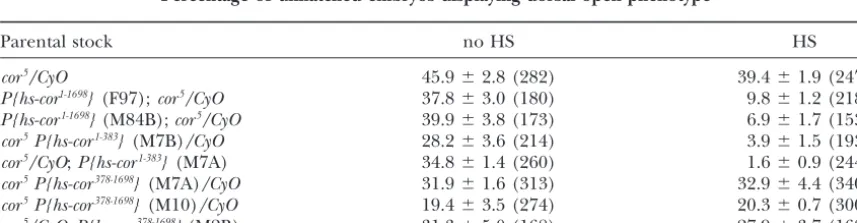
TABLE 2
Percentage of unhatched embryos displaying dorsal open phenotype
Parental stock no HS HS
cor5/CyO 45.9⫾2.8 (282) 39.4⫾1.9 (247)
P{hs-cor1-1698}(F97);cor5/CyO 37.8⫾3.0 (180) 9.8⫾1.2 (218)
P{hs-cor1-1698}(M84B);cor5/CyO 39.9⫾3.8 (173) 6.9⫾1.7 (153)
cor5P{hs-cor1-383}(M7B)/CyO 28.2⫾3.6 (214) 3.9⫾1.5 (193)
cor5/CyO;P{hs-cor1-383}(M7A) 34.8⫾1.4 (260) 1.6⫾0.9 (244)
cor5P{hs-cor378-1698}(M7A)/CyO 31.9⫾1.6 (313) 32.9⫾4.4 (340)
cor5P{hs-cor378-1698}(M10)/CyO 19.4⫾3.5 (274) 20.3⫾0.7 (300)
cor5/CyO;P{hs-cor378-1698}(M2B) 31.3⫾5.0 (168) 27.9⫾3.7 (168)
rescued all the other embryonic defects described above. Expression of COR1-383in these embryos greatly
reduced the cuticular thinning (Figure 2), as well as the necrosis of the salivary glands and the tracheal inflation defect (data not shown). Furthermore, a small percent-age ofcor5mutant embryos expressing COR1-383hatched
as larvae, indicating that expression of the FERM do-main alone is sufficient for complete embryonic devel-opment, although these animals died as larvae (data not shown).
Previous work indicated that Coracle serves an essen-tial structural role in the pleated septate junctions of embryonic epithelia (Lambet al.1998). To test the idea that the FERM domain provides all functions necessary for septate junction structure and function, we induced the expression of COR1-383incor5 mutant embryos and examined the septate junctions. Whereas loss ofcoracle
function results in embryonic epithelia that lack the individual septae that characterize the septate junction (Figure 3D), expression of COR1-383restored the normal
appearance of the septate junctions (Figure 3G). To assess the function of the septate junctions in similarly rescued embryos, we investigated the permeability of the salivary gland epithelium to a rhodamine-labeled dextran. Injection of this marker into the hemocoel of stage 16 mutant embryos results in the rapid accumula-tion of the dye into the lumen of the salivary gland (Figure 3F andLambet al.1998). In contrast, the salivary
Figure 2.—The FERM domain of Coracle is sufficient to
gland epithelium of cor5 mutant embryos expressing rescue the weak cuticle phenotype ofcor5mutant embryos.
Cuticle preparations showing a ventrolateral view of the denti- COR1-383was found to restrict the diffusion of the labeled
cle belts from the first four abdominal segments of wild-type dextran (Figure 3I). Taken together, these results indi-(A),cor5;P{hs-cor1-383}(B), andcor5(C) embryos. The embryo
cate that the FERM domain provides all functions that in (B) has been heat shocked to induce the expression of
are essential for the characteristic structure of the sep-COR1-383. The denticle belts in the “rescued” embryo (B) are
tate junction and for the formation of a transepithelial nearly wild type in appearance. Note that although the
denti-cles are fainter in thecor5mutant embryo, the overall pattern barrier.
is normal. Bar, 50m. To more fully investigate the role of the FERM do-main throughout development we wished to assess the ability of COR1-383 to rescue defects unique to
post-associated with loss of coracle function in the embryo embryonic stages. Since complete loss ofcoraclefunction (Table 2; Figure 2). For example, the expression of is embryonic lethal, the use of clonal analysis was neces-COR1-383 in acor5 background resulted in a significant
sary to determine the function of coracle in imaginal reduction in the number of embryos displaying a dorsal tissues. Clones of null or strongly hypomorphiccoracle
open phenotype (Table 2). This observation held true mutant cells are at a growth disadvantage in heterozy-for two independent transgenic lines of P{hs cor1-383},
gous imaginal tissues (R. S. Lamb and R. G. Fehon, and the magnitude of the rescue was equal to the rescue unpublished observations). For example, clones ofcor4 of the dorsal closure defect ofcor5by heat-shock induction
mutant cells fail to persist except as very small cell clus-of two independent transgenic lines clus-ofP{hs cor1-1698}(Table
ters, much smaller than the corresponding twin spot 2). In contrast, rescue of the dorsal closure defect of (Figure 4A). However, expression of COR1-383 through-cor5was never produced by the induction of COR378-1698, out the imaginal tissue by daily heat-shock induction
a derivative of the full-length protein lacking the FERM fully rescues this growth disadvantage (Figure 4, B–F). domain (Table 2). The failure of COR378-1698 to rescue This result indicates that the function of the FERM
the dorsal closure defect was not due to the inadequate domain is required for normal proliferation in imaginal expression of this protein. Immunoblot analysis of embry- tissues.
onic lysates from the three transgenic lines expressing A second functional domain is required after em-COR378-1698indicates that the recombinant protein is being bryogenesis:The observation that the FERM domain is
Figure3.—The FERM domain is suf-ficient to promote normal septate junc-tion structure and funcjunc-tion. (A, D, and G) Transmission electron micrographs of epidermis from late stage 17 wild-type (A),cor5(D), andcor5;P{hs-cor1-383}(G) embryos induced to express the coracle transgene. The individual septae that characterize the pleated septate junction in wild-type tissue (solid arrows in A) are missing incor5tissue. Expression of COR1-383incor5mutant embryos restores the normal appearance of the septate junction (solid arrows in G). (B, C, E, F, H, and I). The transepithelial barrier function of the septate junction is dis-rupted in cor5 mutant embryos and can be restored by the expression of COR1-383. Confocal optical sections of
stage 16 wild-type (B and C),cor5(E and F), andcor5;P{hs-cor1-383}embryos (H and I) showing the diffusion of a 10-kD rho-damine-dextran injected into the he-mocoel (dextran shown in C, F, and I, corresponding differential interference contrast images in B, E, and H). Note that in the wild-type embryo and the mu-tant embryo expressing the FERM do-main the dextran fails to cross the sali-vary gland epithelium (open arrow), whereas in the cor5mutant embryo the dextran freely crosses the salivary gland epithelium. Bars: A, D, G, 100 nm; B, C, E, F, H, I, 10m.
suggests the presence of another essential functional lecular organization in which the FERM domain is nec-essary for embryonic development and cell prolifera-domain that maps outside the FERM prolifera-domain and
func-tions at later stages of development. As a means to iden- tion, whereas a second region near the C terminus contains a functional domain that seems dispensable in tify this putative functional domain, we sequenced the
coding regions of thecoraclelocus in severalcoraclealleles embryos but necessary for some aspect of post-embry-onic development.
(Table 3;Fehonet al.1994;Lambet al.1998). We
pre-viously reported that mutations incor4andcor6specifi- If this model is correct, expression of the FERM do-main may rescue coracle alleles bearing defects in the cally affect the FERM domain, result in mislocalization
of the mutant Coracle protein, and display fully pene- N-terminal functional domain but not those bearing defects in the putative C-terminal domain. To test this trant embryonic lethality (Lambet al.1998;Wardet al.
1998).cor8andcor10are both weakly hypomorphic alleles idea we used the GAL4/UAS system (Brandand
Perri-mon1993) to drive expression of a P{UAS myc cor1-383} that result from missense mutations within or
immedi-ately C-terminal to the FERM domain, but do not affect transgene using endogenous enhancer elements, thereby eliminating the stress induced by repeated heat shocks. subcellular localization (Table 3; data not shown).
Con-sistent with the notion that the FERM domain is affected TheT80enhancer trap line was used to express GAL4 ubiquitously in the embryo, beginning approximately in cor8and
cor10animals, both alleles display
predomi-nately embryonic lethality (Lamb et al.1998). In con- at germ-band retraction, and in the imaginal tissues throughout development (R.Wardand D.LaJeunesse, trast, lethal phase analysis ofcor14indicates that it is one
of the weakest alleles, showing nearly penetrant larval unpublished observations). Expression of COR1-383 by
T80:GAL4was incapable of providing rescue to the adult
lethality (Lambet al.1998). Sequence and immunoblot
analyses (data not shown) reveal thatcor14results from stage for the strongest alleles whose lesions affect the FERM domain, cor4andcor6, although it was sufficient a nonsense mutation at Arg1607, truncating the protein
at the start of a C-terminal region that is well conserved to provide moderate rescue to the weaker alleles cor8 andcor10(Table 3). Many of the rescued adults displayed between Coracle and its vertebrate homologs, but not
found in any other family member (Fehonet al.1994). mild phenotypes reminiscent of hypomorphic coracle
escapers (Lambet al.1998), such as slightly roughened The subcellular localization of COR14is normal (data
Figure4.—The FERM domain is sufficient to rescue thecoraclecell viability phenotype. Somatic mosaic clones of homozygous cor4mutant cells were induced at 48 hr in a heterozygous background using the FLP/FRT recombination system. Homozygous mutant clones are marked by the absence of the PiMyc marker (red arrows), while homozygous wild-type sister clones induced at the same time are indicated by higher levels of Myc staining (yellow arrows). (A) Homozygouscor4mutant cells in clones (red arrows) survive poorly in the wing imaginal epithelium, as indicated by their relatively small size and low frequency relative to the simultaneously induced sister wild-type clone (yellow arrows). (B and C) Homozygouscor4mutant clones induced in sibling larvae that also express COR1-383under the control of the heat-shock promoter. The two wing imaginal discs shown in B and C
have a higher frequency ofcor4 mutant clones relative to A, and these clones are larger, indicating that the FERM domain provides essentialcoraclefunctions for viability in clones. (D–F) Tangential optical section through the apical ends of epithelial cells in the notal region of imaginal disc shown in C, stained for wild-type Coracle (D), Myc-tagged COR1-383expressed under
the heat-shock promoter (E), and the two proteins combined (F). Large clones ofcor4mutant cells (red arrow in D) that express COR1-383(red arrows in E) are readily visible. Merged image (F) demonstrates that COR⫹and COR1-383 are coexpressed at the
plasma membrane in the apical region. Inset at lower left in F shows higher magnification view of membrane localization of COR1-383in the mutant clone (green cells) and its colocalization with COR⫹in surrounding wild-type cells (orange cells). Bars:
A–C, 50m; D and E, 25m.
rescue was substantial, it was not complete. However, driver, produced moderate rescue of cor14 (Table 3), which, taken with the failure of COR1-383to provide
ge-the rescued cor8 and cor10 animals were found to be
fertile even though this was rarely, if ever, detected in netic rescue to cor14, strongly supports the idea of a second functional domain outside the FERM domain.
coracleescapers (Lambet al.1998).
In contrast to the observed rescue of thecor8andcor10 However, no rescue ofcor5, a null allele, was observed in these control experiments, indicating that theT80:GAL4
alleles, expression of COR1-383byT80:GAL4had no effect
on the viability ofcor14animals (Table 3). Control experi- driver did not fully recapitulate the expression pattern of endogenouscoracle (Table 3).
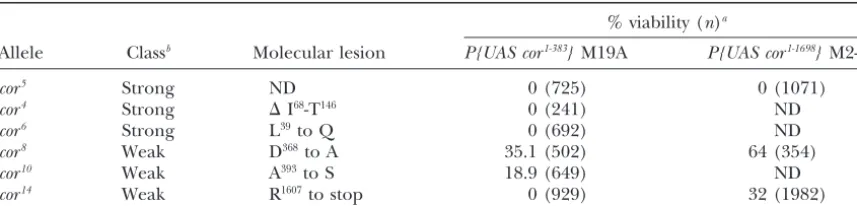
TABLE 3
Genetic rescue ofcoraclealleles byT80:GAL4; P{UAS cor}
% viability (n)a
Allele Classb Molecular lesion P{UAS cor1-383}M19A P{UAS cor1-1698}M2-1
cor5 Strong ND 0 (725) 0 (1071)
cor4 Strong ⌬I68-T146 0 (241) ND
cor6 Strong L39to Q 0 (692) ND
cor8 Weak D368to A 35.1 (502) 64 (354)
cor10 Weak A393to S 18.9 (649) ND
cor14 Weak R1607to stop 0 (929) 32 (1982)
aViability as determined by number of rescued flies/number of expected rescued flies (based upon eclosed balancer class flies)⫻100, withn⫽balancer class flies eclosed.
bBased upon embryonic phenotype (seeLambet al.1998). ND, not done.
DISCUSSION FERM domain and cause embryonic lethality, can be rescued to viable, fertile adults by the ubiquitous expres-Structural aspects of thecoraclelocus:Genetic rescue
sion of just the FERM domain (Table 3). In contrast, experiments and molecular characterization of several
cor4andcor6mutant animals, which also have molecular
coraclealleles suggest that Coracle is a modular protein
lesions within the FERM domain, are not rescued by having at least two separate functional domains. The
ubiquitous expression of COR1-383 (Table 3).
Interest-finding that each of the three identifiedcoracleisoforms
ingly, thecor4andcor6mutant proteins display abnormal was capable of rescuing coracle mutant animals to the
subcellular localizations (Wardet al.1998), raising the adult stage (Table 1) indicates that regions A, D, G, and
possibility that correct subcellular localization is as cru-I harbor all essential functional domains. cru-Interestingly,
cial for the function of the C-terminal domain as it is regions A (the N-terminalⵑ400 aa) and I (the
C-termi-for the function of the FERM domain. Also,cor1andcor2, nal ⵑ100 aa) encode the Coracle sequences that are
which have an intact FERM domain display embryonic most highly conserved with human Protein 4.1 (⬎60%
defects, but like most nonsense mutations these alleles and ⬎35% identity, respectively). Consistent with the
show reduced protein expression (Fehonet al.1994). notion that these are essential domains, many of the
Our experiments strongly suggest the existence of mutations thus far identified incoraclealleles fall within
an essential functional domain within the C-terminal these two regions.cor4,
cor6,
cor8, and
cor10all result from
region of Coracle. Even thoughcor14
is one of the weak-either in-frame deletion or missense mutation within
est alleles tested in these experiments, ectopic expres-region A. cor14 results from a nonsense mutation at
sion of the FERM domain is incapable of rescuingcor14 Arg1607, truncating the protein within region I. Taken
animals. In contrast,cor14is rescued by expression of a together, these data suggest the existence of two impor- full-length coracle transgene (Table 3), indicating that tant functional domains in Coracle, one corresponding a region outside the FERM domain is necessary for to the conserved FERM domain and the other corre- viability. cor14 results from a nonsense mutation at sponding to the C-terminal 100 amino acids. Arg1607, suggesting that the C-terminal functional
do-Interestingly, allcoraclemutations that are predicted main includes sequences within the highly conserved to affect the N-terminal functional domain are embry- C-terminal 100 amino acids.
onic lethal, whereascor14, which truncates the C-terminal
The proposed modular organization of the functional domain, shows no embryonic lethality. This observation domains within Coracle leads to the following predic-raises the possibility that the N-terminal functional do- tion: alleles that specifically alter only one functional main is required to complete embryonic development, domain should complement alleles that affect only the whereas the C-terminal domain is required at a later other functional domain. We have previously reported stage. Ectopic expression experiments using just the on such an experiment (Lambet al.1998). If alleles that FERM domain strongly support this supposition. Em- dramatically reduce the expression level of the mutant bryos completely lackingcoraclefunction display a range protein or alter their subcellular localization are ex-of defects including failure in dorsal closure, thinning cluded, examination of these data bears out this hypoth-of the cuticle, necrosis hypoth-of the salivary glands, and an esis. Specifically, combinations involving cor8 and
cor10is⬎75% viable when heterozygous withcor14, andcor8 lin FKBP13 interacts with the C-terminal region of Pro-tein 4.1G, one of several ProPro-tein 4.1 paralogues in mam-weakly complementscor14(Lambet al.1998). This result
is in agreement with the results obtained here using mals (Walenskyet al.1998). If such interactions occur via the Coracle C-terminal domain, they could function molecular genetic approaches and strongly supports our
conclusions on the modular nature of the functional to anchor additional proteins to the region of the sep-tate junction. In contrast, two recent studies have sug-domains within Coracle.
Cellular functions of the Coracle domains:Our previ- gested interactions between this same domain of Protein 4.1 and proteins known to function in the nucleus. ous studies have suggested that most, if not all, of the
embryonic defects associated with loss ofcoraclefunction These proteins are NuMA, the nuclear mitotic apparatus protein (Mattagajasingh et al.1999; Ye et al. 1999), are due to an inability to maintain a physiologically
“tight” epithelium (Lamb et al. 1998). In studies de- and PIKE, a putative regulator of PI3kinase activity in the
nucleus (Yeet al.2000). At the moment the functional scribed here, we demonstrate that ectopic expression
of the FERM domain incoraclemutant embryos is suffi- significance of these interactions is not known, nor do we know if Coracle has similar interactions. Further cient to rescue all of the described embryonic defects,
raising the possibility that this rescue was accomplished experiments, particularly using genetic approaches, will be required to determine their functional significance. by restoring the integrity of the septate junction.
Ultra-structural and physiological analyses confirmed this hy- However, both our data and data regarding putative protein-protein interactions are consistent with a func-pothesis (Figure 3), demonstrating that this domain
provides an essential structural function at the septate tion for the C-terminal domain that is distinct from that junction in embryonic epithelia. of the FERM domain and may differ significantly from
Although our results indicate that the FERM domain current ideas about Protein 4.1/Coracle functions. provides an essential structural function during embry- We thank the Bloomington Drosophila stock center at Indiana onic development, it is less clear what role this domain University for fly stocks. We thank D. LaJeunesse (University of North Carolina, Greensboro), D. Kiehart (Duke University, Durham, NC),
plays in post-embryonic development. Loss of coracle
and J. Genova (Duke University, Durham, NC) for valuable
sugges-function in imaginal epithelia results in a proliferative
tions and discussions. This work was supported by grant no.
RPG-97-disadvantage that is ameliorated by expression of just
026-04-DDC from the American Cancer Society to R. G. Fehon. R. E.
the FERM domain (Figure 4), but does not alter overall Ward and R. S. Lamb were supported by National Institutes of Health epithelial integrity or polarity (Lamb et al. 1998). A training grants GM-07754 and GM-07184, respectively.
number of cell signaling pathways have been implicated in controlling cell proliferation and growth in imaginal epithelia. Included among these are the epidermal
LITERATURE CITED growth factor, Wingless, Notch, and the Dpp pathways
Adams, M. D., S. E. Celniker, R. A. Holt, C. A. Evans, J. D. Gocayne
(Diaz-Benjumea and Garcia-Bellido 1990; Burke
et al., 2000 The genome sequence of Drosophila melanogaster.
andBasler1996; JohnstonandEdgar 1998). Muta- Science287:2185–2195.
tions that perturb the proper transmission of these sig- Algrain, M., O. Turunen, A. Vaheri, D. LouvardandM. Arpin, 1993 Ezrin contains cytoskeleton and membrane binding
do-nals produce imaginal defects similar to those we report
mains accounting for its proposed role as a
membrane-cytoskele-here forcoracle. Additionally,coraclewas originally identi- tal linker. J. Cell Biol.120:129–139. fied as a dominant suppressor ofEgfrEllipse, a
hypermor-Anderson, R. A., andR. E. Lovrien, 1984 Glycophorin is linked by band 4.1 protein to the human erythrocyte membrane skeleton.
phic allele of the epidermal growth factor receptor
ho-Nature307:655–658.
molog (Fehonet al.1994). It is possible that the FERM Bellen, H. J., Y. Lu, R. BecksteadandM. A. Bhat, 1998 Neurexin domain facilitates the transduction of one or more of IV, caspr and paranodin—novel members of the neurexin family:
encounters of axons and glia. Trends Neurosci.21:444–449.
these signaling cascades by binding to and thereby
lo-Boedigheimer, M., andA. Laughon, 1993 expanded: a gene involved
calizing an important intracellular factor or factors. Our in the control of cell proliferation in imaginal discs. Development continuing efforts to identify additional genes that inter- 118:1291–1301.
Brand, A. H., andN. Perrimon, 1993 Targeted gene expression as a
act withcoraclewill undoubtedly help resolve the
func-means of altering cell fates and generating dominant phenotypes.
tion of this domain in regulating proliferation. Development118:401–415.
What, then, is the role of the C-terminal domain? Bretscher, A., 1999 Regulation of cortical structure by the ezrin-radixin-moesin protein family. Curr. Opin. Cell Biol.11:109–116.
By analogy with Protein 4.1 and the ERM proteins, we
Burke, R., andK. Basler, 1996 Dpp receptors are autonomously
suspect that this region in Coracle contains a
protein-required for cell proliferation in the entire developingDrosophila
binding domain. In the ERM proteins, the C-terminal wing. Development122:2261–2269.
Chishti, A. H., A. C. Kim, S. M. Marfatia, M. Lutchman, M.
Hans-domain is thought to regulate the function of the FERM
palet al., 1998 The FERM domain: a unique module involved
domain via an intramolecular interaction (Gary and
in the linkage of cytoplasmic proteins to the membrane. [letter]
Bretscher1995; Reczek andBretscher 1998). It is Trends Biochem. Sci.23:281–282.
Correas, I., T. L. Leto, D. W. SpeicherandV. T. Marchesi, 1986
not known yet if similar interactions may occur in
Cora-Identification of the functional site of erythrocyte protein 4.1
cle or Protein 4.1. In addition, recent experiments have
involved in Spectrin-actin associations. J. Biol. Chem.261:3310–
identified several potential protein-protein interactions 3315.
Diaz-Benjumea, F. J., and A.Garcia-Bellido, 1990 Genetic analysis
immunophi-of the wing vein pattern immunophi-of Drosophila. Roux’s Arch. Dev. Biol. Rebay, I., R. G. FehonandS. Artavanis-Tsakonas, 1993 Specific
198:336–354. truncations of Drosophila Notch define dominant activated and
Fehon, R. G., K. Johansen, I. RebayandS. Artavanis-Tsakonas, dominant negative forms of the receptor. Cell74:319–329. 1991 Complex cellular and subcellular regulation of Notch ex- Reczek, D., andA. Bretscher, 1998 The carboxyl-terminal region pression during embryonic and imaginal development ofDrosoph- of EBP50 binds to a site in the amino-terminal domain of ezrin ila: implications for Notch function. J. Cell Biol.113:657–669. that is masked in the dormant molecule. J. Biol. Chem.273:
Fehon, R. G., I. A. DawsonandS. Artavanis-Tsakonas, 1994 A 18452–18458.
Drosophilahomologue of membrane-skeleton protein 4.1 is associ- Rouleau, G. A., P. Merel, M. Lutchman, M. Sanson, J. Zucmanet al., ated with septate junctions and is encoded by thecoraclegene. 1993 Alteration in a new gene encoding a putative membrane-Development120:545–557. organizing protein causes neurofibromatosis type 2. Nature363:
Gary, R., and A. Bretscher, 1995 Ezrin self-association involves 515–521.
binding of an N-terminal domain to a normally masked C-termi- Trofatter, J. A., M. M. MacCollin, J. L. Rutter, R. Eldridge, N. nal domain that includes the F-actin binding site. Mol. Biol. Cell Kleyet al., 1993 A novel moesin-, ezrin-, radixin-like gene is a
6:1061–1075. candidate for the neurofibromatosis 2 tumor suppressor. Cell72:
Hoover, K. B., andP. J. Bryant, 2000 The genetics of the protein 791–800.
4.1 family: organizers of the membrane and cytoskeleton. Curr. Tsukita, S., and S. Yonemura, 1999 Cortical actin organization: Opin. Cell Biol.12:229–234. lessons from ERM (ezrin/radixin/moesin) proteins. J. Biol.
Johnston, L. A., andB. A. Edgar, 1998 Wingless and Notch regulate Chem.274:34507–34510.
cell-cycle arrest in the developing Drosophila wing. Nature394: Tsukita, S., K. Oishi, N. Sato, J. Sagara, A. Kawaiet al., 1994 ERM
82–84. family members as molecular linkers between the cell surface
LaJeunesse, D. R., B. M. McCartneyandR. G. Fehon, 1998 Struc- glycoprotein CD44 and actin-based cytoskeletons. J. Cell Biol. tural analysis of Drosophila merlin reveals functional domains
126:391–401.
important for growth control and subcellular localization. J. Cell Turunen, O., T. Wahlstro
¨ mand A. Vaheri, 1994 Ezrin has a Biol.141:1589–1599.
COOH-terminal actin-binding site that is conserved in the ezrin
Lamb, R. S., R. E. Ward, L. SchweizerandR. G. Fehon, 1998
Dro-protein family. J. Cell Biol.126:1445–1453. sophila coracle, a member of the protein 4.1 superfamily, has
essen-Walensky, L. D., P. Gascard, M. E. Fields, S. Blackshaw, J. G.
tial structural functions in the septate junctions and
develop-Conboyet al., 1998 The 13-kD FK506 binding protein, FKBP13, mental functions in embryonic and adult epithelial cells. Mol.
interacts with a novel homologue of the erythrocyte membrane Biol. Cell9:3505–3519.
cytoskeletal Protein 4.1. J. Cell Biol.141:143–153.
Marchesi, V. T., 1985 Stabilizing infrastructure of cell membranes.
Ward, R. E., R. S. LambandR. G. Fehon, 1998 A conserved func-Annu. Rev. Cell Biol.1:531–561.
tional domain of Drosophila coracle is required for localization
Mattagajasingh, S. N., S. C. Huang, J. S. Hartenstein, M. Snyder,
at the septate junction and has membrane-organizing activity. J.
V. T. Marchesiet al., 1999 A nonerythroid isoform of protein
Cell Biol.140:1463–1473. 4.1R interacts with the nuclear mitotic apparatus (NuMA)
pro-Ye, K., D. A. Compton, M. M. Lai, L. D. WalenskyandS. H. Snyder, tein. J. Cell Biol.145:29–43.
1999 Protein 4.1N binding to nuclear mitotic apparatus protein
McCartney, B. M., R. M. Kulikauskas, D. R. LaJeunesseandR. G.
in PC12 cells mediates the antiproliferative actions of nerve
Fehon, 2000 The neurofibromatosis-2 homologue, Merlin, and
growth factor. J. Neurosci.19:10747–10756. the tumor suppressor expanded function together in Drosophila
Ye, K., K. J. Hurt, F. Y. Wu, M. Fang, H. R. Luoet al., 2000 Pike. to regulate cell proliferation and differentiation. Development
127:1315–1324. A nuclear gtpase that enhances PI3kinase activity and is regulated
Morrison, H., L. S. Sherman, J. Legg, F. Banine, C. Isackeet al., by protein 4.1N. Cell103:919–930.
2001 The NF2 tumor suppressor gene product, merlin, medi- Yonemura, S., M. Hirao, Y. Doi, N. Takahashi, T. Kondoet al., ates contact inhibition of growth through interactions with CD44. 1998 Ezrin/radixin/moesin (ERM) proteins bind to a positively
Genes Dev.15:968–980. charged amino acid cluster in the juxta-membrane cytoplasmic
Pasternack, G. R., R. A. Anderson, T. L. LetoandV. T. Marchesi, domain of CD44, CD43, and ICAM-2. J. Cell Biol.140:885–895. 1985 Interactions between protein 4.1 and band 3. J. Biol.