Effect of Supernatant Solutions on the
Formation of Liesegang Rings
Vimal S. Joshi
Principal, Shri R. K. Parikh Arts and Science College, Petlad-388450, Dist: Anand, Gujarat, India
ABSTRACT: Liesegang phenomenon has been studied by German chemist R. E. Liesegang first time. Afterwards
various biological, physical and chemical pattern formations have increasing interest in the various scientific community. The precipitation structures, known as Liesegang rings, which may often rings in circular geometries, and bands in linear geometries, formed by the non-uniform spatial distribution of crystals in a precipitation reaction in a gel. In the present study, the effect of different additive solutions on the Liesegang ring formation have been studied during the growth of calcium hydrogen phosphate dihydrate (CHPD) urinary crystals. Calcium Oxalate and Calcium phosphate are well-known urinary crystals. Calcium phosphate is present in urinary stones either as Apatite [Ca10(PO4)6(OH)2] or Brushite [CaHPO4,2H2O]. During the crystal growth process, periodic pattern of Liesegang rings
are seen within the gel column prior to crystal growth.
KEYWORDS: Crystal, Silica gel, Calcium Oxalate, Calcium Phosphate, Urinary Stone, Liesegang phenomenon,
Belousov-Zhabotinsky reaction, Liesegang rings.
I. INTRODUCTION
"Liesegang phenomenon" known as the periodic precipitation process has been first time studied by German chemist R. E. Liesegang. Even though, during the twentieth century the phenomenon impacted the thoughts of thousands of researchers from different fields, and hundreds of papers have been published on this topic formation of Liesegang patterns. Different types of Biological, Physical and Chemical pattern formations have increasing interest in the various scientific community during the last decades of the twentieth century. In the chemical patterning one of the most intensively investigated area was the Belousov-Zhabotinsky reaction. There are several research publications on different patterning, like, electrochemical deposition, morphogenesis of fungal colonies as well as some other simple living bodies, viscous fingering, diffusion limited aggregation etc. Even though superficially these systems are quite different, there are many similarities in their corresponding patterns formation. All of them contain at least one or more diffusion-limited steps, while the formation of the spatial or spatiotemporal order is always a result of a complicated relationship of these and the primary chemical, physical or biological processes. The structures, which are often rings in circular geometries, and bands in linear geometries, are formed by the non-uniform spatial distribution of crystals in a precipitation reaction in a gel [1]. The Optical and XRF study on growth and characteristics of Liesegang Rings in Cu– Cr System has been studied by M. Vyˇsinka et al. [2]. They have presented first results using X–Ray fluorescence technique for Cu–Cr system obtained at beam line BL4A, Photon Factory, KEK, Japan and found that the Cu and Cr concentration profiles are in phase except the green ring at the boarder of the ring system with higher Cu concentration. Julyan H. E. Cartwright et al. have discussed the occurrence of Liesegang rings in crystal growth experiments with two competing crystalline phases, and also compare computational predictions with the results of laboratory experiments [3]. Apart from deterministic rings and bands, experiments [4] show the formation of other structures ranging from continuous precipitation to non-periodic bands as the initial concentrations of the reagents are varied. Rings and bands can also be perturbed into spirals, breaking the symmetry in the directions perpendicular to the concentration gradients. Classical Liesegang rings result from the precipitation reaction in a gel between a cation and an anion that form a single crystalline phase, but the possibilities of two competing crystal phases were also studied. H. E. Cartwright et al. have performed experiments in the gel crystallization of calcium phosphates and find that two competing crystal phases, hydroxyapatite [Ca5(PO4)3(OH)] and brushite [CaHPO4.2H2O] precipitate such that they form two sets of Liesegang
rings. One phase precipitates primarily first, followed by the other [3,5]. Simulation models for the formation of Liesegang rings start with the quite simple chemistry of P and Q reacting to give PQ, i.e., P + Q → PQ(s). Dee [6], and
Banu SÍS et al. [8] have reported the Liesegang Rings in a 52-year-old woman breast tissue as an unusual component of a foreign body reaction and also observed Liesegang ring with a laminated structure and radial cross-striations near the birefringent suture material (Hematoxylin-Eosin, x 400).
Some researchers found that the Liesegang rings are rare, acellular laminated ring-like structures that have been observed mostly in inflammatory, cystic, necrotic and hemorrhagic tissue processes [9,10] and they can accompany various lesions: renal cysts, necrotic renal tissue, breast cysts, eyelid cysts, conjunctival cysts, inflamed synovium, peritoneal endometriotic implants and mucocele of the paranasal sinuses [9,11]. Shuko, F.et al have studied the effect of microgravity on the spatial oscillation behavior of Belousov-Zhabotinsky reactions catalyzed by Ferroin [12]. Renal calculi are abnormal concretion occurring in the kidneys. They are consisting of organic matrix as well as crystalline components. Urinary calculi are among the oldest afflictions of humans as well as animals. Majority, Calcium oxalate monohydrate (COM), Calcium oxalate dihydrate (COD) and Calcium phosphates are found in urinary stones. Randall [13] and Vermotten [14] suggested theories for the growth of urinary calculi. Girija et al. [15] investigate the components of urinary stones. Srinivasan and Natarajan [16], Joshi and Joshi [17] as well as Joseph and Joshi [18] grow some urinary crystals by gel technique. In the present investigations, the formation of Liesegang Rings during the growth of calcium hydrogen phosphate (CHP) crystals in gel column has been reported in the presence of different supernatant solutions.
II. MATERIALS AND METHOD
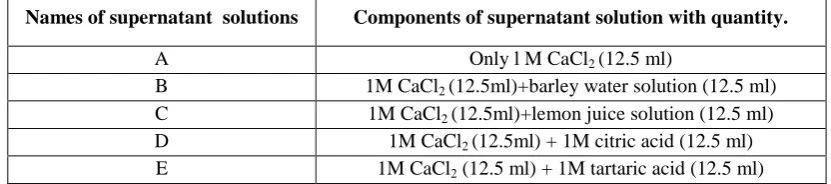
For the growth media, the aqueous solution of sodium metasilicate having specific gravity 1.06 was selected. As a crystallization vessels, test tubes of 2.5 cm internal diameter and 14 cm length were selected. The pH of the sodium metasilicate solution was set to 6.0 by adding aqueous solution of 2.5 M ortho-phosphoric acid. After gelation takes place supernatant solutions as mentioned in the Table 1 were poured. Table 1 describes the names given to the supernatant solutions, for the purpose of this study, and components of supernatant solutions including its volume
Table 1: Composition of supernatant solutions.
III. RESULTS AND DISCUSSION
The gel technique is very useful to grow urinary crystals. Srinivasan and Natarajan [16] reported the formation of Liesegang rings during the growth of CHP crystals. Hatscheck [19]; Morse and Pierce [20] had also studied the formation of Liesegang rings in various gels. Henisch and Garcia-Ruiz [21,22] suggested numerical methods to obtain the formation of Liesegang rings on the basis of Fick’s diffusion equation. In the present investigations when 1M CaCl2
solution was added as a feed solution, the Liesegang rings (LR) were developed. Table 2 shows the details of supernatant solution poured, distance of the first Liesegang ring from Gel-Liquid Interface and number of rings developed in the case of each supernatant solutions. It can be observed that the distance between the rings were gradually increased from gel-liquid interface (G.L.I.) to bottom of the test tube. Number of rings and the distance of the first ring from gel liquid interface were changed as the supernatant solution was changed. In the case of supernatant solution D and supernatant solution E, the development of Liesegang ring was not observed so the details of supernatant solution D and supernatant solution E are excluded in the Table 2.
Names of supernatant solutions Components of supernatant solution with quantity.
A Only l M CaCl2 (12.5 ml)
B 1M CaCl2 (12.5ml)+barley water solution (12.5 ml)
C 1M CaCl2 (12.5ml)+lemon juice solution (12.5 ml)
D 1M CaCl2 (12.5ml) + 1M citric acid (12.5 ml)
Supernatant solution Numbers of Liesegang rings
Distance of the first ring from gel liquid interface in mm
A 18 6.0
B 13 8.0
C 03 33.0
Table 2: Distance of Liesegang rings and numbers of LR occurred
Figure 1 is the photograph of the Liesegang rings for supernatant solution A containing 1M CaCl2.It was observed that,
when lowest ring developed the initial few rings got started to diffuse. From the figure 1, it is clear that the distance between two consecutive rings increases as moves towards the bottom of the test tube.
Figure 1: Photograph of the Liesegang rings for solution A Figure 2: Plot of the distance of LR from GLI against
number of ring for Solution A Figure 2 is plot of the distance of Liesegang ring from gel liquid interface (G.L.I.) against number of the ring for pure 1M CaCl2.
Figure 3 shows the photograph of the Liesegang rings developed within the gel column in the case of supernatant solution B, which contains 1M CaCl2 plus barley water solution. Growth of some crystals also observed within the gel
medium as seen in the figure.
Figures 4 shows plot of distance of Liesegang ring from gel liquid interface (G.L.I.) against number of the rings in the case of supernatant solution B which contains 1M CaCl2 plus barley water solution. One can notice that, the numbers of
Figure 3: Photograph of the LR for solution B Figure 4: Plot of the distance of LR from GLI against
number of ring for solution B
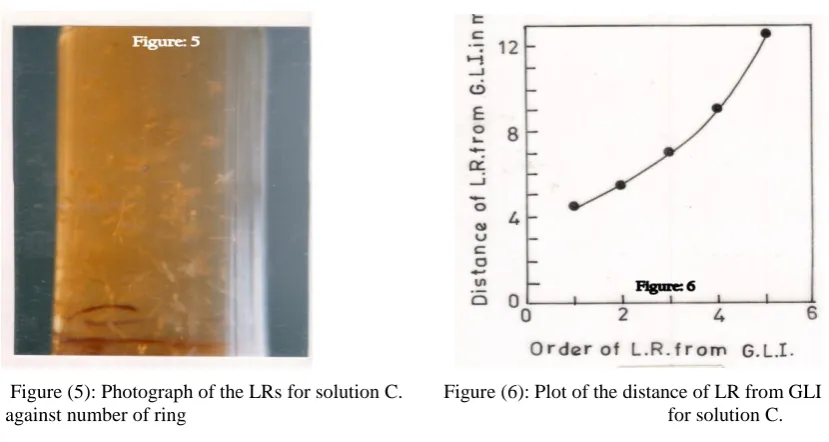
Figure 5 shows the photograph of the Liesegang rings developed within the gel column in the case of supernatant solution C, which contains 1M CaCl2 plus Lemon juice solution. Growth of some tiny spherulitic crystals was observed
in the case of supernatant solution C containing 1M CaCl2 plus lemon juice as seen in the figure 5.
Figures 6 shows plot of distance of Liesegang ring from gel liquid interface (G.L.I.) against number of the rings in the case of supernatant solution C which contains 1M CaCl2 plus lemon juice solution. One can notice that, the numbers of
Liesegang rings decreased in this case with compared to case A and B, but nature of the plot is same as in the case of supernatant solution A and B. Therefore, it can be concluded that the lemon juice also hinder the development of Liesegang rings.
Figure (5): Photograph of the LRs for solution C. Figure (6): Plot of the distance of LR from GLI against number of ring for solution C.
Whereas in the case of supernatant solution C containing CaCl2 plus lemon juice solution, the crystals were of
snowflake shapes. The size of crystals reduced progressively from 18 mm to 15 mm and 6 mm for pure CaCl2; CaCl2
plus barley water solution and CaCl2 plus lemon juice solution. The separate paper has already been published on this,
so detailed discussion is omitted here [23].
No crystals were grown inside the gel in the case of citric acid. However in the case of tartaric acid prismatic transparent crystals inside the liquid at the gel- liquid interface were observed. An independent research paper has published so exhaustive discussion is excluded here [24].
IV. CONCLUSION
The formations of Liesegang rings and their periodicity are according to the theory suggested by Henisch and Garcia-Ruiz. The addition of different inhibitive solutions in the supernatant solution reduces the number of Liesegang rings and the size of grown crystals of CHP. Some additive solutions completely inhibit the formation of Liesegang rings and the growth of crystals.
ACKNOWLEDGEMENT
Author is thankful to Prof. M.J. Joshi, Department of Physics, Saurashtra University, Rajkot. Author is also thankful to Petlad Education Trust for encouragement.
REFERENCES
[1] Henisch, H.K., “Periodic Precipitation”, Pergamon Press, pp. 1-4, 1991.
[2] Vyˇsinka M., Mizusawa M. and Sakurai K., “Growth and Characteristics of Liesegang Rings in Cu–Cr System: Optical and XRF Study” WDS'11 Proceedings
of Contributed Papers, Part III, (2011) 147–154. (ISBN: 978-80-7378-186-6 © MATFYZPRESS).
[3] Cartwright J.H.E., García-Ruiz J.M. and Villacampa A. I., “Pattern formation in crystal growth: Liesegang rings”Computer Physics Communications, Vol. 121–122, pp. 411–413, 1999.
[4] García-Ruiz, J.M., Rondón, D., García-Romero, A., Otálora, F., Journal of Physics Chemistry, Vol.100, pp. 8854–8860, 1996.
[5] García-Ruiz, J.M., Villacampa, A.I., “Synthesis of a new hydroxyapatite-silica composite material”,Journal of Crystal Growth, Vol. 211, issue: 1-4, pp. 111 – 115, 2000
[6] Dee, G.T., “Patterns Produced by Precipitation at a Moving Reaction Front”, Physical Review Letters, Vol. 57, issue 3, pp. 275, 1986.
[7] Van, M.E. Le and Ross, J., Journal of Physics Chemistry, Vol. 91, pp. 6300–6308, 1987.
[8] Banu SÍS, Tülay CANDA, Ömer HARMANCIOĞLU, “Liesegang Rings in Breast Tissue: An Unusual Component of a Foreign Body Reaction”, Turkish
Journal of Medical Sciences, Vo. 34, pp. 191-193, 2004.
[9] Kumar, N., Jain, S., “Liesegang rings in cytologic samples accompanied by calcium oxalate-like crystals. A report of three cases”, Acta Cytologica, Vol. 44, no. 3, pp. 429-432, 2000.
[10] Raso, D.S., Greene, W.B., Finley, J.L., Silverman, J.F., “Morphology and pathogenesis of Liesegang rings in cyst aspirates: Report of two cases with ancillary studies”, Diagnostic Cytopathology, Vol. 19, issue 2, pp. 116-119, 1998.
[11] Sneige N., Batsakis J.G., Hawkins R.A., Doble H.P., “Pseudo parasitic (Liesegang) bodies in paranasal sinus”, The Journal of Laryngology and Otology, Vol.
102, pp. 730-732, 1988.
[12] Shuko, F., S., Yoshihiro, M., Atsuko, F., Wei, Z., and Tsunehisa, A., “Effect of Microgravity on the Spatial Oscillation Behavior of Belousov−Zhabotinsky
Reactions Catalyzed by Ferroin”, Journal of Physical Chemistry A, Vol. 101 (43), pp. 7926–7928, 1997.
[13] Randall A.; “A Hypothesis for the Origin of Renal Calculus.” New England Journal of Medicine, Vol. 214, pp. 234-242, 1936.
[14] Vermotten, V., “Origin and development in renal papilla of Randall’s calcium plaques”, Journal of Urology, Vol.48, pp. 27-37, 1942.
[15] Girija, E.K., Kalkura, S.N. and Sivaraman, P.B., “Investigations on the crystalline components of urinary stones”, Proceedings of VII National Symposium on
Crystal Growth, pp.258-263, 1997.
[16] Srinivasan, N. and Natarajan, S., “Growth of some urinary crystals and studies on inhibitors and promoters I. Standardization of parameters for crystal growth and characterization of crystals”, Indian Journal of Physics, Vol. 70, pp. 563–568, 1996.
[17] Joshi, V. S. and Joshi, M. J., “FTIR Spectroscopic, Thermal and Growth Morphological Studies of Calcium Hydrogen Phosphate Dehydrate Crystal”, Crystals
Research and Technology, Vol. 38, pp. 817-821, 2003.
[18] Joseph, K.C. and Joshi, M.J., “The study of the different parameters affecting Liesegang rings formation during the growth of calcium hydrogen phosphate
dihydrate crystals.” Indian Journal of Physics, Vol. 76, pp.159-163, 2002. [19] Hatschek, E., Kolloid Zeitschriff, Vol. 8, pp. 13, 1911.
[20] Morse, W.H. and Pierce, G.W., Z. Phys. Chem., - Zeitschrift Fur Physikalische Chemie-International Journal of Research in Physical Chemistry and Chemical
Physics, Vol. 45, pp.589, 1903.
[21] Henisch, H.K. and García-Ruiz, J.M., “Crystal growth in gels and Liesegang ring formation: I. Diffusion relationships”. Journal of Crystal Growth, Vol. 75,
Issue 2, pp. 195-202, 1986.
[22] Henisch, H.K. and García-Ruiz, J.M., “Crystal growth in gels and Liesegang ring formation: II. Crystallization criteria and successive precipitation”., Journal of Crystal Growth, Vol. 75, Issue 2, pp. 203-211, 1986.
[23] Joshi, V. S. and Joshi, M. J., “The influence of Inhibition of Citric Acid and lemon Juice to the growth of Calcium Hydrogen Phosphate Dehydrate Urinary
Crystals”, Indian Journal of Pure and Applied Physics, Vol. 41, pp.183-192, 2003.