Experimental Analysis of Sound Absorption
Coefficient of the Combined Mechanism of
Enhanced Egg Carton, Gypsum Board and
Sound Diffuser
Avinash Kumar Ghilahare1, Mukesh Pandey2
P.G. Scholar, Department of Civil Engineering, ITM University, Gwalior, M.P., India1
Professor and Head, Department of Civil Engineering, ITM University, Gwalior, M.P., India2
ABSTRACT: Sound control is an important aspect of our society. There are a bunch of Articles mentioning the bad effects of noise pollution on health and society. Thereby high level of importance is given to provide a good and economical acoustical environment in a building. Apart from that acoustic also helps to an array and enhances the artistry of the music. Therefore it is also an important issue to satisfy the customers of concert halls, recording studios, and other entertainment industries. Nowadays Egg cartons are becoming a successful material for sound absorbers because of its quality of being regularly accessible, easy to setup and having a cost next to nothing. But, their capability is being questioned. There are few experiments that elaborate egg cartons is bad at sound absorption. To overcome its weakness certain types of improved egg cartons and Gypsum Boards are used. Aside from these two materials Sound diffuser is use. The sole purpose is to demonstrate the acoustical performance of this combine mechanism of Enhanced Egg Carton, Gypsum Board and Sound Diffuser by observing it Sound absorption coefficient reading on different frequency range from 125 Hz to 4000 Hz.
KEYWORDS: Enhanced Egg carton, Gypsum Board, Wooden plywood, sound absorption, sound diffuser, Frequency, sound absorption coefficient.
I. INTRODUCTION
Providing a quality Acoustic in an enclosed space is always being desirable for Engineers, Architect and if it comes with low cost than it becomes even more alluring. There are bunches of material available to provide a good acoustical solution in an enclosed space but only a few live up with the terms of both quality and cheapness. Egg cartons are always considered as one of this material by general people. It is considered as a good sound insulation and absorption material because of mainly three reasons first they are very easily available second they very cheap and third it is easy to install. However, their use as a good sound absorbing material is long being questioned by acoustical experts. One such expert named by Quintero Antonio[1] show in his experiment that egg cartons perform very poor in sound absorption test because its low sound absorption coefficient and so it inadvisable to use this misguided material for the purpose of improved acoustic in an enclosed room.
However, this enhanced Egg cartons are not good enough when its absorption coefficient is compared with Glass wool, Rock wool, Acoustical wedges and other Acoustical treatment material but when it comes to the term of carbon foot print and human health this egg carton are more suitable then other as this carton are made up of recycle paper and then blended to a pulp, therefore, they are eco-friendly in nature but lack the desirability of acoustical performance hence, an alternative solution is proposed where this Enhanced Egg Cartons are been combine with Gypsum Board to give better output.
Now, this Gypsum Board may be considered as an Environment-friendly acoustical solution as it can be recycled. Aside from that, they are rapidly constructed and the sound insulation is obtained with lower surface weights. But, these incompetent constructions lead to a considerable problem that is they are very inadequate for low frequencies (under 100 Hz). To overcome this problem few solution is proposed. One of this proposal is to increase the depth of the cavity between wall face and gypsum board face this solution is given by A.C.C.Warnock and J.D. Quirt [3]. And another solution is given by Raitis Brencis, Juris Skujans, UldisIljins [4] where they suggested this decrease of absorption coefficient value for lower frequencies can be prevented by placing rock wool behind the Gypsum board and wall face. So instead of rock wool, Enhanced Egg Cartons are used here. These Enhanced Egg Cartons are placed in the cavity between wall face and gypsum board face. Further Sound Diffuser made up of plywood is used to scattered sound waves evenly in all direction so that there is an in reducing in reverberation and echoes which ultimately improve sound clarity.
The objective of this work is to find out a good and economical acoustical solution of an enclosed space using the combination of Gypsum board, enhanced egg carton, and sound diffuser and compare its effectiveness with other Acoustical material. It is hoped that this research will conclude the debate surrounding the sound absorption performance of egg cartons and Gypsum Board.
II. LITERATURE REVIEW
2.1 Concept of Sound Transmission
Humans are very bound with the term Sound and use it all the time. We always rely on sounds to hear and communicate with each other. Now Sound is a form of energy which travels in form of wave. These waves are generated due to the vibration which accrued in a point of origin and then these waves propagate through a medium like air, water and solid. These vibrations create a sound pressure inconstancy which is identified by a receiver. When rapid vibrations take place, high note is heard and if slow vibration takes place, then the low note is heard. These Sound waves need a medium to propagate such as in solid, liquid, or gas medium.The vibrations created by pressure level transfer through every of those (solid, liquid and gas) mediums by traveling through its molecules. The molecules in solids are packed terribly tightly as compared to liquid and gas thereby Sound wave travels quicker in solids matter. That why when somebody drops the ball on the higher floor it's clearly sonic on the lower floor as compared to Lesson loud music in our neighbors.
2.2 Acoustical Terms and its concepts
2.2.1 Sound Absorption
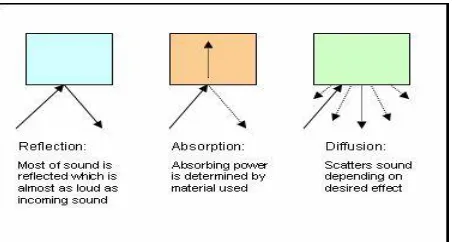
2.2.2 Sound Reflection
In Sound Reflection rather than the absorption of the undulation, they're mirrored back after they hit the reflective surface. Material like Concrete, block, wood, and metals, etc are some of commonly used Sound Reflector. This Reflective material solely bounces the Sound Waves in several directions.
2.2.3 Sound diffuser
The sound diffuser works otherwise as compared with Sound absorbent material and Reflector because during this method sound wave is scatter equally all told direction in an exceedingly given surroundings rather than being mirrored back.Diffusors (or diffusers) are used for the treatment unwanted sound issues in rooms like reverberation and echoes. They are considered as an honest alternative or complement material to sound absorption because this sound diffuser doesn't replicate or take away sound energy, however they're designed to scatter or disperse sound waves instead of eliminating it, so they reducing echoes and reverberation to enhance sound clarity.
2.2.4 Reverberation
Reverberation is outlined as the prolongation of acoustic wave when a sound is being introduced. The rationale behind it prevalence is that the reflection of acoustic waves from reflected surfaces and at that time this mirrored sound wave starts decay that's the sound is obtaining absorbed by the surfaces of objects within the house. It will prohibit communications and assist higher noise levels. Reverberation happens naturally once somebody tries to play associate instrument or tries to sing or speak in an exceedingly hall or performance house that has sound-reflective surfaces.
2.2.5 STC (Sound Transmission Class)
The Sound Transmission Class (STC) may be a mechanism design to grasp the potency of a fabric or construction assembly to restrain sound transmission. STC helps to tell a perceiver regarding what proportion loud transmitted sound is being listened on the opposite facet of a wall or ceiling. Material with higher STC values is simpler at reducing sound transmission.
2.2.6 Sound Absorption Coefficient
The sound coefficient is the quantitative relation between sound being absorbed by a fabric to the incident sound intensity and may be expressed as,
∝
=
Where,
“α = Sound absorption coefficient
IA = sound intensity absorbed (W/m2)
Ii = incident Sound intensity (W/m2)”
2.2.7 NRC (Noise Reduction Coefficients)
The NRC value is the average of the sound absorption coefficients at 250, 500, 1000 and 2000 hertz frequencies. This 250, 500, 1000 and 2000 hertz frequencies are four 1/3 octave frequencies.
2.3 Sound absorption of Enhanced Egg Cartons
Egg cartons are used to carry and hold Eggs temporarily. Egg cartons have groove or dimple in it where Eggs are held. They are made from recycled paper where various used papers are collected and then mixed with water, blended to a pulp, molded and finally dried to make egg carton. This recycled paper pulp forms the light; micro-porous cartons approximately 2-mm thick. The micro-pores give the egg cartons the potential to absorb sound energy. They are lightweight approximately 70gm per piece.
The acoustic performance of egg cartons has long been questioned. In most studies, it's found that Egg cartons is a neither sensible sound insulators nor a sensible sound absorbers. However, Kassim and Goh [5] using a non-standardized test method, where they found that rock wool filled egg cartons can block 14.42% of low frequencies, 13.01% of medium frequencies and 17.71% of high frequencies. This study may be seen as an initial indication that if combined with other sound absorbing materials like Rock wool it can be used as a good acoustical material. In this experiment instead of Rock wool recycle material like shredded rice straw paper and textile waste is filled to enhance it overall NCR value. With PrasastoSatwiko, VerzaDillanoGharata, HerybertSetyabudi and FefenSuhedi [2] successful experiment it is shown that Enhanced Egg Cartons filled with recycling material like shredded rice straw paper and textile waste can absorb more than 50% of sound energy from 315 to 2500 Hz or in the lower mid-range to Upper mid range frequencies. And it is hoped that it provides same results or even better results in this experiment.
2.4 Sound absorption of Gypsum Board
Gypsum board is a universal material for the purpose of interior surface treatment in modern buildings construction. The absorption coefficients measured in octave bands for Gypsum board provided by ACOUSTICAL SURFACES, INC. [5] are as follow:
Frequency (Hz ) Sound absorption coefficient ( α )
125 29/100
250 10/100
500 05/100
1000 04/100
2000 07/100
It is clear with this data that they have the weakness for midrange frequency to higher range frequency. Apart from that, due to its lower surface weights, they are very unsuitable for low frequencies (under 100 Hz). To overcome this drawback the depth of the cavity between wall face and wallboard face is increased and Enhanced Egg Cartons are placed within the cavity between wall face and wallboard face. It is assumed that by doing this combine experiment great acoustical solutions will come up. It is hoped that this research will conclude the debate surrounding the sound absorption performance of sustainable and economical material like Egg Cartons and Gypsum Board.
III.RESEARCHMETHOD
This Research study is based on both a literature and an experimental method. Where literature review scrutinizes various aspect of different Acoustical terms and also explore various advantages and disadvantages of egg cartons and Gypsum Board as sound absorbing material. And in experiment both Egg Cartons and Gypsum Board are being combined to give better results as these materials are separately not good enough as Sound Absorber.
3.1 Experiment Strategy
The impact of improved Egg Cartons on the sound absorption properties of Gypsum board were tested in a controlled room.
Testing was performed to know Sound absorption coefficient at four 1/3 octave frequencies for each of following stages in following sequence:
1.
Empty room without any Acoustical aid.2.
Adding Enhanced Egg Cartons on all the wall faces of room.3.
Applying one layer of Gypsum Board over Enhanced Egg Cartons.4.
And finally adding plywood Sound Diffuser over Gypsum Board wall surface.3.2 Facility
3.2.1 Experimental Room
3.2.2Enhanced Egg Cartons
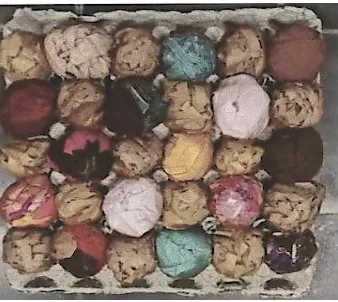
To Enhance Egg Cartons small net bags made up of 50% textile waste and 50% of shredded rice straw paper. These small net bags were infusing with egg cartons by filling net bags into the cavities between egg cartons. Over it another Egg Carton is placed and was attached to each other on their undersides. The Enhanced egg cartons contained shredded rice straw paper and textile waste at a ratio of 1:1.
3.2.3Sound Diffuser
After applying Gypsum Board over the surface of Wooden penal and Enhanced egg carton 4 Sound Diffuser is placed in center of every Gypsum Board wall face. Dimension of each Sound diffuser is 1 square feet.
Figure 2.Experiments room provided with wooden panel parallel to the wall face Figure 3.Providing perpendicular wooden panel to the wall face
3.2.4 Apparatus
1. To generate sound a SPL Sound meter Application is used which is run for five minutes at each frequency level from: 125, 250, 500, 1000, 2000, and 4000 hertz. This SPL Sound meter Application is installed in a mobile and the mobile is plugged into an amplifying speaker.
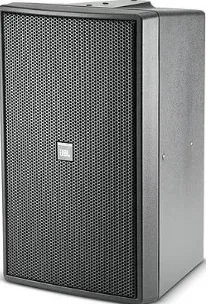
2. To amplify this frequency level one standard stereo speaker is used which has power capacity of 300 watt, 8 ohm impedance, 90 dB sensitivity and frequency response 37 Hz to18 kHz (-10 dB).
Figure 6.Wooden Sound Diffuser
Figure 7:SPL Sound Meter Application
3. For SPL (Sound Pressure Level) measurement a sensitive Condenser Microphone is used which is plugged into a computer.
4. For SPL recording software that contain a built in VU (Volume Unit) meter is used and operated from computer. Computer is operated from outside the Experiment Room.
3.2.5 Experimental Procedure
1.
In the experiment room (without providing any acoustics) generate 125 Hz frequency by SPL meter app and amplifying it by turning on the stereo speaker.2.
Record the SPL sensitivity by Condenser Microphone and measure it recording software that contain a built in VU meter.3.
Measure sound level and take 3 readings.4.
Calculate the average sound level.5.
Determine the constant (C) of sound reduction, using the subsequent formula given in Decibel Drop and Noise Reduction Coefficients for Material Combinations [6] := 1
−
10
Where,
d = the decibel drop reading obtained by calculating the average of measured Sound level.
7. Again repeat steps 1 to 5 for the experiment room provided with Gypsum Board over it.
8. And finally repeat steps 1 to 5 after applying Sound Diffuser over Gypsum Board
.
IV.RESULTS&DISCUSSION
4.1 Sound Pressure Level
The 1/3-octave band sound pressure level measurements for each of the following stages are presented below:
4.2 Sound Absorption Coefficient
Sound absorption coefficient for the following sound pressure level of the 1/3-octave band is calculated by using the
formula. :
= 1
−
10
Where,
d = the decibel drop reading obtained by calculating the average of measured Sound level. Different Stages in Experiment room Frequency (Hertz)
125 250 500 1000 2000 4000
Empty room without acoustics 89.30 91.20 92.40 95.30 93.70 94.20
Enhance Egg Carton over the wall 88.67 87.86 81.65 85.41 86.17 87.27
Gypsum Board over Enhanced Egg
Carton 86.08 86.17 73.99 80.41 82.33 84.03
Plywood Sound Diffuser over Gypsum
Board 84.11 79.83 71.49 72.21 79.28 80.65
Now, for calculation lets take SPL value of Enhanced Egg Cartons over the wall at 125 Hz that is88.9 dB to calculate“d” subtract the drop decibel value from initial value that is
d = 89.3 - 88.67= 0.63 dB
Put the value of d in
= 1
−
10
Then,
c = 0.07
Therefore, the Sound absorption coefficient for SPL value (88.67 dB) is 0.07
Similarly for different SPL values for 1/3-octave band of the following stages are presented below:
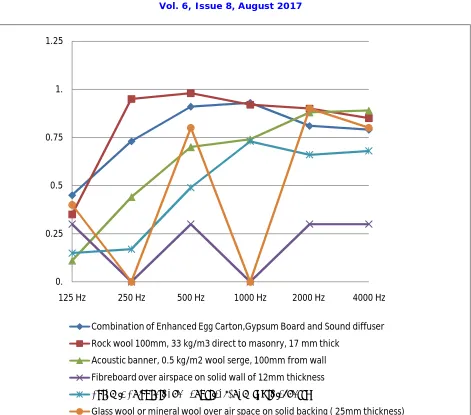
Different Stages in Experiment room Sound Absorption Coefficient in different frequency (Hertz)
125 250 500 1000 2000 4000
Empty room without acoustics 0.02 0.03 0.03 0.03 0.04 0.07
Enhance Egg Carton over the wall 0.07 0.32 0.71 0.68 0.58 0.55
Gypsum Board over Enhanced Egg
Carton 0.31 0.44 0.88 0.82 0.73 0.69
Plywood Sound Diffuser over Gypsum
Board 0.45 0.73 0.91 0.93 0.81 0.79
It is clear from the above data that the introduced Enhance technique of the combination of Enhanced Egg Carton, Gypsum Board and Sound Diffuser has a good Sound Absorption Coefficient for 1/3-octave band. Thus by placing Enhanced Egg Cartons in the cavity between wall face and gypsum board face and adding Plywood Sound Diffuser over Gypsum Board substantially help in increasing overall Acoustic profile.
It is clearly shown in Figure that the combine mechanism of Enhanced Egg Carton, Gypsum Board and Sound Diffuser perform better than other commercial used Acoustic material except from Rock wool. However the estimated cost of 50 mm x 1200 mm x 600 mm of Rock Wool of Pack of 8 Slabs is £20.75. Its price is very heigh when it compare with the combine mechanism of Enhanced Egg Carton, Gypsum Board and Sound Diffuser. Thus from an acoustic as well as economical point of view it can be considered a suitable replacement of Rock Wool and other commercially used Acoustic material.
Apart from this Sound absorption coefficient fact this experiments highlight some other facts, as well, which are explain as follows:
1. Enhanced Egg Carton could easily be made using tools available at home, such as scissors, knives, adhesive
0. 0.25 0.5 0.75 1. 1.25
125 Hz 250 Hz 500 Hz 1000 Hz 2000 Hz 4000 Hz
Combination of Enhanced Egg Carton,Gypsum Board and Sound diffuser Rock wool 100mm, 33 kg/m3 direct to masonry, 17 mm thick
Acoustic banner, 0.5 kg/m2 wool serge, 100mm from wall Fibreboard over airspace on solid wall of 12mm thickness
Pyramid Polyurethane Acoustical Foam (2″ thickness)
Glass wool or mineral wool over air space on solid backing ( 25mm thickness)
Figure 11:Comparison of combine mechanism of Enhanced Egg Carton, Gypsum Board and Sound Diffuser with other commercial
2. Enhanced Egg Carton requires some extra time to install textile waste and shredded rice straw paper into small bags. It took approximately 5 min to 6 min to make one Enhanced Egg Carton module.
3. Enhanced Egg Carton was not tested for fire protection and fire hazards. Because of its chemical composition their recycled materials may easily burned. A fire-resistant substance can be applied, but it will add to the cost.
4. Enhanced Egg Carton requires lots of time in its installation in wall face. It takes hours to stick up in wall with huge amount of adhesive gel. It take approximately 3 hrs and 5 packet of 1 kg adhesive gel to paste it on one face of wall.
5. Nailing and screwing of Gypsum Board over the surface of Wooden panels is very easy and quick. Nails are screwed in a staggered manner this provide an extra grip and support between Gypsum Board and Wooden panels.
6. Because of Sound diffuser unwanted sound problems in rooms such as reverberation and echoes are being treated well.
7. Overall NCR value of this experiment is 0.84.
8. Because Enhanced Egg Cartons are placed in the cavity between wall face and gypsum board face it cannot be damage by normal impact.
9. In terms of cost, this combine mechanism of Enhanced Egg Carton, Gypsum Board and Sound Diffuser have a much lower cost than other commercially used Acoustic material.
V. CONCLUSION
With the study of this mix mechanism of Enhanced Egg Carton, plasterboard and Sound Diffuse it's proven that the use of free or cheap recycled materials like cut rice straw paper and textile waste once mix with Egg Carton then they are often helpful as an honest Sound absorbent. It is observe that only Enhanced Egg Carton can increase absorption for more than 50% from 250 to 4000 Hz or in the lower mid-range to upper mid-range frequencies. After combining Gypsum Board over it this value increase from 50% to 65% absorption of sound energy and finally when Plywood Sound Diffuser is added it value increase up to 79%. Thus, it is very effective as Sound Absorption material as it can increase absorption for more than 79%. Now from figure 2 it is clear that this combine mechanism of Enhanced Egg Carton, Gypsum Board and Sound Diffuser perform better than other commercial used Acoustic material in term of both performance wise and cost wise. Although this study show that this experiment requires lots of time in its installation in wall face and not protective against any fire hazards but the results of Sound Absorption Coefficient is promising for 1/3-octave band.
However, to form it sensible, additional analysis into the hearth safety, endurance and aesthetics problems with this mix mechanism of Enhanced Egg Carton, Gypsum board and Sound Diffuser is required to be done. This experiment is also specifically promising from the point of view of its suitability as an Eco-friendly material, so further research involving the analysis of various alternate recycled materials is to be conducted.
REFERENCES
1. Antonio QR.,Measurement of the sound-absorption coefficient on egg cartons using the tone burst method,In: Proceedings of the 11th WSEAS
international conference on Acoustics & music: theory & applications, Iasi, 13–15 June 2010.
2. PrasastoSatwiko, VerzaDillanoGharata, HerybertSetyabudi and FefenSuhedi, Enhancingegg cartons’ sound absorption coefficient
3. A. C. C. Warnock and J. D. Quirt,Control of Sound Transmission through Gypsum Board Walls, National Research Council of Canada, January 1997 ISSN 1206-1220
4. Raitis Brencis, Juris Skujans, UldisIljins, Acoustic and Mechanical properties of foam Gypsum Decorative Ceiling Panels, 4International
Conference CIVIL ENGINEERING 13 Proceedings Part I CONSTRUCTION AND MATERIALS.
5. The absorption coefficients measured in octave bands for Gypsum board [online] Available at: https://www.acousticalsurfaces.com
6. Decibel Drop and Noise Reduction Coefficients for Material Combinations [online] Available at
:https://www.thermaxxjackets.com/noise-reduction-coefficients-and-decibel-drop
7. Kassim U and Goh J, Recycle materials as Industrialised Building System (IBS) internal partition , J Built Environ Technol Eng 2016; 1: 330–
334.
8. Kassim U and Goh J, Standard test method for laboratory measurement of airborne sound transmission loss of building partitions and elements,
West Conshohocken, PA: ASTM International, 2016.
9. Kassim U and Goh J. Acoustic myths & realities: can egg carton be used as an acoustical treatment? Available at:
http://www.acousticsfirst.com/eggc.htm (accessed 20 November 2016).
10. Asdrubali F, Schiavoni S and Horoshenkov KV, A review of sustainable materials for acoustic,, Build Acoust 2012; 19(4): 283–310.
11. Ravandi M, Mardi H, Langari A, et al,A review on the acoustical properties of natural and synthetic noise absorbent, Open Access Lib J 2015;
2: 1–11.
12. Carvalho APO, Sound absorption of egg boxes and trays, In: Proceedings of internoise 2015, San Francisco, CA, 9–12 August 2015.
13. James Shriver, Acoustical Insulation Density and its role in Acoustical Performance, Available at: https://www.thermafiber.com
14. IlhemNaghmouchi, Frances X.Espinach, R. Del Rey, J. Alba, Sami Boufi and Pere Mutje, Comparison of the soundproofing characteristics of
Olive stone filled Polypropylene, Gypsum Board and Wood Fiber reinforced Polypropylene, Cellulose Chem. Technol., 50(3-4), 411-415(2016)
15. J. Picaut; H. HossamEldien; A. Billon , An Experimental Study of the use of Acoustic Diffuser to reduce Noise in Urban Areas ,
INTERNOISE 2010 JUNE 13-16 LISBON PORTUGAL Available at: https://www.internoise 2010.org
16. Absorbers / Diffusers / Barriers / Isolators [online] Available at: http://www.acousticsfirst.com/acoustics-first-products-overview.htm
17. M. Ramesh Kumar, P.S Alagisamy, M. Sakhtivel, ArunMahalingam and B V A Rao, A REVIEV OF BUILDING ACOUSTIC MATERIALS,
ACOUSTIS2013NEWDELHI,, New Delhi, India, November 10-15, 2013
18. Timothy Gerard Hawkins , STUDIES AND RESEARCH REGARDING SOUND REDUCTION MATERIALS WITH THE PURPOSE OF
REDUCING SOUND POLLUTION, A Thesis presented to the California Polytechnic State University, San Luis Obispo in April 2014
19. Scotty John Wertel , EXPERIMENTAL ANALYSIS OF NOISE REDUCTION PROPERTIES OF SOUND ABSORBING FOAM, A Research
Paper Submitted in The Graduate College University of Wisconsin-Stout May, 2000