ISSN(Online): 2319-8753 ISSN (Print): 2347-6710
I
nternational
J
ournal of
I
nnovative
R
esearch in
S
cience,
E
ngineering and
T
echnology
(A High Impact Factor & UGC Approved Journal)
Website: www.ijirset.com
Vol. 6, Issue 8, August 2017
Protecting Wireless Medical Sensor Data from
Inside Attackers through Data Collection
Protocol
N. Naveen Kumar1, Punna Shilpa2
Assistant Professor, Department of CSE, School of Information Technology (JNTUH), Village KPHB, Mandal
Kukatpally, District Medchal, Telangana, India1
M. Tech Student, Department of CSE, School of Information Technology (JNTUH), Village KPHB, Mandal
Kukatpally, District Medchal, Telangana, India2
ABSTRACT Recently, the utilization of Wireless sensor Network (WSN) in health care applications is growing quickly as a result of it's got many benefits over the standard wired systems like easy use, reduced risk of infections, reduced risk of failures, reduced user discomfort and it provides increased quality, however providing security and privacy could be a major concern. There are many solutions so as to guard the patient information throughout transmission, however it cannot stop the within attacker from revealing the patient sensitive information. The within attacker is a patient information administrator. the most aim of this paper is to stop the within attack by distributing the patient information firmly in multiple servers and to use the Paillier cryptosystem to carry out statistic analysis on the patient information while not compromising the privacy of the patient’s information.
KEYWORDS: Wireless Sensor Network, Paillier Cryptosystem
I. INTRODUCTION
ISSN(Online): 2319-8753 ISSN (Print): 2347-6710
I
nternational
J
ournal of
I
nnovative
R
esearch in
S
cience,
E
ngineering and
T
echnology
(A High Impact Factor & UGC Approved Journal)
Website: www.ijirset.com
Vol. 6, Issue 8, August 2017
transmission, nodes quality, detection of event delivery of information in time, power management, etc. Deploying new technologies in care applications while not considering security typically makes patient privacy vulnerable; as an example, the patient’s physiological important signals are very sensitive that the leakage of the patient’s diseased information may makes the patient embarrassed. Generally revealing disease data will create it not possible for them to get insurance protection and additionally lead to someone losing their job. Further, wireless medical device networks cover a broad varies of care applications, like physiological information monitoring, activity monitoring in health-clubs, location tracking for athlete are the broad vary of care applications. WMSNs share individual information with physicians and insurance corporations. So unauthorized collection and use of patient information by adversaries will cause grave risks to the patient and create the patient’s personal matters in public available. As an example, an easy state of affairs, a patient’s body sensors transmit the body information to a nurse; the patient’s privacy is broken once some aggressor is overhang dropping. Later that attacker will post the patient information on social web site and create risks to the patient’s privacy. so wireless care can give several benefits to patient monitoring, however the medical health information of a private are highly vulnerable to various threats, therefore security and privacy become a number of the big issues for care applications, once it involves adopting wireless technology. A healthcare supplier is subjected to strict civil and criminal penalties if insurance portability and responsibility Act rules don't seem to be followed properly. So the safety and privacy of the sensed information is that the major concern in care applications.
II. RELATEDWORK
ISSN(Online): 2319-8753 ISSN (Print): 2347-6710
I
nternational
J
ournal of
I
nnovative
R
esearch in
S
cience,
E
ngineering and
T
echnology
(A High Impact Factor & UGC Approved Journal)
Website: www.ijirset.com
Vol. 6, Issue 8, August 2017
III. FRAMEWORK
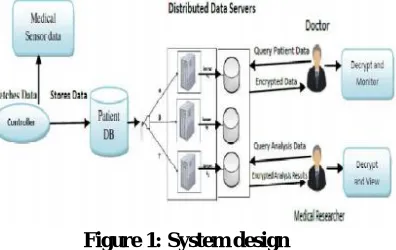
This paper proposes an approach that provides high finish security for the patient’s sensitive physiological information and assures most privacy for the patients. This approach deals with the protection of information by using a cryptography mechanism known as Paillier cryptosystem that includes a distinctive homomorphic property of manufacturing the total of plaintexts whereas encrypting the merchandise of cipher texts. This mechanism is an important approach during this projected system. The design of projected methodology is shown in Figure one.
Figure 1: System design
Figure 1: System design the most focus of the projected system is securing the remote medical sensor data and acting applied math analysis on the received information. This technique makes use of 3 data servers to method the patients’ physiological information received from the bio sensors and stores the info in their various face databases for more query process. Like different tending applications, the projected system has four parts as follows. A wireless medical device network information server that stores the complete patient’s health information that's received from the medical sensors and forwards the patient information to the patient’s information system; The information system of patients that is responsible to store the patient records and provides services for doctors or medical researchers to query the patient info system; an information access system for patients, that is used by the doctor to achieve access to the patient health records and endlessly monitor the patients remotely. An information analysis system for patients, to be employed by the medical scientist to perform applied math analysis on the patients’ information;
A. Data Collection Protocol
This is the primary readying innovate the projected system that is between the medical device information server and therefore the 3 knowledge servers that is handled by the controller. Here the 3 completely different secret keys are hardcoded into the 3 servers and within the controller system to transmit information securely. The controller splits the patient information (e.g., temperature reading) into 3 random elements exploitation the Split data rule and sends to a few information servers by encrypting with secret key based mostly AES rule. the initial worth of patient information ρ is split into 3 elements as, ρ = α + β + ϒit shows that the initial worth is split into 3 elements α, β, ϒ specified their total equals the initial worth. This split part are 1st decrypted and keep by 3 information servers in their various databases. Here, SHA-3 hashing technique is employed to ascertain the authentication of the user.
B. Access control Protocol
This section is an initialization part before the doctors may gain access to the patient’s physiological information. during this section, 1st the general public and secret keys are generated for Paillier cryptosystem mechanism and Digital Signature rule is employed for making digital signatures to verify whether or not the doctor has the authority to achieve access to the patient information. Once the doctor queries the patient information, he has got to 1st submit his digital signature to the 3 data servers. The servers can verify the signatures and checks for the access management policies of the doctor. If he's authorized then server SR1 picks a random worth r1 happiness to the set of integers and
encrypts the split worth α using Paillier encryption and sends C1 to information server SR2. The data server SR2 picks
a random worth r2 belonging to the set of integers and encrypts the split worth β Paillier encryption and sends the
ISSN(Online): 2319-8753 ISSN (Print): 2347-6710
I
nternational
J
ournal of
I
nnovative
R
esearch in
S
cience,
E
ngineering and
T
echnology
(A High Impact Factor & UGC Approved Journal)
Website: www.ijirset.com
Vol. 6, Issue 8, August 2017
doctor will decrypt the information and acquire the worth ρ = α + β + ϒwherever ρ is that the original patient health
attribute value.
C. statistical Analysis Protocol
This section is used by the medical researchers who need to get the analysis results only. Varied analyses are performed like average analysis, variance analysis, correlation analysis and regression analysis. The medical researcher should 1st generate a digital signature and submit a question on that analysis he desires the servers to perform. When the 3 information servers receive the request, they 1st check for the authentication of the medical scientist and his access management policies. If the researcher is allowed, the 3 servers join forces to perform computations on the patient information and code the info exploitation Paillier secret writing theme as shown before and forward them to the researchers. When receiving the statistical analysis results, the scientist decrypts the information and views the analysis results.
IV. EXPERIMENTAL RESULTS
The planned technique is predicted to secure the patient physiological information throughout transmission and this solution is secure although 2 of the 3 information servers are compromised by the individual. That is, as long collectively of the 3 servers isn't compromised, the projected system assures high end security to the patients. In any of the server application, define access to login as admin and then create the users. The communications between the medical sensors and the three servers; the communications between the user (e.g., physicians or medical professional) and three servers; the communications among the three servers;
Add the users of access type either patient information retrieval or average analysis protocol. PIR will retrieve the specified patient information as shown below.
ISSN(Online): 2319-8753 ISSN (Print): 2347-6710
I
nternational
J
ournal of
I
nnovative
R
esearch in
S
cience,
E
ngineering and
T
echnology
(A High Impact Factor & UGC Approved Journal)
Website: www.ijirset.com
Vol. 6, Issue 8, August 2017
V. CONCLUSION
We have surveyed differing kinds of security technique to secure the wireless medical sensor information. Here, we additionally planned the Paillier cryptosystem and ElGamal cryptosystem to encoding and coding of information. Planned resolution will preserve the patient information privacy as long together of 3 data server isn't compromised. Additionally needs that the amount of the compromised information servers is at the most one.
REFERENCES
[1] Advanced encryption standard (AES). (2001, Nov. 26). FIPS PUB 197 [Online]. Available: http://csrc.nist.gov/publications/fips/ fips197/fips-197.pdf
[2] P. Belsis and G. Pantziou, “A k-anonymity privacy-preserving approach in wireless medical monitoring environments,” J. Personal Ubiquitous Comput., vol. 18, no. 1, pp. 61–74, 2014.
[3] D. Bogdanov, S. Laur, and J. Willemson, “Sharemind: A framework for fast privacy-preserving computations,” in Proc. 13th Eur. Symp. Res. Comput. Security, 2008, pp. 192–206.
[4] R. Chakravorty, “A programmable service architecture for mobile medical care,” in Proc. 4th Annu. IEEE Int. Conf. Pervasive Comput. Commun. Workshop, Pisa, Italy, Mar. 13–17, 2006, pp. 532–536.
[5] Crypto++ 5.6.0 Benchmarks [Online]. Available: http://www. cryptopp.com/benchmarks.html, 2009.
[6] J. Daemen, G. Bertoni, M. Peeters, and G. V. Assche. (2012, Jul. 6). Permutation-based encryption, authentication and authenticated encryption. Proc. Directions Authenticated Ciphers, Stockholm, Sweden [Online]. Available: http://www.hyperelliptic.org/DIAC/ slides/PermutationDIAC2012.pdf
[7] S. Dagtas, G. Pekhteryev, Z. Sahinoglu, H. Cam, and N. Challa, “Real-Time and secure wireless health monitoring,” Int. J. Telemed. Appl., pp. 1–10, Jan. 2008.
[8] W. Diffie and M. Hellman, “New directions in cryptography,” IEEE Trans. Inf. Theory, vol. IT-22, no. 6, pp. 644–654, Nov. 1976.
[9] (2013, Jul.). Digital signature standard (DSS). FIPS PUB 186-4 [Online]. Available: http://nvlpubs.nist.gov/nistpubs/FIPS/ NIST.FIPS.186-4.pdf