DOI: 10.1534/genetics.104.029371
Allelic and Haplotypic Diversity at the
Rp1
Rust Resistance Locus of Maize
Shavannor M. Smith,* Anthony J. Pryor
†and Scot H. Hulbert*
,1*Department of Plant Pathology, Kansas State University, Manhattan, Kansas 66506 and†Commomwealth Scientific and
Industrial Research Organization, Canberra, Australian Capital Territory 2601, Australia Manuscript received March 27, 2004
Accepted for publication May 4, 2004
ABSTRACT
The maizeRp1rust resistance locus is a complex consisting of a family of closely related resistance genes. The number ofRp1 paralogs in different maize lines (haplotypes) varied from a single gene in some stocks of the inbred A188 to⬎50 genes in haplotypes carrying theRp1-Aand Rp1-Hspecificities. The sequences of paralogs in unrelated haplotypes differ, indicating that the genetic diversity ofRp1-related genes is extremely broad in maize. Two unrelated haplotypes with five or nine paralogs had identical re-sistance phenotypes (Rp1-D) encoded in genes that differed by three nucleotides resulting in a single amino acid substitution. Genes in some haplotypes are more similar to each other than to any of the genes in other haplotypes indicating that they are evolving in a concerted fashion.
P
LANT genomes carry large numbers of genes that nature of genes in complex loci likeRp1andRp3(Sunet al. 2001;Webbet al. 2002) make it difficult to estimate control active defenses to pathogens. The largest class
of these disease resistance genes codes for proteins with gene number by gel blot analysis because of comigration of genes with similar restriction sites. Most haplotypes nucleotide binding site (NBS) and leucine-rich repeat
(LRR) domains (Meyerset al. 1999;Baiet al. 2002). Vari- that carry known Rp1genes appear to have roughly as many or more rp1 family members than the HRp1-D
ous NBS-LRR genes control resistances to fungi,
bacte-ria, viruses, nematodes, and insects (Bent1996;Baker haplotype, making it very difficult to identify the genes controlling the resistance. The resistance reactions of
et al. 1997;Hammond-KosackandJones1997;Elliset
al. 2000;Hulbertet al. 2001). some of the Rp1 near-isogenic lines are indistinguish-able with current collections of rust biotypes, indicating TheRp1rust resistance complex of maize consists of
a family of closely related NBS-LRR genes, which are that they carry phenotypically identicalRp1genes, even though they were originally identified in different germ-all tightly linked at theRp1locus (Collinset al. 1999).
These genes mispair extensively in meiosis, and recom- plasm sources. In some cases these lines have been shown by DNA gel blot analysis to carry very differentRp1 hap-bination events within the cluster while they are
mis-paired reassort the genes into new combinations or hap- lotypes, while in others the haplotypes appear identical (Collinset al. 1999).
lotypes. The best-characterizedRp1haplotype isHRp1-D,
which carries theRp1-Dgene along with eight paralogs This study was conducted to examine the differences betweenRp1haplotypes, in both gene number and gene (Sunet al. 2001). Transcripts were detected for five of
seven paralogs capable of coding for proteins similar diversity. The number ofRp1paralogs in haplotypes with a range of numbers ofRp1-homologous restriction frag-toRP1-D, with 91–99% amino acid identity. An eighth
paralog was predicted to code for a truncated protein ments was examined by sequencing PCR-amplified or directly cloned fragments of the genes. The haplotypes with no LRR. Other than theRp1-Dgene, which confers
race-specific rust resistance, no phenotype has been as- examined include pairs of haplotypes that appear unre-lated by gel blot analysis but carry genes that are pheno-sociated with the other genes in this haplotype.
Southern blot analysis of different maize lines has typically indistinguishable. The feasibility of using such pairs of haplotypes to identify the genes controlling the indicated that most lines carry differentRp1haplotypes.
The number of different restriction fragments homolo- resistance phenotype was examined. gous to anRp1probe varies from one or a few to more
than a dozen. The partially conserved, highly duplicated
MATERIALS AND METHODS
Amplification, cloning, and sequencing ofRp1genes:To sam-ple as manyRp1genes as possible from differentRp1 haplo-Sequence data from this article have been deposited with the
types, several PCR primers were designed from conserved re-EMBL/GenBank Data Libraries under accession nos. AY309779–
gions in the genes. Three primer pairs were used to amplify AY309783 and AY581258.
nearly completeRp1coding regions, as nonspecifically as pos-1Corresponding author:Department of Plant Pathology, 4024
Throck-sible (Table 1). The use of P6 with 4890R was used to amplify morton Plant Sciences Center, Kansas State University, Manhattan,
KS 66506-5502. E-mail: [email protected] ⵑ4-kb fragments that included nearly the whole coding
gion. In case this pair was unable to amplify certain sequences, Rp1 sequences. Neighbor-joining tree images were generated with the TreeView bioinformatics program (http://taxonomy. two other primers pairs were also used. The primer pair P6
and P15 amplified anⵑ2-kb fragment corresponding to most zoology.gla.ac.uk/rod/treeview.html). All parameters were set to default.
of the 5⬘half of the coding region of the genes. Primer pair
2290F and 4890R was used to amplify the 3⬘half of the genes. Isolation of an alteredRp1-Dgene from theCuzcohaplotype:
F1hybrids between maize lines homozygous forHRp1-D-Cuzco
Thirteen internal primers were used to sequence the coding
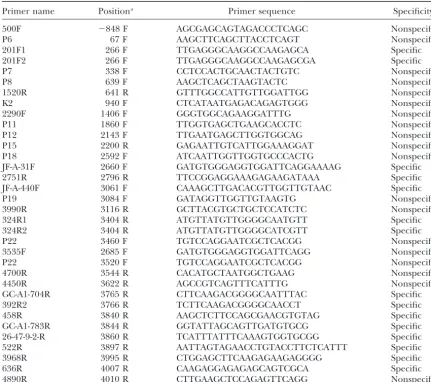
region of selected genes (P6, P7, P8, K2, 2290F, P11, P15, andHRp1-Iwere backcrossed by a susceptiblerp1line (H95) and 26,000 progeny were screened for variant phenotypes. P12, P18, 3990R, P19, 4450R, and P22; Table 1). To examine
the number of different genes in a haplotype without sequenc- Ten-day-old seedlings were inoculated simultaneously with a mixture of rust spores (biotypes IN1 and IN2) and placed in ing the whole coding region, a highly polymorphic region
(ⵑ835 bp) of the LRR was amplified using the primers 3535F high humidity for 12–15 hr. Both rust isolates are avirulent on lines carrying eitherRp1-DorRp1-I. Eight to 10 days following and 4700R.
A variety of more specific primers were made to search for inoculation, seedlings were scored using a resistance reaction rating scale of 0–4. A high level of resistance with no sporula-specific genes or recombinant genes in certain haplotypes
(Ta-ble 1). Specific primers were designed by aligning the gene’s tion was indicated by a 0 rating. A rating of 1 indicated a high level of resistance with one or a few uredinia per leaf. A rating sequence to all the genes from theHRp1-Dhaplotype and any
other available full-length sequences and searching for unique of 2 indicates a large number of uredinia with necrotic or chlorotic spots and a visible hypersensitive response. One indi-polymorphisms among the aligned sequences. Gene-specific
primers were typically paired with nonspecific primers in at- vidual with a rating of 2 was self-fertilized to generate a homo-zygous line (Rp1-D2I3), which was screened with rust biotypes tempts to amplify specific genes.
PCR amplification of genomic DNA templates was performed IN1, IN2, IN3, and HI1 separately to determine its race speci-ficity and confirm the altered phenotype.
using Enhanced DNA polymerase (Stratagene, La Jolla, CA)
withⵑ1 min of extension time for every kilobase of fragment To identify the variant gene, genomic DNA isolated from the Rp1-D2I3line was PCR amplified with a forward specific primer size. Optimal PCR parameters were followed as suggested by
the manufacturer. Total RNA isolation was performed on fully designed to match theRp1-Dgene (500F) and nonspecific re-verse primers (26-47-9-2-R, 2751R, and 3968R; Table 1). These expanded second leaves using GIBCO BRL (Rockville, MD)
Trizol reagent as described by the manufacturer. RT-PCR was primers amplified fragments up toⵑ4.4 kb that include the whole coding region and part of the promoter. The PCR prod-performed using a ProStar first-strand RT-PCR kit with optimal
ucts were purified, cloned, sequenced, and analyzed as de-RT-PCR conditions suggested by the manufacturer (Stratagene).
scribed above. Following first-strand synthesis with an oligo(dT) primer, one
primer pair (P12 and 3990R; Table 1) was used to amplify Rp1cDNA sequences. To distinguish between differentRp1
RESULTS genes, these primers were designed from regions that were
conserved among theRp1-Dparalogs and flank a polymorphic
Indistinguishable specificities in related and unrelated
region. These primers amplify anⵑ835-bp fragment. The PCR
haplotypes: Three sources ofRp1-Dwere identified by
products were gel purified and cloned into the Invitrogen
(Carlsbad, CA) TOPO TA cloning vector. Recombinant plas- Hooker and co-workers: the African cultivarsKitaleand
mids were prepared using the QIAGEN (Valencia, CA) mini- Njoroand the South American cultivar Cuzco( Wilkin-prep purification system. Clones were digested withEcoRI (New sonandHooker1968). When DNA from lines homozy-England Biolabs, Beverly, MA) and analyzed by agarose gel
gous for each of the three haplotypes was examined by
electrophoresis prior to sequencing. M13 forward and reverse
gel blot analysis, the lines derived from the African
ma-primers were used to fully sequence smaller fragments (835 bp)
or sequence the ends of larger clones, and selected clones terial appeared identical, but these appeared unrelated
were sequenced using primers from conserved regions of the to the line with theCuzcohaplotype. TheHRp1-D-Cuzco Rp1genes. All sequencing was performed at Kansas State Uni- haplotype consistently had fewer fragments when com-versity Sequencing Facility.
pared toHRp1-D. The previously characterizedHRp1-D,
DNA sequence analysis:Sequence alignment of each clone
originally from the African cultivarKitale, carried nine
(5⬘or 3⬘ends or entire coding regions) was done using the
rp1 paralogs (Sun et al. 2001). Gel blot hybridization
GCG Seqweb version 2 program or the BCM (//searchlauncher.
bcm.tmc.edu/), Basic Local Alignment Search Tool (http:// with a 1.5-kb probe representing the 5⬘half of the cod-www.ncbi.nlm.nih.gov/blast/). Only single clones were exam- ing region typically detects fewer than nine restriction ined for most of the genes from theRp1-A,Rp1-H, andRp1-JF
fragments because of comigration of similar size
frag-haplotypes. Although high-fidelity polymerases were used to
ments. The enzymeNsiI was exceptional in that it
pro-amplify the sequences, the potential for introduction of
se-duced nine restriction fragments, corresponding to
quence errors during PCR amplification of the genes could
not be ruled out. Therefore, polymorphic bases were scruti- each of the nine genes in the haplotype. In contrast,
nized by determining if otherRp1genes shared the polymor- only two fragments were detected inNsiI digests of the phisms. Polymorphic nucleotides that were unique to a single HRp1-D-Cuzcohaplotype. Similarly, only two fragments gene were considered to be possible sequence errors.
Alterna-were observed in restriction digests withSphI,XbaI, and
tively,informativepolymorphisms, where the polymorphic bases
EcoRV and three fragments were observed inNcoI and
were shared by different genes, were considered to provide
use-ful information for classifying the genes and estimating gene HindIII digests. Typically, some fragments hybridized
number. Only genes that differed for multiple informative nucle- more intensely than the others, indicating that there otide polymorphisms were considered to be unique genes. were probably more than two or three genes, but less
Bioinformatics programs:Clustal X bioinformatics program
than the previously characterizedHRp1-D.
was used for sequence alignment and bootstrap analysis (ftp://
The resistances conferred byRp1-AandRp1-Fare also
ftp-igbmc.u-strasbg.fr/pub/ClustalX/) of the predicted protein
Hul-Figure 2.—A neighbor-joining tree of the coding region ofRp1genes fromHRp1-D-CuzcoandHRp1-D-Kitale, generated using the predicted protein sequences of 13rp1genes. Num-bers at nodes represent the percentage (of 1000) of the time the genes cluster together in bootstrap analysis. The paralog designations -dp and -Cuscop indicate origins in the HRp1-D-KitaleandHRp1-D-Cuscohaplotypes. Uppercase locus desig-nations (Rp1) indicate a phenotypically detectable gene.
genes were amplified using the P12 and P15 primers
Figure1.—Gel blot analysis of DNAs isolated from related
and 9 clones of the 3⬘ half of the gene were isolated
and unrelatedRp1haplotypes. DNAs were digested withNcoI
using the 2290F and 4890R primers. Partial sequence
and probed with a probe corresponding to the 5⬘half of the
Rp1-Dcoding region.Rp1haplotypes with indistinguishable analysis of these clones showed that they corresponded
race specificities exhibited banding patterns that were either to previously cloned sequences, indicating that the five identical (HRp1-A and HRp1-F) or very different. Fragment
genes identified account for all theRp1genes in
HRp1-sizes in kilobases are shown on the left.
D-Cuzco. At least 1 full-length clone was completely se-quenced for each of these five genes.
The identification of only five different genes by
se-bertet al. 1991). Two different sources ofRp1-Awere
originally identified from the cultivars Golden Glow and quence analysis agreed with the gel blot analysis of gene number. No more than four restriction fragments were Golden King (HookerandLeRoux1957). The source
ofRp1-Fis P.I. 172332, from Australia. This latter gene observed in any enzyme digest. In digests such asNcoI andHindIII, three fragments were observed, but one hy-was originally given a differentRp1 allelic designation
because the resistance specificity appeared different, bridized more intensely than the others, suggesting that they probably represented two genes (Figure 2). The probably due to other factors in the genetic background
in which the genes were identified (HookerandRus- fiveHRp1-D-Cuzco genes were designatedrp1-Cuzcop1–
rp1-Cuzcop4(for paralogs 1–4) andRp1-D-Cuzco. The
lat-sell1962). When compared,HRp1-F and the two
hap-lotypes carryingRp1-Aall appeared identical by gel blot ter gene was determined to code for a functionalRp1-D
protein (see below). analysis (Figure 1).HRp1-J andHRp1-H have
indistin-guishable race specificities and resistance phenotypes Comparisons of theHRp1-DandHRp1-D-Cuzco haplo-types:In addition to differences inRp1 gene number, (Hulbert et al. 1991) but appeared unrelated by gel
blot analysis (Figure 1). theRp1-D-carrying haplotypes fromKitaleandCuzco dif-fered in several other respects. The previously
character-Isolation of genes from theHRp1-D-Cuzcohaplotype:
Rp1genes fromHRp1-D-Cuzcowere sequenced following izedKitalehaplotype carried nineRp1paralogs, one of which was truncated before the LRR coding region. No PCR amplification and cloning. Twenty different clones
carryingⵑ4-kb fragments from PCR products with the truncated members were identified inHRp1-D-Cuzcoby sequence analysis of PCR-amplified sequences or by hy-primers P6 and 4890R were partially sequenced.
Com-parison of these sequences indicated they corresponded bridization to gel blots of genomic DNA with probes from different regions of theRp1-Dgene. Depending on to five different genes. Additional conserved primer pairs
were used to amplify genes fromHRp1-D-Cuzcobecause the restriction enzyme used to cut the genomic DNA, probes from different regions of the gene hybridized to of the possibility that genes would be missed due to
tent with the idea that truncated genes are not required D-Cuzco) of the two genes with high sequence identity to the Rp1-D gene, the Rp1-D-Cuzco gene is the best forRp1-mediated resistance (Sunet al. 2001).
Another novel aspect ofHRp1-D-Cuzcois the fact that candidate for the gene conferring theRp1-Dresistance phenotype inHRp1-D-Cuzco.
two of the five genes are very similar in sequence
(Fig-ure 2). The genes in the previously characterizedHRp1-D A second approach to identifying the Rp1-D-Cuzco
gene with theRp1-Dphenotype was to identify a muta-fromKitalecapable of coding for NBS-LRR genes coded
for predicted amino acid sequences that ranged from tion or recombination event that altered the gene. A variant showing a reduced level of resistance was derived 88 to 94% identity in amino acid sequence. While the
least closely related genes inHRp1-D-Cuzcocoded for pre- from a testcross population of 26,000 individuals from anHRp1-I⫻HRp1-D-Cuzcocross. This variant specified dicted proteins only 89% identical to each other, two
of the genes in this haplotype were predicted to code for a reduced resistance reaction (reaction type 2) with bio-types IN1 and IN2 when compared to the parental lines, proteins that differed by only two amino acids (⬎99.5%
identity). which were both highly resistant (reaction type 0 or 0–1) to both isolates. The variant specified a resistance To determine the relationship and similarity between
the genes in these two haplotypes, the DNAs of the coding reaction of 2 and 4 (fully susceptible) with biotypes IN3 and HI1, respectively, while theRp1-Dparental line regions and their predicted amino acid sequences were
aligned. Only two of the genes fromHRp1-D-Cuzcoap- specified a resistance reaction of 0 and 4 and theRp1-I
parental line specified a resistance reaction of 4 and 0 peared similar to any of the genes inHRp1-D. TheRp1-D
gene from HRp1-D-Kitalewas identical to a gene from with biotypes IN3 and HI1, respectively. The variant line maintains the same resistance specificity as the Rp1-D HRp1-D-Cuzco (Rp1-D-Cuzco) except for three
nucleo-tides and different from the rp1-Cuzcop4 gene at only parent, resistant to IN1, IN2, and IN3, but not HI1. The variant line has a reduced level of resistance to the five nucleotides. The three nucleotide differences
be-tween the Rp1-D and Rp1-D-Cuzco genes resulted in a biotypes it is resistant to, typically showing a dozen or more uredinia per seedling leaf while Rp1-D-carrying single amino acid substitution. An aspartic acid in the
RP1-D protein at position 1064 in the LRR region is lines typically show none or a few. The putative modified
Rp1gene was designatedRp1-D2I3. A similar reduced re-changed to phenylalanine in the predicted protein
coded by Rp1-D-Cuzco. Nonsynonymous substitutions sistance variant (Rp1-D*5) was previously identified from
HRp1-D-Kitaleand was found to be derived from an intra-have been observed at this site in two other HRp1-D
genes (Sun et al. 2001). The other three genes in genic recombination event involving the Rp1-D gene (Sunet al. 2001). The similar phenotype of the HRp1-HRp1-D-Cuzco are only 86–89% identical to theRp1-D
gene but are more similar to each other. A neighbor- D2I3variant suggested that theRp1-Dgene from HRp1-D-Cuzco was involved. Therefore, HRp1-D2I3 genomic joining tree, generated using sequences representing
all of the genes fromHRp1-DandHRp1-D-Cuzco, showed DNA was PCR amplified with primers designed from regions conserved inRp1 genes (P6-4890R), which in-that two genes from HRp1-D-Cuzco form a group with
Rp1-D, while the three remaining genes form a second clude the entire coding region. Approximately 600 bp of the 5⬘and 3⬘ends of the resulting cloned PCR prod-group (Figure 2).
Identification of theRp1-Dgene inHRp1-D-Cuzcoand ucts were sequenced and aligned withHRp1-D-Cuzco para-logs for sequence comparisons. One of theHRp1-D2I3 the recombinantRp1-D2I3gene:The very high level of
sequence identity between two Rp1 genes from HRp1- clones did not completely match any of the genes from
HRp1-D-Cuzco. Sequences from this clone were identical
D-Cuzcoand theRp1-Dgene indicated that one or both
of these genes were possible candidates for the gene to theRp1-D-Cuzcogene on the 5⬘end but did not match
Rp1-D-Cuzcoor any of the other genes forHRp1-D-Cuzco
conferring the resistance phenotype. Two approaches
were used to determine which of the genes controls on the 3⬘end. This indicated the 3⬘end was contributed by anHRp1-Igene. To verify that this was actually a recom-the phenotype. Previous analysis withHRp1-DfromKitale
indicated some paralogs are not transcribed. To deter- binant gene and not a previously unidentified gene from
HRp1-D-Cuzco, genomic DNA from the putative recombi-mine whether or not theRp1-Dcandidates in theCuzco
haplotype are transcribed, cDNA isolated from HRp1- nant and the two parental haplotypes,HRp1-D-Cuzcoand
HRp1-I, were PCR amplified using a nonspecific forward
D-Cuzcoseedlings was amplified using the P12 and 3990R
primers (Table 1). These primers match sequences con- primer (P22) and a reverse gene-specific primer (26-47-9-2-R) designed to be specific to the 3⬘region of the
Rp1-served among all the genes in this haplotype and flank
polymorphic nucleotides. Sequence analysis of the re- D2I3putative recombinant gene (Table 1). The primer pair amplified a fragment of the expected size in the sulting 33 RT-PCR clones found that 27 clones matched
rp1-Cuzcop2and 6 clones matchedRp1-D-Cuzco. No RT- recombinant haplotype andHRp1-Ibut did not amplify from HRp1-D-Cuzco DNA, indicating that the putative PCR clones were found to match therp1-Cuzcop1,
rp1-Cuzcop3, andrp1-Cuzcop4genes, indicating that they ei- recombinant was not anHRp1-D-Cuzcogene. Sequence analysis of the specific PCR-amplified fragments from ther are not transcribed or are transcribed at lower
TABLE 1
Primers used to amplifyRp1sequences
Primer name Positiona Primer sequence Specificityb
500F ⫺848 F AGCGAGCAGTAGACCCTCAGC Nonspecific
P6 67 F AAGCTTCAGCTTACCTCAGT Nonspecific
201F1 266 F TTGAGGGCAAGGCCAAGAGCA Specific
201F2 266 F TTGAGGGCAAGGCCAAGAGCGA Specific
P7 338 F CCTCCACTGCAACTACTGTC Nonspecific
P8 639 F AAGCTCAGCTAAGTACTC Nonspecific
1520R 641 R GTTTGGCCATTGTTGGATTGG Nonspecific
K2 940 F CTCATAATGAGACAGAGTGGG Nonspecific
2290F 1406 F GGGTGGCAGAAGGATTTG Nonspecific
P11 1860 F TTGGTGAGCTGAAGCACCTC Nonspecific
P12 2143 F TTGAATGAGCTTGGTGGCAG Nonspecific
P15 2200 R GAGAATTGTCATTGGAAAGGAT Nonspecific
P18 2592 F ATCAATTGGTTGGTGCCCACTG Nonspecific
JF-A-31F 2660 F GATGTGGGAGGTGGATTCAGGAAAAG Specific
2751R 2796 R TTCCGGAGGAAAGAGAAGATAAA Specific
JF-A-440F 3061 F CAAAGCTTGACACGTTGGTTGTAAC Specific
P19 3084 F GATAGGTTGGTTGTAAGTG Nonspecific
3990R 3116 R GCTTACGTGCTGCTCCATCTC Nonspecific
324R1 3404 R ATGTTATGTTGGGGCAATGTT Specific
324R2 3404 R ATGTTATGTTGGGGCATCGTT Specific
P22 3460 F TGTCCAGGAATCGCTCACGG Nonspecific
3535F 2685 F GATGTGGGAGGTGGATTCAGG Nonspecific
P22 3520 F TGTCCAGGAATCGCTCACGG Nonspecific
4700R 3544 R CACATGCTAATGGCTGAAG Nonspecific
4450R 3622 R AGCCGTCAGTTTCATTTG Nonspecific
GC-A1-704R 3765 R CTTCAAGACGGGGCAATTTAC Specific
392R2 3766 R TCTTCAAGACGGGGCAACCT Specific
458R 3840 R AAGCTCTTCCAGCGAACGTGTAG Specific
GC-A1-783R 3844 R GGTATTAGCAGTTGATGTGCG Specific 26-47-9-2-R 3860 R TCATTTATTTCAAAGTGGTGCGG Specific 522R 3897 R AATTAGTAGAACCTGTACCTTCTCATTT Specific
3968R 3995 R CTGGAGCTTCAAGAGAAGAGGGG Specific
636R 4007 R CAAGAGGAGAGAGCAGTCGCA Specific
4890R 4010 R CTTGAAGCTCCAGAGTTCAGG Nonspecific
Nonspecific primers were designed from conserved regions among theRp1-D paralogs. Specific primers were designed from specificRp1genes.
aPosition of 5⬘ end of the homologous sequence of theRp1-Dgene where position 1 corresponds to the
predicted start codon. F and R correspond to the sequences of the coding and noncoding strands of theRp1 gene from which the primers were designed.
bSpecific primers were designed for amplification of specific Rp1 genes while nonspecific primers were
designed to amplify most or allRp1genes.
amplified from the recombinant haplotype was a recom- these two highly similar genes, but flank a polymorphic region to distinguish the two genes. Direct sequencing binant gene and provided partial sequence of the
paren-tal gene fromHRp1-I(Figure 3). The recombinant gene of the amplified product indicated that only the recom-binant gene was present in the recomrecom-binant haplotype, was identical to theRp1-D-Cuzco gene until base 3674.
The sequence diverged at base 3675 where it became notRp1-D-Cuzcop4. This is consistent with our previous postulate, based on sequence similarity and expression, identical to the candidateHRp1-Igene. The crossover
was determined to have occurred within a 63-bp region that theRp1-D-Cuzcogene confers theRp1-Dresistance specificity inHRp1-D-Cuzco. This also indicates the re-of perfect identity between the two parental genes.
Therp1-Cuzcop4gene is very similar to theRp1-D-Cuzco duced level of resistance conferred by the recombinant haplotype is due to the recombination event that replaces gene involved in the recombination event. To
deter-mine if this gene is present in the recombinant haplo- the last 173 nucleotides of the coding region, corre-sponding to the N-terminal 57 amino acids of the LRR type, genomic DNA from the recombinant haplotype
Figure 3.—DNA sequence alignment of the recombinantRp1-D2I3gene with the two parental genes involved in the recombination event. Num-bers correspond to the number of bases from the start codon in theRp1-Dgene. The exchange point occurred in the 63-nucleotide region of per-fect identity (shaded) defined by the polymorphic bases between the parental genes. Bases that are polymorphic between the parental genes are in boldface type. The recombinant gene confers the Rp1-Dspecificity with a reduced level of resistance.
ferred by Hrp1-D-Cuzco and it is the loss of this gene partial sequence analysis ofRp1paralogs. TheRp1-JF69
haplotype is a recombinant haplotype that carries both in the recombinant haplotype that causes the reduced
resistance. This explanation seems less likely since no theRp1-Fgene and theRp1-Jgene (Hulbertet al. 1993). TheRp1-JF69haplotype was selected from 11 other re-transcripts were identified for this gene, although it is
possible that very low levels of transcript are sufficient. combinant haplotypes with both genes because it had the fewestRp1-hybridizing restriction fragments (data It is also possible that the rp1-Cuzcop4 gene does not
contribute to resistance but is capable of coding for a not shown). The primers 2290F and 4890R were used to amplify and clone genomic fragments corresponding functionalRP1-Dprotein if it were transcribed.
Characterization of other Rp1haplotypes:Examina- to part of the LRR-coding domain for sequencing. Of
65 clones sequenced from HRp1-JF69, 21 different se-tion of several maize lines with no noticeableRp1
-medi-ated resistance identified one accession of the inbred quences were observed (Figure 4). All 21 of the gene fragments had at least three informative differences be-A188 that had only a single restriction fragment in
sev-eral enzyme digests (Figure 1). To determine the actual tween them. Genes inHRp1-AandHRp1-Hwere also par-tially sequenced. Forty-seven different sequences were number of genes in thisRp1-A188haplotype we
ampli-fied and cloned fragments from genomic DNA of this observed among 77 clones sequenced fromHRp1-A, and 52 were observed in 91 clones sequenced fromHRp1-H
line using primer pair P6 and 4890R, which amplifies
anⵑ4-kb fragment (Table 1). The primer pair was used (Figure 4). As with the genes fromHRp1-JF, most of the sequences varied in many informative bases. TheRp1-H
to amplifyrp1sequences nonspecifically and was designed
from the conserved coding region among the Rp1-D haplotype sequences all varied by at least four informa-tive bases. Three of the HRp1-Asequences differed by paralogs. The PCR-amplified fragment was cloned and
used as template to sequence and characterize the clones. only one informative base, but the remainder differed by at least three informative bases.
The 5⬘and 3⬘ends of 7 clones were sequenced,
provid-ingⵑ500 bp of the coding region for each end. No dif- A neighbor-joining tree was generated using the se-quences of the genes to visualize the relationships be-ferences were found among the 7 clones, indicating that
Figure 4.—A neighbor-joining tree of Rp1 genes from HRp1-D-Cuzco, HRp1-D-Kitale, HRp1-H, HRp1-A, and HRp1-JF, generated us-ingⵑ835 bases in the LRR-coding region of 132Rp1 se-quences. Numbers at nodes indicate the frequency at which the genes cluster to-gether in bootstrap analysis (percentage of 1000 trees generated) if ⬎50%. Gene designations indicate haplo-type (a, HRp1-A; d, HRp1-D-Kitale;h,HRp1-H;jf, HRp1-JF69; a188, Rp1-A188; and Cuzco,HRp1-Cuzco) and par-alog number (p with num-ber) corresponding to the specific paralog in that hap-lotype. Phenotypically de-tectable genes are indicated with an uppercase locus des-ignation (Rp1). Braces indi-cate groups composed of genes from a single haplo-type. Asterisks indicate iden-tical genes in HRp1-A and HRp1-JF69. Rp1 haplotypes contained from 1 to ⬎50 different sequences.
different complements ofRp1 genes and vary in their that genes in some Rp1 haplotypes are evolving in a concerted manner (Figures 2 and 4).
haplotypic diversity. Genes from unrelated haplotypes
were always different in sequence. The genes clustered If sufficient numbers of genes are sequenced from
HRp1-JF69,HRp1-A, andHRp1-H, we reasoned it should into a large number of different groups, as expected.
Most of the groups include genes from more than one be possible to identify genes that are identical or highly similar between the haplotypes.HRp1-Ais very similar or haplotype, but some of the groups were composed of
genes from a single haplotype. This is similar to what was identical to theHRp1-Fparent ofHRp1-JF69. Only three of the partially sequenced genes in each of theHRp1-A
and HRp1-JF69 haplotypes appeared identical (Figure the same haplotype (Meyerset al. 1999). It is not clear why some haplotypes would show more evidence of 4). It is possible one of the three identical genes
iden-tified in HRp1-A and HRp1-JF69 controls the Rp1-A/F within-haplotype homogenization than others. It is pos-sible the haplotypes like HRp1-D-Cuzco evolved for an specificity but it is likely more identical genes would be
identified if more genes were sequenced from these extended period in a population with limited variation at the locus.
haplotypes. When⬎30 additional genes fromHRp1-A,
HRp1-JF69, andHRp1-Hwere sequenced, the majority of The twoRp1-D-carrying haplotypes are unrelated, but both carry functional versions of theRp1-Dgene. These the sequences corresponded to previously identified
genes with no more than eight sequences representing two versions have a very high level of sequence iden-tity differing by only three nucleotides in the coding unidentified genes, suggesting that the majority of the
genes in these haplotypes had been sampled efficiently. region, resulting in one nonsynonymous and two synon-ymous substitutions. Functional alleles at theRps2locus Consequently, it is likely these haplotypes carry more than
the number of genes identified by sequencing. HRp1- of Arabidopsis were also found to be very similar. Five resistant accessions were found to have only one to four
JF69 also carries theRp1-J gene, which is identical in
phenotype and race specificity to theRp1-Hgene in an nucleotide substitutions (Caicedoet al. 1999) when com-pared to theRps2allele from Colombia. The high levels unrelated haplotype. None of the sequences
character-ized were found in both haplotypes, so no candidates of sequence identity among alleles conferring the same resistance specificities indicate these alleles may be fairly for theRp1-J/Hspecificity were identified. This was again
probably due to the large numbers of genes in these recent in their evolutionary origin. Genes conferring otherRp1specificities should be cloned from unrelated haplotypes, which were not exhaustively sampled by our
cloning and sequencing efforts. haplotypes (e.g.,Rp1-Jand Rp1-H) to further examine whether these resistance specificities are recent or an-cient in their evolutionary origins, but the large number
DISCUSSION
of paralogs in many haplotypes will make their iden-tification difficult.
The second Rp1-D-carrying haplotype characterized
shows some surprising contrasts to the first. Both haplo- UnrelatedRp1haplotypes typically have very different complements ofRp1genes. No identical genes were iden-types are phenotypically identical, carrying a gene
con-ferring theRp1-D specificity. The first haplotype char- tified when genes from HRp1-H, HRp1-A, the two Rp1-D-carrying haplotypes, and the single gene from A188
acterized, from Kitale, carried Rp1-D (now designated
Rp1-D-Kitale) and 7 other full-length genes capable of were compared. Typically, the different genes showed multiple informative polymorphic sites within the 835 coding for proteins with amino acid identities ranging
from 88 to 94% identical to the RP1-D-Kitale protein. bases compared. This, coupled with the fact that most maize lines appear to have different haplotypes when This haplotype also carried a ninth gene that was
tran-scribed, but truncated, coding for no LRR. Different compared by gel blot analysis, indicates that maize germ-plasm carries many hundreds of differentRp1genes. pairs of genes in this haplotype sometimes had stretches
of DNA sequence identity, as might be expected when Different Rp1 lines have different numbers of para-logs resulting in variability of haplotype size. Haplotype family members recombine frequently, but none showed
sequence affinities through the full coding region. In size atRp1varies from 1 to⬎50 genes. It is highly likely there are more than the 47 and 52 genes identified in contrast, HRp1-D-Cuzco carried only 5 genes. None of
these genes are closely related to the genes in HRp1- theHRp1-AandHRp1-Hhaplotypes, respectively, since the haplotypes were not sampled exhaustively and
para-D-Kitale, other than theRp1-D-Kitalegene. The two
hap-lotypes are clearly not closely related or derived from logs that were identical through theⵑ835-bp region se-quenced would not be differentiated. Less dramatic dif-each other by a small number of recombination events.
Another interesting aspect ofHRp1-D-Cuzco is that most ferences in haplotype size have also been observed at the maizeRp3locus (Webbet al.2002) and the soybeanRsv1
of the genes are more similar to other members of the
haplotype than to genes in the other haplotypes. The locus (Hayeset al.2004). Recently, genome sequence analysis of theRp1 complex in the maize line B73 has larger haplotypes we examined, like HRp1-A and
HRp1-H, carried a great diversity ofrp1genes, but also shed light on the nature of the intergenic regions (Ramakrishnaet al. 2002). Regions between two pairs carried pairs or groups of highly similar genes. Similarly,
when Ramakrishna et al. (2002) sequenced 4 of the ofrp1genes were sequenced and found to beⵑ38 and 68 kb in size. Considering these distances, the difference estimated 15 genes from the B73 haplotype, 2 of the
genes differed at only a single nucleotide. This is evi- in size of a largeRp1 haplotype with 50 or more genes and a haplotype with 1 or a few genes could be⬎2 Mb. dence that the genes are evolving in a concerted
man-ner, as might be predicted for genes that mispair very These different size haplotypes could also vary consider-ably in the amount ofRp1transcript that is made. The frequently in meiosis (Hulbert et al. 2001). In most
Bent, A. F., 1996 Plant disease resistance genes: function meets
genes inHRp1-D-Cuzco.Presumably the haplotypes with
structure. Plant Cell8:1757–1771.
large numbers of genes have more genes that are tran- Caicedo, A. L., B. A. SchaalandB. N. Kunkel, 1999 Diversity and
molecular evolution of theRPS2resistance gene in Arabidopsis
scribed, but this has not been demonstrated. It is often
thaliana. Proc. Natl. Acad. Sci. USA96:302–306.
assumed that functional resistance genes are associated
Collins, N., J. Drake, M. Ayliffe, Q. Sun, J. Elliset al., 1999
Molec-with a physiological cost to the plant in environments ular characterization of the maizeRp1-Drust resistance haplotype and its mutants. Plant Cell11:1365–1376.
without the pathogen (Leonard 1997). There is now
Ellis, J., P. Doddsand T. Pryor, 2000 Structure, function and
experimental evidence of this for the Rpm1 gene of evolution of plant disease resistance genes. Curr. Opin. Plant Biol. Arabidopsis, where lines engineered to carry theRpm1 3:278–284.
Grant, M. R., J. M. McDowell, A. G. Sharpe, M. de Torres Zabala,
gene were compared to isogenic lines without the gene
D. J. Lydiateet al., 1998 Independent deletions of a
pathogen-(Tian et al. 2003). The Rpm1 gene is unusual in that resistance gene inBrassicaandArabidopsis.Proc. Natl. Acad. Sci. most accessions that do not carry the functional gene USA95:15843–15848.
Hammond-Kosack, K. E., and J. D. G. Jones, 1997 Plant disease
do not carry homologous sequences (Grantet al. 1998).
resistance genes. Annu. Rev. Plant Physiol. Plant Mol. Biol.48:
Most R genes, like most other genes, have alternative 575–607.
Hayes, A. J., S. C. Jeonga, M. A. Gorea, Y. G. Yua, G. R. Bussaet al.,
alleles, which might be expected to exhibit similar
physi-2004 Recombination within a
nucleotide-binding-site/leucine-ological costs. A complex locus likeRp1would be more
rich-repeat gene cluster produces new variants conditioning
resis-similar to a polymorphism like Rpm1 in some respects, tance to soybean mosaic virus in soybeans. Genetics166:493–503.
Hooker, A. L., andP. M. LeRoux, 1957 Sources of protoplasmic
because different haplotypes would be expressing and
resistance to puccinia sorghi in corn. Phytopathology47:113–187.
maintaining different numbers of genes. A large haplo- Hooker, A. L., andW. A. Russell, 1962 Inheritance of resistance type probably has a higher physiological cost than a toPuccinia sorghi in six corn inbred lines. Phytopathology52:
122–128.
small one. Some recombinantRp1haplotypes have been
Hu, G., C. A. WebbandS. H. Hulbert, 1997 Adult-plant phenotype
associated with adult-plant chlorotic spotting pheno- of theRp1-DJcompound rust resistance gene in maize. Phytopa-types in some genetic backgrounds that probably have thology87:236–241.
Hulbert, S. H., andJ. A. Drake, 2000 Rust-resistantsh2sweet corn
a physiological cost (Huet al. 1997;HulbertandDrake
populations. Hortscience35:145–146.
2000), but it is not known if this is associated with the Hulbert, S. H., P. C. LyonsandJ. L. Bennetzen, 1991 Reactions
of maize lines carrying Rp resistance genes to isolates of the
number or expression ofRp1genes or due to specific
common rust pathogen,Puccinia sorghi.Plant Dis.75:1130–1133.
genes or gene combinations. Hulbert, S. H., M. A. Sudupak andK. S. Hong, 1993 Genetic In conclusion, characterization of differentRp1hap- relationships between alleles of theRp1rust resistance locus of
maize. Mol. Plant-Microbe Interact.6:387–392.
lotypes found a wide range of haplotypic size and
diver-Hulbert, S. H., C. A. Webb, S. M. SmithandQ. Sun, 2001
Resis-sity. Unrelated haplotypes carry different genes and very tance gene complexes: evolution and utilization. Annu. Rev. Phy-different numbers of genes. Some of the genes in some topathol.39:285–312.
Leonard, K. J., 1997 Modeling gene frequency dynamics, pp. 211–230
haplotypes are more similar in sequence to each other
inThe Gene-for-Gene Relationship in Plant-Parasite Interactions, edited
than to genes in other haplotypes, suggesting that the by I. R.Crute, E. B.Holuband J. J. Burdon. CAB International,
London.
genes in these haplotypes are evolving in a concerted
Meyers, B. C., A. W. Dickerman, R. W. Michelmore, R. M. Pecherer,
manner. Comparisons of unrelated haplotypes that carry
S. Sivaramakrishnanet al., 1999 Plant disease resistance genes
phenotypically identical genes could be a good method encode members of an ancient and diverse protein family within the nucleotide-binding superfamily. Plant J.20:317–332.
of identifying genes controlling the phenotype, but it
Ramakrishna, R., J. Emberton, M. Ogden, P. SanMigualandJ.
may be necessary to sequence many genes to identify Bennetzen, 2002 Structural analysis of the maize Rp1 complex the common one. reveals numerous sites and unexpected mechanisms of local
re-arrangement. Plant Cell14:3213–3223.
This article is based upon work supported by the National Science Sun, Q., N. C. Collins, M. Ayliffe, S. M. Smith, J. Drakeet al., 2001 Foundation under grant 0090883 and is publication 03361J from the Recombination between paralogues at the rp1 rust resistance Kansas Agricultural Experiment Station. locus in maize. Genetics158:423–438.
Tian, D., M. B. Traw, J. Q. Chen, M. KreitmanandJ. Bergelson, 2003 Fitness costs of R-gene-mediated resistance in Arabidopsis thaliana. Nature423:74–77.
Webb, C. A., T. E. Richter, N. C. Collins, M. Nicolas, H. N. Trick
LITERATURE CITED et al., 2002 Genetic and molecular characterization of the maize rp3rust resistance gene. Genetics162:381–394.
Bai, J., L. Pennill, J. Ning, S. W. Lee, J. Ramalingamet al., 2002 Wilkinson, D. R., and A. L. Hooker, 1968 Genetics of reaction Diversity of nucleotide binding site-leucine-rich repeat genes in toPuccinia sorghiin ten corn inbreds from Africa and Europe. cereals. Genome Res.12:1871–1884. Phytopathology58:605.
Baker, B., P. Zambryski, B. StaskawiczandS. P. Dinesh-Kumar, 1997