Testing of Strength Parameters When Coarse
Aggregate is replaced with Scrap Tyre
Rubber in Concrete
Pagudala Srinivas1, M.Vasudeva Naidu 2, S.Madhan Mohan3, Dr.S. Sreenatha Reddy 4
P.G. Student, Department of Civil Engineering, Gurunanak Institute of Technology, Rangareddy, Telangana, India1
Associate Professor, Department of Civil Engineering, Gurunanak Institute of Technology, Rangareddy, India2
Professor, Department of Civil Engineering, Gurunanak Institute of Technology, Rangareddy, Telangana, India3
Principle, Department of Mechanical Engineering, Gurunanak Institute of Technology, Rangareddy, Telangana, India4
ABSTRACT: Concrete is a composite mixture of heterogeneous material which is used in construction, because of its high structural strength and stability. Scrap rubber the waste material which is obtained from useless vehicles .the replacement of coarse aggregate as a major ingredient of concrete by scrap tyre rubber will be a economic as well as environmental protective solution to the above problem. The present research work was carried out to study the strength and stability of concrete containing scrap tyre rubber as a partial replacement of coarse aggregate at various percentages. In this research the experimental investigations carried out in the M25 mix grade concrete is used with scrap tyre rubber in proportions of 0%,3%,6%,9%,12%.from this research this results are much better as compare to conventional concrete
KEYWORDS: Scrap tyre rubber, Compressive strength, Split tensile strength
I. INTRODUCTION
Tyre rubber wastes represent a serious environmental issue that needs to be addressed with urgency by the scientific community. investigations carried out so far reveal that tyre waste. Concrete is specially recommended for concrete structures located in areas of severe earthquake risk and also for applications submitted to severe dynamic actions like railway sleepers.
This material can also be used for non load-bearing purposes such as noise reduction barriers. Investigations about rubber waste concrete show that concrete performance is very dependent on the waste aggregates. further investigations are needed to clarify for instance which are the characteristics that maximize concrete performance. Nevertheless, future investigations should clarify which treatments can maximize concrete performance being responsible for the lowest environmental impact. Mechanical trifurcation can be done to rubber scraps of post- used tyres from motor vehicles and trucks. They have long been investigated for resource reutilization as an aggregate in concrete resulting in the rubcrete mix, which can be conveniently used in various applications with promising effects. rubcrete provides a final product with good mechanical properties and also represents an effective and inexpensive way of recycling the discarded tyres, replacing partially or totally natural aggregates.
II. RELATEDWORK
K.C.Panda, P.S.Parthi and T.Jenahas investigated on Scrap tyre rubber replacement for aggregate in cement concrete Solid waste management has gained a lot of attention to the research community now a days. Out of thevarious solid waste, accumulated waste tyres, has become a problem of interest because of its non-biodegardable nature. Most of the waste tyre rubbers are used as a fuel in many of the industries such as thermal power plant, cement kilns and bricks kilns etc. This kind of usage is not environment friendly and requires high cost. Thus ,the use of scrap tyre rubber in the preparation of concrete has been thought as an alternative disposal of such waste to protect the environment.th this study an attempt has been made to identify the various properties necessary for the design of concrete mix with the coarse tyre rubber chips as aggregate in a systematic manner. In the present experimental investigation, the M20 grade concrete has been chosen as the reference concrete specimen. Scrap tyre rubber chips has been used as coarse aggregate with replacement of conventional coarseaggregate
PravinA.Shirule,MujahidHussainhas investigated on -Reuse of scrap tyre as partial replacement of fine aggregate in concrete and its impact on properties of concrete. This paper suggests a safe and environmentally consistent method of disposal of tyre waste material. The fine rubber particles obtained during remoulding process of tyre at state transport workshop, Jalgoan are used for replacement of fine aggregate (sand)in certain percentage in concrete. The blends are prepared by replacing 0%,3%,6%,9%12%,15% and 18% of fine aggregate(sand) by fine rubber particle by weight. The mechanical property of wet concrete like density, compressive strength, split tensile strength and flexural strength are test for strength of concrete.
N.Shah,PradipD.Jadhao,S.M.Dumnehas investigated on the effect of chipped rubber aggregates on performance of concrete by Sunil.Due to rapid growth in automobile industry, use of tyre increases day to day and there is no reuse of the same to decrease the environmental pollution. The decomposition and disposing of waste tyrerubber is harmful to environment .this research reflects the reuse of waste tyre rubber into concrete after observing their properties. In that experimental work chipped rubber aggregates replaced to the natural coarse aggregates by varying percentage of 3,6,9 and 12 with comparison of 0% replacemnet.Silica fume is replaced in 10% with cement for improving the bond properties between cement paste and rubber. In evaluation test has been carried out to determine the properties of concrete such as workability, unit weight, flexural strength and split tensile strength. The workability of fresh concrete is observed with the help of compaction factor test. From the compaction factor, workability is decrease with increasing percentage of chipped rubber. The specific gravity of chipped rubber aggregates is lower as compared to natural aggregates therefore decrease the unit weight of rubber nix concrete. increasing chipped rubber aggregates as partial replacement into concrete reduces compressive strength. So these can use in-primary structural applications of medium to low strength requirements .the overall results of study that it is possible to use recycled rubber tyre aggregates in concrete construction as partial replacement to natural coarseaggregates
III. MATERIALSUSED
.
Cement
An ordinary portland cement with 53 grade conforming to IS:2269-2013 was used. The cement is having a specific gravity of 3.04
Fine aggregate
Optimum quality of river sand was used as fine aggregate conforming to grading zone 11 of IS:383-1970 was used. its specific gravity was 2.3.
Coarse aggregate
Coarse aggregate obtained for nearby quarry units has used for this study .Maximum size of aggregate used is 20mm with specific gravity 2.67
Scrap tyre rubber
industry such as in daily cover in landfills, septic fields and roads bed construction.
In this investigation scrap rubber tyre is collected from mechanic garages. It was observed the specific gravity of scrap tyre rubber is 1.19.
Water
Throughout the experimental investigation potable water which is free from organic substances is used for mixing and curing.
IV.EXPERIMENTAL INVESTIGATIONS
In the present study M25 grade concrete were designed as per IS:10262-2009
A. Workability
Concrete as soon as it is freshly mixed was tested for workability by slump value. In this investigation,M25 mix concrete is considered to perform the test by weight basis by replacing 0%,3%,6%,9%,12% of coarse aggregate replaced by scrap tyre rubber
Fig1:Mixing of scrap tyre rubber in concrete
B.CompressiveStrengh:
In this investigation, M25 mix concrete is considered to perform the test by weight basis with 0%,3%,6%,9%,12% of coarse aggregate replaced by scrap tyre rubber .a concrete cube with mathematical dimensions of 150*150mm was used as test specimens to determine the compressive strength of concrete cubes. The ingredients of concrete were thoroughly mixed until a uniform consistency was achieved. A proper compaction was given to the cubes all the concrete cubes were de-moulded with 24 hours of their casting. the de-moulded test specimens were properly cured in water available in the laboratory for a duration of 28 days. Compression test was conducted on a 2000KN capacity universal testing machine. The load was uniformly applied until the failure of the specimen occurs. The specimen was horizontally placed between the loading surfaces of the compression testing machine and load was applied without any sudden impact until the failure of the specimenoccurred
C. Split tensile strength
V. RESULTSANDDISCUSSION A. Workability:
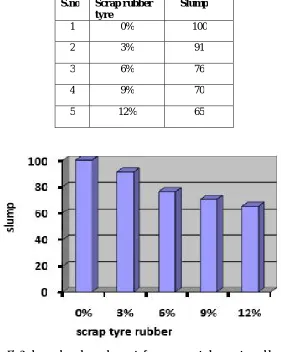
Slump test of various mix proportions of scrap tyrerubber in concrete are shown below
Table1: Slump values with various proportions of scrap rubber tyre replacing coarse aggregate in M25 grade concrete
S.no Scrap rubber tyre
Slump
1 0% 100
2 3% 91
3 6% 76
4 9% 70
5 12% 65
Fig 2: slump values when replacement of coarse aggregate by scrap tyre rubber
From the above slump results, it is observed that as scrap rubber tyre percentage is increasing the workability decreases
B.Compressive StrengthTest
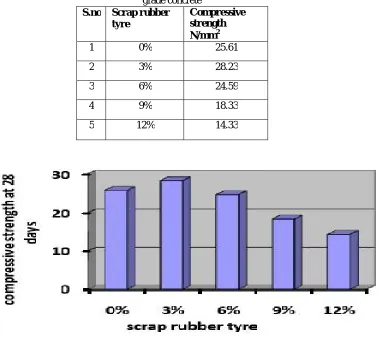
Table 2: Compression test at 28 day with various proportions of scrap rubber tyre replacing coarse aggregate in M25 grade concrete
S.no Scrap rubber tyre
Compressive strength N/mm2
1 0% 25.61
2 3% 28.23
3 6% 24.59
4 9% 18.33
5 12% 14.33
Fig3: compressive strength values when replacement of Coarse aggregate by scrap tyre rubber
From the above compressive strength results, it is observed that scrap rubber tyre based concretes have achieved an increase in strength for 3% replacement of cement for 28 days when compared to conventional concrete
C.Split TensileTest
The tensile strength of concrete with 28 days curing period for various proportions and presented below The specimens were cast and tested as per IS: 516-1959.
Table 3: Split tensile test at 28 day with various proportions of Scrap rubber tyre replacing coarse aggregate in M25 grade concrete
S.No Scrap rubber tyre
Split tensile strength N/mm2
1 0% 2.48
2 3% 2.6
3 6% 2.05
4 9% 1.98
Fig4: split tensile strength values when replacement of coarse aggregate by scrap tyre rubber
VI. CONCLUSION
Based on the experimental investigations the following conclusions are drawn:
Slump values are decreased as the percentage of replacement of scrap tyre rubber increased. So decrease inworkability. The compressive strength is decreased as the percentage of replacement increased, but rubber concrete
developed slightly higher compressive strength than those of without rubberconcrete. The split tensile strength is increased with decreased percentage of scrap tyrerubber.
Decrease in compressive strength, split tensile strength of the specimen due to lack of proper bonding between rubber and cement pastematrix.
From the above compressive strength results, it is observed that scrap tyre rubber based concretes have achieved an increase in strength for 3% replacement of coarse aggregate for 28 days when compared to conventionalconcrete.
From the above split tensile strength results, it is observed that scrap tyre rubber based concretes have achieved an increase in strength for 3% replacement of coarse aggregate for 28 days when compared to conventionalconcrete.
From the above experimental investigation scrap rubber tyre can be used as alternate material to coarse aggregate up to 3%.
REFERENCES
[1] PravinA.Shirule,MujahidHusain-Reuseofscraptyreas partialreplacementoffineaggregatein concreteanditsimpactonpropertiesofconcrete [2] Eldhose C.,Dr.SoosanT.G.StudiesonScrapAddedConcrete forRigidPavements.
[3] Kotresh K.M1,MesfinGetahunBelachewStudyOnWasteTyreRubberAsConcreteAggregates.
[4] Sunil N. Shah1, PradipD. Jadhao1, S. M. Dumne2 Effect of Chipped Rubber Aggregates on PerformanceofConcrete [5] IS2386:Part3:“MethodsofTestforAggregatesforconcrete”Part3,1963
BIOGRAPHY
Pagudala srinivas was born in 1991 in Chennareddygudam village in Rangareddy District, Telangana. He received his Bachelor of Technology degree in Civil Engineering from Gurunanak institute of engineering and technology(GNIET) affliated to Jawaharlal Nehru Technological University Hyderabad in 2014.He is currently a Final year student of Master of Technology in Structural Engineerin from GuruNanak Institute of Technology .His research interest in application of fluid viscous dampers in multi-storey buildings
Associate Prof. M.Vasudeva Naidu was born in 1978 in Srikakulam District, Andhra Pradesh. He received his Bachelor of Technology degree in Civil Engineering from Nagarjuna University in 2001. In 2003 he received his Master's Degree in Structural Engineering from RGPVV, Madhya Pradesh. He joined in GuruNanak Institute of Technology as a faculty where he is an Associate Professor of Civil Engineering Department with a total experience of 10 years in field of Research, Designing and education. He is guiding M.tech Thesis work in field of Structural Engineering
Prof. S.Madan Mohan received his Bachelor of Technology degree in Civil Engineering from JNTUCE Hyderabad in 1998. In 2001 he received his Master's Degree in Structural Engineering from University College of Engineering Osmania University, Hyderabad. He joined GuruNanak Institute of Technology as a faculty where he is a Professor and Head of the Civil Engineering Department with a total experience of 17 years in field of Research, Designing and education
Dr. S SREENATHA REDDY Professor &principal, Guru Nanak Institute of Technology, Under JNTUH, Hyderabad.Dr.SSreenatha Reddyobtained his B.Tech in Mechanical Engineering from JNTU, Hyderabad, and M.Tech in Heat power, Refrigeration &Air conditioning from JNTU, Hyderabad and Ph.D. Faculty of mechanical engineering from JNTUA.Dr.SSreenatha Reddy held various administrative posts and developed the institution with his projects. Notable among his award i.e. National award for best research publication i.e. Jawaharlal Nehru Memorial prize issued institution of engineers on the occasion of
inauguration 27th Indian engineering congress at New Delhi. He is a young & dynamic technical person