R E S E A R C H A R T I C L E
Open Access
Development of a questionnaire for
assessing the childbirth experience (QACE)
Pierre Carquillat
1, Françoise Vendittelli
2,3, Thomas Perneger
4and Marie-Julia Guittier
1,5*Abstract
Background:Due to its potential impact on women’s psychological health, assessing perceptions of their childbirth experience is important. The aim of this study was to develop a multidimensional self-reporting questionnaire to evaluate the childbirth experience.
Methods:Factors influencing the childbirth experience were identified from a literature review and the results of a previous qualitative study. A total of 25 items were combined from existing instruments or were created de novo. A draft version was pilot tested for face validity with 30 women and submitted for evaluation of its construct validity to 477 primiparous women at one-month post-partum. The recruitment took place in two obstetric clinics from Swiss and French university hospitals. To evaluate the content validity, we compared item responses to general childbirth experience assessments on a numeric, 0 to 10 rating scale. We dichotomized two group assessment scores:“0 to 7”and“8 to 10”. We performed an exploratory factor analysis to identify underlying dimensions. Results:In total, 291 women completed the questionnaire (response rate = 61%). The responses to 22 items were statistically significant between the 0 to 7 and 8 to 10 groups for the general childbirth experience assessments. An exploratory factor analysis yielded four sub-scales, which were labelled“relationship with staff”(4 items),“emotional status”(3 items),“first moments with the new born,”(3 items) and“feelings at one month postpartum”(3 items). All 4 scales had satisfactory internal consistency levels (alpha coefficients from 0.70 to 0.85). The full 25-item version can be used to analyse each item by itself, and the short 4-dimension version can be scored to summarize the general assessment of the childbirth experience.
Conclusions:The Questionnaire for Assessing the Childbirth Experience (QACE) could be useful as a screening instrument to identify women with negative childbirth experiences. It can be used as both a research instrument in its short version and a questionnaire for use in clinical practice in its full version.
Keywords:Childbirth experience, Questionnaire, Development, Primiparous Women
Background
Advancing the understanding of women’s perceptions of their childbirth experience during the perinatal period generates interest from researchers and health practitioners in obstetrics. The importance of asses-sing the childbirth experience is now known. This significant life event may have an impact on the psy-chological health of women, including potential bene-fits or damage [1, 2]. A positive experience can lead
to a sense of accomplishment and feelings of self-worth and self-confidence. Negative childbirth experi-ences can give rise to a feeling of maternal distress, disempowerment, postpartum depression, and even post-traumatic stress disorder [3–7]. These
patho-logical consequences can compromise subsequent
pregnancies, mother-infant interactions, and repercus-sions on the infant’s psychomotor development [8–12]. Studies have also suggested that postnatal depressive symptoms in women could be a predictor of paternal depression and may have negative effects on a couple’s relationship [13–15]. These results indicate the importance of assessing the women’s per-ceptions of their childbirth experience to identify
* Correspondence:[email protected] 1
University of Applied Sciences and Arts, Western Switzerland, 47 Avenue de Champel, 1206 Geneva, Switzerland
5Department of Gynecology and Obstetrics, Geneva University Hospitals, Geneva, Switzerland
Full list of author information is available at the end of the article
© The Author(s). 2017Open AccessThis article is distributed under the terms of the Creative Commons Attribution 4.0
negative experiences. For this reason, several question-naires have been developed to describe childbirth ex-periences. The commonly interrelated factors that were identified as contributing to the construction of the childbirth experience were perceived control, support and relationship with the caregiver, fear, pain and delivery methods [16]. Stevens et al. suggested
that perceived control could be an important
predictor of childbirth experience [17]. This variable can influence positively or negatively the perception of this event according to women’s personality. Social support conceptualised and measured in different ways has been found to positively influence the childbirth experience [18]. Many studies reported that women with antenatal fear of childbirth may have increased risk of negative experience. For instance, severe fear of childbirth was demonstrated as a risk factor for elect-ive caesarean delelect-ivery, especially among multiparous respondents [19, 20]. Childbirth is one of the most painful events that a woman is likely to experience during her life. Many authors explored the relation between pain and satisfaction of birth. Women may hope for a labour and delivery free of pain relief, but many found that they needed or benefited from it [18]. In our last study, we observed that delivery method influenced key factors of the childbirth experi-ence [21]. We did a qualitative study which aimed to determine important elements associated with the first time childbirth experience through interviews, which
confirmed the importance of such factors [22].
Participants reported two additional factors to those found in the literature review which are positive or negative emotions and the first moments with the baby. This study also reported that the concordance of expectations of the women prior to delivery with the childbirth experience is a key factor to improve positive women’s views.
A concept analysis of labour and birth experiences by Larkin et al. described the diversity and the complexity of this experience [16]. They defined it as“an individual life event, incorporating interrelated subjective psycho-logical and physiopsycho-logical processes, influenced by social, environmental, organisational and policy contexts”. The attributes identified were: individual, complex, process and life event. Most existing instruments focus on the mother’s experiences, with regard to their satisfaction with the care, rather than the overall perception of the women [23]. The satisfaction concepts that were de-rived from bio-medical models of childbirth were not clearly defined, and often the distinction between satis-faction with care and satissatis-faction with the childbirth experience is ambiguous [24, 25]. Another limitation is that the assessed satisfaction with the childbirth experi-ence seemed inappropriate in reflecting the women’s
feelings and perceptions about it [26]. Additionally, most questionnaires tend to report homogenous levels of satisfaction, with few women expressing dissatisfac-tion. So we think it is important to assess women’s positive and negative perceptions of their childbirth ex-perience because satisfaction measures do not capture the multidimensionality of it.
A limited number of instruments have taken into account multiple relevant factors that influence the childbirth experience, and none validated in French language [27–33]. For instance, the Labor Agentry Scale [27] was developed to measure personal control, and the Wijma Delivery Experience Questionnaire was con-structed as a uni-dimensional instrument that is used to measure fear of childbirth [34]. To our knowledge, the instruments that are used to assess women’s childbirth experience that cover all of the previous described fac-tors are lacking. The aim of this study was to develop a multidimensional self-reporting questionnaire assessing the women’s perceptions of their childbirth experience. The current study reports on the methodological devel-opment of the Questionnaire Assessing the Childbirth Experience (QACE) and provides an analysis of the measurement properties.
Methods
Instrument development
The QACE was built in several stages [35, 36]. First, we synthesized the results of previous studies that evaluated factors influencing the childbirth experience. We com-pared these results with those of our previous qualitative study on this topic [22]. This step allowed us to map a pragmatic combination of items into six main thematic categories. These thematic categories were: expectations (items 9, 15 and 20, Table 2), sensory experiences (items 3 and 16), perceived control (items 8, 10, 11, 12, 14, and 18), relationship with caregivers and the father (items 5, 6, 7, and 13), emotions (items 1, 2, 4, 21, 22, 23, and 24), and the first moments with the baby (items 17, 18, and 19). Several items were taken or adapted from other existing questionnaires [27–33], including the QMAALD (Questionnaire Measuring Attitudes about Labor and Delivery), CEQ (Childbirth experience questionnaire), LAS (Labour Agentry Scale) and PCQ (Pregnancy and Childbirth Questionnaire). Additional items (3, 16, 17, 18, 19, 20, 22, 23, 24, and 25) were created de novo. Items 1 to 19 and 25 measure causal indicators that potentially influence the childbirth experience. Items 20 to 24 measure the consequences of the childbirth experi-ence. They were drafted to cover the identified areas and formulated as positive and negative statements. The response format was a 4-point Likert scale, ranging from
format was used to prevent a noncommittal response set. For six items (10 to 16), we distinguished two periods for the response, which included ‘during labour’ or ‘during delivery’. We used a 0 to 10 numeric rating scale (NRS) for two items to assess pain recall (0 = no pain and 10 = excruciating pain) and to provide a general self-assessment of the childbirth experience (0 = very bad and 10 = very good). One additional“item 25”, not included in the QACE, measures the represen-tation of an ideal childbirth:“According to you, an ideal
birth is …”. They were assessed with six propositions (Vaginal birth, Spontaneous labor, No pain, Caesarean, With the professional of my choice, and Schedule deliv-ery) that the respondents were asked to rank from most important (n°1) to least important (n°6).
In the second stage, we submitted the draft version to a panel of five experts, one with questionnaire expertise and four with childbirth expertise as clinical and academic midwives. We asked them to evaluate the relevance, content coverage, and comprehensiveness of the items. Their comments helped refine the question-naire for the pre-test.
In the third stage, the QACE was pilot tested for face validity (e.g., comprehension and relevance) among 30 primiparous women [37]. We used two methods for this face-to-face test, the “think aloud” and “cognitive
inter-viewing”, methods to obtain feedback from the women [38]. The questionnaire draft was regularly revised based on the women’s comments. Finally, our questionnaire measured six previously described domains of interest through the 25 items in total.
The fourth stage was the evaluation of the measurement properties of the instrument.
Study sample and data collection
The recruitment was carried out at the University Hospitals of Geneva (Switzerland) and the University Hospital of Clermont-Ferrand (France) maternity wards by four research midwives. Women were recruited during their stay in the maternity ward and asked if they agreed to participate. The inclusion criteria were: speak and read French, primiparous, singleton foetus, gestational age greater than 37 weeks and the new born was not separated from his mother for medical reasons during the maternity stay. We excluded multiparous subjects because, in general, they were more satisfied in their childbirth experiences than primiparous subjects [39]. We can explain this phenomenon by some obstetric factors, including: shorter labor, fewer interven-tions, and more realistic expectations according to their previous childbirth experiences. Additionally, according to their predisposition to dissatisfaction, the primiparous subjects represented a population of choice to explore factors associated with the childbirth experience. We
preferentially sent the questionnaire by e-mail but the option of sending by post was given to participants. The questionnaire was sent to participants at four weeks post-partum. Two recalls if necessary were done up to six weeks post-partum. The online questionnaire procedure was easier for gathering data, had minimal cost, decreased the possibility of data errors with responses automatically stored in a database, and could ensure women’s privacy when answering potentially sensitive questions about perceived partner support dur-ing childbirth. The choice of the best time to collect the data regarding the childbirth experience was based on the results and recommendations from previous studies [2, 39–44]. The purpose was threefold: to avoid the ini-tial period of euphoria or denial that can characterize the early postpartum period, to minimize socially desir-able responses by completing the questionnaire without the proximity of caregivers, and to be not so far away from the childbirth experience to keep relatively fresh memories.
Sample size
According to Rouquette & Falissard [45], as a rule of thumb, a minimum of 300 subjects is acceptable to reveal the factor structure. We addressed the QACE to 477 women to anticipate a response rate between 50 and 70%.
Statistical analyses
We examined the distributions of all of the items to identify any missing responses or the ceiling and floor effects, e.g., the proportions of the most favourable rat-ings (“totally” for positively worded items, “not at all” for negatively worded items).
summative scoring, to facilitate reporting (we used 17 items from Table 2, numbered 1–9 and 17–24, excluding the paired items 10–16). We retained factors with an eigenvalue >1, and applied the varimax rotation to facili-tate the interpretation of the loadings. At that stage, we also eliminated items that had unclear loading patterns (see Results). We obtained Cronbach alpha coefficients for the scales obtained by EFA.
To measure the construct validity of our instrument, we compared the responses to items in the self-assessment of the general experience of childbirth that were rated on a 0–10 numerical scale. The descriptive analysis of the response distribution for these items suggested a break point at 8. This NRS scores were transformed to categorical values to compare the follow-ing two groups:“NRS scores of 0 to 7”versus“NRS scores
of 8 to 10”. Moreover, the 50th percentile of the scores was eight, which allowed us to compare groups of fairly equal size. As the goal for caregivers is for women to have the best childbirth experience possible, we dichoto-mized the four response modalities to “totally” versus
“in part, not so much, and not at all” or “not at all” versus “not so much, in part, and totally”, according to the expected positive or negative responses to each item. The proportions were compared between groups, and the differences were tested using the Fisher exact test.
To analyse the score data, we coded the answer format of the 4-point Likert scale, as follows: 1 (totally), 2 (in part), 3 (not so much), and 4 (not at all). The ratings of negatively worded statements were reverse-scored so that the higher scores more reflected a negative childbirth experiences. The means, with their standard deviations, were calculated for continuous variables, and the statistical significance of differences between groups was tested with Student’s t-test.
Statistical analyses were performed using SPSS 22.0 for Windows (SPSS Inc., Chicago, IL, USA), and Stata, version 13.1 (StataCorp, College Station, TX, USA).
Results
We sent the questionnaire to 477 women between June and December 2014. Seventy-nine per cent of the participants were recruited in Switzerland, and 96% of questionnaires were sent by email. We received 291 completed or quasi-completed question-naires (61% response rate).
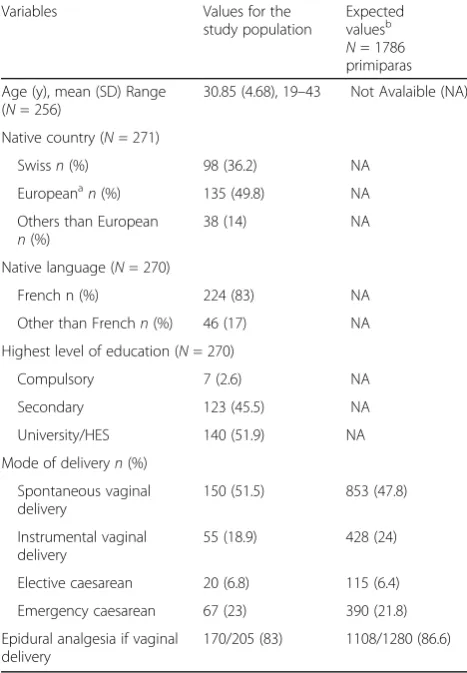
The characteristics of the study population are reported in Table 1. Most of the participants were Swiss or European (86%), native French speakers (83%), and had a secondary to university level of education (97%). Thirty percent had a caesarean section. Among women who had a vaginal delivery 83% had an epidural analgesia.
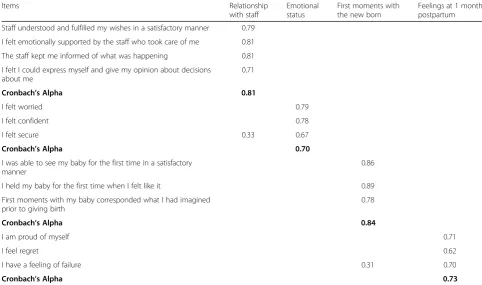
The factor analysis displayed a poor fit of the theoret-ical model: the confirmatory factor analysis failed to converge (as described in Methods), and the exploratory factor analysis identified multiple mismatches between the high loading factors and anticipated item groupings. Nevertheless, we sought to identify correlated and themat-ically related items that could by summarized by a summative score, using exploratory factory analysis in a data-driven approach. We started with 17 items (Table 2, excluding paired items 10–16), and finally retained 13 items grouped into 4 dimensions for a short-form of the questionnaire (Table 3). We excluded 4 items from the final EFA, because they could not be naturally classified into one of the 4 dimensions and displayed an unclear loading pattern (items 3, 9, 20, and 24).
We computed the dimension scores by averaging the corresponding items if at least 2 items were non-missing and after inversion of the negatively formu-lated items. The first scale included 4 items that rated interactions and relationships with the staff (items 5, 6, 7, and 8), the second grouped 3 items that rated Table 1General and obstetrical characteristics of the study population
Age (y), mean (SD) Range (N= 256)
30.85 (4.68), 19–43 Not Avalaible (NA)
Native country (N= 271)
Native language (N= 270)
French n (%) 224 (83) NA
Other than Frenchn(%) 46 (17) NA
Highest level of education (N= 270)
Compulsory 7 (2.6) NA
Secondary 123 (45.5) NA
University/HES 140 (51.9) NA
Mode of deliveryn(%)
Spontaneous vaginal
Elective caesarean 20 (6.8) 115 (6.4)
Emergency caesarean 67 (23) 390 (21.8)
Epidural analgesia if vaginal delivery
170/205 (83) 1108/1280 (86.6)
a
All others European countries except Switzerland b
emotional status (items 1, 2, and 4), the third grouped 3 items that rated the first moment and interaction with the new born (items 17, 18, 19), and the fourth grouped 3 items that rated the feelings at one month after giving birth (items 21, 22, 23).
The Cronbach’s Alpha coefficients for these scores were 0.85, 0.70, 0.84 and 0.72, respectively (Table 3). The differ-ences in the four subscale score between the 0–7 versus 8–10 NRS experiences were significantly different between the“NRS zero to seven”group for general self-assessment childbirth experiences compared with the “NRS eight to
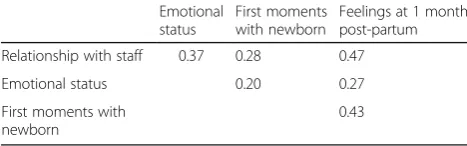
ten” group, which had four item groups that were scored higher (Table 4). The scales were weakly to moderately correlated (Table 5).
We therefore propose 2 possible uses for the instrument:
– Use of each of the 24 items in their own right if
the emphasis was on the specific content of each
item (Table 2). The general self-assessment
childbirth experience, as reported with the NRS,
showed that 43% (n = 126) of the women
esti-mated that their experience was between 0 to 7
compared with 57% (n= 165) who estimated that
their experience was between 8 to 10. The differ-ence between the positive and negative perception groups was statistically significant for all items except 2 (the support of the partner and the pain assessment during labour). Complete version of the QACE in English language is available in
Additional file 1 and in French language in
Additional file 3.
Table 3Factor loadingafrom the exploratory factor analysis (varimax rotation)
Items Relationship
with staff
Emotional status
First moments with the new born
Feelings at 1 month postpartum
Staff understood and fulfilled my wishes in a satisfactory manner 0.79
I felt emotionally supported by the staff who took care of me 0.81
The staff kept me informed of what was happening 0.81
I felt I could express myself and give my opinion about decisions about me
0.71
Cronbach’s Alpha 0.81
I felt worried 0.79
I felt confident 0.78
I felt secure 0.33 0.67
Cronbach’s Alpha 0.70
I was able to see my baby for the first time in a satisfactory manner
0.86
I held my baby for the first time when I felt like it 0.89
First moments with my baby corresponded what I had imagined prior to giving birth
0.78
Cronbach’s Alpha 0.84
I am proud of myself 0.71
I feel regret 0.62
I have a feeling of failure 0.31 0.70
Cronbach’s Alpha 0.73
a
Only factor loading greater than 0.30 are reported in the table
Table 4Differences in the subscales score between NRS_Experience 0–7 versus 8–10
Dimensions NRS* _Experience
0–7 N= 126
NRS*_Experience 8–10 N= 165
t-test
Relationship with staff mean, subscale score** (SD) 1.65 (0.65) 1.26 (0.44) < 0.001
Emotional status mean, subscale score** (SD) 2.04 (0.62) 1.78 (0.58) < 0.001
First moments with the new born mean, subscale score** (SD) 2.03 (1.03) 1.52 (0.82) < 0.001
Feelings at 1 month postpartum mean, subscale score** (SD) 1.82 (0.79) 1.34 (0.50) < 0.001
– When summary descriptions of the mother’s experience are needed, we suggest the use of the 4 summative scales, based on 13 items. This simplified tool may be particularly useful for research or monitoring. Short version of the QACE in English
language is available in Additional file2and in
French language in Additional file4.
The women’s responses to their representations of an ideal birth (item 25) that ranked first and second, in quasi equality, were“Spontaneous labour” 114/283 (40.3%) and
“Vaginal birth” 112/283 (39.6%). “No pain” 107/283 (37.8%) was third, “with the professional of my choice” 125/283 (44.5%) was fourth,“scheduled” 126/283 (45.3%) was fifth, and“by caesarean”148/283 (53%) was sixth.
Discussion
In this study, we developed a self-reporting question-naire in French to assess the childbirth experiences of first-time mothers. Our findings suggest that the QACE could be used as an instrument to identify women with negative experiences, to perform quality of care monitoring in birthplaces, and to assess childbirth experiences by researchers. The full ver-sion (25 items) is an index that is used to analyse each item by itself as a “clinimetric scale” [47]. The short version contained 13 items, with a total of 4 sub-scales to measure the general assessment of the childbirth experience with scores per dimension.
Strengths
This QACE was developed following a rigorous meth-odological protocol [35, 36]. The initial list of domains and corresponding pool of items were derived from a literature review on childbirth experiences and the exist-ing measurement instruments for them. We created new items to specifically evaluate representations of an ideal childbirth, comprehension of events during childbirth, and first moments with the new born according to the results of our previous qualitative study on the childbirth experience [22]. The generation of these items ensured that the core determinants of the delivery experience were not missed. Several successive revisions were performed according to opinions from a panel of clinical and methodological experts and a pilot-test with 30
women to maximize the content validity. The“support of
the partner”and“feeling of pain during labour”items were not consistent with what was expected. This was surpris-ing and different from factors that were traditionally associated with the delivery experience [48–50]. In our study, more than 76% of the participants reported to be totally supported by their partner; however, we did not observe a positive association with the NRS in their self-assessments of the delivery experience. For the feeling of pain, 83% of the participants had an epidural analgesia. This could explain the lack of an association between pain and the NRS of their self-assessment of the delivery experience. Nevertheless, we decided to keep these items in the full version because they can be helpful in another context of evaluation.
Limits
The exploratory factor analysis did not identify the six thematic categories as expected; however, the grouping of the extracted items made sense and could be labelled for the initially described thematic cat-egories, except for “sensory perceptions” (items 3, 16) and “feeling of control” (items 8, 10, 11, 12, 14, 18). The lack of consensus about the definition of some thematic categories reported in different instruments to assess childbirth experience could explain the heterogeneity of the results. For instance, in many research studies, the control concept was insuffi-ciently defined [16]. Consequently, items related to the feeling of control are often included in other concepts in questionnaires. For instance, in the Childbirth Experience Questionnaire [32], the dimen-sion labelled “Own capacities” included items regard-ing experienced emotions, sense of control and experienced labour pain. “Feeling of control” is traditionally described as very important for the childbirth experience [44, 51–53]. Nevertheless, the feeling of control is very subjective. This is a complex
phenomenon and includes internal and external
dimensions. Additionally, we suggest weighing the im-pact of the feeling of control during the childbirth experience with regards to the two psychological pro-files described by Green et al. [39], which include a woman’s desire to “participate in decisions” or con-versely to “surrender to the medical world”. This point of view is also supported by Stevens et al. (2012) [17]. Moreover, this sense of control is not static dur-ing labour and birth, as it evolves accorddur-ing to the sequence of events and the responses to each. A uni-dimensional tool regarding this exists [27] and could be submitted in parallel to the QACE if researchers want to measure this latent variable. Another example of the heterogeneity of the thematic categories is given by Bryanton et al. [54]. They explained that fear Table 5Pearson correlation coefficients between the four
summary scales
Emotional status
First moments with newborn
Feelings at 1 month post-partum
Relationship with staff 0.37 0.28 0.47
Emotional status 0.20 0.27
First moments with newborn
was not a predictor in any of the studies that exam-ined several predictors simultaneously. Fear was rep-resented in other studies by variables such as anxiety, loss of control, and worry about the baby.
A woman’s mood on the day she answers the ques-tionnaire can change the perception of the childbirth ex-perience [6, 55]. During this period, women can feel weary and tired and postnatal depression can appear [56]. This is a scientific bias for the responses to any item that questions memories of emotions. Additionally, 186 (39%) women declined to participate, and this was a potential selection bias that may have affected the final assessment.
The four dimension-specific scores were obtained through a data-driven process and were not based on an a priori measurement model. Therefore, these dimen-sions may be over-fitted in our sample. A verification of the relevance of these dimensions in other samples is warranted.
A clinimetric approach rather a psychometric statistical approach
This QACE was developed primarily as a clinical instru-ment in which each specific item provided information about the women’s childbirth experiences. Feinstein de-scribe it as“clinimetrics scales”[47] and Streiner described it as“indexe” [57]. The full version of the QACE did not include a psychometric scale composed of theoretically correlated items that would be caused by a hypothesized latent variable. This QACE is a screening instrument that is derived from items that have been found to empirically correlate with the childbirth experience. According to Streiner [57], it is important to differentiate the two test construction models to reflect the fact that different statis-tical approaches are used with them. Psychometrics test models are not appropriate for indexes for the QACE, although they remain the most widely used method to assess questionnaire validities. As stated by Juniper et al. [58], it “can lead to situations in which either a scale is
wrongly dismissed for not being reliable or the indexes are unfairly criticized for not yielding useful results”.
The short version was a thematic grouping that could facilitate the interpretation the women’s responses by summarizing the general childbirth experiences with scores for four key dimensions. Higher scores reflected more negative childbirth experiences. We suggest that practitioners or researchers add some items to the short version from the full version, according to their specific domains of interest.
Conclusions
Assessing the childbirth experience is important because a negative experience could be harmful for a woman’s health as well as her relationship with her partner and
infant. The QACE is a multidimensional questionnaire that was developed to identify women with negative ex-periences. It can be used as both a research instrument in its short version and a questionnaire for use in clinical practice in its full version. Future research studies are needed to evaluate the predictive value of the QACE for the detection of multiple consequences due to negative childbirth experiences, particularly the occurrence of postnatal depression. As well, studies with diverse popu-lations will help to improve the reliability and validity of the QACE.
Additional files
Additional file 1:English language versions of the QACE (complete version). (DOC 107 kb)
Additional file 2:English language versions of the QACE (short version). (DOC 70 kb)
Additional file 3:French language of the QACE (complete version). (DOC 102 kb)
Additional file 4:French language of the QACE (short version). (DOC 68 kb)
Abbreviations
CEQ:Childbirth Experience Questionnaire; CFA: Confirmatory Factor Analysis;
EFA: Exploratory Factor Analysis; LAS: Labour Agentry Scale; NRS: Numeric Rating Scale; PCQ: Pregnancy and Childbirth Questionnaire;
QACE: Questionnaire for Assessing the Childbirth Experience; QMAALD: Questionnaire Measuring Attitudes About Labor and Delivery
Acknowledgements
We thank all of the participants who responded to the QACE. We thank Delphine Courvoisier for serving as the methodological expert for the questionnaires as well as Ophélie Boucher and Antonina Chilin (clinical midwives), and Anne Gendre and Barbara Kaiser (academic midwives). Their comments helped refine the questionnaire for the pre-test. We also thank Corine Oberson for the data management. Chloé Barasinski and Marine Julien were the research midwives who collected the data at Clermont-Ferrand.
Funding
This study was supported by the University Of Applied Sciences and Arts of Western Switzerland and the maternity of the Geneva University Hospital.
Availability of data and materials
The datasets used and/or analysed during the current study are available from the corresponding author on reasonable request.
Authors’contributions
PC and MJG conceived of the study. PC, MJG and FV conducted recruitment
and data collection. PC, MJG and TP analyzed and interpreted the participant’s
data and contributed significantly to the writing of the manuscript. All authors had full access to all data in the study and take responsibility for the integrity of the data and the accuracy of the data analysis. All authors contributed to the final draft of the manuscript and approved the decision to submit the manuscript for publication. All authors read and approved the final manuscript.
Ethics approval and consent to participate
The Geneva Canton Ethics Commission President ruled that the protocol of our study was exempt from a full review by the Ethics Commission because it carried a low risk for participants, in accordance with the Swiss federal law on research on human beings. This study was also exempt from French Institutional Review approval according to French research human law because it was not an interventional research study. Before November 2016,
the French law on biomedical researches (Article L.1121–1-1 and Article
and a CPP (Comité de Protection des Personnes) authorisation was not mandatory. Because of the low risk categorization of our study by these two ethics commissions, consent to participate was given verbally by women.
Consent for publication
Not applicable.
Competing interests
All of the authors report no competing financial interests.
Publisher’s Note
Springer Nature remains neutral with regard to jurisdictional claims in published maps and institutional affiliations.
Author details
1
University of Applied Sciences and Arts, Western Switzerland, 47 Avenue de Champel, 1206 Geneva, Switzerland.2Pôle Femmes et Enfants, Centre Hospitalier Universitaire de Clermont-Ferrand, site Estaing, 1 place Lucie et Raymond Aubrac, 63003 Clermont-Ferrand Cedex 1, France.3Clermont Université, Université d’Auvergne, EA 4681, PEPRADE (Périnatalité, grossesse, Environnement, PRAtiques médicales et DEveloppement), Clermont-Ferrand, France.4Division of clinical epidemiology, Geneva University Hospitals, and University of Geneva, Geneva, Switzerland.5Department of Gynecology and Obstetrics, Geneva University Hospitals, Geneva, Switzerland.
Received: 17 December 2015 Accepted: 21 August 2017
References
1. Tissot H. Dépression post-partum maternelle et développement de l’enfant :
revue de littérature et arguments en faveur d’une approche familiale.
Psychiatr Enfant. 2011;54(2):611–37.
2. Waldenström U, Hildingsson I, Rubertsson C, Rådestad I. A negative birth
experience: prevalence and risk factors in a national sample. Birth Berkeley
Calif. 2004;31(1):17–27.
3. Emmanuel E, St John W. Maternal distress: a concept analysis. J Adv Nurs.
2010;66(9):2104–15.
4. Shlomi Polachek I, Huller Harari L, Baum M, Strous RD. Postpartum
anxiety in a cohort of women from the general population: risk factors and association with depression during last week of pregnancy, postpartum depression and postpartum PTSD. Isr J Psychiatry Relat Sci.
2014;51(2):128–34.
5. Zaers S, Waschke M, Ehlert U. Depressive symptoms and symptoms of
post-traumatic stress disorder in women after childbirth. J Psychosom
Obstet Gynaecol. 2008;29(1):61–71.
6. Garthus-Niegel S, von Soest T, Vollrath ME, Eberhard-Gran M. The impact of
subjective birth experiences on post-traumatic stress symptoms: a longitudinal
study. Arch Womens Ment Health. 2013;16(1):1–10.
7. O’Donovan A, Alcorn KL, Patrick JC, Creedy DK, Dawe S, Devilly GJ.
Predicting posttraumatic stress disorder after childbirth. Midwifery.
2014;30(8):935–41.
8. Gottvall K, Waldenström U. Does a traumatic birth experience have an
impact on future reproduction? BJOG. 2002;109(3):254–60.
9. Størksen HT, Garthus-Niegel S, Vangen S, Eberhard-Gran M. The impact of
previous birth experiences on maternal fear of childbirth. Acta Obstet
Gynecol Scand. 2013;92(3):318–24.
10. Nilsson C, Bondas T, Lundgren I. Previous birth experience in women
with intense fear of childbirth. J Obstet Gynecol Neonatal Nurs.
2010;39(3):298–309.
11. Burke L. The impact of maternal depression on familial relationships. Int Rev
Psychiatry Abingdon Engl. 2003;15(3):243–55.
12. Kingston D, Tough S, Whitfield H. Prenatal and postpartum maternal
psychological distress and infant development: a systematic review.
Child Psychiatry Hum Dev. 2012;43(5):683–714.
13. Paulson JF, Bazemore SD. Prenatal and postpartum depression in fathers
and its association with maternal depression: a meta-analysis. JAMA. 2010;
303(19):1961–9.
14. Nicholls K, Ayers S. Childbirth-related post-traumatic stress disorder in
couples: a qualitative study. Br J Health Psychol. 2007;12(Pt 4):491–509.
15. Boyce P, Condon J, Barton J, Corkindale C. First-time fathers’study:
psychological distress in expectant fathers during pregnancy. Aust N Z J
Psychiatry. 2007;41(9):718–25.
16. Larkin P, Begley CM, Devane D. Women’s experiences of labour and birth:
an evolutionary concept analysis. Midwifery. 2009;25(2):e49–59.
17. Stevens NR, Wallston KA, Hamilton NA. Perceived control and maternal
satisfaction with childbirth: a measure development study. J Psychosom
Obstet Gynaecol. 2012;33(1):15–24.
18. Rijnders M, Baston H, Schönbeck Y, van der Pal K, Prins M, Green J,
et al. Perinatal factors related to negative or positive recall of birth experience in women 3 years postpartum in the Netherlands. Birth
Berkeley Calif. 2008;35(2):107–16.
19. Ryding EL, Wijma B, Wijma K, Rydhström H. Fear of childbirth during
pregnancy may increase the risk of emergency cesarean section. Acta
Obstet Gynecol Scand. 1998;77(5):542–7.
20. Larsson B, Karlström A, Rubertsson C, Hildingsson I. The effects of counseling
on fear of childbirth. Acta Obstet Gynecol Scand. 2015;94(6):629–36.
21. Carquillat P, Boulvain M, Guittier M-J. How does delivery method influence factors
that contribute to women’s childbirth experiences? Midwifery. 2016;43:21–8.
22. Guittier M-J, Cedraschi C, Jamei N, Boulvain M, Guillemin F. Impact of mode
of delivery on the birth experience in first-time mothers: a qualitative study. BMC Pregnancy Childbirth. 2014;14:254.
23. Rudman A, El-Khouri B, Waldenström U. Women’s satisfaction with
intrapartum care - a pattern approach. J Adv Nurs. 2007;59(5):474–87.
24. Britton JR. The assessment of satisfaction with care in the perinatal period.
J Psychosom Obstet Gynaecol. 2012;33(2):37–44.
25. Sawyer A, Ayers S, Abbott J, Gyte G, Rabe H, Duley L. Measures of
satisfaction with care during labour and birth: a comparative review. BMC Pregnancy Childbirth. 2013;13:108.
26. Proctor S. Using women’s views to inform and develop quality in midwifery.
Pract Midwife. 1999;2(6):20–3.
27. Hodnett ED, Simmons-Tropea DA. The labour Agentry scale: psychometric
properties of an instrument measuring control during childbirth. Res Nurs
Health. 1987;10(5):301–10.
28. Fawcett J, Knauth D. The factor structure of the perception of birth scale.
Nurs Res. 1996;45(2):83–6.
29. Fawcett J, Pollio N, Tully A. Women’s perceptions of cesarean and vaginal
delivery: another look. Res Nurs Health. 1992;15(6):439–46.
30. Cranley MS, Hedahl KJ, Pegg SH. Women’s perceptions of vaginal and
cesarean deliveries. Nurs Res. 1983;32(1):10–5.
31. Marut JS, Mercer RT. Comparison of primiparas’perceptions of vaginal and
cesarean births. Nurs Res. 1979;28(5):260–6.
32. Dencker A, Taft C, Bergqvist L, Lilja H, Berg M. Childbirth experience
questionnaire (CEQ): development and evaluation of a multidimensional instrument. BMC Pregnancy Childbirth. 2010;10:81.
33. Truijens SEM, Pommer AM, van Runnard Heimel PJ, Verhoeven CJM, Oei SG,
Pop VJM. Development of the pregnancy and childbirth questionnaire (PCQ): evaluating quality of care as perceived by women who recently gave
birth. Eur J Obstet Gynecol Reprod Biol. 2014;174:35–40.
34. Wijma K, Wijma B, Zar M. Psychometric aspects of the W-DEQ; a new
questionnaire for the measurement of fear of childbirth. J Psychosom
Obstet Gynaecol. 1998;19(2):84–97.
35. Boynton PM, Greenhalgh T. Selecting, designing, and developing your
questionnaire. BMJ. 2004;328(7451):1312–5.
36. Streiner DL, Kottner J. Recommendations for reporting the results of
studies of instrument and scale development and testing. J Adv Nurs.
2014;70(9):1970–9.
37. Perneger TV, Courvoisier DS, Hudelson PM, Gayet-Ageron A. Sample size for
pre-tests of questionnaires. Qual Life Res Int J Qual Life Asp Treat Care
Rehabil. 2015;24(1):147–51.
38. Ackermann AC, Blair J. Efficient respondent selection for cognitive
interviewing. Paper presented at the American Association of Public Opinion Research Annual Meeting. Montreal; 2006.
39. Green JM, Coupland VA, Kitzinger JV. Expectations, experiences, and
psychological outcomes of childbirth: a prospective study of 825 women.
Birth Berkeley Calif. 1990;17(1):15–24.
40. Simkin P. Just another day in a woman’s life? Women’s long-term perceptions
of their first birth experience. Part I. Birth Berkeley Calif. 1991;18(4):203–10.
41. Simkin P. Just another day in a woman’s life? Part II: nature and consistency
of women’s long-term memories of their first birth experiences. Birth
42. Waldenström U, Borg IM, Olsson B, Sköld M, Wall S. The childbirth experience:
a study of 295 new mothers. Birth Berkeley Calif. 1996;23(3):144–53.
43. Soet JE, Brack GA, DiIorio C. Prevalence and predictors of women's
experience of psychological trauma during childbirth. Birth. 2003;30:36–46.
44. Bramadat IJ, Driedger M. Satisfaction with childbirth: theories and methods
of measurement. Birth Berkeley Calif. 1993;20(1):22–9.
45. Rouquette A, Falissard B. Sample size requirements for the internal validation
of psychiatric scales. Int J Methods Psychiatr Res. 2011;20(4):235–49.
46. Hu L, Bentler PM. Cutoff criteria for fit indexes in covariance structure
analysis: conventional criteria versus new alternatives. Struct Equ Model
Multidiscip J. 1999;6(1):1–55.
47. Feinstein AR. Clinimetrics. New Haven: Yale University Press; 1987.
48. Lavender T, Walkinshaw SA, Walton I. A prospective study of women’s views of
factors contributing to a positive birth experience. Midwifery. 1999;15(1):40–6.
49. Larsson C, Saltvedt S, Edman G, Wiklund I, Andolf E. Factors independently
related to a negative birth experience in first-time mothers. Sex Reprod
Healthc Off J Swed Assoc Midwives. 2011;2(2):83–9.
50. Van der Gucht N, Lewis K. Women’s experiences of coping with pain during
childbirth: a critical review of qualitative research. Midwifery. 2015;31(3):349–58.
51. Fair CD, Morrison TE. The relationship between prenatal control,
expectations, experienced control, and birth satisfaction among primiparous
women. Midwifery. 2012;28(1):39–44.
52. Larkin P, Begley CM, Devane D. « not enough people to look after you »: an
exploration of women’s experiences of childbirth in the Republic of Ireland.
Midwifery. 2012;28(1):98–105.
53. Hodnett ED. Caregiver support for women during childbirth. Cochrane
Database Syst Rev. 2002;1:CD000199.
54. Bryanton J, Gagnon AJ, Johnston C, Hatem M. Predictors of women’s
perceptions of the childbirth experience. J Obstet Gynecol Neonatal Nurs.
2008;37(1):24–34.
55. Truijens SEM, Wijnen HA, Pommer AM, Oei SG, Pop VJM. Development of
the childbirth perception scale (CPS): perception of delivery and the first
postpartum week. Arch Womens Ment Health. 2014;17(5):411–21.
56. Andrews-Fike C. A review of postpartum depression. Prim Care Companion
J Clin Psychiatry. 1999;1(1):9–14.
57. Streiner DL. Being inconsistent about consistency: when coefficient alpha
does and doesn’t matter. J Pers Assess. 2003;80(3):217–22.
58. Juniper EF, Guyatt GH, King DR. Comparison of methods for selecting items
for a disease-specific quality-of-life questionnaire - importance versus
factor-analysis. Qual Life Res. 1994:52–3.
• We accept pre-submission inquiries
• Our selector tool helps you to find the most relevant journal
• We provide round the clock customer support
• Convenient online submission
• Thorough peer review
• Inclusion in PubMed and all major indexing services
• Maximum visibility for your research
Submit your manuscript at www.biomedcentral.com/submit