Magnetohydrodynamic waveguide/resonator for Pc3 ULF pulsations at cusp
latitudes
V. Pilipenko1, E. Fedorov1, N. Mazur1, M. J. Engebretson2, and W. J. Hughes3
1Institute of the Physics of the Earth, Moscow 123810, Russia 2Department of Physics, Augsburg College, Minneapolis, MN 55454, U.S.A.
3Center for Space Physics, Boston University, Boston, MA 02215, U.S.A.
(Received April 9, 1999; Accepted June 3, 1999)
We present a possible theoretical model for the generation of travelling Alfven waves by external compressional disturbances in a two-dimensional inhomogeneous plasma. The transformation of a compressional wave mode into Alfven waves guided by the magnetic field is considered in a region with decreased Alfven velocity. This region represents, on the one hand, a waveguide for compressional oscillations, and on the other hand, a resonator with opaque boundaries for Alfven waves. The wave transformation is most effective in a resonant case, when the frequency of a compressional mode approaches the local Alfven frequency of a resonator. This model is applied to the interpretation of Pc3 observations in the cusp region. The mechanism can ensure the selective amplification of magnetosheath turbulence in the Pc3 band in the high-latitude cusp.
1.
Introduction
The dayside cusp/cleft region is characterized by an in-crease in the intensity of ULF wave activity over a wide fre-quency range (Olson, 1986; Glassmeier, 1989). However, the Pc3 band (20–100 mHz) is especially prominent beneath the cusp as compared with the background level (Engebretson et al., 1986; Lepidiet al., 1996). Several types of fluctuations in the nominal Pc3 band have been noted near the footprint of the cusp. The first and most common one is noise-like wide-band fluctuations, classified as Pi1 pulsations (Engebretson et al., 1995). Another one is the proper Pc3: narrow-band short-lived wavelets (Engebretsonet al., 1986; Olson and Fraser, 1994). Engebretsonet al.(1995) indicated that the cusp-associated Pc3 pulsations appearing in dynamic FFT spectrograms are band-limited, but can often be masked by strong Pi1 activity. The intense Pi1 pulsations dominate at high solar wind velocities, while Pc3 can be observed at cusp latitudes when the solar wind velocity is low or mod-erate (Engebretsonet al., 1995). An intermediate group is composed of band-limited Pc3 pulsations. The occurrence of narrow-band and band-limited Pc3 is found to be con-trolled by the cone-angle of the IMF, whereas their central frequency is related to IMF magnitude (Engebretsonet al., 1986, 1989; Plyasova-Bakouninaet al., 1986). However, a linear relationship between the frequency of cusp-associated ULF waves and hourly averages of the IMF magnitude was noted by Wolfe et al.(1990) only for ULF waves above a cutoff frequency about 30 mHz.
The variety of the observed types of ULF wave activity in the nominal Pc3 frequency band in the region of cusp projection is caused by inputs of different generation
mech-Copy right cThe Society of Geomagnetism and Earth, Planetary and Space Sciences (SGEPSS); The Seismological Society of Japan; The Volcanological Society of Japan; The Geodetic Society of Japan; The Japanese Society for Planetary Sciences.
anisms. Most probably, as Engebretsonet al.(1991a) pro-posed, wide-band Pi1 pulsations and some Pc3 pulsations are closely related to the fluxes of precipitating particles in the cusp region. Engebretsonet al.(1994) showed quantita-tively that cusp Pc3 magnetic pulsations can be produced by the modulated precipitation of energetic particles. This idea, though not thoroughly theoretically justified yet, explains many interrelationships between auroral, riometric and ULF magnetic observations in the cusp region.
The actual interrelationships between ULF signals and par-ticle modulation have not been revealed so far. This modu-lation may be an intrinsic property of intense particle fluxes and develop in a spontaneous way, whereas magnetic noise would be an image of the irregular character of the overhead precipitation. Otherwise, the particle modulation may be induced by external ULF wave activity in the high-altitude cusp. The source of the Pc3 activity in the cusp might be the turbulent hydromagnetic noise in the magnetosheath, pen-etrating into the magnetosphere (Engebretsonet al., 1989, 1991a). Simultaneous observations in the upstream solar wind, subsolar magnetosheath, and outer equatorial magne-tosphere that focus on Pc3–4 pulsations (Engebretsonet al., 1991b; Linet al., 1991) showed that during times the IMF geometry supports the generation of upstream waves in the foreshock region, the magnetosheath is characterized by in-tense broadband turbulence in the magnetic field (with no recognizable sinusoids anywhere near Pc3–4 frequencies) and with large variations in all bulk plasma parameters and greatly increased populations of energized plasma.
The occurrence of narrow-band Pc3 signals on the ground at cusp latitudes implies the operation of some natural mech-anism of frequency-selective noise filtering/amplification at cusp latitudes. These signals are unlikely to be produced by direct penetration of magnetosheath turbulence to the
sphere, as the spectral content of hydromagneticfluctuations in the magnetosheath downstream of a quasi-parallel shock takes the form of broadband noise, with no distinct peaks (Engebretsonet al., 1991b; Le and Russell, 1994).
It is widely accepted that, at middle latitudes, the narrow-band spectral structure of Pc3 waves is formed owing to resonant features of the magnetospheric Alfven resonator. The magnetospheric resonator is formed along geomagnetic field lines, and terminated with conductive ionospheres (Southwood, 1974). At cusp latitudes, however, this type of resonator is can hardly be operative. At near-cusp closed field lines the fundamental eigenfrequency is aboutTA5–
10 min, so the possibility of excitation of standing Alfven harmonics with numbersn =TA/TPc310–20 appears to
be unrealistic. Further, in contrast with ULF satellite ob-servations in the inner magnetosphere, the cusp-related Pc3 variations show little evidence of discrete harmonics.
Moreover, compressional disturbances penetrating through the magnetopause in the polar cusp region from the magnetosheath apparently cannot propagate deep into the magnetosphere: ray-tracing of Pc3 compressional waves in multi-component plasma by Zhanget al.(1993) showed that waves in the Pc3 range are trapped in the region of the high-latitude cusp.
Here we suggest an alternative hypothesis for the mech-anism of natural band-filtering near the high-latitude cusp. We propose that in the region of the high-altitude cusp (en-try layer) compressional wide-band noise may convert into guided propagating Alfven waves, leaking alongfield lines toward the ionosphere. This transformation has a resonant character, which forms a band-limited spectrum of ULF waves near the geomagnetic projection of the cusp.
2.
Emission of Alfven Waves from a MHD
Wave-guide
Let us consider linear oscillations of a cold (β1) plasma embedded in a magnetic box. Accounting for afinite plasma pressure is essential for the consideration of small-scale ki-netic effects or a slow magnetosonic mode, but it does not in-fluence the spectral features of fast magnetosonic and Alfven modes. Thezaxis of a Cartesian coordinate system is as-sumed to be oriented along a homogeneous magneticfield B0 = B0ez. Though in a real system the spatial
distribu-tion of VA is produced by variations of both the magnetic
field and the plasma density, for simplicity we assume the inhomogeneity of an Alfven velocity to be produced by the plasma density inhomogeneity only, i.e.ρ0 = ρ0(x,z). In
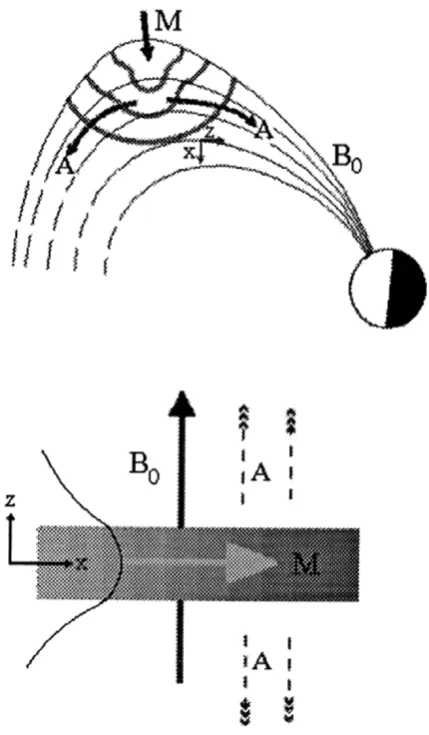
contrast with the well-known theory of a magnetospheric field line resonator at mid-latitudes (Southwood, 1974) our suggested mechanism assumes the excitation of propagat-ing (non-standpropagat-ing) Alfven waves. A sketch of this model is depicted in Fig. 1.
The disturbed electromagneticfield is presented as a sum of partial Alfven(E(a),B(a)) and compressional (E(s),B(s)) waves. This decomposition is convenient to perform with the help of potentials for Alfven (ϕ) and compressional (ψ) disturbances, as follows
E(a)= −∇⊥ϕ, ∂tB(a)=c[ez× ∇⊥]∂zϕ, (1a) E(s)=[ez× ∇⊥]ψ, ∂tB(s)=c
∇⊥∂zψ−
∇2
⊥ψ
ez
(1b)
Fig. 1. (upper). Schematic plot of the transformation of magnetosheath disturbances (M) into propagating Alfven waves (A) in a cusp-related MHD waveguide. Grey lines stand for the isolines of an Alfven velocity; (bottom). The model of a plasma waveguide, where a compressional mode (M) (itsfield-aligned distribution is depicted near the coordinate axis) converts into propagating away Alfven waves (A).
The differential operators in (1) are∇⊥=(∂x,i ky,0), [ez×
∇⊥]=(−i ky, ∂x,0), and∇⊥2 =∂x x−k2y. The potentialϕis proportional to thefield-aligned current jztransmitted by an MHD disturbance, as follows from∂tjz =(c2/4π)∇⊥2∂zϕ. The potentialψ characterizes magnetic field compression, that is,∂tBz(s)= −c∇⊥2ψ. Because this model system is ho-mogeneous along the yaxis, we consider only a particular harmonic exp(i kyy−iωt). For the complex Fourier har-monic of potentialsϕ andψ the system of Maxwell’s and ideal MHD equations reduces to
∂xLˆA∂xϕ−k2yLˆAϕ = −i kygψ, (2a)
∂xLˆM∂xψ−k2yLˆMψ=i kygϕ. (2b)
Here LˆA = ∂zz +kA2 denotes the Alfven operator, LˆM =
∇2
⊥+∂zz+kA2is the“magnetosonic”operator, andkA(x,z)=
ω/VA(x,z)is an Alfven wave number. The factorg(x,z)=
∂xk2
A(x,z)is due to the transverse inhomogeneity of a system
and determines the coupling between modes.
two-dimensionally inhomogeneous plasma. It is assumed that the field aligned distribution of VA(z)has a symmetrical mini-mum atz=0, thus forming a waveguide for a compressional mode.
The commonfield line resonance theory (e.g., Fedorovet al., 1995) has a local character, i.e., it describes the wavefield only in the vicinity of a resonant shell, where LˆAϕ → 0,
and can provide exact magnitudes of the excitation coeffi-cients only with the help of additional numerical calculations. However, for a gradual variation of an Alfven velocityVA(x)
or for small azimuthal wave numberskyan asymptotic theory can be constructed, and the fast compressional mode trans-formation into Alfven waves can be described analytically throughout the system. So, we assume that the variation of VAalong thexaxis (across the geomagneticfield) is smooth.
One can take into account this dependence explicitly by in-troducing the small parameterε=(scale of the disturbance variation)/(scale of the plasma system inhomogeneity). Then the standard WKB approach can be applied. The details of the analytical formalism and more general relationships can be found in Fedorovet al.(1998).
The interaction between compressional and Alfven waves is weak when the coupling factorεkyis small. In a zeroth-order approximation over this parameter these modes do not interact with each other and can be described by decou-pled Eqs. (2a) and (2b) with vanishing right-hand sides. In this case (2a) reduces to the equation for small-scale Alfven waves (Timofeev, 1979), while (2b) describes the compres-sional waves.
In contrast with usual models offield line resonance, where excitation of standing Alfven waves between conjugate iono-spheres is considered, here we address the generation of prop-agating Alfven waves, emitted from a local layer with dense plasma, but without any reflecting boundaries. Herein we consider the process of the emission of Alfven waves, partly escaping along thefield lines from the conversion region, by a compressional mode confined within a layer with a lowVA
(Fig. 1).
Wefirst analyze the uncoupled Eq. (2b) without the right hand side and construct solutions describing the propagation of compressional waveguide modes along x with the use of the WKB technique. The reverse influence of Alfven waves on compressional disturbances scales asε2 and can be neglected. In this case the expression for the potentialψ, which describes the modulated compressional eigenmode, has the form (withεaccuracy)
ψ(x,z)=A where A is the amplitude of some waveguide mode, inde-pendent ofxandz. The functionw(x,z)in (3) describes the distribution of the potentialψ inside the waveguide in the cross-sectionx=const (schematically shown in the bottom of Fig. 1). Bothw(x,z)and the transverse wave number k2
⊥(x) = (k2x +k
2
y) vary gradually along x axis. In fact, they are just the normalized eigenfunction and eigenvalue of the operatorLˆA(x), that isLˆA(x)w(x,z)= k2⊥(x)w(x,z).
Here and throughout we assume that there is at least one propagating waveguide mode.
The region with lowVA(a“magnetic well”) can be treated
not only as a waveguide for a compressional mode, but also as a field-aligned resonator with opaque (partly reflecting) boundaries for Alfven waves. The partial reflection of Alfven waves takes place at the steep gradient ofVAat the walls of
the magnetic well. The mechanism of partial reflection (the total reflection of an Alfven wave is impossible because the corresponding wave equation (2a) has no turning point) has been used already to interpret the trapping of Alfven waves in the solar chromosphere (Leroy, 1980) and the formation of an Alfven resonator in the topside ionosphere (Polyakov, 1981; Lysak, 1988).
The equation for Alfven waves emitted from a waveg-uide/resonator can be found by substituting the compres-sional potentialψ into the right-hand side of (2a). Neglect of terms∼ o(2)essentially simplifies the Eq. (2a), which
can be reduced to an ordinary differential equation, where the coordinatex comes in just as a parameter. As a result, the Alfven potentialϕcan be found from the relationu= ∇2
⊥ϕ, where the functionu(x,z)is determined by
ˆ
LA(x,z)u(x,z)= −i kyg(x,z)ψ(x,z). (4)
The solution of (4) provides to the first order an explicit formula for the potentialϕfor Alfven waves both inside the waveguide and emitted from the resonator.
Estimates of the amplitudes of the emitted Alfven waves are expressed via the ratiobAbetween the magnitude of
mag-netic components of an emitted Alfven wave outside the waveguide and the magnitude of a compressional mode at the center of the waveguide
bA(x)=B(a)(x,z= ±∞)/B(s)(x,z=0). (5)
The relevant magneticfields in (5) can be determined through the expressions derived for potentialsϕ andψ, and (1). In Section 3 we consider a simple case when the exact analytical expressions forbA(x, ω)can be found.
3.
Step-like Waveguide Profile
For illustration of the basic physics we simplify the model and assume that thefield-aligned profile of Alfven velocity can be approximated by a step-like dependence onzinside (VA(|z|<a)=V1) and outside (VA(|z|>a)=V2) a layer
with thickness 2a. The variations of plasma parameters along the waveguide (x-axis) are still smooth, but arbitrary. In this case the calculation of eigenvalues and eigenfunctions of the operator LˆAis similar to the problem of a rectangular
po-tential well in quantum mechanics. Moreover, to make the expressions more tractable, we consider separately the cases when only one parameter fromV1,V2andavaries along the
waveguide. Explicit expressions for the dependence of the amplitude conversion factorbAon the normalized frequency
h = πω/2ωA are obtained with elementary functions for
a fundamental compressional mode in two particular cases. Thefirst one (a) is when the parametersV1andV2arefixed,
but the width of the layer 2a(x)varies along the waveguide, whereas the case (b) corresponds to a layer with a constant thickness, when only the Alfven velocityV1(x)inside a
mag-netic well varies. The dependences ofbAon frequency at a
dimensionless factorsb∗(h):
bA=kya
dad x b∗(h),
b∗=(1−δ2) h 2cosξ
(h2−ξ2)3/2 ·
δ
(tan2h+δ2)1/2,
(6a)
bA=kya
a dhh d x b∗(h),
b∗ = tanh
sinξ −(1−δ
2)1/2
h3sin 2ξ
(h2−ξ2)5/2
· δ
(tan2h+δ2)1/2.
(6b)
Here the parameterξ(h, δ)is defined implicitly by the equa-tionξ (cosξ)−1 =h(1−δ2)1/2 (0≤ ξ < π/2). The ratio
δ = V1/V2 between Alfven velocities inside and outside
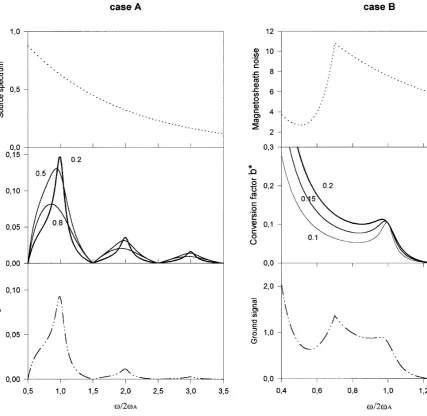
Fig. 2. Idealized color-noise spectrum in the magnetosheath in arbitrary units (upper); Dependence of the conversion factorb∗on the normalized frequencyω/2ωAfor several values of the parameterδfor the case (a)
(middle); Schematic plot of the expected spectrum (in arbitrary units) under the cusp projection (bottom).
the layer, as will be shown below, determines the resonant features of the system we consider.
The general structure of the conversion factorb∗(6) rep-resents a function which decays with frequency, multiplied by the periodic functionδ(δ2+tan2h)−1/2which oscillates
between 0 and 1. The dependence ofb∗ in afixed pointx on frequency for the case (a) is shown in the middle plot of Fig. 2 and for the case (b) in Fig. 3. In both cases these dependences are rather similar to each other.
Analysis of the expressions (6) and Figs. 2 and 3 shows that Alfven waves are excited most effectively when the fre-quency ωapproaches the local frequencies of Alfven har-monics in the resonator, i.e.h → πn,(n =1,2, . . .). The resonant nature of the transformation process is more clearly revealed in case (a). The amplitudes of resonant maxima decrease rapidly with harmonic numbern.
The set of curves in Figs. 2 and 3, shown for different val-ues ofδ, indicates that asδdecreases, the resonant spectral
peaks become more evident. The parameterδdetermines the halfwidth of resonant peaks, e.g.h =δorω=δV1/a,
and an effective Q-factor for an Alfven resonator, corre-spondingly. Summarizing the above, the resonant features of the transformation process owing to an effective Alfven resonator are given by the following
ω2nωA=(πV1/a)n, (n=1,2, . . .),
Q=nπ/2δ. (7)
4.
Relevance to ULF Observations in the Cusp
The high-altitude cusp in the terrestrial magnetosphere is a region where such a resonant transformation into propagat-ing (guided) Alfven waves may take place. A local minimum of theVA(z)distribution along thefield line exists near thehigh-altitude cusp owing to smallB values. As some indi-rect evidence of the existence and relative stability of this high-altitude region with minimum magneticfield magni-tude, we mention the observations of a“magnetic bottle” near the exterior cusp, and of its particle trapping (Chenet al., 1998). The idea of cusp-related waveguide recently got support from the POLAR spacecraft observations (Chen and Fritz, 1998). As mentioned in this paper, the turbulent ULF magnetic energy reaches maximal magnitudes just in the re-gion of high-altitude cusp.
This region forms an Alfven resonator without conductive boundaries. In this resonator hydromagnetic turbulence pen-etrating from the magnetosheath can accumulate and trans-form into Alfven waves escaping along thefield lines. Due to the resonant nature of the transformation process a narrow-band or narrow-band-limited spectrum of cusp-related Pc3 pulsations can be formed.
Let us consider several predictions stemming from the model of the cusp waveguide. As a rough estimate, we assume that the typicalfield-aligned scale of the minimum of the Alfven velocity in the region of the exterior cusp is 2a =2RE, and that inside it,VAdrops from magnetospheric
valuesV2 =103km/s toV1=4×10²km/s. Our model (7)
then predicts that the most effective transformation of broad-band compressional wave energy will occur at frequencies f V1/2a 30 mHz, which falls into the Pc3 band. The
resonant features of an Alfven resonator in the cusp region can be estimated from (7), and for the above set of parameters theQ-factor of the fundamental mode in the cusp waveguide isQ4. This value can produce experimentally noticeable modifications of the ULF spectrum. Because the heights of resonant peaks drop off sharply with harmonic number, no harmonic structure of cusp-related Pc3 waves is likely to be observed. In a schematic way the formation of a narrow-band spectrum of ground Pc3 pulsations from the magne-tosheath noise is depicted in Fig. 2, where in the upper plot an idealized spectrum of compressional disturbance source is shown, whereas the bottom plot shows the expected spec-trum of emitted Alfven waves as a result of convolution of the source spectrum with the frequency-dependent conver-sion factor. According to our scheme the observed frequency would be mainly determined by local parameters of the cusp resonator.
In regard to order of magnitude, relationships (6) can be scaled asbAb∗(kya)(a/Lx), whereLx=(∂loga/∂x)−1
is the scale of the waveguide inhomogeneity. Formally, the model is valid under the approximation(a/Lx)1 due to the assumed smoothness of variations of plasma parameters. However, the estimates obtained under a WKB approxima-tion are qualitatively valid even at the margin of applica-bility, i.e., when (a/Lx) ≤ 1. The azimuthal component of the wave vector ky is approximately the inverse of the azimuthal scale of the cusp, that is ky L−1
y 1/2RE.
Thus, the above estimates show that emitted Alfven waves may reach amplitudes about 1 to 1.5 orders of magnitude less than the amplitudes of the driving compressional wave activity. The ground ULF signature from Alfven waves may be higher, by a factorBionosphere/Bcusp∼10 owing to
convergence of geomagneticfield lines. Note also that re-lationships (6) describe amplitudes of emitted Alfven waves outside the resonator. Amplitudes of Alfven waves trapped within the resonator are aboutδ−1times larger.
The recent observations by POLAR show that in the day-side polar cusp a local magnetic turbulence demonstrates sev-eral spectral peaks near 0.3 Hz (seefigure 4 in Chen and Fritz (1998)) with power density up to∼103nT2/Hz. Even with
relatively low conversion rates given by the WKB approx-imation, the cusp turbulence of such intensity may ensure ground ULF signals of order of several nT.
As (6) demonstrates, the transformation efficiency grows when the gradient becomes more steep. The realistic physical situation may well correspond to the casea/Lx 1, which is too difficult for the analytical treatment. So, it would be desirable to consider analytically the other extreme situa-tion, whena/Lx 1, and to check the match between the results of two models at the boundary of validity. The most efficient way the predictions of our model can be verified is with the use of modern 2- and 3-dimensional MHD codes, which have been used so far only for the study of the propaga-tion/transformation of compressional pulses launched at the magnetospheric equator (Allanet al., 1986; Lee and Lysak, 1989).
The decaying behavior of the dependence bA(ω),
espe-cially evident in case (b), indicates that the high-latitude Alfven resonator in the cusp can operate also as a low-pass filter. Examination of characteristics of the broadband mag-netosheath noise spectra (e.g., Plates 2 and 4 of Engebretson et al., 1991b) indicates a low-frequency cutoff, as schemat-ically shown in the upper plot of Fig. 3. This cutoff fre-quency corresponds to the upstream wave frefre-quency, in gen-eral. Hence, the band-limited ULF spectral structure ob-served in cusp-latitude ground magnetometer data, as de-picted in the bottom plot of Fig. 3, can be produced by the combination of two effects: a low-frequency cutoff charac-teristic of the magnetosheath noise and low-pass features of the transformation process. In this case the frequency of this non-resonant spectral peak is mainly determined by the cutoff frequency, controlled by IMF magnitude.
The growth ofb∗ at low frequenciesω ωA, evident
of the guided surface-type compressional mode is just a for-mal consequence of the model we have considered and it cannot be observed in reality. In fact, its spatial scale ex-ceeds the size of the MHD waveguide in the cusp. Thus, this model cannot be applied for the ULF cusp phenomena in the low-frequency rangeωωA, though it may describe
guidance of compressional disturbances along a large-scale plasma layer, like in the magnetosphere of Saturn (Cramm et al., 1998).
The model developed is based on a variation of the Alfven velocity that is due to the variation in plasma density N, whereas in the real situation the variation is primarily due to the variability in the magnitude of the magneticfield B. Actually, for the same geometry of the magneticfield, MHD modes are sensitive to variations of Alfven velocity, but not to separate variations of N or B. So, the model with an inhomogeneous plasma density only is a good approximation of the real situation.
The model assumes that the variations of the Alfven ve-locity is symmetric aroundz=0, because the comprehen-sive analytical treatment of non-symmetric profile of Alfven velocity (e.g., VA(−∞) = VA(+∞)) is much more
cum-bersome. When this simplifying assumption is not valid, we expect that principal features of the waveguide/resonator remain qualitatively the same, but the emission of Alfven waves would be non-symmetric: the leakage into a side with smaller gradient ofVAwould be higher.
5.
Discussion
In this paper we have considered only one aspect of a more general problem: what are the physical differences be-tween cusp-associated Pc3 and mid-latitude Pc3 pulsations? Are these different classes of MHD activity, just acciden-tally falling in the same frequency band? Which is the main channel of transmission of wave energy in the Pc3 band from the solar wind into the magnetosphere—through the cusp or through the near-equatorial magnetosphere? Ear-lier analyses of the meridional distribution of Pc3 pulsations (Bol’shakova and Troitskaya, 1984; Plyasova-Bakouninaet al., 1986) noted a maximum at cusp latitudes. However, these studies compared only averaged amplitudes over about 10-min and longer intervals, and consequently these results only indicate that the intensity of waves in the Pc3 band in the cusp is higher than at mid-latitudes. They do not address the question of the possible identity (a common source) of the signals.
We are inclined to think that the cusp Pc3 and mid-latitude Pc3 have a common source in turbulent magnetosheath plasma, the features of which depend predominantly on IMF orientation, but that their means of penetration to the iono-sphere are different. One channel is the propagation of compressional mode waves in the near-equatorial magne-tosphere. There, periodic wave trains are formed under the influence of magnetospheric field line Alfven resonances. Another channel is the penetration of magnetosheath wave turbulence directly via the polar cusp region. Here also some filtering of input signals takes place, and in this paper we have indicated one possible mechanism. Hence, we expect that general characteristics of Pc3 activity at the cusp lati-tudes and at mid-latilati-tudes might be similar, because they are
caused by the same source. However, because the propa-gation channels are different, we would not expect tofind a detailed coherence between cusp Pc3 and mid-latitude Pc3 activity: the difference in the channels of the penetration of wave energy into the magnetosphere through the cusp and via the equatorial plane of the magnetosphere results in the absence of close correlations between the separate daytime Pc3 packets at high and middle latitudes (Pilipenkoet al., 1996).
It is also probable that some non-MHD plasma mecha-nisms operating in the cusp, such asflow and current insta-bilities, modulated particle precipitation, ionospheric turbu-lence, etc., produce magnetic signals in the same ULF band. However, most of these models actually predict the genera-tion of wide-band turbulence.
The analysis of possible plasma parameters near the high altitude cusp shows that resonant features of the MHD waveg-uide/resonator are not very high, which may explain that narrow-band Pc3 are relatively rare at cusp latitudes as com-pared with Pi1. The resonant features of the cusp-related resonator depend on the actual field-aligned profile of an Alfven velocity, and when the effective Q-factor drops to unity and less, the band-limited resonantfiltering is not well pronounced and broad-band wave activity are to be observed. According to our scheme the band-limitedfiltering of mag-netosheath noise may occur owing to resonant features of the wave conversion mechanism (Fig. 2). In this case an observed wave packet’s frequency is mainly determined by local parameters of the cusp resonator, which may explain the absence of Pc3-IMF correlations at cusp latitudes below 30 mHz in the data set of Wolfeet al.(1990). There is also a pos-sibility that band-limited spectral structure of Pc3 is formed in non-resonant way, as a combination of cutoff frequency in the magnetosheath spectrum and decaying frequency de-pendence of the wave conversion efficiency (Fig. 3). In this case an expected frequency is related to the cutoff frequency, which is controlled by the IMF magnitude.
Below we will indicate briefly the expected distinctions between cusp-associated narrow-band Pc3 and mid-latitude Pc3. First, due to the specific polarization asymmetry of res-onant amplification offield line oscillations at mid-latitudes, the Hcomponent is enhanced in comparison to theD com-ponent. This fact is already used for the extraction of the resonant frequency from complicated ULF spectra in the so-calledH/Dpolarization method (Baranskyet al., 1995). A similar asymmetry is not expected to be observed for the cusp-associated Pc3.
Our suggested mechanism has a second geophysical con-sequence which differentiates the excitation of standingfield line oscillations from the generation of propagating Alfven wavelets. In the former case a good conjugacy between ULF waves in opposite ionospheres should be observed at cusp latitudes. The latter scenario, on the contrary, implies a lack of coherence between conjugate points. This conclusion stems from the following qualitative consideration. During propagation the front of an Alfven pulse undergoes distor-tion owing to the inhomogeneous distribudistor-tion of VAacross
anal-ogous to the phase mixing during the time evolution of an Alfven disturbance in an inhomogeneous system. As a result, when an Alfven pulse reaches the ionosphere its transverse wave vector will bekx L−1
x (kl), whereLxis the scale of the transverse inhomogeneity, andl is the distance passed. For example, an Alfven pulse emitted from the northern po-lar cusp will have a scale above the southern ionosphere kx 2×10⁻² km−1fork
l 10 andLx 5×10²km. This signal is substantially attenuated at the ground, because kxH 2 (H 120 km is the height of the ionosphere). Upon reflection from the ionosphere an Alfven pulse will get an additional increase of transverse wave vector of about
kx 2kcotI (I is the inclination of the geomagnetic field), which will further decrease the transverse scale. The above relationship follows from the conservation of the hori-zontal component of the Alfven wave vector upon reflection from the ionosphere. As a result the Pc3 signal is likely to totally dissipate due to small-scale kinetic mechanisms on its returnflight. Hence, although the Alfven pulses may be emitted symmetrically from the polar cusp waveguide in both directions along the field lines, the signal at the con-jugate point will be substantially attenuated due to phase mixing over its larger travel distance, even in the absence of any damping mechanisms. So, while overall ULF activity in both cusps, primarily determined by the turbulence level in the solar wind, might be similar in general, we would expect tofind no coherence between separate wave packets.
This consequence of our model is in accord with some cusp-related ULF observations. Analysis of Pc3 pulsations at the conjugate stations Iqaluit, Canada and South Pole, Antarctica by Wolfeet al.(1990) during local daytime hours indicated a lack of conjugacy on an event by event basis.
We suggest also a third distinctive feature of cusp-related Pc3 activity. Mid-latitude Pc3 waves are believed to be trans-ported from an extra-magnetospheric source by large-scale compressional waves, which ensures the global nature of these pulsations. They have large scales in the azimuthal direction (or smallm values). Though the meridional dis-tribution of Pc3 amplitudes might be non-monotonic, the Pc3 wave packets can be traced from sub-auroral latitudes to the equator. On the contrary, the proposed model of cusp Pc3 assumes the excitation of Alfven waves in a relatively localized region of the magnetosphere. As was mentioned above, Alfven waves are weakly converted into compres-sional waves. Thus, we expect that the cusp-related Pc3 would be a localized wave phenomenon, mostly associated with the equatorward cusp boundary.
Some observational results confirm this notion. Alfordet al.(1996) studied the spatial structure of relatively narrow-band Pc3–4 signals near local noon at the MACCS network in Arctic Canada, covering 5 hours in magnetic LT at lat-itudes from 75◦ to 79◦. Multistation comparisons showed that the spatial scale of Pc3 pulsations was typically less than 300 km. This result is consistent with the observations reported by Olson and Fraser (1994), who found good co-herence only between two cusp-latitude stations separated by 150 km. Similarly, Olson and Szuberla (1997) and Szuberla et al.(1998), though not discriminating clearly between Pi1 and Pc3, estimated the upper bound for the coherence length of these pulsations near the cusp to be near or slightly less
than 200 km. The scale of an Alfven wave beam in the iono-sphere must be about∼120 km less than at the ground. Thus the ground magnetic observationsfit the Halley PACE radar observations, indicating lack of coherence at Pc3 frequencies over distances in the North-South direction beyond about 60 km (Bakeret al., 1998).
6.
Conclusion
The existence of new magnetospheric phenomenon: MHD waveguide/resonator in the high-altitude cusp is suggested. The accumulation of turbulent ULF magnetic energy in the region of the high-altitude cusp evidenced by POLAR space-craft observations is consistent with this prediction. How-ever, a relevant analytical description of the wave trapping and transformation in such a system is actually a complicated 2-dimensional problem, which is much beyond the standard 1-dimensional field line resonance theory. The analytical model developed, though having some pitfalls caused by oversimplifications of the realistic situation, predicts leak-age of Alfven waves from the region with trapped wave energy. In contrast to the well-known model of field line resonance, in the mechanism suggested here the transforma-tion of ULF wave modes occurs in a localized region with a decreased Alfven velocity, which has no reflecting bound-aries. This transformation into propagating Alfven waves has a frequency-resonant character, which may ensure the formation of band-limited spectra of ULF Pc3 pulsations in the cusp region. Also, it is possible that band-limited Pc3 spectra could be the result of the convolution of the typi-cal magnetosheath spectrum with cutoff frequency with the frequency decaying conversion factor.
Probably, the cusp-associated narrow-band Pc3 waves and mid-latitude Pc3 waves have a common source in the turbu-lent magnetosheath plasma, the features of which depend on the orientation and magnitude of the IMF. However, their mechanism of penetration to the ionosphere is different, and it is this which enables us to consider them as different wave phenomena. Observations with a dense meridional profile with sufficiently high time resolution will be needed to con-firm this mechanism and determine the spatial boundary be-tween cusp-related Pc3/Pi1 and mid-latitude Pc3 waves.
Acknowledgments. The collaboration of the Institute of the Physics of the Earth with Augsburg College and Boston University is supported by National Science Foundation grants ATM-9610072 to Augsburg College and ATM-9704766 to Boston University.
References
Alford, J. L., M. J. Engebretson, K. A. Schmidt, W. J. Hughes, R. L. Arnoldy, C. G. Maclennan, and H. Fukunishi, Studies of the coherence and propa-gation of Pc 3 pulsations at cusp/cleft/polar cap latitudes (abstract),EOS Trans. AGU,77, 46, Fall Meet. Suppl, F609, 1996.
Allan, W., S. P. White, and E. M. Poulter, Impulse excited hydromagnetic cavity andfield-line resonances in the magnetosphere,Planet. Space Sci.,
34, 371–385, 1986.
Baker, K. B., M. J. Engebretson, A. S. Rodger, and R. L. Arnoldy, The coherence scale length of band-limited Pc3 pulsations in the ionosphere, Geophys. Res. Lett.,25, 2357–2360, 1998.
Baransky, L. N., A. W. Green, E. N. Fedorov, N. A. Kurneva, V. A. Pilipenko, and W. Worthington, Gradient and polarization methods of ground-based monitoring of magnetospheric plasma,J. Geomag. Geoelectr.,47, 1293–
1309, 1995.
Transl.,24, 633–636, 1984.
Chen, J., T. A. Fritz, R. B. Sheldon, H. E. Spence, W. N. Spjeldvik, J. F. Fennell, S. Livi, C. T. Russell, J. S. Pickett., and D. A. Gurnett, Cusp energetic particle events: Implications for a major acceleration region of the magnetosphere,J. Geophys. Res.,103, 69–78, 1998.
Chen, J. and T. A. Fritz, Correlation of cusp MeV helium with turbulent ULF power spectra and its implications,Geophys. Res. Lett.,25, 4113–4116, 1998.
Cramm, R., K.-H. Glassmeier, M. Stellmacher, and C. Othmer, Evidence for resonant mode coupling in Saturn’s magnetosphere,J. Geophys. Res.,
103, 11,951–11,960, 1998.
Engebretson M. J., C.-I. Meng, R. L. Arnoldy, and L. J. Cahill, Jr., Pc3 pulsations observed near the south polar cusp,Geophys. Res. Lett.,91, 8909–8918, 1986.
Engebretson, M. J., B. J. Anderson, L. J. Cahill, Jr., R. L. Arnoldy, P. T. Newell, C.-I. Meng, L. J. Zanetti, and T. A. Potemra, A multipoint case study of high latitude daytime ULF pulsations,Geophys. Res. Lett.,94, 17,143–17,160, 1989.
Engebretson, M. J., L. J. Cahill, Jr., R. L. Arnoldy, B. J. Anderson, T. J. Rosenberg, D. L. Carpenter, U. S. Inan, and R. H. Eather, The role of the ionosphere in coupling upstream ULF wave power into the dayside magnetosphere,Geophys. Res. Lett.,96, 1527–1542, 1991a.
Engebretson, M. J., N. Lin, W. Baumjohann, H. Luehr, B. J. Anderson, L. J. Zanetti, T. A. Potemra, R. L. McPherron, and M. G. Kivelson, A comparison of ULFfluctuations in the solar wind, magnetosheath, and dayside magnetosphere, 1. Magnetosheath morphology,Geophys. Res. Lett.,96, 3441–3454, 1991b.
Engebretson, M. J., J. R. Beck, D. L. Detrick, T. J. Rosenberg, R. L. Rairden, S. B. Mende, R. L. Arnoldy, and L. J. Cahill, Jr., Optical evidence that modulated electron precipitation near the magnetospheric boundary drives high latitude Pc3-4 magnetic pulsations, inPhysical Signatures of Magnetospheric Boundary Layer Processes, NATO ASI Series C, vol. 425, edited by J. A. Holtet, and A. Egeland, 456 pp., pp. 361–373, Kluwer, Dordrecht, the Netherlands, 1994.
Engebretson, M. J., W. J. Hughes, J. L. Alford, E. Zesta, L. J. Cahill, Jr., R. L. Arnoldy, and G. D. Reeves, Magnetometer array for cusp and cleft studies observations of the spatial extent of broadband ULF magnetic pulsations of cusp/cleft latitudes,J. Geophys. Res.,100, 19,371–19,386, 1995.
Fedorov, E. N., N. G. Mazur, V. A. Pilipenko, and K. Yumoto, On the theory offield line resonances in plasma configurations,Physics of Plasmas,
2(2), 527–532, 1995.
Fedorov, E. N., N. G. Mazur, V. A. Pilipenko, and K. Yumoto, MHD wave conversion in plasma waveguides,J. Geophys. Res.,103, 26,595–26,605, 1998.
Glassmeier, K.-H., ULF pulsations in the polar cusp and cap, in Electromag-netic Coupling in the Polar Clefts and Caps, NATO ASI Series, edited by P. E. Sandholt and A. Egeland, 465 pp., pp. 167–186, Kluwer, Dordrecht, the Netherlands, 1989.
Le, G. and C. T. Russell, The morphology of ULF waves in the Earth’s foreshock, inSolar Wind Sources of Magnetospheric ULF Waves, Geo-physical Monograph 81, edited by M. J. Engebretson, K. Takahashi, and M. Scholer, 424 pp., pp. 87–98, AGU, Washington D.C., 1994.
Lee, D.-H. and R. L. Lysak, Magnetospheric ULF wave coupling in the dipole model: the impulsive excitation,J. Geophys. Res.,94, 17,097–
17,104, 1989.
Lepidi, S., U. Villante, M. Vellante, P. Palangio, and A. Meloni, High res-olution geomagneticfield observations at Terra Nova Bay, Antarctica, Annali di Geofizica,33, 519–525, 1996.
Leroy, B., Propagation of waves in an atmosphere in the presence of a magneticfield. II. The reflection of Alfven waves,Astron. Astrophys.,
91, 136–146, 1980.
Lin, N., M. J. Engebretson, R. L. McPherron, M. G. Kivelson, W. Baujohann, H. Luehr, T. A. Potemra, B. J. Anderson, and L. J. Zanetti, A compari-son of ULFfluctuations in the solar wind, magnetosheath, and dayside magnetosphere, 2. Field and plasma conditions in the magnetosheath,J. Geophys. Res.,96, 3455–3464, 1991.
Lysak, R. L., Theory of auroral zone Pib pulsation spectra,J. Geophys. Res.,
93, 5942–5946, 1988.
Olson, J. V., ULF signatures of the polar cusp,J. Geophys. Res.,91, 10,055–
10,062, 1986.
Olson, J. V. and B. J. Fraser, Pc3 pulsations in the cusp, inSolar Wind Sources of Magnetospheric ULF Waves, Geophysical Monograph 81, edited by M. J. Engebretson, K. Takahashi, and M. Scholer, 424 pp., pp. 325–334, AGU, Washington D.C., 1994.
Olson, J. V. and C. A. L. Szuberla, A study of Pc3 coherence at cusp latitudes, J. Geophys. Res.,102, 11,375–11,383, 1997.
Pilipenko, V., N. Kleimenova, O. Kozyreva, K. Yumoto, and J. Bitterly, Is the cusp a source of mid-latitude Pc3 pulsations?Geomagn. and Aeronomy,
36, 39–48, 1996.
Plyasova-Bakounina, T. A., V. A. Troitskaya, J. W. Munch, and H. F. Gauler, Super-high-latitude maximum of Pc2–4 intensity,Acta Geod., Geophys. et Montanist. Hung.,21, 143–153, 1986.
Polyakov, S. V., Ionospheric Alfven resonator,Geomagn. and Aeronomy,
21, 371–377, 1981.
Southwood, D. J., Some features offield line resonances in the magneto-sphere,Planet. Space Sci.,22, 483–491, 1974.
Szuberla, C. A. L., J. V. Olson, M. J. Engebretson, B. J. Fraser, S. Ables, and W. J. Hughes, Interstation Pc3 coherence at cusp latitudes,Geophys. Res. Lett.,25, 2381–2384, 1998.
Timofeev, A. V., To the theory of Alfven oscillations in an inhomogeneous plasma, inReviews of Plasma Physics, Vol. 9, edited by M. A. Leontovich, pp. 205–232, Plenum Publishing Corp., 1979.
Wolfe, A., D. Venkatesan, R. Slawinski, and C. G. Maclennan, A conjugate area study of Pc3 pulsations near cusp latitudes,J. Geophys. Res.,95, 10,695–10,698, 1990.
Zhang, X., H. Comfort, Z. E. Musielak, T. E. Moore, D. L. Gallagher, and J. L. Green, Propagation characteristics of Pc3 compressional waves generated at the dayside magnetopause,J. Geophys. Res.,98, 15,403–
15,410, 1993.