Throughput Analysis of Fading Sensor Networks
with Regular and Random Topologies
Xiaowen Liu
Department of Electrical Engineering, University of Notre Dame, Notre Dame, IN 46556, USA Email:[email protected]
Martin Haenggi
Department of Electrical Engineering, University of Notre Dame, Notre Dame, IN 46556, USA Email:[email protected]
Received 30 November 2004; Revised 5 June 2005
We present closed-form expressions of the average link throughput for sensor networks with a slotted ALOHA MAC protocol in Rayleigh fading channels. We compare networks with three regular topologies in terms of throughput, transmit efficiency, and transport capacity. In particular, for square lattice networks, we present a sensitivity analysis of the maximum throughput and the optimum transmit probability with respect to the signal-to-interference ratio threshold. For random networks with nodes distributed according to a two-dimensional Poisson point process, the average throughput is analytically characterized and nu-merically evaluated. It turns out that although regular networks have an only slightly higher average link throughput than random networks for the same link distance, regular topologies have a significant benefit when the end-to-end throughput in multihop connections is considered.
Keywords and phrases:throughput, Rayleigh fading, slotted ALOHA, network topology, interference.
1. INTRODUCTION
A sensor network [1] consists of a large number of sensor nodes which are placed inside or near a phenomenon. Uni-formly random or Poisson distributions are widely accepted models for the location of the nodes in wireless sensor net-works, if nodes are deployed in large quantities and there is little control over where they are dropped. A typical scenario is a deployment from an airplane for battlefield monitoring. On the other hand, depending on the application, it may also be possible to place sensors in a regular topology, for exam-ple, in a square grid.
Throughput is a traditional measure of how much traf-fic can be delivered by the network [2, 3]. There is a rich literature on throughput capacity for wireless networks [2, 4,5] with random or regular topologies. The seminal pa-per [2] shows that, for peer-to-peer traffic, in a static two-dimensional network withN nodes and N/2 randomly se-lected source-destination pairs, the end-to-end throughput of a connection is Θ(W/√N), where W is the maximum transmission rate for each node. The reason for this poor
This is an open access article distributed under the Creative Commons Attribution License, which permits unrestricted use, distribution, and reproduction in any medium, provided the original work is properly cited.
scaling behavior is that the per-link1 throughput remains constant while the number of hops grows with√N. Marco et al. [6] show that with many-to-one traffic, the per-node transport capacity isΘ(1/N). Such “order of ” results do not provide any guidelines for protocol design, since the scaling behavior is very robust against changes in MAC and routing protocols [7]. All the above research work assumes networks with randomly located nodes. There are also research efforts focusing on networks with regular topologies. Silvester and Kleinrock [4] calculate the throughput of regular square net-works with a slotted ALOHA channel access scheme. Xie and Kumar [7] prove that theΘ(N) upper bound on transport capacity is tight for regular networks where nodes are placed on integer lattice points for path loss exponents greater than 3 and is achieved by multihop transmission. De et al. [8] compare the performance of regular topologies with random topology in wireless CDMA sensor networks. The authors in [9,10] evaluate the performance for regular grid and random topologies. They assume a “torus” network to avoid bound-ary effects and use the expected interference power to re-place the exact interference power. In particular at high load,
1The link throughput is the total achievable throughput over a link,
replacing the actual interference by its mean yields overly pessimistic results. Indeed, the expected interference may be infinite [11].
Most of the work above is based on a “disk model,” where it is assumed that the radius for a successful transmission of a packet has a fixed and deterministic value, irrespective of the condition and the realization of the wireless channel. Such simplified link models ignore the stochastic nature of the wireless channel. Our analysis is based on a Rayleigh fading channel model, which includes both large-scale path loss and stochastic small-scale variations in the channel characteris-tics. Note that even with static nodes as assumed in this pa-per, the channel quality varies because any movement in the environment affects the multipath geometry of the RF sig-nal, which is easily confirmed experimentally [12, page 45]. The significant variation of the link quality when nodes are immobile is also pointed out in [13,14,15], and the short-comings of the “disk model” are discussed in [11].
This paper addresses the throughput problem for large sensor networks with Rayleigh fading channels. To provide insight on the impact of the topology on the network per-formance, we compare networks with a random topology and three regular topologies. Placing nodes in regular lat-tices has an obvious advantage in terms of coverage [16], so we are not addressing coverage issues here. We define the (per-link) throughput as the expected number of successful packet transmissions of a given link per timeslot. The end-to-endthroughput over a multihop connection, defined as the minimum of the throughput values of the links involved, is a performance measure of a route and the MAC scheme.
We consider a variant of the slotted ALOHA channel ac-cess scheme, originally devised in [17], that takes advantage of spatial reuse. It is assumed, as in [4,18,19,20], that in ev-ery timeslot, each node transmits independently with a cer-tain fixed probability p. While often a “heavy traffic” model is used [4,20], where nodes always have packets to trans-mit and ponly reflects the channel access probability, we do not restrict ourselves to this “MAC-centric” case. Rather, we considerpto be composed of two factors, that is,p= pqpt, where pqis the probability that there is a packet in a node’s queue awaiting transmission, and pt is the probability of transmission conditioned on having a packet in the queue (the channel access probability). So, pqis given by the traffic model,ptis the actual slotted ALOHA channel access prob-ability, and p is the unconditioned probability of transmis-sion. The heavy traffic case mentioned above corresponds to pq=1,pt=p, and the other extreme case ispq=p,pt=1, where Bernoulli traffic is generated with probabilitypqand each node with a packet to transmit has immediate access to the channel. Since there is no need for a MAC scheme in this case, we may denote it as “traffic-centric.” Hence, the de-composition ofpshows that the throughput analysis and op-timization with respect to pin fact includes a range of traf-fic intensities and channel access probabilities. The Bernoulli traffic model is well justified by the following three observa-tions: (1) in [18], it was shown that the traffic from a slot-ted ALOHA population of nodes can indeed be modeled as Bernoulli; (2) in [21, page 278], it is pointed out that the
retransmission traffic is usually Bernoulli (since an unsuc-cessfully transmitted packet reenters the queue); and (3) the Bernoulli traffic model is memoryless and thus the discrete-time counterpart of the ubiquitous Poisson model.
The traffic distribution in a sensor networks is usually spatially and temporally bursty, that is, busy periods alter-nate temporally and busy areas alteralter-nate spatially with pe-riods and areas with little or no traffic. It may therefore be impractical to employ reservation-based MAC schemes such as TDMA and FDMA that require a substantial amount of coordination traffic and cannot be implemented efficiently and in a fully distributed fashion.2 In any case, the slotted ALOHA scheme is the simplest meaningful MAC scheme and therefore provides a lower bound on the performance for more elaborate schemes. Since areas of the network or pe-riods with little or no traffic pose no problems, our analysis focuses on and applies to busy areas and busy periods of the network where collisions are unavoidable and the through-put is interference-limited. During such a burst of traffic, we assume that the parameters p,pq, and pt remain constant. An important example of a busy area is certainly the critical area around the base station or fusion center, where traffic accumulation due to the many-to-one transmission scheme often results in heavy traffic [22].
In Section 2, the Rayleigh fading link model is intro-duced. For a slotted ALOHA MAC scheme, the conditional success probability of a transmission for a node given the transmitter-receiver and interference-receiver distances is de-rived. Section 3 evaluates the throughput for regular net-works with three topologies and compares their perfor-mance.Section 4investigates the average throughput for ran-dom networks for fixed and ranran-dom transmitter-receiver dis-tances d0. This section also analyzes the transport capacity and end-to-end throughput.Section 5concludes the paper.
2. THE RAYLEIGH FADING LINK MODEL
We assume a narrowband Rayleigh block fading channel. A transmission from node i to node j is successful if the signal-to-noise-and-interference ratio (SINR) γi j is above a certain thresholdΘthat is determined by the communica-tion hardware and the modulacommunica-tion and coding scheme [14]. The SINRγis given byγ =Q/(N0+I), whereQis the re-ceived power, which is exponentially distributed with mean
¯
Q. Over a transmission of distancedwith an attenuationdα, we have ¯Q=P0d−α, whereP0denotes the transmit power,α is the path loss exponent.N0denotes the noise power, andIis the interference power, that is, the sum of the received power from all the undesired transmitters. Our analysis is based on the following theorem.
Theorem 1. In a Rayleigh fading network with slotted ALOHA, where nodes transmit at equal power levels with prob-ability p, the success probability of a transmission given a de-sired transmitter-receiver distance d0 and n other nodes at
distancesdi(i=1,. . .,n) is
whereP0is the transmit power,N0the noise power, andΘthe SINR threshold.
Proof. LetQ0 denote the received power from the desired transmitter andQi,i =1,. . .,n, the received power fromn potential interferers. All the received powers are exponen-tially distributed, that is,pQi(qi)=1/Qie¯ ·−qi/Q¯i, where ¯Qi de-notes the average received power ¯Qi=Pidi−α. The cumulated interference power at the receiver is
I=
n
i=1
SiQi, (2)
where Si is a sequence of i.i.d. Bernoulli random variables withP(Si = 1) = pandP(Si = 0) = 1−p. The success probability of a transmission is3
Ps|d0,d1,...,dn =EI
Since the throughput in large sensor networks is limited by the interference, in the following, we focus on the inter-ference part (the second factor of (3), assumingN0 = 0) to determine bounds that are fundamental in the sense that they cannot be exceeded even if the transmit power is not constrained. The first exponential term is easily evaluated if N0=0.
3A similar calculation has been carried out in [23] for the case where in
every timeslot it is known exactly which node is transmitting. In contrast, Theorem 1incorporates the uncertainty at the MAC level: we only assume we know the probability of a transmission, but not exactly which node is transmitting in every timeslot.
Corollary 1. Under the same assumptions as inTheorem 1but withN0=0and unit transmit powerPi=1, the success prob-ability given a desired link of normalized distancer0=d0/d0= 1andnother nodes at normalized distancesri=di/d0is
Ps|r0,r1,...,rn =
which is the Laplace transform of the interference powerI eval-uated at the SIR thresholdΘ.
Proof. With unit transmit power, the mean power from the ith interferer at distanceriis 1/rα
i. The Laplace transform of the exponential distribution with mean 1/µisµ/(µ+s), thus
In this section, we investigate networks with three regular topologies (square, triangle, hexagon) in which every node has the same number of nearest neighbors and the same dis-tance to all nearest neighbors.
3.1. Square networks
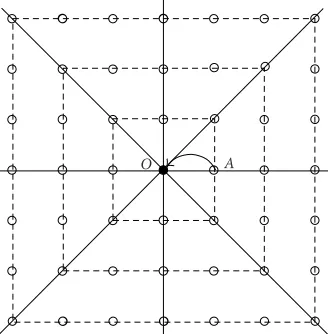
We first analyze square networks withNnodes placed in the vertices of a square grid with distance 1 between all pairs of nearest nodes (density 1). The next-hop receiver of each packet is one of the four nearest-neighbor nodes of the trans-mitter, so the transmitter-receiver distanced0=1. If the re-ceiver nodeOis located in the center of the network as shown inFigure 1and nodeAis the desired transmitter, the success probability for nodeObased on (6) can be written as
O A
Figure1: The topology of a square network. NodeOis the receiver and nodeAis the desired transmitter such that the link distance
d0= |OA| =1.
0 0.01 0.02 0.03 0.04
g
α=5
α=2
0 0.2 0.4 0.6 0.8 1
p
Figure2: The analytic throughputg(p) based on (7) for a square network with 40×40 nodes, withΘ=10.
The first term in (7) accounts for the other three nearest-neighbor nodes of the receiver; the second term for the 4 diagonal nodes at distance √2; all the other terms from the nodes located on the dashed squares with edge ≥ 2 in Figure 1. The throughput4is given by
g(p)=p(1−p)Ps(p), (8)
where pis the probability thatAtransmits and 1−pis the probability that Odoes not transmit in the same timeslot. Note that g is the throughput achievable with a simple ARQ scheme (with error-free feedback) [25]. The analytic throughput g(p) based on (7) and (8) for a regular square
4The throughput is calculated as the throughput of the center link of
the busy area under consideration. This is the worst case since most other nodes experience a lower interference. In the case of infinite networks, the interference distribution is the same at every node.
network with 40×40 nodes with node densityλ=1 is dis-played in Figure 2. Forα = 4, the maximum throughput gmax =0.0247 is achieved at an optimal transmit probabil-ity popt = 0.066. The transmit efficiency, defined asTeff = gmax/ popt, is 37.4%.
For thesensitivityanalysis of the throughput with respect to Θ, we need to determine popt(Θ) and gmax(Θ). We use three analytic approximations forpopt(Θ) andgmax(Θ). From (6),gcan be written as
g=p(1−p) n
i=1
1− p 1 +riα/Θ
, (9)
whereri=di/d0.
Since popt = arg maxpg(p) = arg maxplog(g(p)), we maximize
log(g)=log(p) + log(1−p)
+ n
i=1 log
1− p
1 +riα/Θ
, (10)
using log(1 +x)≈xfor smallx,5yielding
p2
opt−popt(1 + 2s) +s=0, (11)
with
s=n 1
i=1(1/(1 +riα/Θ))
. (12)
Noteri=diford0=1. So,poptis given by
popt=s+ 1 2
1−1 + 4s2. (13)
gmaxcan be obtained bygmax=popt(1−popt)Ps(popt), where Ps(popt) is obtained by pluggingpoptinto (7). This method is calledAnalytic 1.
Forα = 4, we usei2 to approximate d4
i for the nodes located in one quadrant. As shown inFigure 3, the distance of nodei(i = 1,. . ., 8) in the first quadrant to the receiver nodeOisdi.Table 1comparesd4
i andi2fori=1,. . ., 8. By Euler’s summation formula,d4
i ≈ i2allows a simplification (the node at distance 1 is the desired transmitter):
k+1
i=2 1 1 +i2/Θ ≈
Θ
arctank+ 3√ /2
Θ −arctan 3 2√Θ
. (14)
Fork→ ∞,
s≈ 1
4√Θπ/2−arctan(3/2√Θ), (15)
5The approximation is accurate for pin the range of interest, that is,
O
1 5
3 4
2
6
7 8
Figure3: Node numbering scheme pertaining toTable 1for nodes in the first quadrant of a square network.Ois the receiver.
Table1: Comparison ofd4
i andi2.
i 1 2 3 4 5 6 7 8
d4
i 1 1 4 16 16 25 25 64
i2 1 4 9 16 25 36 49 64
where the factor 4 in (15) comes from the fact that nodes are located in 4 quadrants. Plugging (15) into (13) is our method Analytic 2.
In method Analytic 3, we use the approximation s ≈
1/(4√Θ), which is within ∓20% for the practical range 9/(2 cot(0.8))2≈2.4<Θ<9/(2 cot(1.2))2≈14.9, and sub-stitute it into (13), which yields
popt= 1 4√Θ+
1 2
1−
1 + 1
4Θ
. (16)
Based on (10) and (12),gmaxis given by
gmax=popt
1−popt
e−popt/s. (17)
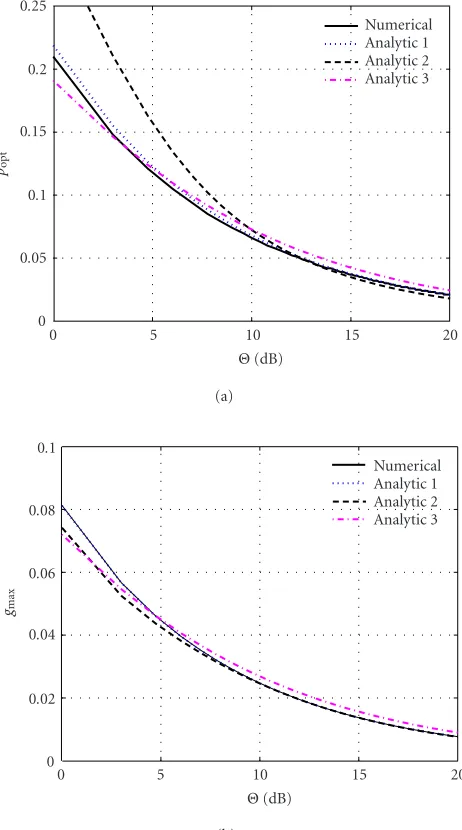
The numerical result obtained by direct maximization of (7) for differentΘis compared with the results from the three analytical approximations inFigure 4. InAnalytic 2, approx-imating interfering nodes at distancediby the larger distance i1/2(shown inTable 1) results in lower interference. The in-terference has a more significant impact on the throughput (andpopt) for smallΘ(see (14)). Thus for smallΘ, this lower interference leads to a higher popt than forAnalytic 1. The transmit efficiency isTeff = gmax/ popt = (1−popt)e−popt/s, which is monotonically increasing from lims→0Teff =e−1 ≈ 0.37 to lims→∞Teff = 1/2. The upper bound is achieved if the interference goes to zero, in which case popt = 1/2 and gmax=1/4. For the lower bound, ass→0, we havepopt→0 andgmax→0, andTeffconverges toe−1. Hence,sis a measure for spatial reuse. Indeed fors→0, which happens forα→06 orΘ→ ∞, the network does not permit any spatial reuse. In
6In fact,α→2 is sufficient for infinite networks.
0 0.05 0.1 0.15 0.2 0.25
pop
t
0 5 10 15 20
Θ(dB)
Numerical Analytic 1 Analytic 2 Analytic 3
(a)
0 0.02 0.04 0.06 0.08 0.1
gmax
0 5 10 15 20
Θ(dB)
Numerical Analytic 1 Analytic 2 Analytic 3
(b)
Figure4: For a square network with 40×40 nodes andα=4, the numerical results and analytic results fromAnalytic 1, Analytic 2, andAnalytic 3for (a) the relationship betweenpoptandΘ; (b) the
relationship betweengmaxandΘ.
this case, the transmit efficiency reduces to the efficiency of conventional slotted ALOHA [17], where for a network with Nnodes,popt =1/NandTeff=limN→∞(1−1/N)N−1=e−1
[4]. The fact that our limit coincides with the limit for con-ventional slotted ALOHA further validates our approxima-tions.
3.2. Triangle networks and hexagon networks
(a) (b)
Figure5: The topology of (a) triangle network and (b) hexagon network.
0 0.01 0.02 0.03 0.04 0.05 0.06
g
0 0.2 0.4 0.6 0.8 1
p α=2
α=5
(a)
0 0.01 0.02 0.03 0.04 0.05 0.06
g
0 0.2 0.4 0.6 0.8 1
α=2 α=5
p
(b)
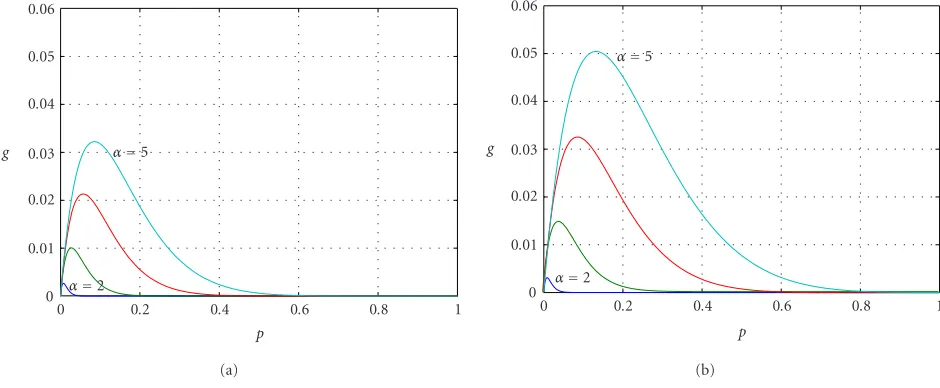
Figure6: The analytic throughputg(p) versuspfor two-dimensional networks with (a) triangle topology and (b) hexagon topology, where Θ=10 andN=1600 nodes.
of the nearest-neighbor nodes of the transmitter, so the transmitter-receiver distance d0 is equal to the side length of the regular polygon. In the triangle network, each node is located in a hexagon with area (√3d02)/2. For node den-sity equal to 1,d2
0 =2/
√
3. Similarly, for hexagon networks, d2
0=4/(3
√
3).
Similar to the calculation of square lattice networks as in (7), we obtain the relationship between the throughput g and the transmit probability p and compare the perfor-mance of triangle and hexagon networks in Figure 6. For a fair comparison, we introduce thetransport capacitywhich can be defined as Z := gmaxd0. The results for square, triangle, and hexagon networks for α = 4 are shown in Table 2. The performance difference among the three topolo-gies can be explained by the distance and number of the potential interfering nodes. Note that the transmit efficiency Teffis very close to the one of conventional slotted ALOHA and does not depend on the topology.
4. RANDOM NETWORKS
Here, we assume that the positions of the nodes constitute a Poisson point process.7In the following, we will investigate the throughput averaged over network realizations when the transmitter-receiver distanced0is fixed (Section 4.1) and not fixed (Section 4.2).
4.1. Average throughput for fixedd0
In this case, we assume the distance between the desired transmitter and receiver is fixed and there areNother nodes constituting a two-dimensional Poisson point process. Al-though (6) gives the success probability conditioned on node distances, we still need to find the joint density of
7For large networks, this is equivalent to a uniformly random
Table2: Comparison of square, triangle, and hexagon networks forα =4 andΘ =10, where popt,gmax, andTeffdenote the op-timum transmit probability, maximum throughput, and transmit efficiency. one-dimensional Poisson point processes with densityλ, the ordered distance from nodes to the desired receiver form the arrival times of a Poisson process [24]. The interarrival inter-vals are i.i.d. exponential with parameterλ:
fdi−di−1 density function of the interarrival intervals is
fd1,d2,...,dN
When nodes are distributed according to a two-dimensional Poisson point process with density λ, the squared ordered distances from the desired receiver have the same distribu-tion as the arrival times of a Poisson process with densityλπ [24]. The squared ordered distances have a joint distribution with density
The conditional success probability can be written as (see (6))
Integrating (22) with respect to the joint density (20), and in particular, evaluating it forα=4, we obtain
Ps|d0
Figure7: Forα=4 andΘ=10, the analytical average throughput E[g|d0 =1] based on (25) for networks with node numberN =
100, 121, and 144.
By applying a similar inductive technique as in [24], it can be shown that
Based on (25), we numerically evaluate the average through-putE[g|d0]= p(1−p)Ps|d0 (averaged over all network
re-alizations) and plot it as a function of p in Figure 7for a network with node numbersN =100, 121, and 144, where d0 =1. It is shown that they are very close, indicating that only a portion of the nodes interfere at the receiver and nodes further away have little impact on the transmission.
4.2. Average throughput for variabled0
In the previous analysis, we assumed that the transmitter-receiver distanced0is fixed and there areNpotential interfer-ing nodes uniformly distributed. Now we assume that the re-ceiver located at the center selects its nearest-neighbor node as its desired transmitter. Then there areN−1 nodes further away than the desired transmitter. The distance to the near-est neighbor has the Rayleigh density function (as shown in [23])
fd0(x)=2πxe −πx2
0 by solid line; the simulation result over 10 000 runs by + mark.
Since d0 is the nearest distance, di2 in (22) can be varying By induction, it can be shown that
xN−1
The success probability isPs|d0averaged overd0:
Ps= lytic (solid line) and simulation result (marked by +) match perfectly.
0 0.005 0.01 0.015 0.02 0.025
E
[
g
|
d0
]
0 0.2 0.4 0.6 0.8 1
p
Regular Random
Figure10: Comparison of the average throughput of regular square network and random network. For both networks,N=1600,d0=
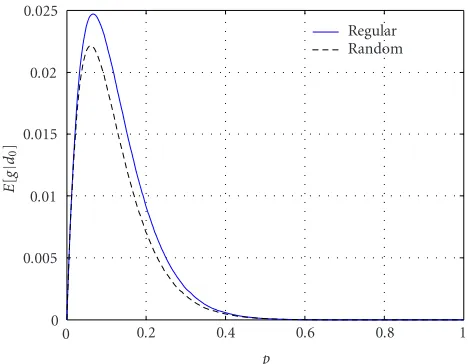
1,α=4, andΘ=10.
Now consider the generic routing strategy from [23]: each node in the path sends packets to its nearest neigh-bor that lies within a sector φ, that is, within ±φ/2 of the source-destination direction. The previous scheme whered0 is obtained as the distance to the nearest neighbor makes no progress in the source-destination direction. Such a choice ofd0would correspond to routing withinφ=2π, clearly an inefficient choice ofφ. More sensible isφ≤π. Letd0be the distance to the nearest neighbor within sectorφ. The proba-bility density ofd0is given by [23]
fd0(x)=xφe −x2φ/2
. (31)
If the routing sectorφ = π/2, thenE[d0] =1. Ford0 = 1, Figure 10 displays the throughput for square network and random network withN = 1600. It turns out that for the same transmitter-receiver distance, square networks have a slightly higher average throughput than random networks.
We compare the transport capacitygmaxd0of regular and random networks.Figure 11ashowsgmaxversusd0andpopt versus d0 for a random network. Figure 11bcompares the transport capacity of random and regular networks. It is shown that at a specific transmitter-receiver distanced0, reg-ular networks slightly outperform random networks in terms of transport capacity.
4.3. End-to-end throughputgEEin a random network
In wireless sensor networks with multihop communication, the end-to-end throughput (the minimum of the throughput values of the links involved) of a route with an average num-ber of hops is a better performance indicator than the average throughput. For two-dimensional random sensor networks (busy aream×m, density 1, routing within sectorφ) with uniformly randomly selected source and fixed destination
located at the corner,8we can approximate the average path length in hops
¯ h≈ ¯r¯
Dη, (32)
where ¯r denotes the expected distance between the source and the destination, ¯Dthe expected hop length, and ηthe expected path efficiency, where the path efficiency is the ratio between the Euclidean distance and the travelled distance of a path. ¯Dηcan be viewed as the effective hop length—the av-erage hop length projected onto the source-destination axis. The expected distance from a random point in a square to a corner can be derived from [27, Exercise 2.4.5]:
¯ r=
√
2 3 +
1 3arctanh
1
√
2
m≈0.769m. (33)
From [23], we know that
¯ D=
π
2φ, η= 2 φsin
φ
2
. (34)
So the average path length in hops can be approximated by plugging (33) into (32). To evaluate the end-to-end through-put of a route with ¯hhops, we use a semianalytic approach by generating an ¯h-hop path with each hop length obtained as a realization ofDaccording to the pdf in (31), and evalu-ate the throughput of each hop based onFigure 9a. The av-erage end-to-end throughput is then obtained by taking the minimum of each path and averaging the minimum over the number of realizations of the simulated routes. It is shown inFigure 12that the maximum end-to-end throughputgEE is 0.0086, 0.0053, and 0.0039 forφ=π,π/2, andπ/3.
What is the end-to-end throughput for regular networks? It can be directly obtained from Figures 2 and6, which is 0.0247, 0.0213, and 0.0326 for square, triangle, and hexa-gon networks. For regular networks, every hop has the same length, and the throughput is calculated for a link in the cen-ter of the network, which is the worst case, so the end-to-end throughput is the throughput of the center link of the busy area. In terms of the end-to-end throughput for multihop communication, regular networks significantly outperform random networks. For larger networks, the benefit is larger since largermresults in longer paths.
5. CONCLUSIONS
We have shown that for a noiseless Rayleigh fading network with slotted ALOHA, the success probability of a transmis-sion is the Laplace transform of the interference evaluated at the SIR thresholdΘ. We assume that in every timeslot, each
8For the many-to-one traffic typical in sensor networks, we assume the
0 0.1 0.2 0.3 0.4 0.5
0 0.5 1 1.5 2 2.5
popt
gmax
d0
(a)
0 0.01 0.02 0.03 0.04 0.05
gmax d0
0 0.5 1 1.5 2 2.5
Random Square Triangle Hexagon
E[d0]=1
d0
(b)
Figure11: WithN=1600,α=4, andΘ=10, (a)gmaxversusd0andpoptversusd0for a random network; (b) transport capacitygmaxd0for
random and regular networks with the same size and node density. For random networks,E[d0]=1 forφ=π/2.
0 0.002 0.004 0.006 0.008
gEE
0 0.1 0.2 0.3 0.4 0.5
p
φ=π φ=π/2 φ=π/3
Figure 12: The average end-to-end throughput of random net-works for different routing sectorsφ, whereα=4 andΘ=10.
node transmits independently with a certain fixed probabil-ityp=pqpt, wherepqis the intensity of the Bernoulli traffic andptis the channel access probability. This decomposition of p shows that the throughput analysis and optimization with respect to pincludes a range of traffic intensities and channel access probabilities.
Among the three regular networks (square, triangle, hex-agon), the hexagon network provides the highest throughput since every node has only three nearest neighbors which is the smallest among the three networks. The sensitivity analy-sis of the maximum throughputgmaxand optimum transmit probability popt with respect to Θfor square networks ex-plains why the transmit efficiencyTeff=gmax/ poptis approx-imately 37%. These results hold quantitatively for the other two regular networks—triangle and hexagon networks.
For random networks, two scenarios are considered— fixed and variable transmitter-receiver distances d0. Ifd0is the same for regular and random networks, regular networks slightly outperform random networks in terms of through-put and transport capacity. In the case of variabled0 where the receiver selects the nearest-neighbor node as its desired transmitter, the average throughput of random networks is better than that of regular ones. This is because strong sig-nal powers resulting from very smalld0offset the impact of interference even for high transmit probabilities. This result, however, only pertains to local data exchange. When multi-hop communication and routing is taken into account, reg-ular topologies have a significant advantage in terms of end-to-end throughput. The reason for the inferior end-end-to-end performance of random networks is the large variance in the node distances.
ACKNOWLEDGMENT
The support of the US National Science Foundation (Grants ECS 03-29766 and CAREER CNS 04-47869) is gratefully ac-knowledged.
REFERENCES
[1] I. F. Akyildiz, W. Su, Y. Sankarasubramaniam, and E. Cayirci, “Wireless sensor networks: a survey,” Computer Networks, vol. 38, no. 4, pp. 393–422, 2002.
[2] P. Gupta and P. R. Kumar, “The capacity of wireless networks,”
IEEE Trans. Inform. Theory, vol. 46, no. 2, pp. 388–404, 2000. [3] S. Toumpis and A. J. Goldsmith, “Capacity regions for wireless ad hoc networks,”IEEE Transactions on Wireless Communica-tions, vol. 2, no. 4, pp. 736–748, 2003.
[4] J. Silvester and L. Kleinrock, “On the capacity of multihop slotted ALOHA networks with regular structure,”IEEE Trans. Commun., vol. 31, no. 8, pp. 974–982, 1983.
of ad hoc wireless networks,” inProc. 20th Annual Joint Con-ference of the IEEE Computer and Communications Societies (INFOCOM ’01), vol. 3, pp. 1360–1369, Anchorage, Alaska, USA, April 2001.
[6] D. Marco, E. Duarte-Melo, M. Liu, and D. L. Neuhoff, “On the many-to-one transport capacity of a dense wireless sen-sor network and the compressibility of its data,” inProc. 2nd IEEE International Workshop on Information Processing in Sen-sor Networks (IPSN ’03), pp. 1–16, Palo Alto, Calif, USA, April 2003.
[7] L.-L. Xie and P. R. Kumar, “A network information theory for wireless communication: scaling laws and optimal operation,”
IEEE Trans. Inform. Theory, vol. 50, no. 5, pp. 748–767, 2004. [8] S. De, C. Qiao, D. A. Pados, and M. Chatterjee, “Topological and MAI constraints on the performance of wireless CDMA sensor networks,” inProc. 23rd Annual Joint Conference of the IEEE Computer and Communications Societies (INFOCOM ’04), vol. 1, Hong Kong, China, March 2004.
[9] G. Ferrari and O. K. Tonguz, “Performance of ad hoc wire-less networks with Aloha and PR-CSMA MAC protocol,” in
Proc. IEEE Global Telecommunications Conference (GLOBE-COM ’03), vol. 5, pp. 2824–2829, San Francisco, Calif, USA, December 2003.
[10] S. Panichpapiboon, G. Ferrari, and O. K. Tonguz, “Sensor net-works with random versus uniform topology: MAC and in-terference considerations,” inProc. IEEE Vehicular Technology Conference (VTC ’04), vol. 4, pp. 2111–2115, Milan, Italy, May 2004.
[11] E. S. Sousa and J. A. Silvester, “Optimum transmission ranges in a direct-sequence spread-spectrum multihop packet radio network,”IEEE J. Select. Areas Commun., vol. 8, no. 5, pp. 762– 771, 1990.
[12] N. H. Shepherd, et al., “Coverage prediction for mobile radio systems operating in the 800/900 MHz frequency range,”IEEE Trans. Veh. Technol., vol. 37, no. 1, pp. 3–72, 1988, Special is-sue on radio propagation.
[13] A. J. Goldsmith and S. B. Wicker, “Design challenges for energy-constrained ad hoc wireless networks,”IEEE Wireless Communications, vol. 9, no. 4, pp. 8–27, 2002.
[14] A. Ephremides, “Energy concerns in wireless networks,”IEEE Wireless Communications, vol. 9, no. 4, pp. 48–59, 2002. [15] A. Woo, T. Tong, and D. Culler, “Taming the underlying
chal-lenges of reliable multihop routing in sensor networks,” in
Proc. 1st International Conference on Embedded Networked Sensor Systems, pp. 14–27, Los Angeles, Calif, USA, Novem-ber 2003.
[16] S. Megerian, F. Koushanfar, G. Qu, G. Veltri, and M. Potkon-jak, “Exposure in wireless sensor networks: theory and prac-tical solutions,”Wireless Networks, vol. 8, no. 5, pp. 443–454, 2002.
[17] N. Abramson, “The aloha system - another alternative for computer communications,” inProc. Fall Joint Computer Con-ference, AFIPS Conference, vol. 37, pp. 281–285, Houston, Tex, USA, November 1970.
[18] F. Tobagi, “Analysis of a two-hop centralized packet radio network—Part I: slotted ALOHA,” IEEE Trans. Commun., vol. 28, no. 2, pp. 196–207, 1980.
[19] F. Baccelli, B. Blaszczyszyn, and P. M¨uhlethaler, “A Spatial Reuse Aloha MAC Protocol For Multihop Wireless Mobile Networks,” Tech. Rep. 4955, Institut National de Recherche en Informatique et en Automatique (INRIA), Rocquen-court, Le Chesnay Cedex, France, October, 2003, Avail-able at http://www.terminodes.org/MV2003-Present/Me15/ Spacial-Baccelli.pdf.
[20] R. Nelson and L. Kleinrock, “The spatial capacity of a slotted ALOHA multihop packet radio network with capture,”IEEE Trans. Commun., vol. 32, no. 6, pp. 684–694, 1984.
[21] D. Bertsekas and R. Gallager,Data Networks, Prentice-Hall, Englewood Cliffs, NJ, USA, 2nd edition, 1991.
[22] M. Haenggi, “Energy-balancing strategies for wireless sensor networks,” inProc. IEEE International Symposium on Circuits and Systems (ISCAS ’03), vol. 4, pp. IV-828–IV-831, Bangkok, Thailand, May 2003.
[23] M. Haenggi, “On routing in random Rayleigh fading net-works,” to appear inIEEE Transactions on Wireless Commu-nications,http://www.nd.edu/∼mhaenggi/.
[24] R. Mathar and J. Mattfeldt, “On the distribution of cumulated interference power in Rayleigh fading channels,”Wireless Net-works, vol. 1, no. 1, pp. 31–36, 1995.
[25] N. Ahmed and R. G. Baraniuk, “Throughput measures for delay-constrained communications in fading channels,” in
Proc. Allerton Conference on Communication, Control and Computing, Monticello, Ill, USA, October 2003.
[26] M. Hellebrandt and R. Mathar, “Cumulated interference power and bit-error-rates in mobile packet radio,”Wireless Networks, vol. 3, no. 3, pp. 169–172, 1997.
[27] A. M. Mathai,An Introduction to Geometrical Probability, Gor-don and Breach Science Publishers, New York, NY, USA, 1999.
Xiaowen Liu received the M.S. degree in signal and information processing from the Institute of Acoustics, Chinese Academy of Sciences, in 1998. She entered the Univer-sity of Notre Dame as a graduate student in January 2001. She earned the Master de-gree in electrical engineering in 2002. Cur-rently, she is working toward the Ph.D. de-gree in the Department of Electrical Engi-neering. Her current research interests
in-clude wireless network and communications, especially the perfor-mance analysis of wireless ad hoc and sensor networks.
Martin Haenggi received the Dipl. Ing. (M.S.) degree in electrical engineering from the Swiss Federal Institute of Technology in Zurich (ETHZ) in 1995. In 1995, he joined the Signal and Information Processing Lab-oratory at ETHZ as a Teaching and Research Assistant. In 1996, he earned the Dipl. NDS ETH (post-diploma) degree in information technology, and in 1999, he completed his Ph.D. thesis on the analysis, design, and
![Figure 8: For α = 4 and Θ = 10, E[g] versus p for random networkwith N = 144. The analytic result from (27) and (30) is displayedby solid line; the simulation result over 10000 runs by + mark.](https://thumb-us.123doks.com/thumbv2/123dok_us/913894.1110523/8.600.50.287.351.665/figure-versus-random-networkwith-analytic-result-displayedby-simulation.webp)