R E S E A R C H A R T I C L E
Open Access
The effectiveness of an online intervention
in preventing excessive gestational weight
gain: the e-moms roc randomized
controlled trial
Christine M. Olson
1*, Susan W. Groth
2, Meredith L. Graham
3, Jennifer E. Reschke
4, Myla S. Strawderman
3and Isabel Diana Fernandez
4Abstract
Background:Excessive gestational weight gain (GWG) is common and contributes to the development of obesity
in women and their offspring. Electronic or e-health interventions have the potential to reach large groups of women and prevent excessive GWG, but their effectiveness has not been demonstrated. The purpose of this study was to evaluate, in a real-world setting, the effectiveness of a self-directed, integrated online and mobile phone behavioral intervention in preventing excessive GWG.
Methods:This effectiveness trial was a double-blind, three-arm trial with a parallel group design. Two arms received the same e-health intervention during pregnancy with the third arm serving as the placebo control. The intervention was based on a previously efficacious non-digital intervention that was adapted to electronic format. It included three behavior change tools: a weight gain tracker, and separate diet and physical activity goal-setting and self-monitoring tools. Both treatment conditions received access to informational tools, event reminders, and a blogging feature. Healthy pregnant women age 18-35 years with body mass indexes (BMI)≥18.5 and < 35, at ≤20 weeks gestation, and an e-mail address were eligible. The proportion of women with excessive total GWG, as defined by the Institute of Medicine (IOM), was the primary outcome. 1689 randomized women were analyzed in the intent-to-treat (ITT) analysis. The study was designed to have 87% power to detect a 10 percentage point reduction from a control rate of 55% with a sample of 1641 (p= 0.0167, two-sided).
Results:In the ITT sample, 48.1% (SD = 2.0%) gained excessively in the intervention group as did 46.2% (SD = 2.4%) in the placebo control group. These proportions were not significantly different (RR 1.09; 95% CI 0.98, 1.20,p= 0.12). The results were not altered in several sensitivity analyses.
Conclusion:The addition of three behavior change tools to an informational placebo control did not result in a difference in the proportion of women with excessive total GWG compared to the placebo control in this effectiveness trial of an online, self-directed intervention. The similarity of intervention and control treatments and low usage of the behavior change tools in the intervention group are possible explanations.
Trial registration:NCT01331564, ClinicalTrials.gov.
Keywords:Gestational weight gain, Behavior change, Online intervention, Pregnancy, Randomized controlled trial
* Correspondence:[email protected]
1Division of Nutritional Sciences, 406 Savage Hall, Cornell University, Ithaca,
NY 14853, USA
Full list of author information is available at the end of the article
Background
Excessive gestational weight gain (GWG) is a risk factor for postpartum weight retention that contributes to long-term weight gain in women [1–3]. It is also related to increased risk of obesity in offspring [2, 4]. In the US in 2015, about 39% of normal weight, 61% of overweight, and 55% of obese women, gained more than the recom-mended amount of weight during pregnancy [5]. Obesity experts have called for obesity prevention to begin dur-ing pregnancy and early infancy [6].
A recent Cochrane review found diet and/or exercise interventions during pregnancy reduced the risk of ex-cessive GWG by 20% [7]. The estimate was robust and supported by high-quality evidence. Electronic commu-nication technologies have the potential to reach large numbers of women during pregnancy with behavioral interventions to prevent excessive weight gain. However, there is currently a paucity of data on their effectiveness for this purpose [8, 9]. There is a growing body of evi-dence that electronic communication interventions, often called e- and m-health interventions, are effica-cious in several different domains of health behavior change including weight loss and weight gain prevention among non-pregnant individuals [10,11].
The aim of this study was to evaluate the effectiveness of a self-directed, integrated mobile phone and online behavior change intervention in preventing excessive GWG in a real-world setting.
Methods
Overview and design
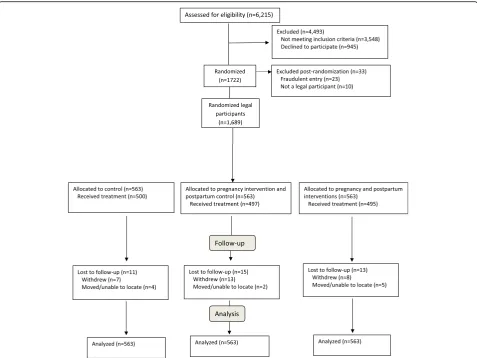
The overall goal of the project of which this study is a part was to expand the understanding of how to slow the accu-mulation of weight in childbearing women. This paper re-ports on the pregnancy portion of a longer study that followed women until 12 months postpartum in order to evaluate the effectiveness of pregnancy intervention and combined pregnancy and postpartum intervention on weight retention at 12 months postpartum. Thus during pregnancy, two arms received the same intervention (one of these arms becomes a control postpartum) and the third arm was the placebo control (Fig. 1). The primary hypothesis for the pregnancy portion of the study was that the intervention would lead to a 10 percentage point re-duction in the proportion of women with excessive total GWG in the intervention arms (45%) compared to the placebo control arm (55%).
This trial was a double-blind, three-arm randomized trial with a parallel group design with the individual as the unit of randomization and analysis [12]. Pregnant women were screened by research staff in prenatal clinics, private obstetric practices, ultra-sound offices, and over the phone and online in a large Northeastern US city from May 2011 through July 2012. Inclusion
criteria were age 18-35 years and gestational age≤ 20 weeks at time of enrollment. Exclusion criteria in-cluded body mass index (BMI) < 18.5 and≥35 kg/m2, multiple gestation, weight-affecting medical or psychi-atric conditions, and no e-mail address [12]. The age limits were set by the Early Adult Reduction of Weight through LifestYle interventions (EARLY) consortium of weight management studies of which this trial was a part [13]. Eligible women provided written informed consent and signed a form for release of their medical records. Upon consent, participants were electronically random-ized via computer to 2 intervention arms and 1 control arm within 4 income (with low income defined by Medicaid eligibility) and BMI (normal BMI and over-weight plus obese class 1 BMI) strata in blocks of six: strata 1 - normal BMI low income; strata 2 - normal BMI high income; strata 3 - overweight plus obese class 1 low income; and strata 4 - overweight plus obese class 1 high income. The study protocol was approved by the University of Rochester Research Subject Review Board and the Cornell University Institutional Review Board.
Intervention
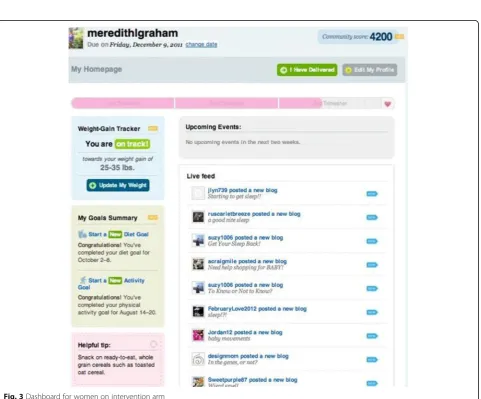
Participants assigned to the intervention arms received access to the intervention website and those assigned to the placebo control condition received access to the con-trol website, both of which were password protected. A more detailed description of the theory, development and implementation of the pregnancy intervention is available [14, 15]. Briefly, the self-directed, integrated online and mobile phone behavioral intervention was de-signed using the Integrative Model of Behavior Prediction [16] and the Behavior Model for Persuasive Design [17] in addition to formative research with the target population [14]. It was based on a non-electronic pregnancy lifestyle intervention that was demonstrated to be efficacious in low-income women [18]. Women in the intervention arms received access to three behavior change tools in-cluding a weight gain tracker, a diet and a physical activity goal-setting and self-monitoring tool, as well as, health in-formation including tips, articles, frequently asked ques-tions; a description of pregnancy and parenting-related resources available in the local community; a blogging tool; and an event and appointment reminder. Fig. 2
summary, two different suites of tools were made available to trial participants on a password protected study website and mobile phone platform. Women were reminded weekly to login, and they decided what, when, and how much they would use the tools made available to them. All women in the trial re-ceived standard prenatal care from their self-selected health care provider.
Measures and data collection
Data were collected at screening by research staff, with two online surveys completed by participants during pregnancy (one before 28 weeks gestation and one from 32 weeks until delivery), and through an audit of the women’s prenatal, labor and delivery, and 6 week post-partum medical records by research staff. Socio-demographic, behavioral, psychosocial and adverse event data were collected through online surveys [12]. Health and weight data were abstracted from the medical rec-ord [12]. Participants received financial incentives for
enrolling in the study and for each of the online ques-tionnaires they completed. They could earn up to $45 for completing all data collection activities during preg-nancy. They were not paid for engaging with interven-tion or control treatments. An online satisfacinterven-tion survey using EARLY questions and for which no financial in-centive was provided was made available to participants to complete at 6 weeks postpartum [13].
Fig. 2Website features, leverage points and behavioral targets for intervention
class 1 BMI - > 9 kg [1]. Excessive average weekly GWG in the last half of pregnancy and total GWG in kg were
pre-specified secondary outcomes. Average weekly
GWG was calculated as the difference between the last weight at≥37 weeks of gestation and the weight nearest to 20 weeks gestation (+/−2 weeks) divided by the num-ber of weeks between the two weights. This value was defined as excessive if it exceeded the upper limit for weekly weight gain for each BMI group as specified by the IOM [1]. Adherence to the treatment protocol was defined as logging into the treatment arm specific pro-ject website at least once in each 45 day interval during pregnancy. This time interval was based on the schedule of prenatal care visits which are on average every 30 days during pregnancy. Formative research showed that a large proportion of women did not have scales in their homes and thus in order to use the weight gain tracker they needed to use the weights measured at their pre-natal care visits [14]. This level of adherence was consid-ered as providing a minimal possibly effective dose of exposure to treatment.
Sample size
The target sample size of 1641 (547/arm) was deter-mined by the weight retention endpoint at 12 months postpartum, the ending time point for the overall study [12]. Assuming 15% attrition during the pregnancy period, yielding 465 controls and 930 intervention sub-jects, we estimated 87% statistical power to detect a re-duction of 10 percentage points from the overall expected 55% of women with excessive total GWG in the control group. The expected rate was calculated from data made available through the Finger Lakes Perinatal Data System which aggregates birth certificate information from hospitals in the region. (See Add-itional file 1: Table S1.) The study was not powered to examine intervention effects within strata. A Bonferroni-corrected significance level of 1.67% (2-sided), reflecting the three primary comparisons in the entire study, was applied to the primary analysis of excessive total GWG. Otherwise, no multiple comparison procedures were ap-plied and a significance level of 5% was used.
Statistical analysis
Missing data were handled using multiple imputation to address issues of bias which may result from ana-lyzing only complete cases [19]. Sufficient weight
in-formation for the calculation of the primary
outcome required having a measured weight at both < 14 weeks and≥37 weeks of gestation. If weight in-formation was insufficient, the first, 20 week, and/or last weights were imputed using Statistical Analysis System (SAS) Proc MI. A previous evaluation of the non-electronic version of the intervention indicated
that both income and BMI affected GWG outcomes, leading to the stratified randomization design for the present study [18]. Therefore, to allow for a poten-tial interaction between income, BMI, and interven-tion within the imputed data, 60 imputed data sets were created within each income and BMI group and used in the analysis.
The overall proportion of women with excessive GWG on each arm was estimated by pooling across the im-puted data sets, accounting for the variability between imputations, as described by Ratitch, Lipkovich and O’Kelly [20]. Relative risk (RR) estimates for the binary outcomes (proportion of women with excessive total and weekly GWG) were obtained from log-binomial regres-sion models. In two of the sensitivity analyses, some of the log-binomial models did not converge in a few of the 60 imputed data sets. The COPY method was then applied to address the computational issues [21] and was successful in addressing convergence issues in all cases. Mean differences in total GWG (kg) were similarly estimated from least-squares regression models. All mul-tivariable model estimates for the overall effect of inter-vention versus control arms were adjusted for strata, early pregnancy BMI, gestational age at delivery (to ad-just for length of gestation and thus the amount of time over which weight could be gained), and two variables to additionally adjust for the timing of weight measure-ments: the number of weeks between the first and last pregnancy weight, and the number of weeks between the last pregnancy weight and delivery. SAS Proc MIA-NALYZE was then used to combine the model results from within each imputed data set in the standard way according to Rubin’s Rules. The interaction between treatment arm and the four category strata variable was assessed as a secondary analysis. Several sensitivity ana-lyses were conducted with various subsamples of study participants.
Descriptive information is presented on engagement within treatment arm. Satisfaction with study participa-tion was compared by treatment arm using chi-square analysis. To describe the safety of the intervention, 10 infant and maternal health outcomes and complications were compared by arm within each of the four strata using Fisher’s Exact Test. Birthweight was compared using the T-Test.
Results
Description of sample
monetary purposes. In addition, 10 women misreported their ages and were too young to give informed consent or their signed consent forms were missing. A sample of 1689 pregnant women was included in the intention-to-treat (ITT) analysis (Fig.1).
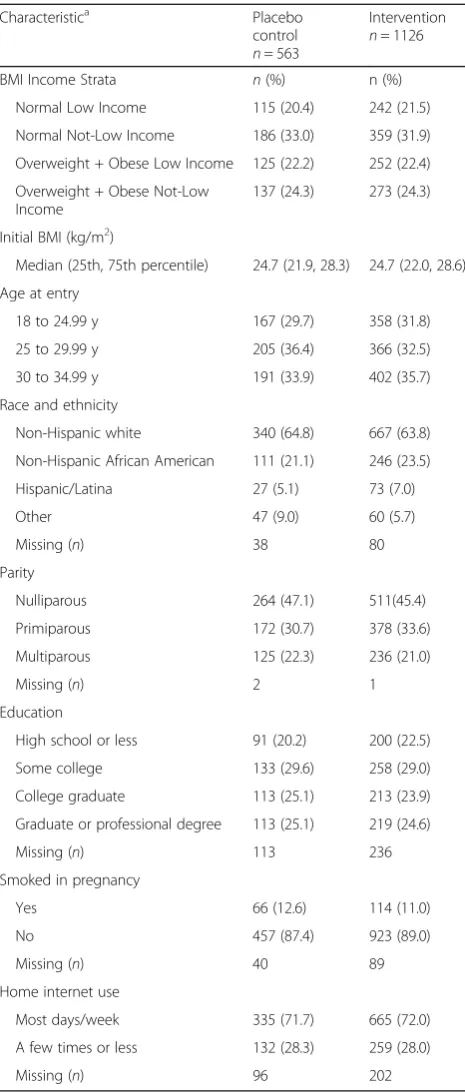
Participants’ socio-demographic characteristics were similar between randomized arms (Table1). Overall, the sample was about 43% low income which means they qualified to received Medicaid (government subsidized prenatal care) during pregnancy and had household in-comes < 185% of the Federal poverty threshold. In each treatment group, 53.4% of women had a BMI in the nor-mal range and 46.6% were overweight or class 1 obese. The sample was about 64% non-Hispanic white with Af-rican AmeAf-ricans making up 21.1% of the control group and 23.5% of the intervention group. The sample re-cruited into the study had a higher rate of overweight and obese low income women compared to the popula-tion who met study eligibility criteria and delivered in-fants at the four participating hospitals in the study area (22.3% vs. 15.3%) and had a lower rate of normal BMI high income women compared to the population (32.3% vs. 40.6%). Otherwise, the sample was similar to the population (Additional file1: Table S1).
Engagement with treatment
Participants engaged with their treatment arm specific website beginning at a median of 12 weeks of gestation and 34.6% of the placebo control and 46.1% of the inter-vention arms logged into the website at least once in each 45-day interval of participation and thus were de-fined as adherent to treatment (Table 2). Control and intervention women had access to the study website a median of 199 and 196 days, respectively, and they logged in a median of 3.2% and 5.6% of those days. The median number of logins and web page views for the placebo control and intervention women were 6 and 10 for logins and 15 and 24 for page views, respectively, with 6 of the page views for behavior change tools in the intervention group.
Additional file2Table S2 displays the exposure to and engagement with the information and social content (the placebo content) by treatment arm. The two arms were sent an equal number of weekly e-mail messages, at a median of 28.Overall, the two arms were very simi-lar in their exposure to the placebo content.
Overall, 1169 women (69.2%) submitted a satisfaction survey with no difference in the completion rate by arm. Of these women, 930 (80%) completed the two satisfac-tion quessatisfac-tions reported here. On the 0 to 10 point scale, the majority of participants (53.6%) in both arms scored a 9 or 10 on the item related to recommending the website to other pregnant women (Additional file 3: Table S3). A significantly greater proportion of women
in the intervention group scored 9 or 10 on the item asking about enjoying participation in the trial compared to the placebo control group (45.5% vs 37.6%;p= 0.02).
Table 1Baseline characteristics of sample by treatment arm (n= 1689)
Normal Low Income 115 (20.4) 242 (21.5)
Normal Not-Low Income 186 (33.0) 359 (31.9)
Overweight + Obese Low Income 125 (22.2) 252 (22.4)
Overweight + Obese Not-Low Income
137 (24.3) 273 (24.3)
Initial BMI (kg/m2)
Median (25th, 75th percentile) 24.7 (21.9, 28.3) 24.7 (22.0, 28.6)
Age at entry
18 to 24.99 y 167 (29.7) 358 (31.8)
25 to 29.99 y 205 (36.4) 366 (32.5)
30 to 34.99 y 191 (33.9) 402 (35.7)
Race and ethnicity
Non-Hispanic white 340 (64.8) 667 (63.8)
Non-Hispanic African American 111 (21.1) 246 (23.5)
Hispanic/Latina 27 (5.1) 73 (7.0)
Other 47 (9.0) 60 (5.7)
Missing (n) 38 80
Parity
Nulliparous 264 (47.1) 511(45.4)
Primiparous 172 (30.7) 378 (33.6)
Multiparous 125 (22.3) 236 (21.0)
Missing (n) 2 1
Education
High school or less 91 (20.2) 200 (22.5)
Some college 133 (29.6) 258 (29.0)
College graduate 113 (25.1) 213 (23.9)
Graduate or professional degree 113 (25.1) 219 (24.6)
Missing (n) 113 236
Most days/week 335 (71.7) 665 (72.0)
A few times or less 132 (28.3) 259 (28.0)
Missing (n) 96 202
a
Gestational weight gain (GWG) outcomes
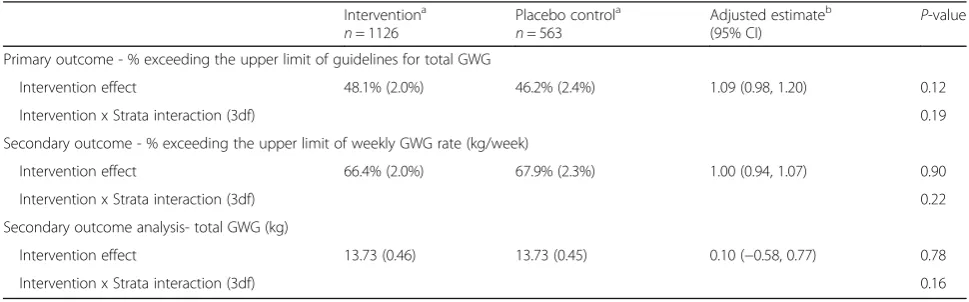
Forty-eight and one-tenth percent of women in the inter-vention arm gained excessively as did 46.2% of women in the placebo control arm (Table3). In the adjusted analysis, no differences between treatment arms were found in the ITT sample for the primary and secondary outcomes: pro-portion with excessive total GWG, propro-portion with exces-sive weekly GWG, and total GWG in kg (RR 1.09; 95% CI 0.98, 1.20; p= 0.12; RR 1.00; 95% CI 0.94, 1.07; p= 0.90; mean difference 0.10 kg; 95% CI -0.58, 0.77; p= 0.78), re-spectively. The interaction of treatment with the four-category strata variable (strata 1 - normal BMI low income; strata 2 - normal BMI high income; strata 3 - overweight plus obese class 1 low income; and strata 4 - overweight
plus obese class 1 high income) was not significant for any outcome (p= 0.19,p= 0.22, andp= 0.16, respectively). The sensitivity analyses are shown in Table4for both excessive total GWG and excessive weekly GWG. Since the results between the two outcomes do not differ, only those for the primary outcome, excessive total GWG, are described in the text. The eligible and participating (treated) sam-ple (n= 1335) showed results that were similar to those in the ITT sample: RR 1.10; 95% CI 0.98, 1.22;
p= 0.09. Additional analyses with the complete case sample (n= 1337) for whom no weights were imputed and the per-protocol sample (n= 714) that only included women who were defined as adherent by logging in at least once in each 45 day interval of participation, also showed no significant difference between treatment arms. A sensitivity analysis that used self-reported pre-pregnancy weight rather than first measured weight at < 14 weeks gestation for the calculation of gestational weight gain showed no intervention effect, nor did an ana-lysis that included only those who had not gained exces-sively at the time they started treatment (Table4).
Safety and clinical outcomes
Two of the 40 maternal and neonatal outcomes and complications compared by treatment arm within strata differed in the eligible and participating sample: the pro-portion of cesarean deliveries that were repeat cesarean deliveries was significantly greater in the intervention than the control arm (92.3% vs. 66.7%;p≤0.05) in strata 4 (overweight plus obese class 1 high income) and macrosomia (birthweight > 4000 g) was significantly less common in the intervention than control arm (6.8% vs. 14.0%; p≤0.05) in strata 2 (normal BMI high income) (Additional file4: Table S4). Thus, there is little evidence indicating the intervention harmed women or infants.
Table 2Engagement with treatment assignment (n= 1689)
Indicator of engagementa Placebo control
n= 563
Intervention
n= 1126 Logged into study web site at
least once,n(%)
473 (84.0) 946 (84.0)
Week of pregnancy of first login 11.8 (8.9, 15.4) 12.0 (8.6, 16.0)
Logged-in each 45 days of participation (adherent),n(%)
195 (34.6) 519 (46.1)
Number of days with access to website
199 (166, 220) 196 (161, 220)
Percent of access days with a login 3.2 (0.9, 6.7) 5.6 (0.2, 11.7)
Number of logins for treatmentb 6 (2, 14) 10 (2, 24)
Number of web page views 15 (2, 48) 24 (3,62)
Number of web page views of control content
15 (2, 48) 17 (3, 48)
Number of web page views of behavior change tool content
0 (0, 0) 6 (0, 14)
a
Table entries are median (25th percentile, 75th percentile) unless otherwise noted
b
This excludes logins for questionnaire completion and other study administrative tasks
Table 3Primary and secondary gestational weight gain (GWG) outcomes in the ITT sample
Interventiona
Primary outcome - % exceeding the upper limit of guidelines for total GWG
Intervention effect 48.1% (2.0%) 46.2% (2.4%) 1.09 (0.98, 1.20) 0.12
Intervention x Strata interaction (3df) 0.19
Secondary outcome - % exceeding the upper limit of weekly GWG rate (kg/week)
Intervention effect 66.4% (2.0%) 67.9% (2.3%) 1.00 (0.94, 1.07) 0.90
Intervention x Strata interaction (3df) 0.22
Secondary outcome analysis- total GWG (kg)
Intervention effect 13.73 (0.46) 13.73 (0.45) 0.10 (−0.58, 0.77) 0.78
Intervention x Strata interaction (3df) 0.16
a
Results are pooled across imputed data sets and are unadjusted for other factors (n= 1689)
b
Discussion
A socio-economically and racially diverse sample of women that was similar in terms of income and BMI to the popula-tion from which it was recruited entered into the study. The integrated online and mobile phone intervention that included 3 behavior change tools had no significant effect beyond the informational placebo control on any of the pri-mary or secondary GWG outcomes. The result was robust to several sensitivity analyses.
In effectiveness trials with self-directed, online interven-tions focused on preventing excessive GWG, the level of engagement required to achieve a successful outcome is not known. In this trial, the level of engagement with the treatment arm specific website, also called adherence, was determined by research participants. In the intervention arm women, adherence at a level considered to be a mini-mum possibly effective dose was 46.1% (Table2), despite the weekly e-mail reminders to login and view new con-tent on the website that was also listed in the message.
Currently five relatively small pilot or feasibility effi-cacy trials in the literature used mobile and web-based communication technologies to address excessive GWG [22–26]. Among those with positive results, engagement with behavior change interventions was higher than for this study, ranging from 61 to 86%. These findings sug-gest that the low prevalence of adherence in the inter-vention arm may have contributed to the null findings of this effectiveness trial with its self-directed, online intervention.
While the placebo control and intervention partici-pants had a similar number of web page views of infor-mational content (the majority of page views), the intervention arm members had only 6 page views of the behavioral change tools. In addition, 135 of the 1126 women in the intervention group (12%) only viewed pla-cebo control content, essentially self-assigning them-selves to the control group. The weight gain tracker was the most widely used behavior change tool with 70% of
Table 4Sensitivity analyses for excessive total gestational weight gain (GWG) and excessive weekly GWG
Sensitivity Sample Outcome Interventiona Placebo controla Adjusted estimateb
(95% CI) P
-value
Eligible and participating samplec Excessive total GWG 47.6% (1.7%) 45.9% (2.4%) 1.10 (0.98, 1.22)
0.09
Excessive weekly GWG 66.8% (1.6%) 68.9% (2.3%) 0.99 (0.93, 1.07)
0.85
Complete case sampled Excessive total GWG 47.0% 45.1% 1.11
(1.00, 1.24)
0.06
Excessive weekly GWG 67.0% 68.4% 1.01
(0.94, 1.08)
0.85
Per-protocol samplee Excessive total GWG 45.5% (2.3%) 41.6% (3.6%) 1.14
(0.96, 1.37)
0.14
Excessive weekly GWG 64.2% (2.2%) 62.2% (3.7%) 1.07 (0.95, 1.20)
0.28
As treated samplef Excessive total GWG 47.4% (1.8%) 46.6% (2.2%) 1.08
(0.97, 1.2)
0.15
Excessive weekly GWG 66.6% (1.7%) 68.8% (2.0%) 1.00 (0.93, 1.07)
0.89
Self-reported pre-pregnancy weightg Excessive total GWG 53.9% (1.9%) 53.1% (2.4%) 1.05 (0.96, 1.15)
0.26
Excessive weekly GWG Not applicable Not applicable Not applicable Not applicable
Not excessive GWG at start of treatmenth Excessive total GWG 42.8% (2.0%) 39.3% (2.7%) 1.12 (0.96, 1.30)
0.15
Excessive weekly GWG 65.6% (2.0%) 66.3% (2.6%) 1.02 (0.93, 1.11)
0.68
a
Results are pooled across imputed data sets (except for the complete case sample) and are not adjusted for other factors, [Mean % (SD)]
b
Relative Risk (RR) estimates of excessive GWG from log-binomial model for intervention vs placebo adjusted for strata, gestational age at delivery, continuous BMI, and two timing of weight measurements variables. The COPY method was used if any of the 60 log-binomial models did not converge
c
Eligible and participating sample:N= 1335; Intervention arm (n= 898), Placebo control arm (n= 437)
d
Complete case sample for excessive total GWG:N= 1337; Intervention arm (n= 891), Placebo control arm (n= 446). Complete case sample for excessive weekly GWG rate:N= 1364; Intervention arm (n= 912), Placebo control arm (n= 452)
e
Per protocol sample comprised of subjects who logged into website within each 45 day interval of participation:N= 714; Intervention arm (n= 519), Placebo control arm (n= 195)
f
The as treated sample moves all those in the intervention arm who did not login or when they logged in, did not view the behavior change tools to the placebo control condition:N= 1335; Intervention arm (n= 788), Placebo control arm (n= 547)
g
ITT sample with excessive GWG determined using self-reported pre-pregnancy weight rather than first measured weight≤14 weeks gestation
h
intervention arm women using the tool at least once [14] and 27.3% using it consistently across pregnancy [27]. In an analysis of usage of intervention website fea-tures, using the weight gain tracker consistently across pregnancy was associated with a reduction in the pro-portion of women with excessive total and weekly GWG and mean total GWG among not-low income women [27, 28]. These results support the supposition that the low prevalence of consistent engagement with a key be-havior change tool, the weight gain tracker, was not suf-ficient to produce a difference in weight outcomes between treatment arms and demonstrate the challenge of implementing the IOM guidelines in public health contexts.
Pregnancy has been described as a teachable moment when women are highly motivated to engage in healthy behaviors [29]. For motivated women in the placebo control arm, the information and blogging tools may have been sufficient for preventing excessive GWG. An-other RCT with a health coaching intervention to pre-vent excessive GWG that had an education only control condition also saw no difference in weight gain out-comes between treatment groups [30]. However, no as-sociations were found in this trial between the amount of use of the website and weight outcomes in the pla-cebo control arm decreasing the likelihood of this ex-planation for the null findings [28].
In this study, personal contact with study staff was limited and similar across treatment arms. A recent re-view of mobile phone interventions for weight manage-ment has shown that the amount of personal contact was significantly (p= 0.05) related to differences in weight outcomes [31].
This study has several limitations related to the meas-urement of weight outcomes and the design of the inter-vention. This study used a weight < 14 weeks gestation from women’s medical records for calculating total GWG. These medical records came from 29 different practices and clinics likely leading to measurement error and inflating the variability in GWG. However, the sensi-tivity analyses showed that using self-reported pre-pregnancy weights for calculating GWG, as is done in most studies of this topic, did not alter trial outcomes, indicating that the lack of an intervention effect is not highly sensitive to measurement error.
The study relied on self-reported weight and height for calculating BMI for strata assignment and identifying the upper limit for GWG for the weight gain tracker. If women under-reported their pre-pregnancy weight, which was likely, that would lead to a lower BMI and potential misclassification by BMI group. The results would be that under-reporting women would have been told by the study website to gain too much weight dur-ing pregnancy. This would decrease the likelihood that
the intervention would have a positive effect compared to no weight advice given to the placebo control condi-tion. In future trials, women should be weighed at entry in early pregnancy by research staff in order to correctly identify the upper limit of GWG and avoid giving incor-rect advice on appropriate GWG.
Another limitation of the study was that the interven-tion was self-directed. This was done to meet the very diverse needs of the population of women [32] and to mimic real-world conditions for this translational research trial. The goal was to provide an intervention that was similar to what women could find on their own in the online environment. This may have been an unwise decision. A recent review of the literature on e-behavioral nutrition interventions showed that struc-tured, tailored interventions were more likely to be suc-cessful in achieving dietary change [33].
A major strength of this study that supports the importance of publishing this null findings paper is that it is the first large RCT to test a self-directed, integrated e- and m-health intervention to prevent excessive GWG in a real-world setting, much like what any woman could access on her own in an on-line environment. A related strength is that the trial included a socio-economically, racially, and ethnically diverse sample and used a theory-based suite of be-havior change intervention features.
Conclusion
This trial failed to show a positive effect of a self-directed, integrated online and mobile phone behavior change intervention on the proportion of the sample with excessive total GWG compared to an information only placebo control condition. The lack of effect was robust to several sensitivity analyses. There are likely multiple explanations for this result. Our view is that in the overall sample, the behavior change features in the intervention were used too little by too few women to produce a difference from the information only placebo control condition. The behavior change features, par-ticularly the weight gain tracker, could possibly have had an effect if they had been more widely and consistently used across pregnancy. Finally, obtaining an accurate measured body weight very early in pregnancy is essen-tial for giving the correct advice on GWG and for the calculation of the GWG outcome.
Additional files
Additional file 1:Table S1.Description of population and intent-to-treat (ITT) sample by strata; text (PDF 184 kb)
Additional file 2:Table S2.Engagement with informational content by treatment arm; text (PDF 191 kb)
Additional file 3:Table S3.Proportion of participants with very high satisfaction scores (9 or 10) by treatment arm; text (PDF 192 kb)
Additional file 4:Table S4.Infant and maternal health outcomes and complications; text (PDF 268 kb)
Abbreviations
BMI:Body mass index,; CI: Confidence interval; EARLY: Early Adult Reduction of Weight through LifestYle; GWG: Gestational weight gain; IOM: Institute of Medicine; ITT: Intention to treat; kg: kilograms; m: meters; RR: Relative risk; SAS: Statistical Analysis System; SD: Standard deviation; US: United States; y: years
Acknowledgements
The authors would like to thank professors Geri Gay and Jeff Niederdeppe from the Department of Communication at Cornell University for their work on developing the pregnancy intervention and Christian Schimke, Joe Tunis, and Jeremy Larkin of Form Collective for the design, development, and maintenance of the participant website. The authors are grateful to Eva Pressman, Chair of Obstetrics and Gynecology at the University of Rochester School of Medicine and Dentistry and Patrick Stover, Director of the Division of Nutritional Sciences at Cornell University for their administrative leadership that allowed completion of this project.
Funding
National Heart, Lung and Blood Institute and the Eunice Kennedy Shriver National Institute of Child Health and Human Development, Grant No. U01HL096760. The content of this article is solely the responsibility of the authors and does not necessarily represent the official views of the National Institutes of Health.
Availability of data and materials
The data sets used for this paper are available at the National Heart Lung and Blood Institute (NHLBI) Public Use Data Website (https://biolincc.nhlbi. nih.gov/studies/emoms_roc/?q=e-MomsRoc). Data access is based on a protocol approved by the NHLBI IRB. In brief, investigators requesting access to data from the NHLBI Data Repository must: register on the website, briefly describe their project, provide an IRB approval or certification of exemption from IRB review and sign a data use agreement.
Authors’contributions
CMO, SWG, MLG, MSS, and IDF designed the research; SWG, MLG, JER, MSS conducted research with JER serving as the study coordinator; MSS analyzed the data; CMO, IDF, SWG, MSS, JER, MLG interpreted the data; CMO and MSS wrote the initial draft of the paper, and SWG, MLG, JER and IDF provided critical reviews and comments. All authors (CMO, SWG, MLG, JER, MSS and IDF) have read and approved the final manuscript.
Ethics approval and consent to participate
The study protocol was approved by the University of Rochester Research Subject Review Board and the Cornell University Institutional Review Board. All participants provided written informed consent to participate.
Competing interests
The authors declare that they have no competing interests.
Publisher’s Note
Springer Nature remains neutral with regard to jurisdictional claims in published maps and institutional affiliations.
Author details
1Division of Nutritional Sciences, 406 Savage Hall, Cornell University, Ithaca,
NY 14853, USA.2School of Nursing, University of Rochester, Box SON, 601
Elmwood Ave., Rochester, NY 14642, USA.3Division of Nutritional Sciences, 352 MVR Hall, Cornell University, Ithaca, NY 14853, USA.4Department of Public Health Sciences, University of Rochester School of Medicine and Dentistry, 265 Crittenden Blvd, CU420644, Rochester, NY 14642, USA.
Received: 26 July 2017 Accepted: 24 April 2018
References
1. Institute of Medicine, National Research Council. Weight gain during pregnancy: reexamining the guidelines. Washington, DC: National Academy of Sciences; 2009.
2. Zilko C, Rehkopf D, Abrams B. Association of maternal gestational weight gain with short- and long-term maternal and child health outcomes. Am J Obstet Gynecol. 2010;202:574. e1-8
3. Linne Y, Dye L, Barkeling B, Rossner S. Weight development over time in parous women—the SPAWN study—15 years follow-up. Int J Obes. 2003;27:1516–22.
4. Sridhar SB, Darbinian J, Ehrlich SF, et al. Maternal gestational weight gain and offspring risk for childhood overweight or obesity. Am J Obstet Gynecol. 2014;211:259. e1-8
5. Branum AM, Sharma AJ, Deputy NP. Gestational weight gain among women with full term, singleton births compared with
recommendations–48 states and the District of Columbia, 2015. Morb Mortal Wkly Rep. 2016;65:1121.
6. Gillman M, Ludwig D. How early should obesity prevention start? N Engl J Med. 2013;369(23):2173–5.
7. Muktabhant B, Lawrie TA, Lumbiganon P, Laopaiboon M. Diet or exercise, or both, for preventing excessive weight gain in pregnancy. Cochrane Database of Syst Rev. 2015;(Issue 6, Art. No:CD007145).https://doi.org/10. 1002/14651858.CD007145.pub3.
8. O'Brien OA, McCarthy M, Gibney ER, McAuliffe FM. Technology-supported dietary and lifestyle interventions in healthy pregnant women: a systematic review. Eur J Clin Nutr. 2014;68(7):760–6.
9. Sherifali D, Nerenberg KA, Wilson S, Semeniuk K, Ali MU, Redman LM, Adamo KB. The effectiveness of ehealth technologies on weight management in pregnant and postpartum women: systematic review and meta-analysis. J Med Internet Res. 2017;19(10):e337.
10. Tang J, Abraham C, Greaves C, Yates T. Self-directed interventions to promote weight loss: A systematic review of reviews. J Med Internet Res. 2014;16(2):e58.
11. Wantland D, Portillo C, Holzemer W, Slaughter R, McGhee E. The effectiveness of web-based vs. non-web-based interventions: a meta-analysis of behavioral change outcomes. J Med Internet Res. 2004;6(4):e40. 12. Fernandez I, Groth S, Reschke J, Graham M, Strawderman M, Olson C.
Electronically-mediated weight interventions for pregnant and postpartum women. Study design and baseline characteristics. Contemp Clin Trials. 2015;43:63–74.
13. Lytle LA, Svetkey LP, Patrick K, Belle SH, Fernandez ID, Jakicic JM, Johnson KC, Olson CM, Tate DF, Wing R, Loria CM. The EARLY trials: a consortium of studies targeting weight control in young adults. Transl Behav Med. 2014; 4(3):304–13.
14. Graham ML, Uesugi KP, Niederdeppe J, Gay GK, Olson CM. The theory, development, and implementation of an online intervention to prevent excessive gestational weight gain: eMoms roc. Telemed J E Health. 2014; 20(12):1–8.
15. Demment M, Graham M, Olson C. How an online intervention to prevent excessive gestational weight gain is used and by whom: a randomized controlled process evaluation. J Med Internet Res. 2014;16(8):e194. 16. Fishbein M, Yzer MC. Using theory to design effective health behavior
interventions. Communication Theory. 2003;13:164–83.
17. Fogg B. Persuasive technology. Using computers to change what we think and do. San Francisco: Morgan Kaufmann; 2002.
18. Olson CM, Strawderman MS, Reed RG. Efficacy of an intervention to prevent excessive gestational weight gain. Am J Obstet Gynecol. 2004;191(2):530–6. 19. Graham J. Missing data analysis: making it work in the real world. Ann Rev
Psychol. 2009;60:549–76.
21. Deddens JA, Petersen MR. Approaches for estimating prevalence ratios. Occup Environ Med. 2008;65:501–6.
22. Herring SJ, Cruice JF, Bennett GG, Rose MZ, Davey A, Foster GD. Preventing excessive gestational weight gain among African American women: a randomized clinical trial. Obesity (Silver Spring). 2016;24(1):30–6. 23. Pollak KI, Alexander SC, Bennett G, Lyna P, Coffman CJ, Bilheimer A, Farrell
D, Bodner ME, Swamy GK, Ostbye T. Weight-related SMS texts promoting appropriate pregnancy weight gain: a pilot study. Patient Educ and Couns. 2014;97:256–60.
24. Soltani H, Duxbury AMS, Arden MA, Dearden A, Furness PJ, Garland C. Maternal obesity management using mobile technology: a feasibility study to evaluate text messaging-based complex intervention during pregnancy. J Obesity. 2015;2015:814830.
25. Willcox JC, Wilkinson SA, Lappas M, Ball K, Crawford D, McCarthy EA, Fjeldsoe B, Whittaker R, Maddison R, Campbell KH. A mobile health intervention promoting healthy gestational weight gain form women entering pregnancy at a high body mass index: the txt4two pilot randomised controlled trial. BJOG. 2017;https://doi.org/10.1111/1471-0528.14552.
26. Redman LM, Gilmore LA, Breaux J, Thomas DM, Elkind-Hirsch K, Stewart T, Hsia DS, Burton J, Apolzan JW, Cain LE, Altazan AD, Ragusa S, Brady H, Davis A, Tilford JM, Sutton EF, Martin CK. Effectiveness of SmartMoms, a novel ehealth intervention for management of gestational weight gain: randomized controlled pilot trial. JMIR Mhealth and Uhealth. 2017;5(9):e133.
27. Olson CM, Strawderman MS, Graham ML. Association between consistent weight gain tracking and gestational weight gain: Secondary analysis of a randomized trial. Obesity (Sliver Spring). 2017;25:1217–27.
28. Graham ML, Strawderman MS, Demment M, Olson CM. Does usage of an ehealth intervention reduce the risk of excessive gestational weight gain? Secondary analysis from a randomized controlled trial. J Med Internet Res. 2017;19(1):e6.
29. Phelan S. Pregnancy: a "teachable moment" for weight control and obesity prevention. Am J Obstet Gynecol. 2010;202:135. e1-8
30. Skouteris H, McPhie S, Hill B, McCabe M, Milgrom J, Kent B, Bruce L, Herring S, Gale J, Mihalopoulos C, et al. Health coaching to prevent excessive gestational weight gain: a randomized-controlled trial. Br J Health Psychol. 2016;21(1):31–51. 31. Schippers M, Adam PCG, Smolenski DJ, Wong HTH, de Wit JBF. A
meta-analysis of overall effects of weight loss interventions delivered via mobile phones and effect size differences according to delivery mode, personal contact, and intervention intensity and duration. Obes Rev. 2017;18:450–9. 32. Paul KH, Graham ML, Olson CM. The web of risk factors for excessive
gestational weight gain in low income women. Matern Child Health J. 2013;17:344–51.
33. Olson CM. Behavioral nutrition interventions using e- and m-health communication technologies: a narrative review. Annu Rev Nutr. 2016;36:647–64.