R E S E A R C H
Open Access
Introducing novel and comprehensive
models for predicting recurrence in breast
cancer using the group LASSO approach:
are estimates of early and late recurrence
different?
Majid Akrami
1, Peyman Arasteh
2,1, Tannaz Eghbali
1*, Hadi Raeisi Shahraki
3, Sedigheh Tahmasebi
1,
Vahid Zangouri
4, Abbas Rezaianzadeh
1and Abdolrasoul Talei
1Abstract
Background:In here, we constructed personalized models for predicting breast cancer (BC) recurrence according to timing of recurrence (as early and late recurrence).
Methods:An efficient algorithm called group LASSO was used for simultaneous variable selection and risk factor prediction in a logistic regression model.
Results:For recurrence < 5 years, age (OR 0.96, 95% CI = 0.95–0.97), number of pregnancies (OR 0.94, 95% CI = 0. 89–0.99), family history of other cancers (OR 0.73, 95% CI = 0.60–0.89), hormone therapy (OR 0.76, 95% CI = 0.61–0. 96), dissected lymph nodes (OR 0.98, 95% CI = 0.97–0.99), right-sided BC (OR 0.87, 95% CI = 0.77–0.99), diabetes (OR 0.77, 95% CI = 0.60–0.98), history of breast operations (OR 0.38, 95% CI = 0.17–0.88), smoking (OR 5.72, 95% CI = 2. 11–15.55), history of breast disease (OR 3.32, 95% CI = 1.92–5.76), in situ component (OR 1.58, 95% CI = 1.35–1.84), tumor necrosis (OR 1.87, 95% CI = 1.57–2.22), sentinel lymph node biopsy (SLNB) (OR 2.90, 95% CI = 2.05–4.11) and SLNB+axillary node dissection (OR 3.50, 95% CI = 2.26–5.42), grade 3 (OR 1.79, 95% CI = 1.46–2.21), stage 2 (OR 2.71, 95% CI = 2.18–3.35), stages 3 and 4 (OR 5.01, 95% CI = 3.52–7.13), and mastectomy+radiotherapy (OR 2.97, 95% CI = 2.39–3.68) were predictors of recurrence < 5 years. Moreover, relative to mastectomy without radiotherapy (as reference for comparison), quadrantectomy without radiotherapy had a noticeably higher odds ratio compared to quadranectomy with radiotherapy for recurrence < 5 years. (OR 17.58, 95% CI = 6.70–46.10 vs. OR: 2.50, 95% CI = 2–3.12).
Accuracy, sensitivity, and specificity of the model were 82%, 75.6%, and 74.9%, respectively.
For recurrence > 5 years, stage 2 cancer (OR 1.67, 95% CI = 1.31–2.14) and radiotherapy+mastectomy (OR 2.45, 95% CI = 1.81–3.32) were significant predictors; furthermore, relative to mastectomy without radiotherapy (as reference for comparison), quadranectomy without radiotherapy had a noticeably higher odds ratio compared to quadranectomy with radiotherapy for recurrence > 5 years (OR 7.62, 95% CI = 1.52–38.15 vs. OR 1.75, 95% CI = 1.32–2.32). Accuracy, sensitivity, and specificity of the model were 71%, 78.8%, and 55.8%, respectively.
Conclusion:For the first time, we constructed models for estimating recurrence based on timing of recurrence
which are among the most applicable models with excellent accuracy (> 80%).
Keywords:Breast cancer, Early, Late, Recurrence, Prediction, Model
* Correspondence:[email protected]
1Breast Diseases Research Center, Shiraz University of Medical Sciences,
Shiraz, Iran
Full list of author information is available at the end of the article
Background
Breast cancer (BC) is the most common cancer among women and is considered to be the second cause of death among all cancer-related deaths in women [1].
The main treatment of BC is surgery. Recurrence poses a major concern after surgical treatment of BC and is associated with a great increase in BC-related death, which usually occurs during the first 5 years of diagnosis [2,3].
To date, multiple models have been introduced for predicting BC prognosis, which have mainly focused on survival [4, 5]. These models have aided in developing guidelines and managing BC patients. However, these models have utilized limited variables regarding patients’ clinical characteristics and some have used machine learning algorithms which have difficult clinical interpre-tations [6,7].
Considering that most predictors of recurrence (clinico-pathological features and tumor specific characteristics) are highly correlated, we aimed to develop a comprehen-sive model to predict recurrence which would preclude associational factors. In addition, considering that BC re-currence during early stages and late stages of the disease course significantly affects patients’quality of life, we hy-pothesized that predictors of recurrence may differ for early recurrence and late recurrence. Thus, in order to an-swer the question whether or not predictors of early re-currence (defined as earlier than 5 years) are different from those of late recurrence (later than 5 years), we fur-ther developed two ofur-ther models based on time of recur-rence using advanced statistical modeling.
Methods
Study settings and patient selection
This study is part of an ongoing BC registry termed the Shiraz Breast Cancer Registry (SBCR), which has started its patient registration program since 2005. The breast clinic is located in Motahhari Medical Clinic, Shiraz, Iran. Patients are referred to the breast clinic from mul-tiple medical health centers within the city and from other provinces (mostly those from Southern Iran). Cur-rently, the registry includes more than 6000 registered patients with BC and data on more than 200 variables on patient and clinical characteristics have been docu-mented for each individual within the registry.
Participants were selected from the SBCR, and all indi-viduals diagnosed with BC since 1995 have been included in the current study. All male cases of BC were excluded.
Patients were categorized into three groups according to their recurrence time: those who presented with re-currence during the first 5 years of their initial diagnosis of BC, those who had recurrence after 5 years of their initial diagnosis, and those who did not present with any recurrence more than 10 years from diagnosis.
Variable selection
More than 35 variables on baseline characteristics, socio-economic determinants, obstetrics and gynecological his-tory, family hishis-tory, history of other diseases and other tumors, BC specifics including side of involvement, type of BC, treatment specifics, staging and grading of tumor, and histopathological features were considered and com-pared between the groups.
Education level was defined as illiterate, high school or less, and college education.
Job of individuals was classified as stay at home, re-tired, governmental job, and self-employment.
Regarding sports activity patients either said yes or no to having sport activities. Regularity of sport activity was also questioned (either regular or irregular sports activity). Axillary management was classified as either sentinel lymph node biopsy (SLNB), axillary lymph node dissec-tion (AND), both, or none.
Breast surgery was classified as either mastectomy or breast conserving surgery (BCS).
Histopathological in situ component and tumor necro-sis were either existing or not.
Statistical analysis
with 1000 replications was applied to calculate standard error of coefficients. To investigate prediction accuracy of the proposed model in classification of patients with and without recurrence, receiver operator characteristic (ROC) curve analysis was performed and optimal cut off point for obtained probability of BC recurrence was re-ported; in addition, area under the curve (AUC), sensi-tivity, and specificity of the obtained cut-off point were also reported. Statistical analysis was performed using SPSS 18.0 and grpreg package in R 3.3.1 software. Con-sidering the main research question, we further classified patients into two groups of those with early recurrence (< 5 years) and late recurrence (> 5 years) and con-structed models to predict recurrence in each of these groups, separately.
For evaluation of radiotherapy, considering that indi-cations of radiotherapy differ according to type of breast surgery (either mastectomy or BCS), individuals were first categorized based on type of surgery and radiother-apy was then evaluated in each groups, separately.
Statistical tests were two-sided, and a p value of less than 0.05 was considered statistically significant.
Results
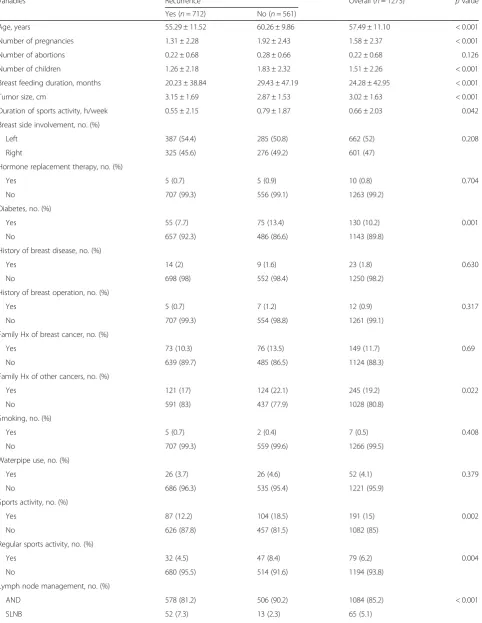
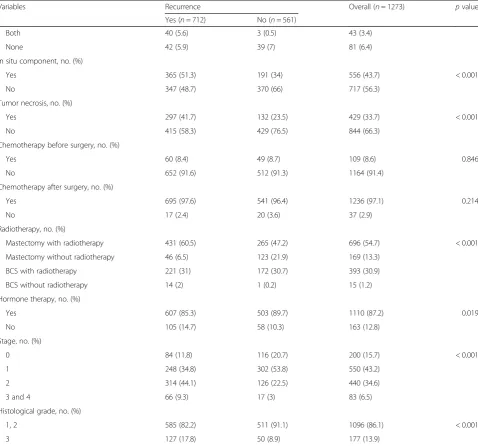
Patients’baseline characteristics and comparison of indi-viduals with recurrence and those without recurrence are shown in Table1.
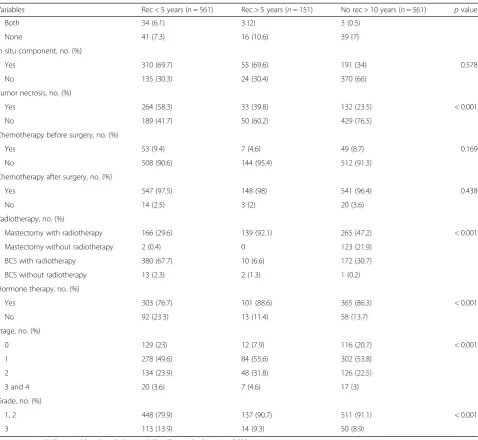
We further compared those with early and late recur-rence and compared them to those without recurrecur-rence. Individuals without recurrence more than 10 years were significantly older than those with recurrence > 5 years and recurrence of < 5 years (60.27 ± 9.87, 59.18 ± 9.67, and 54.25 ± 11.76 years old, respectively; p< 0.001) had more pregnancies (1.92 ± 2.43, 1.39 ± 2.25, and 1.29 ± 2.29, respectively; p< 0.001), more children (1.83 ± 2.32, 1.35 ± 2.20, and 1.24 ± 2.176, respectively; p< 0.001), higher rates of retired individuals (18.6%, 13.6%, and 8.5%, respectively, p= 0.038), higher rates of diabetes (13.4%, 13.2%, and 6.2%, respectively; p< 0.001), higher rates of sports activity (18.5%, 12.6%, and 12.1%, respect-ively,p= 0.007), higher rates of scheduled sports activity (8.4%, 5.3%, and 4.3%, respectively, p= 0.015), lower rates of radiotherapy (78.8%, 88.3%, and 87.4%, respect-ively, p< 0.001), and lower stages of BC (21.3%, 16.9%, and 11.9% for stage 1, respectively, p< 0.001). Those with recurrence of < 5 years had higher rates of left-sided breast involvement compared to those with re-currence > 5 years and those with no rere-currence after
10 years (56%, 45.6%, and 50.5%, respectively, p=
0.040), and higher rates of tumor necrosis (58.3%, 39.8%, and 45.1%, respectively, p< 0.001).
Those with recurrence of > 5 years had higher rates of other types of cancer in family members compared to the < 5 years recurrence group and those without
recurrence > 10 years (25.8%, 14.6%, and 22.1%, respect-ively, p< 0.001), and higher rates of hormone therapy (88.6%, 76.7%, and 86.3%, respectively,p< 0.001).
The three groups were also significantly different re-garding invasion status (p< 0.001) and pathological grade (p< 0.001) (Table2).
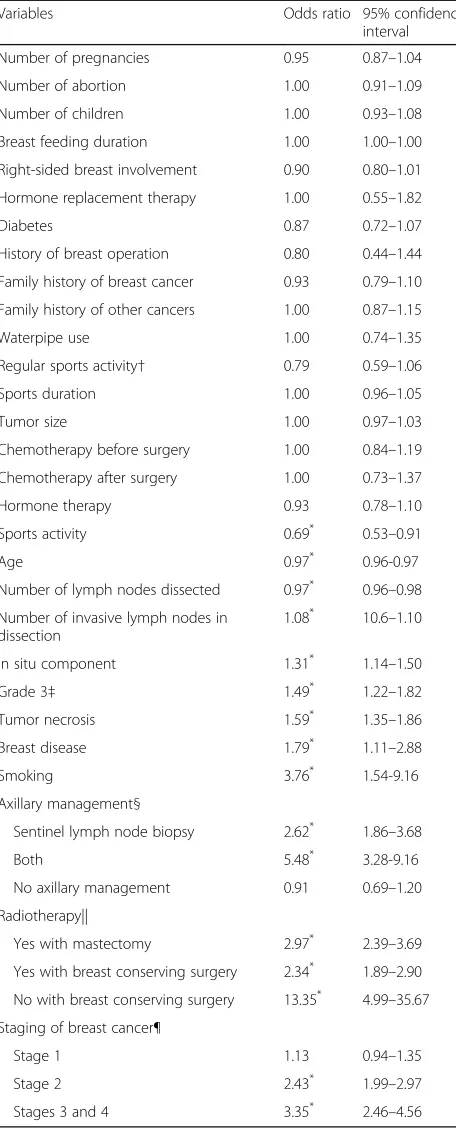
In the LASSO regression model, sports activity (OR 0.69; 95% CI = 0.53–0.91), number of lymph nodes (LN)
dissected in SLNB and AND (OR 0.97; 95% CI = 0.96–
0.98), and higher age (OR 0.97; 95% CI = 0.96–0.97) were associated with later recurrence, respectively. Moreover, number of invasive LNs in dissection (OR 1.08; 95% CI
= 1.06–1.10), in situ component (OR 1.14; 95% CI =
as base for comparison), radiotherapy with mastectomy (compared to mastectomy without radiotherapy) (OR 2.97; 95% CI = 2.39–3.69), and higher stage of BC [stage 2 (OR 2.43; 95% CI = 1.99–2.97) and stages 3 and 4 (OR 3.53; 95% CI = 2.46–4.56)] were predictors of recurrence (Table3).
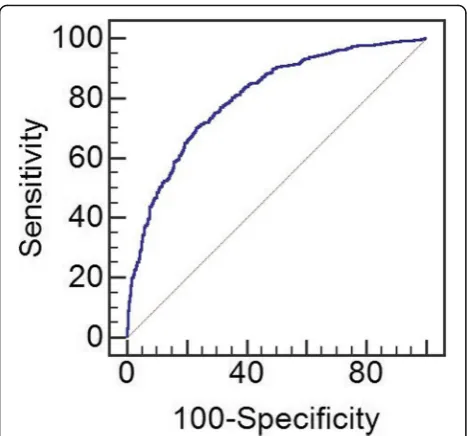
Using coefficients, probability of BC recurrence was calculated for each patient. Cut-off point was deter-mined as p= 0.566 in ROC analysis and accuracy of the
proposed model was equal to 80% (95% CI = 78.2–
82.6%). Furthermore, sensitivity and specificity for group LASSO was 70.1% and 76.8%, respectively. Tuning par-ameter for this model was 0.006 (Fig.1).
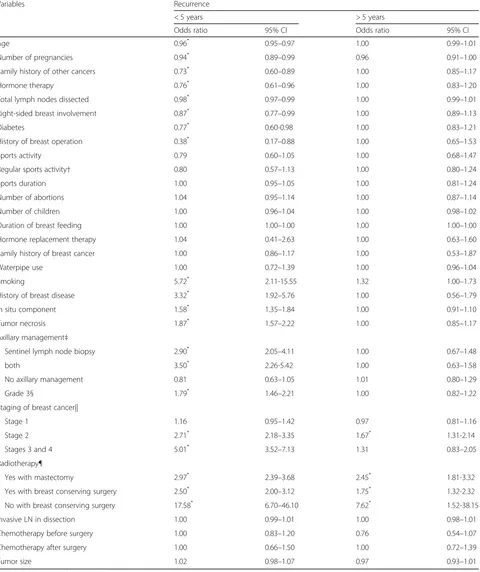
When stratified according to timing of recurrence, our models showed that for recurrence < 5 years, age (OR 0.96, 95% CI = 0.95–0.97), number of pregnancies (OR 0.94, 95% CI = 0.89–0.99), family history of other cancers
(OR 0.73, 95% CI = 0.60–0.89), hormone therapy (OR
0.76, 95% CI = 0.61–0.96), total number of dissected LN (OR 0.98, 95% CI = 0.97–0.99), right-sided BC (OR 0.87, 95% CI = 0.77–0.99), diabetes (OR 0.77, 95% CI = 0.60– 0.98), and history of breast operations (OR 0.38, 95% CI = 0.17–0.88) were protective against recurrence. How-ever, smoking (OR 5.72, 95% CI = 2.11–15.55), history of previous breast disease (OR 3.32, 95% CI = 1.92–5.76), in
situ component (OR 1.58, 95% CI = 1.35–1.84), tumor
necrosis (OR 1.87, 95% CI = 1.57–2.22), SLNB (OR 2.90,
95% CI = 2.05–4.11) and concomitant SLNB and AND
Table 1Baseline and clinicopathological characteristics of individuals with and without recurrence*
Variables Recurrence Overall (n= 1273) pvalue
Yes (n= 712) No (n= 561)
Age, years 55.29 ± 11.52 60.26 ± 9.86 57.49 ± 11.10 < 0.001
Number of pregnancies 1.31 ± 2.28 1.92 ± 2.43 1.58 ± 2.37 < 0.001
Number of abortions 0.22 ± 0.68 0.28 ± 0.66 0.22 ± 0.68 0.126
Number of children 1.26 ± 2.18 1.83 ± 2.32 1.51 ± 2.26 < 0.001
Breast feeding duration, months 20.23 ± 38.84 29.43 ± 47.19 24.28 ± 42.95 < 0.001
Tumor size, cm 3.15 ± 1.69 2.87 ± 1.53 3.02 ± 1.63 < 0.001
Duration of sports activity, h/week 0.55 ± 2.15 0.79 ± 1.87 0.66 ± 2.03 0.042
Breast side involvement, no. (%)
Left 387 (54.4) 285 (50.8) 662 (52) 0.208
Right 325 (45.6) 276 (49.2) 601 (47)
Hormone replacement therapy, no. (%)
Yes 5 (0.7) 5 (0.9) 10 (0.8) 0.704
No 707 (99.3) 556 (99.1) 1263 (99.2)
Diabetes, no. (%)
Yes 55 (7.7) 75 (13.4) 130 (10.2) 0.001
No 657 (92.3) 486 (86.6) 1143 (89.8)
History of breast disease, no. (%)
Yes 14 (2) 9 (1.6) 23 (1.8) 0.630
No 698 (98) 552 (98.4) 1250 (98.2)
History of breast operation, no. (%)
Yes 5 (0.7) 7 (1.2) 12 (0.9) 0.317
No 707 (99.3) 554 (98.8) 1261 (99.1)
Family Hx of breast cancer, no. (%)
Yes 73 (10.3) 76 (13.5) 149 (11.7) 0.69
No 639 (89.7) 485 (86.5) 1124 (88.3)
Family Hx of other cancers, no. (%)
Yes 121 (17) 124 (22.1) 245 (19.2) 0.022
No 591 (83) 437 (77.9) 1028 (80.8)
Smoking, no. (%)
Yes 5 (0.7) 2 (0.4) 7 (0.5) 0.408
No 707 (99.3) 559 (99.6) 1266 (99.5)
Waterpipe use, no. (%)
Yes 26 (3.7) 26 (4.6) 52 (4.1) 0.379
No 686 (96.3) 535 (95.4) 1221 (95.9)
Sports activity, no. (%)
Yes 87 (12.2) 104 (18.5) 191 (15) 0.002
No 626 (87.8) 457 (81.5) 1082 (85)
Regular sports activity, no. (%)
Yes 32 (4.5) 47 (8.4) 79 (6.2) 0.004
No 680 (95.5) 514 (91.6) 1194 (93.8)
Lymph node management, no. (%)
AND 578 (81.2) 506 (90.2) 1084 (85.2) < 0.001
had a noticeably higher odds ratio compared to quadra-nectomy with radiotherapy for recurrence < 5 years (OR 17.58, 95% CI = 6.70–46.10 vs. OR 2.50, 95% CI = 2–3.12) (Table4).
Cut-off point for this model (< 5-year recurrence) was determined asp= 0.495 in ROC analysis and accuracy of
the proposed model was equal to 82% (95% CI = 80–
84%). Sensitivity and specificity for group LASSO was 75.6% and 74.9%, respectively. Tuning parameter for this model was 0.006 (Fig.2).
For recurrence of > 5 years, only stage 2 cancer
(OR 1.67, 95% CI = 1.31–2.14) and radiotherapy in
mastectomy (OR 2.45, 95% CI = 1.81–3.32) were
predictors of worse recurrence; furthermore, relative to mastectomy without radiotherapy (as reference for
comparison), quadranectomy without radiotherapy
had a noticeably higher odds ratio compared to quad-rantectomy with radiotherapy for recurrence > 5 years
(OR 7.62, 95% CI = 1.52–38.15 vs. OR 1.75, 95% CI =
1.32–2.32).
Cut-off point for this model (> 5-year recurrence) was determined asp= 0.206 in ROC analysis and accuracy of
the proposed model was equal to 71% (95% CI = 67–
74%). Sensitivity and specificity for group LASSO were 78.8% and 55.8%, respectively. Tuning parameter for this model was 0.007 (Fig.2).
Table 1Baseline and clinicopathological characteristics of individuals with and without recurrence*(Continued)
Variables Recurrence Overall (n= 1273) pvalue
Yes (n= 712) No (n= 561)
Both 40 (5.6) 3 (0.5) 43 (3.4)
None 42 (5.9) 39 (7) 81 (6.4)
In situ component, no. (%)
Yes 365 (51.3) 191 (34) 556 (43.7) < 0.001
No 347 (48.7) 370 (66) 717 (56.3)
Tumor necrosis, no. (%)
Yes 297 (41.7) 132 (23.5) 429 (33.7) < 0.001
No 415 (58.3) 429 (76.5) 844 (66.3)
Chemotherapy before surgery, no. (%)
Yes 60 (8.4) 49 (8.7) 109 (8.6) 0.846
No 652 (91.6) 512 (91.3) 1164 (91.4)
Chemotherapy after surgery, no. (%)
Yes 695 (97.6) 541 (96.4) 1236 (97.1) 0.214
No 17 (2.4) 20 (3.6) 37 (2.9)
Radiotherapy, no. (%)
Mastectomy with radiotherapy 431 (60.5) 265 (47.2) 696 (54.7) < 0.001
Mastectomy without radiotherapy 46 (6.5) 123 (21.9) 169 (13.3)
BCS with radiotherapy 221 (31) 172 (30.7) 393 (30.9)
BCS without radiotherapy 14 (2) 1 (0.2) 15 (1.2)
Hormone therapy, no. (%)
Yes 607 (85.3) 503 (89.7) 1110 (87.2) 0.019
No 105 (14.7) 58 (10.3) 163 (12.8)
Stage, no. (%)
0 84 (11.8) 116 (20.7) 200 (15.7) < 0.001
1 248 (34.8) 302 (53.8) 550 (43.2)
2 314 (44.1) 126 (22.5) 440 (34.6)
3 and 4 66 (9.3) 17 (3) 83 (6.5)
Histological grade, no. (%)
1, 2 585 (82.2) 511 (91.1) 1096 (86.1) < 0.001
3 127 (17.8) 50 (8.9) 177 (13.9)
SLNBsentinel lymph node biopsy;ANDaxillary node dissection,BCSbreast conserving surgery (quadrantectomy) *
Table 2Comparison of clinicopathological characteristics of breast cancer according to timing of recurrence as early and late
recurrence*
Variables Rec < 5 years (n= 561) Rec > 5 years (n= 151) No rec > 10 years (n= 561) pvalue
Age, years 54.25 ± 11.76 59.18 ± 9.67 60.26 ± 9.86 < 0.001
Number of pregnancies 1.29 ± 2.29 1.39 ± 2.25 1.92 ± 2.43 < 0.001
Number of abortions 0.22 ± 0.703 0.20 ± 0.62 0.28 ± 0.66 0.287
Number of children 1.24 ± 2.176 1.35 ± 2.20 1.83 ± 2.32 < 0.001
Breast feeding duration, months 20.12 ± 39.71 20.64 ± 35.56 29.43 ± 47.19 0.001
Tumor size, cm 3.21 ± 1.80 0.50 ± 1.46 2.87 ± 1.53 < 0.001
Duration of sports activity, h/week 0.57 ± 2.30 0.05 ± 1.46 0.79 ± 1.87 < 0.001
Breast side involvement, no. (%)
Left 311 (56) 68 (45.6) 285 (50.8) 0.040
Right 244 (44) 81 (54.4) 276 (49.2)
Hormone replacement therapy, no. (%)
Yes 3 (1.4) 2 (3.3) 5 (0.9) 0.611
No 204 (98.6) 58 (96.7) 556 (99.1)
Diabetes, no. (%)
Yes 35 (6.2) 20 (13.2) 75 (13.4) < 0.001
No 526 (93.8) 131 (86.8) 486 (86.6)
History of breast disease, no. (%)
Yes 13 (2.3) 1 (0.7) 9 (1.6) 0.355
No 548 (97.7) 150 (99.3) 552 (98.4)
History of breast operation, no. (%)
Yes 2 (0.4) 3 (2) 7 (1.2) 0.112
No 559 (99.6) 148 (98) 554 (98.8)
Family Hx of breast cancer, no. (%)
Yes 57 (10.2) 16 (10.6) 76 (13.5) 0.190
No 504 (89.8) 135 (89.4) 485 (86.5)
Family Hx of other cancer, no. (%)
Yes 82 (14.6) 39 (25.8) 124 (22.1) 0.001
No 479 (85.4) 112 (74.2) 437 (77.9)
Smoking, no. (%)
Yes 5 (0.9) 0 2 (0.4) 0.299
No 556 (99.1) 151 (100) 559 (99.6)
Waterpipe use, no. (%)
Yes 22 (3.9) 4 (2.6) 26 (4.6) 0.531
No 539 (96.1) 147 (97.4) 535 (95.4)
Sports activity, no. (%)
Yes 68 (12.1) 19 (12.6) 104 (18.5) 0.007
No 493 (87.9) 132 (87.4) 457 (81.5)
Regular sports activity, no. (%)
Yes 24 (4.3) 8 (5.3) 47 (8.4) 0.015
No 537 (95.7) 143 (94.7) 514 (91.6)
Lymph node management, no. (%)
SLNB 48 (8.6) 6 (4) 506 (90.2) < 0.001
The three final models are provided in Additional file1, which can be utilized to estimate recurrence time based on our selected variables; furthermore, the models will also be available at the breast clinic web-site at www.bdrc.sums.ac.ir.
Discussion
In here, we aimed to introduce models to predict recur-rence in a large sample of individuals during a period of 20 years from 1995 to 2016. We further defined a model to predict recurrence among those with early recurrence and late recurrence and compared estimates.
In our final model which included more than 50 vari-ables on different aspects of BC and patient baseline char-acteristics, we found that aside to more common and previously known risk factors like clinical stage, and pathological grade, factors like sports activity, higher age, number of LNs dissected in SLNB and AND, and radio-therapy in BCS were protective against recurrence, on the other hand, in situ component in pathology, tumor necro-sis, having other breast diseases, smoking, LN manage-ment including SLNB, and simultaneous SLNB and AND (considering AND as base for comparison), number of in-vasive LNs after dissection, and radiotherapy after mastec-tomy were associated with earlier recurrence.
Table 2Comparison of clinicopathological characteristics of breast cancer according to timing of recurrence as early and late recurrence*(Continued)
Variables Rec < 5 years (n= 561) Rec > 5 years (n= 151) No rec > 10 years (n= 561) pvalue
Both 34 (6.1) 3 (2) 3 (0.5)
None 41 (7.3) 16 (10.6) 39 (7)
In situ component, no. (%)
Yes 310 (69.7) 55 (69.6) 191 (34) 0.578
No 135 (30.3) 24 (30.4) 370 (66)
Tumor necrosis, no. (%)
Yes 264 (58.3) 33 (39.8) 132 (23.5) < 0.001
No 189 (41.7) 50 (60.2) 429 (76.5)
Chemotherapy before surgery, no. (%)
Yes 53 (9.4) 7 (4.6) 49 (8.7) 0.169
No 508 (90.6) 144 (95.4) 512 (91.3)
Chemotherapy after surgery, no. (%)
Yes 547 (97.5) 148 (98) 541 (96.4) 0.438
No 14 (2.5) 3 (2) 20 (3.6)
Radiotherapy, no. (%)
Mastectomy with radiotherapy 166 (29.6) 139 (92.1) 265 (47.2) < 0.001
Mastectomy without radiotherapy 2 (0.4) 0 123 (21.9)
BCS with radiotherapy 380 (67.7) 10 (6.6) 172 (30.7)
BCS without radiotherapy 13 (2.3) 2 (1.3) 1 (0.2)
Hormone therapy, no. (%)
Yes 303 (76.7) 101 (88.6) 365 (86.3) < 0.001
No 92 (23.3) 13 (11.4) 58 (13.7)
Stage, no. (%)
0 129 (23) 12 (7.9) 116 (20.7) < 0.001
1 278 (49.6) 84 (55.6) 302 (53.8)
2 134 (23.9) 48 (31.8) 126 (22.5)
3 and 4 20 (3.6) 7 (4.6) 17 (3)
Grade, no. (%)
1, 2 448 (79.9) 137 (90.7) 511 (91.1) < 0.001
3 113 (13.9) 14 (9.3) 50 (8.9)
Recrecurrence;SLNBsentinel lymph node biopsy;ANDaxillary node dissection;BCSbreast conserving surgery *
When we stratified our models based on early and late recurrence, we found that for early recurrence (< 5 years), in addition to factors that were significant for overall re-currence, number of pregnancies, family history of other cancers, hormone therapy, right-sided BC, diabetes, and history of breast operations were predictors of better outcome. Furthermore, only stage 2 BC and radiother-apy were significant predictors in late recurrence (> 5 years).
Recently, Wu et al. [9] introduced a model for estimat-ing 5-year recurrence in a population of 4505 women. In their final model, they found age of less than 54 years old, alcohol consumption and adjuvant therapy to be protective, African American ethnicity, nuclear grade 3, tumor size, number of positive nodes, and lymphovascu-lar invasion to be malignant predictors of 5-year recur-rence. They introduced one of the most comprehensive models for estimating 5-year recurrence using both epi-demiological data and BC specific data and by using a Cox analysis approach. Similar to the mentioned study, we had one of the most comprehensive models for pre-dicting BC recurrence in two phases of early recurrence and late recurrence. Furthermore, as we included a wide range of data from our BC registry, we introduced a more comprehensive model including baseline charac-teristics, socioeconomic determinants, obstetrics and gynecological data, pathological data, and personal habits like smoking and sports activity. In our results, we also found a number of positive nodes and grade to be predictors of worse recurrence.
Considering the clinical value of timing of recurrence, we introduced two models according to time of recur-rence as early and late recurrecur-rence. Accordingly, our models showed that only radiotherapy and stage of can-cer remained to be significant in recurrence of > 5 years. This is an important clinical finding as it aids signifi-cantly in the understanding of late recurrence in BC patients.
In a smaller study in 2016 [10], those with early (< 5 years) and those with late recurrence (> 5 years) were compared regarding clinical characteristics. They found that these two groups differed regarding tumor size,
number of positive nodes, grade, ER and PR receptors
and HER2, and adjuvant therapy. In their multivariate
regression models, they found tumor size, ER receptor
and HER2 to be associated with worse > 5-year recur-rence and grade 2 BC to be associated with better late recurrence. They used regression modelling to estimate predictors of late recurrence in a population of 300 women, and their study did not provide an overview of differences between those who present with early and those who present with late recurrence as they only had limited set of participants and variables. Another study
in 2016 [11] evaluated factors associated with BC
Table 3Risk factor assessment for overall recurrence based on group LASSO analysis
Variables Odds ratio 95% confidence
interval
Number of pregnancies 0.95 0.87–1.04
Number of abortion 1.00 0.91–1.09
Number of children 1.00 0.93–1.08
Breast feeding duration 1.00 1.00–1.00
Right-sided breast involvement 0.90 0.80–1.01
Hormone replacement therapy 1.00 0.55–1.82
Diabetes 0.87 0.72–1.07
History of breast operation 0.80 0.44–1.44
Family history of breast cancer 0.93 0.79–1.10
Family history of other cancers 1.00 0.87–1.15
Waterpipe use 1.00 0.74–1.35
Regular sports activity† 0.79 0.59–1.06
Sports duration 1.00 0.96–1.05
Tumor size 1.00 0.97–1.03
Chemotherapy before surgery 1.00 0.84–1.19
Chemotherapy after surgery 1.00 0.73–1.37
Hormone therapy 0.93 0.78–1.10
Sports activity 0.69* 0.53–0.91
Age 0.97* 0.96-0.97
Number of lymph nodes dissected 0.97* 0.96–0.98
Number of invasive lymph nodes in dissection
1.08* 10.6–1.10
In situ component 1.31* 1.14–1.50
Grade 3‡ 1.49* 1.22–1.82
Tumor necrosis 1.59* 1.35–1.86
Breast disease 1.79* 1.11–2.88
Smoking 3.76* 1.54-9.16
Axillary management§
Sentinel lymph node biopsy 2.62* 1.86–3.68
Both 5.48* 3.28-9.16
No axillary management 0.91 0.69–1.20
Radiotherapy||
Yes with mastectomy 2.97* 2.39–3.69
Yes with breast conserving surgery 2.34* 1.89–2.90
No with breast conserving surgery 13.35* 4.99–35.67
Staging of breast cancer¶
Stage 1 1.13 0.94–1.35
Stage 2 2.43* 1.99–2.97
Stages 3 and 4 3.35* 2.46–4.56
*
Shows statistical significance (p< 0.05)
†Irregular sports activity was considered base for comparison ‡Grades 1 and 2 were considered base for comparison
recurrence after BCS and found premenopausal state,
ER expression, and hormone therapy to be factors
as-sociated with recurrence. Similarly, we also found hormone therapy to be significant in our < 5-year re-currence model.
Our study presents a novel assessment of BC recur-rence, and accordingly, we found some interesting re-sults regarding determinants of BC recurrence using advanced statistical modeling.
Among the most interesting findings was the associ-ation between sports activity and recurrence, although sports activity was measured in a subjective manner and patients were asked regarding their daily routine and physical activity, sports activity presented as highly pro-tective in BC recurrence. Studies on recurrence and physical activity in the settings of a large sample with long-term follow-up were mainly missing up to 2006 ac-cording to a meta-analysis by McNeely [12] in 2006 who evaluated the relationship between exercise and BC. To date, most studies have mostly focused on physical activ-ity and BC outcomes as a whole; however, more recently two studies evaluated the association between exercise and BC recurrence, one was conducted in Germany and another in a Canadian registry. A meta-analysis in 2015 [13] found that using data from the two mentioned stud-ies, exercise showed a protective role against recurrence with an odds ratio very similar to that of our study (OR 0.72; 95% CI = 0.56–0.91). Although the exact mechan-ism by which exercise decreases recurrence rates still re-mains unknown, studies have shown exercise to improve quality of life in BC patients [12], and others have also attributed this to changes in adipose tissue and skeletal muscle [14].
Regarding pathology-related parameters, in situ com-ponent and tumor necrosis were associated with worse recurrence.
We found those who had both SLNB and AND were at higher risk of recurrence when compared to those who had isolated SLNB or AND alone, respectively.
As SLNB has recently been added as a treatment mo-dality to replace isolate AND [15], furthermore consider-ing isolated SLNB has recently been accepted and applied in our center and in literature, and our study in-cluded patients from 1995 which is before the introduc-tion of SLNB to replace AND, some patients that had axillary dissection may have been node negative in the past (a mixture of both patients with good and bad prognosis). This may have been among the reasons for the higher recorded recurrence rate associated with SLNB (compared to AND), thus, judgment on the mat-ter should be done with caution. Those who had both axillary management modalities had definitive positive LNs and consequently had worse prognosis. However, all these are mainly considered for locoregional recurrence, and distant metastasis presents more complicated phe-nomena and may not be easily explained. Although, AND is not considered among patient without palpable masses or signs of metastasis in sonography evaluation, a review in 2013 [16] found that among individuals with-out the mentioned conditions, AND improves recur-rence rates by 1–3% compared to isolated SLNB, which was similar to our results. In a more recent review by Bromham and colleagues [17] that included RCT’s com-paring individuals with no axillary surgery and those with AND, they found that no axillary surgery increased locoregional recurrence by 1.10 to 3.06; however, regard-ing distant metastasis, they found uncertain results as to whether no surgery increased metastasis rates (HR 1.06; 95% CI = 0.87–1.30). Comparing isolated AND and SLNB showed uncertain results regarding distant metastasis in the mentioned study (HR 0.80; 95% CI = 0.42–1.53).
Among the interesting findings was that number of LNs dissected in AND or SLNB management was associated with better overall recurrence. On the other hand, number of invasive nodes detected in AND and SLNB was associ-ated with worse recurrence. These findings should be con-sidered with caution regarding its clinical application as higher number of dissection will ultimately produce higher complications such as lymphedema.
In our model history of breast diseases presented as a strong risk factor for recurrence, this is a novel concept yet to be described and evaluated.
Table 4Comparison of estimates of recurrence between those with early and late recurrence using group LASSO analysis
Variables Recurrence
< 5 years > 5 years
Odds ratio 95% CI Odds ratio 95% CI
Age 0.96* 0.95–0.97 1.00 0.99–1.01
Number of pregnancies 0.94* 0.89–0.99 0.96 0.91–1.00
Family history of other cancers 0.73* 0.60–0.89 1.00 0.85–1.17
Hormone therapy 0.76* 0.61–0.96 1.00 0.83–1.20
Total lymph nodes dissected 0.98* 0.97–0.99 1.00 0.99–1.01
Right-sided breast involvement 0.87* 0.77–0.99 1.00 0.89–1.13
Diabetes 0.77* 0.60-0.98 1.00 0.83–1.21
History of breast operation 0.38* 0.17–0.88 1.00 0.65–1.53
Sports activity 0.79 0.60–1.05 1.00 0.68–1.47
Regular sports activity† 0.80 0.57–1.13 1.00 0.80–1.24
Sports duration 1.00 0.95–1.05 1.00 0.81–1.24
Number of abortions 1.04 0.95–1.14 1.00 0.87–1.14
Number of children 1.00 0.96–1.04 1.00 0.98–1.02
Duration of breast feeding 1.00 1.00–1.00 1.00 1.00–1.00
Hormone replacement therapy 1.04 0.41–2.63 1.00 0.63–1.60
Family history of breast cancer 1.00 0.86–1.17 1.00 0.53–1.87
Waterpipe use 1.00 0.72–1.39 1.00 0.96–1.04
Smoking 5.72* 2.11-15.55 1.32 1.00–1.73
History of breast disease 3.32* 1.92–5.76 1.00 0.56–1.79
In situ component 1.58* 1.35–1.84 1.00 0.91–1.10
Tumor necrosis 1.87* 1.57–2.22 1.00 0.85–1.17
Axillary management‡
Sentinel lymph node biopsy 2.90* 2.05–4.11 1.00 0.67–1.48
both 3.50* 2.26-5.42 1.00 0.63–1.58
No axillary management 0.81 0.63–1.05 1.01 0.80–1.29
Grade 3§ 1.79* 1.46–2.21 1.00 0.82–1.22
Staging of breast cancer||
Stage 1 1.16 0.95–1.42 0.97 0.81–1.16
Stage 2 2.71* 2.18–3.35 1.67* 1.31-2.14
Stages 3 and 4 5.01* 3.52–7.13 1.31 0.83–2.05
Radiotherapy¶
Yes with mastectomy 2.97* 2.39–3.68 2.45* 1.81-3.32
Yes with breast conserving surgery 2.50* 2.00–3.12 1.75* 1.32-2.32
No with breast conserving surgery 17.58* 6.70–46.10 7.62* 1.52-38.15
Invasive LN in dissection 1.00 0.99–1.01 1.00 0.98–1.01
Chemotherapy before surgery 1.00 0.83–1.20 0.76 0.54–1.07
Chemotherapy after surgery 1.00 0.66–1.50 1.00 0.72–1.39
Tumor size 1.02 0.98–1.07 0.97 0.93–1.01
*
Shows statistical significance (p< 0.05)
†Irregular sports activity was considered base for comparison
‡Having axillary lymph node dissection was considered base for comparison §Grades 1 and 2 were considered base for comparison
||Stage zero was considered base for comparison
Among other novel findings in our endeavor to find as-sociated factors with recurrence, was the association of smoking with recurrence and the insignificant association of waterpipe use with recurrence. As the use of waterpipes continues to grow worldwide, it has become a global epi-demic with recent reports from the middle-east indicating that it has even surpassed cigarette smoking to become the most common form of tobacco used in the region [18]. This is the first study to evaluate waterpipe use in BC recurrence.
We found multiple obstetrics-related variables such as number of pregnancies, number of abortions, number of children, and breast feeding duration to not be signifi-cantly associated with overall recurrence, however num-ber of pregnancies, history of breast operation, hormone therapy, right-sided BC, history of previous breast dis-ease demonstrated significance in our < 5-year recur-rence model.
We found diabetes to be a good predictor of < 5-year recurrence, which was similar to that reported by Chen et al. [19]. Using the Surveillance, Epidemiology and End-Results (SEER)-Medicare database, they found
Met-formin use to be associated with a 31% (95% CI 0.53–
0.90) decrease in BC recurrence.
Our results indicate that regarding treatment modal-ities only radiotherapy seems to affect recurrence of > 5 years which renders different results based on type of BC surgery performed for the patient (as either mastec-tomy or BCS).
This study was not without limitation. As we had lim-ited number of individuals in some of the categories, all variables in our database were not applicable in the final
model due to the limited number of data. Taking into consideration that individuals who were recently (less than 10 years from their initial diagnosis) added to our registry may not have had the chance to present signs of recurrence, we considered those without recurrence of more than 10 years from their initial diagnosis of BC and this decreased the size of the comparison groups.
Conclusion
As the main outcome of our study, we used advanced statistics to construct models based on multiple factors to predict both early and late recurrence. Compared to previous literature which has included limited variables, our models are among the most applicable and compre-hensive models for predicting recurrence based on tim-ing of recurrence with excellent accuracy (> 80%).
Additional file
Additional file 1:Formulas for the prediction of recurrence. (DOCX 15 kb)
Acknowledgements
Authors would like to thank all personnel at the Shiraz Breast Clinic for their help in gathering the data. The study is registered as the thesis of Dr. Tannaz Eghbali for their MD course.
Funding
The study was funded by Shiraz University of Medical Sciences (Grant #95-01-01-12906).
Availability of data and materials
Suggestion and opinions of all respectable readers and researchers are welcomed for the enhancement of future research. Readers and institutions are requested to submit their suggestions and research proposals to the Shiraz Breast Cancer Research Center at [email protected] or by directly contacting [email protected] or [email protected] via email. Website of the research center is also under development and is open to respected readers’comments and research propositions athttp://bdrc.sums.ac.ir/en/.
Authors’contributions
MA, PA, TE, and HRS aided in the study design, interpretation of data, data analysis, and preparation of the manuscript. ST, VZ, AR and AT aided in the study development and design and critical revision of final draft. All authors read and approved the final manuscript.
Ethics approval and consent to participate
Study protocol was approved by the Institutional Review Board (IRB) of Shiraz University of Medical Sciences (ethics IR.sums.med.rec.1396.s248).
Consent for publication
All authors have approved the final format of the manuscript.
Competing interests
The authors declare that they have no competing interests.
Publisher’s Note
Springer Nature remains neutral with regard to jurisdictional claims in published maps and institutional affiliations.
Author details
1
Breast Diseases Research Center, Shiraz University of Medical Sciences, Shiraz, Iran.2Non-communicable Diseases Research Center, Fasa University of Medical Sciences, Fasa, Iran.3Department of Biostatistics and Epidemiology, Faculty of Health, Shahrekord University of Medical Sciences, Shahrekord, Fig. 2ROC curve for model predicting recurrence less than 5 years
Iran.4Surgical Oncology Division, General Surgery Department, Shiraz University of Medical Sciences, Shiraz, Iran.
Received: 16 March 2018 Accepted: 5 September 2018
References
1. Ban KA, Godellas CV. Epidemiology of breast cancer. Surg Oncol Clin N Am. 2014;23(3):409–22.
2. Wapnir IL, Anderson SJ, Mamounas EP, Geyer CE Jr, Jeong JH, Tan-Chiu E, et al. Prognosis after ipsilateral breast tumor recurrence and locoregional recurrences in five national surgical adjuvant breast and bowel project node-positive adjuvant breast cancer trials. J Clin Oncol. 2006;24(13):2028–37. 3. Zhang Y, Schroeder BE, Jerevall PL, Ly A, Nolan H, Schnabel CA, et al. A
novel breast cancer index for prediction of distant recurrence in HR+ early stage breast cancer with 1 to 3 positive nodes. Clin Cancer Res. 2017. 4. Wishart GC, Azzato EM, Greenberg DC, Rashbass J, Kearins O, Lawrence G, et
al. PREDICT: a new UK prognostic model that predicts survival following surgery for invasive breast cancer. Breast Cancer Res. 2010;12(1):R1. 5. Wishart GC, Bajdik CD, Dicks E, Provenzano E, Schmidt MK, Sherman M, et al.
PREDICT Plus: development and validation of a prognostic model for early breast cancer that includes HER2. Br J Cancer. 2012;107(5):800–7. 6. Kim W, Kim KS, Lee JE, Noh DY, Kim SW, Jung YS, et al. Development of
novel breast cancer recurrence prediction model using support vector machine. J Breast Cancer. 2012;15(2):230–8.
7. Michaelson JS, Chen LL, Bush D, Fong A, Smith B, Younger J. Improved web-based calculators for predicting breast carcinoma outcomes. Breast Cancer Res Treat. 2011;128(3):827–35.
8. Tibshirani R. Regression shrinkage and selection via the lasso. J R Stat Soc Ser B Methodol. 1996;58(1):267–88.
9. Wu X, Ye Y, Barcenas CH, Chow WH, Meng QH, Chavez-MacGregor M,
Hildebrandt MAT, Zhao H, Gu X, Deng Y, Wagar E, Esteva FJ, Tripathy D, Hortobagyi GN. Personalized prognostic prediction models for breast cancer recurrence and survival incorporating multidimensional data. J Natl Cancer Inst. 2017;109(7):djw314.
10. Wangchinda P, Ithimakin S. Factors that predict recurrence later than 5 years after initial treatment in operable breast cancer. World J Surg Oncol. 2016;14(1):223.
11. Ditsatham C, Somwangprasert A, Watcharachan K, Wongmaneerung P,
Khorana J. Factors affecting local recurrence and distant metastases of invasive breast cancer after breast-conserving surgery in Chiang Mai University Hospital. Breast cancer (Dove Medical Press). 2016;8:47–52. 12. McNeely ML, Campbell KL, Rowe BH, Klassen TP, Mackey JR, Courneya KS.
Effects of exercise on breast cancer patients and survivors: a systematic review and meta-analysis. CMAJ. 2006;175(1):34–41.
13. Lahart IM, Metsios GS, Nevill AM, Carmichael AR. Physical activity, risk of death and recurrence in breast cancer survivors: a systematic review and meta-analysis of epidemiological studies. Acta oncologica (Stockholm, Sweden). 2015;54(5):635–54.
14. Dieli-Conwright CM, Lee K, Kiwata JL. Reducing the risk of breast cancer recurrence: an evaluation of the effects and mechanisms of diet and exercise. Current Breast Cancer Rep. 2016;8(3):139–50.
15. Krag DN, Anderson SJ, Julian TB, Brown AM, Harlow SP, Costantino JP, et al. Sentinel-lymph-node resection compared with conventional axillary-lymph-node dissection in clinically axillary-lymph-node-negative patients with breast cancer: overall survival findings from the NSABP B-32 randomised phase 3 trial. The Lancet Oncology. 2010;11(10):927–33.
16. Rao R, Euhus D, Mayo HG, Balch C. Axillary node interventions in breast cancer: a systematic review. JAMA. 2013;310(13):1385–94.
17. Bromham N, Schmidt-Hansen M, Astin M, Hasler E, Reed MW. Axillary treatment for operable primary breast cancer. The Cochrane Database Syst Rev 2017;1:Cd004561.
18. Maziak W, Taleb ZB, Bahelah R, Islam F, Jaber R, Auf R, et al. The global epidemiology of waterpipe smoking. Tob Control. 2014;https://doi.org/10. 1136/tobaccocontrol2014-051903.