R E S E A R C H
Open Access
Pepper leaf curl Lahore virus requires the DNA B
component of Tomato leaf curl New Delhi virus
to cause leaf curl symptoms
Muhammad Shafiq, Shaheen Asad, Yusuf Zafar, Rob W Briddon, Shahid Mansoor
*Abstract
Background:Begomoviruses are whitefly-transmitted geminiviruses with genomes that consist of either two components (known as DNA A and DNA B) or a single component (homologous to the DNA A component of bipartite begomoviruses). Monopartite begomoviruses are often associated with a symptom-modulating DNA satellite (collectively known as betasatellites). Both bipartite and monopartite begomoviruses with associated satellites have previously been identified in chillies showing leaf curl symptoms in Pakistan.
Results: Achilli plant (Capsicum annum) with chilli leaf curl disease symptoms was found to contain a begomovirus, a betasatellite and the DNA B component ofTomato leaf curl New Delhi virus(ToLCNDV). The begomovirus consisted of 2747 nucleotides and had the highest sequence identity (99%)with Pepper leaf curl Lahore virus(PepLCLV-[PK: Lah:04], acc. no. AM404179).Agrobacterium-mediated inoculation of the clone to
Nicotiana benthamiana, induced very mild symptoms and low levels of viral DNA, detected in systemically infected leaves by PCR. No symptoms were induced inNicotiana tabacumor chillies either in the presence or absence of a betasatellite. However, inoculation of PepLCLV with the DNA B component of ToLCNDV induced leaf curl
symptoms inN. benthamiana, N. tabacumand chillies and viral DNA accumulated to higher levels in comparison to plants infected with just PepLCLV.
Conclusions:Based on our previous efforts aimed at understanding of diversity of begomoviruses associated with chillies, we propose that PepLCLV was recently mobilized into chillies upon its interaction with DNA B of ToLCNDV. Interestingly, the putative rep-binding iterons found on PepLCLV (GGGGAC) differ at two base positions from those of ToLCNDV (GGTGTC). This is the first experimental demonstration of the infectivity for a bipartite begomovirus causing chilli leaf curl disease in chillies from Pakistan and suggests that component capture is contributing to the emerging complexity of begomovirus diseases in the region.
Background
Viruses of the familyGeminiviridaehave circular, single-stranded (ss) DNA genomes and are divided into four genera based upon genome arrangement, host range and insect vectors. The most numerous, and economically the most destructive, are the whitefly-transmitted gemi-niviruses that are included in the genus Begomovirus
[1,2]. Begomoviruses are transmitted by the whitefly
Bemisia tabaciand exclusively infect dicotyledonous
plants. They have emerged everywhere in the world where environmental conditions support large whitefly
populations, and have become a major constraint in the production of food and fiber crops such as cassava, tomato, cucurbits, pepper, beans and cotton [3-5].
Chilli leaf curl disease (ChLCD) is an important factor limiting chilli production on the Indian subcontinent and is caused by begomoviruses [6-8]. Symptoms of the disease are severe leaf curl with cup-shaped, upward curling leaves, yellowing, and stunted plant growth. Pre-viously chilli leaf curl betasatellite (ChLCB) has been identified in a large collection of chilli samples with leaf curl symptoms from all over the Pakistan [9]. A single species of betasatellite (ChLCB) was found associated with isolates showing geographical segregation and are similar to that reported earlier [6]. Chilli peppers often * Correspondence: [email protected]
Agricultural Biotechnology Division, National Institute for Biotechnology and Genetic Engineering (NIBGE), P O Box 577, Jhang Road, Faisalabad, Pakistan
show symptoms similar to tomato leaf curl disease, such as yellowing, leaf curling, a reduction in leaf size and stunting. Since chilli and tomato crops overlap in the field, it is likely that chilli peppers may become infected with tomato begomoviruses. The disease was experi-mentally transmitted from infected to healthy chilli and tomato seedlings by the whitefly Bemisia tabaci[10,11]. Inoculated chilli plants developed typical symptoms of the disease. However, the inoculated tomato plants developed severe leaf curl symptoms similar to those of leaf curl disease of tomato caused by Tomato leaf curl
New Delhi virus(ToLCNDV) [11,12]. Analysis of a large
collection of chilli samples from Pakistan showed that diverse begomoviruses may infect chillies [7]. Recently another distinct begomovirus,Pepper leaf curl Lahore
(PepLCLV), has been identified in chilli in Pakistan although the infectivity of the virus to chillies was not established experimentally [13].
Here we have characterised a further isolate of PepLCLV from chilli and have investigated its interac-tion with betasatellites and the DNA B component of ToLCNDV. We show that the virus requires the DNA B of ToLCNDV to infect plants and induce disease symp-toms but its interaction with ChLCB is poor.
Materials and methods
Collection of virus infected plant samples
A chilli plant showing typical symptoms of begomovirus infection was observed in a field near Faisalabad, Pakistan, in 2004. A leaf sample with leaf curl symptoms and a leaf from an asymptomatic plant were collected. Samples were brought to the laboratory and stored at -80°C before extraction of DNA. This isolate was pre-viously shown to harbour ChLCB ([PK:Fai69:04]; acc. no. AM279673) [9].
Isolation, cloning and sequencing
Total DNA was extracted from symptomatic and asymp-tomatic chilli samples using the CTAB method [14]. Uni-versal primers were used in PCR to amplify full-length begomovirus, betasatellite and alphasatellite molecules [15-17]. Two primer pairs, BC1F/BC1R [10], were used for the detection of DNA B of ToLCNDV. PCR amplified products of the expected sizes resulting from DNA extracted from the symptomatic leaf sample were cloned into the pTZ57R/T vector (Fermentas, Arlington, Canada) and a single clone, containing a potentially full-length begomovirus clone (~2800 nt), designated PGL1, was selected for further analysis. PGL1 was sequenced in both orientations with no ambiguities remaining (Macro-gen, Korea). DNA sequences were assembled and ana-lyzed with the aid of the Lasergene package of sequence analysis software (DNA Star Inc., Madison, WI, USA), and multiple sequence alignments were performed using
Clustal X [18]. Phylogenetic trees were constructed using Clustal X (neighbor-joining method), displayed, manipu-lated and printed using Treeview [19]. Specific pairwise comparisons of all available sequences in the databases used the Pairwise Sequence Comparison (PASC) tool http://www.ncbi.nlm.nih.gov/sutils/pasc.
Agrobacterium-mediated inoculation of plants
Standard methods were used to produce partial direct and tandem repeat constructs for Agrobacterium -mediated inoculation in the binary vector pGreen0092 [20]. After sequence confirmation of PGL1, a 1498 nt fragment encompassing the intergenic region was excised from withXbaI andEcoRI and subcloned into theXba
I-EcoRI sites of pGreen0092 to produce the clone pGPeA. The full-length insert of PGL1 was excised withXbaI and inserted into pGPeA at its uniqueXbaI site to yield clone icPGL1. Insert integrity and orientation were confirmed by digestion with EcoRI. This partial direct repeat of PGL1 was mobilized intoAgrobacterium tumefaciens
strain GV3103 by electroporation.
The infectivity of PGL1 was performed alone or in com-bination with the DNA B component of ToLCNDV [21], chilli leaf curl betasatellite (ChLCB-[PK:MC:97]; acc. no AJ316032; [6]) and cotton leaf curl Multan betasatellite (CLCuMB-[PK:Fai1:96]; AJ298903; [22]) in Nicotiana
benthamiana,N. tabacum cv Samsun, andCapsicum
annumcv Loungi byAgrobacterium-mediated inoculation.
A total of 10 plants were inoculated for each plant species. Plants were kept at 25°C with 70% relative humidity and 16 h/day light in an insect-free greenhouse. Plants were examined daily for the appearance of symptoms.
Results
Detection of begomovirus components in chilli samples showing leaf curl symptoms
DNA B in the symptomatic plant. The presence of a betasatellite in samples was detected using the universal primer pair Beta01/Beta02 [16]. These primers produced a fragment of approximately 1350 nt and confirmed the presence of a betasatellite in the sample. The betasatellite was characterized earlier and shown to be an isolate of ChLCB [9].
Analysis of the sequence of PGL1
The sequence of the begomovirus clone PGL1 was determined to be 2747 nt in length and this sequence is available in the databases under accession number AM691745. Sequence comparisons revealed that the genome had the highest sequence identity (99%) with PepLCLV-[PK:Lah:04](AM404179) followed by 89% with PepLCuBDV-PK[PK:Kha:04](DQ116881). This indicates that PGL1 is an isolate of PepLCLV for which we pro-pose the isolate descriptor PepLCLV-[PK:Fai:04] [23].
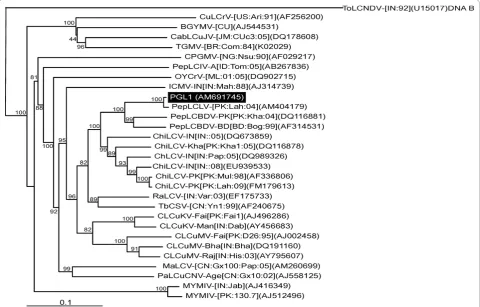
This conclusion is supported by a phylogenetic analysis which shows PGL1 to group with the only other isolate of PepLCLV for which a full-length sequence is available in the databases (PepLCLV-[PK:Lah:04]) and to be clo-sely related to PepLCBDV (Figure 1).
The clone shows the typical genome organization of begomoviruses with two open reading frames (ORFs) in the virion-sense (V2 and V1) and four in the comple-mentary-sense (C1, C2, C3 and C4) [2]. The main genetic features of this begomovirus sequence are given in Table 1. Among the six ORFs, a small difference was noted in the gene encoding the replication-associated protein (Rep). The sequence of the PepLCLV isolate determined here has the capacity to encode a Rep that is larger than that of the only other isolates of this virus characterised to date [13], as well as those of other begomoviruses. The Rep protein has a potential 14 amino acid leader sequence at the N-terminal end that
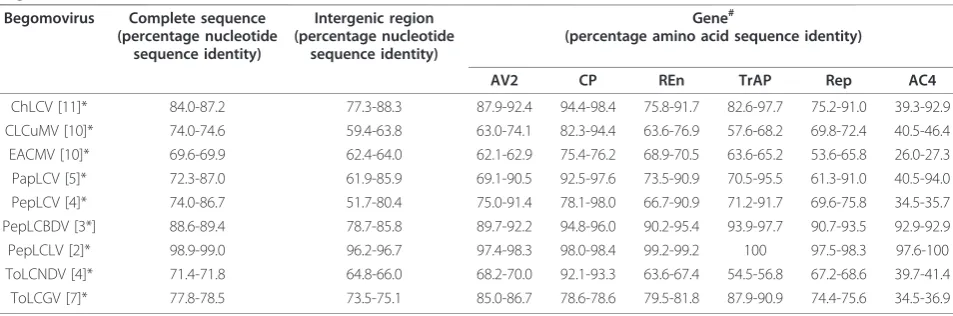
is not present in closely related begomoviruses infecting pepper (Figure 2). The intergenic region (IR) consists of approximately 241 nucleotides and is similar to those of ToLCNDV isolates (Figure 3 Table 2). The IR contains a predicted stem-loop sequence with conserved nonanu-cleotide sequence (TAATATTAC) in the loop which can be found in the majority of geminiviruses character-ized to date and marks the origin of virion-strand DNA replication [24]. Within the intergenic region, incom-plete direct repeats of an iteron (GGGGAC) were detected adjacent to the TATA box of the Rep promo-ter. These sequences are species specific Rep binding motifs [25,26].
Infectivity and symptoms of PepLCLV
The infectivity of PepLCLV clone PGL1 was investigated
inN.benthamiana,N.tabacum Samsun, andC.annum
by Agrobacterium-mediated inoculation (Table 3).
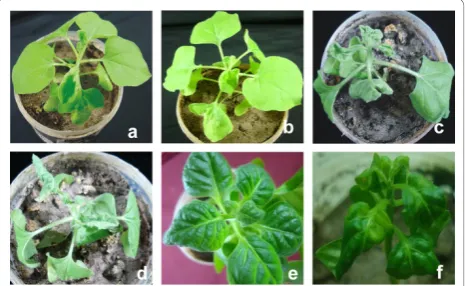
Inoculation of N. benthamianawith PepLCLV resulted in low infectivity (2/10) and infected plants exhibited very mild leaf curl symptoms (Figure 4). The virus was detected in systemic leaves by PCR with specific primers but was not detected by Southern blot hybridisation (Figure 5), indicating that only very low levels of virus DNA accumulated in infected plants. ChLCB was infec-tious toN. benthamiana with the helper virus Cotton
leaf curl Multan virus (CLCuMV) and induced very
severe leaf curl symptoms (Table 3), indicating that the
ChLCB clone is infectious and capable of enhancing helper virus symptoms. However, when inoculated in the presence of ChLCB, PepLCLV also only induced very mild symptoms inN. benthamiana(Figure 4) and the virus levels in plants were below the detection threshold of Southern blot hybridisation (Figure 5). Inoculation of PepLCLV toN. tabacum, either alone or with ChLCB did not result in infection. In order to further study the interaction of PepLCLV with betasatel-lites, the clone was inoculated with another distinct betasatellite, CLCuMB [6]. However, inoculation with these betasatellites did not result in infection. Both CLCuMB and ChLCB were infectious to N. benthami-anawith the helper virus CLCuMV (Table 3).
PepLCLVtrans-replicates ToLCNDV DNA B and induces leaf curl symptoms
Agroinoculation with partial repeats of PepLCLV along with the DNA B of ToLCNDV [21] induced leaf curl symptoms inN.tabacumSamsun,N.benthamiana, and
C. annum. The symptoms inN. benthamianaconsisted
of severe upward leaf curling and severe stunting. Southern hybridization using PepLCLV as probe detected typical begomovirus replication intermediates (Figure 5). Virus levels accumulating in plants inocu-lated with PepLCLV alone were not detectable by Southern hybridization (Figure 5 lane 2). Inoculation of PepLCLV with ToLCNDV DNA B and ChLCB resulted
Table 1 Features of the begomovirus isolated from Capsicum annum
ORF* Start codon (nucleotide coordinates)
Stop codon (nucleotide coordinates)
Predicted size of ORFs (nt)
Predicted size of protein (no. of amino acids)
V2 510 145 365 122
CP 1075 305 770 257
Rep 2651 1524 1127 376
TrAP 1621 1217 404 134
REn 1476 1072 404 134
C4 2452 2195 257 86
* Genes are indicated as coat protein (CP), replication-associated protein (Rep), transcriptional activator protein (TrAP), and replication enhancer (REn). The products encoded by ORFs V2 and C4 have yet to be named.
in disease symptoms but the virus levels were lower (Figure 5 lanes 3 and 4) than in plants inoculated with PepLCLV and ToLCNDV DNA B (Figure 5 lanes 5-7). Symptoms in chillies and N. tabacum consisted of downward leaf curling and yellowing.
Discussion
The geminiviruses are a rapidly emerging group of plant viruses, which can be attributed to various factors, including increased insect vector populations and the presence of alternative hosts. Though it was speculated that geminiviruses had the capacity to evolve rapidly in response to changes in their environment (such as altera-tions in cropping systems and/or population dynamics of the insect vector), there are few studies documenting geminivirus evolution. The success in the Old World of begomoviruses that associate with betasatellites appears to be due to the ability of betasatellites to be replicated
by several distinct begomoviruses [27]. Thus, the ability of begomoviruses to interact with diverse betasatellites, the mobilization of begomovirus components from alter-nate hosts and recombination among begomoviruses or associated satellites has been documented as the major driving force in rapid emergence and resistance break-down by begomovirus-betasatellite complexes [5]. There are numerous reports documenting mixed infection of geminiviruses. For example, in cassava, infection by two distinct begomovirus species resulted in a severe disease due to synergism [28]. Interestingly, ToLCNDV, a bipar-tite begomovirus has been consistently detected in sev-eral hosts in the Indian subcontinent and suggest that the virus has flexibility in its interaction with other bego-movirus components that may help virus to expand host range. We have previously shown that ToLCNDV inter-acts with ChLCB under field conditions that result in severe symptoms [12]. Another study showed that
Table 2 Pairwise percent of nucleotide identities between the genomic components and amino acid sequence identities of encoded genes from the virus isolate PGL1 with the components and genes of selected other begomoviruses available in the databases.
Begomovirus Complete sequence (percentage nucleotide
sequence identity)
Intergenic region (percentage nucleotide
sequence identity)
Gene#
(percentage amino acid sequence identity)
AV2 CP REn TrAP Rep AC4
ChLCV [11]* 84.0-87.2 77.3-88.3 87.9-92.4 94.4-98.4 75.8-91.7 82.6-97.7 75.2-91.0 39.3-92.9 CLCuMV [10]* 74.0-74.6 59.4-63.8 63.0-74.1 82.3-94.4 63.6-76.9 57.6-68.2 69.8-72.4 40.5-46.4 EACMV [10]* 69.6-69.9 62.4-64.0 62.1-62.9 75.4-76.2 68.9-70.5 63.6-65.2 53.6-65.8 26.0-27.3 PapLCV [5]* 72.3-87.0 61.9-85.9 69.1-90.5 92.5-97.6 73.5-90.9 70.5-95.5 61.3-91.0 40.5-94.0 PepLCV [4]* 74.0-86.7 51.7-80.4 75.0-91.4 78.1-98.0 66.7-90.9 71.2-91.7 69.6-75.8 34.5-35.7 PepLCBDV [3*] 88.6-89.4 78.7-85.8 89.7-92.2 94.8-96.0 90.2-95.4 93.9-97.7 90.7-93.5 92.9-92.9 PepLCLV [2]* 98.9-99.0 96.2-96.7 97.4-98.3 98.0-98.4 99.2-99.2 100 97.5-98.3 97.6-100 ToLCNDV [4]* 71.4-71.8 64.8-66.0 68.2-70.0 92.1-93.3 63.6-67.4 54.5-56.8 67.2-68.6 39.7-41.4 ToLCGV [7]* 77.8-78.5 73.5-75.1 85.0-86.7 78.6-78.6 79.5-81.8 87.9-90.9 74.4-75.6 34.5-36.9
* Numbers of sequences from the databases used in the comparisons.
#
Gene names are as indicated in Table 1.
Tomato leaf curl Gujarat virus captured the DNA B component of ToLCNDV, resulting in a virus capable of inducing more severe disease symptoms [29,30]. Our recent analysis has shown that ToLCGV may exist with-out a DNA B in some weeds (M. Mubin, manuscript in preparation) which suggests that ToLCGV was mobilized from a weed into tomato upon its interaction with the DNA B of ToLCNDV. Thus, it appears that component capture during mixed infection, probably in weed hosts, may result in viruses with enhanced virulence to crop plants.
Geminivirus genomes replicate by a rolling circle mechanism which is initiated by the virus-encoded repli-cation-associated protein (Rep) [31]. Rep is a sequence
specific DNA binding protein which recognises and binds to repeated sequences, known as iterons, in the intergenic region immediately upstream of a hairpin structure that contains the ubiquitous (for gemini-viruses) nonanucleotide sequence (TAATATTAC). Rep then initiates replication by nicking in the nonanu-cleotide sequence. The DNA A and DNA B components of bipartite begomoviruses have the same iteron sequences, thereby ensuring that the DNA A-encoded Rep may initiate replication of both components; main-taining the integrity of the split genome. However, mutational analyses and sequencing of field isolates sug-gests that begomoviruses may tolerate some sequence
Figure 4Symptoms induced by PepLCLV clone PGL1 in N.
benthamiana, N. tabacumandC. annum.a)AnN. benthamiana plant infected with PepLCLV at 20 days post-inoculation (dpi)b)An N. benthamianaplant infected with PepLCLV and ChLCB at 20 dpi.
c)AN. benthamianaplant infected with PepLCLV and ToLCNDV DNA B at 14 dpi.d)AN. benthamianaplant infected with PepLCLV, ChLCB and ToLCNDV DNA B at 14 dpi.e)AN. tabacumplant infected with PepLCLV and ToLCNDV DNA B at 30 dpi.f)AC. annumplant infected with PepLCLV and ToLCNDV DNA B at 40 dpi.
Figure 5Virus replication in systemic leaves of inoculatedN.
benthamianaplants probed with PGL1. Plants were agroinoculated with PepLCLV (lane 1) PepLCLV and ChLCB (lane 2), PepLCLV, ChLCB and ToLCNDV DNA B (lanes 3,4), PepLCLV and ToLCNDV DNA B (lanes 5-7). The DNA sample in lane 9 was extracted from a chilli plant infected with PepLCLV collected in the field. Approximately 10μg of total DNA was loaded per sample. A photograph of the genomic DNA on the ethidium bromide stained agarose gel is shown below the blot to confirm equal sample loading.
Table 3 Infectivity and symptoms induced by Pepper leaf curl Lahore virus
Plant species Inoculum Infectivity
(plants infected/inoculated)
Symptoms
Experiment
I II III IV Total
N. benthamiana PepLCLV 2/10 1/6 0/7 1/5 4/28 very mild leaf curling PepLCLV + ChLCB 1/10 0/6 1/7 0/5 2/28 very mild leaf curling PepLCLV + ToLCNDV DNA B 9/10 6/6 6/7 4/5 25/28 severe downward leaf curling PepLCLV + ToLCNDV DNAB + ChLCB 8/10 5/6 7/7 4/5 24/28 severe downward leaf curling
PepLCLV + CLCuMB 0/10 - - - 0/10 no symptoms
CLCuMV + ChLCB 4/5 5/6 - - 9/11 severe leaf curling
CLCuMV + CLCuMB 5/5 - - - 5/5 severe leaf curling
N. tabacum PepLCLV + ChLCB 0/10 0/4 - - 0/14 no symptoms PepLCLV + ToLCNDV DNA B 8/10 3/6 - - 11/16 leaf curling
variation in iteron sequences without deleterious effects on Rep recognition. Here we show that the predicted iteron sequence of PepLCLV (GGGGAC) differs at two base positions from the iteron sequence of ToLCNDV (GGTGTC; Figure 5). Thus, it appears that the first two or three bases may be more important in iteron recogni-tion by Rep. An interesting finding of the study is that PepLCLV isolate examined here has no, or at least only limited, ability to trans-replicate betasatellites. This con-trasts with the results of Tahiret al. [13], who showed the association of ChLCB with another isolate of PepLCLV from Pakistan. Our analysis suggests that the putative Rep protein of the virus has an N-terminal lea-der sequence (Figure 2) which may be important in the inability of the virus to trans-replicate betasatellites. However, in the absence of any evidence this remains a hypothesis that requires confirmation by mutagenesis. The other possibility may be that there are natural var-iants of PepLCLV that lack leader peptide in the Rep protein that may be able interact with betasatellites. Since our efforts to characterize begomoviruses in recent samples is not exhaustive, it will not be surpris-ing if another begomovirus capable of interaction with betasatellite is present in naturally infected chillies.
Chilli leaf curl disease (ChLCD) is an important factor limiting chilli production across Pakistan and India. The genomes of begomoviruses are either bipartite (with two genomic components known as DNA A and DNA B) monopartite (with a genome consisting of only a homolog of the DNA A component) or monopartite associated with a symptom determining satellite (collectively known as betasatellites). All three types have been previously identi-fied in chillies [9,10,12]. The full-length genome of a bego-movirus associated with ChLCD originating from the Punjab (Pakistan), PGL1 was cloned and shown to consist of 2747 nucleotides. Sequence comparisons showed that the genome had the highest sequence identity (99%) with Pepper leaf curl Lahore virus (PepLCLV-[PK:Lah:04]) indi-cating that it represents an isolate of PepLCLV based on the 89% species demarcation threshold for begomoviruses [23].Agrobacterium-mediated inoculation of the clone to
N. benthamianainduced only very mild symptoms.
Inocu-lation of the clone with a betasatellite previously isolated from a ChLCD affected plant gave similarly mild symp-toms and virus levels were not detectable by Southern hybridization. However, inoculation with the DNA B com-ponent of ToLCNDV induced symptoms typical of ChLCD inN. benthamiana,N. tabacumandC. annum. These results suggest that the virus characterised here may be bipartite. A surprising finding is that the levels of viral DNA were lower in plants inoculated with PepLCBDV, ToLCNDV DNA B and ChLCB in compari-son to plants inoculated in the absence of ChLCB (Figure
5). This is the first experimental demonstration of infectiv-ity for a bipartite begomovirus causing ChLCD.
These results presented here demonstrate that ChLCD in Pakistan may be caused by a bipartite variant of PepLCLV, which is associated with a DNA B compo-nent related to ToLCNDV DNA B, in addition to a monopartite variant of PepLCLV which associates with a betasatellite (ChLCB) [13]. The difference in the ability of the two PepLCLV isolates to interact with ChLCB may be due to the presence, in the isolate characterised here, of additional N-terminal amino acid sequences of Rep. However, since we as yet do not fully understand the mechanism of interaction of begomovirus-encoded Rep with betasatellites to initiate satellite replication (betasatellites lack the iteron sequences encoded by their helper viruses [27]), this will require experimental confirmation. Despite the differences in the predicted iteron sequences of PepLCLV and ToLCNDV, PepLCLV has the ability to trans-replicate ToLCNDV DNA B and induce ChLCD in experimental hosts and chilli. This is the first experimental demonstration of Koch’s postu-lates using cloned viral DNA components for a bipartite begomovirus causing ChLCD. The bipartite PepLCV has some residual ability to interact with betasatellites although the presence in plants of both a DNA B and a betasatellites appears to reduce virus titre and symptom severity, suggestive of interference. The nature of this interference will be the focus of our future studies since this may provide a novel mechanism of obtaining resis-tance to the viruses causing ChLCD. The complex nat-ure of ChLCD across the Indian sub-continent, which has been shown to be caused by several bipartite and monopartite, betasatellite-associated begomoviruses will be a challenge for the development of resistant varieties either by conventional or non-conventional means. The high yield losses resulting from ChLCD are threatening chilli cultivation and are forcing farmers in some areas to grow other crops.
Acknowledgements
MS is supported by a Ph.D. fellowship from Higher Education Commission (HEC), Government of Pakistan. RWB is supported by HEC under“Foreign Faculty Hiring Program”. We thank Dr. Muhammad Mubin for his valuable suggestions in experimental design, analysis and encouraging comments.
Authors’contributions
MS performed the experiments. MS, SA, YS, RWB and SM were involved in data analysis. SA, YS, RWB and SM provided overall direction and experimental design. RWB and SM wrote the manuscript. All authors read and approved the final manuscript.
Competing interests
The authors declare that they have no competing interests.
References
1. Jones DR:Plant viruses transmitted by whiteflies.Eur J Plant Pathol2003,
109:195-219.
2. Stanley J, Bisaro DM, Briddon RW, Brown JK, Fauquet CM, Harrison BD, Rybicki EP, Stenger DC:Geminiviridae.InVirus Taxonomy, VIIIth Report of the ICTV.Edited by: Fauquet CM, Mayo MA, Maniloff J, Desselberger U, Ball LA. London: Elsevier/Academic Press; 2005:301-326.
3. Morales FJ, Anderson PK:The emergence and dissemination of whitefly-transmitted geminiviruses in Latin America.Arch Virol2001,146:415-441. 4. Varma A, Malathi VG:Emerging geminivirus problems: A serious threat to
crop production.Ann Appl Biol2003,142:145-164.
5. Mansoor S, Briddon RW, Zafar Y, Stanley J:Geminivirus disease complexes: an emerging threat.Trends Plant Sci2003,8:128-134.
6. Briddon RW, Bull SE, Amin I, Idris AM, Mansoor S, Bedford ID, Dhawan P, Rishi N, Siwatch SS, Abdel-Salam AM,et al:Diversity of DNAβ: a satellite molecule associated with some monopartite begomoviruses.Virology 2003,312:106-121.
7. Shih SL, Tsai JH, Green SK, Khalid S, Ahmad I, Rezaian MA, Smith J:
Molecular characterization of tomato and chili leaf curl begomoviruses from Pakistan.Plant Dis2003,87:200.
8. Senanayake DMJB, Mandal B, Lodha S, Varma A:First report ofChilli leaf curl virusaffecting chilli in India.Plant Pathol2006,56:343.
9. Hussain M, Iram S, Mansoor S, Briddon RW:A single species of
betasatellite is prevalent in chili across north central Pakistan and shows phylogeographic segregation.J Phytopath2009,157:576-579.
10. Hussain M, Mansoor S, Iram S, Zafar Y, Briddon RW:First report ofTomato leaf curl New Delhi virusaffecting chilli pepper in Pakistan.Plant Pathol 2004,54:794.
11. Khan MS, Raj SK, Singh R:First report of Tomato leaf curl New Delhi virus infecting chilli in India.Plant Pathol2006,55:289-289.
12. Akhter A, Qazi J, Saeed M, Mansoor S:A severe leaf curl disease on chilies in Pakistan is associated with multiple begomovirus components.Plant Dis2009,93:962.
13. Tahir M, Haider MS, Briddon RW:Chili leaf curl betasatellite is associated with a distinct recombinant begomovirus, Pepper leaf curl Lahore virus, inCapsicumin Pakistan.Virus Res2010,149:109-114.
14. Doyle JJ, Doyle JL:Isolation of plant DNA from fresh tissue.Focus1990,
12:13-15.
15. Bull SE, Briddon RW, Markham PG:Universal primers for the PCR-mediated amplification of DNA 1: a satellite-like molecule associated with begomovirus-DNAβcomplexes.Mol Biotechnol2003,23:83-86.
16. Briddon RW, Bull SE, Mansoor S, Amin I, Markham PG:Universal primers for the PCR-mediated amplification of DNAβ; a molecule associated with some monopartite begomoviruses.Mol Biotechnol2002,20:315-318. 17. Shahid MS, Mansoor S, Briddon RW:Complete nucleotide sequences of
cotton leaf curl Rajasthan virus and its associated DNAβmolecule infecting tomato.Arch Virol2007,152:2131-2134.
18. Thompson JD, Gibson TJ, Plewniak F, Jeanmougin F, Higgins DG:The Clustal_X windows interface; flexible strategies for multiple sequence alignment aided by quality analysis tools.Nucleic Acids Res1997,
25:4876-4882.
19. Page RDM:TREEVIEW: An application to display phylogenetic trees on personal computers.Comp Appl Biosci1996,12:357-358.
20. Hellens RP, Edwards EA, Leyland NR, Bean S, Mullineaux PM:pGreen: a versatile and flexible binary Ti vector for Agrobacterium-mediated plant transformation.Plant Mol Biol2000,42:819-832.
21. Padidam M, Beachy RN, Fauquet CM:Tomato leaf curl geminivirus from India has a bipartite genome and coat protein is not essential for infectivity.J Gen Virol1995,76:25-35.
22. Briddon RW, Mansoor S, Bedford ID, Pinner MS, Saunders K, Stanley J, Zafar Y, Malik KA, Markham PG:Identification of DNA components required for induction of cotton leaf curl disease.Virology2001,
285:234-243.
23. Fauquet CM, Briddon RW, Brown JK, Moriones E, Stanley J, Zerbini M, Zhou X:Geminivirus strain demarcation and nomenclature.Arch Virol 2008,153:783-821.
24. Heyraud F, Matzeit V, Kammann M, Schafer S, Schell J, Gronenborn B:
Identification of the initiation sequence for viral-strand DNA synthesis of wheat dwarf virus.EMBO J1993,12:4445-4452.
25. Argüello-Astorga G, Herrera-Estrella L, Rivera-Bustamante R:Experimental and theoretical definition of geminivirus origin of replication.Plant Mol Biol1994,26:553-556.
26. Chatterji A, Padidam M, Beachy RN, Fauquet CM:Identification of replication specificty determinants in two strains of tomato leaf curl virus from New Delhi.J Virol1999,73:5481-5489.
27. Saunders K, Briddon RW, Stanley J:Replication promiscuity of DNA-β satellites associated with monopartite begomoviruses; deletion mutagenesis of the Ageratum yellow vein virus DNA-βsatellite localises sequences involved in replication.J Gen Virol2008,89:3165-3172. 28. Vanitharani R, Chellappan P, Pita JS, Fauquet CM:Differential roles of AC2
and AC4 of cassava geminiviruses in mediating synergism and suppression of posttranscriptional gene silencing.J Virol2004,
78:9487-9498.
29. Chakraborty S, Vanitharani R, Chattopadhyay B, Fauquet CM:Supervirulent pseudorecombination and asymmetric synergism between genomic components of two distinct species of begomovirus associated with severe tomato leaf curl disease in India.J Gen Virol2008,89:818-828. 30. Briddon RW, Patil BL, Bagewadi B, Nawaz-ul-Rehman MS, Fauquet CM:
Distinct evolutionary histories of the DNA-A and DNA-B components of bipartite begomoviruses.BMC Evol Biol2010,10:97.
31. Hanley-Bowdoin L, Settlage SB, Orozco BM, Nagar S, Robertson D:
Geminviruses: models for plant DNA replication, transcription, and cell cycle regulation.Crit Rev Plant Sci1999,18:71-106.
doi:10.1186/1743-422X-7-367
Cite this article as:Shafiqet al.:Pepper leaf curl Lahore virus requires the DNA B component of Tomato leaf curl New Delhi virus to cause leaf curl symptoms.Virology Journal20107:367.
Submit your next manuscript to BioMed Central and take full advantage of:
• Convenient online submission
• Thorough peer review
• No space constraints or color figure charges
• Immediate publication on acceptance
• Inclusion in PubMed, CAS, Scopus and Google Scholar
• Research which is freely available for redistribution