R E S E A R C H
Open Access
Modeling of a method of parallel hierarchical
transformation for fast recognition of dynamic
images
Leonid I Timchenko
*, Nataliya I Kokryatskaya and Viktoriya V Shpakovych
Abstract
Principles necessary to develop a method and computational facilities for the parallel hierarchical transformation based on high-performance GPUs are discussed in the paper. Mathematic models of the parallel hierarchical (PH) network training for the transformation and a PH network training method for recognition of dynamic images are developed.
Keywords:Parallel hierarchical (PH) transformation; PH network training; Fast recognition of dynamic images; Normalizing equation; Classification and processing of images of extensive laser routes
1. Introduction
Rapidly growing requirements to modern computational media encourage the development of new intelligent methods of information transfer and processing. Rigid re-quirements to real-time information processing systems force scientists to develop and regularly upgrade data transfer systems. Today, most internet channels cannot provide required quality of data exchange between such systems, leading to the congestion of those channels and formation of so-called digital bottlenecks. Large volumes of information may be transferred easily through a fiber-optic cable, but laying such cable is rather expensive, even on short distances. At the same time, this problem can be solve using laser-based technologies [1-3], one of the most promising models of information transfer for the near fu-ture. In this case, for instance, tons of full-length films and virtual worlds could be transferred to any part of the globe in a blink of an eye.
Most satellites transmit information, such as TV pro-grams, by means of the microwave radiation, while laser-based information transmission could be hundreds of times faster, considerably increasing a carrying capacity of the channel. The laser-based information transmission requires that both satellite and receiving unit (RU) were positioned
properly. A position of the RU lens, the diameter of which is only several centimeters, must be adjusted to one thou-sandth degree, or the information will not be transferred.
To operate properly, the system requires that a RU monitors a satellite at all stages of the system operation. For this purpose, an occurrence of laser beam spot (LBS) on images, namely, their geometrical characteris-tics distorted by the turbulence and air masses, should be predicted accurately.
However, significant noise distortion of those images can not only considerably worsen forecast results but also prevent the system from responding adequately to varia-tions in the monitored object location. To solve a problem of the efficient forecast, frames of the LBS image sequence should be classified to filter a laser route from images con-siderably distorted by noise, thus forming a tunnel of ref-erence images [see Additional file 1].
Development of computerized real-time forecasting sys-tems gained new momentum with the emergence of high-efficiency automated systems of information collection, processing, and storage. Such systems include a number of tools able to classify and forecast characteristics of re-spective objects, phenomena, or real-time processes based on special algorithms and geometric characteristics of ob-ject boundaries. Fragments of laser beam routes used in the optical communication, navigation, ranging, and mili-tary equipment are studied in this paper. The development of the parallel hierarchical (PH) network-based forecasting
* Correspondence:[email protected]
Department of the Telecommunication Technologies and Automation, State Economic Technological University of Transport, 19 Lukashevich Street, Kyiv 03049, Ukrainе
systems allows the solution of a problem in automatic object control, laser-based data transfer, and forecasting the moving optical object behavior.
Today, high-performance fast calculations are extremely important as information volumes are still growing, and computational complexity is increasing. The most signifi-cant problems include operative response and real-time decision-making, high-resolution video data processing, and classification and forecasting of quick-changing dynamic data [4-6].
High-performance fast calculations are developed quite well and have many applied aspects, helping solve com-plex problems. Neurocomputers have many advantages as compared to regular Harvard structure computers, but they also have one significant drawback: their price; as a result, some alternatives should be sought.
One of the most efficient methods to process large data arrays is parallel processing based on specialized system so-lutions, in particular, on the neural-like parallel hierarchical systems. However, LBS hardware implementation of such systems faces a problem of selecting an adequate platform for fast and efficient parallel processing of data bulk.
A hierarchic transformation is an important and power-ful computing operation. This motivates the studies of par-allel approaches, such as graphical processing units, or low level complexity algorithms, such as the adaptive reson-ance theory (ART). Though ART was realized with graphic processing units (GPUs), there are a few hierarchical appli-cations of GPU ART. Every ART layer is propagating in the GPU while being trained at the same time. Experimen-tal results show that for deep trees, graphic processors should be used due to the significant advantage of GPUs.
Programming of GPUs using NVIDIA Compute Unified Device Architecture (CUDA) technology is of interest in the computational systems, especially for population algorithms [7-9]. This is important when GPU [10,11] programming is used to achieve certain advantages in hierarchical transformation algorithms [12,13].
ART is attractive for hierarchical transformation due to its speed and scalability to the parallel transformation [14]. However, GPU-based ART has not been developed earlier. Its only drawback is the rigidity of memory usage for the core value if a set of dynamic arrays is restricted to the CPU exclusively. Typical tree algorithms provide pointers for the creation of both a node and a reference [15], which is ineffi-cient when the CUDA technology is used. In [16-18], the implemented GPU programming focused on the behavior of a single ART unit; however, a hierarchical transformation requires a different approach. Architecture of such trans-formation is based on the pipeline processing structure [19]. A method of organization of the multi-layer tree struc-ture composed on CUDA platform-based units is described in [20]. Presented experimental results demonstrate an increase in performance for different data sets and
parameters that were compared with those obtained with regular CPUs.
A goal of this paper is to develop and apply the suggested method and means of parallel hierarchical transformation for fast recognition of dynamic images, namely, those of LBSs. A method of parallel hierarchical transformation based on the normalizing equation allows computational structures to accelerate. Unlike prevalent types of video in-formation encoding (for instance, differential encoding, code-pulse encoding, and delta modulation), which are based on the sequential encoding of difference information, an approach suggested here processes the results of the data array encoding distributed in the space-time domain.
In addition, the use of the normalizing equation allows a preliminary procedure of image classification by forming tuning coefficients to be realized quite simply, thus determining weighting coefficients for each class. In particular, to perform a real-time classification and ana-lysis of, for instance, adjacent frames of a multimedia image, the use of the normalizing equation gives better results in comparison to other approaches [21].
Specifically, this research aims to analyze a sequence of LBS image frames forming separate routes. Each route is formed from fragments obtained from the receiver with a frequency of 40 ms. Each image of the pattern has a dimen-sion of 128 × 128 decomposition elements.
The paper consists of the following parts: Description of parallel-hierarchical transformation algorithms, software modeling and efficiency of the PH transformation, experi-mental results and physical modeling of the PH transform-ation for fast recognition of LBS images, and conclusions.
2.1 A method of parallel hierarchical transformation with formation of the normalizing equation for fast image recognition
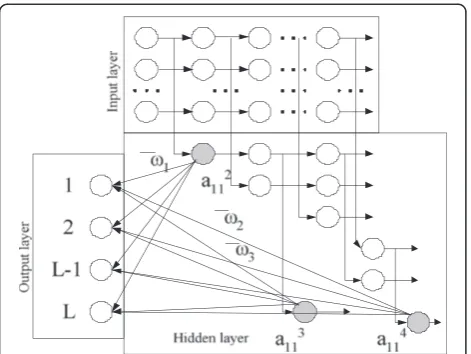
Application of the masking method of information process-ing for fast recognition of LBS images [22] indicates a need to improve a method of the parallel hierarchical transform-ation. A task to train the suggested PH network by analogy with training in the radial basis function (RBF) networks is in practice brought down to the controlled training of initial-layer network elements. Based on the general idea of the structural organization of artificial neural-like networks as‘input layer - hidden layer - output layer, it is possible to produce a trainable PH network, where the first network level serves as an input layer, levels 2 to k (where k is a number of the hidden layer levels) serve as hidden layers, and the output layer, which is traditionally used in artificial neural-like networks, serves as an output layer (Figure 1):
An organizational structure of the multi-layer PH network is shown in Figure 2.
elements. Averaged values of weighting coefficients are determined by formula (1):
–—
where Nis a dimensionality of the taught sample P. ris the PH network hidden layer number.
A system of equations to determine tuning coefficients
w1r−wkr−1can be composed as system (2):
at11 is the reference frame component of the
extended route being recognized. ∑ ia
k
i and a211−ak11 are
Figure 1A three-layer structure of the PH network.Grey circles represent the tail elements of the network, and the white circles are their interim elements for various levels.
a11
the current frame components of the extended route be-ing recognized.
After finding values w1−wk−1, a normalizing Equation (3) can be formed:
d¼
To normalize results of the PH network with tuning coefficients (2), the main property of the PH network
will be used: X
k t¼2
at11¼∑
i ai [21]. Then, a right part of
the normalizing Equation (3) represents a ratio of the sum of products of averaged tuning coefficients and tail elements to the sum of the tail elements of the network.
With the correct recognition of LBS images, this nor-malized measured→1. The similarity of the images being recognized is measured by a degree of its closeness to 1.
Using the normalizing Equation (3), where wR
1 ¼wR2
¼…¼wR
k−2¼wRk−1¼1, it is possible for a fixed value of d to formulate quite easily a preliminary procedure of image classification and then, according to system (2), form tuning coefficients w1−wk−1 , thus determining
weighting coefficients for each class.
In particular, for the real-time classification and analysis of adjacent frames of extended laser beam routes, the normalizing Equation (3) acquires form (4):
d¼ a
is a value of tail elements of images of the previous (jth) and following ((j+ 1)th) frames, respectively.
Given the above-mentioned property of the PH network, the normalizing Equation (3) acquires form (5):
d¼ ð Þa1
Because in calculating expression (5), there is no need to determine tail elements a211
jþ1 − ak11
jþ1
to process
the (j+ 1)th frame. A recognition time significantly decreases for normalized results of input data processing (a1−aN) in comparison to the known neural-like
net-works, where input data of the jth frame cannot be used for recognition in the initial layer of the (j+ 1)th frame.
To realize a parallel hierarchical transformation for fast recognition of LBS images, an average valueat
i should be
selected from the available digital information and rounded to the closest integer; then, two connected PH networks should be formed to process positive and negative difference components. In this case, for each of those PH networks, a system of equations can be formed, where the roots for all equations except for the first one are pairs of tuning coefficients (2):
– for positive difference components: (w1r(+)−wkr(+)−1)
– for negative difference components: (w1r(−)−wkr(−−)1).
For the first layer of the PH network, only the tuning coefficientw1r(+)is being calculated because there are only positive difference components here.
When processing a sequence of extended laser route images, it will be more appropriate to use a normalizing equation for two adjacent image frames, where the first image is taken as the reference one. Then, the normalizing equation will have form (6):
d¼
where w1−wk are tuning coefficients obtained during the
preliminary processing on the first images of the set; (a11t )j, (a11t )j − 1 are tail elements of the current and previous images, respectively.
Usually, when processing a sequence of extended laser route images, it is necessary to detect ‘bad’ images, or those internal and external contours of which are most distorted by atmosphere, and exclude those from the route analysis. Because the normable criterion (6) can be found for both a single frame of the laser route, and for the laser route as a whole, we can form a set А from coefficientsdi(7):
A¼ðd1;d2;…dNÞ; ð7Þ
(7), which have low values, can be classified as ‘bad’ images:
aki;ð Þj⋯
e
∩
a kð Þ⋯ i;j
n¼
}good}image;if di≥χ;
}bad}image otherwise
ð8Þ
whereχis a determined threshold criterion. As 0≤d≤1, then 0≤χ≤1. Experiment demonstrated that the thresh-old criterion (9) should be set within limits (9) for insig-nificant image deformations and within limits (10) in case of more substantial deformations.
For the quality classification and processing of a se-quence of extended laser route frames, this threshold criterion may be used in‘tighter’limits (9):
0;8≤χ≤1 ð9Þ
For those laser routes which contain images significantly distorted by atmospheric agents, it is recommended to set less strict limits of the threshold value (10):
0;4≤χ≤1 ð10Þ
2.2 The computational efficiency of the developed method of parallel hierarchical transformation in comparison with other existing transformations
The number of computational operations used for the PH transformation isN(N+ 1), whereNis the total number of elements processed. For comparison, the number of opera-tions used in other transformaopera-tions widely applied in prac-tice, e.g., orthogonal transformations, are the following: 4N2log2Nfor fast Fourier transformation, 2N2log 2N2 for Hadamard, and 4N(N+ 1) for Haar.
Absence of time-consuming operations indicates a suf-ficient simplicity of the computational procedure that re-alizes the parallel hierarchical transformation and makes it an efficient method for use in various applied areas requiring a combination of a high level of the parallelism and a compact form of data representation.
3.1 Development of the parallel hierarchical transformation algorithms
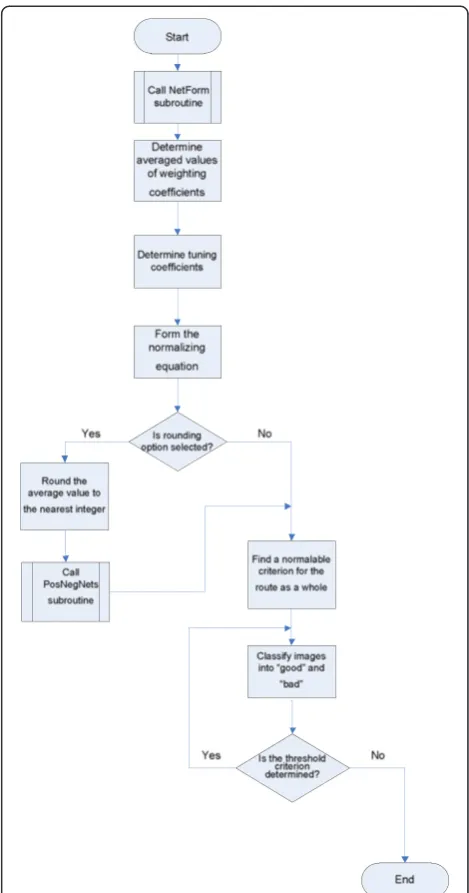
A general algorithm for fast recognition of LBS images can be developed based on the suggested method of the parallel hierarchical transformation for processing dy-namic images (Figure 3):
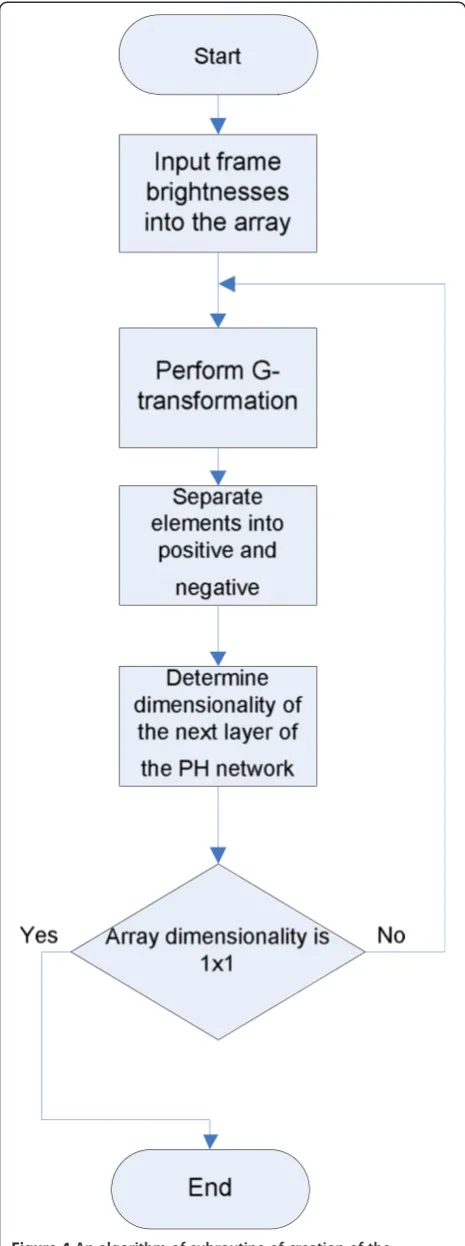
This algorithm envisages a call to subroutine NetForm (NETFORM Engineering Machinery Metal Ltd., Turkey), a subprogram serving to construct network structures for images. A detailed description of the subroutine is shown as an algorithm (Figure 4):
This subroutine inputs the initial information to the PH network. After that, G-transformation of information [21] takes place at all levels of the PH network. The G-transformation is performed in the following way. A
vector of incoming image is sent to the PH network in-put (to inin-put elements of first-level branches of the net-work, Figure 1). A mathematical model of the parallel decomposition of the set μ¼f gai ;i¼1;n [21], used in
each branch of the PH network, looks as follows:
Xn
i¼1 ai¼
XP
j¼1
nX
j1
k¼0 nk
!
aj aj1
;
where ai≠0.P is a dimensionality of this set (a number
of set elements) or a dimensionality of the PH network branch of its every level. az, z¼1 , and P are the
elements of subsets consisting of equal elements; nzis a
number of elements in the kth subset (i.e., order of numberai), andaj
is an element of the set {az}, selected at thej*th step,j¼1;P,a0= 0,n0= 0.
When a structure of the two networks is constructed, the average values of weighting coefficients and tuning coeffi-cients (4) are being determined. Based on the calculated tun-ing coefficients, a normaliztun-ing Equation (6) is betun-ing formed.
If an average valueat
i is rounded to the closest integer,
subroutine PosNegNets is called. It is a subprogram that forms two connected PH networks for the processing of positive and negative difference components. A forma-tion algorithm of the two networks is similar to the
Figure 4An algorithm of subroutine of creation of the structure of image networks.
formation algorithms of the network structure for images. After that, a normalizing criterion (7) for the route as a whole is being found with further classifica-tion of images into good and bad according to ratio (8). If the threshold criterion is determined, the classification is conducted again. Let us develop a preliminary pro-cessing algorithm of route fragments (Figure 5).
An image of the laser route fragment arriving to the system input undergoes the following preliminary processing:
1. Determine maximum fragment brightness to formn border lines.
2. Having selected a necessary number of boundaries, find their geometrical centers and average
parameters for the whole frame.
3. Form tunnel boundaries using a trained sample and averaged frame parameters.
4. Check if calculated frame parameters are included into the tunnel. Based on this verification, frame image classification is performed. If an image was Figure 6Screen form of the PH network application for fast recognition of laser beam spot images.
Table 1 Comparative characteristics of means of the parallel hierarchical transformation
Number Parameter Indices
Known soft hardware (imitational modeling based on MLP and RBF networks [23])
Known soft hardware (imitational modeling based on neural-like network technology [22])
Known soft hardware (central processor, PH transformation method based on the Q-decomposition [19])
Suggested soft hardware (graphical processor, method of the PH network training based on the normalizing equation)
1 Average size of good route fragments (%)
70 74 50 18
2 Average value of correct recognition (%)
92 92,5 84,8 94
3 Accuracy of the energy center determination, decomposition elements
1.5 1.5 1.2 0.01
4 Average recognition time of network processing(s)
- - 8.4 1.52
5 Average time of preliminary processing of route fragments(s)
classified as bad, the image parameters are corrected and included into the taught sample; then, an additional training of the system is performed.
3.2 Program modeling and application efficiency of the parallel hierarchical transformation for fast recognition of LBS images
The developed application is intended to process and classify the LBS images. The software window (Figure 6) represents a form divided into two parts: the left part contains a processing panel of the reference frame of the LBS images route, and the right one that of the current frame of the LBS images route.
Information about the frame parameters is exhibited in the upper part:
– frame width, pixels;
– frame height, pixels;
– information about the route containing the frame;
– frame file name;
– number of frames in the route.
The bottom part contains tabs:
– construction of the network graph, which can be obtained and saved as a PH network graph file;
– route fragment processing, where a route fragment can be processed;
– image comparison, where LBS images being compared and classified;
– determination of energy centers, where LBS energy centers are determined and the PH network is trained.
An energy center is a point in the image, where coordi-nates (x,y) of a two-dimensional signal with a specific nonlinear density w(f(x,y)) meet a given value of f(x,y) and are expressed as follows:
xec¼
1
M XN−1
x¼0 XN−1
y¼0
w f xð ð ;yÞÞ⋅x
yec¼
1
M XN−1
x¼0 XN−1
y¼0
w f xð ð ;yÞÞ⋅y
M¼X
N−1
x¼0 X
N−1
y¼0
w f xð ð ;yÞÞ;
whereMis the first order moment of inertia.
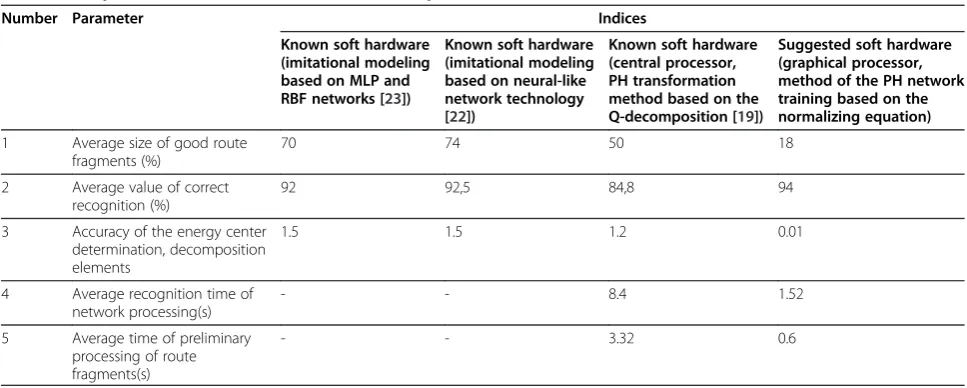
To estimate the efficiency of the suggested algorithms and the soft hardware that developed on their basis, let us describe the technical advantages of means of the PH transformation as demonstrated by the developed products and conducted experiments. The comparative characteristic is shown in Table 1.
The use of neural-like network technologies for the classification of extended laser route images is analyzed in [22]. The computer modeling revealed 92.5% correctly recognized images, including 74% good images and 60% bad images. In [23], a recognition system was modeled on the basis of the MLP neural-like network and RBF-based neural-like network. Recognition of a sample that included 140 laser route spot objects by the RBF-based neural-like network modeled in the Statistica Neural Networks 4.0 (StatSoft Inc., Moscow, Russia) yielded 92% correctly
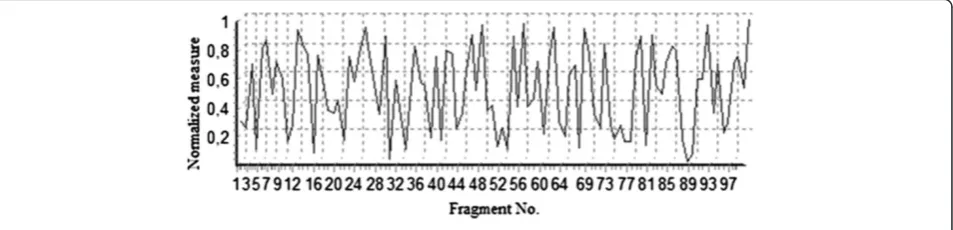
Figure 7Determination of the normalized measure for further classification of route 1 fragments.
recognized images. Comparing the results of [22,23] and those studied in this article, the latter has more potential.
Therefore, the suggested method, algorithms, and soft hardware permit to measure the energy center coordinates of the laser route fragment images based on the normalizing equation with accuracy of no more than 0.01 decomposition elements, thus exceeding known methods (e.g., based on determination of the gravity center using the method of moment characteristics [24-27]) by accur-acy 1.5 times on average, which is reflected in Table 1. A time necessary for preliminary and network processing of laser route fragment images decreases, too.
4 Experimental results and physical modeling of the parallel hierarchical transformation for fast recognition of LBS images
Four routes, each containing 100 frames, were used in the experimental research of the parallel hierarchical transformation for fast recognition of LBS images. Using the normalizing Equation (6), let us determine the normalized measures for route 1 (Figure 7).
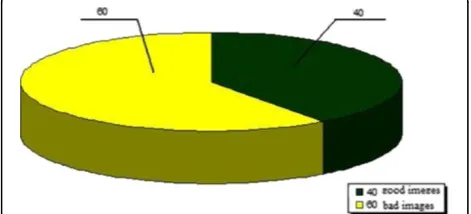
Using Equations (8) and (9), let us classify the images (Figure 8).
As we see, a portion of good images is 18%. As a rule, in real conditions, positions of energy centers cannot be deter-mined absolutely accurately; therefore, less tight limits
should be set for the threshold criterion using relation (10) (Figures 9 and 10):
An average portion of the good images in this case is 40% and 59%, respectively. Then, the PH network is trained for repeated processing of the bad route fragments. In physical modeling of the method of PH transformation and deter-mination of extended laser rout image coordinates using the graphic adapter Radeon X1300 (Advanced Micro Devices, Inc., Sunnyvale, USA), processing of a single image takes about 0.6 s. Radeon X1300 is a basic solution in the ATI Radeon family of graphic adapters based on the graphic processor RV515 with main characteristics of four pixel pipelines, four texture units, and two vertex pipelines [28].
An approach of flow programming is suggested to gram the GPU. This approach includes splitting a pro-gram into relatively small stages (core propro-grams) that process data flow elements. Core programs go into shaders, and data flows go into textures in the GPU. A shader is a program performed on the GPU and pro-cesses a data flow. The ‘data flow’ means information about coordinates of polygon vertices, each vertex illu-mination, normal, texture coordinates, and so on, which
Figure 9Classification of route 1 fragments (with the threshold criterion (8) 0, 6≤χ≤1).
Figure 10Classification of route 1 fragments (with the threshold criterion (8) 0, 4≤χ≤1).
a)
b)
Figure 12A diagram of formation of good and bad images in route 1.
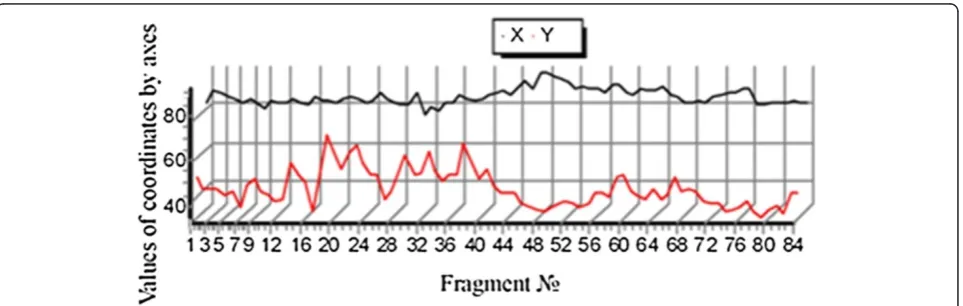
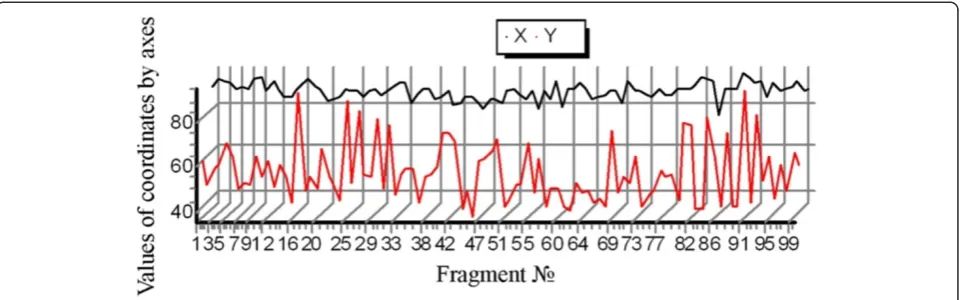
Figure 13Determination of coordinates of energy centers of Route 1 fragments.
Fragment No.
135791216 21 26 31 36 41 46 51 56 61 66 71 76 81 869094 99
Valu
es
o
f coordi
nat
e
s b
y
axes
100
80
60
permanently arrives in blocs to the shader program. A video processor receives outgoing information for all three vertices of the polygon. Having data on the three vertices, the GPU goes through all pixels of a single polygon, while gradually changing (interpolating) vertex values from one vertex to another. A shader length is a memory space of the shader program. Considering that data arriving to the shader is random for the program-mer in a sense that an order in which the data will be sent to the shader is not preset, the shader program does not have any statistical or general variables. Otherwise, the shader program is similar to a regular C program. There are input, output and time variables, standard functions, structures, arrays, cycles, and conditional operators.
Image processing takes place on the GPU with cores realized at all elements covered by the initial region. The only obvious way to calculate a scalar of the input vector is to represent 1 × 1 initial elements and use a core that is read in all values from the input texture. This
approach has several drawbacks. First, only one of the parallel elementary processors would be busy. Second, that would probably exceed a maximum memory size, including memory of the shader and static instruction of calculation for some hardware. That is why we will perform a parallel operation of reduction based on global methods of communication on parallel computers.
At the high level, GPU-based parallel calculation is a cor-rection of sizes of the input and output texture and of index elements. For the presented vectorMof the lengthM, the output of the first step is M/2 with textureM/2. For each of its elements, the coordinates for input texture are corrected in such a way that they correspond to discon-nected 2 × 2 subregions. Then, the values in those subre-gions are compared. This is repeated recursively until the 2 × 2 texture is reduced finally to the 1 × 1‘scalar’texture through a logarithmic series of repetitions.
Next, the series of images finalize the first step of the 8 × 8 algorithm reduction of the input texture (Figure 11a).
Figure 15Determination of energy center coordinates of the route 2 fragments.
Figure 11a demonstrates the input texture. The initial elements are marked in green. Figure 11b is a result of the first round of reduction. Each initial element contains a local transfer maximum of the 2 × 2 subregion in the input texture (marked in blue and orange). This relation, in addition, is distinguished in the second line of images (Figure 11b).
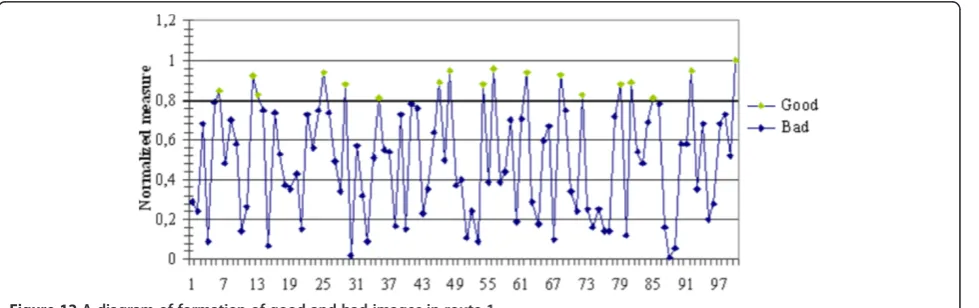
Let us determine the coordinates of the energy centers of the fragment of route 1 (Figure 12).
A diagram of changes in the energy center coordinates of route 1 fragments is shown in Figure 13.
After the PH network training, a portion of the good images was 83% (as compared to 18%). The graphic interpretation of the determination of energy center co-ordinates after the PH network training is demonstrated in Figures 14 and 15.
After the PH network training, a portion of the good images of route 2 was 76% (12% before training), as shown in Figures 16 and 17.
After the PH network training, a portion of the good images of route 3 fragments was 65% (15% before training), as shown in Figures 18 and 19.
After the PH network training, a portion of good images of route 3 reached 83% as compared to 17% before training (Figure 20).
5 Conclusions
The paper deals with an important problem of improved efficiency of dynamic image recognition. The analyses of modern trends in the development of fast recognition technologies for dynamic images, as well as the analysis of the PH transformation development, classify the suggested parallel hierarchical approach as a neural-like method of transformation with a network of direct propagation and the space-time organization of connections. Authors think that the efficiency of computational structures can be increased by applying a developed method of PH trans-formation with the trans-formation of the normalizing equation.
For quality classification and processing of a sequence of extended laser route spot images, a threshold criter-ion was introduced. Methods of PH transformatcriter-ion were developed by introducing a set A that contains measures of correspondence between the reference and current PH network tuning coefficients and by finding a measure of correspondence between two networks as a whole.
Using a normalizing equation, the processing and rec-ognition algorithms for LBS images were developed, and the PH network structures for images based on G-transformation were constructed. The developed algo-rithms allow the determination of energy center posi-tions and classify laser route image frames. Peculiarities of real-time realization of the algorithm of the developed method for route fragments are discussed, and a choice of means for software development is explained. On the basis of the developed algorithms, software was created for modeling a neural-like parallel hierarchical network, which was used for image classification and fast processing. Ex-perimental methods to study the processing of LBS image
fragments were developed, which helped in verifying the adequacy of the developed algorithms and in obtaining the results of fast processing and classification of LBS image fragments.
In the conducted experiments, an average portion of good route fragments was 17%, as compared to 50% in [21]. However, after the training, it increased to 79.25% (as compared to 65% [21]). It was also established that an average rate of correct recognition was 94% (84.8% [21]), and the accuracy of energy center determination was no more than 0.01 decomposition elements (as compared to 1.2 decomposition elements [20]), which is reflected in Table 1. This is, on average, 1.5 times higher than the accuracy of known methods, for instance, based on the gravity center determination using a method of moment characteristics. Physical modeling of the method of PH transformation for fast image recognition using the Radeon X1300 graphic adapter demonstrates that processing of one image requires approximately 0.6 s (3.32 s [21]), and the network processing requires 1.52 s (8.4 s [21]).
Figure 19Determination of energy center coordinates of the route 4 fragments.
Additional file
Additional file 1:Title: Importance of laser beam profiling systems in telecommunications.Description: Importance of research in the area of development of new methods and means of laser beam profiling and classification of laser spot images in telecommunication systems is explained in this video. A need to use developed means in the tasks of image transfer, processing, and classification for optical communications is demonstrated.
Competing interests
The authors declare that they have no competing interests.
Acknowledgments
The authors express their gratitude to the scientific co-director of the work Yuri Kutaev for problem formulation and for his participation in its practical realization. Authors express their sheer gratitude to the team of the Chair of the Telecommunication Technologies and Automatics of the State Economy and Technology University of Transport (Kyiv, Ukraine) for the valuable comments and recommendations expressed in the course of the experimental research. Authors also thank Rector M.V. Makarenko, Vice Rector on Scientific Work Associate PhD V.I. Danilevskiy, and Dean of the Department of Infrastructure and Rolling Stock of Railway Transport Professor A.D. Voznenko for the provided facilities and equipment for scientific studies of this problem in the framework of the state-financed scientific research topics.
Received: 14 August 2012 Accepted: 31 March 2013 Published: 25 April 2013
References
1. JM Khosrofian, BA Garetz, Measurement of a Gaussian laser beam diameter through the direct inversion of knife-edge data. J Appl Opt 22, 3406–3410 (1983)
2. NG Basov, EM Zemskov, RI Il'kaev, VM Kazansky, GA Kirillov, SM Kulikov, YF Kutaev, OY Nosach, SA Sukharev, Laser system for observation and removal of space debris, inProceedings of GCL/HPL 98, vol. 3574, eds. A Boreisho and GA Baranov (SPIE, Bellingham, 1998), pp. 219–228 3. LI Timchenko, YF Kutaev, VP Kozhemyako,Method for training of a
parallel-hierarchical network, based on population coding for processing of extended laser paths images, in SPIE Proceedings, ed(Bellingham, AG Tescher (SPIE, 2002). pp. 465–479
4. GPGPU, General purpose computations on graphic processing unit. http://www.gpgpu.org. Accessed 16 April 2013
5. Wikipedia, Open computing language. http://en.wikipedia.org/wiki/OpenCL. Accessed 16 April 2013
6. NVIDIA Corporation, NVIDIA homepage. (2013). http://www.nvidia.ru/page/ home.html. Accessed 16 April 2013
7. DM Chitty, A data parallel approach to genetic programming using programmable graphics hardware, GECCO '07, inProceedings of the 9th annual conference on genetic and evolutionary computation, ed. by JF Miller (ACM, New York, 1991). vol. 2, pp. 1566–1573
8. Z Luo, H Liu, X Wu, Artificial neural network computation on graphic process unit, IJCNN '05. Paper presented at the IEEE international joint conference on neural networks, Florida. 31 July–4 Aug 2005 9. JM Li, DL Wan, ZX Chi, XP Hu, A parallel particle swarm optimization
algorithm based on fine-grained model with GPU accelerating. Harbin Gongye Daxue Xuebao/J Harbin Inst Technol38(12), 2162–2166 (2006) 10. C Chun-Yuan, C Chih-Hao, C Min-An, W An-Yeu, EURASIP Multi-prediction
particle filter for efficient parallelized implementation. J Adv Signal Process
2011, 53 (2011)
11. P Abel, A Plaza, Clusters versus GPUs for parallel target and anomaly detection in hyperspectral images. EURASIP J Adv Signal Process2010, 915639 (2010)
12. R Xu,DC Wunsch II, Clustering(IEEE/Wiley Press, Hoboken, NJ, 2008) 13. D Everitt, S Landau, M Leese,Clustering Analysis, 4th edn. (Arnold, London,
UK, 2001)
14. DC Wunsch,ART properties of interest in engineering applications. Paper presented at the IEEE/INNS international joint conference on neural networks
(Atlanta, GA, June 2009), pp. 14–19
15. D Knuth,The Art of Computing Programming: Fundamental Algorithms, vol. 1, 3rd edn. (Addison-Wesley, Boston, 1997)
16. M Martnez-Zarzuela, F Pernas, A de Pablos, M Rodrguez, J Higuera, D Giralda, D Ortega, Adaptative resonance theory fuzzy networks parallel computation using CUDA, bio-inspired systems. Comput Ambient Intell
5517, 149–156 (2009)
17. M Gorchetchnikov, H Ames, M Versace,Simulating Biologically Realistic Neural Models on Graphics Process Units(ICCNS, Boston, 2008)
18. RJ Meuth, GPUs surpass computers at repetitive calculations. Potentials IEEE
26(6), 12–23 (2007)
19. AJ Martin, SM Burns, TK Lee, D Borkovic, PJ Hazewindus,The Design of an Asynchronous Microprocessor(MIT Press, Cambridge, MA, 1986) 20. S Kim, DC Wunsch, A GPU based parallel hierarchical fuzzy ART clustering.
Advanced Res1, 2778–2782 (2003)
21. LI Timchenko, NI Kokryatskaya, VA Melnikov, Method of organization of a parallel-hierarchical network for image recognition. J Cybern Syst Anal47(1), 140–151 (2011)
22. AA Yarovyy, RS Vlasiuk,Intelligent System of Compression and Recognition of Images Designed for Laser Beam Profiling, vol. 2 (Vinnytsia National Technical University, Ukraine, 2010). pp. 1–11
23. AA Yarovyy, RS Vlasiuk,Simulation Modeling of Neuronetworking Recognition System of Multicolour Spotted Images of Laser Beam Profile, vol. 3 (Vinnytsia National Technical University, Ukraine, 2010). pp. 1–6
24. SU Jung, YS Chung, JH Yoo, KI Chung, U.S. Patent 007697734B2, Method and apparatus of detecting eye using symmetry and moment characteristics of object. 13 April 2010
25. SX Liao,Image analysis by moments(University of Manitoba Winnipeg, Thesis, 1993)
26. RJ Prokop, AP Reeves, A survey of moment-based techniques for unoccluded object representation and recognition. J Graph Model Image Process54(5), 438–460 (1992)
27. CH Teh, RT Chin, On image analysis by the methods of moments. J IEEE Trans Pattern Anal Machine Intell10, 496–512 (1988)
28. S Wasson, ATI's Radeon X1000 series GPUs: The graphics game changes again. Tech Report, October 5, 2005. http://techreport.com/review/8864/ ati-radeon-x1000-series-gpus. Accessed 16 April 2013
doi:10.1186/1687-6180-2013-87
Cite this article as:Timchenkoet al.:Modeling of a method of parallel hierarchical transformation for fast recognition of dynamic images.
EURASIP Journal on Advances in Signal Processing20132013:87.
Submit your manuscript to a
journal and benefi t from:
7Convenient online submission 7Rigorous peer review
7Immediate publication on acceptance 7Open access: articles freely available online 7High visibility within the fi eld
7Retaining the copyright to your article