Modular Software-Defined Radio
Arnd-Ragnar Rhiemeier
Institut f¨ur Nachrichtentechnik, Universit¨at Karlsruhe (TH), 76128 Karlsruhe, Germany Email:[email protected]
Received 1 October 2004; Revised 14 February 2005
In view of the technical and commercial boundary conditions for software-defined radio (SDR), it is suggestive to reconsider the concept anew from an unconventional point of view. The organizational principles of signal processing (rather than the signal processing algorithms themselves) are the main focus of this work on modular software-defined radio. Modularity and flexibility are just two key characteristics of the SDR environment which extend smoothly into the modeling of hardware and software. In particular, the proposed model of signal processing software includes irregular, connected, directed, acyclic graphs with random node weights and random edges. Several approaches for mapping such software to a given hardware are discussed. Taking into account previous findings as well as new results from system simulations presented here, the paper finally concludes with the utility of pipelining as a general design guideline for modular software-defined radio.
Keywords and phrases:flexible digital baseband signal processing, firmware support for reconfiguration, computing resource allocation, multiprocessing, modeling of SDR software.
1. INTRODUCTION
Software-defined and hardware reconfigurable radio systems have attracted more and more attention recently because they are expected to be among the key techniques to serv-ing future wireless communication market needs. In con-trast to the strong convergence tendency in wired networks, a growing number of standards and communication modes can be observed in wireless access networks. Presumably, this trend will prevail, eventually due to the natural diversity in service requirements and radio environments. The better the match between the physical channel (the properties of which are determined in part by the user mobility) and the signal processing in the transceiver, the easier to achieve the opti-mal quality of service (QoS) on the physical layer. Further-more, the ongoing introduction of UMTS in Europe shows that diversity in standards is not only a technical challenge; if market response falls short of business expectations (based on a particular communication standard), or if user’s de-mand shifts to a different wireless access technology (and thus to a different sort of underlying signal processing), it would be beneficial for any manufacturing company to be able to respond quickly to such situations. Software-defined and reconfigurable radio systems have the potential to allow short time-to-market product designs under these commer-cial conditions.
This is an open access article distributed under the Creative Commons Attribution License, which permits unrestricted use, distribution, and reproduction in any medium, provided the original work is properly cited.
The present paper puts an emphasis on the physical-layer signal processing because its capabilities represent the fundamental limits for higher layers in delivering their ser-vices. Therefore, masteringallaspects of physical-layer sig-nal processing in software-defined and hardware reconfig-urable radios is vital for delivering best end-to-end service to the end user, by means of a single communication de-vice. Modular software-defined radio (Mod-SDR) strives for casting light on one important aspect which has been largely neglected hitherto: the design guidelines which govern the coordinated interplay of signal processing software modules embedded in logical structures of some arbitrary wireless communication standards.
1.1. Related work
from a truly unorthodox point of view, but his findings still pertain to algorithms and eventually do not reach beyond the Turing’s theory of computing. Nevertheless, his contribution hints at the fact that SDR requires an understanding which is radically different from classical communications and its BER curves.
1.2. Motivation for modular software-defined radio The motivation for introducing a novel view of flexible radio system design is twofold. First, the fact that a radio terminal accomplishes its signal processing by software or reconfig-urable hardware rather than by dedicated hardware does not render the rules of real-time computing obsolete, but so far this aspect has not been considered systematically in the con-text of software-defined radio. Second, any BER produced by some software implementation has to be at least as good as the BER of its equivalent ASIC implementation. Hence, it ap-pears to be questionable to present BER curves as a measure of quality for the design of a software-defined radio.
The goal of modular software-defined radio is to estab-lish general guidelines for designing and operating flexible signal processing systems. In order to make these guidelines general, they need to be independent of particular commu-nication standards, independent of algorithmic implementa-tion details, and independent of technological advances in microelectronics. The model for SDR software will reflect these important aspects.
1.3. Compatibility with the real world
In the same way as the ideal software radio concept [1,25] has evolved into some compromise approaches usually sum-marized under the term of software-defined radio, the advent of reconfigurable, distributed signal processing hardware in radio devices [26,27] can be seen as another step in this evo-lution towards implementations which are both technologi-cally feasible and economitechnologi-cally attractive.
Critics generally claim that SDRs will always be noto-riously power-inefficient and inherently overpriced, hence never prove competitive against carefully designed ASICs. This may be true indeed if the flexibility of SDR is uncon-ditionally passed on to the end user in the form of “future upgradability.” Therefore, it is more reasonable to predict that the flexibility of SDR is likely to stay under the imme-diate control of manufacturers, all the more so to support a sustainable business model. Actually, time-to-market is the master argument in favor of software-defined radio tech-niques. The present paper shares this view suggesting to per-ceive software-defined and reconfigurable radios as wireless communications embedded real-time systems which are tun-able to end-user needs or network operator needs, but not more. Modular software-defined radio provides those em-bedded systems with design guidelines and the core of a QoS manager for the physical layer.
2. MODELING OF HARDWARE AND SOFTWARE
One fundamental assumption is that SDR will become real-ity soonest in the form of some distributed multiprocessing
hardware architecture, providing sufficient computing power at a much lower electric power consumption than that of a single comparable general-purpose processor. Furthermore, all hardware resources of a Mod-SDR device such as pro-cessors, buses, memories, and interfaces are administered by a nonpreemptive operating system. Supplied by the termi-nal manufacturer, this piece of firmware is protected from any direct manipulation on the part of the end user. How-ever, by means of a physical layer API, both user applications and the network may address transmission mode requests to the QoS manager which belongs to the core framework ser-vices/applications running immediately on top of the oper-ating system (see SCA, [28, Figure 2-1]). A request will cer-tainly include an abstract representation of the signal pro-cessing software which needs to be executed to realize the transmission mode. modular software-defined radio makes use of directed acyclic graphs to represent signal processing software.
The main task of the QoS manager consists of the map-ping of signal processing software to the available hardware while respecting the real-time requirements which are de-fined by the air interface of the requested communication standard [29]. In return for requests, the QoS manager ac-cepts or rejects transmission modes, based on the availability of resources and on a decision process which includes parti-tioning of the graph and scheduling of all software modules. Partitioning is the process of uniquely assigning each module to a processor, while scheduling means determining individ-ual trigger instants for each module.
Throughout this work, a software module is defined to be the smallest entity of executable machine code, which can-not be preempted by the operating system. Software mod-ules are self-contained, independent entities, and there is no data exchange across module boundaries other than input data from predecessor modules and output data to successor modules. In principle, any module may be connected to any other module, the only requirement being data type compat-ibility in between all modules.
2.1. Details of the software model
For the Mod-SDR software model to be independent of pro-cessor types (DSP, FPGA, ASSP, specific copropro-cessor, and ASIC) and of technological advances in microelectronics, the processing runtime of software modules is taken into ac-count as the main behavioral attribute of signal processing software. At the same time, algorithmic details are abstracted away in this manner. Given the framework of directed acyclic graphs, the nodes of a graph represent software modules car-rying some signal processing runtime as the node weight. Due to the vast variety of unpredictable influences on the processing runtime of software modules in an SDR envi-ronment [29], node weights are subject to random variation within a stochastic linear resource runtime model [30]. The basic assumption of linearity originates from the idea that the more processing runtime is needed, the more data is to be produced at the output of a software module:
where pmis the processing runtime of some nodemandrm
ism’s output memory resource demand. Formally,α ∈R+
is the constant of proportionality translating a memory de-mand into a runtime, hence its unit [α] = (bit/s)−1.It can be interpreted as the absolute speed of a processor when executing the signal processing machine code behind node m. The constant factorcis unitless, and its value is drawn from a random experiment, for each manew. The charac-teristics of the SDR environment as well as all shortcomings of a strictly linear resource runtime model are modeled by the real-valued random variableC. A complete description of this variable is given by its probability density function (pdf) fC(c). Throughout this paper, all realizations cstem
from independent identically distributed random variables C for all nodes m. The pdf employed in this work has a rectangularly windowed Gaussian shape with the parameters µC =1.0,σC,eff =E{(C−µC)2} =0.25, and windowed
in-terval [0.5; 1.5]. The choice of a Gaussian is certainly arbi-trary, but there are strong hints that the actual shape of the pdf has much less influence on the performance of the QoS manager than the effective relative spreadσP,eff/µP,effof pro-cessing runtimes [31].
The structural properties of Mod-SDR software are cap-tured in directed edgesm,nbetween a pair of nodesmand nof a graph. In order to be independent of any particular communication standard, those graphs are not only random in their node runtimes, but also in their directed edges.
The random graph generator which is used for computer simulations produces irregular, connected, directed, acyclic graphs with a fixed number of nodes M = 40. The gener-ation process starts out from a chain of two nodes indexed m=1 (referred to as the source node) andm=2 (referred to as the target node). Subsequently, nodes are added in an iterative process by placing them somewhere relative to the existing graph. For every node to be placed, one predeces-sor and one succespredeces-sor are selected at random and with equal probability from the existing nodes of the graph. Should a new node shortcut the edge between adjacent existing nodes, then that edge is removed with probability of 0.5. Connect-edness of the graph is enforced in a simple way by exempting m=1 from the node selection procedure, whereas the prop-erty of noncyclicity needs to be verified throughout the en-tire graph generation process. Finally, some additional graph properties, which are related to the data input and output behavior of nodes, need to be determined. First, the output-to-input data ratio of all nodes be 1.0. Second, all edges out-going from any demultiplexing node convey the full output data volume. Third, all edges incoming to any multiplexing node convey only oneKth of the predecessors’ output data volumes, where Kis the number of incoming edges. These rules make sure that edge weights remain in the same order of magnitude throughout the entire graph.Figure 1shows one realization of a random graph as an example.
2.2. Details of the hardware model
A symmetric multiprocessor architecture (see Figure 2) serves as the model of a modular, easy-to-extend multi-processing hardware system for Mod-SDR. The architecture
8
Figure1: Irregular, connected, directed, acyclic graph.
Shared
Figure2: Symmetric multiprocessor architecture.
generally includesL∈Nidentical processorsPlwith
associ-ated (distributed) memoryMl, a shared memory and an
in-put/output (i/o) memory for interfacing of the physical layer signal processing subsystem to the outside world, that is, to other processing subsystems or to the analog front end of the Mod-SDR transceiver.
All of these hardware resources are connected byB∈N separate data buses. It is assumed that processors are actively involved in bus transfers, that is, no useful signal processing code of a module can be executed by a processor while this processor is exchanging data with the shared memory or with the i/o memory via some bus. This is certainly a conservative assumption, which can also be interpreted as a worst case on one hand. On the other hand, however, it is very unlikely that simultaneous signal processing and bus communica-tions can be achieved in the general case of Mod-SDR graphs. Even if a processor architecture supports communication la-tency hiding behind useful core computations, those mech-anisms would require coordination on the code program-ing level across module boundaries. However, this intermod-ule control flow contradicts the Mod-SDR self-containment paradigm, where any module may indeed be linked to any other module (logically, by the directed edge of a graph), in order to accomplish a useful signal processing task, but with-out mutual knowledge of their respective machine code in-ternals.
Naturally, bus access is exclusive. Conflicting access tim-ings on the part of processors need to be arbitrated by the scheduler, which is built into the QoS manager. The bus speed is given relative to the signal processing speedαof the processors, in the form of a relative bus speedβ∈R+. The
the same amount of data as the output of a module (by reg-ular signal processing). Large values of the relative bus speed (β1) represent fast buses, whereasβ <1 represents slow buses. Partitioning always entails a cut affecting a certain sub-set of edges in the graph. The logical data flow along cut edges then translates into an asynchronous, physical data flow be-tween processors via the shared memory. How this is orga-nized using pairs of bus transfer nodes is described in detail in [32]. The basic idea is that bus transfers require runtime in the same way as regular signal processing nodes, but paired for intermediate results to be written to and read from the shared memory. Therefore, the resulting runtime model for bus transfer nodes is similar to (1), but includesβin the place ofc:
pm,n=α·β−1·rm, ∀edgesm,naffected by the cut.
(2)
These runtimes do not depend on the SDR environment, but on the deterministic capabilities of the Mod-SDR device. Their valuespm,nreappear later as edge weights that repre-sent potential link cost for all edgesm,n. Actual costs are only incurred by those edges affected by the partitioning cut. The focus of the present work is on fundamental design and operating principles in Mod-SDR systems. Before tack-ling the general case of L ∈ Nprocessors, the case L = 2 should be well understood first. WithL=2 processors, only B ≤ 2 is reasonable. In this paper, the case ofB =1 bus is studied.
2.3. Proposed measure of quality
It is the declared goal of Mod-SDR to go beyond designing for some particular set of standards or transmission modes. Therefore, concrete real-time requirements such as deadline periods (which are clearly determined by the air interfaces of any standard) are missing. Instead, the more general require-ment for maximumspeedupof a multiprocessing hardware system is considered. The speedups∈R+ is defined as the
factor by which the multiprocessor Mod-SDR tion terminates faster than the same software implementa-tion on a single processor running at the same speed ofα. The advantage of speedup is evident; it is a relative measure of quality for the design of (and the way of operating) a mul-tiprocessor computing system. The actual value ofαis not of importance because it cancels out in the speedups.
3. MAPPING APPROACHES
Although the Mod-SDR software model includes random graphs, statistics in this approach should not be confused with any “statistical structure of computational demand” [24]. The way of building and usinga populationof SDR ter-minals involves a random process, but transmission mode re-quests arerealizationsof this random process. Therefore, the QoS manager has to deal withrealizationsof random graphs. Per request, the total number of nodes and all associated node weights are arbitrary, but fixed. Likewise, the logical structures captured in the set of directed edges remain fixed
over their entire utilization period. Potentially, QoS parame-ters may be negotiated during connection setup, but once a transmission mode has been accepted, the (static) scheduling situation is deterministic, and so is the demand for comput-ing power [29].
All SDR design techniques related to mapping structured signal processing software to hardware may be roughly classi-fied by the number of graph copies involved in the partition-ing and schedulpartition-ing process; some approaches use but a sin-gle copy, while others imply multiple identical copies of the graph. In principle, techniques of both classes are applicable to signal processing for circuit-switched services as well as for packet-switched services. However, ordinary protocol re-quirements in packet-oriented networks (e.g., stop-and-wait ARQ) may oftentimes force the QoS manager to operate on a single copy of the given graph. As a matter of principle, single-copy variants are less demanding in terms of program memory and data memory.
The following partitioning approaches are employed in Mod-SDR system simulations to be discussed in a later sec-tion of the this paper.
(i) Implicit partitioning by the Hu algorithm [29]— eventually, a scheduling algorithm.
(ii) Kernighan-Lin (KL) algorithm [30]—a method for local search of the design space.
(iii)Spectral partitioning [33]—an application of alge-braic graph theory.
These approaches primarily operate on a single copy of the graph which is given by some transmission mode request. The originally implied scheduling idea is that radio signals are processed on a frame-by-frame basis, only one frame per real-time period, and all computations relate to a single radio frame only. An accurate pseudocode of the static scheduler is given in [34].
However, pipelined scheduling [33,35] in combination with these partitioning approaches revokes the memory ad-vantage of a single graph copy, because pipelining involves the processing of radio signals related to several different radio frames within the time of one real-time period. The number of different radio frames involved in these computa-tions is called the depth of the pipeline. Indeed, the program memory remains unaffected by pipelining, but not the data memory; multiple intermediate computation results from several different frames must be kept in memory, which re-sults in a much higher demand than before.
10−1 100 101 102
Relative bus speedβ
0.6 0.7 0.8 0.9 1
F
ra
ct
ion
of
max
sp
ee
d
up
Figure3: Implicit Hu partitioning, no pipelining.
idea where the QoS manager supports the following kind of time-interleaved frame processing; while one processor is still busy processing the second half of some frame indexed i, the other processor already starts processing its successor frame indexed (i+ 1). In contrast to GDP, this approach re-quires lobalanced partitioning of the graph under one ad-ditional side condition, namely maintaining a vertical cut rel-ative to the source node and the target node. Both the KL al-gorithm and a modified variant of spectral partitioning have been tested for this purpose. It can be shown [38] that the KL algorithm is a simple and efficient partitioning support for HFP.
In principle, all of these mapping approaches are eligible for application by the QoS manager of a Mod-SDR, inde-pendent of the service type. It remains to be shown which approach achieves a high probability of good speedup in the highly unpredictable SDR environment.
4. SYSTEM SIMULATIONS OF MOD-SDR
The three partitioning approaches have been discussed ex-tensively elsewhere, but the comparison of performance was merely based on one particular sample graph. The node weights did stem from random experiments, but the struc-ture of the graph remained fixed throughout all simula-tion runs. Here, in contrast, the random graph model of Section 2.1(also including random edges) is applied to im-prove the expressiveness of Mod-SDR system simulations. Those new results are discussed in the following.
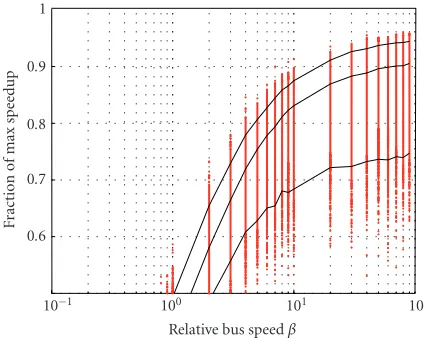
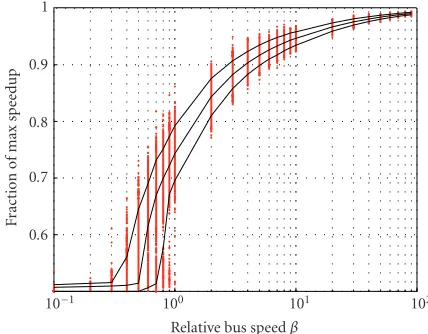
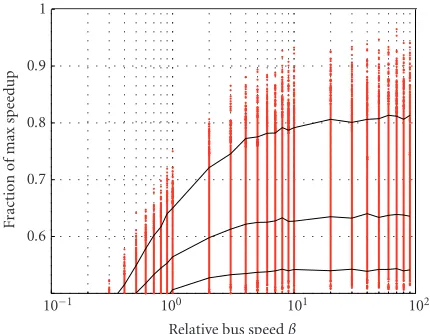
All figures show speedup measurements (dots) as a func-tion of the relative bus speed β. These results are given as a fraction of the maximum speedup s which is theoreti-cally achievable [33] by perfect parallelization. Hence, on one hand, a fractional value of 1.0 represents the upper per-formance limit for any Mod-SDR realization. On the other hand, the fractional value of 0.5 represents a reasonable lower limit, because belows=0.5, the two-processor system would effectively work slower than a single-processor system, thus rendering any distributed processing approach meaningless
in principle. At a sample size of 2000 realizations perβ, the observed measurement range is often so densely populated by dots that the latter amalgamate into vertical lines. There-fore, in addition to the individual speedup measurements, the contour lines of the 5%, the 50% (median), and the 95% quantile are estimated and overlayed to the figures. A con-tour line represents the maximum speedup achieved by the given quantile of Mod-SDR realizations (95%: topmost, 5%: bottommost, median: in between) as a function ofβ.
4.1. Circuit-switched services
Figure 3shows the speedup results for implicit Hu partition-ing and nonpipelined schedulpartition-ing. Obviously, the faster the bus, the better the speedup. Since Hu’s algorithm is eventu-ally a pure scheduling algorithm, it does not take into ac-count any link cost while partitioning graphs implicitly. A naive working assumption could be that speedup approaches the limit of 1.0, if the bus is somewhat fast enough, be-cause link cost approaches zero as β → ∞. Figure 3 dis-proves this assumption. The behavior observed over the en-tire βrange can be explained in part by the occurrence of PHYSICAL WAIT IDLE and LOGICAL WAIT IDLE condi-tions [30]. The former arises after the arbitration of concur-rent bus access requests, whereas the latter originates from logical interdependencies of nodes in the graph; although the bus is fully accessible, one processor is forced to remain idle waiting for some intermediate results to be produced by the other processor.
Both conditions cause idle times in the processors, and thus reduce speedup. While concurrent bus access requests become more and more unlikely as bus speed increases, the LOGICAL WAIT IDLE condition continues to prevail in all schedules independent ofβ. Another reason for speedup loss against the limit can be identified in a special property of Hu’s algorithm; the approach strictly aims at maximum paral-lelization. However, the random graph model produces real-izations with a degree of inherent parallelism ˜d, 0.3≤d˜≤0.8 [36]. As a consequence, if the graph cannot be parallelized due to its given structural properties (small ˜dvalue below
˜
d = 0.5), the Hu algorithm systematically fails to generate high speedup. Load imbalance between the two processors (equal to the difference of aggregate runtimes between the two partitions) is the resulting effect of this failure.
10−1 100 101 102
Relative bus speedβ
0.6 0.7 0.8 0.9 1
F
ra
ct
ion
of
max
sp
ee
d
up
Figure4: Implicit Hu partitioning, pipelining.
10−1 100 101 102
Relative bus speedβ
0.6 0.7 0.8 0.9 1
F
ra
ct
ion
of
max
sp
ee
d
up
Figure5: KL partitioning, no pipelining.
The KL algorithm has been introduced to Mod-SDR [30] as a remedy for this situation.Figure 5shows its performance without pipelining. Astonishingly enough at a first glance, although the approach explicitly considers link cost (and it is even capable of trading load balance for link cost), the KL algorithm shows no systematic superiority compared to Hu’s algorithm under these operating conditions. Speedup degradation in the lowβrange is a bit more graceful than inFigure 3, but at high bus speeds, the KL algorithm is eas-ily outperformed by an approach as simple as Hu’s. This can be explained by the fact that the partitioning approach by Kernighan and Lin indeed considers link cost, but tacitly as-sumes that bus transfers are nonconflicting at all times. Fur-thermore, its partitioning cut has an arbitrary orientation relative to the source node and the target node. As a con-sequence, a large number of LOGICAL WAIT IDLE condi-tions still occurs causing a large spread over the [0.7; 0.9] range of speedup values.
As before, processor idle times associated with LOGI-CAL WAIT IDLE conditions can be completely eliminated
10−1 100 101 102
Relative bus speedβ
0.6 0.7 0.8 0.9 1
F
ra
ct
ion
of
max
sp
ee
d
up
Figure6: KL partitioning, pipelining.
by pipelining. Figure 6 shows the resulting performance of the KL algorithm. The contour lines reveal the highest speedup and the lowest speedup spread observed so far. Nat-urally, the speedup increases as the relative bus speed β in-creases, because link cost tends to be reduced and bus con-flicts become less and less likely. Nevertheless, the results of this figure prove that there are better partitions than Hu’s for allβ. It can be concluded that the approach of Kernighan and Lin successfully effects a good compromise between maxi-mum load balance and minimaxi-mum link cost.
Since the KL algorithm is based on a local search of the design space (taking Hu’s solution as a starting config-uration), it may terminate in local optimum points. Global search methods, in contrast, should be able to avoid local optima and finally produce a better overall speedup. Spec-tral partitioning is a global search method, because it assesses the properties of the graph as a whole by operating on the matrix Wof node weights and edge weights [33], and it is based on eigenvector computation for minimizing the cost of the partitioning cut [39]. What’s more,W’s diagonal el-ementswm,m = pm are the nodes’ processing runtimes
ac-cording to (1) and its off-diagonal elementswm,n=2·pm,n amount to the potential runtimes of bus transfer node pairs, wherepm,nis from (2). The weight matrixWis real-valued and symmetric, and spectral partitioning deliberately ex-ploits this property [40,41].
10−1 100 101 102
Figure7: Spectral partitioning, no pipelining.
Previous figures have shown that, as a matter of fact, bet-ter contour lines and narrower spread are possible using the same hardware and nonpipelined scheduling. Therefore, the reason for the inferior speedup behavior of spectral parti-tioning needs to be identified.Figure 8shows its speedup re-sults under partitioning. Obviously, only a small part of all realizations experience an improvement in speedup due to the elimination of LOGICAL WAIT IDLE conditions. No-tably, the 5% contour line remains at the same speedup level for high bus speeds. These results back previous findings on spectral partitioning; the approach in its current form [33] does not generate well-balanced partitions. Load imbalance, as mentioned before in the context of Hu’s algorithm, is a genuine feature of partitioning, not of scheduling. Failure to generate load-balanced partitions cannot be compensated for by any scheduling technique.
To sum up, the KL algorithm is able to outperform Hu’s algorithm (but not systematically) in the low-to-midrangeβ region (β <5), if frame-by-frame signal processing is the de-sired way of operating the software-defined physical layer of a Mod-SDR. True systematic superiority of the KL algorithm in speedup can only be observed under pipelining. A big dis-advantage, however, is the depth of the pipeline; it depends on the graph structure, its actual value is not predictable, and it is quite a large integer number. (Histograms not shown graphically here: mean value around 20 at M = 40 nodes per graph, spread over a window of [5; 35], independent of βfor implicit Hu and spectral partitioning, depending onβ for KL.) Memory demand increases linearly with the depth of the pipeline, and therefore pipelined operation in combi-nation with the above approaches does not lead to workable Mod-SDR implementations.
In retrospect, frame-by-frame signal processing must be considered inadequate for circuit-switched services. There is simply no need to restrict partitioning algorithms to operat-ing on a soperat-ingle graph copy anyway under these conditions. If the restriction is dropped, the QoS manager can approach partitioning and scheduling in a different, much simpler way. First of all, it turns out [35] that GDP (cf.Section 3) is op-timal regarding delay; the depth of the pipeline is exactly 2
10−1 100 101 102
Figure8: Spectral partitioning, pipelining.
(or 3, if continuous RF transmission is to be automatically supported by the physical layer processing subsystem [38]). Second, GDP is optimal regarding speedup; it reaches the speedup limits, or the fractional value of 1.0 in Figures4,6, and8, independent ofβ. In view of the previously discussed difficulties inapproachingthe limit, GDP is certainly the best design choice for circuit-switched services. If GDP’s mem-ory demand is still an issue, the QoS manager could easily resort to HFP. Its speedup performance for circuit-switched services (see [38, Figure 2]) is suboptimal, but totally com-parable to that of the KL algorithm under pipelining (see Figure 6), however, at a constant pipeline depth of 2 and at less program and data memory demand than GDP’s.
4.2. Packet-switched services
As mentioned in the beginning ofSection 3, packet-oriented networks may require the QoS manager to operate on a sin-gle copy of the graph. Then the graph contains the complete set of computational tasks necessary for processing a single packet, but subsets of these tasks may be repetitive in nature. Taking the IEEE 802.11a wireless LAN standard as an exam-ple, it is easy to identify such tasks, even when looking at a single packet only: intercarrier/intraconstellation interleav-ing, constellation mappinterleav-ing, and IFFT [42]. All of these need to be repeated for every single OFDM symbol alike, just op-erating on different data within the packet. In contrast, non-repetitive computations (per single packet) include scram-bling and channel coding of IEEE 802.11a.
The speedup which could be expected under the con-ditions of the random graph model and a completely nonrepetitive task graph would be identical to that of Figures 3,5, and7. However, if a dominant subset of tasks were in fact repetitive, then pipelining approaches such as HFP and GDP could result in better speedup, when applied to the subset.
The following results of HFP and GDP for packet pro-cessing are conditional on the assumption that there are ex-actlyNFframes per packet which need to be processed
NF=2
Figure 9: Half-frame pipelining, packet processing. Sample size
2000 per (β,NF).
cannot finish the remainder of some higher-layer computa-tional task, while the other processor already starts process-ing the radio signals of a physical layer packet.
Figures9and10(adopted from [38]) show the speedup performance of HFP and GDP, respectively. For reasons of legibility, only the contour line triplets are drawn, parameter-ized by the number of frames per packetNF: 2≤NF≤7. In
comparison to circuit-switched processing, GDP is no longer optimal, since the filling and the emptying of the pipeline cause idle times on the processors. A detailed discussion of HFP and GDP can be found in [38]. However, the crucial point in the above figures lies in the dashed lines representing upper bounds on HFP speedup, but lower bounds on GDP speedup. Therefore, it can be concluded that GDP systemat-ically outperforms HFP in packet processing.
Even for reasonable values of β and low numbers of frames per packet (or task repetitions in parts of a graph), GDP closely approaches the speedup limit s. So far, only transmissions with a constantNFhave been examined.
How-ever, IP traffic in real WLANs consists of a mix of packet sizes, and hence physical layer packets contain different numbers of radio frames. To gain more insight into this matter, packet size statistics of some tangible system have to be known. For the example of IEEE 802.11a, it has been shown [37] that smallNF(values of 10 and below) occur in the great majority
of packets, so smart signal processing of small-sized packets is indeed an important issue in established WLAN standards. Given its superior speedup performance, GDP should be the first choice for packet-oriented signal processing.
5. SUMMARY AND CONCLUSION
As a starting point, some technical and commercial bound-ary conditions of SDR have been briefly reviewed. It follows from this account that certain design issues, which are related
NF=3
Figure10: Graph duplication pipelining, packet processing.
Sam-ple size 2000 per (β,NF).
to real-time multiprocessing and modularity in flexible sig-nal processing software, have been neglected at large in the existing SDR literature. Modular software-defined radio ad-dresses these issues by looking into the organizational princi-ples of signal processing rather than into the signal process-ing itself. Therefore, a novel way of modelprocess-ing SDR software had to be introduced. Several techniques for mapping such software to hardware have been briefly reviewed. Mod-SDR system simulations presented inSection 4allow to draw the following conclusions.
(i) With respect to circuit-switched services, frame-by-frame signal processing has proven inadequate. Pipelining methods such as GDP and HFP are to be preferred a priori. GDP is optimal regarding speedup and delay. HFP is subop-timal, but requires less memory than GDP. Therefore, HFP can only prove competitive against GDP if memory is a se-rious design issue. HFP can merely establish a compromise between the achievable speedup and dynamic power dissipa-tion of the bus.
(ii) With respect to packet-switched services, frame-by-frame signal processing generally retains its right to exist. Pipelining is a viable alternative only if repetitive signal pro-cessing tasks can be identified. If so, GDP should be used. As for the repetitive task in isolation, HFP is systematically outperformed by GDP. Even frame-by-frame signal process-ing (which is independent of the number of repetitions) may show higher speedup than HFP.
Future research directions include the improvement of spectral partitioning for direct comparison with the (non-pipelined) KL approach and a more comprehensive study of terminal behavior in packet-oriented networks. Further on, a suitable extension of the current hardware model to hetero-geneous multiprocessor systems and interconnect topologies other than a bus would advance the design theory of modular software-defined radio.
REFERENCES
[1] J. Mitola, “The software radio architecture,”IEEE Commun.
Mag., vol. 33, no. 5, pp. 26–38, 1995.
[2] IEEE J. Select. Areas Commun., vol. 17, no. 4, 1999, Special Issue on Software Radio.
[3] IEEE Commun. Mag., vol. 37, no. 2, 1999, Special Issue on Software Radio.
[4] A. Ivers and D. Smith, “A practical approach to the imple-mentation of multiple radio configurations utilizing
reconfig-urable hardware and software building blocks,” inProc. IEEE
Military Communications Conference (MILCOM ’97), vol. 3, pp. 1327–1332, IEEE, Monterey, Calif, USA, November 1997. [5] A. Kountouris, C. Moy, L. Rambaud, and P. Le Corre, “A reconfigurable radio case study: a software based multi-standard transceiver for UMTS, GSM, EDGE and Bluetooth,” in Proc. IEEE Vehicular Technology Conference (VTC ’01), vol. 2, pp. 1196–1200, Atlantic City, NJ, USA, October 2001. [6] O. Faust, B. Sputh, D. Nathan, S. Rezgui, A. Weisensee, and
A. Allen, “A single-chip supervised partial self-reconfigurable
architecture for software defined radio,” in Proc. 17th
In-ternational Symposium on Parallel and Distributed Processing (IPDPS ’03), pp. 191–191, IEEE, Nice, France, April 2003. [7] H. Miranda, P. Pinto, and S. Silva, “A self-reconfigurable
re-ceiver architecture for software radio systems,” inProc. IEEE
Radio and Wireless Conference (RAWCON ’03), pp. 241–244, IEEE, Boston, Mass, USA, August 2003.
[8] A. Pacifici, C. Vendetti, F. Frescura, and S. Cacopardi, “A re-configurable channel codec coprocessor for software radio
multimedia applications,” inProc. International Symposium
on Circuits and Systems (ISCAS ’03), vol. 2, pp. II-41–II-44, IEEE, Bangkok, Thailand, May 2003.
[9] T. Hentschel and G. Fettweis, “Sample rate conversion for
software radio,”IEEE Commun. Mag., vol. 38, no. 8, pp. 142–
150, 2000.
[10] W. Abu-Al-Saud and G. Stuber, “Efficient sample rate
conver-sion for software radio systems,” inProc. IEEE Global
Telecom-munications Conference (GLOBECOM ’02), vol. 1, pp. 559– 563, IEEE, Taipeh, Taiwan, Republic of China, November 2002.
[11] W. Abu-Al-Saud and G. Stuber, “Modified CIC filter for
sam-ple rate conversion in software radio systems,”IEEE Signal
Processing Lett., vol. 10, no. 5, pp. 152–154, 2003.
[12] J. Ming, H. Y. Weng, and S. Bai, “An efficient IF architecture
for dual-mode GSM/W-CDMA receiver of a software radio,” inProc. IEEE International Workshop on Mobile Multimedia Communications (MoMuC ’99), pp. 21–24, IEEE, San Diego, Calif, USA, November 1999.
[13] J. Dodley, R. Erving, and C. Rice, “In-building software radio
architecture, design and analysis,” inProc. IEEE 11th
Interna-tional Symposium on Personal, Indoor, and Mobile Radio Com-munications (PIMRC ’00), vol. 1, pp. 479–483, IEEE, London, UK, September 2000.
[14] W. Schacherbauer, A. Springer, T. Ostertag, C. Ruppel, and R. Weigel, “A flexible multiband frontend for software radios
us-ing high IF and active interference cancellation,” inProc. IEEE
MTT-S International Microwave Symposium Digest (IMS ’01), vol. 2, pp. 1085–1088, IEEE, Phoenix, Ariz, USA, May 2001.
[15] A. Wiesler, Parametergesteuertes Software Radio f¨ur
Mobil-funksysteme, Ph.D. dissertation, Forschungsberichte aus dem Institut f¨ur Nachrichtentechnik, Universit¨at Karlsruhe (TH), Karlsruhe, Germany, May 2001.
[16] M. Beach, J. MacLeod, and P. Warr, “Radio frequency
trans-lation for software defined radios,” inSoftware Defined Radio:
Enabling Technologies, W. Tuttlebee, Ed., pp. 25–78, John Wi-ley & Sons, London, UK, 2002.
[17] P. B. Kennington and L. Astier, “Power consumption of A/D
converters for software radio applications,”IEEE Trans. Veh.
Technol., vol. 49, no. 2, pp. 643–650, 2000.
[18] J. Singh, “High speed analog-to-digital converter for software
radio applications,” inProc. IEEE 11th International
Sympo-sium on Personal, Indoor, and Mobile Radio Communications (PIMRC ’00), vol. 1, pp. 39–42, IEEE, London, UK, Septem-ber 2000.
[19] G. Ahlquist, M. Rice, and B. Nelson, “Error control coding in
software radios: an FPGA approach,”IEEE Personal
Commu-nications, vol. 6, no. 4, pp. 35–39, 1999.
[20] M. Valenti, “An efficient software radio implementation of the
UMTS turbo codec,” inProc. IEEE 12th International
Sympo-sium on Personal, Indoor, and Mobile Radio Communications (PIMRC ’01), vol. 2, pp. G108–G113, IEEE, San Diego, Calif, USA, September 2001.
[21] V. Thara and M. Siddiqi, “Power efficiency of software radio
based turbo codec,” inProc. IEEE Region 10 Conference on
Computers, Communications, Control, and Power Engineering (TENCON ’02), vol. 2, pp. 1060–1063, IEEE, Beijing, China, October 2002.
[22] A. Wiesler and F. K. Jondral, “A software radio for 2nd and 3rd
generation systems,”IEEE Trans. Veh. Technol., vol. 51, no. 4,
pp. 738–748, 2002.
[23] F. K. Jondral, “Parametrization—a technique for SDR
imple-mentation,” inSoftware Defined Radio: Enabling Technologies,
W. Tuttlebee, Ed., pp. 232–256, John Wiley & Sons, London, UK, 2002.
[24] J. Mitola, “Software radio architecture: a mathematical
per-spective,” IEEE J. Select. Areas Commun., vol. 17, no. 4,
pp. 514–538, 1999.
[25] J. Mitola, “Software radios—survey, critical evaluation and
future directions,” inProc. National Telesystems Conference
(NTC ’92), pp. 13/15–13/23, IEEE, Washington, DC, USA, May 1992.
[26] C. Dick, “Reinventing the signal processor,” Xcell Journal,
vol. 45, pp. 72–75, Spring 2003.
[27] P. Galicki, “FPGAs have the multiprocessing I/O
infrastruc-ture to meet 3G base station design goals,” Xcell Journal,
vol. 45, pp. 80–84, Spring 2003.
[28] “Software communications architecture specification,
jtrs-5000sca v2.2.1,” Joint Tactical Radio System (JTRS)
Joint Program Office, April 2004, [Online] available:
http://jtrs.army.mil.
[29] A.-R. Rhiemeier and F. K. Jondral, “Mathematical modeling
of the software radio design problem,”IEICE Transactions on
Communications, vol. E86-B, no. 12, pp. 3456–3467, 2003, Special Issue on Software Defined Radio Technology and Its Applications.
[30] A.-R. Rhiemeier and F. K. Jondral, “A software partitioning
al-gorithm for modular software defined radio,” inProc. 6th
In-ternational Symposium on Wireless Personal Multimedia Com-munications (WPMC ’03), pp. 42–46, Yokosuka, Japan, Octo-ber 2003.
[31] A.-R. Rhiemeier and F. K. Jondral, “On the design of
on DSP Enabled Radio, Institute for System Level Integration (ISLI), Alba Campus, Livingston, Scotland, UK, September 2003.
[32] A.-R. Rhiemeier and F. K. Jondral, “Enhanced resource
uti-lization in software defined radio terminals,” in
Interna-tionales Wissenschaftliches Kolloquium (IWK ’03), Technische Universit¨at, Ilmenau, Germany, September 2003.
[33] U. Berthold, A.-R. Rhiemeier, and F. K. Jondral, “Spectral
par-titioning for modular software defined radio,” inIEEE 59th
Vehicular Technology Conference (VTC ’04), vol. 2, pp. 1218– 1222, Milano, Italy, May 2004.
[34] A.-R. Rhiemeier and F. K. Jondral, “Software partitioning and
hardware architecture for modular SDR systems,” in Proc.
Software Defined Radio Technical Conference and Product Ex-position (SDR ’03), vol. 2, pp. 9–15, SDR Forum, Orlando, Fla, USA, November 2003.
[35] U. Berthold, A.-R. Rhiemeier, and F. K. Jondral, “A pipelin-ing approach to operatpipelin-ing modular software defined radio,” in
Proc. IEEE/SarnoffSymposium on Advances in Wired and Wire-less Communication (SARNOFF ’04), pp. 201–204, Princeton, NJ, USA, April 2004.
[36] A.-R. Rhiemeier, “A comparison of scheduling approaches in
modular software defined radio,” inProc. 3rd Karlsruhe
Work-shop on Software Radios (WSR ’04), pp. 33–38, Karlsruhe,
Ger-many, March 2004, also appeared as reprint in:Frequenz:
Jour-nal of Telecommunications, vol. 58, no. 5/6, pp. 115–120, 2004. [37] A.-R. Rhiemeier, T. Weiss, and F. K. Jondral, “Half-frame
pipelining for modular software defined radio,” inProc. IEEE
15th International Symposium on Personal, Indoor, and Mobile Radio Communications (PIMRC ’04), vol. 3, pp. 1664–1668, IEEE, Barcelona, Spain, September 2004.
[38] A.-R. Rhiemeier, T. Weiss, and F. K. Jondral, “A simple and ef-ficient solution to half-frame pipelining for modular software
defined radio,” inProc. Software Defined Radio Technical
Con-ference and Product Exposition (SDR ’04), vol. A, pp. 119–125, SDR Forum, Phoenix, Ariz, USA, November 2004.
[39] C. H. Q. Ding, X. He, H. Zha, M. Gu, and H. D. Simon, “A min-max cut algorithm for graph partitioning and data
clus-tering,” inProc. IEEE International Conference on Data
Min-ing (ICDM ’01), pp. 107–114, San Jose, Calif, USA, November 2001.
[40] M. Fiedler, “Algebraic connectivity of graphs,”Czechoslovak
Mathematical Journal, vol. 23, no. 98, pp. 298–305, 1973. [41] M. Fiedler, “A property of eigenvectors of non-negative
symmetric matrices and its application to graph theory,”
Czechoslovak Mathematical Journal, vol. 25, no. 100, pp. 619– 633, 1975.
[42] “ANSI/IEEE Std 802.11, Wireless LAN MAC and PHY speci-fications,” 1999 Edition, and IEEE 802.11a-1999, High-speed Physical Layer in the 5 GHz Band.
Arnd-Ragnar Rhiemeier received a first degree in electrical engineering from the Ruhr-Universit¨at Bochum, Germany, in 1995, then continued his studies at the Universit¨at Karlsruhe (TH), Germany. Sup-ported by a grant from the German Aca-demic Exchange Service (DAAD), he spent two terms at the National Institute of Ap-plied Sciences, Lyon, France, in 1996 and 1997, working in the field of pattern
recog-nition. In 1998, he resumed his graduate studies at the Institut f¨ur Nachrichtentechnik, Universit¨at Karlsruhe (TH). In 1999, he completed his final project at the Center for Communications and