Volume 2007, Article ID 54038,8pages doi:10.1155/2007/54038
Research Article
Rate-Based Active Queue Management for
TCP Flows over Wired and Wireless Networks
Jun Wang and Min Song
Department of Electrical and Computer Engineering, Old Dominion University, 231 Kaufman Hall, Norfolk, VA 23529, USA
Received 21 July 2006; Revised 18 November 2006; Accepted 22 November 2006
Recommended by Xiuzhen Cheng
Current active queue management (AQM) and TCP protocol are designed and tuned to work well on wired networks where packet loss is mainly due to network congestion. In wireless networks, however, communication links suffer from significant transmission bit errors and handofffailures. As a result, the performance of TCP flows is significantly degraded. To mitigate this problem, we analyze existing AQM schemes and propose a rate-based exponential AQM (REAQM) scheme. The proposed REAQM scheme uses the input rate as a primary metric and queue length as the secondary metric. The objectives of REAQM are to stabilize net-works with low packet loss, low packet delay, and high link utilization regardless the dynamic of network conditions. We prove the global asymptotic stability of the equilibrium based on Lyapunov theory. Simulation results suggest that REAQM is capable of performing well for TCP flows over both wired and wireless networks, and has comparable implementation complexity as other AQM schemes.
Copyright © 2007 J. Wang and M. Song. This is an open access article distributed under the Creative Commons Attribution License, which permits unrestricted use, distribution, and reproduction in any medium, provided the original work is properly cited.
1. INTRODUCTION
The essence of network congestion control is that a sender adjusts its transmission rate according to the congestion measure of the underline networks. There are two compo-nents to accomplish this. One is a source algorithm that dy-namically adjusts the transmission rate in response to the congestion; the other one is a link algorithm that implicitly or explicitly conveys information about the current conges-tion measure to sources using that link. In the current In-ternet, the source algorithm is carried out by TCP, and the link algorithm is performed by active queue management (AQM) schemes at routers. Examples of AQM schemes are
RED [1], REM [2], AVQ [3], and Yellow [4]. TCP defines how
the source rates are adjusted while AQM schemes define how the congestion measure is defined and updated.
According to the type of metrics used to measure con-gestion, AQM schemes can be classified into three catalogs: queue-based, rate-based, and schemes based on concurrent queue and rate metrics. In queue-based schemes, congestion is observed by average or instantaneous queue length and the control aim is to stabilize the queue length. The drawback of queue-based schemes is that a backlog is inherently necessi-tated. Rate-based schemes predict the utilization of the link,
determine the level of congestion, and take actions based on the packet arrival rate. Rate-based schemes can provide early
feedback for congestion [3]. Other AQM schemes deploy a
combination of queue length and input rate to measure
con-gestion and achieve a tradeoffbetween queue stability and
responsiveness.
Current TCP/AQM algorithms assume that packet loss is mainly due to network congestion. However, these TCP/
AQM algorithms are insufficient for the hybrid wired and
wireless networks. In wireless networks, communication
links have intrinsic characteristics that affect the
perfor-mance of transport protocols including variable bandwidth,
corruption, channel allocation delays, and asymmetry [5].
All of these cause significant noncongestion packet loss. The generic TCP protocol notifies sources to reduce their transmission rates only when facing packet losses due to network congestion. Therefore, the TCP protocol in hy-brid wired and wireless networks needs not only to detect packet losses, but also to detect the reason of packet losses. Moreover, the degree of statistical multiplexing number of
flows over wireless links is different from that over wired
links [5]. For example, a wireless link only has several flows
high degree of statistical multiplexing, they may not work well for wireless links with only several flows.
In this paper, we present a new rate-based exponen-tial AQM (REAQM) with explicit congestion notification (ECN) marking, and use REAQM to enhance the TCP per-formance over wireless links. The main idea of REAQM is to use the mismatch between input rate and link capacity as the primary metric, which exploits the early feedback bene-fit of rate-based marking. Furthermore, REAQM uses queue
length to compute a coefficient of rate mismatch and use it
as a secondary metric. The rationale of the secondary metric
is to achieve a tradeoffbetween queue stability and
respon-siveness of the system. Using ECN marking to notify senders of incipient congestion, REAQM overcomes the packet loss problem of burst data and errors over wireless links, and also performs well for high degree of multiplex of flows over wired links.
The rest of the paper is structured as follows. InSection 2,
we introduce some related work, including the analytical model for TCP/AQM algorithms, the state-of-the-art re-search results on AQM schemes, and the characteristics of wireless links. We present the design of REAQM and
analyt-ical results inSection 3. InSection 4, we discuss simulation
design and results, and compare our REAQM scheme with other AQM schemes. Finally, we provide concluding remarks inSection 5.
2. RELATED WORK
We start this section by introducing three representative AQM schemes. RED is a queue-based, most popular AQM
schemes used [1]. In RED, packets are randomly dropped
before the buffer is completely full, and the drop
proba-bility increases with the average queue length. As source rates increase, queue length grows and more packets are marked/dropped. This prompts the sources to reduce their rates. RED configuration has been a problem since its first proposal, and many studies have tried to address this issue
[6]. While the presence of a persistent queue indicates a
con-gestion, its length gives very little information as to the sever-ity of congestion. Therefore, decoupling queue length from congestion management has some benefits.
REM is a queue-and-rate-based scheme. The objective of REM is to stabilize both the input rate around link capac-ity and the queue length around a predetermined target,
re-gardless of the number of users sharing the link [2]. In REM,
each output queue maintains apricefunction as a congestion
measure. The price is updated based on rate mismatch (i.e.,
difference between input rate and link capacity) and queue
mismatch (i.e., difference between queue length and the
pre-determined target). Correspondingly, REM uses an exponen-tial marking probability function. REM decouples conges-tion measure from performance measure such as packet loss, queue length, or packet delay. Since REM tries to maintain a target queue length regardless the number of flows, it limits
its ability to handle burst traffic.
AVQ is primarily a rate-based scheme, as opposed to
queue length or average queue length-based marking [3,7].
AVQ maintains a virtual queue whose capacity is less than the
actual capacity of the link. When a packet arrives in the real queue, the virtual queue is also updated to reflect the new arrival. Packets in the real queue are marked/dropped when
the virtual buffer overflows. The virtual capacity at each link
is then adapted to ensure that each link achieves a desired utilization of the link. Another rate-based scheme is called
Yellow [4]. Yellow uses the load utilization as a primary
met-ric to manage congestion, and a queue control function as a secondary metric to improve congestion control perfor-mance. According to Yellow, a load factor is calculated from link incoming rate and virtual available capacity, where the virtual available capacity is updated based on the queue con-trol function. The queue concon-trol function is introduced to achieve a stable and smooth response. The main idea of Yel-low is to perform queue management based on the link load factor, and to predict incipient congestion timely and accu-rately with controlled queuing delays, stability, and robust-ness. Packet marking probability is based on the load factor to achieve high link utilization and avoid high packet loss ra-tio.
Rate-based marking provides early feedback and re-sponds fast when there exists a rate mismatch between in-put rate and link capacity. The advantages of this approach
have been explored in [8]. The early feedback is more
ro-bust to the presence of extremely short flows or variability in the number of long flows in the network. When utiliza-tion is close to 100%, the variance introduced by short flows seems to lead to an undesirable transient behavior where excessively large queue lengths persist over long periods of
time. Since queue length is a cumulative difference value of
rate mismatch, queue metric is insensitive to current queue
arrival and drain rates. Low [7] proposed a duality model
for TCP/AQM algorithms to explain the equilibrium prop-erties of a large network under TCP/AQM control, such as throughput, delay, queue length, loss probability, and fair-ness. Duality model considers the process of congestion con-trol as a distributed computation by sources and links over a network to solve a global optimization problem in real time.
Gurtov and Floyd [5] consider the interplay between
wireless links and transport protocols, and present the rules
to appropriately model wireless links. Wireless links suffer
from significant packet losses due to bit errors and handoffs.
A TCP flow can only reduce its sending rate on losses due to
network congestion, not on those due to wireless effects. New
AQM algorithms have been proposed specifically for wireless links. Sagfors et al.use instantaneous queue length to mea-sure congestion and propose a deterministic dropping strat-egy, packet discard prevention counter, which is tailored to an estimate of the pipe capacity and TCP’s rate halving
pol-icy [9]. Li and Liu present an explicit feedback scheme with
AQM to handle large bandwidth delay product and burst
packet losses over wireless links [10]. The main problem in
such scenarios is preventing the slow start overshoot of TCP connections. The overshoot happens because TCP detects
congestion up to one RTT after filling the buffer and the first
Most wireless networks suffer from bursty errors. A two-state Markov error model is used to capture the packet loss
characteristics [11]. The two states represent agoodstate with
a low-bit-error-rate (BER) value and abadstate with a high
BER value. The link switches between good and bad states, and the lifetime of each state is exponentially distributed with
a different mean value at each time. Moreover, the degree of
statistical multiplexing number of flows over wireless links is
different from that over wired links. For example, a wireless
link only has several flows instead of hundreds of flows over a wired link. When the degree of statistical multiplexing is low
and the buffer size is small, existing AQM algorithms may
not perform sufficiently well. While many link technologies
include forward error correction (FEC) and local retransmis-sion for addressing corruption at the link layer, these mecha-nisms can introduce their own complications, and result in a high variability of bandwidth and delay on wireless links.
3. REAQM SCHEME
3.1. Scheme description
The objectives of REAQM scheme are to regulate the link utilization and stabilize the networking system regardless the changing network conditions. Similar to REM, REAQM
maintains a variable,price, as a congestion measure and uses
an exponential marking probability function. On the other
hand, REAQM differs from REM in the definition of
conges-tion measure. Denotepl(t) as the price at queuelin periodt.
The marking probability function of REAQM is
ml(t)=1−φ−pl(t), (1)
whereφis a constant larger than 1. The parameterφ
deter-mines the range of loss or marking probability, which also
depends on the range of pricepl(t). Ideally,φshould be
cho-sen in a way that the end-to-end probability observed at hosts is small, especially for the AIMD algorithm of TCP Reno and its variants.
At each packet arrival epoch, the price is updated accord-ing to the followaccord-ing equation:
pl(t+ 1)=pl(t) +γfql(t)yl(t)−cl+. (2)
Here, pl(0) = 0, and [z]+ = max{z, 0}.ql(t) is the
aggre-gate queue length at queuelin periodt,yl(t) is the aggregate
input rate to queue lin periodt, andcl is the link
capac-ity at queuel. The smoothing parameterγ >0 is a step size
which determines the speed of convergence of the algorithm.
A largerγresults in a faster convergence, but it also incurs a
higher risk of oscillatory queue. The coefficient of rate
mis-match is a function of queue mismis-match at queuelin period
t;
fql(t)= αlql(t)
cl + 1, (3)
where weight parameter, αl, is a constant. Obviously,
f(ql(t))≥1, and it is equal to 1 only ifql(t)=0. If the value of
Price is updated, periodically or asynchronously, mainly based on rate mismatch. The price is incremented if rate matches is positive, and decremented otherwise. Rate mis-match is positive when the input rate exceeds the link capac-ity and negative otherwise. Queue length is used to compute
the coefficient of rate mismatch and adjust the scale of rate
mismatch. If queue length is small, the impact of rate mis-match decreases and REAQM is less aggressive. Otherwise, REAQM is more aggressive. The rationale behind price up-date is that the smaller queue length, the more rate mismatch
is allowed. This makes a tradeoffbetween the system
stabil-ity and utilization. If current input rate exceeds link capac-ity, the packet marking probability will increase; otherwise, it will decrease. Second, the larger the current queue length,
the larger the coefficient of rate mismatch is; thus the larger
the price value increases or decreases as well. While rate
mis-match is positive, that is,yl(t)> cl, the price always increases
for any value of queue length. If αl is larger enough,
fre-quently positive rate mismatch results in a small queue size and may lower system throughput. We modify the price up-date equation in this case as
pl(t+ 1)=
where y0is target queue length while rate mismatch is
pos-itive, and αl is relative weight parameter larger than αl.
REAQM has comparable implementation complexity as
REM, since the mainly difference of REAQM and REM is the
price function.
When the number of TCP flow increases, the rate mis-matches grow and thus push up the price and hence mark-ing probability. This increases the intensity of congestion sig-nal to sources, which then reduce transmission rates. When transmission rates are too small, the mismatches will be neg-ative. This lowers the price and marking probability and raises transmission rates, until eventually the mismatches are driven to zero yielding high utilization and negligible loss and delay in equilibrium. Recall that the mean queue length steadily increases as the number of flows increases in RED. In contrast, the price steadily increases while rate mis-matches grows and the mean queue length is stabilized under REAQM.
Generally, ECN bit is used to inform the source which
losses are due to congestion or wireless effects [2, 7]. If a
packet is marked by setting its ECN bit, the mark is carried to the destination and then conveyed back to the source via ac-knowledgments. We set ECN bit to 1 while packets are prob-abilistically marked according REAQM scheme, and drop
packets only when they arrive at a full buffer. Although this
method cannot completely prevent buffer from overflowing
and thus some packets are dropped by congestion, it diff
We conclude this section by stating that AQM must be
more aggressive to avoid buffer overflow for high degree of
statistical multiplexing and less aggressive to avoid underuti-lization for low degree of statistical multiplexing. Consider a single link accessed by many TCP sources with the same round-trip time (RTT). Assume fixed packet size and the link
is equally shared amongstnTCP long-live flows. A
conges-tion notificaconges-tion to one flow reduces the offered load by a
factor of (1−1/2n). Therefore, the largernis, the less impact
of individual marking.
3.2. Stability analysis
In this section, we present a global stability analysis for REAQM based on the duality model for TCP/AQM system
[7]. The global asymptotic stability of the equilibrium for
REAQM scheme can be proved based on Lasalle’s invariance
principle applied to a suitable Lyapunov function as in [12].
Let (q∗,p∗) be an equilibrium of our system,q∗s andx∗s
be the equilibrium source price and rate for sources,
respec-tively. Further, lety∗l be the equilibrium link rate for queuel.
The queue length is taken as follow:
ql(t+ 1)=ql(t) +yl(t)−cl+. (6) strictly decreasing inqs>0and thatRis of full row rank, then the unique equilibrium pointq∗=0,p∗is globally asymptot-ically stable.
First, we introduce the candidate Lyapunov function
V(q,p):
tive and radially unbounded.
Take the derivative ofV(q,p) along trajectories of our
system:
The last term above can be rewritten as
S
Substituting back, we have
˙
equation (7), and discuss the four cases:
(1) ql>0,pl>0. Here
Lyapunov’s stability theorem, the trajectory (q(t),p(t)) must
remain bounded over the time, and the equilibrium point
(q∗,p∗) is stable in the sense of Lyapunov. Note that ˙V =0
when either yl−cl < 0, or yl−cl < 0 and ql = pl = 0,
which is the desired stable zone. The set of states (q,p) where
the Lyapunov derivative is zero is as same as that in [12]. The
system is globally asymptotically stable by means of Lasalle’s invariance principle.
4. SIMULATIONS AND ANALYSIS
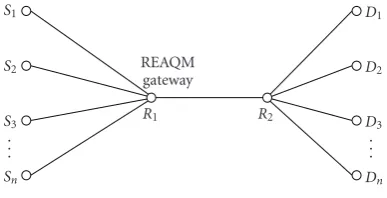
Simulations are conduced using ns-2 simulator. Figure 1
shows the network topology, wherenTCP flows share a
S1
Figure1: Network topology.
InFigure 1, the two routers (R1 and R2) are connected
by a link with a capacity of 10 Mbps, which could be a wired or wireless link. The capacity of all other links is 100 Mbps. The propagation delay of the bottleneck link (between two routers) is set to be 10 milliseconds, and those of the other links are set to be uniformly distributed between 10 millisec-onds and 30 millisecmillisec-onds. NewReno is used as default trans-port protocol with the TCP data packet size 1000 bytes. The performance metrics are average queue length, link utiliza-tion, and packet loss ratio.
In the first experiment, we study the parameter setting of
REAQM, especially, for the parametersαl. We assume that
the bottleneck link is reliable and run the simulation for dif-ferent number of TCP flows. We start the experiment with 50 FTP flows in the system, and new 50 FTP flows are added every 50 seconds until the total number of flows reach 250. The queue size is 50. The objective is to study the
sensitiv-ity for the parameterαland the thumb of rule for parameter
configuration.
The performance influence of parameterαl is given in
Figure 2. The value ofαl determines the prominence given to the queue length when determining the level of
conges-tion. As can be seen the average queue length (Figure 2(a)) is
reduced with increasingαl. The smallerαlis, the smaller the
coefficient of rate mismatch is. Therefore, queue length has
less effect on the rate mismatch. If only (4) is used, the price is
always increased with positive rate mismatch. While smallαl
is chosen, average queue length will be increased. The coeffi
-cient is small while we use smallαl. The price increases lightly
even with large queue length and positive rate mismatch. Eventually, it results in very large queue length. On the other
hand, largeαl indicates that even a small queue length has
relative effect on the coefficient of rate mismatch. If both
the number of flows andαlare large enough, average queue
length is very small and link utilization is also low. Therefore,
price is updated based on (5) in the experiment. For the same
αl, average queue length decreases mostly while the number
of flows increases. The reason is larger number of flows re-sults in a higher probability of positive rate mismatch, which reduces the allowable queue length. It should be noticed that
packet loss ratio (Figure 2(b)) is increased lightly with
in-creasingαl. For differentαl, the larger average queue length
is, the smaller packet loss ratio is. Therefore, choosing diff
er-ent value ofαl makes a tradeoffbetween queue length and
loss ratio. Packet loss ratio is increased with the increasing of
number of flows. Link utilization (Figure 2(c)) is very stable
0.05 0.07 0.09 0.11 0.13 0.15 0.17 0.19
(a) Average queue length.
0.05 0.07 0.09 0.11 0.13 0.15 0.17 0.19 (b) Packet loss ratio.
0.05 0.07 0.09 0.11 0.13 0.15 0.17 0.19
for allαlwhile the number of flows is larger than 50, and has
oscillation while number of flows is 50. We can use different
values ofαlto achieve small queue length or maintain small
packet loss ratio.
In the following experiments, we compare REAQM with other AQM schemes over wired and wireless networks. In these experiments, we use the “gentle” version of RED. The
parameters of REM were chosen as recommended in [2], and
the parameters of AVQ were chosen as recommended in [3].
The queue size is 50 for all AQM schemes. The parameters
of REAQM are set as follows: αl = 0.11,γ = 0.001, and
Φ=1.001.
In the second experiment, we consider the bottleneck link is reliable, and FTP flows are added or dropped to the network. We start the experiment with only small number of FTP flows in the system, and new 50 FTP flows are added ev-ery 50 seconds until the total number of flows reach the max-imal value, 300. Then 50 flows are dropped every 50 seconds until the total number of flows is equal to the initial number. For every 50 seconds, we calculate each performance metric. A long transient period is always with an increasing average queue length while new flows are added before the scheme is able to converge at new network condition. Therefore, aver-age queue length over each 50 seconds interval captures per-sistent transients.
Figure 3shows the performance of each AQM scheme under varying degree of flow multiplexing over the wired link. The overall performance of REAQM is comparable
with REM and RED. Average queue length (Figure 3(a))
of REAQM is comparable with that of REM, and is larger
than that of RED and AVQ. Packet loss ratio (Figure 3(b))
of REAQM is smaller than other schemes. Link utilization (Figure 3(c)) of REAQM is comparable with that of REM, and is higher than RED and AVQ. The average queue length and link utilization of REAQM are also very stable for dif-ferent number of flows. REAQM uses rate mismatch as main metric to update the price, which makes it very ro-bust to the present of variability in the number of flows.
The performance of AVQ is different with other schemes.
It has the smallest average queue length and link utiliza-tion.
In the third experiment, we compare the properties of various AQM schemes while the bottleneck link is wireless. We modify NewReno so that a source halves its window when it receives a mark or detects a loss through timeout, but re-transmits without halving its window when it detects a loss through duplicate acknowledgments. The number of flows added or dropped at each time interval is 10 due to the low degree of flow multiplexing over wireless link.
Figure 4shows the performance of each AQM schemes under varying degree of flow multiplexing over the wireless
link. The average queue length (Figure 4(a)) of REAQM is
slight smaller than that of REM, and higher than that of other
two schemes. Packet loss ratios (Figure 4(b)) of all schemes
are comparable. The link utilization (Figure 4(c)) of REAQM
and REM are better than RED and AVQ. While the number of flows is small, link utilization of AVQ is lower than that of other schemes. (a) Average queue length.
0 50 100 150 200 250 300 (b) Packet loss ratio.
0 50 100 150 200 250 300
Figure3: Performance test versus number of FTP flows for the
0 10 20 30 40 50 60 (a) Average queue length.
0 10 20 30 40 50 60 (b) Packet loss ratio.
0 10 20 30 40 50 60
Figure4: Performance test versus number of FTP flows for the
dif-ferent AQM schemes over wireless link.
5. CONCLUSIONS
In wireless networks, packets are lost mainly because of bit errors and intermittent connectivity. In this paper, we have presented a new rate-based exponential AQM (REAQM) with explicit congestion notification (ECN) marking, and use REAQM to enhance the TCP performance over both wired and wireless links. The main idea of REAQM is to use the mismatch between input rate and link capacity as the primary metric, which exploits the early feedback bene-fit of rate-based marking. Furthermore, REAQM uses queue
length to compute a coefficient of rate mismatch and uses it
as a secondary metric. The rationale of the secondary
met-ric is to achieve a tradeoffbetween queue stability and
re-sponsiveness of the system. The global asymptotic stability of REAQM has been proved using Lyapunov theory. Simulation results suggest that REAQM is capable of performing well for TCP flows over both wired and wireless networks, and has comparable implementation complexity as other AQM schemes.
ACKNOWLEDGMENT
The research of Dr. Min Song is partially supported by U.S. National Science Foundation (NSF) Career Award CNS-0644247.
REFERENCES
[1] S. Floyd and V. Jacobson, “Random early detection gateways for congestion avoidance,” IEEE/ACM Transactions on
Net-working, vol. 1, no. 4, pp. 397–413, 1993.
[2] S. Athuraliya, S. H. Low, V. H. Li, and Q. Yin, “REM: active queue management,”IEEE Network, vol. 15, no. 3, pp. 48–53, 2001.
[3] S. S. Kunniyur and R. Srikant, “An adaptive virtual queue (AVQ) algorithm for active queue management,”IEEE/ACM
Transactions on Networking, vol. 12, no. 2, pp. 286–299, 2004.
[4] C. Long, B. Zhao, X. Guan, and J. Yang, “The yellow active queue management algorithm,”Computer Networks, vol. 47, no. 4, pp. 525–550, 2005.
[5] A. Gurtov and S. Floyd, “Modeling wireless links for trans-port protocols,”ACM SIGCOMM Computer Communication Review, vol. 34, no. 2, pp. 85–96, 2004.
[6] H. Ohsaki and M. Murata, “Steady state analysis of the RED gateway: stability, transient behavior, and parameter setting,”
IEICE Transactions on Communications, vol. E85-B, no. 1, pp.
107–115, 2002.
[7] S. H. Low, “A duality model of TCP and queue management algorithms,”IEEE/ACM Transactions on Networking, vol. 11, no. 4, pp. 525–536, 2003.
[8] S. Deb and R. Srikant, “Rate-based versus queue-based mod-els of congestion control,” inProceedings of Joint International Conference on Measurement and Modeling of Computer Systems
(SIGMETRICS /Performance ’04), pp. 246–257, New York, NY,
USA, June 2004.
[9] M. Sagfors, R. Ludwig, M. Meyer, and J. Peisa, “Queue man-agement for TCP traffic over 3G links,” in Proceedings of IEEE Wireless Communications and Networking Conference
(WCNC ’03), vol. 3, pp. 1663–1668, New Orleans, La, USA,
[10] V. H. Li and Z.-Q. Liu, “PET: enhancing TCP performance over 3G & beyond networks,” inProceedings of the 58th IEEE
Vehicular Technology Conference (VTC ’03), vol. 4, pp. 2302–
2306, Orlando, Fla, USA, October 2004.
[11] H. Wang and N. Moayeri, “Finite-state Markov channel—a useful model for radio communication channels,”IEEE
Trans-actions on Vehicular Technology, vol. 44, no. 1, pp. 163–171,
1995.
[12] F. Paganini, “A global stability result in network flow control,”