Volume 2007, Article ID 71610,11pages doi:10.1155/2007/71610
Research Article
Modelling and Comparative Performance Analysis of
a Time-Reversed UWB System
K. Popovski, B. J. Wysocki, and T. A. Wysocki
School of Electrical, Computer and Telecommunications Engineering, University of Wollongong, Northfields Avenue, Wollongong 2522, NSW, Australia
Received 30 April 2006; Revised 24 November 2006; Accepted 16 January 2007
Recommended by M´erouane Debbah
The effects of multipath propagation lead to a significant decrease in system performance in most of the proposed ultra-wideband communication systems. A time-reversed system utilises the multipath channel impulse response to decrease receiver complexity, through a prefiltering at the transmitter. This paper discusses the modelling and comparative performance of a UWB system utilising time-reversed communications. System equations are presented, together with a semianalytical formulation on the level of intersymbol interference and multiuser interference. The standardised IEEE 802.15.3a channel model is applied, and the estimated error performance is compared through simulation with the performance of both time-hopped time-reversed and RAKE-based UWB systems.
Copyright © 2007 K. Popovski et al. This is an open access article distributed under the Creative Commons Attribution License, which permits unrestricted use, distribution, and reproduction in any medium, provided the original work is properly cited.
1. INTRODUCTION
Following the release for commercial applications in early 2002 [1], ultra-wideband (UWB) communications, or im-pulse radio, has seen significant attention. It is characterised by having a fractional bandwidth of more than 20%, or band-width occupancy greater than 500 MHz [2]. Due to the in-creased bandwidth, UWB is expected to support higher data rates than conventional narrowband systems. The two main competitors for the UWB standard are the “UWB Forum” direct sequence-based system, and the “WiMedia Alliance” orthogonal frequency division multiplexing based scheme [3]. Unfortunately, the IEEE body responsible for the UWB 802.15.3a standard has been disbanded, leaving the decision to be made by market forces [4].
A UWB scheme which has not seen as much attention is time hopped UWB (TH-UWB), which is similar in im-plementation to direct sequence UWB. In this system, pulses transmitted are either delayed in time (pulse position mod-ulation (PPM)) or changed in amplitude (pulse amplitude modulation (PAM)) for data encoding. Users are multiplexed through code division multiple access based upon a family of orthogonal time hopping codes.
This paper deals with a TH-UWB system, utilising a “time-reversed” (TR) approach, which has its origins in
un-derwater acoustics [5]. This scheme has also been referred to as “prerake” [6]. While a conventional system would op-erate with the transmission of subnanosecond width Gaus-sian waveforms, a TR-UWB system uses the channel im-pulse response from the transmitter to the receiver as a transmit prefilter. The transmitted time-reversed signal re-traces its path through the channel, resulting in an autocor-relation of the response being received [7–9]. This extends from work in underwater experimentation with sound-waves, as in [10]. These showed that when energy losses are small, wave equations guarantee that for each sound burst that diverges from a point, there exists a set of waves which would converge through the paths back to the point source.
response length. This is to ensure that the multipath disper-sion has sufficiently passed.
TR-UWB, however, shifts the design complexity from the receiver to the transmitter. With the estimation of the chan-nel impulse response, the transmitter is able to make the propagation channel perform the signal correlation. The re-ceived signal is focused in both time (temporal focusing) and space (spatial focusing) at the intended receiver, concentrat-ing the sent energy with a spatial resolution of the order of the wavelength [7–9, 13–15]. Through temporal focusing, a TR-UWB system is capable of effectively mitigating inter-symbol interference (ISI). Focusing also allows time-reversed communications to be more robust in the presence of nar-rowband interference relative to receiver-equalisation-based UWB [16].
Ultimately, there are fundamental drawbacks of a time-reversed system. These include
(i) determining the channel impulse response from the transmitter to the receiver for use in the former; (ii) the possibility of channel correlation between users;
and
(iii) the large time interval required to obtain the response in heterogeneous systems.
This paper discusses the modelling and comparative per-formance of a TR-UWB system. It is organised as follows Section 2 provides an overview into UWB and TR-UWB communications, Section 3 covers various signal degrada-tions and error performance analysis,Section 4overviews a UWB and TR-UWB simulation, together with a comparative analysis of the theoretical and simulated results for a time-reversed system. Finally,Section 5gives all concluding state-ments and remarks.
2. SYSTEM EQUATIONS
2.1. Equalisation methods
While the concept of channel equalisation does present ben-efits in terms of user error performance, it inevitably leads to an increase in the level of complexity of the system. Increased memory, channel tracking, and additional processing are a few of the requirements, with the possibility of being incor-porated into either the transmitter or the receiver.
Receiver side equalisation, which is more common in wireless communications, entails the collection of channel distorted energy, with increased receiver complexity. A RAKE structure is common in UWB communications in order to offset channel effects, with a branch dedicated to each arriv-ing path encompassed in the decision process [17].
A common application of receiver equalisation is in sen-sor networks, where a collection of nodes each with one or more environment sensors, communicate to higher level node receivers which perform channel equalisation. This al-lows the sensor nodes to be simpler in design, also saving on energy. Existing sensor network methods include “BTnodes” [18] and Intel’s “Imote” [19], both high bandwidth methods based upon bluetooth technology.
0 1 2 3 4 5 6 7 8 9 10
c(1)m c(2)m c(3)m
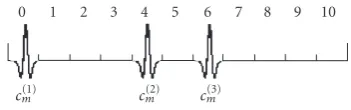
Figure1: Positioning of pulses by a time-hopping code.
A disadvantage in receiver side equalisation is that RAKE receivers, for instance, grow linearly in complexity with an increase in the number of branches [13]. It has been proven that in order to collect about half of the energy in a trans-mission, RAKE receivers with more than 10 taps are required [20].
Transmitter side equalisation comprises of a shift in the design complexity to the transmitter side. An ideal applica-tion would be in actuator networks, where remote nodes are desired to be simple, inexpensive, and consuming minimal power.
Alternate equalisation measures include a time-reversed UWB adaptation whereby an MMSE equaliser is adopted at the receiver to increase energy collection [21]; and a receiver-side equalisation scheme encompassing MMSE cision feedback and the application of stochastic gradient de-scent algorithms [22].
2.2. Receiver-side equalisation
The signal s(u)(t) transmitted for the uth user in a
time-hopped UWB system adopting a RAKE receiver, with equip-robable datab(u)m ∈ {−1, 1}mapped through binary PPM
with the time shiftε, is given by [23]
s(u)(t)=ETX(u) N−1
m=0
wt−mTf−c(u)m Tc−εb(u)m
, (1)
whereETX(u) is theuth user’s signal energy,w(t) is the base
transmitted waveform of widthTm seconds,mis the frame
number, andNrepresents the number of symbols within a single block of data. Tf is a single frame length, which is
segmented into equally spaced intervals called “chips” of du-rationTc. Finally,cm(u) denotes the position within the
par-ticular frame (the chip number) that is occupied by theuth user’s signal in accordance with a time-hopping sequence. If two users simultaneously occupy the same chip, a collision or “hit” occurs. The characterising parameters of these codes are the cardinality (Nh), which specifies the alphabet size;
and the periodicity (Np), which indicates the length of the
code before it is repeated. This time multiplexing is shown in Figure 1, withc(u)m ∈ , 0≤c(u)m ≤Nh−1. In the example,
c(1)m =0,cm(2)=4,c(3)m =6, and a frame ofNh =11 chips is
used.
With the data shiftε, and the pulse durationTm, the
re-maining frame duration is defined as the “guard time”Tg,
where
Tg=Tc−
ε+Tm
−0.25 −0.15 −0.05 0.05 0.15 0.25
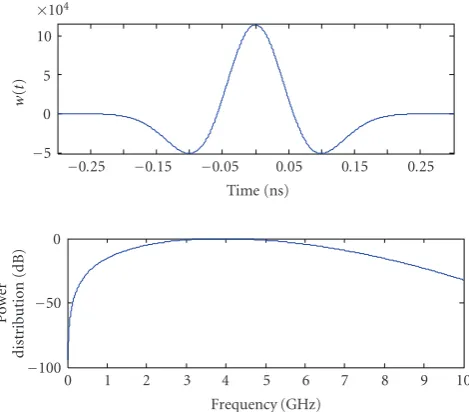
Figure2: Time and frequency domain representations of a second derivative Gaussian monocycle with centre frequency of 3.9 GHz.
This time is adjusted to permit a portion of the multipath components to pass before the transmission of the next pulse. DefiningRas the data rate, andNsthe number of
transmis-sions per symbol, the frame durationTf and chip duration
Tccan be written as
For the purpose of this paper, the pulse shape was set as the second derivative of the Gaussian pulse, with centre fre-quency f0, defined as [24]
with energy normalised Fourier transform of
Figure 2 presents the time domain representation of the energy normalised Gaussian waveform, with its cor-responding power spectral density. A monocycle width of 0.5 nanosecond was selected, corresponding to a centre fre-quency of approximately 3.9 GHz.
Applying the standardised IEEE 802.15.3a UWB chan-nel model, the discrete impulse response of the propagation medium can be expressed as
h(u;x,t)=
wherexis the position of the receiver, andLis the number of paths in the discrete version of the response. Path delay
τlis defined asτl =τ·l, whereτrepresents the time
sepa-ration between multipath components. Coefficientsαl(u;x)
encompass the channel energy, defined as
EH,u;x= L−1
l=0
αl(u;x)2
. (8)
The received signal within a UWB system forNu
simul-taneous users is defined as
r(t)=
where⊗represents convolution, and the channel is assumed static over the transmission of each block of N frames. A RAKE receiver combines the dispersed energy amongNBof
theLreceived paths, thus requiringNBcorrelator branches,
each aligned in time with their respective multipath compo-nent. An All-RAKE receiver considers all replicas of the trans-mitted signal (NB =L); a Selective-RAKE receiver accounts
forNB< Lpaths, considering theNBpaths with largest
mag-nitudeαl(u;x); and finally a Partial-RAKE receiver combines
energy from the firstNBpaths only (0≤l < NB).
This paper focuses on the performance of an All-RAKE receiver.
2.3. Transmitter-side equalisation
Within a TR-UWB scheme, the time reversed complex con-jugate of the forward link channel response is used to diver-sify the signal before transmission. In order to draw a corre-spondence with an All-RAKE receiver structure, allL multi-path components were incorporated into the transmit pre-filter. An alternate prefilter design is presented in [25], based upon a digital FIR filter.
The discrete representation of the time-reversed channel is defined as
antenna, will be identical provided the medium between the antennas is linear and isotropic [26]. Conversely, more ac-curate channel knowledge can be obtained through receiver-side feedback to the transmitter.
The signal transmitted per user is given by
s(u)TR(t)=
where the division withEH,u;xis needed to normalise the
en-ergy of the channel response. This is to ensure that the enen-ergy transmitted remains equal toETX(u).
Without loss of generality, user 1 is taken as the desired user, with the signal detected at its receiver in locationx1
given by
is the correlation of the channel impulse responses from the 1st and the uth user to user 1’s receiver at location x1. It
should be noted that all transmitters were assumed dispersed enough such that the channel responses from eachNu
trans-mitter to any receiver are independent. Additive white Gaus-sian noise with variance ofN0/2 is also present.
The decision variable (Z) is constructed through the multiplication of the received signal with the receiver tem-plate, giving the estimated received data ofb(u)m
ZTR(u)=
It can be seen in (15) that there is an additional shift of τL−1 for the integration, which is required to align the
template with the largest peak in the received signal of the desired user. The (L−1)th path is the in-phase autocor-relation peak position for the channel response, referred to as the main lobe. The template g(t) was adapted for free-space propagation in order to draw an equivalence between an All-RAKE dependent UWB system, and the time-reversed method. When the guard time Tg is chosen such that ISI
is avoided, an All-RAKE-UWB and a TR-UWB system ex-hibit identical diversity orders and thus have the same error performance, even in the presence of multiuser interference (MUI). However, temporal focusing allows TR-UWB to be more resilient in the presence of ISI, as will be shown through simulation inSection 4.
With the received signal taking the form of the autocor-relation of the channel impulse response, it can be inferred that inherent sidelobe energy will exist. Following from this, it can be seen that increasing the randomness of a channel response results in lower sidelobe energy. Thus, an NLOS system is expected to out-perform an LOS system. However, larger lengths of the NLOS channels will ultimately lead to an increase in the duration of the sidelobe energy.
While not studied in this paper, a TR-UWB system may adopt only a portion of the channel response as the signal prefilter. An analysis into time-reversed systems utilising only selected paths of the channel, also referred to as “dynamic TR,” can be found in [6,15].
For a further comparison between transmitter- and receiver-side equalisation, consider the system models for UWB and TR-UWB in Figures 3(a)–3(d). It can be noted that the main variations are the added prefiltering in the TR-UWB transmitter, and subsequently simplified re-ceiver structure relative to theNB branch RAKE receiver in
Figure 3(b). For brevity, frame- and time-hopping shifts have been omitted in the receiver structures.
Hereafter, a chip synchronous single-input-single-output (SISO) system is considered, assuming that the transmit and receive antennas, which would act as pulse shaping filters, have no significant combined effect on the signal transmit-ted. Time-reversal properties also apply in an SISO system, assuming that the bandwidth occupied by transmissions is much larger than the correlation frequency exhibited by the channel [27]. Also, a quasistationary channel is assumed, such that it remains time-invariant for the transmission of a full UWB packet. Calculations are based upon the CM1 channel scenario of the 802.15.3a model, characterised for an LOS system with a 0–4 m separation between all transmit and receive pairs.
3. ERROR PERFORMANCE ANALYSIS
3.1. Time-hopping code analysis
m
δ(t−mTf) Pulse correlator W(f)
TH sequence delay
Data
encoder s(u)(t)
m
w(t−mTf) m
w(t−mTf−cm(u)Tc)
(a)
r(t)
RAKE branch (1)
RAKE branch (2)
RAKE branch (NB) . . .
+
Ns−1
n=0
r(t)g(t−τn)
Integrator Polarity detector b
(u) m
Z(u)= t
Ns−1
n=0
r(t)g(t−τn)
(b)
m
δ(t−mTf) Pulse correlator W(f)
TH sequence delay
Data encoder
Prefiltering H−1(f) s
(u)
TR(t)
m
w(t−mTf)
m
w(t−mTf −c(mu)Tc)
m
w(t−mTf −cm(u)Tc−εb(mu))
(c)
r(t) RAKE branch Integrator Polarity detector b
(u) m r(t)g(t−τL−1) Z
(u)=
tr(t)g(t−τL−1)
(d)
Figure3: System model for (a) UWB transmitter, (b) UWB receiver, (c) TR-UWB transmitter, and (d) TR-UWB receiver.
multiuser interference is the time-hopping code. The cardi-nality of the hopping code is generally chosen to be equal to the number of chips within a single frame (Ns). In order to
predict the performance of a perfectly power controlled sys-tem, the hopping code itself must be analysed.
Intersymbol and multiuser interferences are affected by the separation between consecutive elements within se-quences. These indicate the number of intermediary chips between transmissions by a single user for ISI and chip sep-arations between different users for MUI.Figure 4illustrates the ISI separation for two transmissions, separated by A
frames.
The chip separation probability (Se(A,B)) is determined
for a certain separationBbetween transmissions, whereA
represents the number of intermediate frames. The issue of intermediate pulses over the separation distance is important since the RMS delay spread of a signal may cause intersym-bol interference well over an adjacent frame. These proba-bilities are determined through a brute force analysis of the hopping code (c(u)m ) used for multiuser encoding, averaged
over the all codes within each family of sequences. Evaluated state probabilities for the givenAare [p1,p2,. . .,p2(Nh−1)+1], whereSe(A,B) = pB. For ISI, each code within a sequence
cm(1)
Tf ATf
Tc
Aframes
Bchips+
cm+1+A(1)
Figure4: Symbol separations.
family is analysed separately, while for MUI all possible se-quence pairs are considered.
Probabilities are significantly dependent upon the cardi-nality (Nh) of the hopping code. A larger value will result in
more chips to select from, leading to a more sparse profile. The separation between any two user transmissions ranges fromANh to (A+ 2)Nh−2, whereAis zero for adjoining
frames.
0 2 4 6 8 10 12 14 16 18 20
Chip separation between consecutive sequence elements
Pr
Chip separation between consecutive sequence elements
Pr
Figure5: Chip separation probabilities for (a) Reed-Solomon and (b) linear congruence codes.
probabilities for these sequence families for a cardinality of
Nh = 11, no intermediary pulses (A = 0), and separation
ranging from 0 to 2Nh−2 are given in Figures5(a)and5(b),
respectively.
3.2. Intersymbol interference
Considering typical RMS delay spread for a UWB multi-path channel, intersymbol interference may cause a signif-icant degradation. This is particularly evident in TR-UWB systems, with a larger transmitted waveform close to dou-bling the length of the received signal. ISI is affected by the width of the transmitted pulses, and the data rate. The level of interference will diminish to zero provided that the chip time is greater than twice the length of the channel response
(2Lτ), allowing enough time for the multipath components to pass.
In order to estimate the performance of a TR-UWB sys-tem operating in a scattering environment, the expected ISI variance may be determined. This is accomplished by esti-mating the level of interference for a single transmission, summed over all overlapping adjacent transmissions by the same user. In order to obtain a close approximation, the ISI must be Gaussian distributed.
The ISI estimation in this paper takes an average on theε
shift introduced for the encoding of data. Assuming indepen-dent iindepen-dentically distributed random variables forb(u)m , this
av-erage is equivalent to no data modulation shift.
With the received signal comprised of Gaussian wave-forms, which ideally have a zero average, the ISI has an ex-pected mean of zero. This reduces the variance calculation to
σ2≡(Y−μ)2=Y2, (18)
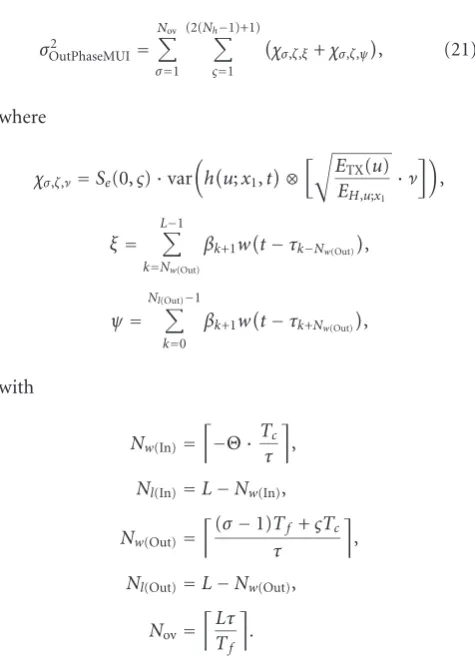
whereμrepresents the signal mean, and·an ensemble av-erage. The variance is calculated over all overlapping trans-missions, also over all possible chip separations by applying the probabilities determined inSection 3.1.
The formula for the variance of the ISI, averaged over
N transmissions, is given by (19), which accounts for in-terference from preceding transmissions (Pre ISI) and fol-lowing transmissions (Post ISI). ParametersNw andNl
de-fine the number of paths expected to overlap for the pre-and post-transmission ISI, respectively, withNov
Here,νrepresents the portion of the transmitted signal which is regarded as ISI, and is referred to as the third param-eter ofχσ,ζ,ν. This formula converges to an ISI variance within 5% of the final value when averaged over approximately 50 iterations.
3.3. Multiuser interference
Within an environment where multiple users operate in close proximity, there is the possibility of interuser inter-ference. For the case of ISI, if the chip time Tc is greater
than the transmission durationLτ, interference is of no con-cern. For MUI, this condition would only remove the par-tial interference caused by transmissions in adjacent chips, while the issue of same chip collisions between users re-mains. For a multiuser scenario, there are three types of interference which must be accounted for: in-phase, where two users transmit in the same chip; pre-out-of-phase, in-terference caused by signals in previous chips; and post-out-of-phase, interference caused by signals in subsequent chips.
The first is dependent upon the separation probabilities of user asynchronisation within a single frame; while the lat-ter two are dependent upon possible separations between users for frames over which a transmission exists. Since user asynchronisation is assumed uniform, the separation proba-bility vectorSe(A,B) will be identical for in-phase and
out-of-phase interference.
The MUI variance estimation presented here accounts for the interference by a single user only, with the re-sult scaled. The in-phase variance given by (20) encom-passes interference from transmissions within the same frame as the desired user. Only the partial overlap is con-sidered for each possible separation Θ, determined as in the ISI case by the parameters Nw(In), which represents
the number of paths before an overlap of the preinter-ference occurs; and Nl(In), which indicates the number of
paths which are overlapping for post-interference. The out-of-phase MUI expression in (21) accounts for overlapping from frames adjacent to the desired user’s transmission. For each MUI type, the expected interference signal is convo-luted with the channel response from the interferer to the desired user’s receiver at position x1, and the energy
nor-malised;
For the out-of-phase counterpart
σOutPhaseMUI2 = Nov
Thus the final variance formula equates to the expected in-terference from a single interferer, multiplied by the number of interferers, evaluated as
σ2
MUI=
σ2
InPhaseMUI+σOutPhaseMUI2
·Nu−1
. (22)
Through testing, it was determined that an MUI variance within 5% of the final value could be obtained after approxi-mately 100 iterations.
The Nl,Nw, and Nov path alignment parameter
varia-tions for both ISI and MUI formulation are illustrated in Figure 6, with a time-reversed transmission approximated by a triangular waveform. Three consecutive chip aligned trans-missions are shown for a single user, together with randomly shifted transmissions from one interfering user (u=1). The dark shading represents the desired signal, while the light shading indicates the interference sources from both ISI and MUI.
3.4. Error analysis
For a binary PPM UWB system sendingNstransmissions per
symbol, the probability of error is determined through [31]
Out-of-phase MUI In-phase MUI Out-of-phase MUI Nl(In)τ
Nl(Out)τ Nw(Out)τ
Tf Nlτ
Nwτ
User 1
Useru NovTf
Pre-ISI Post-ISI
Figure6: Path alignment parameters for ISI and MUI variance for-mulation.
where SINR represents the signal-to-combined noise, ISI, and MUI ratio. Note that this is for “soft” signal reception, where the signal formed byNspulses is observed as a single
multi-pulse transmission. This is in contrast to “hard” signal detection, where independent decisions are computed over each of theNstransmissions, and then a majority criterion
applied to determine the encoded data [32].
In order for (23) to hold, it must be true that all parame-ters of the SINR are Gaussian distributed. The additive white noise exhibited by the system is defined as a statistically in-dependent zero mean Gaussian random variable. The ISI and MUI terms may be brought under the standard Gaussian ap-proximation provided that the number of paths within the channel impulse responses, the number of transmissions per symbol, the number of interfering users, and bit rate for all transmitters are sufficiently large [33]. For all testing pur-poses, the number of paths within the channel responses was set at 40, and a maximum of 10 users were tested. Since the noise and interference terms are assumed Gaussian, and the signal transmitted is deterministic, the received signal is also Gaussian distributed.
Although the received signal power PRX(u) may arrive
at the receiver, only the power in the main autocorrelation peak is used for data decoding ((L−1)th path). This is ac-counted for by an additional ratio “φ,” determined by ob-serving the ratio of main path to sidelobe power over sev-eral tests. For the LOS, 0–4 m channel scenario of the IEEE 802.15.3a model,φ ≈0.566, averaged over 50 independent realisations of the model. The final SINR is
SINR= φ·PRX(u)
σISI2 +σMUI2 +σAWGN2
, (24)
withσ2
MUI=0 for a single user system.
0 5 10 15 20 25
10−5 10−4 10−3 10−2 10−1 100
SNR (dB)
BER
All-RAKE - 10 users All-RAKE - 2 users
TR-UWB - 10 users TR-UWB - 2 users
Figure7: Similarity analysis of UWB and TR-UWB in the absence of ISI at 3 Mbit/s,Ns=1.
4. COMPARISON OF SIMULATED AND ESTIMATED RESULTS
All-RAKE and TR-UWB simulations were adapted from a time hopped PPM UWB simulation by Di Benedetto and Giancola [32]. The cardinality and periodicity of each time hopping code were set to 11, with a pulse width Tm of
0.5 nanosecond, and a data encoding shiftεof 0.5 nanosec-ond. The multipath time separation parameterτ was set to 1 nanosecond, chosen to be greater than the base waveform width, and to allow an encoded signal to be orthogonal to its nonencoded counterpart. All users had equal transmit pow-ers of 1 mW, and equal data rates which were adjusted by changing the frame widthTf. The packet size was set
con-stant at 1024 octets.
In order to ensure the equivalence of the UWB and TR-UWB models in the absence of ISI, simulations were con-ducted at a data rate of 3 Mbit/s,Ns=1, for 2 and 10 users,
with results shown inFigure 7. This data rate andNs
com-bination allows the majority of the 40 nanoseconds channel response tested to pass before the transmission of the next symbol. Equality between the two methods is shown in the presence of varied MUI, where the use of time hopping al-lows the system to exhibit a comparatively reasonable per-formance for a 10-user scenario.
The ISI variance equation was tested by observing the performance of a simulated single user scenario. Result-ing error rates usResult-ing Reed-Solomon time hoppResult-ing for the All-RAKE and UWB simulations, together with the TR-UWB variance equation (“TR-Equ”), are shown in Figures 8 and9 for an Ns of 5 and 10, respectively. It can be
0 5 10 15 20 25 10−7
10−6 10−5 10−4 10−3 10−2 10−1
SNR (dB)
BER
All-RAKE - 15 Mbit/s All-RAKE - 50 Mbit/s All-RAKE - 100 Mbit/s TR-UWB - 15 Mbit/s TR-UWB - 50 Mbit/s
TR-UWB - 100 Mbit/s TR-Equ - 15 Mbit/s TR-Equ - 50 Mbit/s TR-Equ - 100 Mbit/s
Figure8: BER curves for ISI with Reed-Solomon coding (Ns=5).
0 5 10 15 20 25
10−7 10−6 10−5 10−4 10−3 10−2 10−1
SNR (dB)
BER
All-RAKE - 50 Mbit/s All-RAKE - 100 Mbit/s TR-UWB - 50 Mbit/s
TR-UWB - 100 Mbit/s TR-Equ - 50 Mbit/s TR-Equ - 100 Mbit/s
Figure9: BER curves for ISI with Reed-Solomon coding (Ns=10).
intensifies for higher data rates, which leads to a proportional elevation in the level of ISI. These results are supported by RAKE and TR-UWB tests in the presence of ISI conducted in [25].
Through (3), it was seen that the parameterNsalso affects
the frame length. At a data rate of 100 Mbit/s, the ISI plateau is clearly visible. ForNs =5, the formulated plateau occurs
at approximately 10−6, while forNs=10 it appears at nearly
10−4.
0 5 10 15 20 25
10−5 10−4 10−3 10−2 10−1
SNR (dB)
BER
All-RAKE - maximum All-RAKE - average All-RAKE - minimum TR-UWB - maximum
TR-UWB - average TR-UWB - minimum TR-Equ - 30 Mbit/s
Figure10: BER curves for ISI and MUI for Reed-Solomon coding at 30 Mbit/s,Ns=5.
0 5 10 15 20 25
10−3 10−2 10−1
SNR (dB)
BER
All-RAKE - maximum All-RAKE - average All-RAKE - minimum TR-UWB - maximum
TR-UWB - average TR-UWB - minimum TR-Equ - 30 Mbit/s
Figure11: BER curves for ISI and MUI for Reed-Solomon coding at 30 Mbit/s,Ns=10.
MUI variance tests were conducted at a data rate of 30 Mbit/s, withNs=5 and 10. Results are illustrated in
Fig-ures10and11. The plots indicate the maximum, minimum, and average BER rates over all users for both All-RAKE and TR-UWB simulations, and also the average performance as based on the TR-UWB variance formulas. It is evident that the formulated curve closely follows the average simulated performance. At 30 Mbit/s, Ns = 10, it can be seen that
0 5 10 15 20 25 10−6
10−5 10−4 10−3 10−2 10−1
SNR (dB)
BER
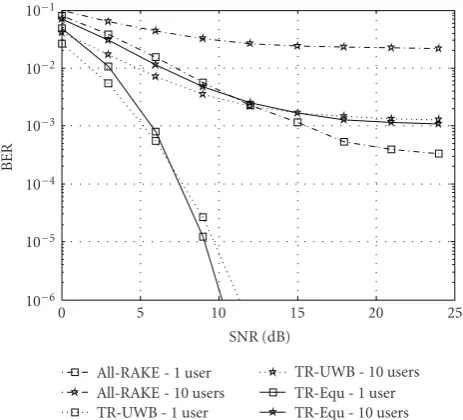
All-RAKE - 1 user All-RAKE - 10 users TR-UWB - 1 user
TR-UWB - 10 users TR-Equ - 1 user TR-Equ - 10 users
Figure12: BER curves for 1-user and 10-user cases with linear con-gruence coding at 30 Mbit/s,Ns=5.
1 2 3 4 5 6 7 8 9 10 0
0.5 1 1.5 2 2.5 3 3.5 4
×10−3
Number of users
BER
Figure13: BER versus number of users at 12 dB, 30 Mbit/s,Ns=5.
minimum error rates. Due to MUI being dominant relative to ISI in the scenarios tested, there is a closer correspondence between All-RAKE and TR-UWB error rates than in a single user system, with errors due to ISI effects only.
Figures10and11also illustrate an interesting property about the variance between user performance in transmit-ter and receiver side equalisation types. While achieving rel-atively better performance, TR-UWB exhibits severe varia-tions in the error probabilities between users. On the con-trary, All-RAKE based UWB has a much fairer error distribu-tion, although all users having relatively worse performance than a time reversed system.
In order to examine the performance of this system with varied hopping schemes, “linear congruence” hopping codes were also tested. Results for 1 and 10 user tests, at a data rate of 30 Mbit/s andNs=5, are shown inFigure 12. The
equiv-alence between the formulated and simulated results can be seen. While the maximum and minimum error rates for the 10-user case are not shown, an alignment with the average BER is apparent. The prevailing difference in performance between All-RAKE and TR-UWB is once again evident.
Figure 13indicates the effects of MUI on the expected performance of a time reversed system at 30 Mbit/s,Ns=5,
with a signal-to-noise ratio of 12 dB. The addition of each user results in an increase in the level of MUI present, fol-lowing a near exponential rise in the error rate. Although a time-reversed system does have the benefit of mitigating ISI, further measures are required to reduce the degrading effects of interfering users.
5. CONCLUSIONS
While a TR-UWB system does require increased processing at the transmitter side, it removes much of the burden from the receiver, and allows more robust operation in the pres-ence of ISI. While this may only be a shift of requirement in a single-transmitter single-receiver system, it has signifi-cant benefits in single-transmitter multiple-receiver circum-stances, such as cluster-based wireless actuator networks.
Through simulation, it was determined that derived equations for the variance of ISI and MUI closely follow expected results. Variance formulae take into consideration separation between user transmissions, together with chip separation probabilities, for both signal degradations. The capabilities of TR-UWB in mitigating ISI to a certain degree were shown, although exhibiting larger variance between user error performances in a multiuser case when compared to a system using an All-RAKE receiver.
Future work that can be conducted in this area includes independent transmitter-based time filtration to decrease the effect of multiuser interference on system performance. Also, a study into the validity of the Gaussian approximation as-sumed for varied system parameters, and the possibility of time-hopping code design based upon chip separation prob-ability analysis, can be envisaged.
REFERENCES
[1] FCC News, “New Public Safety Applications and Broadband Internet Access among uses Envisioned by FCC Authorization of Ultra-Wideband Technology,” Unofficial Announcement of Commission action, February 2002.
[2] FCC Document 00-163, “Revision of Part 15 of the Com-mission’s Rules Regarding Ultra-Wideband Transmission Sys-tems,” April 2002, ET Docket No. 98-153.
[3] S. Lemon, “Standards deadlock hits UWB—the market will have to decide,” IDG News Service, May 2005 http://www .techworld.com/applications/news/index.cfm?NewsID=3674. [4] S. Deffree, “No standard for ultra wideband comms,” January
[5] G. F. Edelmann, T. Akal, W. S. Hodgkiss, S. Kim, W. A. Kuper-man, and H. C. Song, “An initial demonstration of underwater acoustic communication using time reversal,”IEEE Journal of Oceanic Engineering, vol. 27, no. 3, pp. 602–609, 2002. [6] K. Usuda, H. Zhang, and M. Nakagawa, “Pre-Rake
perfor-mance for pulse based UWB system in a standardized UWB short-range channel,” inProceedings of IEEE Wireless Commu-nications and Networking Conference (WCNC ’04), vol. 2, pp. 920–925, Atlanta, Ga, USA, March 2004.
[7] S. M. Emami, J. Hansen, A. D. Kim, et al., “Predicted Time Re-versal Performance in Wireless Communications Using Chan-nel Measurements,” IEEE COMLET, 2002,http://www.nari.ee .ethz.ch/commth/pubs/files/TRComLet.pdf.
[8] R. C. Qiu, H. Liu, and X. Shen, “Ultra-wideband for multi-ple access communications,”IEEE Communications Magazine, vol. 43, no. 2, pp. 80–87, 2005.
[9] T. Strohmer, M. Emami, J. Hansen, G. Papanicolaou, and A. J. Paulraj, “Application of time-reversal with MMSE equal-izer to UWB communications,” inProceedings of IEEE Global Telecommunications Conference (GLOBECOM ’04), vol. 5, pp. 3123–3127, Dallas, Tex, USA, November-December 2004. [10] M. Fink, “Time-reversed acoustics,” Scientific American,
vol. 281, pp. 91–97, 1999.
[11] G. Yue, L. Ge, and S. Li, “Performance of UWB time-hopping spread-spectrum impulse radio in multipath environments,” inProceedings of the 57th IEEE Semiannual Vehicular Technol-ogy Conference (VTC ’03), vol. 3, pp. 1644–1648, Jeju, Korea, April 2003.
[12] J. Foerster, “Channel modelling sub-committee report final,” Report IEEE 802.15.SG3a, IEEE, New York, NY, USA, Decem-ber 2002.
[13] M. Chen and X. Li, “Transmitter-based channel equalization and MUI suppression for UWB systems,” inProceedings of the International Conference on Modern Problems of Radio En-gineering, Telecommunications and Computer Science (TCSET ’04), pp. 501–504, Lviv-Slavsko, Ukraine, February 2004. [14] A. E. Akogun, R. C. Qiu, and N. Guo, “Demonstrating time
re-versal in ultra-wideband communications using time domain measurements,” inProceedings of the 51st International Instru-mentation Symposium, pp. 737–742, Knoxville, Tenn, USA, May 2005.
[15] A. Derode, A. Tourin, and M. Fink, “Random multiple scatter-ing of ultrasound. II. Is time reversal a self-averagscatter-ing process?” Physical Review E, vol. 64, no. 3, Article ID 036606, 13 pages, 2001.
[16] S. Zhao and H. Liu, “Prerake diversity combining for pulsed UWB systems considering realistic channels with pulse over-lapping and narrow-band interference,” in Proceedings of IEEE Global Telecommunications Conference (GLOBECOM ’05), vol. 6, pp. 3784–3788, St. Louis, Mo, USA, November-December 2005.
[17] M. Z. Win and Z. A. Kostic, “Virtual path analysis of selective Rake receiver in dense multipath channels,”IEEE Communi-cations Letters, vol. 3, no. 11, pp. 308–310, 1999.
[18] ETH Zurich, “BTnodes—A Distributed Environment for Prototyping Ad Hoc Networks,” 2005, http://www.btnode .ethz.ch/.
[19] Intel Corporation, “Intel Mote 2 Overview,” 2005,http://www .intel.com/research/downloads/imote overview.pdf.
[20] M. Z. Win and R. A. Scholtz, “On the energy capture of ul-trawide bandwidth signals in dense multipath environments,” IEEE Communications Letters, vol. 2, no. 9, pp. 245–247, 1998. [21] T. Strohmer, M. Emami, J. Hansen, G. Papanicolaou, and A. J. Paulraj, “Application of time-reversal with MMSE
equal-izer to UWB communications,” inProceedings of IEEE Global Telecommunications Conference (GLOBECOM ’04), vol. 5, pp. 3123–3127, Dallas, Tex, USA, November-December 2004. [22] A. G. Klein and C. R. Johnson Jr., “MMSE decision
feed-back equalization of pulse position modulated signals,” in Pro-ceedings of IEEE International Conference on Communications (ICC ’04), vol. 5, pp. 2648–2652, Paris, France, June 2004. [23] T. Erseghe, “Time-hopping patterns derived from
permuta-tion sequences for ultra-wide-band impulse-radio applica-tions,” inProceedings of the 6th WSEAS International Confer-ence on Communications, vol. 1, no. 1, pp. 109–115, Crete, Greece, July 2002.
[24] A. Swami, B. Sadler, and J. Turner, “On the coexistence of ultra-wideband and narrowband radio systems,” in Proceed-ings of IEEE Military Communications Conference on Commu-nications for Network-Centric Operations: Creating the Infor-mation Force (MILCOM ’01), vol. 1, pp. 16–19, McLean, Va, USA, October 2001.
[25] N. Guo, R. C. Qiu, and B. M. Sadler, “An ultra-wideband au-tocorrelation demodulation scheme with low-complexity time reversal enhancement,” inProceedings of IEEE Military Com-munications Conference (MILCOM ’05), vol. 5, pp. 3066–3072, Atlantic City, NJ, USA, October 2005.
[26] C. A. Balanis,Antenna Theory: Analysis and Design, John Wiley & Sons, New York, NY, USA, 2nd edition, 1997.
[27] A. Derode, A. Tourin, J. de Rosny, M. Tanter, S. Yon, and M. Fink, “Taking advantage of multiple scattering to commu-nicate with time-reversal antennas,”Physical Review Letters, vol. 90, no. 1, Article ID 014301, 4 pages, 2003.
[28] R. M. Mersereau and T. S. Seay, “Multiple access frequency hopping patterns with low ambiguity,”IEEE Transactions on Aerospace and Electronic Systems, vol. 17, no. 4, pp. 571–578, 1981.
[29] A. V. Jovancevic and E. L. Titlebaum, “New coding schemes for increased number of users or messages in frequency-hopped multilevel FSK,” inProceedings of the 46th IEEE Vehicular Tech-nology Conference (VTC ’96), ‘Mobile TechTech-nology for the Hu-man Race’, vol. 3, pp. 1732–1735, Atlanta, Ga, USA, April-May 1996.
[30] K. Popovski, B. J. Wysocki, and T. A. Wysocki, “Performance comparison of UWB hopping codes in a multi-user rich scat-tering environment,” inProceedings of the 63rd IEEE Vehicular Technology Conference (VTC ’06), vol. 4, pp. 1864–1868, Mel-bourne, Australia, May 2006.
[31] J. G. Proakis and M. Salehi, Communication Systems Engi-neering, chapter 7, Prentice-Hall, Englewood Cliffs, NJ, USA, 2nd edition, 2002.
[32] M-.G. Di Benedetto and G. Giancola, Understanding Ultra Wide Band Radio Fundamentals, Prentice-Hall Professional Technical Reference, Englewood Cliffs, NJ, USA, 2004. [33] M.-G. Di Benedetto, “MAC for UWB,” Networking with UWB