Feature-guided Neural Model Training for Supervised Document
Representation Learning
Aili Shen Bahar Salehi Jianzhong Qi Timothy Baldwin School of Computing and Information Systems
The University of Melbourne Victoria, Australia
[email protected] [email protected] [email protected] [email protected]
Abstract
With the advent of neural models, there has been a rapid move away from feature engineer-ing, or at best, simplistically combining hand-crafted features with learned representations as side information. We propose a method that uses hand-crafted features to guide learn-ing by explicitly attendlearn-ing to feature indica-tors when learning the relationship between the input and target variables. In experiments over two different tasks — quality assessment of Wikipedia articles and popularity predic-tion of online petipredic-tions— we demonstrate that the proposed method yields neural models that consistently outperform those that simply use hand-crafted features as side information.
1 Introduction and Background
Text classification/regression is a fundamental problem in natural language processing. Tradi-tional methods make use of hand-crafted features, such as the length of a document, to represent a document. A classifier/regressor is built on top of such features to learn a model (Wang and Man-ning, 2012; Warncke-Wang et al., 2013, 2015; Dang and Ignat, 2016). Recently, neural mod-els such as LSTMs (Hochreiter and Schmidhuber, 1997) and convolutional neural networks (CNNs: Kim(2014);Kalchbrenner et al.(2014)) have be-come the de facto for text classification/regression tasks, with one oft-cited advantage being that they are able to learn implicit features as part of the rep-resentation learning.
Studies employing neural models either eschew crafted features or simplistically use hand-crafted features as side information. For example, Dang and Ignat (2017) propose to use a bidirec-tional LSTM (“bi-LSTM”) to classify Wikipedia articles by their quality classes, and Shen et al. (2017) concatenate structural features (e.g., arti-cle length) and readability scores with
bi-LSTM-learned document representations for the same task. Subramanian et al. (2018) hand-engineer a set of features (e.g., the ratio of indefinite and def-inite articles), and concatenate them with CNN-learned document representations to predict the popularity of online petitions. Wu et al. (2018) explore the utility of hand-crafted features in NER by concatenating these features with character rep-resentations learned via an CNN and word embed-dings. These representations are then fed into a bi-LSTM to identify named entities (with the help of a CRF) and re-construct the hand-crafted features in the output simultaneously, which is achieved by combining an auto-encoder loss with the NER loss.
The motivation underlying this work is that when hand-crafted features are represented by nu-merical vectors and concatenated with neural net-work representations, there is no information on what kind of feature each value represents. To make better use of hand-crafted features, we pro-pose a feature-guided neural training method that guides the network to map feature indicators onto (explicit or implicit) features in the document. We evaluate the effectiveness of the proposed method over two datasets for two different tasks: (1) qual-ity assessment of Wikipedia articles, and (2) pop-ularity prediction of online petitions. Taking state-of-the-art approaches for the respective tasks, we achieve consistent improvements when using our model.
the proxy of (potentially much higher-level) hand-crafted features to guide network learning; and (2) our method does not rely on the target variable be-ing closely related to the semantics of a document, leading to better generalisability.
2 Methodology
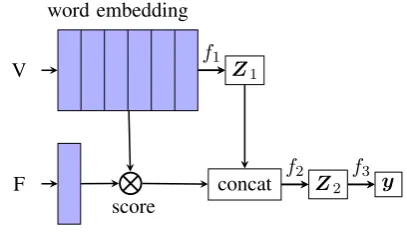
Figure 1 is an illustration of our proposed ap-proach, in the context of a stacked bi-LSTM, where two bi-LSTMs are applied to obtain the sentence and document level representations, re-spectively. Note that our method is not limited to LSTMs, as we show in Section3.
A hand-crafted feature can consist of multiple feature indicators. For example, having level 3+ headings is one of the features in quality assess-ment of Wikipedia articles. This hand-crafted fea-ture consists of two feafea-ture indicators (tokens) {“===”, “====”}. We embed the document and feature indicators into a shared space. Then, as indicated in Figure 1, for each feature indicator, we compute cosine similarity between the fea-ture indicator and word embeddings, followed by average-pooling to obtain a sentence score:
score= 1 N
N
X
j=1
FVj
kFk2kVjk2
. (1)
Here, F and Vj are embeddings of the feature
indicator and thejth word in a sentence, respec-tively;kFk2andkVjk2are the`2norms ofFand Vj, respectively; and N is the number of words
in a sentence. All scores based on the feature in-dicator are concatenated with sentence representa-tions Z1, which are learned through a bi-LSTM layer (f1). Then, another bi-LSTM layer (f2) is applied to the concatenated sentence representa-tions to obtain document representationZ2, which is followed by a dense layer (f3) to computey.
The score computed in Equation 1 is for a single-token feature indicator. If a hand-crafted feature consists of multiple feature indicators (to-kens, e.g.,{“===”, “====”}), the score becomes:
score= 1 M
M
X
i=1
1 N
N
X
j=1
FiVj
kFik2kVjk2
. (2)
Here, M is the number of feature indicators in a hand-crafted feature, and Fi is the word
embed-ding of theith feature indicator in the feature. For example, the feature level 3+ headings is one of structural features described inShen et al.
word embedding
V
feature embedding F
score
Z1 f1
concat Z2 f2
y
f3
Figure 1: Illustration of our proposed method. Here,⊗ denotes cosine similarity between the feature indicator and word embeddings;f1andf2denote bi-LSTM lay-ers;f3denotes a dense layer;Z1andZ2denote sen-tence and document representations, respectively; V andF are the document input and feature indicators, respectively; andyis the target output.
(2017), which consists of two feature indicators {“===”, “====”}. To obtain the similarity score for the featurelevel 3+ headings, we first compute the similarity score between each feature indica-tor “===”/“====” and word embeddings in the sentence, then apply average-pooling to obtain the similarity score for each feature indicator. We ob-tain the similarity score oflevel 3+ headings by averaging similarity scores among the feature in-dicators at the sentence level. Finally, the feature score is concatenated with the sentence represen-tation, which is fed into a latter layer.
While we don’t experiment with this in this pa-per, it is also possible to first average feature indi-cator embeddings and then compute the sentence score by Equation1. This way, we can efficiently reduce the computation of similarity scores for hand-crafted features with a large number of fea-ture indicators. In this paper, we use Equation2, as the maximum number of feature indicators in a given hand-crated feature is less than1,000, and less than10in most cases.
3 Experiments
[image:2.595.319.523.66.182.2]strong neural benchmarks have been established, based on extensive experimentation with both neu-ral and non-neuneu-ral models. Our experiments in this paper are based on the state-of-the-art.
We aim to explore the relative gains of our pro-posed method relative to the current state-of-the-art for the task, which in both cases is not based on contextualised embeddings. For BERT (Devlin et al.,2019) or other contextualised encoders, the same word in different contexts will end with dif-ferent embeddings, leading to localized represen-tations of feature indicators. As such, the proposed method is not directly applicable to models such as BERT, and novel research would be required to adapt the method to such models.
3.1 Wikipedia Document Quality Assessment
Dataset The Wikipedia dataset (Shen et al., 2019) consists of 29,794 English Wikipedia arti-cles and their corresponding quality labels: Fea-tured Article, Good Article, B-class Article, C-class Article, Start Article, and Stub Article, in de-scending order of document quality. The dataset is class-balanced and partitioned into training, devel-opment, and test splits (8:1:1). Documents are rel-atively long, and processed in a hierarchical man-ner, by constructing sentence representations, and composing these into a document representation.
Following Dang and Ignat (2017) and Shen et al.(2019), we formulate the quality assessment of Wikipedia articles as a multi-class classification problem, and all models are trained to minimise cross-entropy loss. We report averageaccuracy
and standard deviation over 10 runs.
Hand-crafted features used to guide network learning here include: (1) references indicators; (2) links to other Wikipedia pages indicators; (3) citation templates indicators; (4) non-citation templates indicators; (5) categories linked in the article indicators; (6) image indicators; (7) in-fobox indicators; (8) level 2 headings indica-tors; and (9) level 3+ heading indicators. These features are from Dang and Ignat (2016) and Shen et al. (2017). Hand-crafted features in
Side-informationare based on counting the number of appearances of such feature indicators.
Model configuration We apply our proposed approach (“Feature-guided”) over the four models detailed below. In each case, we contrast with two baselines: (1) Vanilla, makes no use of hand-crafted features; and (2)
Side-information which uses the hand-crafted features as side information, by concate-nating them with learned representations in the penultimate layer.
1. CNN BILSTM: apply convolution kernels with width 2, 3, and 4 (32 for each width size) to word embeddings within a sentence, and a tanhactivation function to each; pass the output of the filters through a bi-LSTM.
2. AVERAGE BILSTM (Shen et al.,2017): av-erage word embeddings to get the sentence representation, and run a bi-LSTM over the sequence of sentence representations.
3. STACKED BILSTM: feed the word embed-dings in a sentence through a bi-LSTM, and the output through a max-pooling layer; fi-nally, apply another bi-LSTM over the sen-tence representations.
4. STACKED BILSTM ATT(Yang et al.,2016): use a hierarchical STACKED BILSTM, ex-cept that an attention mechanism with a con-text size of 100 is applied to the output of each bi-LSTM to weight words/sentences based on their importance in the sen-tence/document.
A max-pooling layer is applied to the output of the bi-LSTM at the sentence level for all models except STACKED BILSTM ATT to get the docu-ment level representation, which is followed by two dense layers, one with a ReLU activation and one without any activation function. For all models, dropout layers are applied at both the sentence and document levels with a rate of 0.5 during training. For both CNN BILSTM and AVERAGE BILSTM, the bi-LSTM cell size is set to 256. For STACKED BILSTM and STACKED BILSTM ATT, the cell size is set to 32 and 256 for the sentence and document level bi-LSTM, respectively.
We use 50-dimensional pre-trained word em-beddings from GloVe (Pennington et al.,2014).1 For OOV words, the word embeddings are ran-domly initialised based on sampling from a uni-form distributionU(−1,1). All word embeddings
1
We fine-tuned hyper-parameters over the development set for quality predictions of Wikipedia articles. 50-dimensional embeddings were chosen because Vanilla
Model CNN BILSTM AVERAGE BILSTM STACKED BILSTM STACKED BILSTM ATT
Vanilla 57.12±0.58% 57.91±0.81% 57.60±0.65% 56.70±1.21%
Side-information 57.24±0.47% 59.04±0.33% 57.97±0.74% 57.44±0.62%
[image:4.595.321.513.174.241.2]Feature-guided 58.10±0.50%† 59.90±0.45%† 58.30±0.71% 58.30±0.65%†
Table 1:accuracyover Wikipedia dataset. The best result is inbold, and marked with “†” if the improvement is statistically significant (based on a one-tailed Wilcoxon signed-rank test;p <0.05).
are updated in the training process. We use a mini-batch size of 128 and a learning rate of 0.01. We train each model for 50 epochs. To prevent over-fitting, early stopping is adopted. All hyper-parameters are set empirically over the develop-ment data, and the models are optimised using Adam (Kingma and Ba,2015).
Results The experimental results are pre-sented in Table 1. We can see that our method outperforms both Vanilla and
Side-information across all four network architectures, at a level of statistical significance for 3 out of the 4 models. It is worth noting that the performance of STACKED BILSTM ATT is worse than that of STACKED BILSTM for both
Vanilla and Side-information, due to attention in STACKED BILSTM ATTnot being as effective as max-pooling on this task. However, the performance of STACKED BILSTM ATT is not worsened by incorporating the attention for our method, indicating that our feature-guided learning can guide the network to learn better.
3.2 Online Petition Signature Prediction
Dataset The online petitions dataset (Subrama-nian et al.,2018) consists of 10,950 UK petitions and their corresponding signature counts. Follow-ingSubramanian et al.(2018), we chronologically split the data into training, dev, and test (8:1:1).
We formulate signature count prediction as a regression problem, and all models are trained to minimise mean squared error. For evalua-tion, average mean absolute error (“MAE”) and mean absolute percentage error (“MAPE”) over 10 runs are reported. Here, MAPE is calculated as
100
n
Pn 1
|yˆi−yi|
yi , whereyˆiandyi are the predicted
and ground-truth signature counts.
Hand-crafted features used to guide network learning here include: (1) indefinite vs. definite articles; (2) P1 singular and plural, P2, and P3 singular and plural pronouns; (3) subjective, pos-itive, and negative words; and (4) biased words. These features are fromSubramanian et al.(2018).
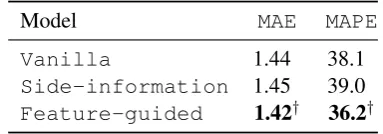
Model MAE MAPE
Vanilla 1.44 38.1
Side-information 1.45 39.0
Feature-guided 1.42† 36.2†
Table 2: Results over online petitions. The best result is indicated inbold, and marked with “†” if the improve-ment is statistically significant (based on a one-tailed Wilcoxon signed-rank test;p <0.05).
Hand-crafted features in Side-information
are based on counting the number of appearances of such feature words.
Model configuration We again compare our proposed Feature-guided approach with
Side-information and Vanilla, in the form of a state-of-the-art CNN with convolution kernels of width 1, 2, and 3 (100 kernels for each width size) over word embeddings, with a ReLU applied to each. The outputs are passed through two dense layers, one with atanhactivation func-tion and one with an ELU activafunc-tion funcfunc-tion, to obtain the final output.
A dropout layer is applied to the output of the convolution filters at a rate of 0.5 during training. We use a mini-batch size of 32, and a learning rate of1e−4. All other hyper-parameters are the same as in the Wikipedia setting, except that the early stopping is based onMAE.
Results Table2summarises our results. We ob-serve that our approach benefits Vanilla and
4 Conclusion and Future Work
We proposed a method to guide network learning by attending to feature indicators associated with hand-crafted features. Experimental results over two tasks (quality assessment of Wikipedia arti-cles, and popularity prediction of online petitions) show that our approach consistently outperforms two baselines, across a range of neural architec-tures. For future work, we are interested in explor-ing hand-crafted features from external sources, such as editor comments of a Wikipedia article.
References
Quang-Vinh Dang and Claudia-Lavinia Ignat. 2016. Measuring quality of collaboratively edited docu-ments: the case of Wikipedia. In Proceedings of the 2nd IEEE International Conference on Collabo-ration and Internet Computing, pages 266–275.
Quang Vinh Dang and Claudia-Lavinia Ignat. 2017. An end-to-end learning solution for assessing the quality of Wikipedia articles. InProceedings of the 13th International Symposium on Open Collabora-tion, pages 4:1–4:10.
Jacob Devlin, Ming-Wei Chang, Kenton Lee, and Kristina Toutanova. 2019. BERT: Pre-training of deep bidirectional transformers for language under-standing. InProceedings of the 2019 Conference of the North American Chapter of the Association for Computational Linguistics: Human Language Tech-nologies, (NAACL-HLT 2019), pages 4171–4186.
Sepp Hochreiter and J¨urgen Schmidhuber. 1997. Long short-term memory. Neural Computation, 9(8):1735–1780.
Nal Kalchbrenner, Edward Grefenstette, and Phil Blun-som. 2014. A convolutional neural network for modelling sentences. In Proceedings of the 52nd Annual Meeting of the Association for Computa-tional Linguistics (ACL 2014), pages 655–665.
Yoon Kim. 2014. Convolutional neural networks for sentence classification. In Proceedings of the 2014 Conference on Empirical Methods in Natural Language Processing (EMNLP 2014), pages 1746– 1751.
Diederik P. Kingma and Jimmy Ba. 2015. Adam: A method for stochastic optimization. In The 3rd International Conference on Learning Representa-tions, (ICLR 2015).
Jeffrey Pennington, Richard Socher, and Christo-pher D. Manning. 2014. GloVe: Global vectors for word representation. In Proceedings of the 2014 Conference on Empirical Methods in Natural Language Processing (EMNLP 2018), pages 1532– 1543.
Aili Shen, Jianzhong Qi, and Timothy Baldwin. 2017. A hybrid model for quality assessment of Wikipedia articles. In Proceedings of the Australasian Lan-guage Technology Association Workshop, pages 43– 52.
Aili Shen, Bahar Salehi, Timothy Baldwin, and Jianzhong Qi. 2019. A joint model for multimodal document quality assessment. InProceedings of the 19th ACM/IEEE-CS on Joint Conference on Digital Libraries (JCDL 2019), pages 107–110.
Shivashankar Subramanian, Timothy Baldwin, and Trevor Cohn. 2018. Content-based popularity pre-diction of online petitions using a deep regression model. In Proceedings of the 56th Annual Meet-ing of the Association for Computational LMeet-inguis- Linguis-tics, (ACL 2018), pages 182–188.
Guoyin Wang, Chunyuan Li, Wenlin Wang, Yizhe Zhang, Dinghan Shen, Xinyuan Zhang, Ricardo Henao, and Lawrence Carin. 2018. Joint embedding of words and labels for text classification. In Pro-ceedings of the 56th Annual Meeting of the Asso-ciation for Computational Linguistics (ACL 2018), pages 2321–2331.
Sida I. Wang and Christopher D. Manning. 2012. Base-lines and bigrams: Simple, good sentiment and topic classification. In Proceedings of the 50th Annual Meeting of the Association for Computational Lin-guistics (ACL 2012), pages 90–94.
Morten Warncke-Wang, Vladislav R. Ayukaev, Brent Hecht, and Loren Terveen. 2015. The success and failure of quality improvement projects in peer pro-duction communities. In Proceedings of the 18th ACM Conference on Computer-Supported Coopera-tive Work and Social Computing, pages 743–756.
Morten Warncke-Wang, Dan Cosley, and John Riedl. 2013. Tell me more: An actionable quality model for Wikipedia. In Proceedings of the 9th Inter-national Symposium on Open Collaboration, pages 8:1–8:10.
Minghao Wu, Fei Liu, and Trevor Cohn. 2018. Evalu-ating the utility of hand-crafted features in sequence labelling. InProceedings of the 2014 Conference on Empirical Methods in Natural Language Processing (EMNLP 2018), page 28502856.