On Scrambling, Another Perspective
James Rogers
Dept. of Computer Science
Earlham College
Richmond, IN USA
[email protected]
Abstract
We explore the possibility of accounting for scrambling patterns in German using multi-dimensional grammars. The primary desir-able characteristic of this approach is that it employs elementary structures with a single uniform component and combining operations which operate at a single point in the derived structure. As a result, we obtain an analysis that is much closer in spirit to ordinary TAG and to the intuitions of TAG based linguistics. Ultimately, we obtain an account in which the variations in word order are consequences of variations of a small set of structural parame-ters throughout their ranges.
1
Introduction
The difficulty of accounting for the phenomenon of scrambling, the apparently arbitrary order in which ar-guments can occur in subordinate clauses in German, has been one of the primary motivations for exploration of ex-tensions to TAG (Rambow, 1994; Kulick, 2000; Rambow et al., 1995; Rambow et al., 2001; Becker et al., 1991). The issue is not generation of the string sets—in most ac-counts these are actually context-free—but rather doing so within a derivational framework in which lexical heads and their arguments are introduced simultaneously. This idea that elementary structures should include all and only a single thematic domain (Frank, 2002) is generally taken to be the foundation of TAG based linguistic theo-ries. Among other things, it insures that every elemen-tary structure is semantically coherent and that deriva-tions maintain that coherence. Under these assumpderiva-tions, it has been shown that scrambling is beyond the gener-ative power of ordinary TAG and, in full generality, be-yond even set-local multicomponent TAG (Becker et al., 1992).
Generally, extensions to TAG intended to accom-modate scrambling involve factorization of elementary
structures either into tree sets or into trees with more or less independent regions accompanied by a modification of the combining operation to interleave these regions in the derived tree. In this paper, following the lead of our exploration of similar issues in TAG accounts of English raising phenomena (Rogers, 2002), we explore one il-lustrative pattern of scrambling using multi-dimensional
grammars (Rogers, 2003). The primary desirable
char-acteristic of this approach is that it employs elementary structures with a single uniform component and combin-ing operations which operate at a scombin-ingle point in the de-rived structure. As a result, we obtain an analysis that is much closer in spirit to ordinary TAG and to the intu-itions of TAG based linguistics. Ultimately, we obtain an account in which the variations in word order are conse-quences of variations of a small set of structural parame-ters throughout their ranges.
We should be clear at the outset that even though our primary motivation is a desire to preserve the fundamen-tal tenets of standard TAG theories of syntax, our goal is not a linguistically complete account of scrambling, or even one that is linguistically motivated beyond the goal of maintaining semantically coherent elementary struc-tures and derivations. Rather, we intend to show how the formal power of the multi-dimensional grammars can, potentially, support such an account. We look only at one particular case of scrambling, but we believe that this case illustrates the relevant formal issues. These results suggest that scrambling phenomena of any concrete de-gree of complexity can be handled at some level of the multi-dimensional grammar hierarchy. We close the pa-per with some speculation about what such a result might have to say about the nature of limits on the acceptability of scrambling as its complexity increases.
2
A Formalized Instance of Scrambling
NP
Figure 1: Class A) NP
S with that embedded S headed by a verb that subcatego-rizes for three NPs, one of which is a PRO subject. This formalizes as
a permutation
where NP
and NP
are the first and second argument of the matrix verb and NP
and NP
are the arguments, other than PRO, of the embedded clause.
There are 24 permutations of the four NP arguments. We divide these into six classes (where
and
each vary over 1,2):
A) NP
3
Class A)—CF Structures
Class A) is the canonical structure with, potentially, the arguments extracted within their own clauses. Standard TAG accounts treat the matrix clause as an auxiliary tree adjoining at the root of the embedded clause. Follow-ing Rogers (1998) and Rogers (1999) we interpret TAG as a sort of Context-Free Grammar over trees. Just as
CFG productions can be interpreted as local (height one) trees expanding a root node to a string yield with the derivation process splicing these together to form deriva-tion trees, TAG auxiliary trees can be interpreted as local three-dimensional structures expanding a root node to a tree yield with the TAG derivation process splicing these together to form three-dimensional derivation structures.
These derivation structures correspond exactly to the derivation trees normally associated with TAG, with the exception that the derived structure (in this case a tree) can be obtained from it by restricting to nodes of max-imal depth (in the third dimension) in a way analogous to taking the string yield of a CFG derivation tree. The intuition behind these structures is that TAG expresses a hierarchical decomposition of trees analogous to the hi-erarchical decomposition of strings that those trees repre-sent.
“tree-NP
Figure 2: Class B) NP
Figure 3: Class C) NP
like” and descendants of a node along a given dimension inherit the relationships of that node in all smaller dimen-sions in the same way that linear precedence is inherited by the nodes in a subtree. (See Rogers (2003).)
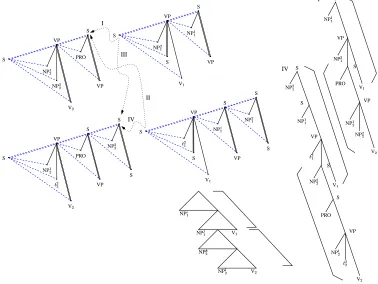
Here, the adjunction of the matrix tree at the root of the embedded tree attaches the root of the three dimen-sional structure representing the former at the S node in the (tree) yield of the latter. (See Figure 1.) The up-per pair of structures represent the base structures, the lower pair the structures with a locally extracted argu-ment. Each of the four variations of Class A) is obtained from one of the four combinations of these four struc-tures. We have followed Rogers (2002) in treating the subject as if it were adjoined, in some sense, at the root of the VP. This is done, here, for purely formal reasons—it will provide the structural flexibility we will need to de-rive the more complex scrambling patterns. We carry this structural configuration through in treating extraction; we assume that extracted arguments attach in a similar fash-ion to the root of the S.
Note that there is potential ambiguity in taking the tree yield of these structures in that the yield of one compo-nent might attach at any of the leaves of the yield of the component which immediately dominates it. In TAG, of course, this is resolved by designating one of the leaves as the foot with all splicing being done at the foot. Here we designate the foot by marking the spine of the compo-nents with doubled lines. We carry this through in higher dimensions, as well; each elementary structure, in each dimension, has a spine leading from its root to a foot node in its yield. Two of the four resulting tree yields are shown on right of the figure.
Since adjunction at the root has the same effect as substitution, this is effectively a context-free structure. As shown schematically in the figure, the (two dimen-sional) yields of the two structures are simply concate-nated. Note that, as in the standard TAG accounts, addi-tional recursion is accommodated by adjoining addiaddi-tional subordinating structures at the root of what is here the matrix structure.
4
Classes B) and C)—Ordinary
Adjunction
In Classes B) and C), the arguments of V are wrapped around those of V
, as shown at the bottom of Figures 2 and 3. This is the pattern corresponding to adjunction proper. Class B) can be obtained by extracting either NP
, NP
then adjoining the matrix structure at the foot of the yield of the extracted NP structure (the point be-tween the extracted element and the original S node). As usual, this has the effect of splitting the tree yields of the subordinate structure into two factors and inserting the tree yield of the matrix structure between them. Note
that all that distinguishes this class from Class A) is the third-dimensional foot node of the embedded structure, which is, itself, determined by the form of the extracted NP structure.
Class C) is nearly identical. We extract both of the arguments of V and adjoin, again, at the point between the extracted elements and the original S node.
Note that in both these cases, the scrambling can apply recursively by attaching additional auxiliary structures at the tree yield of the first. If this is attached at the node corresponding to the root of the yield of that structure, in the manner of Class A), the effect is only to move the arguments scrambled out of the more deeply embedded clauses across the new clause. If, on the other hand, it is attached at the foot of the yield of the extracted NP structure, in the manner of Classes B) and C), then the effect will be to scramble additional arguments out of the intermediate clause.
5
Class D)—Higher-Order Adjunction
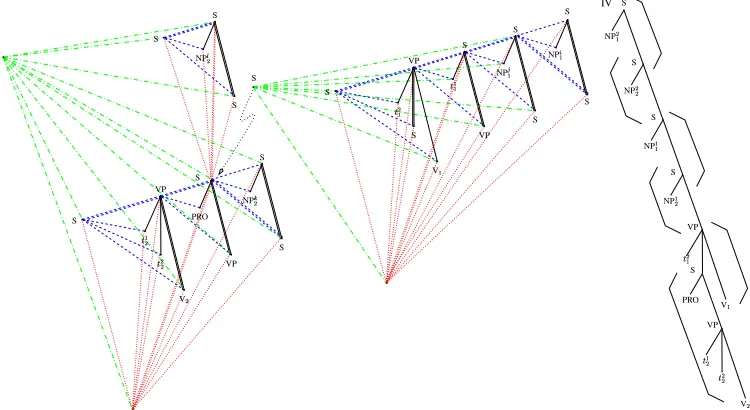
Class D) is the first of the configurations that cannot be obtained by ordinary adjunction. Here the arguments of V
and V
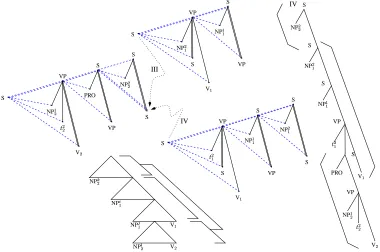
don’t simply nest one inside the other, but, rather interleave in the way shown schematically on the top left of Figure 4. Since the sequences of labels along the spines of TAG tree sets must form CF languages, such “cross-serial” configurations cannot be generated by TAGs. They can, however, be generated if we add an-other level of hierarchical decomposition. Grammars at this level yield tree sets with TAL spine languages (cor-responding to the third level of Weir’s Control Language Hierarchy (Weir, 1992)). A schematic representation of the general embedding pattern provided at this level is given in Figure 5.
To employ this nesting pattern we adopt four-dimensional structures and take the matrix structure to, again, attach between the extracted structure and the orig-inal S, but now along the fourth dimension. (Figure 4.) This has the result of splitting the three-dimensional yield of the embedded structure into two factors and inserting the three-dimensional yield of the matrix structure be-tween them. Given the third-dimensional foot of the ma-trix structure, the “upper” factor of the embedded struc-ture is, effectively, adjoined between the two arguments of the matrix structure which is, in turn adjoined at the root of the “lower” factor. (As shown at the bottom of the figure.) The effect on the tree yield is exactly as if the (two-dimensional) matrix tree had been factored into two components, one adjoining at the root of the embedded tree and one properly along its spine. (As shown at the right.)
NP V
Figure 5: -level nesting
1:
Figure 7: Class E) NP
the point at which it attaches to the embedded structure. (See Figure 6.)
6
Classes E) and F) and a Unified Account
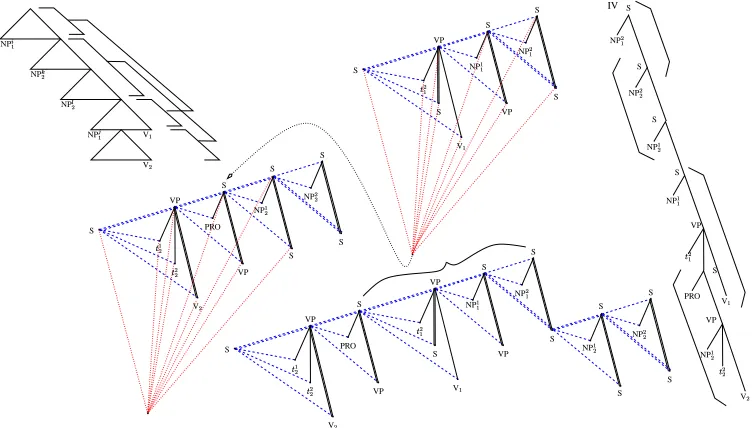
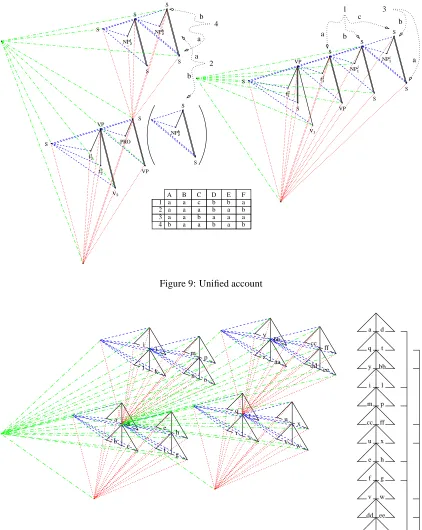
The nesting pattern of Class E) (Figure 7) requires the embedded tree to be factored into three components, not just two. This can still be obtained with multi-component adjoining in a manner similar to that of Class D), with both components of the matrix structure adjoining prop-erly along the spine of the embedded tree. While this pattern is also obtainable in the four-dimensional gram-mars, it necessarily uses the upper half of the VP compo-nent, which, for the sake of consistency, we would rather not do. Consequently, we again add another hierarchical relationship and lift to the fifth level, taking the two argu-ments of V
to be extracted via the fourth relation rather than the third. Class F) can be treated similarly, with the exception that one of the arguments is extracted along the third relation, the other along the fourth. (Figure 8.)
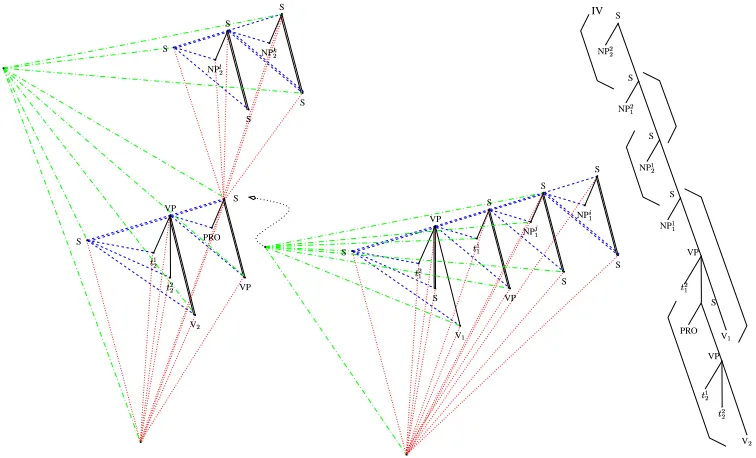
This variation between Classes E) and F) leads to an account in which all six classes are derivable within a single basic structure, shown in Figure 9. Here there are six parameters of variation:
1. The position of the fourth-dimensional foot of the matrix structure.
2. Whether one or both arguments of V
are extracted along the fourth relation.
3. and 4. The position of the three-dimensional feet of the matrix and embedded structures.
5. and 6. And, finally, the relative nesting of the ex-tracted NPs in each structure.
This gives 96 combinations but as the word-order vari-ations are exhaustive, they generate only the 24 distinct configurations of the six classes of structures.
7
Arbitrarily Complex Scrambling
While no level of the multi-dimensional grammar hierar-chy can capture scrambling of arbitrary complexity, there is no bound on the number of tree factors that can be interleaved at some level of this hierarchy. In general, grammars at the level factor the tree yields of the el-ementary structures into
fragments, with the tree yield of the result of adjoining one into another being split into
regions from the initial structure in-terleaved with
regions from the auxiliary structure. (Figure 10 gives the pattern for the fifth level.) Conse-quently, scrambling of any concrete degree of complexity can be captured at some level of the hierarchy, although it is not clear that this can necessarily be done in an plau-sibly “uncontrived” way.
S
given that the level of the grammar corresponds to the number of hierarchical relations we use in encoding the structure of the utterances, one could make a plausible argument that the level of the grammar might be deter-mined by performance considerations, such as working memory limitations. In this way one might arrive at an account of the limits on the complexity of scrambling that was simultaneously performance based—a conse-quence of bounds on working memory—and competence based—a consequence of the complexity of the grammars which can be processed within those bounds.
References
Tilman Becker, Aravind K. Joshi, and Owen Rambow. 1991. Long-distance scrambling and tree adjoining grammars. In Fifth Conference of the European
Chap-ter of the Association for Computational Linguistics (EACL'91), pages 21–26. ACL.
Tilman Becker, Owen Rambow, and Michael Niv. 1992. The derivational generative power of formal systems or scrambling is beyond LCFRS. Technical report, Insti-tute for Research in Cognitive Science, Univ. of Penn-sylvania, Philadelphia, PA.
Robert Frank. 2002. Phrase Structure Composition and
Syntactic Dependencies. MIT Press.
Aravind K. Joshi, Tilman Becker, and Owen Rambow. 2000. Complexity of scrambling: A new twist to the competence-performance distinction. In Anne Abeill´e and Owen Rambow, editors, Tree Adjoining
Gram-mars, chapter 6, pages 167–181. CSLI.
Seth Kulick. 2000. Constraining Non-Local
Dependen-cies in Tree Adjoining Grammar: Computational and
Linguistic Perspectives. Ph.D. thesis, Univ. of
Penn-sylvania.
Owen Rambow, K. Vijay-Shanker, and David Weir. 1995. D-tree grammars. In Proceedings of the
33rd Annual Meeting of the Association for Compu-tational Linguistics (ACL'95), pages 151–158,
Cam-bridge, MA.
Owen Rambow, K. Vijay-Shanker, and David Weir. 2001. D-tree substitution grammars. Computational
Linguistics, 27(1):87–121.
Owen Rambow. 1994. Formal and Computational
As-pects of Natural Language Syntax. Ph.D. thesis, Univ.
of Pennsylvania.
James Rogers. 1998. A descriptive characterization of tree-adjoining languages. In Proc. of the 17th
In-ternational Conference on Computational Linguistics (COLING'98) and the 36th Annual Meeting of the Association for Computational Linguistics (ACL'98),
Montreal. ACL. Project Note.
James Rogers. 1999. Generalized tree-adjoining gram-mar. In Sixth Meeting on Mathematics of Language, pages 189–202.
James Rogers. 2002. One more perspective on seman-tic relations in tag. In Proceedings of the Sixth
Inter-national Workshop on Tree Adjoining Grammars and Related Frameworks, Venice, IT, May.
James Rogers. 2003. wMSO theories as grammar for-malisms. Theoretical Computer Science, 293(2):291– 320.
b
Figure 9: Unified account
bb