Summarization of Noisy Documents: A Pilot Study
Hongyan Jing
IBM T.J. Watson Research Center
Yorktown Heights, NY
[email protected]
Daniel Lopresti
19 Elm Street
Hopewell, NJ
[email protected]
Chilin Shih
150 McMane Avenue
Berkeley Heights, NJ
[email protected]
Abstract
We investigate the problem of summarizing text documents that contain errors as a result of optical character recognition. Each stage in the process is tested, the error effects analyzed, and possible solutions suggested. Our experimental results show that current approaches, which are developed to deal with clean text, suffer signif-icant degradation even with slight increases in the noise level of a document. We conclude by proposing possible ways of improving the per-formance of noisy document summarization.
1
Introduction
Previous work in text summarization has focused pre-dominately on clean, well-formatted documents, i.e., documents that contain relatively few spelling and gram-matical errors, such as news articles or published tech-nical material. In this paper, we present a pilot study of noisy document summarization, motivated primarily by the impact of various kinds of physical degradation that pages may endure before they are scanned and processed using optical character recognition (OCR) software.
As more and more documents are now scanned in by OCR, an understanding of the impact of OCR on summarization is crucial and timely. The Mil-lion Book Project is one of the projects that uses OCR technology for digitizing books. Pioneered by researchers at Carnegie Mellon University, it aims to digitize a million books by 2005, by scanning the books and indexing their full text with OCR technology (http://www.archive.org/texts/millionbooks.php).
Understandably, summarizing documents that contain many errors is an extremely difficult task. In our study, we focus on analyzing how the quality of summaries is affected by the level of noise in the input document, and how each stage in summarization is impacted by the
noise. Based on our analysis, we suggest possible ways of improving the performance of automatic summarization systems for noisy documents. We hope to use what we have learned from this initial investigation to shed light on future directions.
What we ascertain from studying the problem of noisy document summarization can be useful in a number of other applications as well. Noisy documents constitute a significant percentage of documents we encounter in everyday life. The output from OCR and speech recogni-tion (ASR) systems typically contain various degrees of errors, and even purely electronic media, such as email, are not error-free. To summarize such documents, we need to develop techniques to deal with noise, in addi-tion to working on the core algorithms. Whether we can successfully handle noise will greatly influence the final quality of summaries of such documents.
Some researchers have studied problems relating to in-formation extraction from noisy sources. To date, this work has focused predominately on errors that arise dur-ing speech recognition, and on problems somewhat dif-ferent from summarization. For example, Gotoh and Renals propose a finite state modeling approach to ex-tract sentence boundary information from text and audio sources, using both n-gram and pause duration informa-tion (Gotoh and Renals, 2000). They found that precision and recall of over 70% could be achieved by combining both kinds of features. Palmer and Ostendorf describe an approach for improving named entity extraction by ex-plicitly modeling speech recognition errors through the use of statistics annotated with confidence scores (Palmer and Ostendorf, 2001). Hori and Furui summarize broad-cast news speech by extracting words from automatic transcripts using a word significance measure, a confi-dence score, linguistic likelihood, and a word concatena-tion probability (Hori and Furui, 2001).
papers by Taghva, et al. show that moderate error rates have little impact on the effectiveness of traditional infor-mation retrieval measures (Taghva et al., 1996a; Taghva et al., 1996b), but this conclusion does not seem to apply to the task of summarization. Miller, et al. study the per-formance of named entity extraction under a variety of scenarios involving both ASR and OCR output (Miller et al., 2000), although speech is their primary interest. They found that by training their system on both clean and noisy input material, performance degraded linearly as a function of word error rates. They also note in their pa-per: “To our knowledge, no other information extraction technology has been applied to OCR material” (pg. 322). An intriguing alternative to text-based summarization is Chen and Bloomberg’s approach to creating summaries without the need for optical character recognition (Chen and Bloomberg, 1998). Instead, they extract indicative summary sentences using purely image-based techniques and common document layout conventions. While this is effective when the final summary is to be viewed on-screen by the user, the issue of optical character recog-nition must ultimately be faced in most applications of interest (e.g., keyword-driven information retrieval).
For the work we present in this paper, we performed a small pilot study in which we selected a set of documents and created noisy versions of them. These were generated both by scanning real pages via OCR and by using a fil-ter we have developed that injects various levels of noise into an original source document. The clean and noisy documents were then piped through a summarization sys-tem. We tested different modules that are often included in such systems, including sentence boundary detection, part-of-speech tagging, syntactic parsing, extraction, and editing of extracted sentences. The experimental results show that these modules suffer significant degradation as the noise level in the document increases. We discuss the errors made at each stage and how they affect the quality of final summaries.
In Section 2, we describe our experiment, including the data creation process and various tests we performed. In Section 3, we analyze the results of the experiment and correlate the quality of summaries with noise levels in the input document and the errors made at different stages of the summarization process. We then discuss some of the challenges in summarizing noisy documents and suggest possible methods for improving the performance of noisy document summarization. We conclude with future work.
2
The Experiment
2.1 Data creation
We selected a small set of four documents to study in our experiment. Three of four documents were from the TREC corpus and one was from a Telecommunications
corpus we collected ourselves (Jing, 2001). All are pro-fessionally written news articles, each containing from 200 to 800 words (the shortest document was 9 sentences and the longest was 38 sentences).
For each document, we created 10 noisy versions. The first five corresponded to real pages that had been printed, possibly subjected to a degradation, scanned at 300 dpi using a UMAX Astra 1200S scanner, and then OCR’ed with Caere OmniPage Limited Edition. These included:
clean The page as printed.
fax A faxed version of the page.
dark An excessively dark (but legible) photocopy.
light An excessively light (but legible) photocopy.
skew The clean page skewed on the scanner glass.
Note that because the faxed and photocopied documents were processed by running them through automatic page feeders, these pages can also exhibit noticeable skew. The remaining five sample documents in each case were electronic copies of the original that had had synthetic noise (single-character deletions, insertions, and substi-tutions) randomly injected at predetermined rates: 5%, 10%, 15%, 20%, and 25%.
In general, we want to study both real and synthetic noise. The arguments in favor of the former are quite ob-vious. The arguments in favor of the latter is that it is easier to control synthetic noise effects, and often they have exactly the same impact on the overall process as real noise. Even though the errors may be artificial, the impact on later processes is probably the same. For ex-ample, changing ”nuclear” to ”nZclear” does not reflect a common OCR error. But it does have the same effect – changing a word in the dictionary to a word that is no longer recognized. If the impact is identical and it is eas-ier to control, then it is beneficial to use synthetic noise in addition to real noise.
A summary was created for each document by human experts. For the three documents from the TREC cor-pus, the summaries were generated by taking a majority opinion. Each document was given to five people who were asked to select 20% of the original sentences as the summary. Sentences selected by three or more of the five human subjects were included in the summary of the doc-ument. For the document from the Telecommunications corpus, an abstract of the document was provided by a staff writer from the news service. These human-created summaries are useful in evaluating the quality of the au-tomatic summaries.
2.2 Summarization stages
affects the quality of the summaries. Many summariza-tion approaches exist, and it would be difficult to study the effects of noise on all of them. However, the follow-ing stages are common to many summarization systems:
• Step 1: Tokenization. The main task here is to break the text into sentences. Tokens in the input text are also identified.
• Step 2: Preprocessing. This typically involves part-of-speech tagging and syntactic parsing. This step is
optional; some systems do not perform tagging and
parsing at all. Topic segmentation is deployed by some summarization systems, but not many.
• Step 3: Extraction. This is the main step in summa-rization, in which the automatic summarizer selects key sentences (sometimes paragraphs or phrases) to include in the summary.
• Step 4: Editing. Some systems post-edit the ex-tracted sentences to make them more coherent and concise.
For each stage, we selected one or two systems that perform the task and tested their performance on both clean and noisy documents.
• For tokenization, we tested two tokenizers: one is a rule-based system that decides sentence boundaries based on heuristic rules encoded in the program, and the other one is a trainable tokenizer that uses a deci-sion tree approach for detecting sentence boundaries and has been trained on a large amount of data.
• For part-of-speech tagging and syntactic parsing, we tested the English Slot Grammar (ESG) parser (Mc-Cord, 1990). The outputs from both tokenizers were tested on ESG. The ESG parser requires as input di-vided sentences and returns a parse tree for each in-put sentence, including a part-of-speech tag for each word in the sentence. The reason we chose a full parser such as ESG rather than a part-of-speech tag-ger and a phrase chunking system is that the sum-mary editing system in Step 4 uses the output from ESG. Although many sentence extraction systems do not use full syntactic information, it is not rare for summarization systems that do use parsing out-put to use a full parser, whether it is ESG or a sta-tistical parser such as Collin’s, since such summa-rization systems often perform operations that need deep understanding of the original text.
• For extraction, we used a program that relies on lexi-cal cohesion, frequency, sentence positions, and cue phrases to identify key sentences (Jing, 2001). The length parameter of the summaries was set to 20%
of the number of sentences in the original document. The output from the rule-based tokenizer was used in this step. This particular extraction system does not use tagging and parsing.
• In the last step, we tested a cut-and-paste system that edits extracted sentences by simulating the revision operations often performed by professional abstrac-tors (Jing, 2001). The outputs from all the three pre-vious steps were used by the cut-and-paste system.
All of the summaries produced in this experiment were generic, single-document summaries.
3
Results and Analysis
In this section, we present results at each stage of sum-marization, analyzing the errors made and their effects on the quality of summaries.
3.1 OCR performance
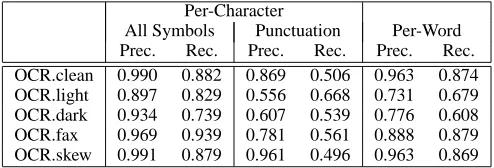
[image:3.612.312.559.619.703.2]We begin by examining the overall performance of the OCR process. Using standard edit distance tech-niques (Esakov et al., 1994), we can compare the out-put of OCR to the ground-truth to classify and quantify the errors that have arisen. We then compute, on a per-character and per-word basis, a figure for average preci-sion (percentage of characters or words recognized that are correct) and recall (percentage of characters or words in the input document that are correctly recognized). As indicated in Table 1, OCR performance varies widely de-pending on the type of degradation. Precision values are generally higher than recall because, in certain cases, the OCR system failed to produce output for a portion of the page in question. Since we are particularly interested in punctuation due to its importance in delimiting sentence boundaries, we tabulate a separate set of precision and recall values for such characters. Note that these are uni-formly lower than the other values in the table. Recall, in particular, is a serious issue; many punctuation marks are missed in the OCR output.
Table 1: OCR performance relative to ground-truth (av-erage precision and recall).
Per-Character
3.2 Sentence boundary errors
Since most summarization systems rely on sentence ex-traction, it is important to identify sentence boundaries correctly. For clean text, the reported accuracy of sen-tence boundary detection is usually above 95% (Palmer and Hearst, 1997; Reyner and Ratnaparkhi, 1997; Riley, 1989). However, detecting sentence boundaries in noisy documents is a serious challenge since punctuation and capitalization, which are important features in sentence boundary detection, are unreliable in noisy documents. As we have just noted, punctuation errors arise frequently in the OCR output of degraded page images.
We tested two tokenizers: one is a rule-based system and the other is a decision tree system. The experimen-tal results show that for the clean text, the two systems perform almost equally well. Manual checking of the re-sults indicates that both tokenizers made very few errors. There should be 90 sentence boundaries in total. The de-cision tree tokenizer correctly identified 88 of the sen-tence boundaries and missed two (precision: 100%; re-call: 98%). The rule-based tokenizer correctly identified 89 of the boundaries and missed one (precision: 100%; recall: 99%). Neither system made any false positive er-rors (i.e., they did not break sentences at non-sentence boundaries).
For the noisy documents, however, both tokenizers made significant numbers of errors. The types of er-rors they made, moreover, were quite different. While the rule-based system made many false negative errors, the decision tree system made many false positive errors. Therefore, the rule-based system identified far fewer sen-tence boundaries than the truth, while the decision tree system identified far more than the truth.
Table 2: Sentence boundary detection results: total num-ber of sentences detected and average words per sentence for two tokenizers. Tokenizer 1 is decision tree based, and tokenizer 2 is rule based.
Tokenizer 1 Tokenizer 2 Sent Words/sent Sent Words/sent
Original 88 23 89 22
Snoise.05 95 20 70 27 Snoise.10 97 20 69 28 Snoise.15 105 19 65 30 Snoise.20 109 17 60 31 Snoise.25 121 15 51 35 OCR.clean 77 23 82 21 OCR.light 119 15 64 28
OCR.dark 70 21 46 33
OCR.fax 78 26 75 27
OCR.skew 77 23 82 21
Table 2 shows the number of sentences identified by each tokenizer for different versions of the documents.
As we can see from the table, the noisier the documents, the more errors the tokenizers made. This relationship was demonstrated clearly by the results for the docu-ments with synthetic noise. As the noise rate increases, the number of boundaries identified by the decision tree tokenizer gradually increases, and the number of bound-aries identified by the rule-based tokenizer gradually de-creases. Both numbers diverge from truth, but they err in opposite directions.
The two tokenizers behaved less consistently on the OCR’ed documents. For OCR.light, OCR.dark, and OCR.fax, the decision tree tokenizer produced more sen-tence boundaries than the rule-based tokenizer. But for OCR.clean and OCR.skew, the decision tree tokenizer produced fewer sentence boundaries. This may be re-lated to the noise level in the document. OCR.clean and OCR.skew contain fewer errors than the other noisy ver-sions (recall Table 1). This indicates that the decision tree tokenizer tends to identify fewer sentence boundaries than the rule-based tokenizer for clean text or documents with very low levels of noise, but more sentence bound-aries when the documents have a relatively high level of noise.
Errors made at this stage are extremely detrimental, since they will propagate to all of the other modules in a summarization system. When a sentence boundary is incorrectly marked, the part-of-speech tagging and the syntactic parsing are likely to fail. Sentence extraction may become problematic; for example, one of the docu-ments in our test set contains 24 sentences, but for one of its noisy versions (OCR.dark), the rule-based tokenizer missed most sentence boundaries and divided the docu-ment into only three sentences, making extraction at the sentence level difficult at best.
Since sentence boundary detection is important to summarization, the development of robust techniques that can handle noisy documents is worthwhile. We will return to this point in Section 4.
3.3 Parsing errors
Some summarization systems use a part-of-speech tagger or a syntactic parser in their preprocessing steps.
Even when ESG produces a complete parse tree for a noisy sentence, the result is incorrect most of times. For instance, the sentence “Internet sites found that almost 90
percent collected personal information from youngsters”
was transformed to “uInternet sites fo6ndha alQmostK0
pecent coll / 9ed pe?” after adding synthetic noise at a
25% rate. For this noisy sentence, the parser returned a complete parse tree that marked the word “sites” as the main verb of the sentence, and tagged all the other words in the sentence as nouns.1 Although a complete
[image:5.612.104.266.312.437.2]parse tree is returned in this case, it is incorrect. This explains the phenomenon that the parser returned a higher percentage of complete parse trees for documents with synthetic noise at the 25% rate than for documents with lower levels of noise.
Table 3: Percentage of sentences with incomplete parse trees. Sentence boundaries were first detected using Tok-enizer 1 and TokTok-enizer 2.
Tokenizer 1 Tokenizer 2 Original 10% 5% Snoise.05 59% 58% Snoise.10 69% 71% Snoise.15 66% 81% Snoise.20 64% 66% Snoise.25 58% 76% OCR.clean 2% 3% OCR.light 46% 53% OCR.dark 37% 43% OCR.fax 37% 30%
OCR.skew 5% 6%
The above results indicate that syntactic parsers are very vulnerable to noise in a document. Even low lev-els of noise lead to a significant drop in performance.
3.4 Extract quality versus noise level
In the next step, we studied how the sentence extrac-tion module in a summarizaextrac-tion system is affected by noise in the input document. The sentence extractor we used (Jing, 2001) relies on lexical links between words, word frequency, cue phrases, and sentence positions to identify key sentences. The performance of the system is affected by noise in multiple dimensions: lexical links are less reliable in a noisy condition; cue phrases are likely to be missed due to noisy spelling; and word frequency is less accurate due to different noisy occurrences of the same word.
Evaluation of noisy document summaries is an inter-esting problem. Both intrinsic evaluation and extrinsic evaluation need to deal with noise effect on the quality
1
One reason might be that the tagger is likely to tag un-known words as nouns, and all the noisy words are considered unknown words.
of final summaries. For intrinsic evaluation, it is de-batable whether clean human summaries or noisy doc-ument summaries (or both) should be used for compari-son. There are two issues related to ’noisy’ human sum-maries: one, whether such summaries are obtainable, and two, whether such summaries should be used in evalua-tion. We note that it is already difficult for a human to recover the information in the noisy documents when the synthetic noise rate reached 10%. Therefore, noisy hu-man summaries will not be available for documents with relatively high level of noise. Secondly, even though the original documents are noisy, it is desirable for the final summaries to be fluent and clean. Therefore, if our ul-timate goal is to produce a fluent and clean summary, it benefits to compare the automatic summaries with such summaries rather than noisy summaries.
We compared the noisy automatic summaries with the clean human summaries by using three measures: uni-gram overlap between the automatic summary and the human-created summary, bigram overlap, and the simple cosine. These results are shown in Table 4. The unigram overlap is computed as the number of unique words oc-curring both in the extract and the ideal summary for the document, divided by the total number of unique words in the extract. Bigram overlap is computed similarly, re-placing words with bigrams. The simple cosine is com-puted as the cosine of two document vectors, the weight of each element in the vector being1/√N, whereN is the total number of elements in the vector.
Not surprisingly, summaries of noisier documents gen-erally have a lower overlap with human-created sum-maries. However, this can be caused by either the noise in the document or poor performance of the sentence ex-traction system. To separate these effects and measure the performance of sentence extraction alone, we also com-puted the unigram overlap, bigram overlap, and cosine between each noisy document and its corresponding orig-inal text. These numbers are included in Table 4 in paren-theses; they are an indication of the average noise level in a document. For instance, the table shows that 97% of words that occurred in OCR.clean documents also ap-peared in the original text, while only 62% of words that occurred in OCR.light appeared in the original. This in-dicates that OCR.clean is less noisy than OCR.light.
3.5 Abstract generation for noisy documents
Table 4: Unigram overlap, bigram overlap, and simple cosine between extracts and human-created summaries (the numbers in parentheses are the corresponding values between the documents and the original text).
Unigram Bigram Cosine Original 0.85 (1.00) 0.75 (1.00) 0.51 (1.00) Snoise.05 0.55 (0.61) 0.38 (0.50) 0.34 (0.65) Snoise.10 0.41 (0.41) 0.22 (0.27) 0.25 (0.47) Snoise.15 0.25 (0.26) 0.10 (0.13) 0.20 (0.31) Snoise.20 0.17 (0.19) 0.04 (0.07) 0.14 (0.23) Snoise.25 0.18 (0.14) 0.04 (0.04) 0.09 (0.16) OCR.clean 0.86 (0.97) 0.78 (0.96) 0.50 (0.93) OCR.light 0.62 (0.63) 0.47 (0.55) 0.36 (0.65) OCR.dark 0.81 (0.70) 0.73 (0.65) 0.38 (0.66) OCR.fax 0.77 (0.84) 0.67 (0.79) 0.48 (0.86) OCR.skew 0.84 (0.97) 0.74 (0.96) 0.48 (0.93)
cut-and-paste stage relies on the results from sentence ex-traction in the previous step, the output from ESG, and a co-reference resolution system.
For the clean text, the cut-and-paste system performed sentence reduction on 59% of the sentences that were ex-tracted in the sentence extraction step, and sentence com-bination on 17% of the extracted sentences. For the noisy text, however, the system applied very few revision oper-ations to the extracted (noisy) sentences. Since the cut-and-paste system relies on the output from ESG and co-reference resolution, which failed on most of the noisy text, it is not surprising that it did not perform well under these circumstances.
Editing sentences requires a deeper understanding of the document and, as the last step in the summarization pipeline, relies on results from all of the previous steps. Hence, it is affected most severely by noise in the input document.
4
Challenges in Noisy Document
Summarization
In the previous section, we have presented and analyzed errors at each stage of summarization when applied to noisy documents. The results show that the methods we tested at every step are fragile, susceptible to fail-ures and errors even with slight increases in the noise level of a document. Clearly, much work needs to be done to achieve acceptable performance in noisy docu-ment summarization. We need to develop summarization algorithms that do not suffer significant degradation when used on noisy documents. We also need to develop robust natural language processing techniques. For example, it will be useful to develop a sentence boundary detection system that can identify sentence breaks in noisy docu-ments more reliably. One way to achieve this might be to
retrain an existing system on tokenized noisy documents so that it will learn features that are indicative of sentence breaks in noisy documents. However, this is only appli-cable if the noise level in the documents is low. For doc-ument with high level of noise, such approach will not be effective.
In the remainder of this section, we discuss several is-sues in noisy document summarization, identifying the problems and proposing possible solutions. We regard this as a first step towards a more comprehensive study on the topic of noisy document summarization.
4.1 Choosing an appropriate granularity
It is important to choose an appropriate unit level to rep-resent the summaries. For clean text, sentence extraction is a feasible goal since we can reliably identify sentence boundaries. For documents with very low levels of noise, sentence extraction is still possible since we can probably improve our programs to handle such documents. How-ever, for documents with relatively high noise rates, we believe it is better to forgo sentence extraction and instead favor extraction of keywords or noun phrases, or gener-ation of headline-style summaries. In our experiment, when the synthetic noise rate reached 10% (which is rep-resentative of what can happen when real-world docu-ments are degraded), it was already difficult for a human to recover the information intended to be conveyed from the noisy documents.
Keywords, noun phrases, or headline-style summaries are informative indications of the main topic of a doc-ument. For documents with high noise rates, extracting keywords or noun phrases is a more realistic and attain-able goal than sentence extraction. Still, it may be de-sirable to correct the noise in the extracted keywords or phrases, either before or after summarization. There has been past work on correcting spelling mistakes and errors in OCR output; these techniques could be useful for this purpose.
4.2 Using other information sources
4.3 Assessing error rates without ground-truth
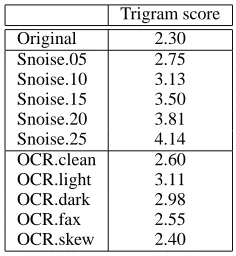
[image:7.612.126.244.437.565.2]The quality of summarization is directly tied to the level of noise in a document. In this context, it would be use-ful to develop methods for assessing document noise lev-els without having access to the ground-truth. Intuitively, OCR may create errors that cause the output text to devi-ate from “normal” text. Therefore, one way of evaluating OCR output, in the absence of the original ground-truth, is to compare its features against features obtained from a large corpus of correct text. Letter trigrams (Church and Gale, 1991) are commonly used to correct spelling and OCR errors (Angell et al., 1983; Kuckich, 1992; Zamora et al., 1981), and can be applied to evaluate OCR output. We computed trigram tables (including symbols and punctuation marks) for 10 days of AP news articles and evaluated the documents used in our experiment. The tri-grams were computed on letters and Good-Turing estima-tion is used for smoothing. The values in the table are av-erage trigram scores for each document set. As expected, OCR errors create rare or previously unseen trigrams that lead to higher trigram scores in noisy documents. As in-dicated in Table 5, the ground-truth (original) documents have the lowest average trigram score. These scores pro-vide a relative ranking that reflects the controlled noise levels (Snoise.05 through Snoise.25), as well as cer-tain of the real OCR data (OCR.clean, OCR.dark, and OCR.light).
Table 5: Average trigram scores.
Trigram score Original 2.30 Snoise.05 2.75 Snoise.10 3.13 Snoise.15 3.50 Snoise.20 3.81 Snoise.25 4.14 OCR.clean 2.60 OCR.light 3.11 OCR.dark 2.98 OCR.fax 2.55 OCR.skew 2.40
Different texts have very different baseline trigram scores. The ranges of scores for clean and noisy text overlap. This is because some documents contain more instances of frequent words than others (such as “the”), which bring down the average scores. This issue makes it impractical to use trigram scores in isolation to judge OCR output.
It may be possible to identify some problems if we scan larger units and incorporate contextual information. For example, a window of three characters is too small to judge whether the symbol @ is used properly: a@b seems to be a potential OCR error, but is acceptable when
it appears in an email address such as [email protected]. In-creasing the unit size will create sparse data problems, however, which is already an issue for trigrams.
In the future, we plan to experiment with improved methods for identifying problematic regions in OCR text, including using language models and incorporat-ing grammatical patterns. Many lincorporat-inguistic properties can be identified when letter sequences are encoded in broad classes. For example, long consonant strings are rare in English text, while long number strings are legal. These properties can be captured when characters are mapped into carefully selected classes such as symbols, numbers, upper- and lower-case letters, consonants, and vowels. Such mappings effectively reduce complexity, allowing us to sample longer strings to scan for abnormal patterns without running into severe sparse data problems.
Our intention is to establish a robust index that mea-sures whether a given section of text is “summarizable.” This problem is related to the general question of assess-ing OCR output without ground-truth, but we shift the scope of the problem to ask whether the text is summa-rizable, rather than how many errors it may contain.
We also note that documents often contain logical components that go beyond basic text. Pages may include photographs and figures, program code, lists, indices, etc. Tables, for example, can be detected, parsed, and refor-mulated so that it becomes possible to describe their over-all structure and even over-allow users to query them (Hu et al., 2000). Developing appropriate ways of summarizing such material is another topic of interest.
5
Conclusions and Future Work
In this paper, we have discussed some of the challenges in summarizing noisy documents. In particular, we broke down the summarization process into four steps: sen-tence boundary detection, preprocessing (part-of-speech tagging and syntactic parsing), extraction, and editing. We tested each step on noisy documents and analyzed the errors that arose. We also studied how the quality of summarization is affected by the noise level and the er-rors made at each stage of processing.
To improve the performance of noisy document sum-marization, we suggest extracting keywords or phrases rather than full sentences, especially when summarizing documents with high levels of noise. We also propose us-ing other sources of information, such as document lay-out cues, in combination with text when summarizing noisy documents. In certain cases, it will be important to be able to assess the noise level in a document; we have begun exploring this question as well. Our plans for the future include developing robust techniques to ad-dress the issues we have outlined in this paper.
Given that noisy documents, and hence their summaries, may contain errors, it is important to find the best ways of displaying such information so that the user may pro-ceed with confidence, knowing that the summary is truly representative of the document(s) in question.
References
R. Angell, G. Freund, and P. Willet. 1983. Automatic spelling correction using a trigram similarity measure.
Information Processing and Management, 19(4):255–
261.
F. R. Chen and D. S. Bloomberg. 1998. Summarization of imaged documents without OCR. Computer Vision
and Image Understanding, 70(3):307–320.
K. Church and W. Gale. 1991. Probability scoring for spelling correction. Statistics and Computing, 1:93– 103.
Jeffrey Esakov, Daniel P. Lopresti, and Jonathan S. Sand-berg. 1994. Classification and distribution of optical character recognition errors. In Proceedings of
Doc-ument Recognition I (IS&T/SPIE Electronic Imaging),
volume 2181, pages 204–216, San Jose, CA, February.
Y. Gotoh and S. Renals. 2000. Sentence boundary detec-tion in broadcast speech transcripts. In Proceedomgs
of ISCA Tutorial and Research Workshop ASR-2000,
Paris, France.
C. Hori and S. Furui. 2001. Advances in automatic speech summarization. In Proceedings of the 7th
European Conference on Speech Communication and Technology, pages 1771–1774, Aalborg, Denmark.
Jianying Hu, Ramanujan Kashi, Daniel Lopresti, and Gordon Wilfong. 2000. A system for understanding and reformulating tables. In Proceedings of the Fourth
IAPR International Workshop on Document Analysis Systems, pages 361–372, Rio de Janeiro, Brazil,
De-cember.
Hongyan Jing. 2001. Cut-and-paste Text
Summariza-tion. Ph.D. thesis, Department of Computer Science,
Columbia University, New York, NY.
K. Kuckich. 1992. Techniques for automatically cor-recting words in text. ACM Computing Surveys,
24(4):377–439.
M. McCord, 1990. English Slot Grammar. IBM.
D. Miller, S. Boisen, R. Schwartz, R. Stone, and R. Weischedel. 2000. Named entity extraction from noisy input: Speech and OCR. In Proceedings of the
6th Applied Natural Language Processing Conference,
pages 316–324, Seattle, WA.
D. Palmer and M. Hearst. 1997. Adaptive multilin-gual sentence boundary disambiguation. Computa-tional Linguistics, 23(2):241–267, June.
D. D. Palmer and M. Ostendorf. 2001. Improving infor-mation extraction by modeling errors in speech recog-nizer output. In J. Allan, editor, Proceedings of the
First International Conference on Human Language Technology Research.
J. C. Reyner and A. Ratnaparkhi. 1997. A maximum en-tropy approach to identifying sentence boundaries. In
Proceedings of the Fifth Conference on Applied Natu-ral Language Processing, Washington D.C.
M. Riley. 1989. Some applications of tree-based mod-elling to speech and language. In Proceedings of
the DARPA Speech and Natural Language Workshop,
pages 339–352, Cape Cod, MA.
Kazem Taghva, Julie Borsack, and Allen Condit. 1996a. Effects of OCR errors on ranking and feedback using the vector space model. Information Processing and
Management, 32(3):317–327.
Kazem Taghva, Julie Borsack, and Allen Condit. 1996b. Evaluation of model-based retrieval effectiveness with OCR text. ACM Transactions on Information Systems, 14:64–93, January.
E. Zamora, J. Pollock, and A. Zamora. 1981. The use of trigram analysis for spelling error detection.