Studying Feature Generation from Various Data Representations for
Answer Extraction
Dan Shen
†‡Geert-Jan M. Kruijff
†Dietrich Klakow
‡†
Department of Computational Linguistics
Saarland University
Building 17,Postfach 15 11 50
66041 Saarbruecken, Germany
‡
Lehrstuhl Sprach Signal Verarbeitung
Saarland University
Building 17, Postfach 15 11 50
66041 Saarbruecken, Germany
{dshen,gj}@coli.uni-sb.de
{dietrich.klakow}@lsv.uni-saarland.de
Abstract
In this paper, we study how to generate features from various data representations, such as surface texts and parse trees, for answer extraction. Besides the features generated from the surface texts, we mainly discuss the feature generation in the parse trees. We propose and compare three methods, including feature vector, string kernel and tree kernel, to represent the syntactic features in Support Vector Machines. The experiment on the TREC question answering task shows that the features generated from the more struc-tured data representations significantly improve the performance based on the features generated from the surface texts. Furthermore, the contribution of the indi-vidual feature will be discussed in detail.
1
Introduction
Open domain question answering (QA), as defined by the TREC competitions (Voorhees, 2003), represents an advanced application of natural lguage processing (NLP). It aims to find exact an-swers to open-domain natural language questions in a large document collection. For example:
Q2131: Who is the mayor of San Francisco? Answer: Willie Brown
A typical QA system usually consists of three basic modules: 1. Question Processing (QP) Mod-ule, which finds some useful information from the
questions, such as expected answer type and key words. 2. Information Retrieval (IR) Module, which searches a document collection to retrieve a set of relevant sentences using the question key words. 3. Answer Extraction (AE) Module, which analyzes the relevant sentences using the informa-tion provided by the QP module and identify the answer phrase.
In recent years, QA systems trend to be more and more complex, since many other NLP tech-niques, such as named entity recognition, parsing, semantic analysis, reasoning, and external re-sources, such as WordNet, web, databases, are in-corporated. The various techniques and resources may provide the indicative evidences to find the correct answers. These evidences are further com-bined by using a pipeline structure, a scoring func-tion or a machine learning method.
In the machine learning framework, it is critical but not trivial to generate the features from the various resources which may be represented as surface texts, syntactic structures and logic forms, etc. The complexity of feature generation strongly depends on the complexity of data representation. Many previous QA systems (Echihabi et al., 2003; Ravichandran, et al., 2003; Ittycheriah and Roukos, 2002; Ittycheriah, 2001; Xu et al., 2002) have well studied the features in the surface texts. In this paper, we will use the answer extraction module of QA as a case study to further explore how to gen-erate the features for the more complex sentence representations, such as parse tree. Since parsing gives the deeper understanding of the sentence, the features generated from the parse tree are expected to improve the performance based on the features generated from the surface text. The answer
traction module is built using Support Vector Ma-chines (SVM). We propose three methods to rep-resent the features in the parse tree: 1. features are designed by domain experts, extracted from the parse tree and represented as a feature vector; 2. the parse tree is transformed to a node sequence and a string kernel is employed; 3. the parse tree is retained as the original representation and a tree kernel is employed.
Although many textual features have been used in the others’ AE modules, it is not clear that how much contribution the individual feature makes. In this paper, we will discuss the effectiveness of each individual textual feature in detail. We fur-ther evaluate the effectiveness of the syntactic fea-tures we proposed. Our experiments using TREC questions show that the syntactic features improve the performance by 7.57 MRR based on the textual features. It indicates that the new features based on a deeper language understanding are necessary to push further the machine learning-based QA technology. Furthermore, the three representations of the syntactic features are compared. We find that keeping the original data representation by using the data-specific kernel function in SVM may capture the more comprehensive evidences than the predefined features. Although the features we generated are specific to the answer extraction task, the comparison between the different feature representations may be helpful to explore the syn-tactic features for the other NLP applications.
2
Related Work
In the machine learning framework, it is crucial to capture the useful evidences for the task and inte-grate them effectively in the model. Many re-searchers have explored the rich textual features for the answer extraction.
IBM (Ittycheriah and Roukos, 2002; Ittycheriah, 2001) used a Maximum Entropy model to integrate the rich features, including query expansion fea-tures, focus matching feafea-tures, answer candidate co-occurrence features, certain word frequency features, named entity features, dependency rela-tion features, linguistic motivated features and sur-face patterns. ISI’s (Echihabi et al. 2003; Echihabi and Marcu, 2003) statistical-based AE module im-plemented a noisy-channel model to explain how a given sentence tagged with an answer can be re-written into a question through a sequence of
sto-chastic operations. (Ravichandran et al., 2003) compared two maximum entropy-based QA sys-tems, which view the AE as a classification prob-lem and a re-ranking probprob-lem respectively, based on the word frequency features, expected answer class features, question word absent features and word match features. BBN (Xu et al. 2002) used a HMM-based IR system to score the answer candi-dates based on the answer contexts. They further re-ranked the scored answer candidates using the constraint features, such as whether a numerical answer quantifies the correct noun, whether the answer is of the correct location sub-type and whether the answer satisfies the verb arguments of the questions. (Suzuki et al. 2002) explored the answer extraction using SVM.
However, in the previous statistical-based AE modules, most of the features were extracted from the surface texts which are mainly based on the key words/phrases matching and the key word fre-quency statistics. These features only capture the surface-based information for the proper answers and may not provide the deeper understanding of the sentences. In addition, the contribution of the individual feature has not been evaluated by them. As for the features extracted from the structured texts, such as parse trees, only a few works ex-plored some predefined syntactic relation features by partial matching. In this paper, we will explore the syntactic features in the parse trees and com-pare the different feature representations in SVM. Moreover, the contributions of the different fea-tures will be discussed in detail.
3
Answer Extraction
Given a question Q and a set of relevant sentences
SentSet which is returned by the IR module, we consider all of the base noun phrases and the words in the base noun phrases as answer candidates aci.
For example, for the question “Q1956: What
coun-try is the largest in square miles?”, we extract the answer candidates { Russia, largest country, larg-est, country, world, Canada, No.2.} in the sentence “I recently read that Russia is the largest country in the world, with Canada No. 2.” The goal of the AE module is to choose the most probable answer from a set of answer candidates
{
ac ac
1,
2,...
ac
m}
for the question Q.
answer candidate pair <Q, aci> into the positive class (the correct answer) and the negative class (the incorrect answer), based on some features. The predication for each <Q, aci> is made inde-pendently by the classifier, then, the ac with the most confident positive prediction is chosen as the
answer for Q. SVM have shown the excellent
per-formance for the binary classification, therefore, we employ it to classify the answer candidates.
Answer extraction is not a trivial task, since it involves several components each of which is fairly sophisticated, including named entity recog-nition, syntactic / semantic parsing, question analy-sis, etc. These components may provide some indicative evidences for the proper answers. Be-fore generating the features, we process the sen-tences as follows:
1. tag the answer sentences with named entities. 2. parse the question and the answer sentences us-ing the Collins’ parser (Collin, 1996).
3. extract the key words from the questions, such as the target words, query words and verbs.
In the following sections, we will briefly intro-duce the machine learning algorithm. Then, we will discuss the features in detail, including the motivations and representations of the features.
4
Support Vector Machines
Support Vector Machines (SVM) (Vapnik, 1995) have strong theoretical motivation in statistical learning theory and achieve excellent generaliza-tion performance in many language processing applications, such as text classification (Joachims, 1998).
SVM constructs a binary classifier that predict
whether an instance x ( ∈ n
w R ) is positive
( f( ) 1x = ) or negative ( ( )f x = −1), where, an instance may be represented as a feature vector or a structure like sequence of characters or tree. In the simplest case (linearly separable instances), the
decision f( )x = sgn(w x⋅ +b ) is made based
on a separating hyperplane w x⋅ + =b 0 ( ∈ n
w R ,
b∈R). All instances lying on one side of the hy-perplane are classified to a positive class, while others are classified to a negative class.
Given a set of labeled training instances
(
) (
) (
)
{
1, 1 , 2, 2 ,..., m, m}
D= x y x y x y , where n
i∈
x R
and yi =
{
1, 1−}
, SVM is to find the optimalhy-perplane that separates the positive and negative training instances with a maximal margin. The margin is defined as the distance from the separat-ing hyperplane to the closest positive (negative) training instances. SVM is trained by solving a dual quadratic programming problem.
Practically, the instances are non-linearly sepa-rable. For this case, we need project the instances in the original space Rn to a higher dimensional
space RN based on the kernel function
1 2 1 2
( , ) ( ), ( )
K x x =< Φ x Φx >,where, ( ):Φ n→ N
x R R is
a project function of the instance. By this means, a linear separation will be made in the new space.
Corresponding to the original space Rn, a
non-linear separating surface is found. The kernel function has to be defined based on the Mercer’s condition. Generally, the following kernel func-tions are widely used.
Polynomial kernel: ( , ) ( 1)p
i j i j
k x x = x x⋅ +
Gaussian RBF kernel:
2 2
2
( , ) i- j
i j
k =e−x x σ
x x
5
Textual Features
Since the features extracted from the surface texts have been well explored by many QA systems (Echihabi et al., 2003; Ravichandran, et al., 2003; Ittycheriah and Roukos, 2002; Ittycheriah, 2001; Xu et al., 2002), we will not focus on the textual feature generation in this paper. Only four types of the basic features are used:
1. Syntactic Tag Features: the features capture the syntactic/POS information of the words in the answer candidates. For the certain
ques-tion, such as “Q1903: How many time zones
are there in the world?”, if the answer candi-date consists of the words with the syntactic
tags “CD NN”, it is more likely to be the
proper answer.
2. Orthographic Features: the features capture the surface format of the answer candidates, such as capitalization, digits and lengths, etc. These features are motivated by the observa-tions, such as, the length of the answers are often less than 3 words for the factoid ques-tions; the answers may not be the subse-quences of the questions; the answers often contain digits for the certain questions.
candidates. They are very effective for the
who, when and where questions, such as, For “Q1950: Who created the literary character Phineas Fogg?“, the answer “Jules Verne” is tagged as a PERSON name in the sentences “Jules Verne 's Phileas Fogg made literary history when he traveled around the world in 80 days in 1873.”. For the certain question tar-get, if the answer candidate is tagged as the certain type of named entity, one feature fires. 4. Triggers: some trigger words are collected for
the certain questions. For examples, for
“Q2156: How fast does Randy Johnson
throw?”, the trigger word “mph” for the ques-tion words “how fast” may help to identify the
answer “98-mph” in “Johnson throws a
98-mph fastball”.
6
Syntactic Features
In this section, we will discuss the feature genera-tion in the parse trees. Since parsing outputs the highly structured data representation of the sen-tence, the features generated from the parse trees may provide the more linguistic-motivated expla-nation for the proper answers. However, it is not trivial to find the informative evidences from a parse tree.
The motivation of the syntactic features in our task is that the proper answers often have the cer-tain syntactic relations with the question key words. Table 1 shows some examples of the typical syn-tactic relations between the proper answers (a) and the question target words (qtarget). Furthermore, the syntactic relations between the answers and the different types of question key words vary a lot. Therefore, we capture the relation features for the different types of question words respectively. The question words are divided into four types:
z Target word, which indicates the expected
an-swer type, such as “city” in “Q: What city is Disneyland in?”.
z Head word, which is extracted from how
ques-tions and indicates the expected answer head,
such as “dog” in “Q210: How many dogs
pull …?”
z Subject words, which are the base noun phrases
of the question except the target word and the head word.
z Verb, which is the main verb of the question.
To our knowledge, the syntactic relation fea-tures between the answers and the question key words haven’t been explored in the previous ma-chine learning-based QA systems. Next, we will propose three methods to represent the syntactic relation features in SVM.
6.1 Feature Vector
It is the commonly used feature representation in most of the machine learning algorithms. We pre-define a set of syntactic relation features, which is an enumeration of some useful evidences of the answer candidates (ac) and the question key words in the parse trees. 20 syntactic features are manu-ally designed in the task. Some examples of the features are listed as follows,
z if the ac node is the same of the qtarget node,
one feature fires.
z if the ac node is the sibling of the qtarget node,
one feature fires.
z if the ac node the child of the qsubject node,
one feature fires.
The limitation of the manually designed features is that they only capture the evidences in the local context of the answer candidates and the question key words. However, some question words, such as subject words, often have the long range
syntac-1. a node is the same as the qtarget node and qtarget is the hypernym of a. Q: What city is Disneyland in?
S: Not bad for a struggling actor who was working at Tokyo Disneyland a few years ago. 2. a node is the parent of qtarget node.
Q: What is the name of the airport in Dallas Ft. Worth?
S: Wednesday morning, the low temperature at the Dallas-Fort Worth International Airport was 81 degrees. 3. a node is the sibling of the qtarget node.
Q: What book did Rachel Carson write in 1962?
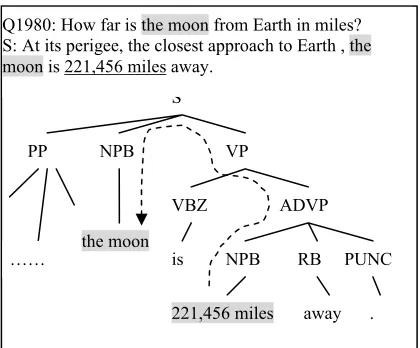
Figure 1: An example of the path from the answer candidate node to the question subject word node tic relations with the answers. To overcome the limitation, we will propose some special kernels which may keep the original data representation instead of explicitly enumerate the features, to ex-plore a much larger feature space.
6.2 String Kernel
The second method represents the syntactic rela-tion as a linked node sequence and incorporates a string kernel in SVM to handle the sequence.
We extract a path from the node of the answer candidate to the node of the question key word in the parse tree. The path is represented as a node sequence linked by symbols indicating upward or downward movement through the tree. For exam-ple, in Figure 1, the path from the answer candi-date node “211,456 miles” to the question subject
word node “the moon” is
“ NPB ADVP VP S NPB↑ ↑ ↑ ↓ ”, where “ ↑ ” and
“↓” indicate upward movement and downward
movement in the parse tree. By this means, we represent the object from the original parse tree to the node sequence. Each character of the sequence is a syntactic/POS tag of the node. Next, a string kernel will be adapted to our task to calculate the similarity between two node sequences.
(Haussler, 1999) first described a convolution kernel over the strings. (Lodhi et al., 2000) applied the string kernel to the text classification. (Leslie et al., 2002) further proposed a spectrum kernel, which is simpler and more efficient than the previ-ous string kernels, for protein classification
prob-lem. In their tasks, the string kernels achieved the better performance compared with the human-defined features.
The string kernel is to calculate the similarity between two strings. It is based on the observation that the more common substrings the strings have, the more similar they are. The string kernel we used is similar to (Leslie et al., 2002). It is defined as the sum of the weighted common substrings. The substring is weighted by an exponentially de-caying factor
λ
(set 0.5 in the experiment) of its length k. For efficiency, we only consider the sub-strings which length are less than 3. Different from (Leslie et al., 2002), the characters (syntac-tic/POS tag) of the string are linked with each other. Therefore, the matching between two sub-strings will consider the linking information. Two identical substrings will not only have the same syntactic tag sequences but also have the same linking symbols. For example, for the node se-quences NP VP VP S NP↑ ↑ ↑ ↓ and NP NP VP NP↑ ↑ ↓ , there is a matched substring (k = 2): NP VP↑ .6.3 Tree Kernel
The third method keeps the original representation of the syntactic relation in the parse tree and incor-porates a tree kernel in SVM.
Tree kernels are the structure-driven kernels to calculate the similarity between two trees. They have been successfully accepted in the NLP appli-cations. (Collins and Duffy, 2002) defined a ker-nel on parse tree and used it to improve parsing. (Collins, 2002) extended the approach to POS tag-ging and named entity recognition. (Zelenko et al., 2003; Culotta and Sorensen, 2004) further ex-plored tree kernels for relation extraction.
We define an object (a relation tree) as the smallest tree which covers one answer candidate node and one question key word node. Suppose that a relation tree T has nodes { , ,..., }t t0 1 tn and
each node ti is attached with a set of
attrib-utes{ , ,...,a a0 1 am}, which represents the local
char-acteristics of ti . In our task, the set of the
attributes includes Type attributes, Orthographic attributes and Relation Role attributes, as shown in Table 2. The core idea of the tree kernel K T T( ,1 2) is that the similarity between two trees T1 and T2 is
PUNC
. away 221,456 miles
S
PP NPB VP
VBZ ADVP
NPB RB the moon
is
Q1980: How far is the moon from Earth in miles? S: At its perigee, the closest approach to Earth , the moon is 221,456 miles away.
T1_ac#target
T2_ac#target
Q1897: What is the name of the airport in Dallas Ft. Worth? S: Wednesday morning, the low temperature at the Dallas-Fort Worth International Airport was 81 degrees.
t4 t3
t2
T: BNP O: null R1: true R2: false t1
Dallas-Fort
T: NNP O: CAPALL R1: false R2: false
International
T: JJ O: CAPALL R1: false R2: false
Airport
T: NNP O: CAPALL R1: false R2: true
Q35: What is the name of the highest mountain in Africa? S: Mount Kilimanjaro, at 19,342 feet, is Africa's highest moun-tain, and is 5,000 feet higher than ….
Mount
T: NNP O: CAPALL R1: false R2: true
Kilimanjaro
T: NNP O: CAPALL R1: false R2: false T: BNP
O: null R1: true R2: false
t0
w0
w1 w2
Worth
T: NNP O: CAPALL R1: false R2: false the sum of the similarity between their subtrees. It
is calculated by dynamic programming and cap-tures the long-range syntactic relations between two nodes. The kernel we use is similar to (Ze-lenko et al., 2003) except that we define a task-specific matching function and similarity function, which are two primitive functions to calculate the similarity between two nodes in terms of their at-tributes.
Matching function
1 if . . and . .
( , )
0 otherwise
i j i j
i j
t type t type t role t role
m t t =
= =
Similarity function
0 { ,..., }
( , )i j ( . , . )i j
m
a a a
s t t f t a t a
∈
=
∑
where, f t a t a( . , . )i j is a compatibility function
be-tween two feature values
. . ( . , . ) 1 if
0 otherwise
i j
i j
t a t a f t a t a =
= [image:6.612.314.541.362.482.2]
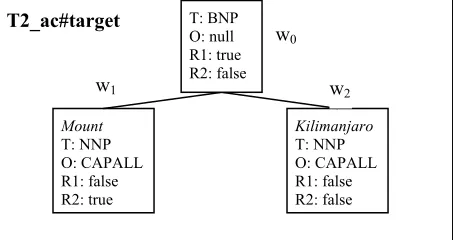
Figure 2 shows two examples of the relation tree
T1_ac#targetword and T2_ac#targetword. The kernel we used matches the following pairs of the nodes <t0, w0>, <t1, w2>, <t2, w2> and <t4, w1>.
Attributes Examples
POS tag CD, NNP, NN…
Type
syntactic tag NP, VP, …
Is Digit? DIG, DIGALL
Is Capitalized? CAP, CAPALL
Ortho-graphic
length of phrase LNG1, LNG2#3,
LNGgt3
Role1 Is answer candidate? true, false
[image:6.612.73.301.396.517.2]Role2 Is question key words? true, false
Table 2: Attributes of the nodes
7
Experiments
We apply the AE module to the TREC QA task. To evaluate the features in the AE module inde-pendently, we suppose that the IR module has got 100% precision and only passes those sentences containing the proper answers to the AE module. The AE module is to identify the proper answers from the given sentence collection.
We use the questions of TREC8, 9, 2001 and 2002 for training and the questions of TREC2003 for testing. The following steps are used to gener-ate the data:
1. Retrieve the relevant documents for each ques-tion based on the TREC judgments.
2. Extract the sentences, which match both the proper answer and at least one question key word, from these documents.
3. Tag the proper answer in the sentences based on the TREC answer patterns
Figure 2: Two objects representing the relations be-tween answer candidates and target words.
in terms of the top 5 answers and the top 1 answer
returned. We employ the SVMLight (Joachims,
1999) to incorporate the features and classify the answer candidates. No post-processes are used to adjust the answers in the experiments.
[image:7.612.316.535.154.214.2]Firstly, we evaluate the effectiveness of the tex-tual features, described in Section 5. We incorpo-rate them into SVM using the three kernel functions: linear kernel, polynomial kernel and RBF kernel, which are introduced in Section 4. Table 3 shows the performance for the different kernels. The RBF kernel (46.24 MRR) signifi-cantly outperforms the linear kernel (33.72 MRR) and the polynomial kernel (40.45 MRR). There-fore, we will use the RBF kernel in the rest ex-periments.
Top1 Top5 MRR
linear 31.28 37.91 33.72
polynomial 37.91 44.55 40.45
RBF 42.67 51.58 46.24
Table 3: Performance for kernels
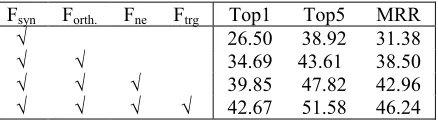
In order to evaluate the contribution of the indi-vidual feature, we test out module using different feature combinations, as shown in Table 4. Sev-eral findings are concluded:
1. With only the syntactic tag features Fsyn., the module achieves a basic level MRR of 31.38. The
questions “Q1903: How many time zones are there
in the world?“ is correctly answered from the sen-tence “The world is divided into 24 time zones.”. 2. The orthographic features Forth. show the posi-tive effect with 7.12 MRR improvement based on Fsyn.. They help to find the proper answer “Grover Cleveland” for the question “Q2049: What presi-dent served 2 nonconsecutive terms?” from the
sentence “Grover Cleveland is the forgotten
two-term American president.”, while Fsyn. wrongly identify “president” as the answer.
3. The named entity features Fne are also benefi-cial as they make the 4.46 MRR increase based on Fsyn.+Forth. For the question “Q2076: What com-pany owns the soft drink brand "Gatorade"?”, Fne
find the proper answer “Quaker Oats” in the
sen-tence “Marineau , 53 , had distinguished himself
by turning the sports drink Gatorade into a mass consumer brand while an executive at Quaker Oats During his 18-month…”, while Fsyn.+Forth. return the wrong answer “Marineau”.
4. The trigger features Ftrg lead to an improve-ment of 3.28 MRR based on Fsyn.+Forth+Fne. They
correctly answer more questions. For the question “Q1937: How fast can a nuclear submarine travel?”, Ftrg return the proper answer “25 knots”
from the sentence “The submarine , 360 feet
( 109.8 meters ) long , has 129 crew members and travels at 25 knots.”, but the previous features fail on it.
Fsyn Forth. Fne Ftrg Top1 Top5 MRR
√ 26.50 38.92 31.38
√ √ 34.69 43.61 38.50
√ √ √ 39.85 47.82 42.96
√ √ √ √ 42.67 51.58 46.24
Table 4: Performance for feature combinations
Next, we will evaluate the effectiveness of the syn-tactic features, described in Section 6. Table 5 compares the three feature representation methods,
FeatureVector, StringKernel and TreeKernel.
z FeatureVector (Section 6.1). We predefine
some features in the syntactic tree and present them as a feature vector. The syntactic fea-tures are added with the textual feafea-tures and the RBF kernel is used to cope with them.
z StringKernel (Section 6.2). No features are
predefined. We transform the syntactic rela-tions between answer candidates and question key words to node sequences and a string ker-nel is proposed to cope with the sequences. Then we add the string kernel for the syntactic relations and the RBF kernel for the textual features.
z TreeKernel (Section 6.3). No features are
predefined. We keep the original representa-tions of the syntactic relarepresenta-tions and propose a tree kernel to cope with the relation trees. Then we add the tree kernel and the RBF ker-nel.
Top1 Top2 MRR
Fsyn.+Forth.+Fne+Ftrg 42.67 51.58 46.24
FeatureVector 46.19 53.69 49.28
StringKernel 48.99 55.83 52.29
TreeKernel 50.41 57.46 53.81
Table 5: Performance for syntactic feature repre-sentations
Table 5 shows the performances of
more linguistic-motivated evidences for the proper answers. For example, the syntactic features help
to find the answer “nitrogen” for the question
“Q2139: What gas is 78 percent of the earth 's at-mosphere?” in the sentence “One thing they have-n't found in the moon's atmosphere so far is nitrogen, the gas that makes up more than three-quarters of the Earth's atmosphere.”, while the textual features fail on it. Furthermore, the String-Kernel (+3.01MRR) and TreeKernel (+4.53MRR)
achieve the higher performance than
FeatureVec-tor, which may be explained that keeping the
original data representations by incorporating the data-specific kernels in SVM may capture the more comprehensive evidences than the predefined
features. Moreover, TreeKernel slightly
outper-forms StringKernel by 1.52 MRR. The reason may
be that when we transform the representation of the syntactic relation from the tree to the node se-quence, some information may be lost, such as the sibling node of the answer candidates. Sometimes the information is useful to find the proper answers.
8
Conclusion
In this paper, we study the feature generation based on the various data representations, such as surface text and parse tree, for the answer extraction. We generate the syntactic tag features, orthographic features, named entity features and trigger features from the surface texts. We further explore the fea-ture generation from the parse trees which provide the more linguistic-motivated evidences for the task. We propose three methods, including feature vector, string kernel and tree kernel, to represent the syntactic features in Support Vector Machines. The experiment on the TREC question answering task shows that the syntactic features significantly improve the performance by 7.57MRR based on the textual features. Furthermore, keeping the original data representation using a data-specific kernel achieves the better performance than the explicitly enumerated features in SVM.
References
M. Collins. 1996. A New Statistical Parser Based on
Bigram Lexical Dependencies. In Proceedings of
ACL-96, pages 184-191.
M. Collins. 2002. New Ranking Algorithms for Parsing and Tagging: Kernel over Discrete Structures, and the Voted Perceptron. In Proceedings of ACL-2002.
M. Collins and N. Duffy. 2002. Convolution Kernels
for Natural Language. Advances in Neural
Informa-tion Processing Systems 14, Cambridge, MA. MIT Press.
A. Culotta and J. Sorensen. 2004. Dependency Tree
Kernels for Relation Extraction. In Proceedings of
ACL-2004.
A. Echihabi, U. Hermjakob, E. Hovy, D. Marcu, E. Melz, D. Ravichandran. 2003. Multiple-Engine
Question Answering in TextMap. In Proceedings of
the TREC-2003 Conference, NIST.
A. Echihabi, D. Marcu. 2003. A Noisy-Channel Ap-proach to Question Answering. In Proceedings of the ACL-2003.
D. Haussler. 1999. Convolution Kernels on Discrete Structures. Technical Report UCS-CRL-99-10, Uni-versity of California, Santa Cruz.
A. Ittycheriah and S. Roukos. 2002. IBM’s Statistical
Question Answering System – TREC 11. In
Pro-ceedings of the TREC-2002 Conference, NIST. A. Ittycheriah. 2001. Trainable Question Answering
System. Ph.D. Dissertation, Rutgers, The State Uni-versity of New Jersey, New Brunswick, NJ.
T. Joachims. 1999. Making large-Scale SVM
Learn-ing Practical. Advances in Kernel Methods -
Sup-port Vector Learning, MIT-Press, 1999.
T. Joachims. 1998. Text Categorization with Support Vector Machines: Learning with Many Relevant Fea-tures. In Proceedings of the European Conference on Machine Learning, Springer.
C. Leslie, E. Eskin and W. S. Noble. 2002. The spec-trum kernel: A string kernel for SVM protein classi-fication. Proceedings of the Pacific Biocomputing Symposium.
H. Lodhi, J. S. Taylor, N. Cristianini and C. J. C. H. Watkins. 2000. Text Classification using String Kernels. In NIPS, pages 563-569.
D. Ravichandran, E. Hovy and F. J. Och. 2003. Statis-tical QA – Classifier vs. Re-ranker: What’s the
dif-ference? In Proceedings of Workshop on Mulingual
Summarization and Question Answering, ACL 2003. J. Suzuki, Y. Sasaki, and E. Maeda. 2002. SVM Answer
Selection for Open-domain Question Answering. In Proc. of COLING 2002, pages 974–980.
V. N. Vapnik. 1998. Statistical Learning Theory. Springer.
E.M. Voorhees. 2003. Overview of the TREC 2003
Question Answering Track. In Proceedings of the
TREC-2003 Conference, NIST.
J. Xu, A. Licuanan, J. May, S. Miller and R. Weischedel. 2002. TREC 2002 QA at BBN: Answer Selection
and Confidence Estimation. In Proceedings of the
TREC-2002 Conference, NIST.
D. Zelenko, C. Aone and A. Richardella. 2003. Kernel
Methods for Relation Extraction. Journal of