T o w a r d s a M o r e C a r e f u l E v a l u a t i o n of B r o a d C o v e r a g e
P a r s i n g S y s t e m s
W i d e It. H o g e n h o u t a n d Yuji M a t s u m o t o
N a r a I n s t i t u t e o f S c i e n c e a n d T e c h n o l o g y8 9 1 6 - 5 T a k a y a m a , I k o m a N a r a 6 3 0 - 0 1 , J a p a n
{ m a r c - h, m a t s u } @is. a i s t - n a r a . a c . j p
A b s t r a c t
Since treebanks have become available to researchers a wide variety of tech- niques has been used to make broad cov- erage parsing systems. This makes quan- titative evaluation very i m p o r t a n t , but the current evaluation methods have a number of drawbacks such as arbitrary choices in the treebank and the difficulty in measuring statistical significance. We suggest a more detailed m e t h o d for test- ing a parsing system using constituent boundaries, with a number of measures t h a t give more information t h a n current measures, and evaluate the quality of the test. We also show t h a t statistical signif- icance cannot be calculated in a straight- forward way, and suggest a calculation method for the case of Bracket Recall.
1
I n t r o d u c t i o n
During the last few years large treebanks have be- come available to m a n y researchers, which has re- sulted in researches applying a range of new tech- niques for parsing systems. Most of the meth- ods t h a t are being suggested include some kind of Machine Learning, such as history based gram- mars and decision tree models (Black et al., 1993; Magerman, 1995), training or inducing statisti- cal g r a m m a r s (Black, Garside and Leech, 1993; Pereira and Schabes, 1992; Schabes et al., 1993), or other techniques (Bod, 1993).
Consequently, syntactical analysis has become an area with a wide variety of (a) algorithms and methods for learning and parsing, and (b) type of information used for learning and parsing (some- times referred to as feature set). These meth- ods only could become popular through evalua- tion m e t h o d s for parsing systems, such as Bracket Accuracy, Bracket Recall, Sentence Accuracy and Viterbi Score. Some of them were introduced in (Black et al., 1991; Harrison et M., 1991).
These evaluation metrics have a n u m b e r of problems, and in this p a p e r we argue t h a t they
need to be reconsidered, and give a number of suggestions either to overcome those problems or to gain a b e t t e r understanding of those prob- lems. Particular problems we look at are arbi- t r a r y choices in the treebank, errors in the tree- bank, types of errors made by parsers, and the statistical significance of differences in test scores by parsers.
2
P r o b l e m s w i t h E v a l u a t i o n
M e t r i c s
Until now a n u m b e r of problems with evaluation have been pointed out. One well known prob- lem is t h a t measures based only on the absence of crossing errors on sentence level, such as Sen- tence Accuracy and Viterbi Consistency, are not usable for parsing systems t h a t apply a partial bracketing, since a sparse bracketing improves the score. For example (Lin, 1995) discusses some other problems, b u t suggests an alternative t h a t is difficult to apply. It is based on transferring constituency trees to dependency trees, but t h a t introduces m a n y ad hoc choices, and treebanks with dependency trees are hardly available.
Also, a treebank usually contains arbitrary choices (besides errors) made by humans, in cases where it was not clear what brackets correctly re- flect the syntactical structure of the sentence.
We also mention some less discussed problems. First of all, given a test result such as Bracket Accuracy, it is necessary to know the confidance interval. In other words, if a parsing system scores 81.2% on a test, in what range should we assume the estimate to be? Basically the same prob- lem arises with the statistical significance of tile difference between the test score of two different parsers. If one scores 81.2% and the other 82.5%, should we conclude the second one is really doing better?
be making a parser for the test set and the per- formance will drop as soon as other d a t a is used.
There are several problems for deciding signif- icance for Bracket Accuracy and Bracket Recall. There is a strong variation between brackets, be- cause some brackets are very easy and SOlIle are very hard. Also one mistake may lead other mis- takes, making t h e m not independent. As an ex- ample of the last problem, think of the indicated bracket pair in the sentence "The dog waited f o r /his m a s t e r on the bridge]." This would probably produce a crossing error, since the treebank would probably contain the pair "The d o g / w a i t e d f o r his maste~] on the bridge." T h e parser is now almost certain to make a second mistake, namely "The dog waited [for his m a s t e r on the bridge]." Conse- quently two crossing errors are counted, whereas correcting one would imply correcting the other.
In this article we will show t h a t this makes it im- possible to calculate the significance in a straight- forward way and suggest two solutions.
Another 1)roblem is t h a t we only get a very gen- eral picture, whereas it would be interesting to know much more details. For example, how m a n y of the bracket-pairs t h a t constituted a crossing er- ror when compared to the treebank would be ac- ceptable to a human? (In other words, how often do a r b i t r a r y choices influence the result?) And, how m a n y brackets t h a t the parser produces are not in the treebank nor constitute a crossing er- ror, and how many of those are not acceptable to humans?
Bracket Accuracy is often lower t h a n it should be when the treebank does not indicate all brack- ets (so-called skeleton parsing). This m a y also make Bracket Recall seem too low.
In this p a p e r we suggest giving more specific information a b o u t test results, and develop meth- ods to estimate the statistical significance for test scores.
3
M o r e C a r e f u lM e a s u r e s
The d a t a resulting from the test m a y be (a) gen- eral d a t a fl'om all bracket pairs, or (b) d a t a on spe- cific structures (i.e. prepositional phrases). T h e measures we give can be applied to either one.
We suggest perforlning two types of tests: regu- lar tests and tests with a h u m a n check. T h e regu- lar test should include a nuinber of figures t h a t we describe below, which are much more informative than the usual Bracket Recall or Bracket Preci- sion. The more elaborate one includes a human check on certain items, which not only gives more exact information on the test result, but in partic- ular shows the quality of the regular test. This is particularly useful if the parsing system was made independently from the treebank.
The items for the regular test are listed here. The last four items only apply to a comparison
of two parsing systems (for example two modifi- cations of the same system), here referred to as A and B.
* T T B : Total Treebank Brackets, number of brackets in the treebank.
. T P B : Total Parse Brackets, number of brack- ets produced by the parsing system.
. E M : Exact Match, the n m n b e r of bracket- pairs produced by the parsing system t h a t are equal to a pair in the treebank.
. CE: Crossing Error, the n u m b e r of bracket- pairs produced by the parsing system t h a t constitute a crossing error against the tree- bank.
. SP: Spurious, number of bracket pairs pro- d a t e d by the parsing system t h a t were not in the treebank but also do not constitute a crossing error.
* P I N H : Parse-error Inherited, the number of bracket-pairs produced by the parsing system t h a t constitute a crossing error and have a di- rect parent bracket-pair t h a t also constitutes a crossing error.
. P N I N I I : Parse-error Non-Inherited, the num- ber of bracket-pairs produced by the parsing system t h a t constitute a crossing error, but were not counted for P I N H .
• T I N H : Treebank Inherited, the number of bracket-pairs in the treebank t h a t were repro- duced by the parsing system and have a direct parent bracket-pair in the treebank t h a t was also reproduced.
• T N I N H : Treebank Non-Inherited, the nmn- ber of bracket-pairs in the treebank t h a t were reproduced by the parsing system but were not counted for T I N H .
. Y Y : N u m b e r of brackets in the treebank t h a t were reproduced by A and B.
• YN: N u m b e r of brackets in the treebank t h a t were reproduced by A but not by B.
• N Y : N u m b e r of brackets in the treebank t h a t were reproduced by B but not by A.
* N N : N u m b e r of brackets in the treebank t h a t were not reproduced by b o t h A and B.
As an example, we take this 2 sentence test:
Treebank:
[He [walks to [the house[]]
[[The president] [gave [a long speech]]]
Parser:
[He [walks [to [the housel]]]
[The [[president gavel [a [long speech]]l]
2, both in the second sentence. The rest, 1-1-1 = 2 is spurious (SP). Further, TTB is 7, TPB is 9,
PINH is 1 and PNINH is 1, TINH is 1 and TNINH
is 4.
This already gives more detailed information, but we can take things a step further by having a human evaluate the most important brackets. If the test set is large, it would be undesirable or impossible to have a human evaluate every single bracket, but we can seriously reduce the workload by not considering the exact matching bracket pairs; they are simply marked as 'accepted.' The only result of evaluating these brackets would be a few errors in the treebank, which is often not really worth the trouble (unless the treebank is suspected to contain many errors). This leaves only the crossing errors and spurious brackets to be evaluated.
This leaves a much smaller amount of work, es- pecially if there are many exact matches. Never- theless we suggest doing a human check only on important tests, such as final evaluations.
In the human evaluation, crossing error and spurious bracket pairs are to be counted as 'ac- ceptable' if they would fit into the correct interpre- tation using the style of bracketing that the pars- ing system aims at, ignoring the style of bracket- ing of the treebank.
The result of this process is that EM, CE and
SP will be divided in accepted and rejected, giving six groups. We will refer to them as EMA, EMR, CEA, CER, SPA and SPR. If the check on EM is not performed, as we suggest, EMR will be 0.
If YN and N Y are both relatively high, this shows that there are structures on which A is bet- ter than B and vice versa (the systems 'comple- ment' each other). In that case we would rec- ommend testing on (more) specific structures, be- cause otherwise the general result will be mislead- ing.
4
A P r a c t i c a l E x a m p l e
To show the difference between the usual evalu- ation and our evaluation method we give the re- sults for two parsing systems we evaluated in the course of our research. We do not intend to make any particular claims about these parsing systems, nor about the treebank we used (the test was not designed to draw conclusions about the treebank), we only use it to discuss the issues involved in eval- uation.
The treebank we used was the E D R corpus (EDR, 1995), a Japanese treebank with mainly newspaper sentences. We compared two versions of a grammar based parsing system developed at our laboratory, using a stochastical grammar to select one parse for every sentence. Having two variations of the same parser, we were interested
in the difference between them. We performed a test on 600 sentences from the corpus (which were not used for training).
Our evaluation was as follows:
1. Unrelevant elements such as punctuation are eliminated fl'om both the treebank tree and the parse tree.
2. Next, all (resulting) empty bracket-pairs are removed. This was done recursively, therefore, if removing an empty bracket-pair caused its parent to become empty, the par- ent is also removed.
3. Double bracket-pairs are removed. For exam- ple "The l/old man]]" is turned into "The [old
magi'.
4. The crossing error bracket-pairs and spurious bracket-pairs were evaluated by hand. This took about three person-hours.
In this process one step is missing, we namely wanted to remove trivial brackets before evaluat- ing. In English there is a simple strategy for this: remove all brackets that enclose only one word. In Japanese this is not so easy. Since Japanese is an agglutinating language and words are not sep- arated, it is difficult to say what the 'words' are in the first place. We decided on a certain level to permit brackets, and the tree from the treebank also stopped at some level so that remaining, more precise bracket-pairs were amongst those counted as spurious.
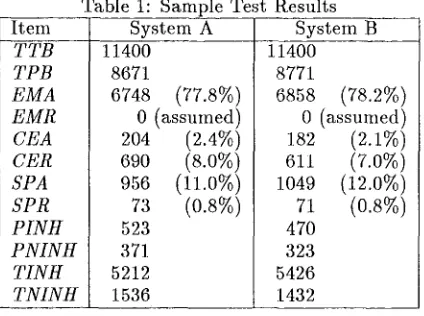
The resulting figures are in table 1 and table 2 gives the comparative items.
Table 1: Sample Test Results
Item
System A System BTTB TPB EMA EMR CEA CER SPA SPR P[NH PNINH
TINH TNINH
11400 8671
6748 (77.8%) O (assumed) 204 (2.4%) 690 (8.0%) 956 (11.0%) 73 (0.8%) 523
371 5212 1536
11400 8771
68 8 (78.2%)
0 (assumed)182
(2.1%)
611 (7.0%) 1049 (12.0%)71
(0.8%)
470323 5426 1432
Table 2: Comparative Measure Results
Y Y 6516 (57.2%)
YN 232 (2.0%)
N Y 343 (3.1%)
[image:3.596.307.519.462.620.2]5 N e w M e a s u r e s
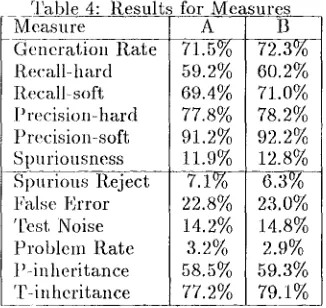
We claim t h a t the items listed in the previous p a r a g r a p h allows a nmre flexible framework for ewduatim~. In this p a r a g r a p h we will show some examt)les of measures t h a t can be used. T h e y can be calculated with these items so there is no need to discuss every one of t h e m all the time. Table 3 gives the measures and table 4 gives the results in percentages. ~l?he measures in the lower p a r t of this tabh> are more directed at the test t h a n at the parsers.
'['able
3:
MeasuresMeasnre
Generation Rate Recall-hard Recall-soft Precision-hm-d Precision-soft Spuriousness Spurious Reject False E r r o r Test Noise t)roblem Rate P - i n h e r i t a n c e 'l?-inheritance
Calculation
EMA / T"I'B
( EMA 4- CEA -I-SPA ) ~ TTB EMA / TPB
( EMA-t CEA-I-SPA ) / TPB (.gPA q-SPR) / fI't'B SPR?(SPA q-SPR)
P I N H / ( PIN H +
I'NINIt)
Table 4: Results for Measures
Measure A B
Generation R a t e P~ecall-hard Recall- soft
I'recision-
hard Precision-soft Spuriousness Spurious Reject False Error 'Pest Noise P r o b l e m R a t e l Lin heritance T - i n h e r i t a n c e59.2% !60.2%
69.4% 71.0% 77.8% , 78.2% 91.2% ! 9 2 . 2 %
11.9% 12.8%
22.8% 23.0% 14.2% 114.8% 3.2% ~ 2.9% 58.5% 59.3?/0 77.2% 179.1%
T h e
generation
rate shows t h a t b o t h systems arc r a t h e r m o d e s t in p r o d u c i n g brackets.We give two types of
recall.
We suggest using recall-lmrd, but when the t r e e b a n k does not indi- cate all brackets recall-soft m a y give an indication of the p r o p e r recall.We also present two types
of precision.
B scores b e t t e r onprecision-soft,
b u t there is n o t m u c h dif- ference forprecision-hard.
This shows t h a t B is b e t t e r at teeM1 b u t also generates nmre spnrious brackets. T h espuriousness
also indicates this.T h e other measures tell us more a b o u t the test itself. A would have been t r e a t e d slightly fa- vorable w i t h o u t a h u m a n cheek, since relatively
more errors go ' u n d e t e c t e d . ' False Error shows t h a t a l m o s t I o u t of 4 crossing errors is not re- ally wrong, which indicates there is much differ- ence in bracketing-style between the t r e e b a n k and the parsing system. 'rest Noise shows how m a n y bracket-pairs were not tested properly. P r o b l e m R a t e shows the real ' m y o p i a ' of the test.
3'he inheritance d a t a shows t h a t in our test; crossing errors are often related (P-inheritance). Also, r e p r o d u c i n g a p a r t i c u l a r bracket-pair from the t r e e b a n k increases the chances on r e p r o d u c i n g its p a r e n t (T-inheritance).
6
S i g n i f i c a n c eT h i n g s would be easy if we could assmne t h a t the chance of apl)lying a bracket is correctly modeled as a binomial experiment. We begin by mention- ing two reasons w h y t h a t is not possible.
• Errors t h a t are related, sneh a~s one wrong a t t a c h m e n t t h a t causes a n u m b e r of cross- ing errors, as was shown in our test by P- inheritance.
• For a binomial process we m a s t assume t h a t the chance on success is the same for every bracket pair. It is not, in fact there are b o t h very easy and very hard bracket pairs, with chances w~rying from very small to very high.
T h e significance levels of all differences are w o r t h knowing, b u t our main interest is the d i s ference between A and B in recall and precision. Because of space limitations we only discuss a s t r a t e g y for e s t i m a t i n g the significance level of the measure recall-hard.
Significance for Recall-Hard
First we will check w h e t h e r the distribution can be modeled properly with a binomial experiment. We do this by looking at the c o m p a r a t i v e itemsYY, YN, N Y
and
NN.
F r o m these values the problem is intuitively clear: there are m a n y easy bracket pairs t h a t b o t h always p r o d u c e correctly, a n d m a n y t h a t b o t h al- m o s t never p r o d u c e because they are too hard, or the parsing systems simply never p r o d u c e a cer- tain t y p e of bracket pair. Also, we have tested two r a t h e r similar parsing systems often giving the same answer, after all t h a t is often j u s t w h a t one is interested in because one wants to measnre im- provement. We will use statistical distributions to confirm this problem occurs, and to find a solution to the significance problem.
We do not have tile space to go into tile details of the relations between the distributions, b u t if A and B would behave like a binomial variable with test size N, with
Pa
and P~ as respective c h a n c e on success, the distribution ofY Y
should again be a binomial variable for test size N, with chancePry = PaPb.
T h e expected value and variance of [image:4.596.65.279.210.364.2] [image:4.596.90.253.406.560.2]E ( Y Y ) = N P y y = N P a P b
V ( Y Y ) = N P w ( 1 - Pyy) = N ( P a P b ) ( 1 - P..Pb)
For N N the distril~ution is the same with the opposite probabilities, a binomial variable for test size N a n d P,~, = ( 1 - P a ) ( 1 - Pb). If we take Pa = l - Pa and Pb = 1 -- Pb, the expected value and variance of N N become
E ( N N ) = N P , ~ . = N f i ~ g
V ( N N ) -- NP~,~(1 - Pnn) = N(Pa-Pb)(1 - P . P b )
We will later put this to more use, but for now we just use it to conclude that Y Y is expected to be around 4063, and N N is expected to be around 1851. Using the variation we find that the ob- served values are both extremely rare, so we can reject the hypothesis that we are comparing two binomial variables.
Our strategy to solve this problem is assuming there are three types of brackets, namely brack- ets that are ahnost always reproduced, those that are almost never reproduced, and those that are sometimes reproduced and therefore constitute the 'real test' between the two parsing systems. Note that the first two types do not tell us any- thing about the difference between the parsing systems. By assuming the rest is similar to a bi- nomial distribution, we can calculate the signif- icance. Of conrse this assumption simplifies the situation, but it is closer to the truth than assum- ing the whole test can be modeled by a binominal distribution. And, if this assumption is not jus- tified the whole test is not appropriate without testing on more specific phenomena.
G u e s s i n g t h e R e a l T e s t Size The idea behind this method is that some brackets are almost al- ways produced, and some are never, and those should be discarded so the real test remains. Ig- noring certain bracket pairs corresponds with the fact that some constituents relate to little and some to much ambiguity, making some suitable for comparison and others not. We look at the num- ber of equal answers to estimate the number of bracket-pairs that were not too easy or too hard.
This is a theoretical operation, thus there is no need to do this in practice. We only need to es- timate two parameters: M1 being the number of bracket-pairs that is discarded because they are always reproduced, and M2 being the number of bracket-pairs discarded because they are not re- produced. We reduce Y Y by M1, and N N by M2 (the test size is thus reduced by M1 4- M2). This indicates an imaginary real test, namely the part of the test that really served to compare the pars- ing systems.
We calculate these quantities by a~suming a bi- nomial distribution for the real test, and making
sure that the corrected values for Y Y and N N be- come equal to their expected value. Let
observed Y Y in real test = E ( Y Y ) in real test = real test size x Pa in real test x Pb in real test
then we get
Y Y - M 1 -- ( Y Y + Y N - M 1 ) ( Y Y + N Y - M1) T T B - M 1
We do not give the derivation, but when doing the same for N N and combining the equations the following relation between M 1 and M2 holds:
M 1 = NY×TTB+M2×YY-(NY++NN)(VY+NY~
M 2 - N N
There are usually rnany values for M1 and M2 that satisfy this condition. In practice M1 and M2 have to be discrete values, so they often are not satisfying the condition exactly, but are close enough.
It may seem logical to find the proper values for M1 and M2 as a next step, in other words deciding how many brackets were 'too easy' and how many were 'too hard.' But our experience is that there is no need to do that, because we are only interested in the significance level of the difference between A and B, and the significance level is practically the same for all values of M1 and M2 that satisfy the condition.
As for our test, M1 and M2 can be, for exam- ple, 6234 and 4027 respectively. W h a t e v e r value
we take, the significance level o{" t h e difference be-
tween A and B corresponds to being 4.7 standard
variations away from the expected value. This means that we can safely conclude that B re- ally performs better than A. The real test is a lot smMler, only 1139 bracket pairs, but that is still enough to be meaningful. (If the nmnber of eqnM answers would be extremely high, the real test size ruay become too small, indicating the test is meaningless.)
7
C o n c l u s i o n
We have pointed out that the measures which are currently in use have a number of weaknesses. To list the most important ones, a number of aspects of parsing systems are not measured, treebanks contain arbitrary choices, some errors are not de- tected and discovering statistical significance is difficult.
We suggest giving the regular items on every test, and sometimes doing a hmnan check to dis- cover the quality of the regular test. T h e a m o u n t of work in the hmnan check can be made small when the recall of the parsing systems is high, by assuming the exact matches are correct.
We have also given a strategy for calculating the significance level of differences in scores on one particular measure, namely recall-hard. This strategy makes it possible to calculate the signif- icance level right away from the test items, not requiring a h a m a n check.
This discussion will certainly not be the last on this subject. We have not mentioned some quanti- ties such as the number of sentences with 1 cross- ing error, 2 crossing errors, and those with m a n y crossing errors. These are of course also useful tools for evaluation. We have also not mentioned the Parse Base (calculated as the geometric mean over all sentences of ~ , where n is the number of words in the sentence and p the n u m b e r of parses tbr the sentence), because t h a t relates to a gram- m a r rather than a parsing system. Nevertheless we feel this will help to improve the evaluation of broad coverage parsing systems.
Language Processing Systems, Association for
Computational Linguistics.
J a p a n Electronic Dictionary Research Institute, Ltd. 1995.
EDR Electronic Dictionary 7~chni-
cal Guide.
D. Lin. 1995. A dependency-based method for evaluating broad-coverage parsers. In
Proceed-
ings of the 14th International Joint Conference
on Artificial Intelligence,
pages 1420 1425. D. M. Magerman. 1995. Statistical decision-treemodels for parsing, in
Proceedings of the 33d
Annual Meeting of the Association for Compu-
tational Linguistics,
pages 276-283.F. Pereira and Y. Schabes. 1992. Inside Outside reestimation from partially bracketed corpora. In
Proceedings of the 30th Annual Meeting of
the Association for Computational Linguistics,
pages 128-]35.
Y. Sehabes, M. Roth, and R. Osborne. 1993. Parsing the wall street journal with the inside- outside algorithm. In
Proceedings of the Sixth
Conference of the European Chapter of the As-
sociation for Computational Linguistics,
pages 34]-347.R e f e r e n c e s
E. Black, S. Abney, D. Flickenger, C. Gdaniec, R. Grishman, P. Harrison, D. Hindle, R. Ingria, F. Jelinek, J. Klavans, M. I,iberman, M. Mar- cus, S. t{oukos, B. Santorini, and T. Strza- lkowski. 1991. A procedure for quantitatively comparing the syntactic coverage of English grammars. In
Proceedings of the Workshop
on Spcech. and Natural Language, Defense Ad-
vanced Research Projects Agency, U.S. Govt.,
pages 306-311.
E. Black, R. Garside, and G. Leech. 1993.
Statis-
tically Driven Computer Grammars of English:
The IBM/Lancaster Approach.
Rodopi.E. Black, F. Jelinek, J. Lafferty, and D. M. Mager- man. 1993. Towards history-based grammars: Using richer models for probabilistic parsing. In
Proceedings of the 31st Annual Meeting of
the Association for Computational Linguistics,
pages 31--37.
R. Bod. 1993. Using an a n n o t a t e d corpus as a stochastic g r a m m a r . In
Proceedings of the Sixth
Conference of the European Chapter of the As-
sociation for Computational Linguistics,
pages 37-44.