Extending corpus-based identification of light verb constructions
using a supervised learning framework
Yee Fan Tan, Min-Yen Kan and Hang Cui Department of Computer Science National University of Singapore 3 Science Drive 2, Singapore 117543
{tanyeefa, kanmy, cuihang}@comp.nus.edu.sg
Abstract
Light verb constructions (LVCs), such as “make a call” in English, can be said to be complex predicates in which the verb plays only a functional role. LVCs pose challenges for natural language un-derstanding, as their semantics differ from usual predicate structures. We extend the existing corpus-based measures for iden-tifying LVCs between verb-object pairs in English, by proposing using new fea-tures that use mutual information and as-sess other syntactic properties. Our work also incorporates both existing and new LVC features into a machine learning ap-proach. We experimentally show that us-ing the proposed framework incorporat-ing all features outperforms previous work by 17%. As machine learning techniques model the trends found in training data, we believe the proposed LVC detection framework and statistical features is easily extendable to other languages.
1 Introduction
Many applications in natural language processing rely on the relationships between words in a docu-ment. Verbs play a central role in many such tasks; for example, the assignment of semantic roles to noun phrases in a sentence heavily depends on the verb that link the noun phrases together (as in “Pierre Vinken/SUBJ, will join/PRED, the board/OBJ”).
However, verb processing is difficult because of many phenomena, such as normalization of ac-tions, verb particle constructions and light verb constructions. Applications that process verbs
must handle these cases effectively. We focus on the identification of light verb constructions (also known as support verb constructions) in English, as such constructions play a prominent and pro-ductive role in many other languages (Butt and Geuder, 2001; Miyamoto, 2000). Although the exact definition of a LVC varies in the literature, we use the following operational definition:
A light verb construction (LVC) is a verb-complement pair in which the verb has little lexical meaning (is “light”) and much of the semantic content of the con-struction is obtained from the comple-ment.
Examples of LVCs in English include “give a speech”, “make good (on)” and “take (NP) into account”. In the case in which the complement is a noun, it is often a deverbal noun and, as such, can usually be paraphrased using the object’s root verb form without (much) loss in its meaning (e.g., take a walk→walk, make a decision→decide, give a speech→speak).
We propose a corpus-based approach to de-termine whether a verb-object pair is a LVC. Note that we limit the scope of LVC detection to LVCs consisting of verbs with noun complements. Specifically, we extend previous work done by others by examining how the local context of the candidate construction and the corpus-wide fre-quency of related words to the construction play an influence on the lightness of the verb.
im-provements of our features on our corpus. Our corpus-based evaluation shows that the combina-tion of previous work and our new features im-proves LVC detection significantly over previous work.
An advantage gained by adopting a machine learning framework is that it can be easily adapted to other languages that also exhibit light verbs. While we perform evaluations on English, light verbs exist in most other languages. In some of these languages, such as Persian, most actions are expressed as LVCs rather than single-word verbs (Butt, 2003). As such, there is currently a un-met demand for developing an adaptable frame-work for LVC detection that applies across lan-guages. We believe the features proposed in this paper would also be effective in identifying light verbs in other languages.
We first review previous corpus-based ap-proaches to LVC detection in Section 2. In Section 3, we show how we extend the use of mutual infor-mation and employ context modeling as features for improved LVC detection. We next describe our corpus processing and how we compiled our gold standard judgments used for supervised machine learning. In Section 4, we evaluate several feature combinations before concluding the paper.
2 Related Work
With the recent availability of large corpora, statis-tical methods that leverage syntactic features are a current trend. This is the case for LVC detection as well.
Grefenstette and Teufel (1995) considered a similar task of identifying the most probable light verb for a given deverbal noun. Their approach fo-cused on the deverbal noun and occurrences of the noun’s verbal form, arguing that the deverbal noun retains much of the verbal characteristics in the LVCs. To distinguish the LVC from other verb-object pairs, the deverbal noun must share similar argument/adjunct structures with its verbal coun-terpart. Verbs that appear often with these char-acteristic deverbal noun forms are deemed light verbs. They approximate the identification of ar-gument/adjunct structures by using the preposition head of prepositional phrases that occur after the verb or object of interest.
Let n be a deverbal noun whose most likely light verb is to be found. Denote its verbal form by v0, and letP be the set containing the three most
frequently occurring prepositions that occur after v0. The verb-object pairs that are not followed by a preposition in P are filtered out. For any verb v, letg(v, n)be the count of verb-object pairsv-n that remain after the filtering step above. Grefen-stette and Teufel proposed that the light verb forn be returned by the following equation:
GT95(n) = arg max v
g(v, n) (1)
Interestingly, Grefenstette and Teufel indicated that their subsequent experiments suggested that the filtering step may not be necessary.
Whereas the GT95 measure centers on the de-verbal object, Dras and Johnson (1996) also con-sider the verb’s corpus frequency. The use of this complementary information improves LVC iden-tification, as it models the inherent bias of some verbs to be used more often as light verbs than oth-ers. Letf(v, n)be the count of verb-object pairs occurring in the corpus, such thatvis the verb, n is a deverbal noun. Then, the most probable light verb fornis given by:
DJ96(n) = arg max v
f(v, n)X n
f(v, n) (2)
Stevenson et al. (2004)’s research examines ev-idence from constructions featuring determiners. They focused on expressions of the form v-a-n and v-det-n, where v is a light verb, n is a de-verbal noun,ais an indefinite determiner (namely, “a” or “an”), anddetis any determiner other than the indefinite. Examples of such constructions are “give a speech” and “take a walk”. They employ mutual information which measures the frequency of co-occurrences of two variables, corrected for random agreement. LetI(x, y)be the mutual in-formation between x and y. Then the following measure can be used:
SFN04(v, n) = 2×I(v, a-n)−I(v, det-n), (3)
where higher values indicate a higher likelihood of v-a-nbeing a light verb construction. Also, they suggested that the determiner “the” be excluded from the development data since it frequently oc-curred in their data.
noccurring in the corpus, (2) the probability thatn is part of any LVC givenn, and (3) the probability ofvoccurring givennand thatv-nis a LVC. Each of these three probabilities can then be estimated by the frequency of occurrence in the corpus, us-ing the assumption that all instances ofv0-a-nis a LVC, wherev0is any light verb andais an indefi-nite determiner.
To summarize, research in LVC detection started by developing single measures that utilized simple frequency counts of verbs and their com-plements. From this starting point, research has developed in two different directions: using more informed measures for word association (specifi-cally, mutual information) and modeling the con-text of the verb-complement pair.
Both the GT95 and DJ96 measures suffer from using frequency counts directly. Verbs that are not light but occur very frequently (such as “buy” and “sell” in the Wall Street Journal) will be marked by these measures. As such, given a deverbal noun, they sometimes suggest verbs that are not light. We hypothesize that substituting MI for frequency count can alleviate this problem.
The SFN04 metric adds in the context provided by determiners to augment LVC detection. This measure may work well for LVCs that are marked by determiners, but excludes a large portion of LVCs that are composed without determiners. To design a robust LVC detector requires integrating such specific contextual evidence with other gen-eral evidence.
Building on this, Fazly et al. (2005) incorpo-rate an estimation of the probability that a cer-tain noun is part of a LVC. However, like SFN04, LVCs without determiners are excluded.
3 Framework and Features
Previous work has shown that different measures based on corpus statistics can assist in LVC detec-tion. However, it is not clear to what degree these different measures overlap and can be used to re-inforce each other’s results. We solve this problem by viewing LVC detection as a supervised clas-sification problem. Such a framework can inte-grate the various measures and enable us to test their combinations in a generic manner. Specifi-cally, each verb-object pair constitutes an individ-ual classification instance, which possesses a set of featuresf1, . . . , fnand is assigned a class label from the binary classification of{LV C,¬LV C}.
In such a machine learning framework, each of the aforementioned metrics are separate features.
In our work, we have examined three different sets of features for LVC classification: (1) base, (2) extended and (3) new features. We start by de-riving three base features from key LVC detection measures as described by previous work – GT95, DJ96 and SFN04. As suggested in the previous section, we can make alternate formulations of the past work, such as to discard a pre-filtering step (i.e. filtering of constructions that do not include the top three most frequent prepositions). These measures make up the extended feature set. The third set of features are new and have not been used for LVC identification before. These include features that further model the influence of context (e.g. prepositions after the object) in LVC detec-tion.
3.1 Base Features
These features are based on the original previ-ous work discussed in Section 2, but have been adapted to give a numeric score. We use the ini-tials of the original authors without year of publi-cation to denote our derived base features.
Recall that the aim of the original GT95 and DJ96 formulae is to rank the possible support verbs given a deverbal noun. As each of these for-mulae contain a function which returns a numeric score inside thearg maxv, we use these functions as two of our base features:
GT(v, n) =g(v, n) (4)
DJ(v, n) =f(v, n)X n
f(v, n) (5)
The SFN04 measure can be used without modifi-cation as our third base feature, and it will be re-ferred to as SFN for the remainder of this paper.
3.2 Extended Features
Since Grefenstette and Teufel indicated that the filtering step might not be necessary, i.e.,f(v, n) may be used instead of g(v, n), we also have the following extended feature:
FREQ(v, n) =f(v, n) (6)
In addition, we experiment with the reverse pro-cess for the DJ feature, i.e., to replace f(v, n) in the function for DJ withg(v, n), yielding the fol-lowing extended feature:
DJ-FILTER(v, n) =g(v, n)X n
In Grefenstette and Teufel’s experiments, they used the top three prepositions for filtering. We further experiment with using all possible prepo-sitions.
3.3 New Features
In our new feature set, we introduce features that we feel better model the v and n components as well as their joint occurrencesv-n. We also intro-duce features that model thev-npair’s context, in terms of deverbal counts, derived from our under-standing of LVCs.
Most of these new features we propose are not good measures for LVC detection by themselves. However, the additional evidence that they give can be combined with the base features to create a better composite classification system.
Mutual information: We observe that a verb v and a deverbal noun nare more likely to appear in verb-object pairs if they can form a LVC. To capture this evidence, we employ mutual informa-tion to measure the co-occurrences of a verb and a noun in verb-object pairs. Formally, the mutual information between a verbvand a deverbal noun nis defined as
I(v, n) = log2 P(v, n)
P(v)P(n), (8)
whereP(v, n) denotes the probability ofvand n constructing verb-object pairs. P(v) is the prob-ability of occurrence of v and P(n) represents the probability of occurrence of n. Let f(v, n) be the frequency of occurrence of the verb-object pair v-nand N be the number of all verb-object pairs in the corpus. We can estimate the above probabilities using their maximum likelihood esti-mates: P(v, n) = f(Nv,n),P(v) =
P
nf(v,n) N and P(n) =
P
vf(v,n) N .
However, I(v, n) only measures the local in-formation of co-occurrences between vand n. It does not capture the global frequency of verb-object pairv-n, which is demonstrated as effective by Dras and Johnson (1996). As such, we need to combine the local mutual information with the global frequency of the verb-object pair. We thus create the following feature, where the log func-tion is used to smooth frequencies:
MI-LOGFREQ=I(v, n)×log2f(v, n) (9)
Deverbal counts: Suppose a verb-object pairv -n is a LVC and the object n should be a dever-bal noun. We denotev0 to be the verbalized form
ofn. We thus expect that v-nshould express the same semantic meaning as that of v0. However, verb-object pairs such as “have time” and “have right” in English scored high by the DJ and MI-LOGFREQ measures, even though the verbalized form of their objects, i.e., “time” and “right”, do not express the same meaning as the verb-object pairs do. This is corroborated by Grefenstette and Teufel claim that if a verb-object pair v-n is a LVC, then nshould share similar properties with v0. Based on our empirical analysis on the corpus using a small subset of LVCs, we believe that:
1. The frequencies ofnandv0 should not differ very much, and
2. Both frequencies are high given the fact that LVCs occur frequently in the text.
The first observation is true in our corpus where light verb and verbalized forms are freely inter-changable in contexts. Then, let us denote the fre-quencies ofnandv0 to bef(n)andf(v0) respec-tively. We devise a novel feature based on the hy-potheses:
min(f(n), f(v0))
max(f(n), f(v0))×min(f(n), f(v
0)) (10)
where the two terms correspond to the above two hypotheses respectively. A higher score from this metric indicates a higher likelihood of the com-pound being a LVC.
One may ask whether this feature is necessary, given the various features used to measure the fre-quency of the verb. As all of the other metrics are corpus-based, they rely on the corpus to be a repre-sentative sample of the source language. Since we extract the verb-object pairs from the Wall Street Journal section of the Penn Treebank, terms like “buy”, “sell”, “buy share” and “sell share” occur frequently in the corpus that verb-object pairs such as “buy share” and “sell share” are ranked high by most of the measures. However, “buy” and “sell” are not considered as light verbs. In addition, the various light verbs have different behaviors. Despite their lightness, different light verbs com-bined with the same noun complement often gives different semantics, and hence affect the lightness of the verb-object pair. For example, one may say that “make copy” is lighter than “put copy”. Incor-porating this small amount of linguistic knowledge into our corpus-based framework can enhance per-formance.
Other features: In addition to the above fea-tures, we also used the following features: the de-terminer before the object, the adjective before the object, the identity of any preposition immediately following the object, the length of the noun object (if a phrase) and the number of words between the verb and its object. These features did not improve performance significantly, so we have omitted a detailed description of these features.
4 Evaluation
In this section, we report the details of our exper-imental settings and results. First, we show how we constructed our labeled LVC corpus, used as the gold standard in both training and testing un-der cross validation. Second, we describe the eval-uation setup and discuss the experimental results obtained based on the labeled data.
4.1 Data Preparation
Some of the features rely on a correct sentence parse. In order to minimize this source of error, we employ the Wall Street Journal section in the Penn Treebank, which has been manually parsed by linguists. We extract verb-object pairs from the Penn Treebank corpus and lemmatize them using WordNet’s morphology module. As a filter, we re-quire that a pair’s object be a deverbal noun to be considered as a LVC. Specifically, we use Word-Net to check whether a noun has a verb as one of
its derivationally-related forms. A total of 24,647 candidate verb-object pairs are extracted, of which 15,707 are unique.
As the resulting dataset is too large for complete manual annotation given our resources, we sam-ple the verb-object pairs from the extracted set. As most verb-object pairs are not LVCs, random sampling would provide very few positive LVC in-stances, and thus would adversely affect the train-ing of the classifier due to sparse data. Our aim in the sampling is to have balanced numbers of po-tential positive and negative instances. Based on the 24,647 verb-object pairs, we count the corpus frequencies of each verbvand each objectn, de-noted asf(v)and f(n). We also calculate the DJ score of the verb-object pair DJ(v, n)by counting the pair frequencies. The data set is divided into 5 bins using f(v) on a linear scale, 5 bins using f(n) on a linear scale and 4 bins using DJ(v, n) on a logarithmic scale.1 We cross-multiply these three factors to generate 5×5×4 = 100 bins. Finally, we uniformly sampled 2,840 verb-object pairs from all the bins to construct the data set for labeling.
4.2 Annotation
As noted by many linguistic studies, the verb in a LVC is often not completely vacuous, as they can serve to emphasize the proposition’s aspect, its argument’s semantics (cf.,θroles) (Miyamoto, 2000), or other function (Butt and Geuder, 2001). As such, previous computational research had pro-posed that the “lightness” of a LVC might be best modeled as a continuum as opposed to a binary class (Stevenson et al., 2004). We have thus anno-tated for two levels of lightness in our annotation of the verb-object pairs. Since the purpose of the work reported here is to flag all such constructions, we have simplified our task to a binary decision, similar to most other previous corpus-based work. A website was set up for the annotation task, so that annotators can participate interactively. For each selected verb-object pair, a question is constructed by displaying the sentence where the object pair is extracted, as well as the verb-object pair itself. The annotator is then asked whether the presented verb-object pair is a LVC given the context of the sentence, and he or she will choose from the following options: (1) Yes,
1Binning is the process of grouping measured data into
(2) Not sure, (3) No. The following three sen-tences illustrate the options.
(1) Yes – A Compaq Computer Corp. spokeswoman said that the company hasn’t made a decision yet, although “it isn’t under active consideration.”
(2) Not Sure – Besides money, criminals have also used computers to steal secrets and in-telligence, the newspaper said, but it gave no more details.
(3) No – But most companies are too afraid to take that chance.
The three authors, all natural language process-ing researchers, took part in the annotation task, and we asked all three of them to annotate on the same data. In total, we collected annotations for 741 questions. The average correlation coefficient between the three annotators isr = 0.654, which indicates fairly strong agreement between the an-notators. We constructed the gold standard data by considering the median of the three annotations for each question. Two gold standard data sets are created:
• Strict – In the strict data set, a verb-object pair is considered to be a LVC if the median annotation is 1.
• Lenient – In the lenient data set, a verb-object pair is considered to be a LVC if the median annotation is either 1 or 2.
Each of the strict and lenient data sets have 741 verb-object pairs.
4.3 Experiments
We have two aims for the experiments: (1) to com-pare between the various base features and the ex-tended features, and (2) to evaluate the effective-ness of our new features.
Using the Weka data mining toolkit (Witten and Frank, 2000), we have run a series of ex-periments with different machine learning algo-rithms. However, since our focus of the exper-iments is to determine which features are useful and not to evaluate the machine learners, we re-port the results achieved by the best single clas-sifier without additional tuning, the random for-est classifier (Breiman, 2001). Stratified ten-fold
cross-validation is performed. The evaluation cri-teria used is the F1-measure on the LV C class, which is defined as
F1= 2P R
P +R, (11)
whereP andRare the precision and recall for the LV Cclass respectively.
4.3.1 Base and Extended Features
Regarding the first aim, we make the following comparisons:
• GT (top 3 prepositions) versus GT (all prepo-sitions) and FREQ
• DJ versus DJ-FILTER (top 3 prepositions and all prepositions)
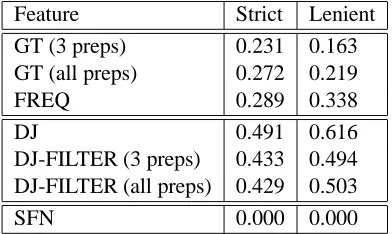
Feature Strict Lenient
GT (3 preps) 0.231 0.163
GT (all preps) 0.272 0.219
FREQ 0.289 0.338
DJ 0.491 0.616
DJ-FILTER (3 preps) 0.433 0.494 DJ-FILTER (all preps) 0.429 0.503
[image:6.595.319.515.318.435.2]SFN 0.000 0.000
Table 1: F1-measures of base features and ex-tended features.
We first present the results for the base features and the extended features in Table 1. From these results, we make the following observations:
• Overall, DJ and DJ-FILTER perform better than GT and FREQ. This is consistent with the results by Dras and Johnson (1996).
• The results for both GT/FREQ and DJ show that filtering using preposition does not im-pact performance significantly. We believe that the main reason for this is that the fil-tering process causes information to be lost. 163 of the 741 verb-object pairs in the corpus do not have a preposition following the object and hence cannot be properly classified using the features with filtering.
have used a corpus whose estimated size is at least 15.7 billion, the number of hits returned in a Google search for the query “the” as of February 2006. The large corpus requirement is thus a main weakness of the SFN metric.
4.3.2 New Features
We now evaluate the effectiveness of our class of new features. Here, we do not report results of classification using only the new features, because these features alone are not intended to constitute a stand-alone measure of the lightness. As such, we evaluate these new features by adding them on top of the base features. We first construct a full fea-ture set by utilizing the base feafea-tures (GT, DJ and SFN) and all the new features. We chose not to add the extended features to the full feature set because these extended features are not independent to the base features. Next, to show the effectiveness of each new feature individually, we remove it from the full feature set and show the performance of classifier without it.
Feature(s) Strict Lenient
GT (3 preps) 0.231 0.163
DJ 0.491 0.616
SFN 0.000 0.000
GT (3 preps) + DJ + SFN 0.537 0.676
FULL 0.576 0.689
- MI-LOGFREQ 0.545 0.660
- DEVERBAL 0.565 0.676
- LV-CLASS 0.532 0.640
Table 2: F1-measures of the various feature com-binations for our evaluation.
Table 2 shows the resulting F1-measures when using various sets of features in our experiments.2 We make the following observations:
• The combinations of features outperform the individual features. We observe that using in-dividual base features alone can achieve the highestF1-measure of 0.491 on the strict data set and 0.616 on the lenient data set respec-tively. When applying the combination of all base features, the F1-measures on both
2
For the strict data set, the base feature set has a preci-sion and recall of 0.674 and 0.446 respectively, while the full feature set has a precision and recall of 0.642 and 0.523 re-spectively. For the lenient data set, the base feature set has a precision and recall of 0.778 and 0.598 respectively, while the full feature set has a precision and recall of 0.768 and 0.624 respectively.
data sets increased to 0.537 and 0.676 respec-tively.
Previous work has mainly studied individ-ual statistics in identifying LVCs while ig-noring the integration of various statistics. The results demonstrate that integrating dif-ferent statistics (i.e. features) boosts the per-formance of LVC identification. More impor-tantly, we employ an off-the-shelf classifier without special parameter tuning. This shows that generic machine learning methods can be applied to the problem of LVC detection. It provides a sound way to integrate various fea-tures to improve the overall performance.
• Our new features boost the overall perfor-mance. Applying the newly proposed fea-tures on top of the base feature set, i.e., us-ing the full feature set, gives F1-measures of 0.576 and 0.689 respectively (shown in bold) in our experiments. These yield a sig-nificant increase (p < 0.1) over using the base features only. Further, when we remove each of the new features individually from the full feature set, we see a corresponding drop in theF1-measures, of 0.011 (deverbal counts) to 0.044 (light verb classes) for the strict data set, and 0.013 (deverbal counts) to 0.049 (light verb classes) for the lenient data set. It shows that these new features boost the overall performance of the classi-fier. We think that these new features are more task-specific and examine intrinsic fea-tures of LVCs. As such, integrated with the statistical base features, these features can be used to identify LVCs more accurately. It is worth noting that light verb class is a simple but important feature, providing the highest F1-measure improvement compared to other new features. This is in accordance with the observation that different light verbs have dif-ferent properties (Stevenson et al., 2004).
5 Conclusions
with identifying LVCs using a machine learning framework that integrates the use of various statis-tics. Moreover, we have extended the existing sta-tistical measures and established new features to detect LVCs.
Our experimental results show that the inte-grated use of different features in a machine learn-ing framework performs much better than uslearn-ing any of the features individually. In addition, we experimentally show that our newly-proposed fea-tures greatly boost the performance of classifiers that use base statistical features. Thus, our system achieves state-of-the-art performance over previ-ous approaches for identifying LVCs. As such, we suggest that future work on automatic detection of LVCs employ a machine learning framework that combines complementary features, and examine intrinsic features that characterize the local con-text of LVCs to achieve better performance.
While we have experimentally showed the ef-fectiveness of the proposed framework incorporat-ing existincorporat-ing and new features for LVC detection on an English corpus, we believe that the features we have introduced are generic and apply to LVC detection in other languages. The reason is three-fold:
1. Mutual information is a generic metric for measuring co-occurrences of light verbs and their complements. Such co-occurrences are often an obvious indicator for determining light verbs because light verbs are often cou-pled with a limited set of complements. For instance, in Chinese, directional verbs, such as xia (descend) and dao (reach), which are often used lightly, are often co-located with a certain class of verbs that are related to peo-ple’s behaviors.
2. For LVCs with noun complements, most of the semantic meaning of a LVC is expressed by the object. This also holds for other lan-guages, such as Chinese. For example, in Chinese, zuo xuanze (make a choice) and zuo jueding (make a decision) has the word zuo (make) acting as a light verb and xuan-ze (choice) or jueding (decision) acting as a deverbal noun (Wang, 2004). Therefore, the feature of deverbal count should also be ap-plicable for other languages.
3. It has been observed that in many languages, light verbs tend to be a set of closed class
verbs. This allows us to use a list of pre-defined verbs that are often used lightly as a feature which helps distinguish between light and non-light verbs when used with the same noun complement. The identity of such verbs has been shown to be largely independent of language, and corresponds to verbs that trans-mit information about possession, direction, aspect and causation.
References
T. Bjerre. 1999. Event structure and support verb
constructions. In 4th Student Session of European
Summer School on Logic, Language and Informa-tion 1999. Universiteit Utrecht Press, Aug, 1999.
L. Breiman. 2001. Random forests. Machine
Learn-ing, 45(1):5–32, Oct, 2001.
M. Butt and W. Geuder. 2001. On the (semi)lexical
status of light verbs. In Semi-lexical Categories,
pages 323–370. Mouton de Gruyter.
M. Butt. 2003. The light verb jungle. In Workshop on
Multi-Verb Constructions.
M. Dras and M. Johnson. 1996. Death and
light-ness: Using a demographic model to find support verbs. In 5th International Conference on the
Cog-nitive Science of Natural Language Processing.
A. Fazly, R. North, and S. Stevenson. 2005. Automat-ically distinguishing literal and figurative usages of highly polysemous verbs. In ACL 2005 Workshop
on Deep Lexical Acquisition, pages 38–47.
G. Grefenstette and S. Teufel. 1995. A corpus-based method for automatic identification of support verbs for nominalizations. In EACL ’95.
T. Miyamoto. 2000. The Light Verb Construction in
Japanese. The role of the verbal noun. John
Ben-jamins.
I. Sag, T. Baldwin, F. Bond, A. Copestake, and D. Flickinger. 2002. Multiword expressions: A pain in the neck for NLP. In Lecture Notes in Computer
Science, volume 2276, Jan, 2002.
S. Stevenson, A. Fazly, and R. North. 2004. Statisti-cal measures of the semi-productivity of light verb constructions. In 2nd ACL Workshop on Multiword
Expressions: Integrating Processing, pages 1–8.
L. Wang. 2004. A corpus-based study of mandarin verbs of doing. Concentric: Studies in Linguistics, 30(1):65–85, Jun, 2004.
I. Witten and E. Frank. 2000. Data Mining: Practical
machine learning tools with Java implementations.