Towards Large-scale Non-taxonomic Relation Extraction: Estimating the
Precision of Rote Extractors
∗Enrique Alfonseca∗†Maria Ruiz-Casado∗†
∗Precision and Intelligence Laboratory
Tokyo Institute of Techonology
[email protected] [email protected]
Manabu Okumura∗Pablo Castells†
†Computer Science Department
Universidad Autonoma de Madrid
[email protected] [email protected] [email protected]
Abstract
In this paper, we describe a rote extrac-tor that learns patterns for finding seman-tic relations in unrestricted text, with new procedures for pattern generalisation and scoring. An improved method for estimat-ing the precision of the extracted patterns is presented. We show that our method ap-proximates the precision values as evalu-ated by hand much better than the proce-dure traditionally used in rote extractors.
1 Introduction
With the large growth of the information stored in the web, it is necessary to have available automatic or semi-automatic tools so as to be able to process all this web content. Therefore, a large effort has been invested in developing automatic or semi-automatic techniques for locating and annotating patterns and implicit information from the web, a task known as Web Mining. In the particular case of web content mining, the aim is automati-cally mining data from textual web documents that can be represented with machine-readable seman-tic formalisms such as ontologies and semanseman-tic- semantic-web languages.
Recently, there is an increasing interest in au-tomatically extracting structured information from large corpora and, in particular, from the Web (Craven et al., 1999). Because of the character-istics of the web, it is necessary to develop effi-cient algorithms able to learn from unannotated data (Riloff and Schmelzenbach, 1998; Soderland, 1999; Mann and Yarowsky, 2005). New types of web content such as blogs and wikis, are also a
∗
This work has been sponsored by MEC, project number TIN-2005-06885.
source of textual information that contain an un-derlying structure from which specialist systems can benefit.
Consequently, rote extractors (Brin, 1998; Agichtein and Gravano, 2000; Ravichandran and Hovy, 2002) have been identified as an appropri-ate method to look for textual contexts that happen to convey a certain relation between two concepts. In this paper, we describe a new procedure for es-timating the precision of the patterns learnt by a rote extractor, and how it compares to previous ap-proaches. The solution proposed opens new pos-sibilities for improving the precision of the gener-ated patterns, as described below.
This paper is structured as follows: Section 2 describe related work; Section 3 and 4 describe the proposed procedure and its evaluation, and Sec-tion 5 presents the conclusions and future work.
2 Related work
Extracting information using Machine Learning algorithms has received much attention since the nineties, mainly motivated by the Message Understanding Conferences. From the mid-nineties, there are systems that learn extraction patterns from partially annotated and unannotated data (Huffman, 1995; Riloff, 1996; Riloff and Schmelzenbach, 1998; Soderland, 1999).
methods are also becoming widely used for rela-tion extracrela-tion (Bunescu and Mooney, 2005; Zhao and Grishman, 2005).
Concerning rote extractors from the web, they have the advantage that the training corpora can be collected easily and automatically, so they are useful in discovering many different relations from text. Several similar approaches have been proposed (Brin, 1998; Agichtein and Gravano, 2000; Ravichandran and Hovy, 2002), with vari-ous applications: Question-Answering (Ravichan-dran and Hovy, 2002), multi-document Named Entity Coreference (Mann and Yarowsky, 2003), and generating biographical information (Mann and Yarowsky, 2005). Szpektor et al. (2004) ap-plies a similar, with no seed lists, to extract auto-matically entailment relationships between verbs, and Etzioni et al. (2005) report very good results extracting Named Entities and relationships from the web.
2.1 Rote extractors
Rote extractors (Mann and Yarowsky, 2005) es-timate the probability of a relation r(p, q) given the surrounding context A1pA2qA3. This is
cal-culated, with a training corpus T, as the number of times that two related elementsr(x, y)fromT
appear with that same contextA1xA2yA3, divided
by the total number of times thatxappears in that context together with any other word:
P(r(p, q)|A1pA2qA3) = P
x,yrc(A1xA2yA3) P
x,zc(A1xA2zA3)
(1)
xis called thehook, andythetarget. In order to train a Rote extractor from the web, this procedure is mostly used (Ravichandran and Hovy, 2002):
1. Select a pair of related elements to be used as seed. For instance,(Dickens,1812)for the relationbirth year.
2. Submit the query Dickens AND 1812 to a search engine, and download a number of documents to build the training corpus. 3. Keep all the sentences containing both
ele-ments.
4. Extract the set of contexts between them and identify repeated patterns. This may just be the m characters to the left or to the right (Brin, 1998), the longest common substring of several contexts (Agichtein and Gravano, 2000), or all substrings obtained with a suf-fix tree constructor (Ravichandran and Hovy, 2002).
5. Download a separate corpus, calledhook cor-pus, containing just the hook (in the example,
Dickens).
6. Apply the previous patterns to the hook cor-pus, calculate the precision of each pattern in the following way: the number of times it identifies a target related to the hook divided by the total number of times the pattern ap-pears.
7. Repeat the procedure for other examples of the same relation.
To illustrate this process, let us suppose that we want to learn patterns to identify birth years. We may start with the pair (Dickens,1812). From the downloaded corpus, we extract sentences such as
Dickens was born in 1812
Dickens (1812 - 1870) was an English writer Dickens (1812 - 1870) wrote Oliver Twist
The system identifies that the contexts of the last two sentences are very similar and chooses their longest common substring to produce the follow-ing patterns:
<hook> was born in <target> <hook> ( <target> - 1870 )
The rote extractor needs to estimate automati-cally the precision of the extracted patterns, in or-der to keep the best ones. So as to measure these precision values, a hook corpus is now down-loaded using the hookDickens as the only query word, and the system looks for appearances of the patterns in this corpus. For every occurrence in which the hook of the relation is Dickens, if the target is 1812 it will be deemed correct, and oth-erwise it will be deemed incorrect (e.g. inDickens was born in Portsmouth).
3 Our proposal
3.1 Motivation
In a rote extractor as described above, we believe that the procedure for calculating the precision of the patterns may be unreliable in some cases. For example, the following patterns are reported by Ravichandran and Hovy (2002) for identifying the relations Inventor, Discoverer and Location:
Relation Prec. Pattern
Inventor 1.0 <target>’s<hook>and Inventor 1.0 that<target>’s<hook>
Discoverer 0.91 of<target>’s<hook>
Location 1.0 <target>’s<hook>
looking for an invention, a discovery or a location. However, if we want to apply them to unrestricted relation extraction, we have the problem that the same pattern, the genitive construction, represents all these relations, apart from the most common use indicating possession.
If patterns like these are so ambiguous, then why do they receive so high a precision estimate? One reason is that the patterns are only evalu-ated for the same hook for which they were ex-tracted. To illustrate this with an example, let us suppose that we obtain a pattern for the rela-tionlocated-atusing the pairs(New York, Chrysler Building). The genitive construction can be ex-tracted from the context New York’s Chrysler Building. Afterwards, when estimating the pre-cision of this pattern, only sentences containing
<target>’s Chrysler Building are taken into ac-count. Because of this, most of the pairs extracted by this pattern may extract the target New York, apart from a few that extract the name of the ar-chitect that built it,van Allen. Thus we can expect that the genitive pattern will receive a high preci-sion estimate as alocated-atpattern.
For our purposes, however, we want to collect patterns for several relations such aswriter-book,
painter-picture, director-film, actor-film, and we want to make sure that the obtained patterns are only applicable to the desired relation. Patterns like<target>’s<hook>are very likely to be ap-plicable to all of these relations at the same time, so we would like to be able to discard them auto-matically by assigning them a low precision.
3.2 Suggested improvements
Therefore, we propose the following three im-provements to this procedure:
1. Collecting not only ahook corpusbut also a
target corpusshould help in calculating the precision. In the example of the Chrysler building, we have seen that in most cases that we look for the pattern‘s Chrysler build-ing the previous words are New York, and so the pattern is considered accurate. How-ever, if we look for the pattern New York’s, we shall surely find it followed by many dif-ferent terms representing difdif-ferent relations, and the precision estimate will decrease. 2. Testing the patterns obtained for one relation
using the hook and target corpora collected for other relations. For instance, if the
geni-tive construction has been extracted as a pos-sible pattern for thewriter-bookrelation, and we apply it to a corpus about painters, the rote extractor can detect that it also extracts pairs with painters and paintings, so that particular pattern will not be very precise for that rela-tion.
3. Many of the pairs extracted by the patterns in the hook corpora were not evaluated at all when the hook in the extracted pair was not present in the seed lists. To overcome this, we propose to use the web to check whether the extracted pair might be correct, as shown below.
3.3 Algorithm
In our implementation, the rote extractor starts with a table containing some information about the relations for which we want to learn patterns. This procedure needs a little more information than just the seed list, which is provided as a table in the format displayed in Table 1. The data provided for each relation is the following: (a) Thename of the relation, used for naming the output files ing the patterns; (b) the name of the file contain-ing theseed list; (c) the cardinality of the relation. For instance, given that many people can be born on the same year, but for every person there is just one birth year, the cardinality of the relationbirth year is n:1; (d) therestrictions on the hook and the target. These can be of the following three cat-egories:unrestricted, if the pattern can extract any sequence of words as hook or target of the relation,
Entity, if the pattern can extract as hook or target only things of the same entity type as the words in the seed list (as annotated by the NERC mod-ule), orPoS, if the pattern can extract as hook or target any sequence of words whose sequence of PoS labels was seen in the training corpus; and (e) a sequence ofqueriesthat could be used to check, using the web, whether an extracted pair is correct or not.
We assume that the system has used the seed list to extract and generalise a set of patterns for each of the relations using training corpora (Ravichan-dran and Hovy, 2002; Alfonseca et al., 2006a). Our procedure for calculating the patterns’ preci-sions is as follows:
1. For every relation,
(a) For every hook, collect a hook corpus
Relation name Seed-list Cardinality Hook-type Target-type Web queries birth year birth-date.txt n:1 entity entity $1 was born in $2 death year death-date.txt n:1 entity entity $1 died in $2 birth place birth-place.txt n:1 entity entity $1 was born in $2 country-capital country-capital.txt 1:1 entity entity $2 is the capital of $1 author-book author-book.txt n:n entity unrestricted $1 is the author of $2
director-film director-film.txt 1:n entity unrestricted $1 directed $2, $2 directed by $1
Table 1:Example rows in the input table for the system.
(b) For everytarget, collect atarget corpus
from the web. 2. For every relationr,
(a) For every pattern P, collected during training, apply it to every hook and tar-get corpora to extract a set of pairs. For every pairp= (ph, pt),
• If it appears in the seed list ofr, con-sider it correct.
• If it appears in the seed list of other relation, consider it incorrect.
• If the hookphappears in the seed list
ofr with a different target, and the cardinality is 1:1 or n:1, consider it incorrect.
• If the targetptappears inr’s seed list
with a different hook, and the cardi-nality is 1:1 or 1:n, incorrect.
• Otherwise, the seed list does not provide enough information to eval-uate p, so we perform a test on the web. For every query provided forr, the system replaces $1 with ph and
$2 with pt, and sends the query to
Google. The pair is deemed correct if and only if there is at least one an-swer.
The precision of P is estimated as the number of extracted pairs that are sup-posedly correct divided by the total number of pairs extracted.
In this step, every pattern that did not apply at least twice in the hook and target corpora is also discarded.
3.4 Example
After collecting and generalising patterns for the relation director-film, we apply each pat-tern to the hook and target corpora collected for every relation. Let us suppose that we want to estimate the precision of the pattern
<target>’s<hook>
and we apply it to the hook and the target
cor-pora for this relation and for author-book. Pos-sible pairs extracted are(Woody Allen, Bananas), (Woody Allen, Without Fears), (Charles Dickens, A Christmas Carol). Only the first one is correct. The rote extractor proceeds as follows:
• The first pair appears in the seed list, so it is considered correct.
• AlthoughWoody Allenappears as hook in the seed list andWithout Fearsdoes not appear as target, the second pair is still not considered incorrect because thedirected-byrelation has n:n cardinality.
• The third pair appears in the seed list for
writer-book, so it is directly marked as incor-rect.
• Finally, because still the system has not made a decision about the second pair, it queries Google with the sequences
Woody Allen directed Without Fears Without Fears directed by Woody Allen
Because neither of those queries provide any answer, it is considered incorrect.
In this way, it can be expected that the patterns that are equally applicable to several relations, such as writer-book, director-film or painter-picture will attain a low precision because they will extract many incorrect relations from the cor-pora corresponding to the other relations.
4 Experiment and results
4.1 Rote extractor settings
Birth year:
BOS/BOS<hook>(/( <target>-/- number/entity )/) EOS/EOS
BOS/BOS<hook>(/( <target>-/- number/entity )/) British/JJ writer/NN
BOS/BOS<hook>was/VBD born/VBN on/IN the/DT first/JJ of/IN time expr/entity ,/,<target>,/, at/IN location/entity ,/, of/IN BOS/BOS<hook>(/( <target>-/- )/) a/DT web/NN guide/NN
Birth place:
BOS/BOS<hook>was/VBD born/VBN in/IN <target>,/, in/IN central/JJ location/entity ,/,
BOS/BOS<hook>was/VBD born/VBN in/IN <target>date/entity and/CC moved/VBD to/TO location/entity BOS/BOS Artist/NN :/,<hook>-/- <target>,/, location/entity (/( number/entity
-/-BOS/BOS<hook>,/, born/VBN in/IN<target>on/IN date/entity ,/, worked/VBN as/IN
Author-book:
BOS/BOS<hook>author/NN of/IN<target>EOS/EOS
BOS/BOS Odysseus/NNP :/, Based/VBN on/IN <target>,/, <hook>’s/POS epic/NN from/IN Greek/JJ mythology/NN BOS/BOS Background/NN on/IN <target>by/IN<hook>EOS/EOS
did/VBD the/DT circumstances/NNS in/IN which/WDT <hook>wrote/VBD "/’’<target>"/’’ in/IN number/entity ,/, and/CC
Capital-country:
BOS/BOS<hook>is/VBZ the/DT capital/NN of/IN <target>location/entity ,/, location/entity correct/JJ time/NN
BOS/BOS The/DT harbor/NN in/IN <hook>,/, the/DT capital/NN of/IN <target>,/, is/VBZ number/entity of/IN location/entity BOS/BOS<hook>,/, <target>EOS/EOS
[image:5.595.326.505.261.404.2]BOS/BOS<hook>,/, <target>-/- organization/entity EOS/EOS
Figure 1:Example patterns extracted from the training corpus for each several kinds of relations.
stores in a separate file the way in which they are annotated in the training corpus: the sequences of part-of-speech tags of every appearance, and the entity type (if marked as such). So, for instance, typical PoS sequences for names of authors are “NNP”1 (surname) and “NNP NNP” (first name and surname). A typical entity kind for an author isperson.
In the case that a pair from the seed list is found in a sentence, a context around the two words in the pair is extracted, including (a) at most five words to the left of the first word; (b) all the words in between the pair words; (c) at most five words to the right of the second word. The context never jumps over sentence boundaries, which are marked with the symbols BOS (Beginning of sen-tence) and EOS (End of sentence). The two related concepts are marked as <hook> and <target>. Figure 1 shows several example contexts extracted for the relations birth year, birth place, writer-bookandcountry-capital city.
The approach followed for the generalisation is the one described by (Alfonseca et al., 2006a; Ruiz-Casado et al., in press), which has a few modifications with respect to Ravichandran and Hovy (2002)’s, such as the use of the wildcard * to represent any sequence of words, and the addition of part-of-speech and Named Entity labels to the patterns.
The input table has been built with the fol-lowing nineteen relations: birth year, death year, birth place, death place, author–book, actor– film, director–film, painter–painting, Employee– organisation, chief of state, soccer player–team,
1
All the PoS examples in this paper are done with Penn Treebank labels.
Relation Seeds Extr. Gener. Filt.
Birth year 244 2374 4748 30
Death year 216 2178 4356 14
Birth place 169 764 1528 28
Death place 76 295 590 6
Author-book 198 8297 16594 283
Actor-film 49 739 1478 3
Director-film 85 6933 13866 200
Painter-painting 92 597 1194 15
Employee-organisation 62 1667 3334 6
Chief of state 55 1989 3978 8
Soccer player-team 194 4259 8518 39
Soccer team-city 185 180 360 0
Soccer team-manager 43 994 1988 9
Country/region-capital city 222 4533 9066 107
Country/region-area 226 762 1524 2
Country/region-population 288 318 636 3
Country-bordering country 157 6828 13656 240
Country-inhabitant 228 2711 5422 17
Country-continent 197 1606 3212 21
Table 2: Number of seed pairs for each relation, and number of unique patterns in each step.
soccer team-city, soccer team-manager, country or region–capital city, country or region–area, country or region–population, country–bordering country, country-name of inhabitant (e.g. Spain-Spaniard), and country-continent. The time re-quired to build the table and the seed lists was less than one person-day, as some of the seed lists were directly collected from web pages.
For each step, the following settings have been set:
• The size of the training corpus has been set to 50 documents for each pair in the original seed lists. Given that the typical sizes of the lists collected are between 50 and 300 pairs, this means that several thousand documents are downloaded for each relation.
No. Pattern Applied Prec1 Prec2 Real
1
[image:6.595.92.519.52.416.2] [image:6.595.92.509.54.415.2]Biography|Hymns|Infography|Life|Love|POETRY|Poetry|Quotations| Search|Sketch|Woolf|charts|genius|kindness|poets/NN */* OF|Of|about|by|for|from|like|of/IN<hook>(/( <target>
-/-6 1.00 1.00 1.00
2 "/’’<hook>(/(<target>-/- 4 1.00 1.00 1.00
3 [BOS]/[BOS]<hook>was/VBD born/VBN about|around|in/IN <target>
B.C.|B.C.E|BC/NNP at|in/IN 3 1.00 1.00 1.00
4 [BOS]/[BOS]<hook>was/VBD born/VBN about|around|in/IN <target>
B.C.|B.C.E|BC/NNP at|in/IN location/entity 3 1.00 1.00 1.00
5 [BOS]/[BOS]location/entity ,/, a/DT<hook>was/VBD born/VBN around/IN <target> B.C.E/NNP at/IN 3 1.00 1.00 1.00
6 [BOS]/[BOS]at|in/IN location/entity ,/,<hook>was/VBD born/VBN around|in/IN <target>B.C.|B.C.E/NNP 3 1.00 1.00 1.00
7
[BOS]/[BOS] */* ATTRIBUTION|Artist|Author|Authors|Composer|Details| Email|Extractions|Myth|PAL|Person|Quotes|Title|Topic/NNP :/,<hook>(/( <target>
-/-3 1.00 1.00 1.00
8
classical/JJ playwrights/NNS of/IN organisation/entity ,/,<hook>was/VBD born/VBN near/IN location/entity in/IN<target>BCE/NNP ,/, in/IN the/DT village/NN
3 1.00 1.00 1.00
9 [BOS]/[BOS]<hook>(/( <target>-/- )/) 2 1.00 1.00 1.00 10 [BOS]/[BOS]<hook>(/( <target>-|--/- )/) 2 1.00 1.00 1.00 11 [BOS]/[BOS]<hook>(/( <target>person/entity BC/NNP ;/, Greek/NNP :/, 2 1.00 1.00 1.00
12 ACCESS|AND|Alice|Author|Authors|BY|Biography|CARL|Dame|Don|ELIZABETH|(...)|web|writer|writerMuriel|years/NNP
<hook>(/(<target>-|- -/- 8 0.75 1.00
13 -/-<hook>(/( <target>-/- 3 0.67 1.00 0.67
14 -|--/-<hook>(/( <target>-/- 3 0.67 1.00 0.67
15 [BOS]/[BOS]<hook>(/( <target>-/- 60 0.62 1.00 0.81 16 [BOS]/[BOS]<hook>(/( <target>-/- */* )/) 60 0.62 1.00 0.81 17 [BOS]/[BOS]<hook>(/( <target>-|--/- 60 0.62 1.00 0.81
18 ,|:/,<hook>(/( <target>-/- 32 0.41 0.67 0.28
19 [BOS]/[BOS]<hook>,/, */* (/( <target>-|--/- 15 0.40 1.00 0.67 20 ,|:|;/,<hook>(/(<target>-|--/- 34 0.38 0.67 0.29
21
AND|Alice|Authors|Biography|Dame|Don|ELIZABETH|Email|Fiction|Frances| GEORGE|Home|I.|Introduction|Jean|L|Neben|PAL|PAULA|Percy|Playwrights| Poets|Sir|Stanisaw|Stanislaw|W.|WILLIAM|feedback|history|writer/NNP<hook> (/(<target>
-/-3 0.33 n/a 0.67
22 AND|Frances|Percy|Sir/NNP<hook>(/(<target>-/- 3 0.33 n/a 0.67
23
Alice|Authors|Biography|Dame|Don|ELIZABETH|Email|Fiction|Frances| GEORGE|Home|I.|Introduction|Jean|L|Neben|PAL|PAULA|Percy|Playwrights| Poets|Sir|Stanisaw|Stanislaw|W.|WILLIAM|feedback|history|writer/NN<hook> (/(<target>
-/-3 0.33 n/a 0.67
24 [BOS]/[BOS]<hook>,|:/, */* ,|:/,<target>-/- 7 0.28 0.67 0.43 25 [BOS]/[BOS]<hook>,|:/, <target>-/- 36 0.19 1.00 0.11 26 [BOS]/[BOS]<hook>,/, */* (/( <target>)/) 20 0.15 0.33 0.10 27 [BOS]/[BOS]<target> <hook>,/, 18 0.00 n/a 0.00 28 In|On|on/IN<target>,/, <hook>grew|was/VBD 17 0.00 0.00 0.00 29 In|On|on/IN<target>,/, <hook>grew|was|went/VBD 17 0.00 0.00 0.00
30 [BOS]/[BOS]<hook>,/, */* DE|SARAH|VON|dramatist|novelist|
playwright|poet/NNP (/(<target>-/- 3 0.00 n/a 1.0
TOTAL 436 0.46 0.84 0.54
Table 3: Patterns for the relation birth year, results extracted by each, precision estimated with this procedure and with the traditional hook corpus approach, and precision evaluated by hand).
between them has been set to 8 words.
• At each step, the two most similar patterns are generalised, and their generalisation is added to the set of patterns. No pattern is dis-carded at this step. This process stops when all the patterns resulting from the generalisa-tion of existing ones contain wildcards adja-cent to either the hook or the target.
• For the precision estimation, for each pair in the seed lists, 50 documents are collected for the hook and other 50 for the target. Because of time constraints, and given that the total size of the hook and the target corpora ex-ceeds 100,000 documents, for each pattern a sample of 250 documents is randomly cho-sen and the patterns are applied to it. This sample is built randomly but with the fol-lowing constraints: there should be an equal amount of documents selected from the cor-pora from each relationship; and there should be an equal amount of documents from hook
corpora and from target corpora.
4.2 Output obtained
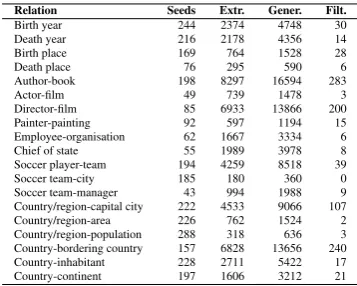
Table 2 shows the number of patterns obtained for each relation. Note that the generalisation proce-dure applied produces new (generalised) patterns to the set of original patterns, but no original pat-tern is removed, so they all are evaluated; this is why the set of patterns increases after the gener-alisation. The filtering criterion was to keep the patterns that applied at least twice on the test cor-pus.
Secondly, the samples of the hook and target cor-pora used are too small for some of the relations to apply, so few patterns apply more than twice.
Note that, for some relations, the output of the generalisation step contains less patterns that the output of the initial extraction step: that is due to the fact that the patterns in which the hook and the target are not nearby were removed in between these two steps.
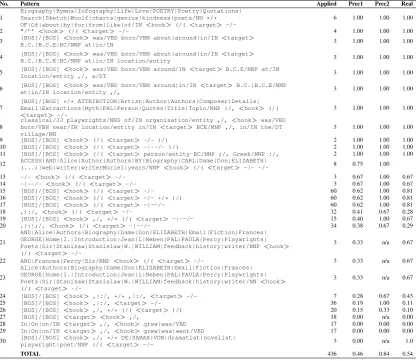
Concerning the precision estimates, a full eval-uation is provided for thebirth-year relation. Ta-ble 3 shows in detail the thirty patterns obtained. It can also be seen that some of the patterns with good precision contain the wildcard *. For in-stance, the first pattern indicates that the presence of any of the words biography, poetry, etc. any-where in a sentence before a person name and a date or number between parenthesis is a strong in-dication that the target is a birth year.
The last columns in the table indicate the num-ber of times that each rule applied in the hook and target corpora, and the precision of the rule in each of the following cases:
• As estimated by the complete program (Prec1).
• As estimated by the traditional hook cor-pus approach (Prec2). Here, cardinality is not taken into account, patterns are evaluated only on the hook corpora from the same rela-tion, and those pairs whose hook is not in the seed list are ignored.
• The real precision of the rule (real). In or-der to obtain this metric, two different an-notators evaluated the pairs applied indepen-dently, and the precision was estimated from the pairs in which they agreed (there was a 96.29% agreement, Kappa=0.926).
As can be seen, in most of the cases our procedure produces lower precision estimates.
If we calculate the total precision of all the rules altogether, shown in the last row of the table, we can see that, without the modifications, the whole set of rules would be considered to have a total precision of 0.84, while that estimate decreases sharply to 0.46 when they are used. This value is nearer the precision of 0.54 evaluated by hand. Although it may seem surprising that the precision estimated by the new procedure is even lower than the real precision of the patterns, as measured by hand, that is due to the fact that the web queries consider unknown pairs as incorrect unless they
Relation Prec1 Prec2 Real
Birth year 0.46 [0.41,0.51] 0.84 [0.81,0.87] 0.54 [0.49,0.59] Death year 0.29 [0.24,0.34] 0.55 [0.41,0.69] 0.38 [0.31,0.44] Birth place 0.65 [0.62,0.69] 0.36 [0.29,0.43] 0.84 [0.79,0.89] Death place 0.82 [0.73,0.91] 1.00 [1.00,1.00] 0.96 [0.93,0.99] Author-book 0.07 [0.07,0.07] 0.26 [0.19,0.33] 0.03 [0.00,0.05] Actor-film 0.07 [0.01,0.13] 1.00 [1.00,1.00] 0.02 [0.00,0.03] Director-film 0.03 [0.03,0.03] 0.26 [0.18,0.34] 0.01 [0.00,0.01] Painter-painting 0.10 [0.07,0.12] 0.35 [0.23,0.47] 0.17 [0.12,0.22] Employee-organisation 0.31 [0.22,0.40] 1.00 [1.00,1.00] 0.33 [0.26,0.40]
Chief of state 0.00 [0.00,0.00] - 0.00 [0.00,0.00]
Soccer player-team 0.07 [0.06,0.08] 1.00 [1.00,1.00] 0.08 [0.04,0.12]
Soccer team-city - -
[image:7.595.309.536.52.197.2]-Soccer team-manager 0.61 [0.53,0.69] 1.00 [1.00,1.00] 0.83 [0.77,0.88] Country/region-capital city 0.12 [0.11,0.13] 0.23 [0.22,0.24] 0.12 [0.07,0.16] Country/region-area 0.09 [0.00,0.19] 1.00 [1.00,1.00] 0.06 [0.02,0.09] Country/region-population 1.00 [1.00,1.00] 1.00 [1.00,1.00] 1.00 [1.00,1.00] Country-bordering country 0.17 [0.17,0.17] 1.00 [1.00,1.00] 0.15 [0.10,0.20] Country-inhabitant 0.01 [0.00,0.01] 0.80 [0.67,0.93] 0.01 [0.00,0.01] Country-continent 0.16 [0.14,0.18] 0.07 [0.04,0.10] 0.00 [0.00,0.01]
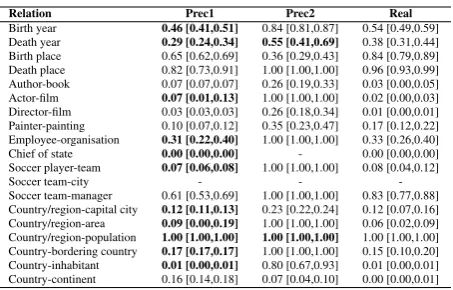
Table 4: Precision estimates for the whole set of extracted pairs byallrules and all relations.
appear in the web exactly in the format of the query in the input table. Specially for not very well-known people, we cannot expect that all of them will appear in the web following the pattern
“X was born in date”, so the web estimates tend to be over-conservative.
Table 4 shows the precision estimates for every pair extracted with all the rules using both proce-dures, with 0.95 confidence intervals. The real precision has been estimating by sampling ran-domly 200 pairs and evaluating them by hand, as explained above for thebirth yearrelation. As can be observed, out of the 19 relations, the precision estimate of the whole set of rules for 11 of them is not statistically dissimilar to the real precision, while that only holds for two relationships using the previous approach.
Please note as well that the precisions indicated in the table refer to all the pairs extracted by all the rules, some of which are very precise, but some of which are very imprecise. If the rules are to be applied in an annotation system, only those with a high precision estimate would be used, and ex-pectedly much better overall results would be ob-tained.
5 Conclusions and future work
We have described here a new procedure for es-timating the precision of the patterns learnt by a rote extractor that learns from the web. Compared to other similar approaches, it has the following improvements:
• For each pair(hook,target)in the seed list, a
This has been observed to improve the esti-mate of the rule’s precision, given that the evaluation pairs not only refer to the elements in the seed list.
• The cardinality of the relations is taken into consideration in the estimation process using the seed list. This is important, for instance, to be able to estimate the precision inn:n re-lations likeauthor-work, given that we can-not assume that the only books written by someone are those in the seed list.
• For those pairs that cannot be evaluated using the seed list, a simple query to the Google search engine is employed.
The precisions estimated with this procedure are significantly lower than the precisions obtained with the usual hook corpus approach, specially for ambiguous patterns, and much near the precision estimate when evaluated by hand.
Concerning future work, we plan to estimate the precision of the patterns using the whole hook and target corpora, rather than using a random sample. A second objective we have in mind is not to throw away the ambiguous patterns with low precision (e.g. the possessive construction), but to train a model so that we can disambiguate which is the relation they are conveying in each context (Girju et al., 2003).
References
E. Agichtein and L. Gravano. 2000. Snowball: Ex-tracting relations from large plain-text collections. InProceedings of ICDL, pages 85–94.
E. Alfonseca, P. Castells, M. Okumura, and M. Ruiz-Casado. 2006a. A rote extractor with edit distance-based generalisation and multi-corpora precision calculation. InPoster session of ACL-2006.
E. Alfonseca, A. Moreno-Sandoval, J. M. Guirao, and M. Ruiz-Casado. 2006b. The wraetlic NLP suite. InProceedings of LREC-2006.
M. Berland and E. Charniak. 1999. Finding parts in very large corpora. InProceedings of ACL-99.
S. Brin. 1998. Extracting patterns and relations from the World Wide Web. InProceedings of the WebDB Workshop at EDBT’98.
R. Bunescu and R. J. Mooney. 2005. A shortest path dependency kernel for relation extraction. In Pro-ceedings of the HLT Conference and EMNLP.
P. Cimiano, S. Handschuh, and S. Staab. 2004. To-wards the self-annotating web. InProceedings of the 13th World Wide Web Conference, pages 462–471.
M. Craven, D. DiPasquo, D. Freitag, A. McCallum, T. Mitchell, K. Nigam, and S. Slattery. 1999. Learn-ing to construct knowledge bases from the world wide web.Artificial Intelligence, 118(1–2):69–113.
O. Etzioni, M. Cafarella, D. Downey, A.-M. Popescu, T. Shaked, S. Soderland, D. S. Weld, and A. Yates. 2005. Unsupervised named entity extraction from the web: An experimental study. Artificial Intelli-gence, 165(1):91–134.
M. Finkelstein-Landau and E. Morin. 1999. Extracting semantic relationships between terms: supervised vs. unsupervised methods. InWorkshop on Ontolo-gial Engineering on the Global Info. Infrastructure.
R. Girju, A. Badulescu, and D. Moldovan. 2003. Learning semantic constraints for the automatic dis-covery of part-whole relations. InHLT-NAACL-03.
M. Hearst. 1992. Automatic acquisition of hyponyms from large text corpora. InCOLING-92.
S. Huffman. 1995. Learning information extraction patterns from examples. InIJCAI-95 Workshop on New Approaches to Learning for NLP.
J. Kietz, A. Maedche, and R. Volz. 2000. A method for semi-automatic ontology acquisition from a cor-porate intranet. InWorkshop “Ontologies and text”.
G. S. Mann and D. Yarowsky. 2003. Unsupervised personal name disambiguation. InCoNLL-2003.
G. S. Mann and D. Yarowsky. 2005. Multi-field in-formation extraction and cross-document fusion. In Proceedings of ACL 2005.
E. Morin and C. Jacquemin. 1999. Projecting corpus-based semantic links on a thesaurus. InACL-99.
D. Ravichandran and E. Hovy. 2002. Learning surface text patterns for a question answering system. In Proceedings of ACL-2002, pages 41–47.
E. Riloff and M. Schmelzenbach. 1998. An empirical approach to conceptual case frame acquisition. In Proceedings of WVLC, pages 49–56.
E. Riloff. 1996. Automatically generating extraction patterns from untagged text. InAAAI.
M. Ruiz-Casado, E. Alfonseca, and P. Castells. in press. Automatising the learning of lexical patterns: an application to the enrichment of WordNet by ex-tracting semantic relationships from the Wikipedia. Data and Knowledge Engineering, in press.
S. Soderland. 1999. Learning information extraction rules for semi-structured and free text. Machine Learning, 34(1–3):233–272.
I. Szpektor, H. Tanev, I. Dagan, and B. Coppola. 2004. Scaling web-based acquisition of entailment rela-tions. InProceedings of EMNLP 2004.