Adjective based inference
∗Marilisa Amoia
INRIA/Universit´e de Nancy 1 & University of the Saarland
Saarbr¨ucken Germany [email protected]
Claire Gardent CNRS/Loria
Campus Scientifique BP 239 54506 Vandoeuvre-les-Nancy, France
Abstract
In this paper, we propose a fine grained classification of english adjectives geared at modeling the distinct inference patterns licensed by each adjective class. We show how it can be implemented in description logic and illustrate the predictions made by a series of examples. The proposal has been implemented using Description logic as a semantic representation language and the prediction verified using the DL theo-rem prover RACER.
Topics: Textual Entailment, Adjectival Semantics
1 Introduction
Understanding a text is one of the ultimate goals of computational linguistics. To achieve this goal, systems need to be developed which can construct a meaning representation for any given text and which furthermore, can reason about the meaning of a text. As is convincingly argued in (Ido Dagan and Magnini, 2005), one of the major inference task involved in that reasoning is the entailment recognition task:
Does textT1 entail textT2?
Indeed entailment recognition can be used to determine whether a text fragment answers a question (e.g., in question answering application), whether a query is entailed by a relevant document (in information retrieval), whether a text fragment entails a specific information nugget (in informa-tion extracinforma-tion), etc.
Because the Pascal RTE challenge focuses on real text, the participating systems must be robust that is, they must be able to handle unconstrained
∗
We thank la R´egion Lorraine, INRIA and the University of Sarrebruecken for partially funding the research presented in this paper.
input. Most systems therefore are based on sta-tistical methods (e.g., stochastic parsing and lex-ical distance or word overlap for semantic simi-larity) and few provide for a principled integra-tion of lexical and composiintegra-tional semantics. On the other hand, one of the participant teams has shown that roughly 50% of the RTE cases could be handled correctly by a system that would ade-quately cover semantic entailments that are either syntax based (e.g., active/passive) or lexical se-mantics based (e.g., bicycle/bike). Given that the overall system accuracies hovered between 50 and 60 percent with a baseline of 50 %1, this suggests that a better integration of syntax, compositional and lexical semantics might improve entailment recognition accuracy.
In this paper, we consider the case of adjectives and, building on approaches like those described in (Raskin and Nirenburg, 1995; Peters and Pe-ters, 2000), we propose a classification of adjec-tives which can account for the entailment patterns that are supported by the interaction of their lexi-cal and of their compositional semantics. We start by defining a classification schema for adjectives based on their syntactic and semantic properties. We then associate with each class a set of axioms schemas which translate the knowledge about lex-ical relations (i.e. antonymy) the adjectives of the class are involved in by extracting this information from WordNet (Miller, 1998) and a set of seman-tic construction rules and we show that these cor-rectly predicts the observed entailment patterns. For instance, the approach will account for the fol-lowing (non)-entailment cases:
(1) a. John frightened the child |=The child is afraid
1
b. Peter claims that John is a murderer |=John is an alledged murderer 6|=John is a murderer
c. This is a fake bicycle |=This is a false bike |=This is not a real bike 6|=This is a bike
d. John is not awake |=John sleeps
6|=John does not sleep
The approach is implemented using Description Logic as a semantic representation language and tested on a hand-built semantic test suite of ap-proximately 1 000 items. In the latter part of the paper we discuss this testsuite and the philosophy behind it.
2 A fine grained classification for adjectives
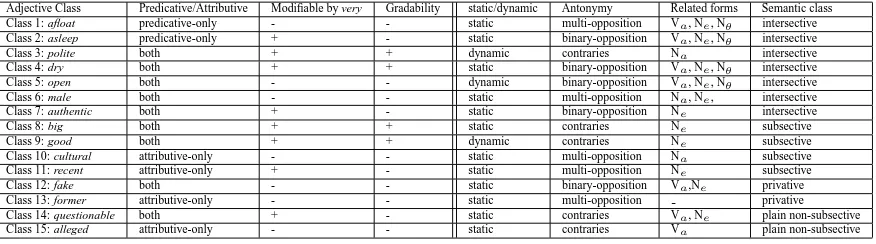
As mentioned above, we propose a classification of adjectives based on their lexical, their model theoretic and their morpho-derivational properties. To facilitate the link with compositional semantics (the construction of a meaning representation for sentences containing adjectives), we also take into account syntactic properties such as the predica-tive/attributive or the static/dynamic distinction. We now detail each of these properties. The over-all categorisation system is given in Figure 1.
2.1 Model theoretic properties
The main criteria for classification are given by (Kamp, 1975; Kamp and Partee, 1995) seman-tic classification of adjectives which is based on whether it is possible to infer from the Adj+N combination the Adj or the N denotation.
Intersective adjectives (e.g., red) licence the following inference inference patterns:
A+N |=A
A+N |=N
For instance, if X is a red car then X is a car and X is red
Subsective adjectives (e.g., big) licence the following inference pattern:
A+N |=N
For instance, if X is a big mouse, then X is a mouse but it is not necessarily true X is big
Privative adjectives licence the inference pattern:
A+N |=¬N
For instance, if X is a fake gun then X is not a gun Plain non-subsective adjectives (e.g., alledged) do not licence any inference
For instance, if X is an alleged murderer then it is unknown whether X is a murderer or not
2.2 Lexical semantics
From the lexical semantics literature, we take one additional classification criterion namely antonymy. As described in (Cruse, 1986), this term covers different kinds of opposite polarity re-lations between adjectives namly, binary opposi-tion, contraries and multiple oppositions.
Binary oppositions covers pairs such as wet/dry which license the following inference pattern:
A1≡ ¬A2 ∧ ¬A1≡A2
So that in particular:
wet≡ ¬dry ∧ ¬wet≡dry
Contraries are pairs such as long/short where the implication is unidirectional:
A1|=¬A2 ∧ ¬A16|=A2
A2|=¬A1 ∧ ¬A26|=A1
and in particular:
long|=¬short∧ ¬long6|=short short|=¬long∧ ¬short6|=long
Multiple oppositions involve a finite set of adjec-tives (e.g., linguistic/economic/mathematical/... ) which are pairwise mutually exclusive. For a set of opposed adjectivesA1. . . An, the following ax-ioms schemas will be licensed:
∀i, j s.t.1≤i, j ≤and i6=j Ai |=¬Aj and ¬Ai6|=Aj
2.2.1 Derivational morphology
We also take into account related forms that is, whether there exists a verb (Va) or a noun that is
semantically related to the adjectives being con-sidered. Moreover, for nominalizations we distin-guish whether the morphologically related noun is an event noun (Ne), a noun denoting a theta role
of the related verb (Nθ) or a non-event noun (Na).
(2) a. John is asleep (Adj→Va)
|=John sleeps
b. John is absent (Adj→Nθ)
|=John is the absentee
c. John is deeply asleep (Adj→Ne)
|=John’s sleep is deep
2.2.2 Syntactic properties
To better support the syntax/semantic interface, we refine the adjectives classes distinguishable on the basis of the above criteria with the following syntactic ones taken from (Quirk et al., 1985). Attributiveness/Predicativeness. English adjec-tives can be divided in adjecadjec-tives which can be used only predicatively (such as alone), adjectives which can be used only attributively (such as me-chanical in meme-chanical enginner) and adjectives which can be used in both constructions such as red.
Modifiability by very. We distinguish between adjectives such as nice which can be modified by very (i.e. very nice) and adjectives such as alleged which cannot (*very alleged).
Gradability. We distinguish between adjectives such as big which express gradable properties and have comparative and superlative forms (bigger, biggest) and adjectives such as rectangular which don’t (*more rectangular).
Staticity/Dynamicity. Dynamic adjectives can be used in imperative constructions and in the pro-gressive form (Be reasonable, He is being reason-able), static adjectives cannot (*Be short, He is be-ing short).
3 Semantic Classes and textual entailment recognition
In order to build our classification, we have anal-ysed a set of about 300 english adjectives each of which was manually mapped to the WordNet synset correspondent to the more frequent mean-ing of the adjective. In some case, when an ad-jective presents polysemic forms which belong to different semantic classes more than one form has been considered. For example, for the adjective civil we consider two senses/forms civil1 (syn-onym of polite, as in civil man) and civil2 (as in civil engineer) which belong to different semantic classes, the first being intersective and the second subsective. As Figure 1 shows, the proposed clas-sification includes 15 adjective classes, each with distinct syntactic and semantic properties.
To account for these differences, we define for each class a set of axiom schemas capturing the model theoretic, lexical semantics and morpho-derivational properties of that class. Lexical se-mantics and morpho-derivational information are derived from WordNet. For example, the axioms describing antonymy are obtained by extracting from WordNet the antonyms of a particular adjec-tive and then by considering the direction of the entailment relevant for the class the adjective be-longs to:
asleep≡wake vs. polite<rude
Morpho-derivational information are derived from WordNet by extracting the derivationally related forms for the given adjective and then iterating the extraction on nouns and verbs in order to obtain information about their antonyms and hyponyms. For scalar adjective like tall, WordNet contains also a relation is a value of which offers a pointer to the noun concept the adjective is a value of. Moreover, WordNet links the noun concept to a list of attributes which describe the scalar prop-erty it represents. For example, the adjective tall is a value of{stature,height} and attributes of{stature,height}are tall and short.
Based on some basic syntactic patterns, we then show that these axioms predict the observed tex-tual entailment patterns for that class.
Before we illustrate this approach by means of some example, we first show how we capture log-ical entailment between NL semantic representa-tions in a description logic setting.
3.1 Using description logic to check entailment between NL sentences
As argued in (Gardent and Jacquey, 2003), de-scription logic (DL) is an intuitive framework within which to perform lexical reasoning: it is efficient (basic versions of description logics are decidable), it is tailored to reason about complex taxonomies (taxonomies of descriptions) and it is equipped with powerful, freely available auto-mated provers (such asRACER, (Volker Haarslev, 2001)). For these reasons, we are here exploring a DL encoding of the entailment recognition task for the set of examples we are considering.The partic-ular language we assume has the following syntax.
C, D→A|>|⊥|¬A|CuD|CtD| ∀R.C| ∃R.C
con-Adjective Class Predicative/Attributive Modifiable by very Gradability static/dynamic Antonymy Related forms Semantic class Class 1: afloat predicative-only - - static multi-opposition Va, Ne, Nθ intersective
Class 2: asleep predicative-only + - static binary-opposition Va, Ne, Nθ intersective
Class 3: polite both + + dynamic contraries Na intersective
Class 4: dry both + + static binary-opposition Va, Ne, Nθ intersective
Class 5: open both - - dynamic binary-opposition Va, Ne, Nθ intersective
Class 6: male both - - static multi-opposition Na, Ne, intersective
Class 7: authentic both + - static binary-opposition Ne intersective
[image:4.612.75.513.12.134.2]Class 8: big both + + static contraries Ne subsective Class 9: good both + + dynamic contraries Ne subsective Class 10: cultural attributive-only - - static multi-opposition Na subsective Class 11: recent attributive-only + - static multi-opposition Ne subsective Class 12: fake both - - static binary-opposition Va,Ne privative Class 13: former attributive-only - - static multi-opposition privative Class 14: questionable both + - static contraries Va, Ne plain non-subsective Class 15: alleged attributive-only - - static contraries Va plain non-subsective
Figure 1: Classes of Adjectives
ceptA, a setAI ⊆∆and to every atomic roleR
a binary relationRI ⊆∆×∆.
>I = ∆
⊥I = ∅ (¬A)I = ∆\AI (CuD)I =
CI∩DI (CtD)I = CI∪DI
(∀R.C)I = {a∈∆| ∀b(a, b)∈RI→b∈CI} (∃R.C)I =
{a∈∆| ∃b∈CI∧(a, b)∈RIn} Now one basic problem with using DL to check entailment between NL expressions, is that DL formulae are “directional” in that they refer to a given set of individuals. For instance the sentence The boat is floating might be represented by either of the two formulae given in 3 but these two for-mulae do not stand in an entailment relation (since they refer to different kind of objects namely float-ing event of a boat in 3a and boats that float in 3b).
(3) a. floatu∃theme.boat
b. boatu∃theme−1.float
To remedy this shortcoming, we introduce the notion of a rotation. Given a DL formula which only contains conjunction (disjunction is trans-lated in DL as different formulas)
Φ=ui=1,nEventiuj=1,m∃Rj.Typej
a rotation of this formula is defined as:
1.Φ
2.∀j∈ {1, ..., m}:
T ypej u ∃R−j1.(ui=1,nEventi u1<k<j,j<k<m
∃Rk.Typek)
so that the formula:
Event1uEvent2u...uEventnu∃R1.Type1u∃R2.Type2...
u∃Rn.Typen
corresponds to the following n Rotations each of which describe the same situation from the point of view of a particular type
0. Eventu∃R1.Type1u∃R2.Type2...u∃Rn.Typen
⊆Event
1. Type1u∃R−11.(Eventu∃R2.Type2...u∃Rn.Typen)
⊆Type1
2. Type2u∃R−21.(Eventu∃R1.Type1...u∃Rn.Typen)
⊆Type2
...
n. Typenu∃R−n1.(Eventu∃R1.Type1...u∃Rn−1.Typen−1)
⊆Typen
So for example, the sentence Mary knows that John is the inventor of the radio will be repre-sented as a predicate logic formula
∃x1mary(x1)∧ ∃x2john(x2)∧ ∃x3radio(x3)∧ ∃e1know(e1)∧ ∃agent(e1, x1)∧∃topic(e1, e2)∧∃e2invent(e2)∧agent(e2, x2)∧
patient(e2, x3)
the denotation of this PL formula corresponds to the set of individuals{x1, x2, x3} ∪ {e1, e2}. The corresponding DL representation will be the un-derspecified representation
knowu∃agent.maryu∃topic.( inventu∃agent.johnu∃
pa-tient.radio)
the denotation of which corresponds to the set {e1} and all its rotations which permit to access the other sets of individuals asserted in the sen-tence. Thus for example, the set {x1} which describes the individual Mary can be accessed through the following rotation:
Rotation1: maryu∃agent−1.(knowu∃topic.( invent
u∃agent.johnu∃patient.radio))
Finally, we say that an arbitrary for-mula/representation Φ1 implies the formula
Φ2iff it is possible to find a rotationRotationiof
Φ1 the denotation of which describes a subset of the denotation ofΦ2:
Definition
3.2 Example class axioms and derivations
We now illustrate our approach by looking at two classes in more detail namely, class 1 and class 8.
3.2.1 Class 1
Syntactically, Class 1 contains adjectives like adrift,afloat,aground which can only be used pred-icatively, are non gradable and cannot be modified by very. Semantically, they behave like intersec-tive adjecintersec-tives which enter in multiple opposition relations with other adjectives. They are further-more morphologically derived from verbs and can be nominalized. To reflect these semantic proper-ties we use the following axioms.
Model theoretic semantics. Adjectives of class 1 are intersective adjective. They will thus li-cence the correponding inference patterns namely:
A+N |=A (2)
A+N |=N (3)
Lexical semantics. Adjectives of class 1 enter in multiple opposition relations. Hence For instance:
afloat|=¬aground∧¬afloat6|=aground aground|=¬afloat∧¬aground6|=afloat sunken|=¬afloat∧¬afloat6|=sunken afloat|=¬sunken∧¬sunken6|=afloat Morpho-derivational semantics. Adjectives in Class 1 can be related to both nouns and verbs. Thus, for example the adjective afloat in WordNet is related to the noun floating which is related to the verb float, by assuming that the semantics as-signed to the verb float isfloat(e), theme(e,a), the adjective afloat is assigned the following seman-tics:
afloat≡ ∃Theme−1.float
This is encoded in the following axiom schemas:
MDR 1. Adj1<¬Adj2 If Adj1 = Anto(Adj2)
e.g., afloat<¬sunken
MDR 2. Adj1≡ ∃Theme−1.V1 If Adj1 is related to V1
e.g.,afloat≡ ∃Theme−1.float
MDR 3. V1<¬V2 If V1 = Anto(V2)
e.g., float<¬sink
MDR 4. N1≡V1 If Adj1 is related to an evt denoting N1
e.g., floating≡float
MDR 5. N1<¬N2 If N1 is an antonym of N2
e.g., floating<¬sinking
MDR 6. N11≡ ∃Theme−1.V1 If Adj1 is related to a
noun N11 denoting the theme role of the verb V1 e.g., floater≡ ∃Theme−1.float
We make the following assumptions about the syntax/semantic interface that is, about the seman-tic representations associated with given sentence patterns.
SCR 1. NP toBe Adj
ADJuN P
SCR 2. NP toBe clearly Adj
ADJuN P
SCR 3. Ni[+event] of NP is clear
Viu ∃theme.N P
SCR 4. Nii[-event] is clear
∃theme−1.V
i
SCR 5. NP toBe V[+ing].
V u ∃T heme.N P
Given the above axiom schemas and semantic constructions rules, the following inference pat-terns can be handled:
1. ADJ1+N|=N
Ex. This boat is afloat.|=This is a boat.
2. ADJ1+N|=ADJ1
Ex. This boat is afloat.|=This is afloat.
3. ADJ1+N6|=¬N
Ex. The boat is afloat.6|=This not a boat.
4. ADJ1+N|=¬ADJ2uN
Ex. The boat is afloat.|=The boat is not sunken.
5. ¬ADJ1+N6|=ADJ2uN
Ex. The boat is not afloat.6|=The boat is sunken.
6. ADJ1+N|=Nu∃theme−1.V1
Ex. The boat is afloat.|=The boat is the floater.
7. ADJ1+N|=V1u∃theme.N
Ex. The boat is afloat.|=The boat is floating.
8. ADJ1+N|=N1u∃theme.N
Ex. This boat is clearly afloat. |=The floating of the boat is clear.
9. ADJ1+N|=Nu∃theme−1.N1
Ex. This boat is clearly afloat. |=The floating of the boat is clear (or the boat is the floating object).
10. ¬(ADJ1+N)|=¬(V1u∃theme.N)6|=¬N
Ex. This is not a floating boat.6|=This is not a boat.
11. ¬(ADJ1+N)6|=¬Adj1
Ex. This is not a floating boat.6|=This is not afloat.
12. ¬(ADJ1+N)6|=¬V1
Ex. This is not a floating boat.6|=This is not floating.
13. ¬(ADJ1+N)6|=¬N1
Ex. This is not a floating boat.6|=This is not a floating.
14. ¬(ADJ1+N)6|=¬ ∃theme−1.V1
Ex. This is not a floating boat.6|=This is not the floater.
15. ¬(ADJ1+N)6|=¬ ∃theme.N
In the inference patterns 10 to 15, the negation of the adjective-noun compound¬(ADJ1+N) is syntactically blocked, as the adjectives in this class are used predicative only, however the equivalent representation V1u∃theme.N can be used to mo-tivate the inferences.
The following show in more detail how the first three of the above (non) entailments are recog-nised.
(4) a. The boat is afloat.
b. |=The boat is floating.
4a ≡BoatuAfloat (by SCR 1) A
4b ≡Floatu∃T heme.Boat (by SCR 5) B
Afloat ≡ ∃T heme−1.F loat (by MDR 2) C
1 ≡Boatu∃T heme−1.F loat (from A and C) D
D|=B (By Defn 1) E
(5) a. The boat is afloat.
b. |=The boat is the floater.
5a ≡BoatuAfloat (by SCR 1) A
5b ≡Boatu∃T heme−1.f loat (by SCR 4) B
Afloat ≡ ∃T heme−1.F loat (by MDR 2) C
A|=B (from B und C) D
(6) a. The boat is afloat.
b. |=The boat is not sinking.
6a ≡BoatuAfloat (by SCR 1) A
6b ≡ ¬sinku∃T heme.boat (by SCR 5) B
Afloat ≡ ∃T heme−1.F loat (by MDR 2) C
Boatu∃T heme−1.F loat (from A and C) D
floatu∃T heme.boat (By Defn 1) E
E|=B (by MDR 1) F
3.2.2 Class 8.
Class 8 contains adjectives like big,fast,tall,deep which can be used attribu-tively and predicaattribu-tively, are gradable, can be modified by very. Semantically, they are classified as subsective adjectives and their antonyms are contraries. They are morphologically related to nouns which describe the particular property denoted by the adjectives and to nouns of which they are attributes.
Model theoretic semantics. Adjectives of class 8 are subsective adjective. They will thus li-cence the correponding inference patterns namely:
A+N 6|=A (4)
A+N |=N (5)
Lexical semantics. The Adjectives of class 8 en-ter in contrary opposition relations. Hence, the fol-lowing axioms schemas will be licensed:
Ai |=¬Anto(Ai) and ¬Ai6|=Anto(Ai) (6) For instance:
long|=¬small∧¬long6|=small deep|=¬shallow∧¬deep6|=shallow Morpho-derivational semantics. Adjectives in Class 8 can be related to nouns but not to verbs. Moreover, such adjectives are mapped in WordNet to noun concepts through two dif-ferent links: derivationally related to
and is a value of. For example, the
adjec-tive tall in WordNet is derivationally related to the noun tallness and is a value of the concept noun height. The adjectives in this class describe grad-able properties so that their semantics corresponds to:
has-property(Related Nounu∃has-measure.Top)
in which the rolehas-measureaccount for the value of the scalar property described by the adjec-tive, which remain underspecified (Top) if the ad-jective is used without a reference to the value of measure. When the value of the measure is speci-fied, for example by combining the adjective with a noun, as for example in This is a tall man, then the noun is assigned as a value of the measure role:
manu∃has-property.(tallness u∃has-measure.man) which translate This is tall as a man.
This is encoded in the following axiom schemas:
MDR 1. Adj1<¬Adj2 If Adj1 = Anto(Adj2)
Ex. tall<¬short
MDR 2. Adj1<∃has property.(N1u∃has measure.Top)
If Adj1 is related to a noun N1 denoting the property described by Adj1
Ex. tall < ∃ has property.(tallness
u∃has measure.Top)
MDR 3. N1<¬N2 If N1=Anto(N2)
Ex. tallness<¬shortness
MDR 4. N1≡N’u∃has value.Adj1
If Adj1 is an attribute of the noun N’ Ex. tallness≡heightu∃has value.tall
MDR 5. N2≡N’u∃has value.Adj2
If Adj2 is an attribute of the noun N’ Ex. shortness≡heightu∃has value.short
MDR 6. N1<N’ If N1 is an hyponym of N’
MDR 7. N2<N’ If N2 is an hyponym of N’
Ex. shortness<height
MDR 8. Adj11<Adj1 If Adj1 is a
scalar attribute with value less then Adj11 (hyponymy is not defined for adjectives)
Ex. giant<tall
For the moment, we don’t account for the se-mantics of comparatives forms of adjectives but we will do that in the feature, by also introducing a representation for scales as described in (Kennedy, 2005).
We make the following assumptions about the semantic representations associated with basic sentence patterns.
SCR 1. NP toBe Adj
NPu∃has property.(N1u∃has measure.NP)
SCR 2. That toBe Det Adj NP
NPu∃has property.(N1u∃has measure.NP)
SCR 3. NP toBe clearly Adj
NPu∃has property.(N1u∃has measure.NP)
SCR 4. N1 of NP is clear
NPu∃has property.(N1u∃has measure.NP)
SCR 5. The Adj N’ of NP
NP u∃ has property.(N’ u∃ has value.Adj
u∃has measure.NP )
SCR 6. NP1 toBe Adj as a N
NP1 u N u∃has property.(N’ u∃ value.Adj u∃
has measure.N)
SCR 7. NP1 toBe NP2[+measure] Adj
NP1 u∃has property.(N’ u∃ value.Adj u∃
has measure.NP2)
SCR 8. NP1 toBe NP2[+measure] Adj N
NP1 u N u∃has property.(N’ u∃has value.Adj u∃
has measure.NP2)
Given the above axioms, the following exam-ples can be handled:
(7) (a) John is a 1.50 meter tall man. |=(b) John is 1.50 meter tall.
7a ≡JohnuManu∃has property.(height A
uhas value.talluhas measure(1.50 meter) ) (by SCR 8)
7b |=Johnu∃has property.(heightuhas value.tall B
uhas measure(1.50 meter) )
(by SCR 7 and from A)
A|=B C
(8) (a) John is a 1.50 meter tall man. 6|=(b) John is a tall man.
8a ≡JohnuManu∃has property.(height A
uhas value.talluhas measure(1.50 meter) ) (by SCR 8)
8b |=JohnuManu∃has property.(heightu B
has value.talluhas measure(man) ) (by SCR1 and from A)
A6|=B C
4 Implementation
For each of the 15 classes, we have specified a set of axioms schemas, some basic semantic construc-tion rules and a set of inference patterns which could be deduced to follow from both of these. The axioms schemas were implemented in De-scription Logic using RACER and for each infer-ence pattern identified, the corresponding Descrip-tion Logic query was checked to verify that the proposed axioms and semantic construction rules did indeed correctly predict the deduced inference patterns.
5 Further work and evaluation
The main contribution of this work is a detailed analysis of the interactions between derivational morphology, lexical and compositional semantics and of their impact on the entailment patterns li-censed by sentences containing adjective or their related nouns/verbs.
To turn this analysis into a computational sys-tem, its components need to be integrated into a semantic analyser and the behaviour of that anal-yser tested against a collection of data. We are currently working on developing such an anal-yser within a symbolic grammar framework. We have also started to develop an evaluation test suite geared towards entailment recognition be-tween sentence pairs containing adjectives. At the moment, the test suite contains about 1 000 infer-ence pairs. Each item in the TestSuite (see fig. 2) is annotated with a judgement about the truth of the entailment between the pair of sentences, with the type of inference involved and with the speci-fication of adjective involved. Moreover, each ad-jective is annotated with the WordNet sense corre-sponding to the given class.
<pair id="1" value="TRUE" class="[CLASS1]" inference="Adj/Verb"> <t>The boat is <sn n="1"> afloat </sn>.</t>
<h>The boat is floating.</h> </pair>
<pair id="2" value="FALSE" class="[CLASS6]" inference="Antonymy"> <t>This is not a <sn n="1"> rectangular </sn> table.</t> <h>This is a <sn n="1"> round </sn> table </h>
</pair>
<pair id="3" value="TRUE" class="[CLASS8]" inference="Adj/Noun"> <t>The line is 2 meter <sn n="1"> long </sn>.</t>
<h>The length of the line is 2 meter.</h> </pair>
<pair id="4" value="FALSE" class "[subs/intersective]" inference="Attr/Pred"> <t>The treasurer is <sn n="2"> present </sn>.</t>
<h>This is the <sn n="1"> present </sn> treasurer.</h> </pair>
Figure 2: TestSuite
test suite illustrates the semantic and syntactic be-haviour of adjectives and their related verbs/nouns with respect to textual entailment. One could imagine other test suites illustrating the seman-tic behaviour of verbs, of quantifiers, of discourse connectives, etc. Just as the TSNLP still proves useful in supporting the development of new sym-bolic parsers/grammars, hand built test suites of artificial examples might prove useful in improv-ing the accuracy of semantic analyser wrt textual entailment. Indeed the Pascal RTE challenge has shown that existing systems fares rather poortly at the textual entailment task. Providing a set of hand crafted semantic test suites might help in remedy-ing this shortcomremedy-ing.
Beside implementing and evaluating the anal-ysis of adjectives presented in this paper, we are also working on refining this analysis by combin-ing it with a detailed analysis of noun semantics so as to handle (non) entailments such as:
(9)
Lyon is the gastronomical capital of France 6|=Lyon is the capital of France
References
D.J. Arnold and Luis des Tombe. 1987. Basic Theory
and methodology in Eurotra. Cambridge University
Press.
DA. Cruse. 1986. Lexical Semantics. Cambridge Uni-versity Press.
Claire Gardent and Evelyne Jacquey. 2003. Lexical reasoning. In Proceedings of the ICON’03
(Inter-national Conference on Natural Language Process-ing), Mysore, India.
Oren Glickman Ido Dagan and Bernardo Magnini. 2005. The PASCAL Recognising Textual Entailment
Challenge.
Hans Kamp and Barbara Partee. 1995. Prototype the-ory and compositionality. Cognition, (57):129–191.
Hans Kamp. 1975. Two theories about adjectives. In Edward L. Keenan (ed.), Formal Semantics of
Nat-ural Language, pages 123–155. Cambridge
Univer-sity Press.
Christofer Kennedy. 2005. Vagueness and grammar: The semantics of relative and absolute gradable ad-jectives. Ms., pages 129–191, June.
K. J. Miller. 1998. Modifiers in wordnet. In C. Fellbaum (ed.), WordNet An Electronic Lexical
Database. Cambridge, MA, The MIT Press.
Stephan Oepen and Klaus Netter. 1995. TSNLP -test suites for natural language processing. Gronin-gen, The Netherlands. Conference on Linguistic Databases.
I. Peters and W. Peters. 2000. The Treatment of
Adjec-tives in SIMPLE: Theoretical Observations. Athens.
R. Quirk, S. Greenbaum, G. Leech, and J. Svartvik. 1985. A Comprehensive Grammar of the English
Language. Longman.
V. Raskin and S. Nirenburg. 1995. Lexical Semantics
of Adjectives, a micro-theory of adjectival meaning.
MCCS Report.
Ralf M¨oller Volker Haarslev. 2001. Description of the racer system and its applications. In Proceedings