An Information State-Based Dialogue Manager for Call for Fire Dialogues
Antonio Roque and David Traum
USC Institute for Creative Technologies 13274 Fiji Way, Marina Del Rey, CA 90292 [email protected], [email protected]
Abstract
We present a dialogue manager for “Call for Fire” training dialogues. We describe the training environment, the domain, the features of its novel information state-based dialogue manager, the system it is a part of, and preliminary evaluation results.
1 Overview
Dialogue systems are built for many different pur-poses, including information gathering (e.g., (Aust et al., 1995)), performing simple transactions (e.g, (Walker and Hirschman, 2000)), collaborative in-teraction (e.g., (Allen et al., 1996)), tutoring (e.g., (Rose et al., 2003)), and training (e.g. (Traum and Rickel, 2002)). Aspects of the purpose, as well as features of the domain itself (e.g., train timetables, air flight bookings, schedule mainte-nance, physics, and platoon-level military opera-tions) will have a profound effect on the nature of the dialogue which a system will need to engage in. Issues such as initiative, error correction, flex-ibility in phrasing and dialogue structure may de-pend crucially on these factors.
The information state approach to dialogue managers (Larsson and Traum, 2000) has been an attempt to cast some of these differences within the same framework. In this approach, a theory of dialogue is constructed by providing informa-tion structure elements, a set of dialogue moves that can be recognized and produced and are used to modify the nature of these elements, a set of update rules that govern the dynamics of how the information is changed as dialogue moves are per-formed, and an update strategy. Many differ-ent dialogue systems have been built according to this general approach (e.g., (Cooper and Larsson,
1999; Matheson et al., 2000; Lemon et al., 2001; Johnston et al., 2002; Traum and Rickel, 2002; Purver, 2002)).
In this paper, we present an information-state based dialogue manager for a new domain: train-ing call for fire dialogues. Like other dialogue sys-tems used as role-players in training applications, the structure of the dialogue is not completely free for a dialogue designer to specify based on issues of dialogue efficiency. The dialogue system must conform as much as possible to the type of dia-logue that a trainee would actually encounter in the types of interaction he or she is being trained for. In particular, for military radio dialogues, much of the protocol for interaction is specified by con-vention (e.g., (Army, 2001)). Still, there is a fair amount of flexibility in how other aspects of the dialogue progress.
This dialogue manager is part of a system we call Radiobot-CFF. Radiobots are a general class of dialogue systems meant to speak over the ra-dio in military simulations. Our most extended effort to date is the Radiobot-CFF system, which engages in “call for fire” dialogues to train ar-tillery observers within a virtual reality training simulation. Our dialogue system can operate ac-cording to three different use cases, depending on how much control a human operator/trainer would like to exercise over the dialogue. There is a fully automatic mode in which the Radiobot-CFF sys-tem engages unassisted in dialogue with the user, a semi-automatic mode in which the Radiobot-CFF system fills in forms (which can be edited) and the operator can approve or change communication with a simulator or trainee, and a passive mode in which the operator is engaging in the dialogue and the Radiobot-CFF system is just observing.
In section 2, we describe the training
tion that our dialogue system has been embedded in as well as the system itself. In section 3, we de-scribe some aspects of “call for fire dialogues”, es-pecially the differences in initiative and purposes of different phases in the dialogue. In section 4, we describe the information-state based dialogue model we have developed for this domain. This in-cludes dialogue moves, information components, and update rules. We describe some error handling capabilities in section 5, and evaluation results in section 6.
2 Testbed
Our current testbed, Radiobot-CFF, has been developed in a military training environment, JFETS-UTM, at the U.S. Army base in in Ft. Sill, Oklahoma. JFETS-UTM trains soldiers to make Calls for Fire (CFFs), in which a Forward Ob-server (FO) team locates an enemy target and re-quests an artillery fire mission by radio from a Fire Direction Center (FDC). The training room resem-bles a battle-scarred apartment in a Middle East-ern country. A window shows a virtual city dis-played by a rear-projected computer screen, and the soldiers use binoculars with computer displays at their ends to search for targets.
Ordinarily, two trainers control a UTM session. One communicates with the FO via a simulated radio, and the other decides what the artillery fire should be and inputs it to a GUI for the simu-lator. It is our goal to replace those two train-ers with one trainer focusing on assessment while Radiobot-CFF handles the radio communications and interfaces with the virtual world.
Radiobot-CFF is composed of several pipelined components. A Speech Recognition component is implemented using the SONIC speech recogni-tion system (Pellom, 2001) with custom language and acoustic models. An Interpreter component tags the ASR output with its its dialogue move and parameter labels using two separate Condi-tional Random Field (Sha and Pereira, 2003; Mc-Callum, 2002) taggers trained on hand-annotated utterances. A Dialogue Manager processes the tagged output, sending a reply to the FO (via a template-based Generator) and, when necessary, a message to the artillery simulator FireSim XXI1to make decisions on what type of fire to send. The reply to FO and messages to simulator are medi-ated by GUIs where the trainer can intervene if
1http://sill-www.army.mil/blab/sims/FireSimXXI.htm
need be.
3 Call for Fire Dialogues
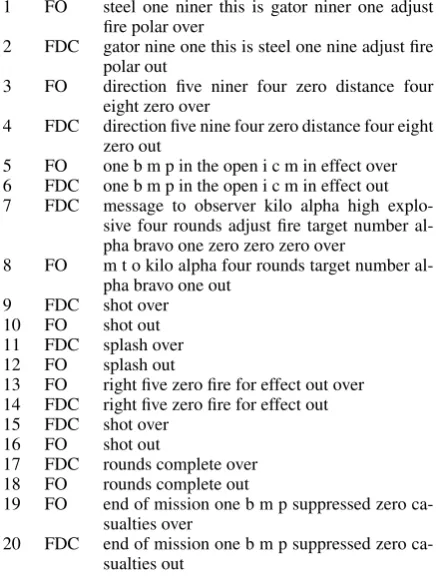
Call for Fire procedures are specified in an Army field manual (Army, 2001) with variations based on a unit’s standard operating procedure. Mes-sages are brief and followed by confirmations, where any misunderstandings are immediately corrected. A typical CFF is shown in Figure 1.
1 FO steel one niner this is gator niner one adjust fire polar over
2 FDC gator nine one this is steel one nine adjust fire polar out
3 FO direction five niner four zero distance four eight zero over
4 FDC direction five nine four zero distance four eight zero out
5 FO one b m p in the open i c m in effect over 6 FDC one b m p in the open i c m in effect out 7 FDC message to observer kilo alpha high
explo-sive four rounds adjust fire target number al-pha bravo one zero zero zero over
8 FO m t o kilo alpha four rounds target number al-pha bravo one out
9 FDC shot over 10 FO shot out 11 FDC splash over 12 FO splash out
13 FO right five zero fire for effect out over 14 FDC right five zero fire for effect out 15 FDC shot over
16 FO shot out
17 FDC rounds complete over 18 FO rounds complete out
19 FO end of mission one b m p suppressed zero ca-sualties over
[image:2.595.312.532.201.491.2]20 FDC end of mission one b m p suppressed zero ca-sualties out
Figure 1: Example Dialogue with Radiobot-CFF
CFFs can generally be divided into three
in quick sequence.
In the second phase of a CFF, (utterances 7-12 in Figure 1), after the FDC decides what kind of fire they will send, they inform the FO in a mes-sage to observer (MTO) as in utterance 7. This includes the units that will fire (“kilo alpha”), the kind of ammunition (“high explosive”), the num-ber of rounds and method of fire (“4 rounds ad-just fire”), and the target number (“alpha bravo one zero zero zero”). CFFs are requests rather than or-ders, and they may be denied in full or in part. In this example, the FO’s request for ICM rounds was denied in favor of High Explosive rounds. Next the FDC informs the FO when the fire mission has been shot, as in utterance 9, and when the fire is about to land, as in utterance 11. Each of these are confirmed by the FO.
In the third phase, (utterances 13-20 in Fig-ure 1) the FO regains dialogue initiative. Depend-ing on the observed results, the FO may request that the fire be repeated with an adjust in location or method of fire. In utterance 13 the FO requests that the shot be re-sent to a location 50 meters to the right of the previous shot as a “fire for effect” all-out bombardment rather than an “adjust fire” targeting fire. This is followed by the abbreviated FDC-initiated phase of utterances 15-18. In utter-ance 19 the FO ends the mission, describing the results and number of casualties.
Besides the behavior shown, at any turn either participant may request or initiate an intelligence report or request the status of a mission. Further-more, after receiving an MTO the FO may imme-diately begin another fire mission and thus have multiple missions active; subsequent adjusts are disambiguated with the target numbers assigned during the MTOs.
4 Dialogue Manager
We have constructed an Information State-based dialogue manager (Larsson and Traum, 2000) on this domain consisting of a set of dialogue moves, a set of informational components with appropri-ate formal representations, and a set of updappropri-ate rules with an update strategy. We describe each of these in turn.
4.1 Dialogue Moves
We defined a set of dialogue moves to represent the incoming FO utterances based on a study of transcripts of human-controlled JFETS-UTM
ses-sions, Army manuals, and the needs of the simu-lator. As shown in Figure 2 these are divided into three groups: those that provide information about the FO or the fire mission, those that confirm in-formation that the FDC has transmitted, and those that make requests.
Mission Information: Observer Coordinates Situation Report Identification Warning Order Method of Control Method of Engagement Target Location Target Description End of Mission
Confirming Information: Message to Observer Shot
Splash
Rounds Complete Intel Report
Other Requests: Radio Check Say Again Status Standby Command
Figure 2: FO Dialogue Moves
The dialogue moves that provide information include those in which the FOs transmit their Ob-server Coordinates (grid location on a map), a generic Situation Report, or one of the various components of a fire mission request ranging from call sign Identification to final End of Mission. The dialogue moves that confirm information in-clude those that confirm the MTO and other FDC-initiated utterances, or a general report on scenario Intel. The final group includes requests to check radio functionality, to repeat the previous utter-ance, for status of a shot, to stand by for transmis-sion of information, and finally a set of commands such as “check fire” requesting cancellation of a submitted fire mission.
Identification-related: fdc_id
fo_id
Warning Order-related: method_of_fire method_of_control method_of_engagement method_of_location
Target Location-related: grid_location
direction distance attitude left_right
left_right_adjust add_drop
add_drop_adjust known_point
End Of Mission-related: target_type
target_description number_of_enemies disposition
Other: command
detail_of_request target_number
Figure 3: Dialogue Move Parameters
Figure 4 shows how the dialogue moves and pa-rameters act to identify the components of an FO utterance. The example is based on utterance 1 in Figure 1; the Identification move has two param-eters representing the call signs of the FDC and the FO, and the Warning Order has two parame-ters representing the method of fire and method of location. Parameters need to be identified to con-firm back to the FO, and in some cases to be sent to the simulator and for use in updating the infor-mation state. In the example in Figure 4, the fact that the requested method of fire is an “adjust fire” will be sent to the simulator, and the fact that a method of fire has been given will be updated in the information state.
Identification:steel one nine this is gator niner one fdc id:steel one nine
fo id:gator niner one
Warning Order: adjust fire polar
method of fire:adjust fire method of location:polar
Figure 4: Example Dialogue Moves and Parame-ters
4.2 Informational Components
The Radiobot-CFF dialogue manager’s informa-tion state consists of five classes of informainforma-tional components, defined by their role in the dia-logue and their level of accessibility to the user. These are the Fire Mission Decision components, the Fire Mission Value components, the Post-Fire Value components, the Disambiguation nents, and the Update Rule Processing compo-nents.
By dividing the components into multiple classes we separate those that are simulator-specific from more general aspects of the domain. Decisions to fire are based on general con-straints of the domain, whereas the exact com-ponents to include in a message to simulator will be simulator-specific. Also, the components have been designed such that there is almost no over-lap in the update rules that modify them (see sec-tion 4.3). This reduces the complexity involved in editing or adding rules; although there are over 100 rules in the information state, there are few unanticipated side-effects when rules are altered.
The first class of components are the Fire Mis-sion DeciMis-sion components, which are used to de-termine whether enough information has been col-lected to send fire. These components are boolean flags, updated by rules based on incoming dia-logue moves and parameters. Figure 5 shows the values of these components after utterance 3 in Figure 1 has been processed. The FO has given a warning order, and a target location (which can ei-ther be given through a grid location, or through a combination of direction and distance values, and observer coordinates), so the appropriate compo-nents are “true”. After the FO gives a target de-scription, that component will be true as well, and an update rule will recognize that enough informa-tion has been gathered to send a fire mission.
has warning order? true has target location? true
has grid location? false has polar direction? true has polar distance? true has polar obco? true has target descr? false
Figure 5: Fire Mission Decision Components
el-ements necessary for requesting a fire mission. These are specific to the FireSim XXI simulator. Figure 6 shows the values after utterance 3 in Fig-ure 1. Components such as “direction value” take number values, and components such as “method of fire” take values from a finite set of possibilities. Several of these components, such as “attitude” have defaults that are rarely changed. Once the dialogue manager or human trainer decides that it has enough information to request fire, these com-ponents are translated into a simulator command and sent to the simulator.
method of control: adjust fire method of fire: adjust fire method of engagement: none given target type:
grid value:
-direction value: 5940 distance value: 480 length: 0
width: 100 attitude: 0
observer coordinate value: 45603595
Figure 6: Fire Mission Value Components
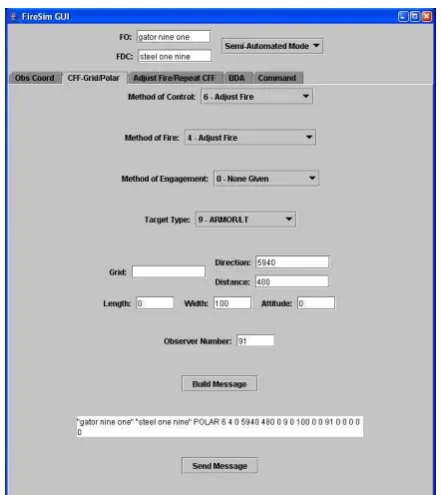
Fire Mission Value components are also directly modifiable by the trainer. Figure 7 shows the GUI which the trainer can use to take control of the session, edit any of the Fire Mission Value com-ponents, and relinquish control of the session back to Radiobot-CFF. This allows the trainer to correct any mistakes that the Radiobot may have made or test the trainee’s adaptability by sending the fire to an unexpected location. The example shown in Figure 7 is after utterance 5 of Figure 1; the sys-tem is running in semi-automated mode and the dialogue manager has decided that it has enough information to send a fire. The trainer may send the message or edit it and then send it. A second GUI, not shown, allows the trainer to take con-trol of the outgoing speech of the Radiobot, and, in semi-automated mode, either confirm the send-ing of a suggested output utterance, alter it before sending, or author new text for the radiobot to say. The third class of components is the Post-Fire Value components, which are also exposed to the trainer for modification. The example shown in Figure 8 is from after utterance 13 in Figure 1; the FO has requested an “adjust fire” with an indica-tor of “fire for effect” and a right adjustment of 50. At this point in the dialogue the FO could have in-stead chosen to end the mission. If the initial fire had been a “fire for effect” it could have been
re-Figure 7: GUI
peated, rather than following up an initial “adjust fire.” The adjust fire stage does not have any de-cision components because typically the adjust in-formation is given in one move.
adjust fire: true
shift indicator: fire for effect repeat FFE: false
left-right adjustment: 50 add-drop adjustment: 0 vertical adjustment: 0
end of mission: false disposition:
number of casualties:
-Figure 8: Post-Fire Value Components
[image:5.595.306.527.59.307.2]that tracks which of the three subdialogue phases (described in section 3) the dialogue is in for the most recently-discussed mission.
An example of the use of the Disambiguation components is to determine whether the phrase “fire for effect” refers to an adjustment of a pre-vious mission or the initiation of a new mission. In utterance 13 in Figure 1, “fire for effect” refers to an adjustment of a CFF that began with an “ad-just fire” in utterance 1. However, the FO could have started that CFF by calling for a “fire for ef-fect”. Furthermore the FO could have started a second CFF in utterance 13 rather than doing an adjust, and might have specified “fire for effect”. By using a rule to check the phase of the mission the move can be disambiguated to understand that it is referring to an adjustment, rather than the ini-tiation of a new fire mission.
mission is polar?: true target number: 0
missions active: 0
last method of fire: adjust phase: Info-Gathering
Figure 9: Disambiguation Components
The last class of components, shown in Fig-ure 10, is closely tied to the update rule processing, and is therefore described in the following section.
current reply: gator nine one this is steel one nine
previous reply: -understood? true send EOM? false send repeat? false
send repeat adjust? false send repeat ffe? false
Figure 10: Update Rule Processing Components
4.3 Update Rules
Update rules update the informational compo-nents, build a message to send to the FO, build a message to send to the simulator, and decide whether a message should actually be sent to the FO or simulator.
As an example of rule application, consider the processing of utterance 1 in Figure 1. Figure 4 shows the moves and parameters for this utterance. When the dialogue manager processes this utter-ance, a set of rules associated with the Identifi-cation move are applied, which starts building a response to the FO. This response is built in the
“current reply” Update Rule Processing compo-nent. Figure 10 shows a reply in the process of being built: a rule has recognized that an Identifi-cation move is being given, and has filled in slots in a template with the necessary information and added it to the “current reply” component.
Next, the update rules will recognize that a Warning Order is being given, and will identify that it is an “adjust fire” method of fire, and up-date the “has warning order” decision component, the “method of control” and “method of fire” value components, and the “last method of fire” disam-biguation component. As part of this, the appro-priate fields of the GUIs will be filled in to allow the trainer to override the FO’s request if need be. Another rule will then fill in the slots of a template to add “adjust fire polar” to the current reply, and later another rule will add “out”, thus finishing the reply to the FO. After the reply is finished, it will place it in the “previous reply” component, for ref-erence if the FO requests a repeat of the previous utterance.
Certain rules are specified as achieving compre-hension — that is, if they are applied, the “under-stood” variable for that turn is set. If no reply has been built but the move has been understood, then no reply needs to be sent. This happens, for ex-ample, for each of utterances 8, 10, and 12 in Fig-ure 1: because they are confirmations of utterances that the FDC has initiated, they do not need to be replied to. Similarly, no reply needs to be sent if no reply has been built and the incoming message is empty or only contains one or two words in-dicative of an open mic and background noise. Fi-nally, if no reply has been built and the move has not been understood, then the FO is prompted to repeat the message.
As described above, the Fire Mission Decision components are used to determine whether to send a fire mission. For other communications with the simulator, a simpler approach is possible. The de-cisions to send an end of mission, a repeat fire, or a repeat fire with the ’adjust’ or ’fire for effect’ spec-ification can be made with update rules acting on a single boolean, and so these are also part of the Update Rule Processing Components as shown in Figure 10.
appropriate rules to each dialogue move in the utterance before applying the rules that send the FO messages or simulator commands, as shown in Figure 11. Rules for producing replies and simula-tor commands are delayed until the end of process-ing an utterance to allow for utterances that may contain self-corrections or relevant details later in the turn.
for each dialogue move in utterance apply rules for that dialogue move end for
apply rules to send reply to FO
apply rules to send simulator commands
Figure 11: Update Strategy for Rules
5 Error Handling
Radiobot-CFF is able to handle various kind of problematic input in a number of ways. It can han-dle partially correct information, as in Figure 12. Speech recognition errors caused the “three casu-alties” information to be lost, but the update rules were able to handle the essential part of the FO contribution: that the mission was ended, and that the target was neutralized. The domain is forgiv-ing in this particular example, although a strict trainer might want to intervene by the GUI and insist that the FO submit the end of mission re-port.
FO Said: end of mission target neutralized estimate three casualties over
ASR Output: in end of mission target neutralized as the make three catch a these over
Radiobot: end of mission target neutralized out
Figure 12: Error Correction
In other cases, such as when giving number co-ordinates, all information must be fully grounded. An example of this is in Figure 13, where the num-ber “five” is lost by the speech recognition. In this case, the domain-appropriate response is to prompt for a repetition.
FO Said: right five zero over ASR Output: right by zero over Radiobot: say again over
Figure 13: Error Correction - Prompt
6 Evaluation
We conducted an evaluation of the Radiobot-CFF system in fully-automated, semi-automated, and human-controlled conditions. The system per-formed well in a number of measures; for exam-ple, Table 1 shows the scores for median time-to-fire and task-completion rates. Additional mea-sures and further details are available in (Robinson et al., 2006).
Table 1:Example Evaluation Measures
Measure Human Semi Fully
Time To Fire 106.2 s 139.4 s 104.3 s
Task Compl. 100% 97.5% 85.9%
Of particular relevance here, we performed an evaluation of the dialogue manager, using the eval-uation corpus of 17 missions run on 8 sessions, a total of 408 FO utterances. We took transcribed recordings of the FO utterances, ran them through the Interpreter, and corrected them. For each ses-sion, we ran corrected Interpreter output through the Dialogue Manager to print out the values of the informational components at the end of every turn. We then corrected those, and compared the cor-rections to the uncorrected values to receive preci-sion, accuracy, and f-scores of 0.99 each.2
7 Summary
We presented a dialogue manager which can en-gage in Call for Fire training dialogues, and de-scribed the environment and system in which it works. It has an information state-based design with several components accessible to a human operator, and may be controlled either fully, in part, or not at all by that human operator.
8 Acknowledgements
This work has been sponsored by the U.S. Army Research, Development, and Engineering Com-mand (RDECOM). Statements and opinions ex-pressed do not necessarily reflect the position or the policy of the United States Government, and no official endorsement should be inferred.
We would like to thank Charles Hernandez and Janet Sutton of the Army Research Laboratory, and Bill Millspaugh and the Depth & Simultane-ous Attack Battle Lab in Fort Sill, Oklahoma, for their efforts on this project. We would also like to thank the other members of the Radiobots project.
References
James F. Allen, Bradford W. Miller, Eric K. Ringger, and Teresa Sikorski. 1996. A robust system for nat-ural spoken dialogue. InProceedings of the 1996 Annual Meeting of the Association for Computa-tional Linguistics (ACL-96), pages 62–70.
Department of the Army. 2001. Tactics, techniques and procedures for observed fire and fire support at battalion task force and below. Technical Report FM 3-09.30 (6-30), Department of the Army.
H. Aust, M. Oerder, F. Siede, and V. Steinbiss. 1995. A spoken language enquiry system for automatic train timetable information. Philips Journal of Research, 49(4):399–418.
Robin Cooper and Staffan Larsson. 1999. Dialogue moves and information states. In H.C. Bunt and E. C. G. Thijsse, editors, Proceedings of the Third International Workshop on Computational Seman-tics.
Michael Johnston, Srinivas Bangalore, Gunaranjan Vasireddy, Amanda Stent, Patrick Ehlen, Mari-lyn Walker, Steve Whittaker, and Preetam Maloor. 2002. Match: An architecture for multimodal dia-logue systems. InProceedings of the 40th Annual Meeting of the Association for Computational Lin-guistics (ACL), pages 376–383.
Staffan Larsson and David Traum. 2000. Information state and dialogue management in the TRINDI dia-logue move engine toolkit. Natural Language En-gineering, 6:323–340, September. Special Issue on Spoken Language Dialogue System Engineering.
Oliver Lemon, Anne Bracy, Alexander Gruenstein, and Stanley Peters. 2001. The witas mult-modal dia-logue system i. InProc. European Conf. on Speech Communication and Tech- nology, pages 559–1562.
Colin Matheson, Massimo Poesio, and David Traum. 2000. Modelling grounding and discourse obliga-tions using update rules. InProceedings of the First Conference of the North American Chapter of the Association for Computational Linguistics.
Andrew Kachites McCallum. 2002. Mal-let: A machine learning for language toolkit. http://mallet.cs.umass.edu.
Bryan Pellom. 2001. Sonic: The university of col-orado continuous speech recognizer. Technical Re-port TR-CSLR-2001-01, University of Colorado.
Matthew Purver. 2002. Processing unknown words in a dialogue system. In Proceedings of the 3rd ACL SIGdial Workshop on Discourse and Dialogue, pages 174–183. Association for Computational Lin-guistics, July.
Susan Robinson, Antonio Roque, Ashish Vaswani, and David Traum. 2006. Evaluation of a spoken dia-logue system for military call for fire training. To Appear.
C. Rose, D. Litman, D. Bhembe, K. Forbes, S. Silli-man, R. Srivastava, and K. van Lehn. 2003. A com-parison of tutor and student behavior in speech ver-sus text based tutoring.
F. Sha and F. Pereira. 2003. Shallow parsing with con-ditional random fields.
David R. Traum and Jeff Rickel. 2002. Embodied agents for multi-party dialogue in immersive virtual worlds. In Proceedings of the first International Joint conference on Autonomous Agents and Mul-tiagent systems, pages 766–773.