Generalized Stack Decoding Algorithms for Statistical Machine Translation
∗Daniel Ortiz Mart´ınez
Inst. Tecnol´ogico de Inform´atica Univ. Polit´ecnica de Valencia
46071 Valencia, Spain [email protected]
Ismael Garc´ıa Varea
Dpto. de Informatica Univ. de Castilla-La Mancha
02071 Albacete, Spain [email protected]
Francisco Casacuberta Nolla
Dpto. de Sist Inf. y Comp. Univ. Polit´ec. de Valencia
46071 Valencia, Spain [email protected]
Abstract
In this paper we propose a generalization of the Stack-based decoding paradigm for Statistical Machine Translation. The well known single and multi-stack decoding algorithms defined in the literature have been integrated within a new formalism which also defines a new family of stack-based decoders. These decoders allows a tradeoff to be made between the ad-vantages of using only one or multiple stacks. The key point of the new formal-ism consists in parameterizeing the num-ber of stacks to be used during the de-coding process, and providing an efficient method to decide in which stack each par-tial hypothesis generated is to be inserted-during the search process. Experimental results are also reported for a search algo-rithm for phrase-based statistical transla-tion models.
1 Introduction
The translation process can be formulated from a statistical point of view as follows: A source lan-guage stringfJ
1 = f1. . . fJ is to be translated into a target language string eI1 = e1. . . eI. Every
tar-get string is regarded as a possible translation for the source language string with maximum a-posteriori probability P r(eI1|fJ
1). According to Bayes’
theo-rem, the target stringeˆI1that maximizes1the product
∗
This work has been partially supported by the Spanish project TIC2003-08681-C02-02, the Agencia Valenciana de
Ciencia y Tecnolog´ıa under contract GRUPOS03/031, the Gen-eralitat Valenciana, and the project HERMES (Vicerrectorado
de Investigaci´on - UCLM-05/06)
1
Note that the expression should also be maximized byI; however, for the sake of simplicity we suppose that it is known.
of both the target language model P r(eI1) and the
string translation modelP r(fJ
1|eI1)must be chosen.
The equation that models this process is:
ˆ
eI1 = arg max
eI
1
{P r(eI1)·P r(f1J|eI1)} (1)
The search/decoding problem in SMT consists in solving the maximization problem stated in Eq. (1). In the literature, we can find different techniques to deal with this problem, ranging from heuristic and fast (as greedy decoders) to optimal and very slow decoding algorithms (Germann et al., 2001). Also, under certain circumstances, stack-based decoders can obtain optimal solutions.
Many works (Berger et al., 1996; Wang and Waibel, 1998; Germann et al., 2001; Och et al., 2001; Ort´ız et al., 2003) have adopted different types of stack-based algorithms to solve the global search optimization problem for statistical machine trans-lation. All these works follow two main different approaches according to the number of stacks used in the design and implementation of the search algo-rithm (the stacks are used to store partial hypotheses, sorted according to their partial score/probability, during the search process) :
• On the one hand, in (Wang and Waibel, 1998; Och et al., 2001) a single stack is used. In that case, in order to make the search feasible, the pruning of the number of partial hypothe-ses stored in the stack is needed. This cauhypothe-ses many search errors due to the fact that hy-potheses covering a different number of source (translated) words compete in the same condi-tions. Therefore, the greater number of covered words the higher possibility to be pruned.
(one for each set of source covered/translated words in the partial hypothesis) in order to solve the disadvantages of the single-stack ap-proach. By contrast, the problem of finding the best hypothesis to be expanded introduces an exponential term in the computational com-plexity of the algorithm.
In (Ort´ız et al., 2003) the authors present an em-pirical comparison (about efficiency and translation quality) of the two approaches paying special atten-tion to the advantages and disadvantages of the two approaches.
In this paper we present a new formalism consist-ing of a generalization of the classical stack-based decoding paradigm for SMT. This new formalism defines a new family of stack-based decoders, which also integrates the well known stack-based decoding algorithms proposed so far within the framework of SMT, that is single and multi-stack decoders.
The rest of the paper is organized as follows: in section 2 the phrase-based approach to SMT is de-picted; in section 3 the main features of classical stack-based decoders are presented; in section 4 the new formalism is presented and in section 5 exper-imental results are shown; finally some conclusions are drawn in section 6.
2 Phrase Based Statistical Machine
Translation
Different translation models (TMs) have been pro-posed depending on how the relation between the source and the target languages is structured; that is, the way a target sentence is generated from a source sentence. This relation is summarized using the con-cept of alignment; that is, how the constituents (typ-ically words or group-of-words) of a pair of sen-tences are aligned to each other. The most widely used single-word-based statistical alignment
mod-els (SAMs) have been proposed in (Brown et al.,
1993; Ney et al., 2000). On the other hand, models that deal with structures or phrases instead of single words have also been proposed: the syntax trans-lation models are described in (Yamada and Knight, 2001) , alignment templates are used in (Och, 2002), and the alignment template approach is re-framed into the so-called phrase based translation (PBT)
in (Marcu and Wong, 2002; Zens et al., 2002; Koehn et al., 2003; Tom´as and Casacuberta, 2003).
For the translation model (P r(fJ
1|eI1)) in Eq. (1),
PBT can be explained from a generative point of view as follows (Zens et al., 2002):
1. The target sentence eI1 is segmented into K
phrases (˜eK
1 ).
2. Each target phrasee˜kis translated into a source phrasef˜.
3. Finally, the source phrases are reordered in or-der to compose the source sentencef˜1K=f1J.
In PBT, it is assumed that the relations between the words of the source and target sentences can be explained by means of the hidden variable ˜aK
1 ,
which contains all the decisions made during the generative story.
Different assumptions can be made from the pre-vious equation. For example, in (Zens et al., 2002) the following model is proposed:
pθ(f1J|eI1) =α(eI1) which is aligned with thek-th target phrasef˜k and that all possible segmentations have the same proba-bility. In (Tom´as and Casacuberta, 2001; Zens et al., 2002), it also is assumed that the alignments must be monotonic. This led us to the following equation:
pθ(f1J|eI1) =α(eI1)
In both cases the model parameters that have to be estimated are the translation probabilities between phrase pairs (θ={p( ˜f|e˜)}), which typically are es-timated as follows:
p( ˜f|e˜) = N( ˜f ,e˜)
where N( ˜f|e˜) is the number of times that f˜have been seen as a translation of e˜within the training corpus.
3 Stack-Decoding Algorithms
The stack decoding algorithm, also calledA∗
algo-rithm, was first introduced by F. Jelinek in (Jelinek, 1969). The stack decoding algorithm attempts to generate partial solutions, called hypotheses, until a complete translation is found2; these hypotheses are stored in a stack and ordered by their score. Typi-cally, this measure or score is the probability of the product of the translation and the language models introduced above. The A∗ decoder follows a
se-quence of steps for achieving a complete (and possi-bly optimal) hypothesis:
1. Initialize the stack with an empty hypothesis.
2. Iterate
(a) Poph(the best hypothesis) off the stack. (b) Ifh is a complete sentence, outputhand
terminate. (c) Expandh. (d) Go to step 2a.
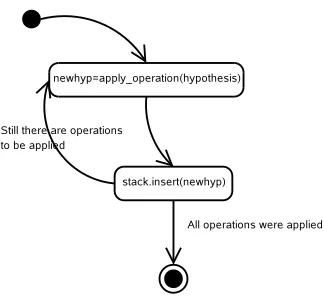
The search is started from a null string and obtains new hypotheses after an expansion process (step 2c) which is executed at each iteration. The expansion process consists of the application of a set of op-erators over the best hypothesis in the stack, as it is depicted in Figure 1. Thus, the design of stack decoding algorithms involves defining a set of oper-ators to be applied over every hypothesis as well as the way in which they are combined in the expansion process. Both the operators and the expansion algo-rithm depend on the translation model that we use. For the case of the phrase-based translation models described in the previous section, the operatoraddis defined, which adds a sequence of words to the tar-get sentence, and aligns it with a sequence of words of the source sentence.
The number of hypotheses to be stored during the search can be huge. In order then to avoid
mem-2
Each hypothesis has associated a coverage vector of length
J, which indicates the set of source words already cov-ered/translated so far. In the following we will refer to this simply as coverage.
Figure 1: Flow chart associated to the expansion of a hypothesis when using anA⋆algorithm.
ory overflow problems, the maximum number of hy-potheses that a stack may store has to be limited. It is important to note that for a hypothesis, the higher the aligned source words, the worse the score. These hypotheses will be discarded sooner when an A∗
search algorithm is used due to the stack length lim-itation. Because of this, the multi-stack algorithms were introduced.
Multi-stack algorithms store those hypotheses with different subsets of source aligned words in dif-ferent stacks. That is to say, given an input sentence
f1J composed of J words, multi-stack algorithms
employes2J stacks to translate it. Such an organi-zation improves the pruning of the hypotheses when the stack length limitation is exceeded, since only hypotheses with the same number of covered posi-tions can compete with each other.
All the search steps given for A∗ algorithm can
also be applied here, except step 2a. This is due to the fact that multiple stacks are used instead of only one. Figure 2 depicts the expansion process that the multi-stack algorithms execute, which is slightly different than the one presented in Figure 1. Multi-stack algorithms have the negative property of spending significant amounts of time in selecting the hypotheses to be expanded, since at each iteration, the best hypothesis in a set of 2J stacks must be searched for (Ort´ız et al., 2003). By contrast, for the
A∗algorithm, it is not possible to reduce the length
of the stack in the same way as in the multi-stack case without loss of translation quality.
Figure 2: Flow chart associated to the expansion of a hypothesis when using a multi-stack algorithm.
approach which consists in assigning to the same stack, those hypotheses with the same number of source words covered.
4 Generalized Stack-Decoding Algorithms
As was mentioned in the previous section, given a sentence fJ
1 to be translated, a single stack
decod-ing algorithm employs only one stack to perform the translation process, while a multi-stack algorithm employs 2J stacks. We propose a possible way to make a tradeoff between the advantages of both al-gorithms that introduces a new parameter which will be referred to as the granularity of the algorithm. The granularity parameter determines the number of stacks used during the decoding process.
4.1 Selecting the granularity of the algorithm
The granularity (G) of a generalized stack algorithm is an integer which takes values between 1 and J, whereJ is the number of words which compose the sentence to translate.
Given a sentence f1J to be translated, a
general-ized stack algorithm with a granularity parameter equal tog, will have the following features:
• The algorithm will use at most2gstacks to per-form the translation
• Each stack will contain hypotheses which have
2J−gdifferent coverages offJ
1
• If the algorithm can store at most S = s hy-potheses, then, the maximum size of each stack will be equal to 2sg
4.2 Mapping hypotheses to stacks
Generalized stack-decoding algorithms require a mechanism to decide in which stack each hypothesis is to be inserted. As stated in section 4.1, given an input sentencefJ
1 and a generalized stack-decoding
algorithm withG = g, the decoder will work with
2g stacks, and each one will contain2J−g different
coverages. Therefore, the above mentioned mecha-nism can be expressed as a function which will be referred to as the µ function. Given a hypothesis coverage composed ofJ bits, theµfunction return a stack identifier composed of onlygbits:
µ: ({0,1})J −→({0,1})g (6)
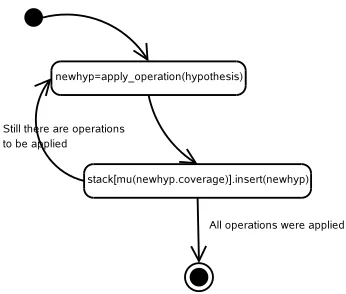
Generalized stack algorithms are strongly in-spired by multi-stack algorithms; however, both types of algorithms differ in the way the hypothesis expansion is performed. Figure 3 shows the expan-sion algorithm of a generalized stack decoder with a granularity parameter equal togand a functionµ
which maps hypotheses coverages to stacks.
Figure 3: Flow chart associated to the expansion of a hypothesis when using a generalized-stack algo-rithm.
The function µ can be defined in many ways, but there are two essential principles which must be taken into account:
• Theµfunction must be efficiently calculated
hypotheses with a similar number of covered words can compete fairly
A possible way to implement the µ function, namelyµ1, consists in simply shifting the coverage vectorJ−gpositions to the right, and then keeping only the first g bits. Such a proposal is very easy to calculate, however, it has a poor performance ac-cording to the second principle explained above.
A better alternative to implement the µfunction, namely µ2, can be formulated as a composition of two functions. A constructive definition of such a implementation is detailed next:
1. Let us suppose that the source sentence is com-posed by J words, we order the set of J bit numbers as follows: first the numbers which do not have any bit equal to one, next, the numbers which have only one bit equal to one, and so on
2. Given the list of numbers described above, we define a function which associates to each num-ber of the list, the order of the numnum-ber within this list
3. Given the coverage of a partial hypothesis, x, the stack on which this partial hypothesis is to be inserted is obtained by a two step process: First, we obtain the image ofxreturned by the function described above. Next, the result is shiftedJ−gpositions to the right, keeping the firstgbits
Letβbe the function that shifts a bit vectorJ−g
positions to the right, keeping the firstgbits; and let
αbe the function that for each coverage returns its order:
α: ({0,1})J −→({0,1})J (7)
Then,µ2is expressed as follows:
µ2(x) =β◦α(x) (8)
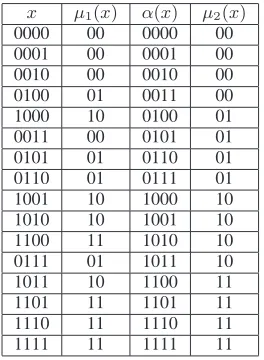
Table 1 shows an example of the values which re-turns theµ1and theµ2functions when the input sen-tence has4words and the granularity of the decoder is equal to 2. As it can be observed, µ2 function performs better than µ1 function according to the second principle described at the beginning of this section.
x µ1(x) α(x) µ2(x)
0000 00 0000 00
0001 00 0001 00
0010 00 0010 00
0100 01 0011 00
1000 10 0100 01
0011 00 0101 01
0101 01 0110 01
0110 01 0111 01
1001 10 1000 10
1010 10 1001 10
1100 11 1010 10
0111 01 1011 10
1011 10 1100 11
1101 11 1101 11
1110 11 1110 11
1111 11 1111 11
Table 1: Values returned by theµ1 andµ2 function defined as a composition of theαandβfunctions
4.3 Single and Multi Stack Algorithms
The classical single and multi-stack decoding al-gorithms can be expressed/instantiated as particular cases of the general formalism that have been pro-posed.
Given the input sentencefJ
1 , a generalized stack
decoding algorithm withG = 0 will have the fol-lowing features:
• The algorithm works with20
= 1stacks.
• Such a stack may store hypotheses with2J dif-ferent coverages. That is to say, all possible coverages.
• The mapping function returns the same stack identifier for each coverage
The previously defined algorithm has the same features as a single stack algorithm.
Let us now consider the features of a generalized stack algorithm with a granularity value ofJ:
• The algorithm works with2J stacks
• Each stack may store hypotheses with only
20
= 1coverage.
• The mapping function returns a different stack identifier for each coverage
EUTRANS-I XEROX
Spanish English Spanish English
Training
Sentences 10,000 55,761
Words 97,131 99,292 753,607 665,400
Vocabulary size 686 513 11,051 7,957
Average sentence leng. 9.7 9.9 13.5 11.9
Test
Sentence 2,996 1,125
Words 35,023 35,590 10,106 8,370
Perplexity (Trigrams) – 3.62 – 48.3
Table 2: EUTRANS-I and XEROXcorpus statistics
5 Experiments and Results
In this section, experimental results are presented for two well-known tasks: the EUTRANS-I (Amengual et al., 1996), a small size and easy translation task, and the XEROX(Cubel et al., 2004), a medium size
and difficult translation task. The main statistics of these corpora are shown in Table 2. The translation results were obtained using a non-monotone gener-alized stack algorithm. For both tasks, the training of the different phrase models was carried out us-ing the publicly available Thot toolkit (Ortiz et al., 2005).
Different translation experiments have been car-ried out, varying the value ofG(ranging from 0 to 8) and the maximum number of hypothesis that the algorithm is allow to store for all used stacks (S) (ranging from 28
to212
). In these experiments the following statistics are computed: the average score (or logProb) that the phrase-based translation model assigns to each hypothesis, the translation quality (by means of WER and Bleu measures), and the av-erage time (in secs.) per sentence3.
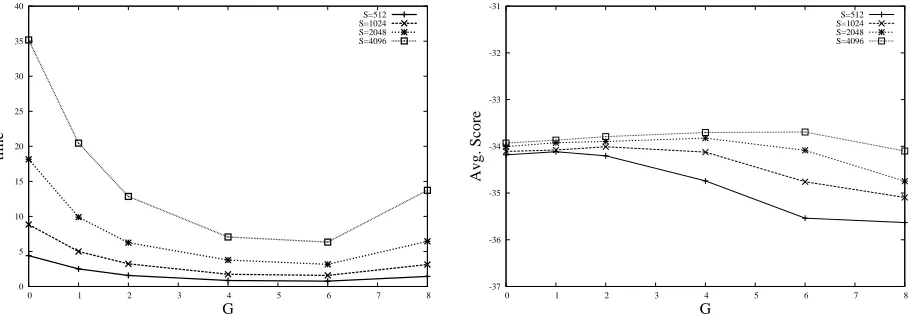
In Figures 4 and 5 two plots are shown: the av-erage time per sentence (left) and the avav-erage score (right), for EUTRANS and XEROX corpora
respec-tively. As can be seen in both figures, the bigger the value ofGthe lower the average time per sentence. This is true up to the value of G = 6. For higher values ofG(keeping fixed the value ofS) the aver-age time per sentence increase slightly. This is due to the fact that at this point the algorithm start to spend more time to decide which hypothesis is to be expanded. With respect to the average score similar values are obtained up to the value ofG= 4. Higher
3
All the experiments have been executed on a PC with a 2.60 Ghz Intel Pentium 4 processor with 2GB of memory. All the times are given in seconds.
values ofGslightly decreases the average score. In this case, as G increases, the number of hypothe-ses per stack decreahypothe-ses, taking into account that the value of S is fixed, then the “optimal” hypothesis can easily be pruned.
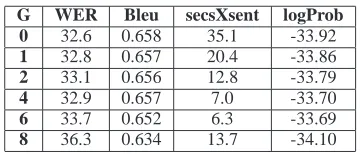
In tables 3 and 4 detailed experiments are shown for a value ofS= 212
and different values ofG, for EUTRANSand XEROXcorpora respectively.
G WER Bleu secsXsent logprob
0 6.6 0.898 2.4 -18.88
1 6.6 0.898 1.9 -18.80
2 6.6 0.897 1.7 -18.81
4 6.6 0.898 1.3 -18.77
6 6.7 0.896 1.1 -18.83
8 6.7 0.896 1.5 -18.87
Table 3: Translation experiments for EUTRANS cor-pus using a generalized stack algorithm with differ-ent values ofGand a fixed value ofS = 212
G WER Bleu secsXsent logProb
0 32.6 0.658 35.1 -33.92
1 32.8 0.657 20.4 -33.86
2 33.1 0.656 12.8 -33.79
4 32.9 0.657 7.0 -33.70
6 33.7 0.652 6.3 -33.69
8 36.3 0.634 13.7 -34.10
Table 4: Translation experiments for XEROX cor-pus using a generalized stack algorithm with differ-ent values ofGand a fixed value ofS = 212
According to the experiments presented here we can conclude that:
• The results correlates for the two considered tasks: one small and easy, and other larger and difficult.
0 0.5 1 1.5 2 2.5
0 1 2 3 4 5 6 7 8
time
G
S=512 S=1024 S=2048 S=4096
-20 -19.5 -19 -18.5 -18
0 1 2 3 4 5 6 7 8
Avg. Score
G
S=512 S=1024 S=2048 S=4096
Figure 4: Average time per sentence (in secs.) and average score per sentence. The results are shown for different values ofGandSfor the EUTRANScorpus.
0 5 10 15 20 25 30 35 40
0 1 2 3 4 5 6 7 8
time
G
S=512 S=1024 S=2048 S=4096
-37 -36 -35 -34 -33 -32 -31
0 1 2 3 4 5 6 7 8
Avg. Score
G
S=512 S=1024 S=2048 S=4096
Figure 5: Average time per sentence (in secs.) and average score per sentence. The results are shown for different values ofGandSfor the XEROXcorpus.
tween the advantages of classical single and multi-stack decoding algorithms.
• As we expected, better results (regarding effi-ciency and accuracy) are obtained when using a value ofGbetween0andJ.
6 Concluding Remarks
In this paper, a generalization of the stack-decoding paradigm has been proposed. This new formalism includes the well known single and multi-stack de-coding algorithms and a new family of stack-based algorithms which have not been described yet in the literature.
Essentially, generalized stack algorithms use a pa-rameterized number of stacks during the decoding
process, and try to assign hypotheses to stacks such that there is ”fair competition” within each stack, i.e., brother hypotheses should cover roughly the same number of input words (and the same words) if possible.
The new family of stack-based algorithms allows a tradeoff to be made between the classical single and multi-stack decoding algorithms. For this pur-pose, they employ a certain number of stacks be-tween1(the number of stacks used by a single stack algorithm) and2J (the number of stacks used by a multiple stack algorithm to translate a sentence with
Jwords.)
effi-ciency and acuraccy) the single and multi-stack al-gorithms proposed so far.
As future work, we plan to extend the experimen-tation framework presented here to larger and more complex tasks as HANSARDS and EUROPARL
cor-pora.
References
J.C. Amengual, J.M. Bened´ı, M.A. Castao, A. Marzal, F. Prat, E. Vidal, J.M. Vilar, C. Delogu, A. di Carlo, H. Ney, and S. Vogel. 1996. Definition of a ma-chine translation task and generation of corpora. Tech-nical report d4, Instituto Tecnol´ogico de Inform´atica, September. ESPRIT, EuTrans IT-LTR-OS-20268.
Adam L. Berger, Peter F. Brown, Stephen A. Della Pietra, Vincent J. Della Pietra, John R. Gillett, A. S. Kehler, and R. L. Mercer. 1996. Language translation ap-paratus and method of using context-based translation models. United States Patent, No. 5510981, April.
Peter F. Brown, Stephen A. Della Pietra, Vincent J. Della Pietra, and R. L. Mercer. 1993. The mathematics of statistical machine translation: Parameter estimation.
Computational Linguistics, 19(2):263–311.
E. Cubel, J. Civera, J. M. Vilar, A. L. Lagarda, E. Vidal, F. Casacuberta, D. Pic´o, J. Gonz´alez, and L. Rodr´ıguez. 2004. Finite-state models for computer assisted translation. In Proceedings of the 16th
Euro-pean Conference on Artificial Intelligence (ECAI04),
pages 586–590, Valencia, Spain, August. IOS Press.
Ulrich Germann, Michael Jahr, Kevin Knight, Daniel Marcu, and Kenji Yamada. 2001. Fast decoding and optimal decoding for machine translation. In Proc.
of the 39th Annual Meeting of ACL, pages 228–235,
Toulouse, France, July.
F. Jelinek. 1969. A fast sequential decoding algorithm using a stack. IBM Journal of Research and
Develop-ment, 13:675–685.
P. Koehn, F. J. Och, and D. Marcu. 2003. Statisti-cal phrase-based translation. In Proceedings of the
HLT/NAACL, Edmonton, Canada, May.
Phillip Koehn. 2003. Pharaoh: a beam search decoder for phrase-based statistical machine translation mod-els. User manual and description. Technical report, USC Information Science Institute, December.
Daniel Marcu and William Wong. 2002. A phrase-based, joint probability model for statistical machine transla-tion. In Proceedings of the EMNLP Conference, pages 1408–1414, Philadelphia, USA, July.
Hermann Ney, Sonja Nießen, Franz J. Och, Hassan Sawaf, Christoph Tillmann, and Stephan Vogel. 2000. Algorithms for statistical translation of spoken lan-guage. IEEE Trans. on Speech and Audio Processing, 8(1):24–36, January.
Franz J. Och, Nicola Ueffing, and Hermann Ney. 2001. An efficient A* search algorithm for statistical ma-chine translation. In Data-Driven Mama-chine
Transla-tion Workshop, pages 55–62, Toulouse, France, July.
Franz Joseph Och. 2002. Statistical Machine
Trans-lation: From Single-Word Models to Alignment Tem-plates. Ph.D. thesis, Computer Science Department,
RWTH Aachen, Germany, October.
D. Ort´ız, Ismael Garc´ıa-Varea, and Francisco Casacu-berta. 2003. An empirical comparison of stack-based decoding algorithms for statistical machine transla-tion. In New Advance in Computer Vision, Lec-ture Notes in Computer Science. Springer-Verlag. 1st Iberian Conference on Pattern Recongnition and Im-age Analysis -IbPRIA2003- Mallorca. Spain. June.
D. Ortiz, I. Garca-Varea, and F. Casacuberta. 2005. Thot: a toolkit to train phrase-based statistical translation models. In Tenth Machine Translation Summit, pages 141–148, Phuket, Thailand, September.
J. Tom´as and F. Casacuberta. 2001. Monotone statistical translation using word groups. In Procs. of the
Ma-chine Translation Summit VIII, pages 357–361,
Santi-ago de Compostela, Spain.
J. Tom´as and F. Casacuberta. 2003. Combining phrase-based and template-phrase-based models in statistical ma-chine translation. In Pattern Recognition and Image
Analisys, volume 2652 of LNCS, pages 1021–1031.
Springer-Verlag. 1st bPRIA.
Ye-Yi Wang and Alex Waibel. 1998. Fast decoding for statistical machine translation. In Proc. of the
Int. Conf. on Speech and Language Processing, pages
1357–1363, Sydney, Australia, November.
Kenji Yamada and Kevin Knight. 2001. A syntax-based statistical translation model. In Proc. of the 39th
Annual Meeting of ACL, pages 523–530, Toulouse,
France, July.
R. Zens, F.J. Och, and H. Ney. 2002. Phrase-based sta-tistical machine translation. In Advances in artificial
intelligence. 25. Annual German Conference on AI,