24
Control of Neutralization Process in Continuous
Stirred Tank Reactor (CSTR)
Dr. Magan P. Ghatule
Department of Computer Science,
Sinhgad College of Science, Ambegaon (Bk), Pune-41. [email protected]
Abstract- As neutralization is a chemical process of acid base reaction in an aqueous solution in which pH value is 7.0 is presented. Basically pH is scaling within the range values 1 to 14. Acid-base reaction is carried out in CSTR and pH is controlled and maintained at 7.0, so as neutralization takes place. Therefore maintain and controlling of pH value is equal to 7.0 gives chemically great significant important. Above and below of this pH value acid–base aqueous solution shows characteristic chemical reactivity. In view of this, laboratory scale CSTR is fabricated, PID (Proportional Integral and Derivative) is developed, which is used to control the CSTR in which acid-base reaction
takes place and make it more stable with respect to any environmental disturbances. From view of the neutralization point, pH is so controlled and maintained precisely by the PID. The PID control loop depends up on the three constants proportionality, integral, and derivative. The controlling stability of CSTR is made by various auto-tuning methods of PID. Set of readings of on line CSTR control are carried out, the process control results are shown graphically and conclusion is extracted accordingly.
Keywords—Neutralization, pH, CSTR, process control, PID, chemical. set- point.
1. INTRODUCTION
Neutralization is a chemically acid base reaction in an aqueous solution. Acidity or basicity can be measured by means of scaling factor, which is known as pH scale or pH value. Basically pH is scaling within the range from 1 to 14. It is just possible to differentiate between neutral, acidic and basic solutions (aqueous) on the basics of pH value. For neutral solutions pH = 7.0, acidic solutions pH < 7.0 and basic solutions pH > 7.0. When pH value of the of the aqueous solution is 7.0 then acid base reaction is said to be neutralize and overall process is called neutralization process [1].
In many chemical process industries like Refining industries, Waste Water Plant, Digestion Process, Biochemical Processes and Mechanical Engine's Coolant system, pH value has great importance. pH measurement and controlling is extensively used for
1)
Quality control of the product and its uniformility.2)
Corrosion inhibition where pH monitoring is used in congestion with oxygen control to minimize corrosion in high pressure boilers and other water streams3)
Effluent pH controlled by neutralization of liquid discharge in to public streams.Hence it is very necessary to control it within the processes to obtain the good quality processes output [2]. Controlling the pH value is a challenging problem mainly because of the uncertainty and non-linearity in nature. The most difficult part of the realization of a nonlinear control is to obtain a mathematical model. In view of overall said problem of precisely controlling the pH, a laboratory scale Continuous Stirred Tank Reactor (CSTR) with necessary electronic interfacing units are fabricated and developed.
PID controller [3] is also developed and used to control the pH. PID controller is capable to stabilizing process at any set point by using a mathematical function in the form of control algorithm. Auto tuning of PID is incorporated in CSTR. The test runs are carried out, data is collected from the process. Process controllability is studied graphically.
25
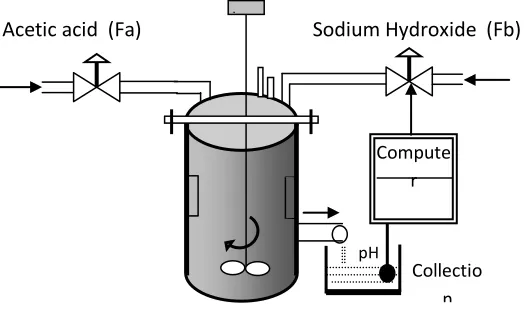
Complete prototype laboratory scale Continuous Stirred Tank Reactor (CSTR) is as shown in Fig. (1). The reactor has two inlets and one outlet. One input stream is of acetic acid (HC2H3O2) and other of
sodium hydroxide (NaOH). The flow rate of acetic acid is maintained constant, while the controller manipulates flow rate of the sodium hydroxide. Due to the incomplete dissociation of acetic acid in water and the equilibrium reaction with sodium acetate, the system will behave like the buffer solution of varying pH from 4.0 to11.0 [1] and it depends on the flow rate, concentrations of the incoming solutions and room temperature. The CSTR is controlled using the digital PID controller. The controller is supervised by a personal computer, which also helps in data acquisition. A mechanical stirrer can achieve uniform mixing of solutions in the CSTR. The pH in the CSTR can be maintained at a specific set-point by manipulating the control valve on the base stream.
3. PID CONTROL ALGORITHM
PID Control (proportional, integral and derivative) is so far widest type of automatic controller used in industry. In this case PID controller is used to stabilize the process with respect to set-point at 7.0 or around the 7.0 so that, it has a relatively simple algorithm [10,14]
As PID controllers are still, most widely used in industry, it is worthwhile to compare the performance of CSTR with them. The velocity form of discrete PID controller algorithm can be written as,
Äu(k) = Kc[e(k)-e(K-1)] + (T/2Ti)[e(K) +
e(K-1)]+Td/T[e(K)-2e(K-1)+e(K-2)] ………(1)
Where, [14]
T is sampling time,
Äu(k) is the increment of control
input,
e(K) is the performance error at the sampling instant,
K and Kc are the controller gains,
Ti is the integral or reset time,
Td is the derivative or rate time.
The auto tuning of PID controller was carried out using closed loop tuning method. Process characteristics were measured and optimum values of Kc, Ti and Td were obtained. The final settings for Kc
and Ti were used 2.5 and 200 seconds for the test run.
Derivative time Td was set to zero.
IV. EXPERIMENTAL RESULTS
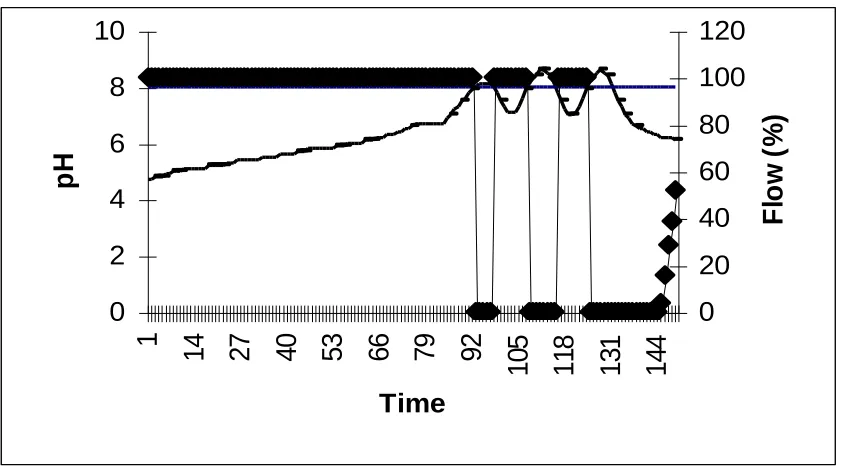
To obtain the quality results, initially the pH process is controlled with a PI controller. Further, PID controller was designed using Ziegler-Nichols closed loop method. In this method controller setting are based on the conditions that generate the loop of the process. Auto tuning [14] results of PID controller in real time run setup is graphically shown in Fig. 2.
Acetic acid (Fa) Sodium Hydroxide (Fb)
[image:2.612.316.578.354.509.2]pH
Fig. 1. Neutralization Plant (CSTR)
Compute r
PH meter
Collectio n
26
The graph of pH versus Time (second) shows that, the experiment is performed at an operating set-point point of 8.0 (pH value) and for final setting values of Kp, Ti and Td are 15, 2 second , 2 second
respectively .
4. SETPOINT TRACKING
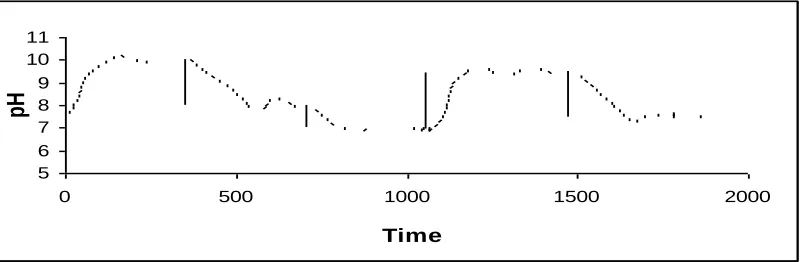
The set point tracking performance of PID controller is tested using a non-constant disturbance. Fig.(3) shows that set-point tracking performance of PID controller for various set points, 8.0, 10.0 and 7.5 of pH value.
The disturbance rejection performance is also observed and studied for non-constant disturbance to obtain the conclusion, which is as shown in fig.(4). From fig.(4), for providing non-constant disturbances the acid flow is decreased by an amount of 30 % at t = 0 second. The flow rate of acid is maintained at t = 99 sec. From graphical Fig. (3) and Fig.(4) controller performance can be studied and shows good results of real time CSTR control system using
PID controller. It also gives better results than the PI controller.
5. CONCLUSION
The overall performance of PI and PID of controllability of pH (nonlinear system) process in a CSTR system has been gives better performance. The PID controller of CSTR control system works well, compared with properly tuned PI controller with respect to set-point tracking and disturbance rejection. Process work on real time state and hence gives better results against the other environmental disturbance conditions. Dead time complication also be self controlled at the pH neutralization stage in the CSTR. This is the unique system which gives exact neutralization of CSTR of strong acid (HC2H3O2) and weak base (NaOH) reaction in real
time process. Finally, CSTR control system developed may be most suitable and applicable to the
large scale Process Industries in which pH require to be controlled.
0
2
4
6
8
10
1
14
27
40
53
66
79
92
1
05
1
18
1
31
1
44
Time
pH
0
20
40
60
80
100
120
F
lo
w
(
%
[image:3.612.77.500.101.334.2])
27
REFERENCES
[1] W. L. Masterton, E. J. Slowinski, ‘Chemical Principles’, W. B. Saunders Company, Toronto / London, 4th Edition, (1977), PP. 447-491. [2] N. C. Pradhan, ‘Instrumentation For Ph
Measurement’, Chemical Product Finder, (April-1998), PP. 51-56.
[3] M. Gopal, ‘Digital Control Engineering’, Wiley Eastern Ltd. New Delhi, PP. 136, 313-328. [4] B. G. Liptak & K. Venczel, ‘Instrumentation
Engineering Hand Book’, Chilton Book Company, Radnor, Pennsylvania, PP. 967-984, 624.
[5] F. G. Shinskey , ‘Process Control System-Application Design & Tuning’, Mcgraw – Hill International Editions, New York, 3rd Edition, (1998), PP. 200, 393.
[6]J. Michael Jacob, ‘Industrial Control Electronics-Applications and Design’, Prentice Hall, Englewood Cliffs, New Jersey, PP. 303-310.
[7] W. L. Luyben, Process Modelling-Simulation And Control For Chemical Engineering, Mcgrew Hill Pub. Co. Singapore, (1990), PP. 391- 395. [8] T. E. Marlin, ‘Process Control’, Mcgrew Hill
International Edition, 2nd Edn.,(2000), PP 267-289, 396-403,
[9] Abdul A. Ishak, M. A. Hussain & Elamin Elkazi, ‘Modeling And Control Studies Of Waste Water Neutralization Process’, Proceeding To Brounei International Conference Of Engineering & Technology, Bandar Seri Begawan, (9-11oct.-2001), PP. 221-231.
[10]M. Chidambram & S. N. Jyothi, ‘Feedforward Control Of Non Linear Systems’, Indian Chemical Engineers Section A, Vol. 41, No. 2, (July –Sept. 1999), PP. 191-192,
[11]D. P. Jarg, ‘Application Of Three Mode Controls For Non Linear System Synthesis’, Ieee Transaction On Automatic Control, (Feb.- 1971), PP. 80-82.
Fig (3) Set-point Tracking of PID Controller
5 6 7 8 9 10 11
0 500 1000 1500 2000
Time
pH
Fig.(4) Non-constant Disturbance Rejection
7 8 9 10 11 12 1
15 29 43 57 71 85 99
[image:4.612.100.525.91.432.2] [image:4.612.109.509.92.223.2]28
[12]S. Pramod & M. Chidambaram ‘Closed Loop Identification By Optimization Method For Tuning Pid Controllers’, Indian Chemical Engineers, Section A, Vol. 43, No. 2, (April-June 1999), PP. 190-194.
[13]M. Chidambaram, ‘Design Formulae Pid Controller’, Indian Chemical Engineers’, Section A, Vol. 37, No. 3, (July–Sept. 1995), PP. 190-193,
[14]G. J. Silva, A. Datta & S. P. Bhattacharyya, ‘On The Stability & Controller Robustness Of Some Popular Pid Tuning Rules’, Ieee Transitions On Automatic Controller, Vol. 48, No. 9, (Sept. 2003), PP. 1638-1640.