Prior-informed Distant Supervision
for Temporal Evidence Classification
Ridho Reinanda
University of Amsterdam
Amsterdam, The Netherlands
[email protected]
Maarten de Rijke
University of Amsterdam
Amsterdam, The Netherlands
[email protected]
Abstract
Temporal evidence classification, i.e., finding associations between temporal expressions and re-lations expressed in text, is an important part of temporal relation extraction. To capture the variations found in this setting, we employ a distant supervision approach, modeling the task as multi-class text classification. There are two main challenges with distant supervision: (1) noise generated by incorrect heuristic labeling, and (2) distribution mismatch between the target and distant supervision examples. We are particularly interested in addressing the second problem and propose a sampling approach to handle the distribution mismatch. Our prior-informed distant supervision approach improves over basic distant supervision and outperforms a purely super-vised approach when evaluated on TAC-KBP data, both on classification and end-to-end metrics.
1 Introduction
Temporal relation extraction is the problem of extracting the temporal extent of relations between entities. A typical solution to the temporal relation extraction problem has three main components: (1)passage retrieval, (2)temporal evidence classification, and (3)temporal evidence aggregation. A community-based effort to evaluate temporal relation extraction was introduced in 2011 as a TAC Knowledge Base Population task: Temporal Slot Filling, or TSF for short (Ji et al., 2011).
An illustration of temporal slot filling is as follows. Having identified aper:spouserelation be-tween two entities (Freeman Dyson, Imme Dyson), a system must establish the temporal boundaries from its supporting sentence. In the case of the sentence “In 1958, he married Imme Dyson”, the goal is to find that the relation lasts from 1958 until the present day. Within the TSF setting, the boundaries are represented as beginning and ending intervals in a tuple (T1,T2, T3,T4) instead of an exact time
expression, so as to allow uncertainty in the system output. We investigate temporal relation extraction following this setting. We focus on the temporal evidence classification part.
One of the challenges with relation extraction is the limited amount of training data available to capture the variations in a target corpus: temporal relation extraction faces the same challenge. Employing distant supervision (Mintz et al., 2009) is a way to address the challenge. But generating example training data in the temporal setting is not straightforward: we have to find not only the query and related entity, but also the time expression, in a single text segment.
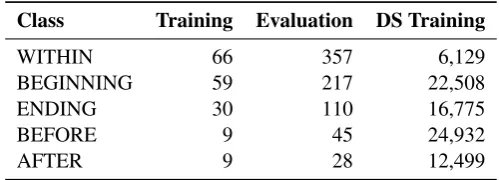
Employing distant supervision for temporal evidence classification will introduce noise, in the form of labels and additional contexts (e.g., lexical features). A lot of previous work in distant supervision has been dedicated to reducing noise in distant supervision (Bunescu and Mooney, 2007; Riedel et al., 2010; Wei et al., 2012). We are interested in another phenomenon: the class distributions found in training data generated by a distant supervision approach. These distributions become an issue if the distant supervision corpus has a different structure and different characteristics compared to the target corpus, e.g., Wikipedia vs. news articles. We observe that in the case of temporal evidence, news articles and Wikipedia do indeed contain different class distributions. Our working hypothesis is that incorporating prior information about temporal class distribution helps improve our distant supervision approach. We
test this hypothesis by comparing a distant supervision strategy with class priors to a distant supervision without class priors. We also demonstrate the effectiveness of our method by contrasting it with a purely supervised approach. In addition, we investigate how the difference in performance in temporal evidence classification affects the final score obtained in the overall end-to-end task.
We discuss related work in Section 2. In Section 3, we describe our distant supervision approach for temporal evidence classification. Our experimental setup is detailed in Section 4. We follow with results in Section 5 and a conclusion in Section 6.
2 Related Work
We discuss two groups of related work: on temporal slot filling and on distant supervision.
2.1 Temporal slot filling
Some previous work uses a pattern-based approach (Byrne and Dunnion, 2011); patterns are defined in terms of query entity, temporal expression, and slot value. For example, the worddivorceshould trigger that the relationper:spouseis ending. Other work uses temporal linking between time expressions and events in an event-based approach (Burman et al., 2011), where the source documents are annotated with TimeML event annotations (Pustejovsky et al., 2003); the authors use intra-sentence event-time links, and inter-sentence event-event links, following a TempEval approach (UzZaman et al., 2012). Garrido et al. (2012) use a graph-based document representation; they convert document context to a graph representation and use TARSQI to determine links between time expressions and events in documents and later map the resulting links into five temporal classes.
Li et al. (2012) combine flat and structured approaches to perform temporal classification. Their approach relies on a custom SVM kernel designed around flat (window and shallow dependency) features and structured (dependency path) features. The structured approach is designed to overcome the long context problem. They use a distant supervision approach for the temporal classification part, obtained on Freebase relations. They further extend their approach with self-training and relabeling (Ji et al., 2013).
Finally, Surdeanu et al. (2011) use n-grams around temporal expressions to train a distant supervision system. To be able to use Freebase facts, they find example sentences in Wikipedia, and use a window of five words from the temporal expression, using Freebase facts asstart and endtrigger. They use Jaccard correlation between n-grams to determine the association to startandend. Sil and Cucerzan (2014) performed distant supervision using facts obtained from Wikipedia infoboxes. From Wikipedia infoboxes, they retrieve the relevant sentences and build n-gram language models of the relations. In a slightly different setting (exploratory search), Reinanda et al. (2013) establish the temporal extent of entity associations simply by looking at their co-occurrence within documents in the corpus.
Our approach to temporal evidence classification differs from most existing approaches in its distant supervision scheme. We use distant supervision to directly perform a multi-class classification of tem-poral evidence against the five main temtem-poral classes (including thebeforeandafterclass), where most of the previous systems train a model to detect the beginning and ending of relationships only.
2.2 Reducing noise in distant supervision
With distant supervision (Mintz et al., 2009), indirect examples in the form of relations from a knowledge base such as Freebase and DBPedia are used. From these relation tuples, instances of relations in the form of sentences in the corpus are searched. Text features are later extracted from these sentences that are then used to train classifiers that can identify relations in the text corpus.
Ritter et al. (2003) focus on the issue of missing data for texts that contain rare entities that do not exist in the original knowledge base. Riedel et al. (2010) work with a relaxed distant supervision assumption; they design a factor graph to explicitly model whether two entities are related, and later train this model with a semi-supervised constraint-driven algorithm; they achieve a 31 percent error reduction.
Bunescu and Mooney (2007) introduce multiple instance learning to handle the weak confidence in the assigned label. They divide the instances into a positive bag (at least one positive example) and a negative bag (all negative examples). They design a custom kernel to work with this weaker form of supervision. Surdeanu et al. (2012) operate on the same principle, but model the relation between entities and relation classes using graphical models. Hoffmann et al. (2011) also use multi-instance learning, but focus on overlapping relations.
What we add on top of existing work is the use of sampling techniques to correct for skewed distri-butions introduced through distant examples. We propose prior sampling, correcting the distridistri-butions of the classes in the generated examples to fit the target corpora.
3 Method
The temporal slot filling task is defined as follows: given a relationR= (q, r,s), whereq is a query entity,ris a related entity, andsis a slot type, one must findTR, a tuple of four dates (T1,T2,T3,T4)
whereRholds, whereT1andT2form the beginning interval of the relation, andT3andT4is the ending
interval. A system first must retrieve all passages or sentences expressing the relation betweenqandr. Each sentences and any time information within them will serve as intermediate evidence. This temporal evidence will later be aggregated and converted to tuple representationTR.
In this paper, we focus ontemporal evidence classification. That is, assuming the passage retrieval component has retrieved the relevant passages as intermediate evidence of temporal relations, we must classify whether the time expressiontin the passage belongs to one these classes: BEGINNING, END-ING, BEFORE, AFTER, and WITHIN. In the training and evaluation data available to us, only the offsets of the time expression within the document are given for each intermediate evidence, therefore we first extract the paragraph and find the context sentence mentioningt.
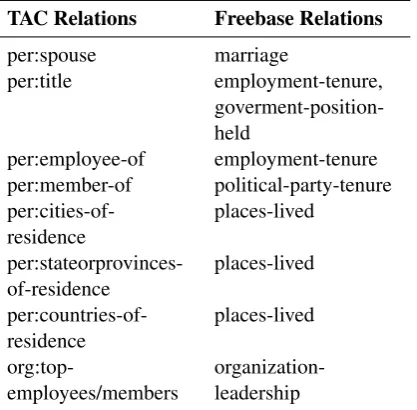
Distant supervision for temporal classification The temporal slot filling task, as specified by TAC-KBP, defines 7 types of temporal-intensive relations. In our distant supervision approach, we use a separate knowledge base to find instances of the equivalent relations. We use Freebase as our reference knowledge base. That is, we use the temporal information found in Freebase to generate training exam-ples. We manually map the TAC-KBP’s 8 temporal relations into 6 Freebase mediator relations. The complete mapping of the relations can be found in Table 1.
In an article, entities and time expressions are not always referred to using their full mentions within a single sentence. Sometimes information is scattered around several sentences: the query entityqin the first sentence, later referred to using a pronoun in the second sentence that contains a time expression, etc. One common way to deal with this problem is to run full co-reference resolution, therefore ensuring all mentions are resolved. We handle this problem by relaxing the distant supervision rule. Rather than retrieving sentences, we retrieve passages containing the query entityq, and related entityrinstead. We later replace every pronoun found within the passage withq. Based on our analysis of the Wikipedia articles, this simple heuristic should work, because most Wikipedia articles are entity-centric, and a lot of the pronouns mentioned in the articles will refer to the query entityq.
TAC Relations Freebase Relations per:spouse marriage
per:title employment-tenure, goverment-position-held
per:employee-of employment-tenure per:member-of political-party-tenure
per:cities-of-residence places-lived
per:stateorprovinces-of-residence places-lived
per:countries-of-residence places-lived
[image:4.595.197.406.77.282.2]org:top-employees/members organization-leadership
Table 1: Relation mapping to Freebase.
Data: Freebase temporal relation (q,r,from,to) Result: labeled training examples
Retrieve the Wikipedia article of the query entityq; Split article into passages;
Retrieve the passages containingq,r;
Extract all time expressions from the passages; fortime-expressiontdo
Retrieve the context sentencescontainingt; Iftisfrom: uses,tas BEGINNING example; Iftisto: uses,tas ENDING example;
Iftbeforefrom: uses,tas BEFORE example; Iftafterto: uses,tas AFTER example;
Iftbetweenfromandto: uses,tas WITHIN example; end
Algorithm 1:Training data generation.
WITHIN class. In newswire, however, we tend to see something different; most of the time expressions will belong to the WITHIN class.
We argue that using the training data with a “smarter” prior is important. More data not only means more information, but may also mean more noise. This is particularly important with therelaxed dis-tant supervisionassumption that we have. Therefore, we choose to sample instead of using all of the generated training examples.
We employ two sampling strategies:uniform, sampling from our generated training data and deliber-ately fitting them to a uniform distribution; andprior-sampling, where we deliberately construct training data to fit a prior distribution. One way to estimate such a prior is by looking at the distributions of classes in the gold-standard training data that we have. In the case where gold-standard data is not available, we can use a heuristic to estimate the distributions of temporal classes based on domain knowledge or on observations of the target corpora.
reach the target percentage of the DS data. Finally, use the sampled training data to train the multi-class classifier.
Feature representation Both for the training, evaluation, and DS data, we extract the context sentence, i..e, the sentence containing the relation and time expressiont.
We normalize the context sentence as follows. First, we detect named entities within the sentence and replace the mentions with their entity types (PERSON, ORGANIZATION, or LOCATION). Second, we detect other time expressions within the context and normalize them with regard to the main time expres-siont, i.e., by normalizing them into TIME-LT and TIME-GT. The idea is to capture the relationships between time expressions as features.
We extract lexical features from the normalized sentence. This comprises tokens surrounding the query entity, related entity (slot filler), and time expression. We consider the following four models as our feature representations:
Model-1: bag-of-words All tokens within the normalized sentences are used as features.
Model-2: context window All tokens within the proximity of 3 tokens from the query entity, related entity, and time expression are used as features.
Model-3: context window with trigger words lexicon All tokens within the proximity of 3 token from the query entity, related entity, and time expression are used as features. In addition, a list of keywords which might indicate the beginning and ending of relationships are used as gazetteer features. These list of keywords are expanded by using WordNet to extract related terms.
Model-4: context window with position All tokens within the proximity of 3 tokens from the query entity, related entity, and time expression are used as features. Rather than considered as bag-of-words tokens, the positions of word occurrences are now taken into account as features.
4 Experimental Setup
We introduce the dataset and the setup of our experiments. Before that we formulate our research ques-tions as these dictate our further choices.
Research questions We aim to answer the following research questions:
RQ1 How does a purely supervised approach with different features and learning algorithms perform on the task of temporal evidence classification?
RQ2 How does the performance of a distant supervision approach compare to that of a supervised learning approach on the task of temporal evidence classification?
RQ3 How does the performance of a prior-informed distant supervision approach compare to that of a basic distant supervision approach on the task of temporal evidence classification?
RQ4 How do the approaches listed above compare in terms of their performance on the end-to-end temporal relation extraction task?
Corpora and knowledge base We use the TAC 2011 document collection, which contains 1.7M docu-ments, consisting of news wires, web texts, broadcast news, and broadcast conversation. We use a recent version of Freebase (October 2013) as our knowledge base and retrieve the latest version of Wikipedia as our distant supervision corpus.
Ground truth We use the TAC-KBP 2011 Temporal Slot Filling Task dataset (Ji et al., 2011) as the ground truth in our experiments. The ground truth comes in two forms: intermediate evidence (with classification labels) and tuples (boundaries of each relation). We use the intermediate evidence to eval-uate our temporal evidence classification framework. We later use the provided tuples to evaleval-uate the end-to-end result.
Class Training Evaluation DS Training
WITHIN 66 357 6,129
BEGINNING 59 217 22,508
ENDING 30 110 16,775
BEFORE 9 45 24,932
[image:6.595.173.423.76.166.2]AFTER 9 28 12,499
Table 2: Class distribution statistics.
Evaluation metric We use F1 as the main evaluation metric for the temporal evidence classification task. For the end-to-end temporal information extraction task, we use the evaluation metric proposed in TAC-KBP 2011, i.e., theQscore. Given a relationrand the ground truth interval tupleGr,Q(Tr), the
quality score of a tupleTrreturned by systemSis computed as follows:
Q(Tr) = 14
4
P
i=1 1 1+di,
wherediis the absolute difference betweenTiin system response and the ground truth tupleGi
(mea-sured in years). To obtain an overall systemQscore, we average theQscores obtained from each relation tuple returned.
Experiments We run four contrastive experiments. In Experiment 1, we contrast the performance on the temporal evidence classification task of the different choices for our supervised methods (Model-1, -2, -3, -4), using either Support Vector Machine, Naive Bayes, Random Forest, or Gradient Boosted Regression Tree. In Experiment 2 we examine our distant supervision method and contrast its perfor-mance with the supervised methods from Experiment 1. In Experiment 3, we contrast different sampling methods for our distant supervision method.
In Experiment 4 we consider the overall performance on the temporal relation extraction task of our methods; in this experiment we use three “oracle runs” that we have not introduced yet: first, the Label-Oracle run uses the actual temporal classification label from the ground truth, use these ground truth label to aggregate the evidence and create the temporal tuples, and compute the end-to-end score; second,
Within-Oracleassigns all temporal evidence to the WITHIN class; third,Nil-Baselineis a lower-bound run that assigns NIL to every element of the temporal tuples.
We use the implementations of the learning algorithms in the Scikit-learn machine learning package (Pedregosa et al., 2011).
5 Results and Discussion
We present the outcomes of the four experiments specified in the previous section. 5.1 Preliminary experiment
To answer RQ1, How does the performance of the supervised learning approaches on the temporal evidence classification task vary with different representations and learning algorithms?, we start with a preliminary experiment. The aim of this experiment is to get an idea of the classification performance with a purely supervised approach. The results are shown in Table 3.
As shown in Table 3, Model-4 with the SVM and NB classifiers achieves the best overall performance. There seems to be a gradual increase in performance from the simpler to the more complex model with SVM and NB classifiers, with the exception of RF. Interestingly, GBRT seems only slightly affected by the different choice of model in this supervised setting.
5.2 Distant supervision experiments
Model SVM NB RF GBRT Model-1 0.405 0.361 0.402 0.422 Model-2 0.409 0.417 0.354 0.420 Model-3 0.412 0.418 0.361 0.420 Model-4 0.426 0.424 0.241 0.422
Table 3: Experiment 1. Supervised approaches to temporal evidence classification.
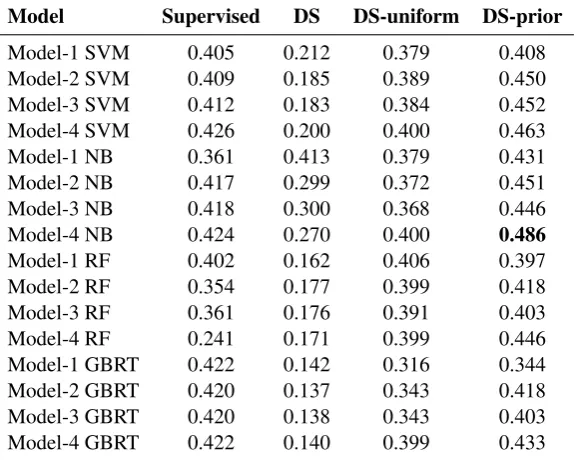
training examples with the approach described in Section 3, and use the full generated training data to train SVM and Naive Bayes classifiers with the same representation models that we use in the previous experiments. The results are shown in Table 4.
Model Supervised DS DS-uniform DS-prior Model-1 SVM 0.405 0.212 0.379 0.408 Model-2 SVM 0.409 0.185 0.389 0.450 Model-3 SVM 0.412 0.183 0.384 0.452 Model-4 SVM 0.426 0.200 0.400 0.463 Model-1 NB 0.361 0.413 0.379 0.431 Model-2 NB 0.417 0.299 0.372 0.451 Model-3 NB 0.418 0.300 0.368 0.446 Model-4 NB 0.424 0.270 0.400 0.486 Model-1 RF 0.402 0.162 0.406 0.397 Model-2 RF 0.354 0.177 0.399 0.418 Model-3 RF 0.361 0.176 0.391 0.403 Model-4 RF 0.241 0.171 0.399 0.446 Model-1 GBRT 0.422 0.142 0.316 0.344 Model-2 GBRT 0.420 0.137 0.343 0.418 Model-3 GBRT 0.420 0.138 0.343 0.403 Model-4 GBRT 0.422 0.140 0.399 0.433
Table 4: Experiment 2 and 3. Supervised, distant supervision, and distant supervision with sampling approaches to temporal evidence classification.
We observe that the distant supervision approach trained on the full set of generated examples (the column labeled “DS”) performs poorly, well below the supervised approach. We hypothesize that the accuracy drops due to the amount of noise generated with our distant supervision assumption trained from full data, and different class distribution statistics.
In Section 3, we proposed our prior-sampling approach for distant supervision. The next experiment is meant to answer RQ3,How does the performance of our prior-informed distant supervision approach compare to that of the basic distant supervision approaches? We sample 20 percent of the generated examples datasets with the following strategies:uniformandprior. The results are also shown in Table 4, in the columns labeled “DS-uniform” and “DS-prior,” respectively.
[image:7.595.156.445.262.492.2]5.3 End-to-end experiments
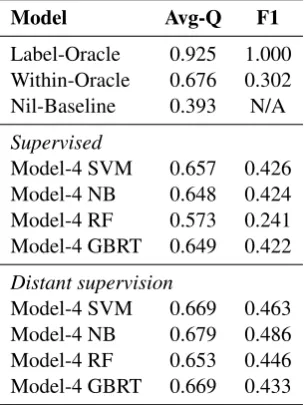
Next, we answer RQ4. That is, we consider how the classification performance on temporal evidence classification affects the end-to-end result. We take the best performing models from the previous exper-iments and evaluate their end-to-end scores. The results are shown in Table 5.1
Model Avg-Q F1 Label-Oracle 0.925 1.000 Within-Oracle 0.676 0.302 Nil-Baseline 0.393 N/A
Supervised
Model-4 SVM 0.657 0.426 Model-4 NB 0.648 0.424 Model-4 RF 0.573 0.241 Model-4 GBRT 0.649 0.422
Distant supervision
[image:8.595.223.376.142.345.2]Model-4 SVM 0.669 0.463 Model-4 NB 0.679 0.486 Model-4 RF 0.653 0.446 Model-4 GBRT 0.669 0.433
Table 5: Experiment 4. End-to-end scores (Avg-Q) next to F1 scores for temporal evidence classification.
From Table 5, we see that Model-4 RF (F1 on temporal evidence classification 0.446) and Model-4 GBRT (F1 on temporal evidence classification 0.433) translate into 0.653 and 0.669, respectively, in terms of Q-score. This means that the misclassifications that Model-4 RF produces have a larger impact than those of Model-4 GBRT. However, the difference in performance is not large.
The evaluation of this end-to-end task is important because not every misclassification has a similar cost. Misclassification of class A into class B can result in a huge increase/decrease in performance. First, the classification performance does not directly map to the end-to-end score. Second, several relations have more pieces of evidence than others; performing misclassifications on relations that have a lot of supporting evidence would probably have less effect on the final score.
The state of the art performance, using distant supervision (Li et al., 2012), achieves an end-to-end Avg-Q score of 0.678 (on training data), where we achieve 0.679 (on evaluation data). However, our scores are not directly comparable since we reduce the number of classes (and the amount of evidence) in our evaluation. It is important to note that Li et al. (2012) use a complex combination of flat and structured features as well as the web, where we use relatively simple features with Wikipedia and prior sampling.
Furthermore, our approach manages to achieve the same level of end-to-end performance as the Within-Oracle run, while achieving a significantly better F-score. More pieces of evidence were ac-tually classified correctly, though this was not reflected directly in the end-to-end score due to issues described above.
5.4 Error Analysis
We proceed to analyse parts of our end-to-end results to see what is causing errors in the temporal evidence classification task. We found several common problems.
Semantic inference Some problems had to do with the fact that several snippets require semantic inference. The fact that someone dies effectively ends any relationships that this person had. Another example is when someone marries someone (AmarriesC), and this beginning of relationships effectively
1As the Nil-Baseline is applied directly to the final tuples rather than the classification labels, there are is no F1 score for
means the end of relationships for previous relations (AandB). A more complex method to deal with this type of semantic inference is needed, simple classification does not work so well. Here is an example:
Angela Merkel is married to Joachim Sauer, a professor of chemistry at Berlin’s Humboldt University, since 1998. Divorced from Ulrich Merkel. No children.
For this example the fact is that the time expression 1998 happensafterwith regard to thespouserelation between Angela Merkel and Ulrich Merkel.
Concise temporal representations Newspaper articles contain lots of temporal information in a con-cise way. For example in the form (X–Y). This implicit interval range is not expressed in a lexical context but rather with symbolic conventions. In several articles, the information encoded is almost tabular rather than expressed in explicitly. For example:
Elected as german chancellor Nov. 22, 2005. Chairwoman, christian democratic union, 2000-present. Chairwoman, christian democratic parliamentary group, 2002–2005.
Complex time-inference BEFORE and AFTER are especially tricky to deal with because they require additional inference. Even if a passage contains the wordafter, the time expression linked to it would probably contain thebeforerelation.
He was called up by the Army in the spring of 1944, after marrying bea silverman in 1943, and was sent to The Philippines.
For the above example, 1943 happensbeforethe “person joined the Army” event.
We observe quite a number of these cases on the evaluation data. Furthermore, the lack of context on some examples and evidence that is scattered around multiple sentences complicates the problem even more. Because of semantic and implicit evidence, temporal evidence classification remains a challenging task. In order to achieve a better absolute performance, collective classification/inference of evidence seems an interesting option.
6 Conclusion
We have presented a distant-supervision approach to temporal evidence classification. The main feature of our distant supervision approach is that we consider the prior distribution of classes in the target do-main in order to better model the task. We show that our prior-informed distant supervision approach manages to outperform a purely supervised approach. Our method also achieves state-of-the-art perfor-mance on end-to-end temporal relation extraction with fewer and simpler features than previous work.
Our error analysis on the temporal evidence classification task revealed several issues that inform our future work aimed at further improving the performance on the subtask of temporal evidence classifica-tion, and the overall temporal relation extraction task. In particular, we intend to deal with the challenging aspect of semantic inference over relations found in the evidence passage. Another interesting direction that we aim to tackle is dealing with evidence that is scattered across multiple sentences.
Acknowledgements
References
Razvan C. Bunescu and Raymond J. Mooney. 2007. Learning to extract relations from the web using minimal supervision. InProceedings of the 45th Annual Meeting of the Association for Computational Linguistics (ACL’07), Prague, Czech Republic, June.
Amev Burman, Arun Jayapal, Sathish Kannan, Ayman Kavilikatta, Madhu abd Alhelbawy, Leon Derczynski, and Robert Gauzauskas. 2011. USFD at KBP 2011: Entity linking, slot filling and temporal bounding. In
Proceedings of the TAC-KBP 2011 Workshop. NIST.
Lorna Byrne and John Dunnion. 2011. UCD IIRG at tac 2011. InProceedings of the TAC-KBP 2011 Workshop. NIST.
Guillermo Garrido, Anselmo Pe˜nas, Bernardo Cabaleiro, and ´Alvaro Rodrigo. 2012. Temporally anchored relation extraction. InProceedings of the 50th Annual Meeting of the Association for Computational Linguistics: Long Papers - Volume 1, ACL ’12, pages 107–116, Stroudsburg, PA, USA. Association for Computational Linguistics.
Raphael Hoffmann, Congle Zhang, Xiao Ling, Luke Zettlemoyer, and Daniel S. Weld. 2011. Knowledge-based weak supervision for information extraction of overlapping relations. InProceedings of the 49th Annual
Meet-ing of the Association for Computational LMeet-inguistics: Human Language Technologies - Volume 1, HLT ’11,
pages 541–550, Stroudsburg, PA, USA. Association for Computational Linguistics.
Heng Ji, Ralph Grishman, and Hoa Trang Dang. 2011. Overview of the TAC 2011 knowledge base population task. InProceedings of the TAC-KBP 2011 Workshop. NIST.
Heng Ji, Taylor Cassidy, Qi Li, and Suzanne Tamang. 2013. Tackling representation, annotation and classification challenges for temporal knowledge base population.Knowledge and Information Systems, pages 1–36.
Qi Li, Javier Artiles, Taylor Cassidy, and Heng Ji. 2012. Combining flat and structured approaches for temporal slot filling or: how much to compress? InProceedings of the 13th international conference on Computational Linguistics and Intelligent Text Processing - Volume Part II, CICLing’12, pages 194–205, Berlin, Heidelberg. Springer-Verlag.
Mike Mintz, Steven Bills, Rion Snow, and Dan Jurafsky. 2009. Distant supervision for relation extraction without labeled data. InProceedings of the 47th Annual Meeting of the Association for Computational Linguistics:
Human Language Technologies (ACL ’09), pages 1003–1011, Stroudsburg, PA, USA. Association for
Compu-tational Linguistics.
Fabian Pedregosa, Ga¨el Varoquaux, Alexandre Gramfort, Vincent Michel, Bertrand Thirion, Olivier Grisel, Math-ieu Blondel, Peter Prettenhofer, Ron Weiss, Vincent Dubourg, Jake Vanderplas, Alexandre Passos, David Cour-napeau, Mattheiu Brucher, Matthieu Perrot, and ´Edouard Duchesnay. 2011. Scikit-learn: Machine learning in Python.Journal of Machine Learning Research, 12:2825–2830.
James Pustejovsky, Jos´e Casta˜no, Robert Ingria, Roser Saur´ı, Robert Gaizauskas, Andrea Setzer, and Graham Katz. 2003. TimeML: Robust specification of event and temporal expressions in text. InFifth International
Workshop on Computational Semantics (IWCS-5.
Ridho Reinanda, Daan Odijk, and Maarten de Rijke. 2013. Exploring entity associations over time. InSIGIR 2013 Workshop on Time-aware Information Access, August.
Sebastian Riedel, Limin Yao, and Andrew McCallum. 2010. Modeling relations and their mentions without labeled text. InProceedings of the 2010 European conference on Machine learning and knowledge discovery in databases: Part III, ECML PKDD’10, pages 148–163, Berlin, Heidelberg. Springer-Verlag.
Alan Ritter, Luke Zettlemoyer, Mausam, and Oren Etzioni. 2003. Modeling missing data in distant supervision for information extraction. InTransactions of the Association for Computational Linguistics, TACL’13, pages 367–378, Stroudsburg, PA, USA. Association for Computational Linguistics.
Avirup Sil and Silviu Cucerzan. 2014. Temporal scoping of relational facts based on Wikipedia data. InCoNLL: Conference on Natural Language Learning.
Mihai Surdeanu, Julie Tibshirani, Ramesh Nallapati, and Christopher D. Manning. 2012. Multi-instance multi-label learning for relation extraction. InProceedings of the 2012 Joint Conference on Empirical Methods in
Natural Language Processing and Computational Natural Language Learning, EMNLP-CoNLL ’12, pages
455–465, Stroudsburg, PA, USA. Association for Computational Linguistics.
Suzanne Tamang and Heng Ji. 2012. Relabeling distantly supervised training data for temporal knowledge base population. InProceedings of the Joint Workshop on Automatic Knowledge Base Construction and Web-scale
Knowledge Extraction, AKBC-WEKEX ’12, pages 25–30, Stroudsburg, PA, USA. Association for
Computa-tional Linguistics.
Naushad UzZaman, Hector Llorens, James F. Allen, Leon Derczynski, Marc Verhagen, and James Pustejovsky. 2012. TempEval-3: Evaluating events, time expressions, and temporal relations.CoRR, abs/1206.5333. Xu Wei, Raphael Hoffmann, Le Zhao, and Ralph Grishman. 2012. Filling knowledge base gaps for distant