Feature Logic with D i s j u n c t i v e Unification
dochen Dgrre, Andreas Eisele
Institut fiir maschinelle Spraehvera.rbcitung
Universit~tt Stuttgart
A b s t r a c t
\Ve i n t r o d u c e lea.tare t e r m s c o n t a i n i n g sorts, vztriables, nega- tion and named disjunction for the specification of feature structures. We show t h a t the possibility to label d i @ m c - tions with names has m~tjor advantages both for the 'use of feature logic in c o m p u t a t i o n a J linguistics and its imple- mentation. We give an open world semantics for feature terms, where the d e n o t a t i o n of a t e r m is d e t e r m i n e d in de- pendence on the disjunctive conte:rt, i.e. the choices taken for the disjunctions. We define conte:ct-unique feature de- scription.% a relational, constraint-based rcpresentation lan- guage and give a normMization procedure t h a t allows to test consistency of feature terms. T h i s procedure does not only avoid expansion 1o disjunctive normal fbrm but maintains also s t r u c t u r e sharing b e t w e e n i n f o r m a t i o n contained in dii:- ferent disjuncts as much as possible. C o n t e x t - u n i q u e feature descriptions can be easily i m p l e m e n t e d in e n v i r o n m e n t s that support ordinary unification (such as I?UOLOG).
1
I n t r o d u c t i o n
1. t. A m b i g u i t y i n N a t ; u r a l ] [ , a n g u a g e
Our use of language mirrors our intellectual capacities, which are as yet my no mea.ns understood. As long as we can not formally de.scribe the processes involved in thinking and u n d e r s t a n d i n g , k)rnlM descriptions of h u m a n language have to b<: rough approximations. One pa.rticular instance of this general fact is; the problem of d i s a m b i g u a t i o n of hu- man utterances. Since our use of words fits our capabilities
of itnderstanding l.heir meaning, contex:t and intent, systems that do ilot have such capabilities can, at best, produce sets of possible analyses. It is well known t h a t such sets can be very la.rge in practice.
A m b i g u i t y in aatnral language is fed by a couple of source.~;, including lexicat ambiguity, where differing analyses are pos- sible for a given word concerning its part of speech, subcat.- cgorization for c o m p l e m e n t s , morphological features, or any o!her i n f o r m a t i o n assigned to it, and structural ambiguity introduced by different possible groupings or i n t e r p r e t a t i o n s of phrases or different interrelaIious between t h e m with re- spect to subcategorizatioil, meaning, p r a g m M i c s etc. On each le.vel, a. bunch of possibilities exist, which could po-- tentially m u l t i p l y to an enormous space of combinations. l lowever, these possibilities interact and restrict each other in such a way, t h a t taking it all together - only a few (hopcfulJy exactly o n e ) i n t e r p r e t a t i o n s remain.
1 . 2 U n i f i c a t i o n - B a s e d F o r m a l i s m s
For a b o u t a decade, m a n y fornral theories of naturM lan-. guage haw: tried to describe their subject in terms of so called feature structures, i.e. p o t e n t i a l l y nested bundels of features that are assigned to words and phrases. These structures are s o m e t i m e s seen as M)stract linguistic objects, which are described using a suitable description language, s o m e t i m e s they are given ~ concrete shape in form of finite a u t o m a t o n s and regarded themselves as descriptions of the linguistic objects [ K a s p e r / R o n n d s 86]. Despite such differ- ences in interpretation, there is a consensus among the the-
ories t h a t linguistic descriptions should provide constraints concerning feature s t r u c t u r e s and t h a t a set. of such con- straints gives a partial description of the feature st, rnctures associated with a phrase. A set of constraints defines a milli real model, i.e. a rninimM s t r u c t u r e satisfying all constrainls in the set. T h e union of two sets of constraints sot (ontra.. dieting each other leads to a m i n i m a l model which is the least c o m m o n extension of the models of both sets. Sn(-h m i n i m a l c o m m o n extensions can be constructed by unifica- tion of the given models, hence the t e r m unification-based form alisrns.
T h e r e is also a consensus among feature-based ti~eories that ambiguity should be described with disjunctive formulas, and most formalisms offer ways to spe(:it} them. If disiunc tlon is present, there is usila.l}y a. tinite ltumber el minimal models instead of only one. Ilowever, until now, the way such disjunctive specifications have been processed compu taiionally was not quite satisfactory. An enumeration of the possibilities using a backtracking scheme or a chart, which c.orresponds to an expansion to disjunctive nornlal form in the underlying logic, often leads to computational ineflMency.
Approaches to i m p r o v e the situa.iion both ill terms of the logic and the i n l p l e m e n t a t i o n (see e.g. [l(arttuncn 81, Ka.'q~er 87, Eisele/Dgrre 88, M a x w e l l / K a p l a n $9]) can be subdivided in those assuming di:,junctive value.s tor fealures and lhose allowing [or more general terms of disjunction. Roughly, we can state t h a t fornia.lisms and implementatio;is t h a t provide wilue disjunction can be implelnented more eas ily a.nd more efiicienilg', since they can exploit the faci that disjunclive i n f o r m a t i o n for a certain feature ha~; no et[ect (~li other features (as long ;is disjunctive iui\3rnlation .'loe~ not interact with path equivalences, see [Eisele/1)grre g8]). t3tlt. the restriction to wdue disjunction decreases the expressive power of the formalism, since disjunctions concerning d i [ l\?rent features must be s t a t e d on a higher level, Schemes providing for general disjunction allow for a more compact r e p r e s e n t a t i o n of such cases. But if disjunctive information is not local to single features, the interaction between differ- ent parts of tile descripi.ion is more dilflcuh to handle (see e.g. [Kasper 87]).
T h e m e t h o d we propose combines advantages of both ap preaches. It can be seen as a generalization of value dis- j u n c t i o n , which allows for a concise description of di~Lju~c- Lion concerning more than one feature, or pat;h. It can also be se.en as an efficient i m p l e m e n t a t i o n of general disjunctiol~ which a.llows to exploit the locality of disjunctive informa- tion w h e n e v e r this is possible.
2
F e a t u r e T e r m s
2 . 1D i s j u n c t i o n
N a m e ss,t
Ax
f : s s F l t
s Lld t
a s o r t a v a r i a b l e
s i m p l e c o m p l e m e n t s s e l e c t i o n
c o n j u n c t i o n ( i n t e r s e c t i o n )
n a m e d d i s j u n c t i o n ( u n i o n )
: = A :r
: = ( ~ ( ~ ) }
: = u - I M ....
: = {a E U I
f z ( a ) E [s~ ....
}: = D]I,,,,~ n [ t L , ~
~ J'~
[ s l y , . i f . ( d ) : /: g t ] ~ , ~ if ~ ( d ) = r
F i g u r e 1: S y n t a x a n d S e m a n t i c s o f F e a t u r e T e r m s
to e x p r e s s t h a t t h e d i r e c t i o n a l r e a d i n g of t h e g e r m a n p r e p o - s i t i o n "in" ( = i n t o ) c o r r e s p o n d s to t h e a c c u s a t i v e case of t h e following n o u n p h r a s e , w h e r e a s t h e s t a t i c r e a d i n g ( = i n ) cor- r e s p o n d s to t h e d a t i v e case. T h i s c a n also b e e x p r e s s e d by (2), w h e r e t h e i n d e x dl at t h e d i s j u n c t i o n sign i n d i c a t e s t h e m u t u a l d e p e n d e n c e of b o t h d i s j u n c t i o n s . T h r o u g h o u t t h i s p a p e r , we will a s s u m e t h a t e a c h d i s j u n c t i o n is labelled w i t h ~ n a m e . E v e n in cases w h e r e a d i s j u n c t i o n a p p e a r s only once in t h e i n i t i a l d e s c r i p t i o n , n a m i n g it will help us to t r e a t t h e :interaction b e t w e e n d i s j u n c t i o n a n d p a t h e q u i v a l e n c e cor- rectly.
( 1 ) ( s y n : a r g : case : d a t A s e m : r e l : s t a t d n )
V ( s y n : a r g : c a s e : a c e A s e r e : rel : d i r d n ) (2) s y n : arg : case : ( d a t
Va,
ace)A sem : tel : ( s t a t d n Vd, dir_in)
r s
2 . 2 S y n t a x a n d S e m a n t i c s o f F e a t u r e t e r m . '
\Ve i n c o r p o r a t e n a m e d d i s j u n c t i o n i n t o ~t l a n g u a g e of so- called f e a t u r e t e r m s ( s i m i l a r to t h o s e in [Smolka 88]), where e a c h f e a t u r e t e r m d e s c r i b e s a set of possible f e a t u r e s t r u c - tures. T h e l a n g u a g e allows for t h e use of sort symbols
A , B , C . . .
(:_ S, on w h i c h s o m e p a r t i a l o r d e r ~ i n d u c e s a lower s e m i l a t t i c e (i.e. VA, B E S :CLB(A, B) e S).
T a n d ± are t h e g r e a t e s t a n d l e a s t e l e m e n t of S. W e also dis- t i n g u i s h a set of s i n g l e t o n s o r t s (a, b, c . . . E S g C S), w h i c h i n c l u d e t h e special s o r t NONE. J_ is t h e only s o r t s m a l l e r t h a n a s i n g l e t o n sort. T h e l a n g u a g e p r o v i d e s a set F of f e a t u r e s y m b o l s ( w r i t t e n f , g, h , . . . ) , an i M i n i t e set. V of v a r i a b l e s ( w r i t t e n x, y, z, xa, Yl, • • .) to e x p r e s s p a t h equivalence, and a n i n f i n i t e set D of d i s j u n c t i o n n a m e s ( w r i t t e n d, dl, d 2 , . . . ) . S, F , V a n d D are pMrwise disjoint. Sort s y m b o l s and vari- ables c a n b e n e g a t e d to e x p r e s s n e g a t i v e values a n d p a t h e q u i v a l e n c e ( s i m p l e n e g a t i o n ) . T h e r e s t r i c t i o n of n e g a t i o n to s o r t s y m b o l s a n d v a r i a b l e s is n o t e s s e n t i a l , since t h e nega- t i o n of any f e a t u r e t e r m c a n always be r e d u c e d to t h e s e f o r m s in l i n e a r t i m e [Smolka 88].D e f i n i t i o n 1 ( F e a t u r e T e r m s ) We define the set F T o f f e a t u r e t e r m s with wwiables, s i m p l e n e g a t i o n a n d n a m e d dis- j u n c t i o n by the c o n t e x t - f r e e p r o d u c t i o n rules g i v e n in Fig. 1.
L e t t e r s s, t, t l , . . . will a l w a y s d e n o t e f e a t u r e t e r m s .
T h e s e m a n t i c s of o u r t e r m s is defined w i t h r e s p e c t to an i n t e r p r e t a t i o n , w h i c h is a p a i r (H, .z) of a u n i v e r s e of t h e i n t e r p r e t a t i o n a n d a n i n t e r p r e t a t i o n f u n c t i o n s n c h t h a t :
• T z : = / / a n d -k z = [~
• for all s o r t s A, 11: G L B ( A , B ) "z = A ~ rl B z • s i n g l e t o n s o r t s are m a p p e d o n t o s i n g l e t o n sets • for (;very f e a t u r e f : f z is a f u n c t i o n b/ -+ lt.
• if a is a s i n g l e t o n s o r t a n d f is a f e a t n r e s y m b o l , t h e n f z m a p s a z i n t o N O N E "/
W h e n i n t e r p r e t i n g a f e a t u r e t e r m w i t h v a r i a b l e s a n d n a m e d d i s j u n c t i o n s , we h a v e to m a k e sure t h a t t h e s a m e value is a s s i g n e d to e a c h o c c u r r e n c e of a v a r i a b l e a n d t h a t t h e s a m e b r a n c h is c h o s e n for each o c c u r r e n c e of a n a m e d d i s j u n c t i o n .
To a c h i e v e this, we i n t r o d u c e variable a s s i g n m e n t s t h a t m a p v a r i a b l e s to e l e m e n t s of tile u n i v e r s e a n d d i s j u n c t i v e contexts t h a t assign to e a c h d i s j u n c t i o n n a m e t h e b r a n c h t h a t has to b e t a k e n for t h i s dis.innction a n d h e n c e specify a possible i n t e r p r e t a t i o n of a f o r m u l a w i t h n a m e d d i s j n n c t i o n . Since we l i m i t ourselves to b i n a r y d i s j u n c t i o n s , a b r a n c h of a dis- j u n c t i o n c a n be specified by one of t h e s y m b o l s l or r.
D e f i n i t i o n 2 ( / / - A s s i g n m e n t ) A l t - a s s i g n m e ~ t a. is an
e l e m e n t o f l.t V , i.e. a J u n c t i o n f r o m V to li.
D e f i n i t i o n 3 ( C o n t e x t ) A c o n t e x t is an e l e m e n t of
(1, r ) D , i.e. a f u n c t i o n f r o m D to the set { l , r } . 7'he.,'gmbols ~, ~', etc. will ahvags d e n o t e c o n t e x t s .
For a given i n t e r p r e t a t i o n , we define t h e d e n o t a t i o n of a
f e a t u r e t e r m in a c o n t e x t ~ E {1, r} D u n d e r an a s s i g n m e n t
a E N v as s h o w n in Fig. 1. T h e d e n o t a t i o n of a feature t e r m as such is defined by:
:_- U
U st,.
nE{l,r} D c~E~/v
3
Context-Unique Feature Descriptions
To d e s c r i b e t h e c o m p u t a t i o n a l m e c h a n i s m s needed for an i m p l e m e n t a t i o n , we will i n t r o d u c e a r e l a t i o n a l l a n g u a g e Io e x p r e s s c o n s t r a i n t s o v e r v a r i a b l e s . Unlike s i m i l a r a p p r o a c h e s (e.g. [Smolka 88]), our c o n s t r a i n t l a n g u a g e will also be nsed to e x p r e s s d i s j u n c t i v e i n f o r m a t i o n . For t h i s l a n g u a g e , we will define a n o r m a l form t h a t e x h i b i t s i n c o n s i s t e n c i e s , and sim- plification rules t h a t allow to n o r m a l i z e a given specification. O u r l a n g u a g e will p r o v i d e only two k i n d s of c o n s t r a i n t s , one t h a t r e l a t e s a v a r i a b l e t o s o m e f e a t u r e t e r m ( w r i t t e n z It) attd one t h a t e x p r e s s e s t h a t c e r t a i n c o n t e x t s are excluded from c o n s i d e r a t i o n b e c a u s e the inforn-tal.ion k n o w n for t h e m is i n c o n s i s t e n t ( w r i t t e n ± [ k ] ) .
In o r d e r to refer to sets of c o n t e x t s , we define
D e f i n i t i o n 4 ( C o n t e x t D e s c . r i p t i o n s )
A c o n t e x t d e s c r i p t i o n is a p r o p o s i t i o n e d . f o r m , l a where the c o n s t a n t TRUE, variables w r i t t e n d,: l and d,: r with d, E D, and the operators A, V a n d ~ m a y be empl~wecl.
C D will deplete the set o f c o n t e x t descriptio~ts. The symbols k, kl . . . . will alwags d e n o t e m e m b e r s o f C D .
The set o f p u r e l y c o ~ j u n c t i v c c o n t e x t descriptiol~s ( , o t eoa- t a i n i n g the operators V a n d ~ ) is d e n o t e d by C D ¢ .
E a c h c o n t e x t x s a t i s f i e s the c o n t e x t d e s c r i p t i o n "rRu[,; (writ- ten n ~,: TUUF), wherea,, n ~ . d : b f o r b E { l , r } only if t~(d) = b. 7'he m e a n i n g o f c o n t e x t d e s c r i p t i o n s invoh.,i,g A, V a n d -~ is defined as irt p r o p o s i t i o n a l logic.
I f n ~ k, we will also s a y t h a t k d e s c r i b e s or covers ~r or that ~ lies in k.
A c o n t e x t d e s c r i p t i o n is called c o n t r a d i c t o r y , if ~m eold~:rt satisfies it.
[image:2.596.76.525.61.145.2]A n i m p o r t a n t form of c o n s t r a i n t s for our approach are con- s t r a i n t s like x I z l kin, x2 w h i c h expresses t h a t x and x l have to be equal in c o n t e x t s w h e r e ~ ( d l ) = 1 a n d so do x a n d x2 in c o n t e x t s w h e r e ~ ( d l ) = r. Such c o n s t r a i n t s are called b i f u r c a t i o n s and Xl, x2 are called ( t h e d l : l - a n d d l : r - ) vari- ants' of x. A s s u m e an a d d i t i o n a l c o n s t r a i n t xl [ xa kid2 x4, t h e n x3 will be called t h e d l : l A d 2 : l - v a r i a n t of x a n d so on. Now, i n s t e a d of a c c u m u l a t i n g c o n s t r a i n t s on t h e variable x which m i g h t be effective in different c o n t e x t s and could in- t e r a c t in c o m p l i c a t e d ways, we (:an i n t r o d u c e n e w variables as v a r i a n t s of ~ and a t t a c h t h e i n f o r m a t i o n to t h e m . We will s o m e t i m e s reffer to a. v a r i a n t of a variable x w i t h o u t h a v i n g a variable n a m e for this variant. To this end, we will use a special n o t a t i o n x / k to d e n o t e the k - v a r i a n t of x. Such e x p r e s s i o n s will be called c o n t e x t c d variables.
D e f i n i t i o n 5 ( C o n t e x t e d V a r i a b l e s ) A c o n t e x t e d vari- able is a p a i r x / k where x G V a n d k ~ C I ) ~ .
V,: wilt d e n o t e the u n i o n o f V with the set o f e o n t e x t e d vario ables. E l e r n e n t s o f V ~ will be w r i t t e n with capital letters X , ?', Z, X 1 , Y'I . . . lib m a r k the d i s t i n c t i o n , we will some.. time.~ call the m e m b e r s o f V pure variables.
D u r i n g t.he n o r m a l i z a t i o n of f e a t u r e d e s c r i p t i o n s we will s o m e t i m e s need variable s u b s t i t u t i o n . If a d e s c r i p t i o n eon- taiz)s e.g. x [y, w h e r e o t h e r c o n s t r a i n t s m i g h t e x p r e s s con- flicting i n f o r m a t i o n a b o u t x a n d y, we w a n t to c o n c e n t r a t e this i n f o r m a t i o n on one variable (say a:) by m~bstituting all o c e u r e n c e s of y in o t h e r c o n s t r a i n t s by x. T h i s could lea(] to p r o b l e m s w h e n c o n s t r a i n t s a t t a c h e d to x and y are r e l e v a n t in different c o n t e x t s . O n e way to t r e a t this s i t u a t i o n cor- rec'.ly would be t h e i n t r o d u c t i o n of c o n d i t i o n a l s u b s t i t u t i o n (see i E i s e l e / D S r r e 90] for d e t a i l s ) . T h e way we choose here is to rest.ric~ t h e use of variables in such a way t h a t it is always safe to use c o n v e n t i o n a l s u b s t i t u t i o n .
Our trick **'ill be to r e q u i r e thud. e s s e n t i a l l y all o c c u r e n c e s of a variable x are r e l e v a n t to t h e s a m e set of c o n t e x t s . We call this c o n d i t i o n (defined m o r e precisely below) t h e context° uniqaer~ess o f variables. ~Ve. will set up t h e n o r m a l fornl and the r e w r i t e s y s t e m in such a way, t h a t c o n t e x t - n n i q u e l , e s s of a d e s c r i p t i o n is m a i n t a i n e d d u r i n g t h e simplilication pro- tess. (See [ E i s e l e / i ) S r r e 90] for a m o r e d e t a i l e d m o t i v a t i o n of c o n t e x t - u n i q u e n e s s ) . 'The set of relevant c o n t e x t s will be r e g a r d e d as an i n h e r e n t a n d i n v a r i a n t p r o p e r t y of varial)les, and we will i n t r o d u c e a c o n t e x t a s s i g n m e n t , i.e. ,~ p a r t i a l f u n c t i o n C o n : V ~--~ CD~: t h a t m a p s each variable in use to a purely c o n j u n c t i v e d e s c r i p t i o n of t h e c o n t e x t s it is rel- e v a n t to. \ \ r e e x t e n d ( ' o n to context.ed v a r i a l ) l e s b y defining
C'ou(:,./~:) ::::
co,,(:~) A ~.in o r d e r Io o b t a i n c o n t e x t - u n i q u e d e s c r i p t i o n s , we generalize our f e a t u r e t e r m s so t h a t t h e y m a y also c o n t a i n c o n t e x t e d variables.
D e f i n i t i o n 6 ( G o n t e x t e d F e a t u r e T e r m s ) A c o n t e x t e d f e a t u r e t e r m is buih' according go d e f i n i t i o n l, but where both p~tre a n d c o n t e x t e d variables m a y occur. T h e set o f c o n t e x t c d f e a t u r e t e r m s will be d e n o t e d by F T ~ . T h e symbols s, t, t~ . .. m a y h e n c @ ~ r t h also d e n o t e c o n t e x t e d f e a t u r e germs. The dc**otation o f a c o n t c x t e d f e a t u r e t e r m in a c o n t e x t n
{I, r} D u n d e r a n a s s i g n m e n t ee ~ l/[ V is defined as f o r usual f e a t u r e t e r m s by adding:
[x/k]~,,~ : = ~ o t h e r w i s e
We can n o w define t h e c o n t e x t c o m p a t i b i l i t y of a f e a t u r e t e r m . T h i s d e f i n i t i o n is s o m e w h a t t e c h n i c a l a n d t h e r e a d e r can skip it, since our a l g o r i t h m will p r o d u c e only c o n t e x t - u n i q u e d e s c r i p t i o n s , anyway.
D e f i n i t i o n 7 ( C o n t e x t c o m p a t i b i l i t y ) Given a partial a s s i g n m e n t C o n : V ~-~ C D e , a contexted feature term t is c o n t e x t - c o m p a t i b l e to a c o n t e x t d e s c r i p t i o n k with respect to C o n , w r i t t e n t ,'ocon k, according to the f o l l o w i n g condi-
tions. A ~ C o n k
X " c o n k -~t "-co,; k f : t ~Co,, k s N t " c o n k s Ud t " C o n k
f o r a r b i t r a r y k E C D ~ iff C o n ( X ) = k l i f t ~ C o . k l i f t ~ C o . k
i f f s ~ C o , k a n d t *~Co,* k i f J s ~ C o ~ k A d : l
a n d t ~co,~ k A d : r
D e f i n i t i o n 8 ( C o n t e x t - u n i q u e f e a t u r e d e s c r i p t i o n s ) A c o n t e x t - u n i q u c f e a t u r e d e s c r i p t i o n ( m 0 , C U C , C o n ) is a triple such that:
* xo C V , called the root variable
e C U C ' is a set o f c o n t e x t - u n i q u e c o n s t r a i n t s which ei- ther have the f o r m
&[k], where k E C D o r
X l t , where X C V ~ , t E F'£~ a n d t "co,~ C o n ( X ) o C o n is a c o n t e x t a s s i g n m e n t w h i c h is defined f o r all
variables in C U C
T h e s e m a n t i c s o f c o n t e x t o u n i q u e f e a t u r e d e s c r i p t i o n s is g i v e n by the s a t i s f a c t i o n r e l a t i o n t-::Co~ between vari- able as.~ignmentfl, c o n t e x t s a n d constraints, which is p a r a m e t r i z e d with a c o n t e x t a s s i g n m e n t .
~, '~ t:=~: ... X l t iJJ" ~ V : ~ C o , . ( X ) o," < X ) c ~t] ... ~,,~ V<'o,, ±[k] ifl ~ > ~ k
7'he d e n o t a t i o n o f a c o n t e x t . u n i q u e f - d e s c r i p t i o n is:
[ ( x 0 , c ~ c , Co,,)lj :--= {~O'0) I ~ < z c v , ~ c {l,r} :° s.t.
Ve ~ C U C
: r_t, ~ t::Co- c}
Given a f e a t u r e t e r m t n o t c o n t a i n i n g t h e variable x0, we (:an find an e q u i v a l e n t c o n t e x t - u n i q u e f e a t u r e d e s c r i p t i o n (x0, {~0 I F } , C o n ) as follows. W e initialize t h e c o n t e x t as- s i g n m e n t C o n so t h a t x0 a n d all v a r i a b l e s e o n t , d n e d in t are m a p p e d to TRUE ( t h e y are r e g a r d e d as relevant to all c o n t e x t s ) . T h e n we o b t M n t h e c o n t e x t e d f e a t u r e t e r m t' by r e p l a c i n g all o c c u r e n c e s of v a r i a b l e s in t which are embed° d e d in d i s j u n c t i o n s by t h e i r a p p r o p r i a t e variants, such t h a t ~J "~C:on TItUE 2.
P r o p o s i t i o n : if t d o e s n o t c o n t a i n t h e variable x0, and if C o n a n d t' are o b t a i n e d fi'om t as d e s c r i b e d above, t h e n [t~ ~.= ~(x0, {:co I t ' } , C 0 n ) ~ . For a proof see [l';isele/l)grre 90].
4
N o r m a l
F e a t u r e
D e s c r i p t i o n s
O n e way to elimina:te a c o n t e x t e d wn:iable (take e.g. x / d l : l ) from a d e s c r i p t i o n is to i n t r o d u c e a b i f u r c a t i o n (x J xl kl~ x2) and replace t h e v a r i a b l e by an a p p r o p r i a t e v a r i a n t (in this case x l ) . AnMogously, c o n t e x t e d variables w i t h rnore coin- p l e x c o n t e x t d e s c r i p t i o n s can be r e p l a c e d by i n t r o d u c i n g several b i f u r c a t i o n s . However, it t u r n s out t h a t our rep- r e s e n t a t i o n can be m o r e c o m p a c t if we allow for the use of c o n t e x t e d variables. But we h a v e to p r e v e n t conflicting in- l b r m a t i o n f r o m b e i n g a t t a c h e d to v a r i a n t s of a variable. Our n o r m a l form will t h e r e f o r e allow t h e use of c o n t e x t e d vari- ables in c e r t a i n places, b u t in s o m e cases, a pure variable has to be used.
A c o n t e x t - u n i q u e f e a t u r e d e s c r i p t i o n (x0, CUC, Con) is
nor°
tool if it satisfies t h e following c o n d i t i o n s :A) All c o n s t r a i n t s in
C U C
h a v e one of t h e forms: • Z[k]• x I xl Ud z2
® x l-~y,
w h e r e x 7~ y• x l A o r x l ~ A
• x l f : Y
w h e r e
k C C D , x ~ , x 2 , x , y
C V , Y C V ~ , d E D a n d A ES \ { T , _ L }
B) 'lThe following r e s t r i c t i o n s apply:
t . ]f ± [ k ] a u d x I~ aro in
c u c ,
t h e nCo.(~')
A -,k is n o tc o n t r a d i c t o r y
2, if x
IX
a u d X I l] are inCUC,
t h e n A =1]
3. if :el a a n dx l t
are inCUC,
t h e n t = a4. if x ] A a n d x I -~I3 are in
CUC,
t h e n A ~ .B a n d5. if x I ~ A a n d a'
I~B
are inC'UC,
t h e n A ~ B 6. if x l f : Y and m l f : Z are inCUC,
t h e n Y = Z7. i f _L[k] and .L[k'] are it, C U C , then k = k'
8. if x 12:1 l a d ~;2 a n d x I t are ill
C[r(?,
t h e n t = ,';'21 U d X24 . ? S i m p l i f i c a t i o n R u l e s f o r N o r m a l i z a t i o n
Fo~: n o r m a l i z a t i o n , we h a v e to c o n s i d e r all ways a c o n t e x t -
u n i q u e f e a t u r e d e s c r i p t i o n could fail to b e n o r m a l , a n d we h a v e to find a n e q u i v a l e n t d e s c r i p t i o n t h a t is in (or closer t.o) n o r m a l form. T o t h i s end, we give simp]ification rules for each possible case. Since t h e r e are m a n y different ways to violate n o r m a l form, we get a lot of different rules, b u t e a c h of t h e m is very s i m p l e a n d t h e i r c o r r e c t n e s s s h o u l d be easy to see. T h e rules are p a r a m e t r i z e d w i t h t h e r o o t v a r i a b l e ( w h i c h s h o u l d n o t b e s u b s t i t u t e d away) aml w i t h th< c o n t e x t a s s i g n m e n t , which will be e x t e n d e d to new vari- abh:.s d u r i n g s~implification. T o f a c i l i t ~ t e n o t a t i o n , we usec .~.; C U C
to d e n o t e {c} uC U C
w h e r eC U C
is s u p p o s e d no~ lo c o n t a i n t h e c o n s t r a i n t c, a n d C / f C x ~ , a d e n o t e sC U C
w i t h all o e c u r e n c e s of x r e p l a c e d by y. Also, if we w r i t e d: b A k', t h e n k' is s u p p o s e d n o t to c o n t a i n d: b. T h e eases we h a v e to h a n d l e are g r o u p e d in those t h a t t r e M single n o n - n o r m a l c o n s t r a i n t s (S) a n d t h o s e t h a t t r e a t i n t e r a c t i o u sb e t w e e n different c o n s t r a i n t s (M).
T h e r e are S-Rules for all forms of c o n s t r a i n t s w h i c h conflict w i l h c o n d i t i o n A), i.e. w h i c h are of o u r of t h e f o r m s
J. */kl~ e. ~ l-,vlk
:L x l Y
4. x l t or xl-~t, w h e r e t has the form T , 2_ or z 5. x ] f : ~ l , w h e r e tl ~ Vc
6.
xltl Flt2
r.
:,:It~
u a t 2 , where { h , t 2 } ¢_ gA m o n g t h e s i t u a t i o n s in which a c o n t e x t e d v a r i a b l e
x / k
con- fliers w i t h n o r m a l form, we h a v e to d i s t i n g u i s h severM cases. If ].: ~ 'I'RUF,, t h e n t h e c o n t e x t d e s c r i p t i o n is i r r e l e v a n t a n d we c a n r e p l a c ex / k
by x ( R u l eS~,,lb).
O t h e r w i s e , if t h e r e exi:qts ah:eady a b i f u r c a t i o n x lxtLlaxr, s u c h t h a t k _~ d : bAk' for s o m e b C {1, r} a n d k' C C D ~ , w h e r e k' does not c o n t a i n d : b, t h e n we c a n r e p l a c ex / k
by t h e s h o r t e r t e r m:cb/k'
( R u l e S~,,lc). ]f t h e r e is a biflu:cation x ]:tt LJd z,- w h e r e d does n o t a p p e a r in k, t h e c o n s t r a i n t a t t a c h e d tox / k
is dist.ributed over t h e wtriablc.s :ct a n d x,. (RuleS~,,ld). In
o r d e r to m a i n t a i n c o n t e x t - u n i q u e n e s s , t h e v a r i a b l e s a p p e a r - ing in t h e c o n s t r a i n t luLve to be r e p l a c e d by t h e i r r e s p e c t i v e el:/. a n d d : r - w ~ r i a n t s . We usei l k
as a s h o r t h a n d for a eon- t e x t e d f e a t u r e t e r m , w h e r e each v a r i a b l e has b e e n replacedby its k - v a r i a n t , i.e. z h a s b e e n r e p l a c e d by
z / k
andz ' / k '
byz ' / ( k ' A k)
(see also rule ( M ~ 8 c ) , below). Only if no bi- f u r c a t i o n e x i s t s for x we h a v e to i n t r o d u c e a new bifttrcation ( R u l e S~,,le). W e select a d i s j u n c t i o n n a m e d f l o m k such t h a t k - d: b Ak'
for s o m eb E {l, r}
attdk' E
C D ¢ , where k' does n o t c o n t a i n d : b, we a d d a b i f u r c a t i o n x lxtLid
:/:,,to
CUC,
w h e r eact
a n d x,. are new v a r i a b l e s , a n d we e x t e n dCon
by m a p p i n g x~ toC o n ( x ) A d:l
and x,- to C o n ( x ) A d: r. Now we can replacex / k
b yxb/k'.
T h e o t h e r rules h a n d l e e q u a l i t i e s by s u b s t i t u t i n g a variable b y s o m e o t h e r v a r i a b l e , e l i m i n a t e r e d u n d a n t c o n s t r a i n t s , h a n d l e i n c o n s i s t e n c i e s , or d e c o m p o s e c o n s t r a i n t s w i t h com- plex f e a t u r e t e r m s i n t o a set of s i m p l e c o n s t r a i n t s .
' l ' h e cases w h e r e a p a i r of c o n s t r a i n t s v i o l a t e s some of the c o n d i t i o n s I l l - 7 c a n b e t r e a t e d as for s i m i l a r n o n - d i s j u n c t i v e r e w r i t e s y s t e m s (see [Smolka 88] or [ E i s c l e / D S r r e 9(/]). Rules M ~ , ] - 7 h a n d l e those. W h e n a b i f u r c a t i o n x Ix: tJdx2 o c c u r s t o g e t h e r w i t h s o m e o t h e r c o n s t r a i u t on z, this could lead to a c o n t r a d i c t i o n w i t h i n f o r m a t i o n k n o w n a b o u t xl a n d ace. ilere, we d i s t i n g n i s h t h r e e cases, if the o t h e r con- s t r a i n t h a p p e n s to b e a b i f u r c a t i o n re I yl Lid Ye with the s a m e d i s j u o c t i o n n a m e
d,
we get e q u a l i t i e s b e t w e e n b o t h d: i - v a r i a n t s a n d b o t h d : r - v a r i a n t s ( R u l e A/¢~8a). If the o t h e r c o n s t r a i n t is a b i f u r c a t i o n x I yl Idol, y2 w i t h a differ- e n t d i s j u n c t i o n n a m e , t h e n the. two d i s j u n c t i o n s i n t e r a c t and h a v e to b e m u l t i p l i e d o u t for t h e w t r i a b l e x ( l h l l e 3/~,8b). To t h i s cud, four new v a r i a b l e s are i n t r o d u c e d as v a r i a n t s of x attd new b i f u r c a t i o n s are i n s t a l l e d t h a t link the new v a r i a b l e s to t h o s e a l r e a d y in use.Con
is e x t e n d e d for the n e w v a r i a b l e s . In a n y o t h e r case, t h e c o n s t r a i n t a t t a c h e d to x is d i s t r i b u t e d over b o t h v a r i a n t s , a n d c o n t e x t descrip- t i o n s for v a r i a b l e s on t h e r i g h t - h a n d side of the c o n s t r a i n t are i n t r o d u c e d or a d a p t e d as r e q u i r e d by c o n t e x t - u n i q u e n e s s ( t l u l e M ~ S c ) .4.2
Soundness; Completeness and Ternfinatlon
We can show t h a t our s i m p l i f i c a t i o n rules c o n s t i t u t e an al- g o r i t h n a for t h e c o n s i s t e n c y (or u n i f i c a t i o n ) p r o b l e m , which is s o u n d a n d c o m p l e t c a n d g u a r a n t e e d to t e r m i n a t e . For de- t a i l e d proofs t h e r e a d e r is referred to [ E i s e l e / I ) S r r e 90]. Be- low, we give t h e key i n t u i t i o n s or s t r a t e g i e s for the proofs. S o u n d n e s s can b e seen by i n s p e c t i n g t h e rules. £ a c h rule r e w r i t e s a clause to one w i t h a n e q u i v a l e n t d e n o t a t l o m To show t h a t t h e a l g o r i t h m Mways finds an answer, we first ob- serve t h a t to e v c r y c o n t e x t - u n i q u e f e a t u r e d e s c r i p t i o n t h a t is p r o d u c e d d u r i n g t r a n s l a t i o n or n o r m a l i z a t i o n aud t h a t is n o t n o r m a l at le,'Lst one of t h e rules applies. W h e n the r e s u l t of simplification is t h e single c o n s t r a i n t ±[k I where k ~ "rRuI.:, t h i s m e a n s t h a t t h e d e s c r i p t i o n failed to unify. i n any o t h e r case we cart c o n s t r u c t m o d e l s from the normal form result. T h e basic i d e a is to c h o o s e a c o n t e x t i~ which is not covered by t h e c o n t e x t d e s c r i p t i o n of a c o n s t r a i n t Z[k] in our f o r m u l a a n d ' p r o j e c t ' t h e f o r m u l a i n t o this c o n t e x t by r e g a r d i n g 0nly t h o s e c o n s t r a i l , t s w h i c h are r e l e v a n t to this context;, t h e r e b y d e g e n e r a t i n g b i f u r c a t i o n s to n o n d i s j u n c t i v e b i n d i n g s a" I Y. T h i s n o n d i s j u n c t i v e set of c o n s t r a i n t s can be m a d e i n t o a m o d e h
( S c u l a )
(s~..~)
(s~,~)
(s~3a)
(s~3~)
(s~3c)
( s ~ 4 . )
(S¢,~4b)
(s~8)
( s ~ 6 )
(s~7)
• /~lx/~' x~ c u c
x l ~ l t s¢ c u c x / k l t X~ x l x ~ d X , . & C U C x / k l t & x l x ~ u a x ~ h C U Cx/~lt s~
c u c
x l-~ylk & C U C x l Y l k & C U C x l y & C U C xo l Y gz C U C z l t & C U C x l t & C U C ~,~lf : t ~tz C U C
x l h r n t 2 & C U C x l h U d t ~ & C U C
---*xo,Co,~ C U C (k -- k' due to c o n t e x t - u n i q u e n e s s )
-*xo,Co. x l t & CUC, if k ~ TRUE
-'*~.o,co~ x b / k ' l t & xlxtLAdX," & CUC, ifk==-d:bAk' --*zo,Co~ x , / k l t / d : l t~ x , . / k l t / d : r Sz ~ l ~ , ~ x T ,~:
c u c ,
if (S:~,lc) does not m a t c h
---~o,co,~ x ~ l k ' l t & x l x ~ U d x ~ & C U C
if ( S ~ l a , b,c,d) do not m a t c h , k =_ d:bA k', x~,x,, are new,
and Con(xb) : = Con(x) A d:b ---+~o,co,~ y / k l " . x 8z C U C ---*~o,Co~ y / k l x ~ C U C --+xo,Con C U C x ~ , if x ¢ x0
-*~o,Co~ CUC~_~,o
--~o,co, ±[Con(z)] & C U C , i f t = ± , t = - ~ V o r t = - ~ x
-~o,co~, C U C , i f t = T , t = ~ _ k o r t = x
~xo.Co~ x l f : y & y[t & C U C , i f t C V ~ where y is new and Con(y) : = Con(x) --"~o,Co. xl& & xlt2 & C U C
--*xo,Co~ x l x t U d X . & xtltt &
x,-lt,
Xc C U Cwhere {&,t2} ¢ V, Xb are new and Con(xb) := C o n ( x ) A d:b
(~4cul)
(M~2)
(i~3~)
(M~4~)
(M~,,4~)
(M~5)
(M~6)
(M~.8a)
(M~s8)
(M:~8~)
±[k] ~ x lt &
C U Cz l A & z t B & C U C x l a & xl-~y & C U C x l a & x l f : Y & C U C x l A Sz xl-~B S¢ C U C x l A ~ z l - , B & C U C x I-,A ~ x l-.B & C U C
x l f : Y & z l f : Z & c u e
±[~] s~ ±[~'] ~
c u e
x I x~ LAd x2 &: x lY~ LJd y2 ~5 C U C xlx~ LAa~ x~ ~ xlyLJd~ z ~ C U C
xlxxu~z~ ~= ~lt & c u e
" - + X 0 , C o n ~-'~ x o , C o ~
- ~ x 0 , C o r L " - ~ x o , C o n " - * x o , C o n "-'-~x 0 , C o n - - ' ~ X o , C O r t
" " + x o , C o ~ - - + x o , C o n
- - + x o , C o n
" - + x o , C o n
_l_[k] & CUC, if Con(x) A -,k is c o n t r a d i c t o r y
x I G L B ( A , B ) & C U C x la & y l-~a & C U C
x l a g¢ Y INONE & c u e
±[Con(x)] ~5 CUC, if a _< B
x [ A & CUC, if G L B ( A , B ) = ± x [ ~ B & CUC, i f A < B
x l f : Y & Z I Y & C U C _l_[k v k'] & C U C
xlx~ uax~ s~ (cucw-x~)u:-x~_
x l x l LJdx x~ ~ xll!/a LAd2 zl ~ xzly2 Lla~ z'2
y l y l k l a ~ y ~ & z l z l t 2 a t z2 ~ CUC,
where dl :/: d2 and yl, y2, zl, z2 are new
--*~o,Co, x l x a u d z 2 & z a l t / d : l $.~ z21t/d:r ~ CrfC
where t is not a bifurcation
F i g u r e 2: S i m p l i f i c a t i o n R u l e s
is limited, the c o n t e x t s associated to variables can not be arbitrarily specific and hence, this process m u s t t e r m i n a t e .
4 . 3 A n E x a m p l e
Due to lack of space, our e x a m p l e can not d e m o n s t r a t e all capabilities of the formalisrn, but will c o n c e n t r a t e on the t r e a t m e n t of disjunction and the s u p p o r t of s t r u c t u r e shar- ing b e t w e e n different disjuncts. Assume as initial feature
term f : (x N g : ta) V3 h : ((x Ud y) yl i : t I ) where t a and t1 might be themselves complex. T r a n s l a t i o n to context- unique tbrm will produce the description (x0, {xolf : (x Ng : t'c;)Nh : ( ( x / d : l L A d y / d : r ) N i : t'D},Conl ) where t'~ and t} might contain c o n t e x t e d variables if necessary. P a r t i a l n o r m a l i z a t i o n then produces
x0 [ x 0 1 h z l x / d : l U a y / d : x~It) '
where the f u r t h e r d e c o m p o s i t i o n of the constraints
X "alta, x~lt~ t need not interest us. Since t h e bifurca-
tion for z contains e o n t e x t e d variables, it is replaced by
zlz, Ud z~, zzlx/d: l, zrly/d: r, b u t the l a t t e r two constraints lead to the i n t r o d u c t i o n of bifurcations also for x and y. Fur- thermore, the feature constraints on x and z are d i s t r i b u t e d
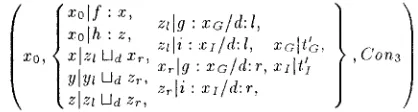
over their respective variants. We e v e n t u a l l y get:
xo, ~ x[.l ud z,.,
6'o~3
~,.1i : xz/d:r,
% ~l~t Ud zr,
A l t h o u g h the resulting description contains contexted vari- ables which refer to variants of z c and :r~, we do not have to i n t r o d u c e bifurcations for these variables. Itcnce the infor- m a t i o n c o n t a i n e d in constraints on the variables x a and xi is not duplicated, a l t h o u g h b o t h variables are used within a disjunction. However, if there would be more information on the values of the g - or / - - f e a t u r e s of z~, x~, or z~, for instance a c o n s t r a i n t of the form z~lg : x', this would lead to the i n t r o d u c t i o n of a bifurcation for x a , and some parts of the s t r u c t u r e e m b e d d e d under x a would have to be dis- t r i b u t e d over the variants of z a . B u t the unfolding of the s t r u c t u r e below xc. would be l i m i t e d to the m i n i m a l neces- sary a m o u n t , since those parts of the s t r u c t u r e that do not i n t e r a c t with i n f o r m a t i o n known a b o u t ~' could make use of c o n t e x t e d variables.
[image:5.596.326.535.523.579.2]i n t e r a c t w i t h the i n f o r m a t i o n c o n t a i n e d in the disjunction.
4,4
A l g o r i t h m i c C o n s i d e r a t i o n s
O n e m a j o r a d v a n t ~ g e of our t r e a t m e n t is its similarity with c o n v e n t i o n a l r e w r i t e systems for feature logic. Since we per- l o r m only c o n v e n t i o n M s u b s t i t u t i o n of variables (opposed to conditional s u b s t i t u t i o n as in [ M a x w e l l / K a p l a n 89], see [ E i s e l e / D g r r e 90] for a discussion), our system can be eas- ily i m p l e m e n t e d in e n v i r o n m e n t s providing t e r m unification ( P n o L o c , ) , or the a h n o s t linear solution of the union/find problem could be exploited (see e.g. [Aft-Kaci 84]). T h e only essential extension we need concerns tire t r e a t m e n t of con- text descriptions. A c o n t e x t description c o n t a i n e d in a con- t e x t e d variable is always purely conjunctive, tIence the nec- essary o p e r a t i o n s (comparison with TRUe;, locating, adding or d e l e t i n g a simple c o n j u n c t ) can each be i m p l e m e n t e d by one simple list operation. In t h e constraint expressing in- consistent c o n t e x t s (A_[k]), k is a disjunction of t h e inconsis- tencies found so far (which themselves are purely conjunc- tive). T h i s could be also represented in a list of (purely conjunctive.) contexts. However, the exclusion of irrelevant c o n s t r a i n t s ~: It, where C o n ( x ) is covered by k in ±[k], and the (final) test if k ~ TRUe involves a bit more propositional calculation. Since these tests might occur more often than the d e t e c t i o n of a new inconsistency, it m i g h t be worthwile to use a r e p r e s e n t a t i o n t h a t facilitates the test for entail- ment. In any case, t h e i m p l e m e n t a t i o n can m a k e use of fast bit-vector operations.
<!:.5 M a x w e l l a n d K a p l a n ' s A p p r o a c h
An a p p r o a c h which ours is especially interesting to con> pare w i t h is the d i s j u n c t i v e constraint satisfaction proce- dure given in [ M a x w e l l / K a p l a n 89], because of the similar r e p r e s e n t a t i o n s involved in the two approaches. T h e y use also d i s j u n c t i o n names and c o n t e x t s to represent disjunc- tive constraints and propose ,~ general t r a n s f o r m a t i o n pro- cedure which turns a rewrite s y s t e m for non-disjunctive con- straints into one which handles disjunction of constraints with the use of corttexted constraints, having the impli.- cational form ( k - ~ d), where ¢ is some non-disjanctlw.' constraint. T h i s is done by replacing every rewrite rule by its " c o n t e x t e d versimF', e.g., ¢1 A ¢2 ~ ¢a is re- placed by (k:t - ~ (/)1) A (k2 - ~ ~ 2 ) - - ' + ( k l A "~k2 ~ (/)1) A (k~ A ~k~ --, O~) A ( < A k~ --, 0~), where k~ and k~ are variables for c o n t e x t descriptions. T h e r e are two severe efficiency-critical problems if we w a n t to use the o u t c o m e of this t r a n s l a t i o n w i t h o u t further optimization. First, any rule of the g e n e r a t e d form should only apply to a pair of con- t e x t e d constraints whose c o n t e x t s are c o m p a t i b l e , i.e. kl A/c2 is not contradictory. But now, since c o n t e x t descriptions taay include c o n j u n c t i o n and negation at any level, this test itself is an A / P - c o m p l e t e problem, which has to be solved before every application of a rule. T h e second problem con- cerns s u b s t i t u t i o n . Consider a rule like z - y A ~ ~ ~,a-.~. T h e t r a n s l a t i o n produces a rule in which (P is r e w r i t t e n to both ~ and (I)v_x , indexed with different c o n t e x t descrip- tions. Thu,~, we c a n n o t simply perform a replacement, but instead, h a v e to m a k e a copy of 45 (or at least those parts of 45 containing y). U n f o r t u n a t e l y , this p r e v e n t s also the efficient u n i o n / f i n d m e t h o d to be employed for bnilding equivalence classes for variables instead of actual substitution. All of I, hese p r o b l e m s arc avoided if we let the c o n t e x t description ,:)f a c o n t e x t e d c o n s t r a i n t depend implicitly on the variables in it t h r o u g h the i n t r o d u c t i o n of c o n t e x t - u n i q u e variables. From this point of view, our m e t h o d can be seen as an op-
tirnized i m p l e m e n t a t i o n of the t r a n s l a t e d rewrite system for unification in feature logic wittt sorts and negation.
5
C o n c l u s i o n
To s u m m a r i z e , we h a v e presented a new unification m e t h o d for tile full la.nguage of feature logic including variables, sorts and negation which avoids expansion to disjunctiw~ normal form, if possible. T h e basic principle is to minimize unnec- essary i n t e r a c t i o n of dilt'erent disjunctions by keeph~g thenl local to those a t t r i b u t e s which they specify different values for t h r o u g h the i n t r o d u c t i o n of disjunction names. W i t h this t r e a t m e n t we avoid expoimntial explosion in m a n y practical cases. A precursor of this a l g o r i t h m [DSrre/Eisele 89] has been i m p l e n l e n l e d and is successfully used in a g r a m m a r de- v e l o p m e n t e n v i r o n m e n t . Besides the obvious advantage of increased etliciency, our c o m p a c t r e p r e s e n t a t i o n of disjunc- tive i n f o r m a t i o n also facilitates the comparison of a h e r n a t i v c solulions with c o m m o n parts, which has been proved to be a very valuable p r o p e r t y in our application. Our algorithm is specified in a c o m p l e t e l y formalised way as a rewrite system for which a model-.theoretic s e m a n t i c s is given. It may seem t h a t there are a lot of rules, but this can be explained by the following facts: we include a c o m p l e t e reduction from feature terms (like in t ( a s p e r / I / o u n d s logic) to feature de- scriptions (as used in Lt."G); we handle all different types of constraints, inchlding sorts ~md negation in one framework; and our rules only involve few p r i m i t i v e operations for which sinrple and fast i m p l e m e n t a t i o n s exist.
Refererlces
[Ai't-I,:aci 84] Ai't-Kaci, l I. (1984). A Lat lice-Theoretic Approadl to Computation Based on a Calculus of Partially-Ordered Type
Structures. Ph.D. Thesis. University of [~ennsylvania. [DSrre/Eisele 89] DSrre, J. and A. I:;isele (1989). Determining
consistency of feature terms with distributed disjunctions. In: D. Mctzing red.) G W A I - 8 9 , 13th German Workshop on Ar- lificial Intelliyence, pp. 270 279. Informatik [;'achberichte 2 I6, Springer.
[F, isele/1)Srre 88] Eisele, A. and J. DSrre (1988). Unification of disjunctive feature descriptions. In: Proc. o/ the '2.6rd Ann. Meeting of the A C L , Buffalo, NY.
[l';isele/D&'re 90] t';isele, A. and J. 13Srre (1990). Dis.junc~ive Uni- fication. IWBS-l~eport, IWBS, IBM Germany, Postfach 80 08 80, 7000 Stuttgart 80, W. Germany. To app. in: f",'oc, of t]~c Workshop on Unification Fo'r'm.alisms .... Syntax. ,q'eman~i,:s and I m p l e m e n t a t i o n , Titisee, MIT Press.
[Karttunen 84] Karttunen, L. (1984). Features and Values. In: P~'oceedings of C O L I N G I98~, Stanford, CA.
[l(asper 87] I(asper, tt.T. (1987). A Unification Melhod for Dis- junctive Feature Descriptions. In: PT"oc. o.f the 25~h el nn. Mee t-
in.q o/ the ACL. Stanford, CA.
[t(asper/l{ounds 86] Kasper, H..T. and \V. flounds (1986). A Logical Semantics for I;'eature Structures. In: Proc. of ~he 2.ill, Ann. ~lqeeling o/ the A CL. Columbia University, New York, NY.
[Maxwell/Kaplan 89] Maxwell, J. and It. [(aplan (i989). Dis- junctive Constraint Satisfaction. Ill: Proc. [nL IVS 0n Parsing
Technologies, Carnegie Mellon, Pittsburgh, PA.
[Smolka 88] Smolka, G. (1988). A Feat~Lre Lo.qic tcizh 5'~tbsorla. LILOG-F~eport 33. IBM Germany. To app. in: J. of Automat od lt.easoning.