Dynamic Programming Method
for Analyzing Conjunctive Structures in Japanese
S a d a o K u r o h a s h i a n d M a k o t o N a g a o D e p t . o f E l e c t r i c a l E n g i n e e r i n g , K y o t o U n i v e r s i t y
Y o s h i d a - h o n m a c h i , S a k y o , K y o t o , 6 0 6 , J a p a n k u r o @ k u e e . k y o t o - u . a c . j p
A b s t r a c t
Parsing a long sentence is very difficult, since long sentences often have conjunctions which result in am- biguities. If the conjunctive structures existing in a long sentence can be analyzed correctly, ambiguities can be reduced greatly and a sentence can be parsed in a high successful rate. Since the prior p a r t and the posterior p a r t of a conjunctive s t r u c t u r e have a similar s t r u c t u r e very often, finding two similar series of words is an essential point in solving this problem. Similarities of all pairs of words are calculated and then the two series of words which have the great- est sum of similarities are found by a technique of dynamic programming. We deal with not only con- junctive noun phrases, b u t also conjunctive predica- tive clauses created by "Renyoh chuushi-ho". We will illustrate the effectiveness of this m e t h o d by the anal- ysis of 180 long Japanese sentences.
1
I n t r o d u c t i o n
Analysis of a long J a p a n e s e sentence is one of m a n y difficult problems which c a n n o t be solved by the con- tinuing efforts of m a n y researchers and remain abau- doned. It is difficult to get a proper analysis of a sentence whose length is more t h a n fifty Japanese characters, a n d almost all the analyses fail for sen- tences composed of more than eighty characters. To clarify why it is is also very difficult because there are varieties of reasons for the failures. People some- times say t h a t there are so m a n y possibilities of modi- fier/modifyee relations between phrases in a long sen- tence. B u t no deeper consideration has ever been given for the reasons of the analysis failure. Analysis failure here means not only t h a t no correct analysis is included in the multiple analysis results which are caused by the intrinsic ambiguity of a sentence and also by inaccurate g r a m m a t i c a l rules, but also t h a t the analysis fails in the middle of the analysis pro- r e 8 8 ,
We have been claiming t h a t many (more t h a n two) linguistic components are to be seen at the same time in a sentence for proper parsing, and also t h a t tree to tree t r a n s f o r m a t i o n is necessary for reliable analysis of a sentence. P o p u l a r g r a m m a r rules which merge
two linguistic components into one are quite insuf- ficient to describe the delicate relationships among components ill a long sentence.
Language is complex. There often h a p p e n s t h a t components whicb are far a p a r t in a long sentence co- occur, or have certain relationships. Such relations m a y be sometimes purely semantic, b u t often they are g r a m m a t i c a l or structural, although they are not definite but very subtle.
A long sentence, particularly of Japanese, con- tains parallel structures very often. T h e y are ei- ther conjunctive noun phrases, or conjunctive pred- icative clauses. The latter is called "Renyoh chuushi- ho". T h e y a p p e a r in an embedded sentence to mod- ify nouns, and also are used to connect two or more sentences. This form is very often used in Japanese, and is a main cause for s t r u c t u r a l ambiguity. Many m a j o r sentential components are omitted in the pos- terior p a r t of Renyoh chuushi expressions and this makes the analysis more difficult.
For tbc successful analysis of a long Japanese sen- tence, these parallel phrases and clauses, including Renyoh chuushi-ho, must be recognized correctly. This is a key point, and this m u s t be achieved by a completely different method from the ordinary syn- tactic analysis methods, because they generally fail in the analysis for a long sentence.
We have introduced au assumption t h a t these par- allel phrases/clauses have a certain similarity, and have developed an algorithm which finds out a most plausible two series of words which can be considered parallel by calculating a similarity measure of two ar- bitrary series of words. This is realized by using the d y n a m i c p r o g r a m m i n g method. The results was ex- ceedingly good. We achieved the score of a b o u t 80% in the detection of various types of parallel series of words in long Japanese sentences.
2
T y p e s o f C o n j u n c t i v e Struc-
tures
and Their Ambiguities
First, we will explain w h a t kind of conjunctive structures (hereafter abbreviated as ' C S ' ) a p p e a r in J a p a n e s e [ l ] N .
The first type is c o n j u n c t i v e n o m i p h r a s e s . We
'l'alfle 1: W a r d s indicating conjunctive structures. ~ - (a) Conjunctive noun phrases
| $ , , / c t l *a 6 @ | c a55~,tt ~a b < ~t L . ~)_.~+(~ Conjunctive predic~ttive clauses
~.la (c) Conjunctive incomplete structures
~
~-Tgg~a ~ g g g K
~ E T K
' + ' means succession of words. Characters in ~( )' may or may not aplmar.
can find these phrases by tile w o r d s for conjunction listed up in T a b l e l(a). E a c h conjunctive noun some- times has adjectival modifiers (Table 2(il)) or clause modifiers ( T a b l e 2(iii)).
T h e second t y p e is c o n j u n c t i v e p r e d i c a t i v e c l a u s e s , ill which two or more itredicates ~ arc in a sentence forming a coordination. We call find these clauses by the ll,enyoh-lbrnts ~ of predicates (Renyoh ehuushi-ho: T a b l e 2(iv)) or by tile predi. cares a c c o m p a n y i n g one of the words in Table l(b) ('rable 2(v)),
'['he. third t.ype is CSs consisl.ing of parts of conjtmc- t i r e predicatiw~ clauses. We call this t y p e e o n j u n e - t l v e i n c o m p l e t e s t r u c t u r e s . We can find these s t r u c t u r e s by the correspondence of p(xstpositional particles (Table 2(vi)) or by the words in Table l(e) which indicate CSs explicitly (Table 2(vii)).
l,br all of these types, it is relatively easy to tind the existence of a CS by d e t e c t i n g a d i s t i n c t i v e k e y b m l s e t s u a (we call this bunsetsu ' K B ' ) which ac- c o m p a n i e s these words explained above. KB lies last in the prior p a r t of at CS, but it is difficult to deter mine which bunsetsu sequences on both side o f tile KB constitute a CS. T h a t is, it is not easy to deter- mine which Imnsetsu to tile hfft of a KII is tile leftmost e l e m e n t of the prior p a r t of a CS, and which bunsetsu to the. right of a Kil is tile r i g h t m o s t element of the posterior p a r t of a US. T h e bunsetsus betweeu these two e x t r e m e e l e m e n t s c o n s t i t u t e the s c o p e o f t h e C S . Particularly in d e t e c t i n g this scope of a CS, it is essential to find out the last Imnsetsn in the posterior p a r t of the CS, which corresponds to the KB. q'here art'. l n a n y c a n d i d a t e s for it ill a s e a t e n c e ; e . g . , ill a
conjunctive noun i)hras~ all nouns after it KII are the candidates. We call snch it c a n d i d a t e bunsetsu '(211'. It is a l m o s t impossible to solve this p r o b l e m merely by using rules based oil phra.se s t r u c t u r e g r a m m a r .
lilt addition to verbs tutti aAjectives~ assertive words (kinds of postpositioxm) " /d"(da), "q2ab5 "(dearu), "e-J- "(desu) and so on, which follow directly after nouus, cm~ be predicate it| d*tl>ltllese.
~'fhe ending foritls of inflectional words which c;m modify vet|>, ~tdjective, o r a ~ e r t i v c word a u ~ c-tiled I ~ e / l y o h - f o r n l in .1 apanese.
3 ]~utmetuu is tile Slllgtllet~t ineanhlgful block tx|nsisting of *tit indelxmdcnt word ( l W ; tmuns, verbs, adjectives, etc.) and aCCOlttpau~yittg word~ ( A W ; l),xslp~sitio|lal pgu'ticles, &uxiliguy verbs, etc.).
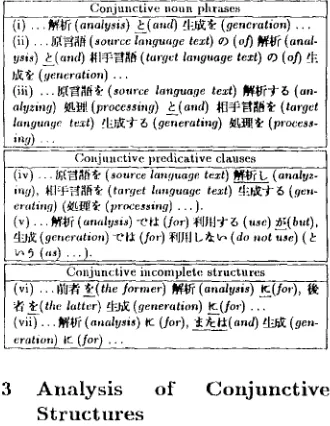
T a b l e 2: E x a m p l e s of conjunctive s t r u c t u r e s . Conjunctive noun phrases
(i) ... lMgr (analysis) ~ ( a,,l} *_l:~ + (generation) ...
(ii) .,./~.~ag (so.,'~e l.avuage text) ~9 (o]) g~dCc (anal-
ysis) ~(and) ~ 1 ~
( ta,'gct
language tezt)© ( oJ) ~k
~ ~ (.qeneration) ...
(iii) ... ~ ' ~ g ~ ( so,,'ce languaqe text) ~i$~T b ( au-
alyziag) ~t~t{(processmg)
~(a,d) ~ H l ~ g ~ :
(targetlanguage text) _d~r~3 ~ 6 (generating) ~ . . ~ " (process-
ing) . ..
I Conjunctive predicative clauses
t a g ) , ~ A I = J 2 ~ ( ta,'uet l.,,9uage text) tl:.~'# ~ (9c,-
ertatittg) ( ~ (processi,,g) ...).
tLl~ (9eneration) :eta (]o,.) *1Jill L @ ~ (do . o t ~ e ) ( ~:
Omljunctive incomplete structures
~,' ~ ( t h e
lat~cr) ~:M~ (~ . . . lion) re(/o,')..'7
( v i i ) . . . ~/t~
(a,,alvsis) ~
(10,'), $ ~:t~(and)~
(9en-
3
A n a l y s i s
of
C o n j u n c t i v e
S t r u c t u r e s
We detect the scope of CSs by using wide range of information around it KB. 4 An i n p u t sentence is first divided into bunsetsus by tile conventional m o r p h o - logical analysis. T h e n we calculate similarities of all pairs o f ~)unsetsus ill a selltence, and calculate a s u m of similarities b e t w e e n a series of b u n s e t s u s on the left of a KII and a series of bunsetsus on the left of a CB. Of all the pairs of the two series of Imnsetsus, the pair which has the g r e a t e s t s u m of similarities is d e t e r m i n e d as the scope of the CS. We wilt explain tins process in detail in the following.
3 . 1 S i m i l a r i t i e s b e t w e e n B u n s e t s u s An a p p r o p r i a t e similarity value between bunsetsus is given by the following process.
• If the parts of speech of I W s ( i n d e p e n d e n t words) are equal, giw~ 2_j>oints as the similarity values. T h e n go to the next stage and add further the following I)oints.
1. If IWs m a t c h exactly (by c h a r a c t e r level) each other, add 10 points and skip the n e x t two steps and go to tile step 4. I f l W s are inflected, infinitives are c o m p a r e d .
2. If both IWs are nouns and they m a t c h par tially by c h a r a c t e r level, ad<l the n u m b e r of m a t c h i n ~ characters x 2 ]mints.
4 We (Io not halldle Colljullclive predicatiw~ el*tune* cteatexl by the Itcnyoh fc*rtns of predicates (|{enyoh c|nmshi-ho) which do ltOt accompany COllllll*t, })e¢llll~: a l m o s t all of these prc,ll- c,ties iilOdify thc llCXL llt~al¢~st [)l'edicltte lilld there is 11~) need t,~ chc<:k the possibility of conjunct|oil.
[image:2.432.225.390.27.240.2]^': ~.pmlal maulr.
P
~ - ... r . . .
. ~ I ~(p n+l)
\ .",.. I "Ne ~'" " similarity value
:"... I~--- A = (.(ij))
Figure 1: A path.
3. Add points for semantic similarities by using the thesaurus 'Buurui Goi Ityou' (BGH)[3]. BGH has the six layer abstraction hierarchy and more than 60,000 words are assigned to the leaves of it. If the most specific common layer between two IWs is the k-th layer and if k is greater than 2, add (k - 2) × 2 points. If ei- ther or both IWs are not contained in BGH, no addition is made. Matching of the generic two layers are ignored to prevent too vague match- ing in broader sense.
4. If some of A W s (accompanying words) matcb, add the number of matchin$ AWs x 3 points. Maximum sum of the similarity values which can be added by the steps 2 and 3 above is limited to 10 points.
• Although the parts of speech o f l W s are not equal, give 2_.points if both bunsetsus can be predicate (see footnote 1).
For example, the similarity point between " ~
~Pi~ (low level language) + , " and " ~ l t ¢ , ~ ' ~ (high
level language) + ~ (and)" is calculated as 2(match of
parts of speech) + 8(match of four characters: Y~l/t~ ~ ) = 10 points. The point between " ~]'aq~ (revision)
+ L (do) + , " and "l~U3(deteetion) +'J-~ (do)" is
2(match of parts of speech) + 2(match by BGII) + 3(match of one AWs) - 7 points.
3 . 2 S i m i l a r i t i e s b e t w e e n T w o S e r i e s o f B u n s e t s u s
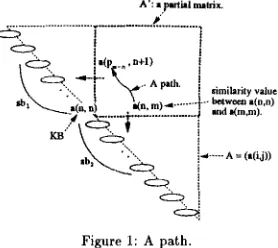
Our method detects the scope o f a CS by two series of bunaetsus which have the greatest similarity. These two aeries of bunsetsus are searched for on a triangu- lar matrix A = (a(i,j)) (Figure 1), whose diagonal
e l e m e n t a(i,i) is the i-th bunsetsu in a sentence and whose element a ( i , j ) (i < j) is the similarity value between bunsetsu a(i,i) and bunsetsu a ( j , j ) .
We call the rectangular matrix A' a p a r t i a l m a - t r i x , where
A' = ( a ( i , j ) ) (O< i < n; n + l < j <1)
t,(i, ~3~ ... i'---~i, j-I )-~i, 9
" J ...
I
i
i \
,(.. ni
i
i
%
Figure 2: An ignored element.
... ~ ... ~,~: ... ! ...
i c5~.( ",,
i
... i ... -2 'v-\ ... ~ ... ... i ... :;'i.:':~'~:~ ...~ ...
Figure 3: Penalty points.
is the upper right part of a KB (Figure 1). In tile following, 1 indicates the number of bunsetsus and
a(n, n) is a KB. We define a p a t h as a series of ele-
ments from a non-zero element in the lowest row to an element in the leftmost column of a partial matrix (Figure 1).
path ::=
(a(pl, m), a(p2 . . . . 1) . . . a(p . . . + 1)), where n + l < m <1, a(pl,m) ¢ O, Pi = n,
PI>>.PI+I( 1 < i < m - n - 1).
The starting element of a path shows the correspon- dence of a KB to a CB. A path has only one element from eacb column and extends towards the upper left. We calculate the similarity between tbe series of bunsetsus on the left side of the path (sbl in Figure 1) and the series under the path (sb2 in Figure 1) as a p a t h s c o r e by the following four criteria:
1. Basically the score of a path is tile sum of each element's points on the path. But if a part of the path is horizontal ( a ( i , j ) , a ( i , j - 1)) as shown in Figure 2, which leads the bunsetsu correspondence of one element a(i, i) to two elements a ( j - 1, j - 1)
and a ( j , j ) , the element's points a(i,j - 1) is not
added to the path score.
2. Since a pair of conjunctive phrases/clanses often appear ~s a similar structure, it is likely that both cmdunctive phrases/clauses contain nearly the same numbers of bunsetsus. Therefore, we impose penalty points on the pair of elements in the path which causes the one-to-plural bun- setsu correspondence so as to give a priority to the CS of the same size. Penalty point for
[image:3.432.263.362.25.228.2] [image:3.432.64.203.28.152.2]'Fable 3: S e p a r a t i n g levels (SLs).
~ : ~
co,,aitio, _, ~o ~,,:,~ot~o
5
- - i
- - 5
2 - - 1
Being the KB of a conjunctive predicative clause, or accompanying a topi(:~ntarking postpositional particle ~' I~ " all(I comma.
Accompanying a postpositional particle not (:re- sting a conjunctive nolul phrase and conlllla, or being an adverb aCColnpanyillg conlnla. Being the Renyoh-[orm of a predicate which does 1|o~ ~tccolnp~l/y conllna~ or accolnpanyil|g tt topic- marking postpositionM particle " t.t ", Being the KB of a conjunctive noun phrase ac- companyillg COlllnla,
Accompanying a comma, or being the KB of a conjullctive IlOllll phrase not aCcolnparlying colnlna.
( a ( p l , j ) , a ( p i + ~ , j - 1)) is calculated by the for m u l e (Figure 3),
[p, - pi+x - 11 X 2 .
T i m penalt,y points are s u b t r a c t e d from the p a t h score.
3. Since each p h r a s e in the CS has a certain cO- herency of m e a n i n g , speciM w o r d s which s e p a r a t e the m e a n i n g in a sentence often limit the scope of a CS. If a p a t h includes such words, we impose p e n a l t y points on the p a t h so t h a t the fmssihil - ity of including those are reduced. We define five 'separating-levels' ( S L s ) for hunsetsus, which ex- press the s t r e n g t h of s e p a r a t i n g a sentence m e a n - ing (Table 3, of. T a h l e 1). If bunsetsus on the left side of t h e p a t h ~md u n d e r it include a bunsetsu whose SL is equal to K B ' s SI, or higher t h a n it, we reduce the p a t h score by
(SL of the hunsetsu - K B ' s SL + 1) x 7. ltowever, two high SL bunsetsus corresponding to each o t h e r ofteu exist in a CS, and those do not limit the scope of the CS. For example, topic- m a r k i n g postpositional particles correspond each other in the following sentential style,
h ~. L ' C ~ ( A s t o A) . . . . -cab 9 (be), f~ ~ L~c ~ (~s to ~l) . . . . - c . ~ (~e).
T h e r e f o r e , w h e n two high SL bunsetsus corre- spond in a CS, t h a t is, the p a t h includes the ele- m e n t which indicates the similarity of t h e m , and those are the ' s a m e - t y p e ' , the p e n a l t y points on t h e m arc not axlded to tile p a t h score. We define thc s a m e - t y p e b u n s e t s u s ~LS two bunsetsus which satisfy the following two conditions.
• I W s of t h e m are of the s a m e p a r t of speech, and t h e y have the identical inflection whcn they arc inflectional words.
• A W s of t h e m arc identical.
Table 4: W o r d s for honuses. ~ll~t A - t A ~ (~Josjultctive noun phrases
4. S o m e words frequently become tile A W of the last bunsetsu in a CS or the I W following it. T h e s e words t h u s signal the end of the CS. Such words are shown in T a b l e 4, Bonus points (6 points) are given to the p a t h which indicates the CS e n d i n g with one of the words in Table 4, as t h a t p a t h shouhl he preferred.
3 . 3 F i n d i n g t h e C o n j u n c t i v e S t r u c - t u r e
S c o p e
As for each non-zero e l e m e n t in the lowest row ill a partial m a t r i x A' in Figure l, we search for tile best p a t h f r o m it which has the g r e a t e s t p a t h score by a technique of the d y n a m i c p r o g r a m m i n g . Calculation is p e r f o r m e d c o h u u n by c o l u m u in the left direction f r o m a non-zero e l e m e n t . For each elenmnt in a col.. u m n , the hast partial p a t h including it in found by e x t e n d i n g the partial p a t h s f r o m the previous c o h m m and by choosing the p a t h with the g r e a t e s t score. T h e n a m o n g the p a t h s to the leftmost column, the p a t h which ha.s the g r e a t e s t score becomes the best
Now calculatill 8 :"
ill
this column., - - ~ v l t . . . . ~--.~---~---, ~---,.---~.--~---,---~--~..-,
: : 1 3 : : : . : : t : : : : l
~-+"~,:+-+
i q ~. . . . +'-
h J~ ~ t ~th v . . . ¢.-+-v+---,-.-4 v ... +--- :+...+..-+..-~ [image:4.432.42.386.32.383.2] [image:4.432.237.375.320.383.2] [image:4.432.240.366.422.522.2]dregte~test+ : i:.-"' '" "~ ;
~ . ~ . ;
"[ Score path. . . . 1 2 : u ' ~ i~thtg i" i O'je|emt~lt.
Figure 4: T h e best p a t h f r o m a e l e m e n t .
~ : ~ - d ... ~'.7 ~F "'~'"'~'~J'ne'n,aximtun path.
< - >
i.:
>"~ L..L.~
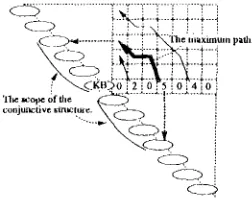
"-4~Kn)o 2 0 5 0 4 o 'llm ~o1~ of the ~ - ~ ... l ... conjunctive ~Lructme. ~ ~ - ~ ! !
~c&7)
i
~ E
Figure 5: T h e m a x i n m m p a t h specifying a conjunc- tive s t r u c t u r e .
p a t h from the non-zero element (Figure 4). O f all the best paths from non-zero elements, the p a t h which have the m a x i m u m p a t h score defines the scope of bhe CS; i.e., the series of bunsetsus on tim left side of the m a x i m u m p a t h and the series of bunsetsus u n d e r it are conjunctive (Figure 5).
4
E x p e r i m e n t s a n d Discussion
We illustrate the effectiveness of our m e t h o d by the analysis of 180 Japanese sentences. 60 sentences which are longer aud more complex t h a n the aver- age sentences are collected from each of the following three sources; Encyclopedic Dictionary of C o m p u t e r Science (EDCS) published by l w a n a m i Publishing Co., A b s t r a c t s of papers of J a p a n Information Cen- ter of Science and Technology (JICST), and popular science journal, "Science", translated into Japanese (Vol.17,No.12 "Advanced C o m p u t i n g for Science"). Each group of 60 sentences consists of 20 sentences from 30 to 50 characters, 20 sentences from 50 to 80 characters, a n d 20 sentences over 80 characters.
As described in the preceding sections, m a n y fac- tors have effects on the analysis of CSs, and it is very i m p o r t a n t to adjust the weights for each factor. The method of calculating the p a t h score was adjusted during the experiments on 30 sentences out of 60 sen- tences from EDCS. Then the other 150 sentences are analyzed by these parameters. As the analyses were successful as shown in the following, this method can be regarded as properly representing the balanced weights on each factor.
This m e t h o d defines where the CS ends, t h a t is, which bunsetsu corresponds to the KB. However, as for conjunctive noun phrases containing clause mod- ifiers or conjunctive predicative clauses, it is almost impossible to find out exactly where the CS starts, be- cause mm~y bunsetsus which modify right-hand bun- setsus exist in each p a r t of the CSs a n d usnally they do not correspond exactly. T h u s it is necessary to re- vise the s t a r t i n g position of the CS obtained by this method. We treat the actual prior p a r t of a CS as extending to bunsetsus which modify a bunsetsu in the prior p a r t of it obtained by this method, unless they contain c o m m a or topic-marking postpositional particle " #2 " ( h a ) .
4 . 1 E x a m p l e s o f C o r r e c t A n a l y s i s Examples of correct analysis are shown in Figure 6 - 8. The revisions of CS scopes are shown in notes of each figure. Chains of a l p h a b e t symbols a t t a c h e d to m a t r i x elements show the m a x i m u m p a t h concerning the KB m a r k e d by the same a l p h a b e t and ' > ' .
[image:5.432.232.406.36.168.2] [image:5.432.231.403.229.343.2]In the case of example(a) in Figure 6, the conjunc- tive noun phrase, in which eight nouns are conjuncted (chains of %', 'b', . . . 'g'), is analyzed rightly t h a n k s to the p e n a l t y points by SLs of every c o m m a between nouns. Thus, the CS consisting of more t h a n two
| ¢ ° 2 2 2 2 2 2 t 4 0 2 2 0 0 : 2 0 J 0 2 0 2 (in~one.,e~,~'l) ~ : ~ . ~ ~ 5 .~ 5 5 2 0 2 ~ 2 0 2 0 2 0 2 2 2 (~clnmr~e) ~b~C/.~. ~b7 ~ 5 5 2 0 2 2 2 0 2 0 :2 0 2 2 2 (collection)
. \ ~ m 4 e . s, s ~ ~ 2 o 2 2 2 o ~ o 2 o 2 2 2 ( r ~ . , ~ c ~ t l o , ~ )
\ k ~ t t ~ l . ~ S S 2 o 2 ~ 2 o a o 2 o 2 2 2 ( ~ m t d ~ )
_ . . . , . . . .
~ m . 4& o 2 2 2 o ~ o 2 o 2 2 2 (~urWcmtum) tzU¢= 0 2 2 0 0 2 0 ~ 2 0 2 0 2 ( ~ , . d ~ . m e a ~ )
~¢~i'~6 0 0 2 0 0 0 2hO 0 0 2 o (mhlU, d ~ )
~
' ~ : 1 1 , 1 2 o o ~ o o ~ o 2 o ~ ( ~ a )~II ~k 0 0 2 0 0 2 ffa 3h 0 4 (n~,ne)
~ ~ t ~ L . 0 0 2 5 0 2 0 n b o (tail'/=) h o o o 0 o o 0 0 O (t,m) " ~ ' ~ o o 2 0 2 0 ~ 0
~ t > ~ l , : 0 0 2 0 0 0 ( d ~
~ t ~ t c O 0 0 5 O 0
l l } t l l o o 2 0 2 ( a t h e n a . )
~wtt ~ ~cludm,t
It k a k i n d o f ~c te~ce which a n a l y z ~ the e , s e a t s ~uui tmatre related to info~ttation'$ occmrence, collection, s y s t e m a t i z ~ o ~ , ~ a f i ~ t retrieval, uaderstendia,8, c,. com- mtmicmtlon, and application, t a d so on, Lad i n v ~ t i g a t ~ social tdaplability o f the clarified m a s s * .
Figure 6: An example of analyzing conjunctive struc- tures ( a )
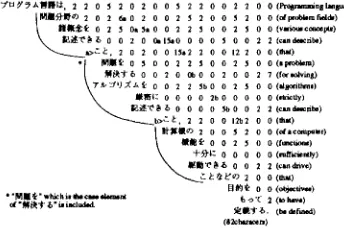
7 ' t ~ s z l ! l l l H $ . 2 2 0 ~ 2 0 2 0 0 s 2 2 0 0 2 M I I ~ I ~ 9 2 0 2 ~ 0 2 0 0 2 s 2 0 0
lilll~ o 2 5 am ~1 0 0 2 2 ~ o o 2 I ~ o o 2 o O m l ~ O o o o 9 o
~ > ' ~ . 2 o 2 o o 15.2 2 0 0 t2 * M ~ ' k o ~ o 0 2 2 ~ 0 0 2 M ~ o o 2 o o b o o ~ o
I ~ : o o o o ~b o o ~ ' O g ~ o o o o ~ o
~ b > '~~ , 2 2 o o 12"02
~ $ e O 0 2
+ \ + ~ t z 0 o o I K I ~ x ' ~ 0 0
a "MOt ~/" ~" is iteiua~a.
Pro~)ramming l~a~uises ame de f n ~ M to have objectives that they c~n d~cribe
~arious c o ~ I s of p~oblem fields, that they can ~Irictly describe algoritlm~ for
*olving • problem, and that they cia drive fuactions of m computer tuffickmfly. Figure 7: An example of analyzing conjunctive struc- tures ( b )
0 (ProemmamlnS I m p ) 0 (d p r ~ m r~Idf) 0 ( v ~ c ~ p m ) 2 ( ~ dmefit~) O (the) 0 ( m f4ro~31mm)
7 (f~ talv~n$)
0 (~g~at4mm)
o (tmct~a) 0 (~ffwit lly) 2 (c~ cbw~)
2 ( ~ )
parts is expressed by tile repetition of the combina- tion of CSs consisting of two parts, in this exam- ple, also the conjunctive predicative clause is analyzed rightly (chains of 'h').
In the case of example(b) in Figure 7, the CS which consists of three noun phrases containing modifier clauses is detected as tile combination of the two con- secutive CSs like example(a) (chain of ' a ' and 'b').
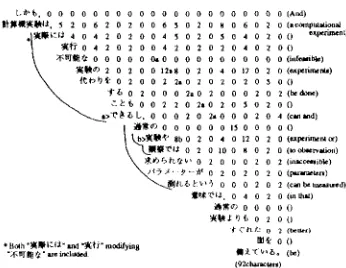
In tile case of example(c) ill Figure 8, the con- junctive noun phrase a n d the conjunctive predicative clause containing it is analyzed rightly. In this exam- ple, the successful analysis is due to the p e n a l t y points by SL of the topic-marking postpositional particle " " in " ~ f f ~ g ~ l ~ r l ~ t
(a computational e~:periment)"
a n d " , ~ 1 ~
(in that)"
which are the outside of tile CS and the bonus points by the AW " ~ v, 5 " in the last bunsetsu of the CS .L . - ,Source Length . . . .
'Fable 5: Results of e x p e r i m e n t s
30-,~o [ 5~:ho I s~-~a9 30-5o
I
so~so I st~44 [ .~5oI
s~so~nTohe cox~junctive un phrases [ Success 5 7 : : 5
Failure ] 3 [ '~
[ "9
The conjm~ctive Success 6
i . . . plete structures }:allure 0 0 ~ ~ ] 0 0 , - 9 0
L,~.~. 0 0 0 0 0 0 0 0 0 0 o 0 0 0 0 0 0 I~ttI~IyS~. ~ 2 0 6 2 2 0 6 ~ 0 2 0 s 0 6 0
• ~ ¢ : 6 ~ 4 o 4 2 2 o ~ ~ o 2 o s o 4 o
' ~ 0 4 2 2 O 4 2 0 2 O 2 0 4 0
• nI~tz o o o ~ o o o o o o o o o
~l~a) 2 2 0 l/)g 0 ~ 0 4 o 17 0
~t~b~ o 2 o 2 2 . 0 2 o 2 o ~ 0
~
i-6 0 0 o 0 2 ~ 0 2 0 0 0 2C'. ~ ~> 0 2 2 0 2 1 0 2 0 5 0 ~'~'/)b. 0 o 0 2 o ~ o o 0 2
~ @ ~ o o o o o O l ~ O o
b>~ I ~ " Sb 0 2 0 4 o 1~ 0
>~¢~StL~, o 2 o o o 2
incx,)+), o 4 o ~151 ,t '9 ~o o ¢ < m ~ : ,
(9~el~t(nl) (^~) (, ~apuade~
0 e~pcamem)
0
(~ptrin~ ~s) 0 (t~ 6ar~) 0
o (c~ and)
o
(t~ m~)
0 0
0
And a compulBtioual experiment is bener ill that infeasible cxpaiments can be dolm slid paran~eters il~z~cesuible to ¢xpelltllent or ~ ? a l i O l l ¢ i l 1 be measttred
Figure 8: All e x a m p l e of a n a l y z i n g c o n j u n c t i v e struc- tures (C).
4 . 2 E x p e r i n a e n t a l E v a l u a t i o n
We e v a l u a t e d tile analysis result of 180 J a p a n e s e sen- tences by hand. T h e results of c v a l u a t l u g every sen- tence by each CS type are shown in Table 5. If tile same typc CSs exist two or more ill a sentence, the analysis is regarded as a success only when all of t h e m are analyzed rightly.
There arc 144 c o n j u n c t i v e noun phrases ill 180 sen- tences, and l l 9 phrases a m o n g t h e m are analyzed rightly. T b e success ratio is 83%. T h e r e are 118 con- j u n c t i v e p r e d i c a t i v e clauses ill 180 sentences, and 94 clauses a m o n g t h e m are analyzed rightly. T h e suc- cess ratio is 80%. There are 3 pairs of the c o n j u n c t i v e incomplete s t r u c t u r e s , and all of t h e m are analyzed
rightly.
As showu in ] ' a b l e 5, the sucecss rate for tile Sell- tences f r o m J 1 C S T a b s t r a c t s arc worse t h a n t h a t of the sentences from other sources. T h e reason for the failures is t h a t tile sentences are often very a m b i g u o u s and confusing even for a l l u m a n because they have too many c o n t e n t s in a sentence to satisfy the l i m i t a t i o n of tile d o c n m e n t size.
4 . 3 E x a m p l e s o f I n c o r r e c t A n a l y s i s
a n d S o l u t i o n s for T h e m
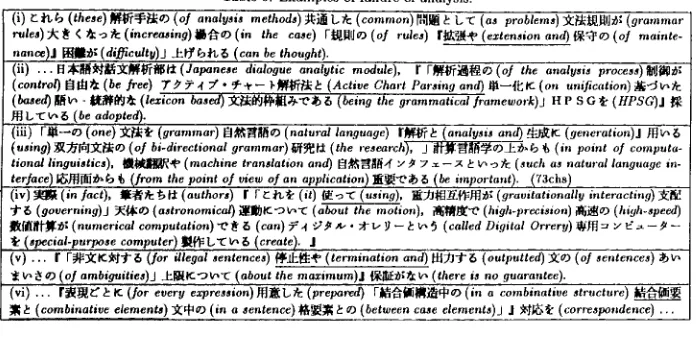
Wc g i v e examples of failure of analysis (Table 6, Fig- urc 9), and indicate st)lutions for t h e m . In Table 6, u n d e r l i n e d p a r t s show the KBs, I- . . . d shows tile wrongly analyzed scope, a n d r . . . j shows the r i g h t scope.
• It is essential ill t h i s m e t h o d to define t h e appro- p r i a t e s i m i l a r i t y between words. T h u s c h a n g i n g the sinlilarity p o i n t s for more detailed groups of parts of speech ( e , g . n o u n s call be d i v i d e d i n t o ilul~lerals~ proper nonns, c o n l m o n nouns, and ac- tion nouns which becomc verbs by the combiua- tion w i t h " ~ - ~ (do)") can i m p r o v e t h e accuracy of the anMysis. For example, t h e e x a m p l e ( i ) in 'Fable 6 may bc analyzed r i g h t l y if the similar- ity p o i n t s between a c t i o n noun "t1~[~ (extension)"
and action noun " t ~ ' f (maintenance)" is greater t h a n t h a t between action noun " t 1 ~ (extension)"
and common noun " ~ 1 ~ ( d i ~ c u l l y ) " .
• Semantic s i m i l a r i t i e s between words are currently calculated only by using B O I l which do n o t con- t a i n technical terms. If tile sinfilarity p o i n t s be- tween technical terms can be g i v e n by t h e s a u r u s , tile accuracy of tile analysis will be i m p r o v e d . E x a m p l e ( i i ) will be analyzed r i g h t l y if greater p o i n t s are given to tile s i m i l a r i t y between " T P
"T 4 7 " . -k 4.-- b ~ f ~ ' ~ ( Actlve Chart Parsing)"
and " l l P S G ( Head-drtve, Phrase Structure G r a m -
i lly the a d d i t i o n a l usage of relatively simple syn- tactic conditions, some sentences which are an- alyzed wrongly by t h i s m e t h o d will be analyzed
rightly. For example, because Japanese modi-
fier/modifyee relations, i n c h n l i n g the relation be- tween a verb and its case frame elements, do not erc~s each other, the m o d i f i e r / m o d i f y e e re- lations in n m m phrases and p r e d i c a t i v e clauses do n o t spread beyond each phrase or clause, except the relation concerning the last b u n s e t s u of t h e m . T h i s condition is not satisfied by the analyzed CS in the example(ill) whose prior noun phrase con- tains no verb related w i t h the case frame e l e m e n t "
~ , ~ " ( g r a m m a r ) " . By t h i s condition it can be~-~- t i m a t e d t h a t only " 1 7 ~ 1 / ~ [ 0 (natural langlage)
MI~ ~ (analysis and)"
o r " ~ i : ~ :(analysis and)"
[image:6.432.39.212.114.248.2]Table 6: Examples of failure of analysis.
(i) r ta.b (these) ~ © (of analysis methods) ~ i ~ L ¢c (common) Pdl~ & L T_ (as problems) ~ l ~ l J ~ : (grammar rules) 9k ~ < ~k-9 ~: (increasing) Jib.a9 (in the case) [-~111.[O (of rules) [~t~-af , (extension and) {~ ,'~a9 (of mainte- .ance)l []~A~$~ ( di.Oieultv) 3 3:=Hr b Sb ~5 (can be thought).
(ii) . . . H;tg~Jt~3~ll~to~t~ (Japanese dialogue analytic module), r V ~ l t y f ~ © (o~ the analysis procesa)~l~r~ (control) I~t ~ ~ (be free) T ~' ~" 4 P" " ~" ~r -- b ~:~£~ )" (Active Chart Parsing and) f f l - - ~ ~ (on unification) ~"~ ~ ~ (based) ~t~W - t l ~ (lexicon based) 3 ~ . t t : ~ t g ~ " C ~b i5 (being the grammatical framework)3 H P S G ~" ( HPSG)J J~ L ~ ~ ~, (be adopted).
(iii) [-~--t9 (one) 3 ~ (grammaO ~1~¢~]~© (natural language) t~lq~ ~ (analysis and) t5~3~2 (generation)J f I J ~ a (using) ~gl5]~3~je~a) (of bi-directional grammar) ~ ? l (the research), 3 i l f ~ f ~ a g A : i ) ~ t 9 ¢~ (in point of computa- tional linguistics), ~ l l ~ l l ~ t ~ (machine translation and) 1 ~ t ~ 4 Y • 7 ~ - :x ~. w-9 ?c (such as natural language in- terlace) l~Jl~J~¢9 ~ (from the point of view of an application} ~.'Oi15~a (be importaut). (73chs)
(iv) ~ (in fact), tll~l~ ~ ~ (authors) ~ r U k'b ~" (it) ~E.9"X: (using), ~ll)'J~ff~l~J~r~: (gravitationally interacting) 3F.~. "j" ~5 (governing)J ~{tgto (astronomical) ~ - g w ' ~ (about the motion), ?~¢I~PJ£~ (high-precision) i l l . a ) (high-speed) I ~ 1 " ~ ~: (numerical computation) ~ ~ t5 (can) ~ 4 ~ ~ x. . ~ t. ~3 -- & ~ 5 (called Digital Orrery) ~ = :/~" ~ --$t --
t
(s~vial-pu,'pase computer)~t.'r
~ ~ (create). J(v) ... f [-~II+3~I~T~ (for illegal sentences) ~3[:~:'~ (termination and) I k l ~ ?5 (outputted) ~ (o) sen'fences) ~bw ~ t~ ~ a) (of ambiguities)3 .]:~t~:'gv~'~ (about the maximum)J ~ r k v. (there is no guarantee).
(vi)
... r ~ ~ (/or every expression) J ~ b t c (prepared) [ - ~ a a ) ( in a combinative structure) ~ _ _ . _ ~~ (combinative elements) 3~r~O (in a sentence) lgh~.~ ~" ¢9 (between case elements)3 J ~ . ~ : (correspondence) ...
i&~&l= 0 2 2 2 2 2 (tctev~lexp*~*au) i ~ L ? : O 0 0 0 0 <pr+~.,tred) 4\XI~'~I~I~*6D g 81 5 2 (ham~mbinltivel~alcture)
Figure 9: An example of failure of analysis.
can be the prior p a r t of the CS. We are plan- ning to do such a correction in the next stage of the syntactic analysis, which analyzes all modi- fier/modifyee relations in a sentence using the CS scopes detected by this m e t h o d .
• in example(iv), the K B in the beginning p a r t of a sentence corresponds to the last CB. T h a t is, a short p a r t of a sentence corresponds to the follow- ing long part. It is very difficult to analyze such an extremely unbalanced CS because this m e t h o d gives a priority to similar CSs. In order to ana- lyze example(iv) the causal relationship between "~1~-9"C (usiug)" and "~tr~'J~z~ (create)" will be necessary.
• Some sentences analyzed incorrectly are too sub- tle even for a h u m a n to find the right CSs. Exam- pie(v) c a n n o t be analyzed rightly without expert knowledge.
• This m e t h o d c a n n o t handle the CSs in which the prior p a r t contains some modifiers a n d the poste- rior p a r t contains nothing corresponding to t h e m (example(vi), Figure 9). For these structures we must think the path extending u p w a r d in a partial matrix, b u t it is impossible by the criteria about word similarities alone.
The CSs such as example(v) and example(vi) can- not be analyzed correctly without semantic informs-
tion. fIowever such expressions are very few in actual text.
5
C o n c l u d i n g R e m a r k s
We have shown t h a t varieties of parallel structures in Japanese sentences can be detected by the m e t h o d explained in this paper. As the result, a long sentence can be reduced into a short one, and the success rate of syntactic analysis of these long sentences will bc- come very high.
There are still some conjunctive expressions which cannot be recognized by the proposed method, and we are tempted to rely on semantic information to get proper analyses for these remaining cases. Semantic information, however, is not so reliable as syntactic information, and we have to make further efforts to find out syntactic r a t h e r than semantic relations in these difficult cases. We think t h a t it is possible. One thing which is certain is t h a t we have to see m a n y more components simultaneously in a wider range of word strings of a loug sentence.
R e f e r e n c e s
[1] M. Nagao, J. Tsujii, N. T a n a k a , M. lshikawa (1983) Conjunctive Phrases in Scientific and Technical Papers a n d Their Analysis (in Japanese). I P S J - WG, NL-36-4.
[2] K. Shudo, K. Yoshimura, K. T s u d a (1986) Co- ordinate S t r u c t u r e s in Japanese Tehuical Sen- tences (in Japanese). 7~'ans.IPS Japan, Vol.27, No.2, pp.183-190.
[3] The National Language Research Institute (1964) Bunrui Goi Hyou (in Japanese). Shu- uei Publishing.
[image:7.432.50.398.36.209.2]