Building a Web-Scale Dependency-Parsed Corpus from Common Crawl
Alexander Panchenko
‡, Eugen Ruppert
‡, Stefano Faralli
†, Simone P. Ponzetto
†, Chris Biemann
‡ ‡University of Hamburg, Department of Informatics, Language Technology Group, Germany†University of Mannheim, School of Business Informatics and Mathematics, Data and Web Science Group, Germany {panchenko,ruppert,biemann}@informatik.uni-hamburg.de
{stefano,simone}@informatik.uni-mannheim.de
Abstract
We present DEPCC, the largest-to-date linguistically analyzed corpus in English including 365 million documents, composed of 252 billion tokens and 7.5 billion of named entity occurrences in 14.3 billion sentences from a web-scale crawl of the COMMONCRAWL project. The sentences are processed with a dependency parser and with a named entity tagger and contain provenance information, enabling various applications ranging from training syntax-based word embeddings to open information extraction and question answering. We built an index of all sentences and their linguistic meta-data enabling quick search across the corpus. We demonstrate the utility of this corpus on the verb similarity task by showing that a distributional model trained on our corpus yields better results than models trained on smaller corpora, like Wikipedia. This distributional model outperforms the state of art models of verb similarity trained on smaller corpora on the SimVerb3500 dataset.
Keywords:text corpus, Web as a corpus, Common Crawl, dependency parsing, verb similarity, distributional semantics
1.
Introduction
Large corpora are essential for the modern data-driven approaches to natural language processing (NLP), espe-cially for unsupervised methods, such as word embed-dings (Mikolov et al., 2013) or open information extrac-tion (Banko et al., 2007) due to the “unreasonable effec-tiveness of big data” (Halevy et al., 2009). However, the size of commonly used text collections in the NLP com-munity, such as BNC1 or Wikipedia is in the range 0.1–3
billion tokens, which potentially limits coverage and per-formance of the developed models. To overcome this lim-itation, larger corpora can be composed of books, e.g. in (Goldberg and Orwant, 2013) a dataset of syntactic n -grams2 was built from the 345 billion token corpus of the Google Books project.3 However, access to books is often restricted, which limits use-cases of book-derived datasets. Another source of large amounts of texts is the Web. Multiple researchers investigated the use of the Web for construction of text corpora, producing resources, such as PUKWAC (Baroni et al., 2009) (2 billion of tokens) and ENCOW16 (Sch¨afer, 2015) (17 billion of tokens), yet the size of these corpora is still at least one order of magni-tude smaller than the web-scale crawls, e.g. CLUEWEB4 and COMMONCRAWL5. On the other hand, directly using the web crawl dumps is problematic for researchers as: (1) the documents are not preprocessed, containing irrelevant information, e.g. HTML markup; (2) big data infrastruc-ture and skills are required; (3) (near)duplicates of pages disbalance the corpus; (4) documents are not linguistically analyzed, thus only shallow models can be used. The men-tioned factors substantially limit the use of web-scale
cor-1
http://www.natcorp.ox.ac.uk 2
http://commondatastorage.googleapis.com/ books/syntactic-ngrams/index.html
3
https://books.google.com 4
http://lemurproject.org/clueweb12 5http://www.commoncrawl.org
pora in natural language processing research and applica-tions.
The objective of this work is to address these issues and
make access to web-scale corpora a commodity by pro-viding a web-scale corpus that is ready for NLP exper-iments as it is linguistically analyzed and cleansed from noisy irrelevant content. Namely, in this paper, we present a technology for constructing of linguistically analyzed cor-pora from the Web and release DEPCC, the largest-to-date dependency-parsed corpus of English texts.
The COMMON CRAWL project regularly produces web-scale crawls featuring a substantial fraction of all public web pages. For instance, as of October 2017, the estimated number of pages on the Web is 47 billion6, while the
cor-responding crawl contains over 3 billion pages. To put this number into perspective, according to the same source, the indexed Web contains about 5 billion pages.
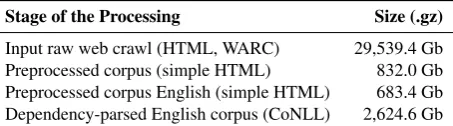
COMMON CRAWL provides the data in the Web ARChive (WARC) format. Each crawl is provided in the raw form features full HTML pages with metadata or in the form of preprocessed archives containing texts (WET). The WET archives contain extracted plaintext from the raw crawls. For instance, the 29.5 Tb raw crawl archive (cf. Table 2) has a corresponding 4.8 Tb WET version with texts. The preprocessing used for producing the WET archives is lim-ited to removal of HTML tags. After a manual check, we also noticed that in WET archives (1) some documents still contain HTML markup; (2) the archives contain document duplicates; (3) documents are written in various languages making it difficult to train language-specific linguistic mod-els. Finally, most importantly, the WET dumps are not lin-guistically analyzed, which significantly limits their utility for language processing applications.
In this work, we address these limitations by constructing a text corpus from COMMONCRAWL, which is filtered from irrelevant and duplicate documents and is linguistically
an-6http://www.worldwidewebsize.com
WaCkypedia Wikipedia PukWaC GigaWord ENCOW16 ClueWeb12 Syn.Ngrams DEPCC
Tokens (billions) 0.80 2.90 1.91 1.76 16.82 N/A 345.00 251.92
Documents (millions) 1.10 5.47 5.69 4.11 9.22 733.02 3.50 364.80
Type Encyclop. Encyclop. Web News Web Web Books Web
Source texts Yes Yes Yes Yes Yes Yes No Yes
Preprocessing Yes No Yes No Yes No No Yes
NER No No No No Yes No No Yes
[image:2.595.56.547.71.168.2]Dependency-parsed Yes No Yes No Yes No Yes Yes
Table 1: Comparison of existing large text corpora for English with the DEPCC corpus.
alyzed. Namely, the contributions of this paper are the fol-lowing:
1. We present a methodology for the creation of the text corpus from the web-scale crawls of COMMON CRAWL.
2. We present asoftwareimplementing the methodology in a scalable way using the MapReduce framework.
3. We present the largest-to-datedependency parsed cor-pus of English texts obtained using the developed methodology, also featuringnamed entity tags. 4. We show the utility of the web-scale corpora on the
verb similaritytask by outperforming the state of the art on the SimVerb3500 dataset (Gerz et al., 2016).
The corpus and the software tools are available online.7
Namely, the corpus can be directly used without the need to download it on the Amazon S3 distributed file system, cf. Section 3.7.8 The software tools used to build the cor-pus are distributed under an open source license. The terms of use of the corpus are described in Section 4.
2.
Related Work
2.1.
Large Scale Text Collections
In Table 1 we compare the DEPCC corpus to seven existing large-scale English corpora, described below.
WACKYPEDIA(Baroni et al., 2009) is a parsed version of English Wikipedia as of 2009. The articles are part-of-speech tagged with the TreeTagger (Schmid, 1994) and de-pendency parsed with the Malt parser (Nivre et al., 2007). Similarly to our corpus, the results are presented in the CoNLL format.9The 2017 version of WIKIPEDIAcontains
three times more tokens, compared to the version of 2009, yet the there are no distributions of linguistically analyzed recent dumps. PUKWAC is a dependency-parsed version of theUKWAC corpus (Baroni et al., 2009), which is pro-cessed in the same way as the WACKYPEDIAcorpus. GIGAWORD (Parker et al., 2011) is a large corpus of newswire, which is not dependency parsed. The CLUEWEB12 is a corpus similar to the raw COMMON CRAWL corpus: it contains archives of linguistically un-processed web pages.
7
https://www.inf.uni-hamburg.de/en/inst/ ab/lt/resources/data/depcc.html
8
https://commoncrawl.s3.amazonaws.com/ contrib/depcc/CC-MAIN-2016-07/index.html 9http://www.universaldependencies.org/
format.html
Stage of the Processing Size (.gz)
Input raw web crawl (HTML, WARC) 29,539.4 Gb Preprocessed corpus (simple HTML) 832.0 Gb Preprocessed corpus English (simple HTML) 683.4 Gb Dependency-parsed English corpus (CoNLL) 2,624.6 Gb
Table 2: Various stages of development of the corpus based on the COMMONCRAWL2016-07 web crawl dump.
The authors of the GOOGLE SYNTACTIC NGRAMS cor-pus (Goldberg and Orwant, 2013) parsed a huge collec-tion of books and released a dataset of syntactic depen-dencies. However, the source texts are not shared due to copyright restrictions, which limits potential use-cases of this resource.
Finally, ENCOW16 (Sch¨afer, 2015) is a large-scale web corpus, which is arguably the most similar one to DEPCC. The authors also rely on the Malt parser and perform named entity tagging. However, this corpus contains roughly 15 times less tokens than DEPCC.
2.2.
Common Crawl as a Corpus
Kolias et al. (2014) present an exploratory study of one of the early versions of the COMMON CRAWL. The authors provide various descriptive statistics of the dataset regard-ing language distribution, formats of the documents, etc.
COMMONCRAWLwas used construct a large-scale Finnish Parsebank consisting of 1.5 billion tokens in 116 million sentences (Laippala and Ginter, 2014). The texts were mor-phologically and syntactically analyzed. In addition, dis-tributional vector space representations of the words were obtained using the word2vec toolkit (Mikolov et al., 2013). The resources were made available under an open license.
GloVe (Pennington et al., 2014) is an unsupervised model for learning distributional word representations similar to word2vec. The authors distribute10two models trained on the English part of a COMMON CRAWL corpus (compris-ing respectively 42 and 820 billion of tokens), which are often used to build neural NLP systems, such as (Tsuboi, 2014). The models were trained on the COMMONCRAWL documents texts tokenized with the Stanford tokenizer. In addition, the smaller training corpus was lowercased.
[image:2.595.310.537.208.271.2]DepCC:Dependency
ParsedCorpus Preprocessing: C4Corpus (Apache Hadoop)
CrawlingWebPages: CCBot (Apache Nutch)
LinguisticAnalysis:
lefex (Apache Hadoop)
WARC web crawls Filtered preprocessed documents
§3.1 §3.2 §3.3
Comp.ofDistributionalModel: JoBimText (Apache Spark)
§5.2
TermVectors,
DistributionalThesaurus
POSTagging(OpenNLP) Lemmatization(Stanford) NamedEntityRecognition(Stanford)
Dep.Parsing(Malt + collapsing)
[image:3.595.65.540.68.159.2]CrawlingWebPages: CCBot (Apache Nutch) TheWeb
Figure 1: Outline of the corpus construction approach and experiments described in the paper.
3.
Building a Web-Scale Dependency-Parsed
Corpus in English from Common Crawl
Figure 1 shows how a linguistically analyzed corpus is built from the Web. First, web pages are downloaded by the web crawler of COMMONCRAWL, called CCBot. Second, preprocessing, involving elimination of duplicates and lan-guage detection, is performed using the C4Corpus tool. Fi-nally, we perform linguistic analysis of the corpus and save the results in the CoNLL format (cf. Section 3.4.).
3.1.
Input Web Crawl: the Common Crawl
The DEPCC corpus is based on the crawl of February 201611containing more than 1.73 billion URLs. The COM -MON CRAWL URL index for this crawl is available on-line12, while the original files are located in the “common-crawl” bucket on the S3 distributed file system.13 As sum-marized in Table 2, the total size of the compressed HTML WARC files is about 30 Tb.
3.2.
Preprocessing of Texts: the C4Corpus Tool
The raw corpus was processed with the C4Corpus tool (Habernal et al., 2016) and is available on the dis-tributed cloud-based file system Amazon S3.14 The tool
performs preprocessing of the raw corpus, in five phases:
1. Language detection, license detection, and removal of boilerplate page elements, such as menus;
2. “Exact match” document de-duplication;
3. Detecting near duplicate documents;
4. Removing near duplicate documents;
5. Grouping the final corpus by language and license.
The resulting output is a gzip-compressed corpus with a total size of 0.83 Tb (cf. Table 2). For further processing, we selected only English texts with the total size of 0.68 Tb, based on the language detection in the first phase. Note that we use all texts written in English, not only those published under the CC-BY license.
11
http://commoncrawl.org/2016/02/ 12
http://index.commoncrawl.org/ CC-MAIN-2016-07
13
s3://commoncrawl/crawl-data/ CC-MAIN-2016-07
14s3://commoncrawl/contrib/c4corpus/
CC-MAIN-2016-07
3.3.
Linguistic Analysis of Texts
Linguistic analysis consists of four stages presented in Fig-ure 1 and is implemented using the Apache Hadoop frame-work15 for parallelization and the Apache UIMA frame-work16for integration of linguistic analysers via the DKPro Core library (Eckart de Castilho and Gurevych, 2014).17
3.3.1. POS Tagging and Lemmatization
For morphological analysis of texts, we used OpenNLP part-of-speech tagger and Stanford lemmatizer.
3.3.2. Named Entity Recognition
To detect occurrences of persons, locations, and organiza-tions we use the Stanford NER tool (Finkel et al., 2005).18 Overall, 7.48 billion occurrences of named entities were identified in the 251.92 billion tokens output corpus.
3.3.3. Dependency Parsing
To make large-scale parsing of texts possible, a parser needs to be not only reasonably accurate but also fast. Unfortu-nately, the most accurate parsers, such as Stanford parser based on the PCFG grammar (De Marneffe et al., 2006), according to our experiments, take up to 60 minutes to pro-cess 1 Mb of text on a single core, which was prohibitively slow for our use-case (details of the hardware configura-tion are available in Secconfigura-tion 3.5.). We tested all versions of the Stanford, Malt (Hall et al., 2010), and Mate (Balles-teros and Bohnet, 2014) parsers for English available via the DKPro Core framework. To dependency-parse texts, we selected the Malt parser, due to an optimal ratio of effi-ciency and effectiveness (parsing of 1 Mb of text per core in 1–4 minutes). This parser was successfully used in the past for the construction of linguistically analyzed web corpora, such as PUKWAC (Baroni et al., 2009) and ENCOW16 (Sch¨afer, 2015). While more accurate parsers exist, e.g. the Stanford parser, according to our experiments, even the neural-based version of this parser is substantially slower. On the other hand, as shown by Chen and Manning (2014), the performance of the Malt parser is only about 1.5–2.5 points below the neural-based Stanford parser. In particu-lar, we used the stack model based on the projective transi-tion system with the Malt.19
15
https://hadoop.apache.org 16
https://uima.apache.org
17https://github.com/uhh-lt/lefex
18stanfordnlp-model-ner-en-all.3class.distsim.crf, 20.04.2015 19The used model is
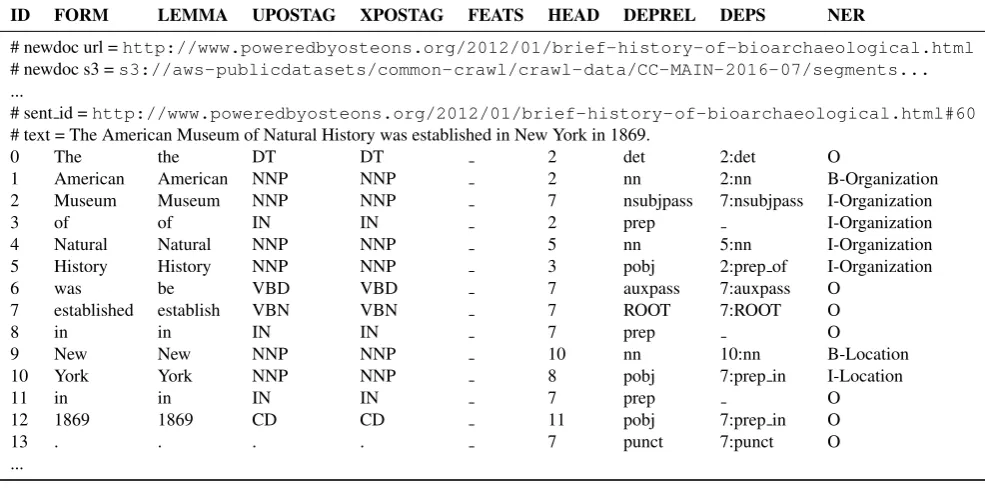
ID FORM LEMMA UPOSTAG XPOSTAG FEATS HEAD DEPREL DEPS NER
# newdoc url =http://www.poweredbyosteons.org/2012/01/brief-history-of-bioarchaeological.html
# newdoc s3 =s3://aws-publicdatasets/common-crawl/crawl-data/CC-MAIN-2016-07/segments...
...
# sent id =http://www.poweredbyosteons.org/2012/01/brief-history-of-bioarchaeological.html#60
# text = The American Museum of Natural History was established in New York in 1869.
0 The the DT DT 2 det 2:det O
1 American American NNP NNP 2 nn 2:nn B-Organization
2 Museum Museum NNP NNP 7 nsubjpass 7:nsubjpass I-Organization
3 of of IN IN 2 prep I-Organization
4 Natural Natural NNP NNP 5 nn 5:nn I-Organization
5 History History NNP NNP 3 pobj 2:prep of I-Organization
6 was be VBD VBD 7 auxpass 7:auxpass O
7 established establish VBN VBN 7 ROOT 7:ROOT O
8 in in IN IN 7 prep O
9 New New NNP NNP 10 nn 10:nn B-Location
10 York York NNP NNP 8 pobj 7:prep in I-Location
11 in in IN IN 7 prep O
12 1869 1869 CD CD 11 pobj 7:prep in O
13 . . . . 7 punct 7:punct O
[image:4.595.53.546.70.314.2]...
Table 3: An excerpt from an output document in the CoNLL format: a document header plus a sentence are shown. Here, “ID” is a word index, “FORM” is word form, “LEMMA” is lemma or stem of word form, “UPOSTAG” is universal part-of-speech tag, “XPOSTAG” is language-specific part-of-part-of-speech tag, “FEATS” is a list of morphological features, “HEAD” is head of the current word, which is either a value of ID or zero, “DEPREL” is universal dependency relation to the “HEAD”, “DEPS” is enhanced dependency graph in the form of head-deprel pairs, and “NER” is named entity tag.
The text downloaded from the Web has highly variable quality due to the inherent nature of user-generated content, but also unavoidable pre-processing errors, e.g. during the cleanup of incomplete HTML markup. To avoid crashes of the dependency parser caused by excessively long sen-tences, we filter all sentences longer than 50 tokens. Our manual analysis revealed that there are hardly any well-formed sentences of 50 tokens or more in this corpus.
3.3.4. Collapsing of Syntactic Dependencies
Collapsed and enhanced dependencies, such as the Stan-ford Dependencies (De Marneffe et al., 2006)20can be use-ful in various NLP tasks as they provide a more compact syntactic trees of a sentence, compared to the original de-pendency tree, thus reducing sparsity of syntax-aware rep-resentations.
To compensate the lack of the dependency enhancement in Malt, we use the system of (Ruppert et al., 2015)21 to perform collapsing and enhancing of dependencies. The authors of the toolkit shown that (1) using the collapsed dependency representations substantially improves quality of construction of distributional thesauri based on sparse syntactic features; (2) the performance of the Stanford en-hanced dependencies and the collapsed Malt dependencies on the same task are comparable. The advantage of using Malt with an external collapsing with respect to the Stan-ford parser, in our case, is speed.
Note that, both original and enhanced versions are saved
20
https://nlp.stanford.edu/software/ stanford-dependencies.shtml
21http://jobimtext.org/
dependency-collapsing
respectively into the columns “DEPREL” and “DEPS” as illustrated in Table 3.
3.4.
Format of the Output Documents
The documents are encoded in the CoNLL format as illus-trated in Table 3. The corpus is released as a collection of 19,101 gzip-compressed files.
Each file is relatively small (around 150Mb) and is easy to download and work with locally during the development phase. However, to work with the entire corpus we recom-mend using some kind of parallelism, e.g. based on mul-tiprocessing/multithreading or frameworks for distributed computing, such as Apache Hadoop/Spark/Flink.
3.5.
Computational Settings
The linguistic analysis was performed on an Apache Hadoop 2.6 cluster using 341 containers each provided with one Intel Xeon CPU [email protected] and 8Gb of RAM. The computational cluster consisted of 16 nodes plus a single head node. The job used 2.75 TB out of 2.82 TB available RAM and 356 out of 640 available Vcores.
3.6.
Running Time
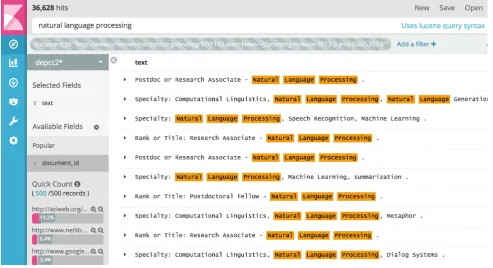
Figure 2: Interactive graphical user interface providing a full text search over 14.3 billion of sentences in the DEPCC corpus and their linguistic meta-data. A user can search for sentences containing specified keywords, named entities or syntactic dependencies.
3.7.
Using the Corpus in the Amazon Cloud
The COMMONCRAWLdatasets are hosted in the Amazon computing cloud platform.22 As mentioned in the intro-duction, our corpus is also was made directly available on Amazon S3 distributed file system in theus-east-1 re-gion (US East, North Virginia) as a part of the COMMON CRAWL contributed datasets. This means thatyou do not need to download the corpusto be able to work with it. In-stead, you can run the jobs directly against the respective bucket on the Amazon S3 file system which contains the DEPCC corpus. For optimal performance, you need to run instances which perform computations with the corpus in-side the Amazon cloud (e.g. using the EC223 or EMR24
services) in theus-east-1region.
3.8.
Index of the Corpus
An access to a full-text search of all 14.3 billion sentences and their dependency relations of the DEPCC corpus is available upon request. This service is free and aims at facilitating access to the corpus for use-cases that do not require download of the entire collection of documents. Us-ing the index, users can quickly retrieve sentences match-ing various lmatch-inguistic criteria (usmatch-ing the Lucene query syn-tax25), e.g. presence of keyword in a sentence, presence of
a specific named entity in a sentence, presence of a specific dependency relation, provenance of a document from a spe-cific web domain, etc. Each retrieved sentence contains all
22
https://aws.amazon.com 23https://aws.amazon.com/ec2
24https://aws.amazon.com/emr
25https://www.elastic.co/guide/en/kibana/
current/lucene-query.html
the meta-data depicted in Table 3, such as the provenance of the sentence.
The corpus can be queried via a RESTful API based on the ElasticSearch search engine26 or via a web-based
graphi-cal user interface based on Kibana27graphical interface to
ElasticSearch. Results of a sample query visualized using Kibana are presented in Figure 2.
We do not distribute the index itself due to its huge size. However, users can re-create the index using the open source software provided as a part of the JoBimText pack-age28 from the the CoNLL files. While these compressed
CoNLL files occupy only around 2.6 Tb, the size of the full index is about 15 Tb or more, depending on the repli-cation factor of ElasticSearch. For this reason, for most practical applications, re-creation of the index is faster and more straightforward than download of a pre-computed in-dex and its subsequent deployment. Besides, some major versions of the ElasticSeach indices are not compatible be-tween one another.
4.
Terms of Use
The DEPCC corpus is based on a COMMON CRAWL dataset. We do not reserve any copyrights as the authors of this derivative resource, but while using the DEPCC cor-pus you need to make sure to respect the Terms of Use of the original COMMONCRAWLdataset it is based on.29
26https://www.elastic.co
27
https://www.elastic.co/products/kibana 28
Model SimVerb3500 SimVerb3000 SimVerb500 SimLex222
Wikipedia+ukWaC+BNC: Count SVD 500-dim (Baroni et al., 2014) 0.196 0.186 0.259 0.200 PolyglotWikipedia: SGNS BOW 300-dim (Gerz et al., 2016) 0.274 0.333 0.265 0.328
8B: SGNS BOW 500-dim (Gerz et al., 2016) 0.348 0.350 0.378 0.307
8B: SGNS DEPS 500-dim (Gerz et al., 2016) 0.356 0.351 0.389 0.385
PolyglotWikipedia:SGNS DEPS 300-dim (Gerz et al., 2016) 0.313 0.304 0.401 0.390
Wikipedia: LMI DEPS wpf-1000 fpw-2000 0.283 0.284 0.271 0.268
Wikipedia+ukWac+GigaWord: LMI DEPS wpf-1000 fpw-2000 0.376 0.368 0.419 0.183
DEPCC: LMI DEPS wpf-1000 fpw-1000 0.400 0.387 0.477 0.285
DEPCC: LMI DEPS wpf-1000 fpw-2000 0.404 0.392 0.477 0.292
DEPCC: LMI DEPS wpf-2000 fpw-2000 0.399 0.388 0.459 0.268
[image:6.595.50.552.70.216.2]DEPCC: LMI DEPS wpf-5000 fpw-5000 0.382 0.372 0.442 0.226
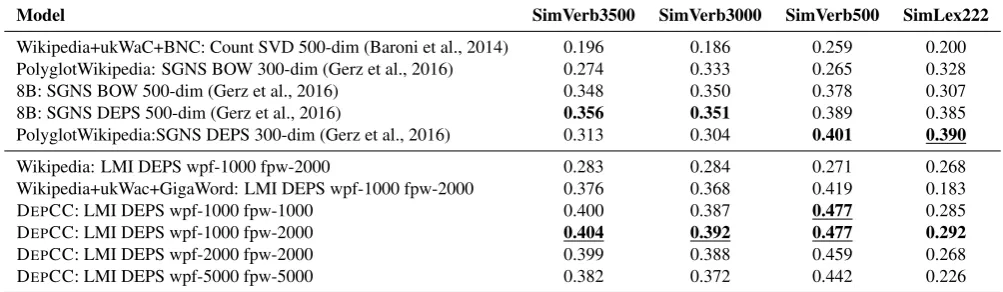
Table 4: Evaluation results on the verb semantic similarity task. Sparse count-based distributional models (LMI) trained on the DEPCC corpus are compared to models trained on the smaller corpora, such as Wikipedia and a combination of Wikipedia, UKWAC, and GIGAWORD. Rows and columns of each LMI-weighted distributional model are pruned as in (Biemann and Riedl, 2013): the wpf indicates the number of words per feature, and thefpwindicates the number of features per word. We also compare our models to the best verb similarity models from the state of the art. Here the “BOW” denotes models based on bag-of-word features, while “DEPS” denotes syntax-based models. SimVerb3000 and SimVerb500 are train and test partitions of the SimVerb3500, while the SimLex222 dataset is composed of verb pairs from the SimLex999 dataset. The best results in a section are boldfaced, the best results overall are underlined.
5.
Evaluation: Verb Similarity Task
As an example of potential use-case, we demonstrate the utility of the corpus and the overall methodology on a verb similarity task.
This task structurally is the same as the word similarity tasks based on such datasets as SimLex-999 (Hill et al., 2015). Namely, a system is given two words as input and needs to predict a scalar value which characterizes semantic similarity of the input words. While in the word similarity task the input pairs are words of various parts of speeches (nouns, adjectives, etc.), in this paper we only consider verb pairs.
We chose this task since verb meaning is largely defined by the meaning of its arguments (Fillmore, 1982), there-fore dependency-based features seem relevant for building distributional representations of verbs.
5.1.
Datasets: SimVerb3500 and SimLex222
Recently a new challenging dataset for verb relatedness was introduced, called SimVerb3500 (Gerz et al., 2016). The dataset is composed of 3500 pairs of verbs and is split into the train and test parts, called respectively SimVerb3000 and SimVerb500. In addition to this benchmark, in our experiments, we also test the performance of the models on the SimLex222, which is the verb part of SimLex999 dataset (Hill et al., 2015) composed of 222 verb pairs. His-torically, the SimVerb3500 dataset was created after the SimLex222, addressing its shortcomings related to the verb coverage. As in our experiments, we do not use the dataset SimVerb3000 for training, and to be consistent with the re-sults reported in (Gerz et al., 2016) we report performance of the tested verb similarity models on all four datasets: SimVerb3500/3000/500, and SimLex222.
5.2.
A Distributional Model for Verb Similarity
We compute syntactic count-based distributional represen-tations of words using the JoBimText framework (Biemann
and Riedl, 2013).30 The sparse vectors are weighted using
the LMI weighting schema and converted to unit length. In our experiments, we varied also the maximum number of salient features per word (fpw) and words per feature (wpf). Conceptually, each row and column of the sparse term-feature matrix is pruned such that at mostwpf non-zero elements in a row and fpwelements in a column are retained.
5.3.
Discussion of Results
Table 4 presents results of the experiments.
5.3.1. Baselines
The top part of the table lists five top systems in various categories (Gerz et al., 2016), representing the current state-of-art result on this dataset. Namely, the Count based SVD system is from (Baroni et al., 2014). In the original pa-per, two corpora were used: the “8B” is a 8 billion to-kens corpus produced by a script in the word2vec toolkit, which gathers the texts from various sources (Mikolov et al., 2013) and the “PolyglotWikipedia” is the English Poly-glot Wikipedia corpus consisting of 1.9 billion tokens (Al-Rfou et al., 2013).
We use the baselines in the top of the table to indicate the best results on the dataset: our goal is to show the impact of the large corpora on performance and not to present a new model for verb similarity.
5.3.2. Impact of the Corpora on Performance
The bottom part of the table presents the distributional model described in Section 5.2. trained on the corpora of various sizes. Note, that the preprocessing steps for each corpus are exactly the same as for the DEPCC corpus. We observe that the smallest corpus (Wikipedia) yields the worst results. While the scores go up on the larger corpus, which is a combination of Wikipedia with two
other corpora, we can reach the even better result by train-ing the model (with exactly the same parameters) on the dependency-based features extracted from the full DEPCC corpus. This model substantially outperforms also the prior state of the art models, e.g. (Baroni et al., 2014) and (Gerz et al., 2016), on the SimVerb dataset, through the sheer size of the input corpus, as previously shown, e.g. (Banko and Brill, 2001) inter alia.
5.3.3. Differences in Performance for Test/Train Sets
For the SimVerb dataset, the absolute performance on the test part (SimVerb500) is higher than the absolute perfor-mance on the train part (SimVerb300) for almost all mod-els, including the baselines. We attribute this to a specific split of the data in the dataset: our models do not use the training data to learn verb representations.
6.
Conclusion
In this paper, we introduced a new web-scale corpus of English texts extracted from the COMMON CRAWL, the largest openly available linguistically analyzed corpus to date, according to the best of our knowledge.
The documents were de-duplicated and linguistically pro-cessed with part-of-speech and named entity taggers and a dependency parser, making it possible to easily start large-scale experiments with syntax-aware models without the need of long and resource-intensive preprocessing. We built an index of sentences and their linguistic meta-data accessible though an interactive web-based search interface or via a RESTful API.
In our experiments on the verb similarity task, a distribu-tional model trained on the new corpus outperformed mod-els trained on the smaller corpora, like Wikipedia, reaching new state of the art of verb similarity on the SimVerb3500 dataset. The corpus can be used in various contexts, rang-ing from trainrang-ing of syntax-based word embeddrang-ings (Levy and Goldberg, 2014) to unsupervised induction of word senses (Biemann et al., 2018) and frame structures (Kawa-hara et al., 2014). A promising direction of future work is using the proposed technology for building corpora in mul-tiple languages.
7.
Acknowledgements
This research was supported by the Deutsche Forschungs-gemeinschaft (DFG) under the project ”Joining Ontologies and Semantics Induced from Text” (JOIN-T). We are grate-ful to Amazon for providing required computational re-sources though the “AWS Cloud Credits for Research” pro-gram. Finally, we thank Kiril Gashteovski and three anony-mous reviewers for their most helpful feedback.
8.
Bibliographical References
Ballesteros, M. and Bohnet, B. (2014). Automatic fea-ture selection for agenda-based dependency parsing. In
Proceedings of the 25th International Conference on Computational Linguistics: Technical Papers (COL-ING’2014), pages 794–805, Dublin, Ireland.
Banko, M. and Brill, E. (2001). Scaling to very very large corpora for natural language disambiguation. In
Proceedings of 39th Annual Meeting of the Association
for Computational Linguistics, pages 26–33, Toulouse, France. Association for Computational Linguistics. Banko, M., Cafarella, M. J., Soderland, S., Broadhead, M.,
and Etzioni, O. (2007). Open information extraction from the web. InProceedings of the 20th International Joint Conference on Artificial Intelligence (IJCAI’07), volume 7, pages 2670–2676, Hyderabad, India. AAAI Press.
Baroni, M., Dinu, G., and Kruszewski, G. (2014). Don’t count, predict! a systematic comparison of context-counting vs. context-predicting semantic vectors. In Pro-ceedings of the 52nd Annual Meeting of the Association for Computational Linguistics (Volume 1: Long Papers), pages 238–247, Baltimore, MD, USA. Association for Computational Linguistics.
Biemann, C. and Riedl, M. (2013). Text: now in 2d! a framework for lexical expansion with contextual similar-ity.Journal of Language Modelling, 1(1):55–95. Biemann, C., Faralli, S., Panchenko, A., and Ponzetto, S. P.
(2018). A framework for enriching lexical semantic re-sources with distributional semantics. Natural Language Engineering, pages 1–48.
Chen, D. and Manning, C. D. (2014). A fast and accu-rate dependency parser using neural networks. In Pro-ceedings of the 2014 Conference on Empirical Methods in Natural Language Processing (EMNLP), pages 740– 750, Dohar, Qatar. Association for Computational Lin-guistics.
De Marneffe, M.-C., MacCartney, B., and Manning, C. D. (2006). Generating typed dependency parses from phrase structure parses. In Proceedings of Conference on Language Resources and Evaluation (LREC’2006), pages 449–454. Genova, Italy, ELRA.
Eckart de Castilho, R. and Gurevych, I. (2014). A broad-coverage collection of portable nlp components for building shareable analysis pipelines. InProceedings of the Workshop on Open Infrastructures and Analysis Frameworks for HLT, pages 1–11, Dublin, Ireland. As-sociation for Computational Linguistics and Dublin City University.
Fillmore, C. J., (1982). Frame semantics, pages 111–137. Hanshin Publishing Co., Seoul, South Korea.
Finkel, J. R., Grenager, T., and Manning, C. (2005). Incor-porating Non-local Information into Information Extrac-tion Systems by Gibbs Sampling. InProceedings of the 43rd Annual Meeting on Association for Computational Linguistics, pages 363–370. Association for Computa-tional Linguistics.
Halevy, A., Norvig, P., and Pereira, F. (2009). The unrea-sonable effectiveness of data. IEEE Intelligent Systems, 24(2):8–12.
Hall, J., Nilsson, J., and Nivre, J. (2010). Single malt or blended? a study in multilingual parser optimization. In
Trends in Parsing Technology, pages 19–33. Springer. Kawahara, D., Peterson, D. W., and Palmer, M. (2014).
Bal-timore, MD, USA. Association for Computational Lin-guistics.
Kolias, V., Anagnostopoulos, I., and Kayafas, E. (2014). Exploratory analysis of a terabyte scale web corpus.
arXiv preprint arXiv:1409.5443.
Levy, O. and Goldberg, Y. (2014). Dependency-based word embeddings. In Proceedings of the 52nd Annual Meeting of the Association for Computational Linguis-tics (Volume 2: Short Papers), pages 302–308, Balti-more, MD, USA. Association for Computational Lin-guistics.
Mikolov, T., Sutskever, I., Chen, K., Corrado, G. S., and Dean, J. (2013). Distributed Representations of Words and Phrases and their Compositionality. InAdvances in Neural Information Processing Systems 26, pages 3111– 3119. Curran Associates, Inc., Harrahs and Harveys, NV, USA.
Nivre, J., Hall, J., Nilsson, J., Chanev, A., Eryigit, G., K¨ubler, S., Marinov, S., and Marsi, E. (2007). Malt-parser: A language-independent system for data-driven dependency parsing. Natural Language Engineering, 13(02):95–135.
Pennington, J., Socher, R., and Manning, C. D. (2014). Glove: Global vectors for word representation. In Pro-ceedings of the 2014 Conference on Empirical Methods in Natural Language Processing (EMNLP), pages 1532– 1543, Doha, Qatar. Association for Computational Lin-guistics.
Ruppert, E., Klesy, J., Riedl, M., and Biemann, C. (2015). Rule-based Dependency Parse Collapsing and Propaga-tion for German and English. InProceedings of GSCL, pages 58–66, Essen, Germany.
Schmid, H. (1994). Probabilistic part-of-speech tagging using decision trees. In International Conference on New Methods in Language Processing, pages 44–49, Manchester, UK.
Tsuboi, Y. (2014). Neural networks leverage corpus-wide information for part-of-speech tagging. InProceedings of the 2014 Conference on Empirical Methods in Natural Language Processing (EMNLP), pages 938–950, Doha, Qatar. Association for Computational Linguistics.
9.
Language Resource References
Al-Rfou, R., Perozzi, B., and Skiena, S. (2013). Poly-glot: Distributed word representations for multilingual nlp. In Proceedings of the Seventeenth Conference on Computational Natural Language Learning, pages 183– 192, Sofia, Bulgaria. Association for Computational Lin-guistics.
Baroni, M., Bernardini, S., Ferraresi, A., and Zanchetta, E. (2009). The wacky wide web: a collection of very large linguistically processed web-crawled corpora. Language resources and evaluation, 43(3):209–226.
Gerz, D., Vuli´c, I., Hill, F., Reichart, R., and Korhonen, A. (2016). Simverb-3500: A large-scale evaluation set of verb similarity. In Proceedings of the 2016 Confer-ence on Empirical Methods in Natural Language Pro-cessing, pages 2173–2182, Austin, TX, USA. Associa-tion for ComputaAssocia-tional Linguistics.
Goldberg, Y. and Orwant, J. (2013). A dataset of syntactic-ngrams over time from a very large corpus of english books. In Proceedings of *SEM in conjunction with NAACL-HLT, pages 241–247, Portland, OR, USA. As-sociation for Computational Linguistics.
Habernal, I., Zayed, O., and Gurevych, I. (2016). C4Corpus: Multilingual web-size corpus with free li-cense. InProceedings of the Language Resources and Evaluation Conference (LREC’2016), pages 914–922, Portoroˇz, Slovenia. ELRA.
Hill, F., Reichart, R., and Korhonen, A. (2015). Simlex-999: Evaluating semantic models with genuine similarity estimation. Computational Linguistics, 41(4):665–695. Laippala, V. and Ginter, F. (2014). Syntactic N-gram
col-lection from a large-scale corpus of internet Finnish. In
Human Language Technologies-The Baltic Perspective: Proceedings of the Sixth International Conference Baltic HLT 2014, volume 268, page 184, Kaunas, Lithuania. IOS Press.