A n A p p r o a c h to t h e A u t o m a t i c A c q u i s i t i o n o f P h o n o t a c t i c
C o n s t r a i n t s
A n j a B e l z
School of Cognitive and C o m p u t i n g Sciences University of Sussex
B r i g h t o n BN1 9QH, U K anj ab©cogs, susx. ac. uk
Abstract
This paper describes a formal approach and a practical learning method for automatically ac- quiring phonotactic constraints encoded as fi- nite automata. It is proposed that the use of different classes of syllables with class-specific intra-syl]abic phonotactics results in a more ac- curate hypothesis of a language's phonological g r a m m a r than the single syllable class tradi- tionally used. Intra-syllabic constraints are en- coded as acyclic finite automata with input al- phabets of phonemic symbols. These automata in turn form the transitions in cyclic finite automata that encode the inter-syllabic con- straints of word-level phonology. A genetic al- gorithm is used to automatically construct finite automata from training sets of symbol strings. Results are reported for a set of G e r m a n syl- lables and a set of Russian bisyllabic feminine
n o u n s .
1 B a c k g r o u n d
1.1 P h o n o t a c t i c D e s c r i p t i o n
In recent years, phonology - - partly under the influence of computational models - - has moved away from procedural, rule-based approaches towards explicitly declarative statements of the constraints that hold on possible phonological forms. Such statements form sets of constraints that apply at a given level of description, and ill-formedness is often defined as constraint vi- olation.
Phonotactic descriptions state the constraints that hold for possible sequences of phonetic or phonemic features or symbols, usually at the level of the syllable (more rarely for onset, peak and coda separately). Phonological words are defined as sequences of at least one syllable.
A phonotactic description is typically thought
to be adequate only if it generalises beyond the set of phonological forms that exist in a lan- guage to a superset of possible forms that also includes forms that could exist but do not. This distinction between non-existent but possible forms on the one hand, and non-existent and impossible forms on the other, is often described in terms of accidental vs. systematic gaps (e.g. Carson-Berndsen (1993), Gibbon (1991), and originally Chomsky (1964)).
Carson-Berndsen (1993) lists five encoding schemes for phonotactic description at the sylla- ble level found in the literature:
templates
that merely state the number of consonants permit- ted in the onset and coda,distribution matrices
with a separate matrix for each type of conso- nant duster,enhanced templates
which add the notion of phoneme classes,feature-based phono-
tactic networks
using feature bundles, natu- ral classes, variables, defaults and underspeci- fication, andphrase-structure rules
which have the same (potential) representative power as feature-based phonotactic networks.In the approach presented here, finite state automata (FSA) encoding is preferred over these other schemes, since they can an equiv- alently be represented by FSAs - - what is de- scribed is always a regular language - - in the most general sense of the term, and since finite- state machinery in itself does not have the dis- advantage of necessarily overgenerating forms (as do templates), or of excluding the possibil- ity of multi-tier description (as do most of the above).
speech recognition, but are usually constructed in a painstaking manual process. The aim of the research presented here is to develop a completely a u t o m a t i c m e t h o d for constructing phonotactic descriptions. This requires a for- mal theoretical approach to the task as well as a practical a u t o m a t i c inference m e t h o d . The for- mer is outlined in the following section, while Section 3 describes the genetic algorithm devel- oped for the latter. T h e remainder of this sec- tion briefly summarises the standard FSA no- tation and definitions used in this paper as well as some n o n - s t a n d a r d usages.
Following (Hopcroft and Ullman, 1979, p.17), • a deterministic finite-state a u t o m a t o n A is a 5- tuple (S, I , ~, so, F ) , in which S is a finite set of states, I is a finite input a alphabet, ~ is the state transition function mapping S x I to S, so E S is the initial state, and F C S is the set of final states. For every state s E S and every symbol a E I, ~(s, a) is a state. Ordinarily, the S-notation (sometimes ~) is also used for the input of strings x E I*, such that ~ maps S × I* to S. The language L accepted by A, denoted
L(A), is {xl~(s0 ,x) E F } .
The transition function ~(s, a) is often repre- sented as a 2-dimensional state transition ma- trix, and (in contrast to most related research which uses sets of production rules of the form Sl - - as2) this matrix is used to represent FSAs in the learning m e t h o d described in Section 3.
The term FSA is taken to refer to n-level transducers, where the input alphabet consists either of individual symbols a E I or of strings x E I*. Although only experiments for l-level transducers with labels a E I have been carried out so far, the approach will be extended to the general case, p e r m i t t i n g multi-tier phonological description. A n o t h e r type of FSA is used which can be considered a further generalisation step, i.e. FSAs where the transitions are themselves FSAs.
2 F o r m a l A p p r o a c h t o t h e A u t o m a t i c A c q u i s i t i o n o f P h o n o t a c t i c s
2.1 S y l l a b l e C l a s s e s
The phonological word is usually defined as a sequence of syllables, in fact not taking this general approach would mean ignoring a ba- sic phonological regularity (the standard argu-
meats in favour of the syllable are summarised e.g. in Blevins (Blevins, 1994)). Phonological description has, as a rule, described syllables in terms of a single structure consisting of smaller units of description (usually onset, peak and coda) on which certain constraints hold, and words as sequences of one or more occurrences of this structure, on which by assumption no further constraints hold. In m a n y languages, however, word-initial a n d / o r word-final conso- nant clusters differ from other consonant clus- ters with regard to (co-)occurrence constraints. Goldsmith (1990, p. 107if) lists several exam- ples from different languages. This has resulted in the use of the notion of extrasyllabicity to account for 'extra' consonantal segments at the beginnings and the ends of words. Similar prob- lems occur with regard to tonal and metrical regularities, where the first a n d / o r the last vow- els in words are often referred to as 'extratonal' a n d / o r 'extrametrical '1.
There are two problems here. T h e first is that if a phonological theory assumes a sin- gle syllable class for a language and if the lan- guage has idiosyncratic word-initial and word- final phonotactics, then the set of possible words that the theory hypothesises is necessarily too large, and includes words that form systematic (rather than accidental) gaps in a language.
The second problem is t h a t if extrasyllabic- ity is used to reduce the first problem, then the resulting theory of syllable structure fails to account for everything t h a t it is intended to account for, and is forced to integrate extrasyl- labic material directly at the word level.
Furthermore, it is likely t h a t all languages display some phonological idiosyncracy at the beginnings a n d / o r ends of phonological words. For these reasons, it seems more practical to make the general assumption that a word is of the form
SISM*SF
(where$1
stands for initial syllable, SM for medial syllable, andSF for final
syllable 2. These basic syllable classes with dif- ferent associated sets of phonotactic constraints enable the integrationat the syllable level
of seg-1E.g. in the case of Kirundi, where words with an initial vowel have no tone assigned to the first vowel by word-level phonology, and in Central Siberian Yup'ik where final syllables are never stressed (Goldsmith, 1990, p. 29 and p.179 respectively).
2I am grateful to John Goldsmith for advice on this matter.
T o t a l n u m b e r o f w o r d f o r m s : 408,603
Uniquely occurring syllables:
T O T A L : 9,851
Initial: 3,851
Medial: 3,858
Final: 7, 119
Monosyllabic words: 5,120
Intersections:
Initial Medial Final
Medial Final Mono
2,626 1,478 1,394 1,946 1,187 3,877
Initial n Medial n Final : 1092
Initial I'1 Medial n Final Cl Mono : 728
Hypothesised sets of possible German words:
length S + S , SM*SF (Smono) C E L E X
1 9,851 5,120 5,120
2 9.7 * 10 7 2.74 * l0 T 54,754
3 9.55 * 1011 1.05 * 1011 105,031
4 9.41 * 1015 4.08.1014 90,278
Figure 1: G e r m a n syllable statistics (from CELEX).
ments traditionally accounted for by extrasyl- labicity, and result in a more accurate hypothe- sis of a language's set of possible words. Mono- syllabic words - - often highly idiosyncratic 3 - - m a y have to be accounted for separately, by a syllable class Smono.
Consider as an example the syllable statistics from the G e r m a n p a r t of the lexical d a t a b a s e C E L E X (Baayen et al., 1995) shown in Fig- ure 1. T h e statistics of set sizes and intersec- tions suggest t h a t 4 syllable classes are needed for G e r m a n (initial, medial, final and monosyl- lables). Hypotheses for possible G e r m a n words based on a single syllable class (5 :+) would ar- rive at m u c h larger word sets t h a n a hypothesis based on 4 syllable classes, and because it over- generates, t h e t h e o r y would not reflect some of the phonotactic constraints t h a t the statistics suggest hold for G e r m a n .
In addition to word-initial and word-final po-
ZDafydd Gibbon, personal communication.
sition, syllables m a y have idiosyncratic phono- tactics as a result of tone and stress e f f e c t s 4.
It therefore seems n a t u r a l to propose language- specific syllable class s y s t e m s where each class has its own set of p h o n o t a c t i c con- straints (intra-syllabic constraints) assigned to it. Words can then be defined as sequences of syllables, where language-specific 'syllable- tactics' (inter-syllabic constraints) constrain the possible combinations of syllables from differ- ent classes, and hence the possible phonological forms of words s.
2.2 Syllabic Sections
For an a u t o m a t i c m e t h o d of constructing phonotactic descriptions, the syllable as a unit of description is problematic in t h a t the meth- ods available for syllabification have recourse to morphological knowledge, an underlying, more abstract, underspecified level of description, a n d / o r involve the notion of extrasyllabicity, and generally tend to require an a m o u n t of prior knowledge of language-specific phonotac- tics t h a t is unacceptable where t h e aim is to discover these very constraints automatically.
The main problems with syllabification arise from difficulties in assigning consonantal seg- ments to exactly one syllable, or drawing unam- biguous syllable boundaries between adjacent codas and onsets. Locating syllable peaks, or dividing lines between vocalic and consonantal segments (distinguishable in the acoustic signal) is less problematic, and the approach to word segmentation proposed here involves utilising the relative ease with which peak boundaries can be located 6. This requires t h e introduc- tion of the t e r m s y l l a b i c s e c t i o n to describe a grouping of phonological segments consisting of a peak and the consonantal m a t e r i a l between it and either the preceding or the following peak. While the resulting sections are not syllables in the traditional sense, t h e y are syllabic in t h a t t h e y form single stress and tone-bearing units.
4An example from Russian is that the vowel/o/only occurs in the peak of stressed syllables.
5Stress and tone effects are ignored in this paper, as they are the subject of ongoing research.
*Ambiguous material such as glides on peak bound- aries poses no problem as long as it is consistently grouped either with the peak or with the surrounding consonantal material.
2.3 L e a r n i n g T a s k
Phonological words are thus analysed in terms of intra-syllabic and inter-syllabic constraints as described in Section 2.1, while the traditional syllable is replaced by syllabic sections for rea- sons outlined in the last section.
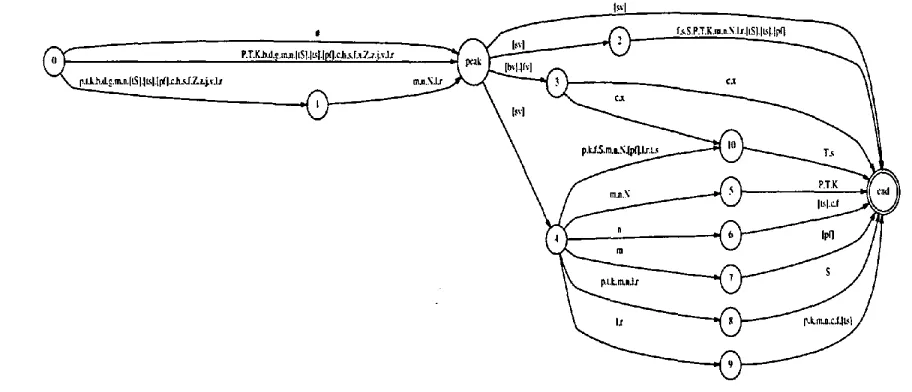
In some languages (such as German, e.g. in the analysis from (Jusek et al., 1994) shown in Figure 3) only peak and coda constrain each other, while in other languages (such as Rus- sia.n) only onset and peak are mutually con- strained (e.g. Halle, (1971)). The third possi- bility is t h a t b o t h types of constraints occur in the same language.
In order to allow for all three possibilities, the following approach is taken: each word in a given training sample is scanned and segmented in two ways, once by division before the peak and once after. This two-way word segmentation results in the following two analyses:
Initial M e d i a l Final
(or*)
(VM+CM*)" (VF+cF
")
+)
In b o t h cases, the initial and final sections together contain three subsections that can be interpreted as the onset, peak and coda of a tra- ditional syllable, which makes it possible to use the same analysis to account for words of arbi- trary length, including monosyllables if appro- priate. This approach also has the advantage that it can incorporate constraints that cross the boundaries of traditional syllables, such as assimilation phenomena.
For a given training sample of words, in the first scan, all initial syllabic sections resulting from the word segmentation described above are grouped together in d a t a set D1, all final sec- tions in d a t a set D3, and all remaining sections (regardless of how many result from each word) in D2. The same process results in d a t a sets D4-D6 for the second scan. T h e learning task is then to automatically construct an acyclic FSA on the basis of each d a t a set, resulting in six a u t o m a t a A1-A6. Two cyclic a u t o m a t a C1 and C2 are then constructed (corresponding to the two scans) t h a t have the following structure,
where A1 and A4 correspond to
Ai,
A2 and A5 toAM
and A3 and A6 toAF:
A_M
The final result is a hypothesis of the (word- level) phonological g r a m m a r of a given lan- guage, based on a given training sample, en- coded by the intersection of C1 and C2 (i.e. a word has to be accepted by both in order to be considered well-formed). T h e present discussion is restricted to a basic syllable class system, but it is likely t h a t descriptive accuracy can be fur- ther improved by extending this basic system to include tone and stress effects. This would of course result in more complex a u t o m a t a C1 and C2 (trivially inferrable here).
3 L e a r n i n g M e t h o d
3.1 B a c k g r o u n d
T h e G r a m m a t i c a l I n f e r e n c e P r o b l e m Generally, the problem considered here is that of identifying a language L from a fixed finite sample D = ( D + , D - ) , where D + C L and D - N L = 0 ( D - may be empty). If D - is empty, and D + is structurally complete with regard to L, the problem is not complex, and there exist a number of reliable inference algo- rithms. If D + is an arbitrary strict subset of L, the problem is less clearly defined. Since any fi- nite sample is consistent with an infinite n u m b e r of languages, L cannot be identified uniquely from D +. "...the best we can hope to do is to infer a g r a m m a r that will describe the strings in D + and predict other strings t h a t in some sense are of the same n a t u r e as those contained in D +'', (Fu and Booth, 1986, p.345).
To constrain the set of possible languages L, the inferred g r a m m a r is typically required to be as small as possible, in accordance with a more general principle of machine learning which holds that a solution should be the short- est or the most economical description consis- tent with all examples, as e.g. suggested in Michalski (1983). However, the problem of find- ing a minimal g r a m m a r consistent with a given sample D was shown to be NP-hard by Gold (1978). Li & Vazirani (1988), Kearns ~ Valiant (1989) and Pitt & W a r m u t h (1993) have added
nonapproximability results of varying strength. In the special case where D contains ail strings of symbols over a finite alphabet I of length shorter than k, a polynomial-time algorithm can be found (Trakhtenbrot and Barzdin, 1973), but if even a small fraction of examples is missing, the problem is again NP-hard (Angluin, 1978).
G e n e t i c S e a r c h Given the nature of the in- ference problem, a search algorithm is the obvi- ous choice. Genetic Algorithms (GAs) are par- ticularly suitable because search spaces tend to be large, discontinuous, multimodal and high- dimensional. The power of GAs as general- purpose search techniques derives partly from their ability to efficiently and quickly search large solution spaces, and from their robustness and ability to approximate good solutions even in the presence of discontinuity, multimodai- ity, noise and highdimensionality in the search space. The most crucial difference to other general-purpose search and optimisation tech- niques is that GAs sample different areas of the search space simultaneously and are therefore able to escape local optima, and to avoid poor solution areas in the search space altogether.
R e l a t e d R e s e a r c h A number of results have been reported for inference of regular and context-free g r a m m a r s with evolutionary tech- niques, e.g. by Zhou & Grefenstette (1986), Kammeyer & Belew (1996), Lucas (1994), Dupont (1994), Wyard (1989) and (1991). Re- sults concerning the inference of stochastic g r a m m a r s with genetic algorithms have been described by Schwehm & Ost (1995) and Keller Lutz (1997a) and (1997b) describe. Much of this research bases inference on both nega- tive and positive examples, and no real linguis- tic data sets have been used. Genotype repre- sentation is always based on sets of production rules, and knowledge of the target g r a m m a r is often utilised. Of these, Zhou & Grefenstette is the one approach directly comparable to the present m e t h o d , and some comparative results are given in Section 4.
3.2 T h e G e n e t i c A l g o r i t h m
The present algorithm 7 maintains a population of individuals represented by genotypes of vary-
rThe algorithm described here was developed in col- laboration with Berkan Eskikaya, School of Cognitive and Computing Sciences, University of Sussex.
ing length which are initialised to r a n d o m gene values and length. In the iteration typical of GAs, individuals are (1) evaluated according to the fitness function, (2) selected for repro- duction by a process that gives fitter individ- uals a higher chance at reproduction, (3) off- spring are created from two selected individu- als by crossover and mutation, and (4) weaker parents are replaced by fitter offspring. These steps are repeated until either the population converges (when the genotypes in the popula- tion have reached a degree of similarity beyond which further improvement is impossible), or the nth generation is reached.
The remainder of this section outlines the fit- ness function (corresponding to the evaluation function common to all search techniques), and describes how generalisation over the training set is achieved. Full details of the GA can be found in Belz ~ Eskikaya (1998).
F i t n e s s E v a l u a t i o n The fitness of a u t o m a t a is evaluated according to 3 fitness criteria that assess (C1) consistency of the language covered by the a u t o m a t o n with the d a t a sample, (C2)
smallness and ( C 3 ) g e n e r a l i s a t i o n to a super- set of the data sample. For the evaluation of C1, the number of strings in the d a t a sam- ple that a given a u t o m a t o n parses are counted. Partial parsing of prefixes of strings is also re- warded, because the acquisition of whole strings by the a u t o m a t a would otherwise be a m a t t e r of chance. Size (C2) is assessed in terms of num- ber of states, the reward being higher the fewer states an FSA has. This criterion serves as an additional pressure on a u t o m a t a to have few states, although the number of states and, more explicitly, the number of transitions is already kept low by crossover and mutation. General- isation (C3) is directly assessed only in terms of the size of the language covered by an au- tomaton, where the reward is higher the closer language size is to a specified target size (ex- pressing a given degree of generalisation).
tion. In the present context, trial runs showed that the structural and functional properties of solution a u t o m a t a are very directly affected by each of the three fitness criteria described above. Therefore, it was most natural to normalise the three criteria to make up one third of the fit- ness value each, but to attach weights to them which can be manipulated (increased and de- creased) to affect the structural and functional characteristics of resulting automata.
Raising the weight on a fitness criterion (in- creasing its importance relative to the other cri- teria) has very predictable effects, in that the criterion with the highest weight is most reli- a b l y satisfied. Lowering the weight on C3 to- wards 0 has the result that language size be- comes unpredictable, while lowering the weight on C2 simply increases the average size of the resulting automata. The weight on C1 tends to have to be increased with increasing sample size.
G e n e r a l i s a t i o n There are two main parame- ters that influence the degree of generalisation a given population achieves: the fitness criteria of size (C2) and degree of overgeneration (C3). C2 encourages a u t o m a t a to be as small as pos- sible, which - - in the limit - - leads to universal automata that parse all strings x E I*. This is counterbalanced by C3 which limits the number of strings not in the training set which automata are permitted to overgenerate. To control the quality of generalisation, transitions that are not used by any member of the training set are eliminated, because a u t o m a t a would otherwise accept arbitrary strings in addition to training set members to make up the required target lan- guage size.
The overall effect is that a range of general- isation can be achieved over the training set, from precise training set coverage towards uni- versal automata, while meaningless overgenera- tion of strings is avoided. When L(A) = train- ing set, only symbols a E I with identical distri- butions in the data set can be grouped together on the same transition between 2 states. As the required degree of generalisation increases, symbols with the most similar distributions are grouped together first, followed by less similar
o n e s .
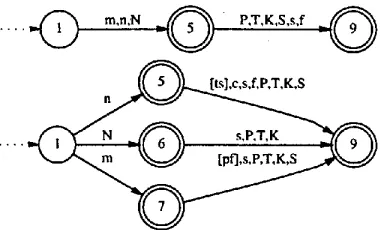
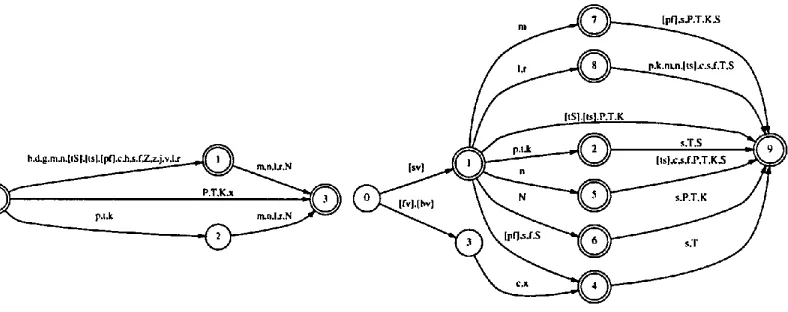
Figure 2 shows an example of what effects can be achieved in the limit. The bottom dia-
gram is part of the best automaton discovered for the second half of the German reduced syl- lable set, shown in Figure 4. Here, the degree of overgeneration was set to 1 (i.e. L(A) = train- ing set), and the size criterion C2 had a small weight. This resulted in generalisation being completely absent, i.e. the automaton generates only nasal/consonant combinations that actu- ally occur in the data set.
The top diagram in Figure 2 shows the effect of having a large weight on the size criterion, and increasing target language size. The nasals were consistently grouped together under these circumstances, because there is a higher de- gree of distributional similarity (in terms of the sets of phonemes that can follow) between m, n, N than between these and other phonemes. This achieves the effect that strings not in the data set can be generated in a linguistically use- ful way, but also may have the side-effect that rarer phoneme combinations (m[p:f], n [ ' t s ] , etc.) are not be acquired, an effect that is de- scribed in (Belz, 1998).
4 R e s u l t s
This section summarises the results that have been achieved for complete presentation of data for finite languages (Section 4.1), and incom- plete presentation of data for finite (Section 4.3) and infinite languages (Section 4.2).
The last example (Section 4.3) illustrates how the GA method can be used in conjunction with the formal approach described in Section 2 to automatically discover word-level phonotac- tic descriptions from raw data sets of phoneme strings.
4.1 G e r m a n S y l l a b l e s
....
.-o m.N . ©
. @
Figure 2: Effect of generalisation on phoneme groupings.
peak, and the second half covers the remainder), a n d the corresponding strings were used as sep- arate training sets (the training set for the first half contained 127 strings, that for the second
82).
Results are summarised in Table 1, and the best a u t o m a t o n that was found is shown in Fig- ure 4. Algorithms based on Hopcroft & Ullman (1979, equivalence proofs pp. 26-27 and 22- 23, minimisation algorithm p.70) to eliminate e-transitions, determinise and then minimise the original manually constructed automaton showed that the automatically discovered FSAs are the minimal deterministic s equivalents of the two halves of the original automaton, and therefore represent optimal solutions.
These results show that the GA is able to lo- cate optimal solutions (although it is not guar- anteed to find them), and that once an optimum has been found, the population also converges on it, rather than on another, suboptimal solu- tion.
4.2
Some Non-linguistic Examples
In order to assess the performance of the GA on known infinite languages, and to compare it to another GA-based technique with similar aims, experiments were carried out for four pre- viously investigated learning tasks (Zhou and Grefenstette, 1986). Task 1 was to discover the language (10)', Task 2 was 0"1"0"1", Task 3 was "all strings with an even number of 0's and an even number of l's", and Task 4 was "all strings such that the difference between the number of l's and 0's is 3 times n (where n is an integer)". Zhou & Grefenstette used both
SThe 2-dimensional transition matrices that are used as genotypes encode only deterministic FSAs.
Target found Z&G T a s k 'L' 'S' at generation Trials
Best Avg
1 4 2 1 2 980
2 7 161 23 29 1027
3 6 42 87 110 2820
4 4 10 69 90 2971
Table 2: Results for non-linguistic examples.
positive and negative examples, and moreover had to "modify the training examples to make the genetic algorithm 'understand' what a per- fect concept should be" (p.172). The present approach used positive data only, consisting of all strings up to a certain length L, resulting in datasets of varying size S. L was incremented from 0 until the first value was found for which 5 random runs produced the target a u t o m a t o n in under 200 generations.
[image:7.612.195.385.67.182.2] [image:7.612.293.502.232.326.2]Front
Back
Consistency Overgeneration (Number of strings)
Best 0
Average Best Average
127(100%) 127(100%)
82(100%)
82(100%)
States
1 2.6
0 9
0 9.7
Transitions Best found at generation
36 78
34.0 93
61 360
61.5 780
Table 1: Results for set of German reduced syllables.
~'r.,.k.h.tL+.m.n.l+l.t
L~l.h~l.c.h.~Lj+'d+r
_ ~ ' - f ' ~ fxS.P.T.K.m.n.N.Is.IISI.IL~].ip~ - ~
ntLS.h" ~ ~ 3 I ea \~
c.x
T.~
Figure 3: Manually constructed a u t o m a t o n for German reduced syllables.
the GA can find optimal solutions for infinite languages.
4.3 R u s s i a n D a t a
For the third experiment the words in a d a t a set of 450 bisyllabic feminine Russian nouns were divided into sections in the way described in Section 2.3. This resulted in five learning sets D1-D5 (because the set of final consonants is e m p t y in this training set). For each of the five learning sets, five a u t o m a t a were in- ferred t h a t precisely generate the learning set. On the basis of these, the degree of generalisa- tion that could be expected given the training sets was estimated, and five a u t o m a t a A1-A5 generalising to between 1.5 and 2.5 times the size of their respective learning sets were then evolved. Finally, two a u t o m a t a C1 and C2 were constructed to encode inter-syllabic constraints, with labels A1-A5 representing the a u t o m a t a that encode intra-syllabic constraints:
The resulting phonological g r a m m a r hypoth-
esis (the intersection of the two a u t o m a t a en- coding inter-syllabic constraints) accepted all words from the original learning set of 450 Rus- sian bisyllabic feminine nouns, generalised to a total set of words of around 10 times this size, and accepted ca. 85% of nouns from a testing set of 200 different such nouns. Generalisation was almost always meaningful in t h a t the greater the similarity between two phonemes (in terms of the phoneme sequences t h a t can follow t h e m ) , the higher was the hkelihood that they were grouped together on the same transition.
5 C o n c l u s i o n a n d F u r t h e r R e s e a r c h
This paper introduced a formal theoretical ap- proach to the a u t o m a t i c acquisition of phono- tactic constraints encoded as finite-state au- t o m a t a , and described a genetic-search m e t h o d for the construction of such a u t o m a t a . Results show t h a t the m e t h o d is reliably successful in constructing FSAs that accurately cover train- ing samples and allow a range of generalisa-
[image:8.612.100.550.64.143.2] [image:8.612.87.543.193.389.2])
Figure 4: Best automatically discovered automata for German reduced syllables.
tion over the learning samples. The approach to phonotactic description involving several syl- lable classes that is proposed in this paper is likely to enable a more accurate account of pos- sible phonological forms in a language than ap- proaches that assume a single syllable class. Fu- ture research will focus on developing word-level phonotactic descriptions for larger datasets of German and Russian words, and extending the approach to descriptions incorporating tone and stress effects.
R e f e r e n c e s
D. Angluin. 1978. On the complexity of min- imum inference of regular sets. Information and Control, 39:337-350.
R. H. Baayen, R. Piepenbrock, and L. Gulikers, editors. 1995. The CELEX Lexical Database (CD-ROM). Linguistic Data Consortium, University of Pennsylvania, Philadelphia, PA. A. Belz and B. Eskikaya. 1998. A genetic al- gorithm for finite-state automaton induction. Cognitive Science Research Paper 487, School of Cognitive and Computing Sciences, Uni- versity of Sussex.
A. Belz. 1998. A few English words can help improve your Russian. In Henri Prade, edi- tor, ECAI98: 13th European Conference on Artificial Iintelligence. John Wiley & Sons. J. Blevins. 1994. The syllable in phonological
theory.
J. Carson-Berndsen. 1993. An event-based phonotactics for German. Technical Report
ASL-TR-29-92/UBI, Fakultaet fuer Linguis-
tik und Literaturwissenschaft, University of Bielefeld.
N. Chomsky. 1964. Current Issues in Linguistic Theory. Mouton, The Hague.
P. Dupont. 1994. Regular grammatical infer- ence from positive and negative samples by genetic search: the GIG method. In Gram- matical Inference and Applications, Second International Colloquium, ICGI-94, Proceed- ings, Berlin. Springer.
K. S. Fu and T. L. Booth. 1986. Gram- matical inference: Introduction and sur- vey. IEEE Transactions on Pattern Analysis and Machine Intelligence, PAMI-8:343-375. (Reprinted from 1975.).
D. Gibbon. 1991. Lexical signs and lexicon structure: Phonology and prosody in the ASL-lexicon. Technical Report ASL-MEMO- 20-91/UBI, University of Bielefeld.
E. M. Gold. 1978. Complexity of automaton identification from given data. Information and Control, 37:302-320.
John A. Goldsmith. 1990. Autosegmental and Metrical Phonology. Blackwell, Cambridge,
Mass.
M. Halle. 1971. The Sound Pattern of Russian.
Mouton, The Hague.
J. E. Hopcroft and J. D. Ullman. 1979. In- troduction to Automata Theory, Languages, and Computation. Addison-Wesley, Reading, Mass.
[image:9.612.86.480.75.231.2]unbekannter Woerter mit Hilfe phonotaktis- cher Modelle. In Mustererkennung 94, 16. DA GM-Symposium.
T. E. Kammeyer and R. K. Belew. 1996. Stochastic context-free grammar induction with a genetic algorithm using local search. Technical Report CS96-476, Cognitive Com- puter Science Rsearch Group, Computer Sci- ence and Engineering Department, University of California at San Diego.
M. Kearns and L. G. Valiant. 1989. Crypto- graphic limitations on learning boolean for- mulae and finite automata. In Proceedings of the 21st Annual A C M Symposium on The- ory of Computing, pages 433-444, New York. ACM.
B. Keller and R. Lutz. 1997a. Evolving stochas- tic context-free grammars from examples us- ing a minimum description length principle. Nashville, Tennessee, July. Paper presented at the Workshop on Automata Induction Grammatical Inference and Language Acqui- sition, ICML-97.
B. Keller and R. Lutz. 1997b. Learning SCFGs fl'om corpora using a genetic algorithm. In
ICA NNGA 97.
M. Li and U. Vazirani. 1988. On the learn- ability of finite automata. In Proceedings of the 1988 Workshop on Computational Learn- ing Theory, pages 359-370, San Mateo, Ca. Morgan-Kaufmann.
S. Lucas. 1994. Context-free grammar evolu- tion. In First International Conference on Evolutionary Computing, pages 130-135. R. S. Michalski. 1983. A theory and method-
ology of inductive learning. In R. Michalski, K. Carbonell, and T. Mitchell, editors, Ma- chine Learning: An Artificial Intelligence Ap- proach Vol. 1, pages 83-143. Tioga, Palo Alto, CA. Also published by Springer in 1994. L. Pitt and M. K. Warmuth. 1993. The mini-
mum consistent DFA problem cannot be ap- proximated within any polynomial. Journal of the Association for Computing Machinery,
40(1):95-142.
M. Schwehm and A. Ost. 1995. Inference of stochastic regular grammars by massively parallel genetic algorithms. In Proceedings of the Sixth International Conference on Ge- netic Algorithms, pages 520-527. Morgan Kaufmann.
B. B. Trakhtenbrot and Ya. Barzdin. 1973. Fi- nite Automata. North Holland, Amsterdam. P. Wyard. 1989. Representational issues for
context free grammar induction using genetic algorithms. Technical report, Natural Lan- guage Group, Systems Research Division, BT Laboratories, Ipswich, UK.
P. Wyard. 1991. Context free grammar induc- tion using genetic algorithms. In Richard K. Belew and Lashon B. Booker, editors, Pro- ceedings of the Fourth International Confer- ence on Genetic Algorithms, pages 514-518, San Diego, CA. Morgan Kaufmann.
H. Zhou and J. J. Grefenstette. 1986. Induc- tion of finite automata by genetic algorithms.
Proceedings of the 1986 International Confer- ence on Systems, Man and Cybernetics, pages 170-174.