International Journal of Research in Advent Technology, Vol.5, No.1, January 2017
E-ISSN: 2321-9637
Available online at www.ijrat.org
11111
Image Tagging In Social Re-Ranking using Cluster
Ms. Tejashri Maruti Dumbre, Miss.Pratiksha Shridhar Kulkarni
DepartmentComputer Engineering Email:[email protected] [email protected]
ABSTRACT
Social websites like facebook,twitter,instagram,etc had made great success recently.Existing strategy is
Re-Ranking,Re-Ranking the images means it is done according to visual details,descriptive information & social demand of it on the social sites.Results of the Re-ranking are according to it’s demand of number of different social users. It ranks images on the basis of score of images & including it’s visual details,size, descriptive information, social demand & associated tags.Semantic differences and similarities of such social images are estimated on their score of tags and based on this tagging scores and same properties the ranking list is prepared which generates the ADP-Average Diverse Precision. In this paper, we propose the concept of clustering the images,i.e. spectral clustering techniques, we can cluster the results of searched images into different-different semantic clusters
Index Terms- Image Tags; Social Re-Ranking; Cluster.
1.INTRODUCTION
Social sites like youtube,flickr blogs,etc provides the lots of social media which is available onlineon these sites. It promotes to users to collaboratively generate and distribute media and it’s information.It helps to describe the media which is uploaded on social sites using keywords which are mainly called as Tags.Example is mentioned in below image.
The precious metadata of social media can facilitate the organization is vast and search it efficiently. If the images are indexed with associated tags,then they can be accessed easily for given query.As every user tag the image according to their mindset they may have incomplete names or short names.So, the image searching through the names may lead to unsatisfactory results.so,the ranking approach will explore both tags and images cont’s details and help users to get the required social images result after
International Journal of Research in Advent Technology, Vol.5, No.1, January 2017
E-ISSN: 2321-9637
Available online at www.ijrat.org
11112
search.Example,At present time,Flickr includes two options for ranking image comments, on click likes,etc.In short,two main types of ranking are upload-time ranking and lik-based ranking.Both methods consider the points of interest and time.But these may give rise to unsatisfactory results i.e unwanted irrevelant results.Ranking also raise the problem of lack of diversity.Example,Some people continuously upload the images in group or together and they ae semantically ,visually close.When user search for images they get few results.So,more efficient way of ranking is desired to generate the relevant & diverse results. This problem is closely related to a key scientific challenge that is recently released by Yahoo re- search: “how do we combine both content-based retrieval with tags to do something better than either approach alone for multimedia retrieval”.
Diversity is necessary in case of searched results for images but relevance is also important in case of information returned. In many cases users cannot accurately and exhaustively describe their requests, and thus keeping diversity
of the search results will provide users more chances to find the desired content quickly. For example, we can consider the fol- lowing cases in image search:
• The users only provide an ambiguous query. For example, the query apple may refer to different topics, such as fruit, computer and mobile. Thus, it is better to provide diverse results to cover multiple topics.
• The users cannot fully describe their requests by simple words. For example, although a user only provides a simple query car, he/she may actually want to find a picture of a red car on grass. In this case, the hit probability of a diverse image set should be greater than a set of images that are quite close.
International Journal of Research in Advent Technology, Vol.5, No.1, January 2017
E-ISSN: 2321-9637
Available online at www.ijrat.org
11113
2.PROJECT IDEA
Social image websites such as Flickr allow users to annotate their images with a set of descriptors such as tags. By using tag query terms tag-based image search can be done efficiently.Noisy image tags,incomplete and irrelevant image tags affects the image search adversely which makes users status usatisfactory.
Most of the literatures regarding the re-ranking of the tag-based image
retrieval focus on tag processing, image relevance ranking and diversity enhancement of the retrieval results. The following parts present the existing works related to the above three aspects respectively.
2.1
Objective
•
To develop a system for tag-based image search approach with social re- ranking.• To develop a System for inter-user re-ranking method and intra-user re-ranking method to achieve a good trade-off between the
diversity and relevance performance.
• To improve the robustness of the algorithm to obtain the co-occurrence word set with respect to the given query
3
.
LITERATURE SURVEY
3.1
Boost Search
Relevance For
Tag-Based Social Image
Retrieval.
Here Author wants to propose the concept of relevant based ranking technique using cluster. It integrates both the visual consistency between
International Journal of Research in Advent Technology, Vol.5, No.1, January 2017
E-ISSN: 2321-9637
Available online at www.ijrat.org
images and the semantic correlation between tags in a unified optimization framework.
Author propose an iterative method to solve the optimization problem, and the
relevance based ranking can thus be accomplished
3.2 Social Image Search
With Diverse Relevance
Ranking
In this paper, Author propose a social re-ranking system for tag based image re- trieval with the consideration of images relevance and diversity. We aim at re- rank- ing images according to their visual information, semantic information and social clues. The initial results include images contributed by different social users. Usu- ally each user contributes several images. First we sort has images by inter-user re-ranking. Users that have higher contribution to the given query rank higher. Then we sequentially implement intra-user re-ranking on the ranked users image set, and only the most relevant image from each users image set is selected. These selected images compose the final retrieved results. Author build an inverted index structure for the social image dataset to accelerate the searching process.
3.3 Towards Relevant And
Diverse Search Of Social
Images
By considering relevance and diversity the content of images and their associated tags are explored.By
using this author presents the diverse relevance ranking technique.At first it considers the relevance scores of images according to query term based on both visual and semantic
information of associated By using Greedy ordering algorithm,relevance scores the ranking list is prepared by a greedy ordering algorithm which optimizes Average Diverse Precision (ADP).
3.4 Hierarchical
Clustering Of WWW
Image Search Results
Using Visual, Textual
And Link
Information.
International Journal of Research in Advent Technology, Vol.5, No.1, January 2017
E-ISSN: 2321-9637
Available online at www.ijrat.org
representations, first is visual feature based representation, second textual
feature based representation and third graph based
representation.
4.PROBLEM
DEFINITION AND
SCOPE
4.1 Problem Statement
To develop and design a system for tag based image search by social re-ranking. With the development of social media based on Web, amounts of images and videos spring up everywhere on the Internet. Thus, a fundamental problem in the re-ranking of the tag-based social image retrieval is how to reliably solve these problems.
4.1.1 Goals And Objectives
•
To develop a system for tag-based image search approach with social re- ranking.• To develop a System for inter-user re-ranking method and intra-user re-ranking method to achieve a good trade-off between the diversity and relevance per- formance.
• To improve the robustness of the algorithm to obtain the co-occurrence word set with respect to the given query.
4.2 Software Context
For developing this system we will required Net beans IDE and implementa- tion language will be Java. For storing back end we used MySQL 5.5. Above mention software are open source.
4.3 Major Constraints
The user needs to login to the system first. A system for tag-based image search approach with social re-ranking.
5. SYSTEM
IMPLEMENTATION
5.1 EXISTING SYSTEM
•
User Cannot precisely describe their request with single words and tag suggestion system always recommend words that are highly correlated to the existing tag set, thus add little information to a user s contribution.• Besides, polysemy and synonyms are the other causes of the query ambiguity
.
5.1.1 Drawbacks Of Existing
System
• The re-ranking problem in the tag-based image retrieval has gained researchers wide attention. • Tag mismatch. Social tagging
requires the user should name the uploaded images with the desired tags .i.e desired keywords. • Image annotation , there is no
predefined ontology or taxonomy in social image tagging. Every user has his own habit to tag images.
5.2 PROPOSED SYSTEM
We propose a social re-ranking system for tag-based image retrieval with the con- sideration of images relevance and diversity. At first user ranks the images using inter-user ranking strategy. Users that have higher contribution to the given query rank higher. Then we sequentially implement intra- user re-ranking on the ranked users image set, and only the most relevant image from each users image set is selected. These selected images compose the final retrieved results.
5.3ARCHITECTURE OF
SYSTEM
Our social re-ranking system includes two main sections: online and offline as shown in following figure The offline section contains two parts:
1. Inverted index structure
construction for image dataset. An inverted index structure is built to accelerate the retrieval speed.
2. Feature extraction. In this project, we extract the visual feature, semantic feature and views for the images dataset. Semantic feature refers to the co-
occurrence word set of query tags and the tags of the images.
Our online parts consist of the following three steps:
1) Keyword Matching 2) Inter-user Re-ranking 3) Intra-user Re-ranking
1. Keyword matching: For an input
query, our system will return the initial retreival results by keyword matching. And the following two online steps are all conducted to re-rank the initial results.
2. Inter-user re-ranking: The
inter-user re-ranking is applied to rank the corresponding users with the consideration of their
3. Intra-user re-ranking: A regularization framework is proposed to determine the relevance level of each image by fusing the visual, semantic and views in- formation into a unified system. Then we sequentially select the most relevant image in each ranked users image set. These selected images constitute our re-ranking results. Here in after the details are displayed.
5.4 ADVANTAGES OF
PROPOSED SYSTEM:
•
Proposed System for inter-user re-ranking method and intra-user re-ranking method to achieve a good trade-off between the diversity and relevance per- formance.• To improve the robustness of the algorithm to obtain the co-occurrence word set with respect to the given query.
System Description:
•
Input: User uploads image or Big Image Database • Output: A social re-ranking methodfor tag-based image retrieval Inter User Module Set A = [ a1, a2, a3, a4, a5, a6, a7, a8] • a1 = Keyword Matching
• a2 = User Query
• a3 = Feature extraction
• a4 = visual feature
• a5 = Semantic feature • a6 = Image Contribution
• a7 = Contribution to given query
Intra User Module Set B = [ b1, b2, b3]
• b1 = relevance level of each image
5.5 PROPOSED
ALGORITHM
1. K-means Clustering Algorithm5.5.1 K-means Clustering Algorithm
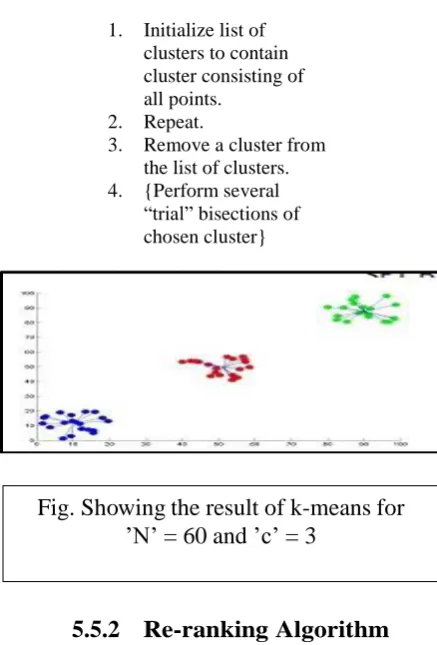
One of the simplest unsupervised learning algorithm that solve the clustering problem is called as K-means Clustering Algorithm. The procedure follows a simple and easy way to classify a given data set through a certain number of clusters (assume k clusters) fixed apriori. The main idea is to define k centers, one for each cluster. These cen- ters should be placed in a cunning way because of different location causes different result. So, the better choice is to place them as much as possible far away from each other.
Seond step is to pick each point from given data set and associate it to next center. Then user has need to re-calculate k new centroids as bary center of the clusters which is result of last step. When we have the k centroids, A new binding must be created between nearest center and obtained points. A loop gets generated.It proves that due to this loop k center changes its location step by step,until no more changes are required so that no more that centers could move.
Algorithm for K-means
clustering:
1. Initialize list of clusters to contain cluster consisting of all points.
2. Repeat.
3. Remove a cluster from the list of clusters. 4. {Perform several
“trial” bisections of chosen cluster}
5. For i=1 to no. of trials do.
6. Bisect selected cluster using basic K-means . 7. End for.
8. Select the two clusters from bisection with lowest total SSE. 9. Add these 2 clusters to
list of clusters.
10. Until the list of cluster contain K-cluster
.
5.5.2 Re-ranking Algorithm
The ranked image for the query tag q: 1. Keyword matching
2. Inter-user ranking
3. Intra-user ranking
The details of these three main part of online system will be described as follows. Keyword matching for the query, from the inverted file index, we can obtain the corresponding images that all tagged with query q, which is denoted bye X. It can be further described by taking the social users information into account as follows. X=x(u1).x(uz),Xz
.
5.6 Modules
Proposed system mainly consist of four modules
1. Tag Based Image Retrieval
2. Social Tags
3. Image search
4. Social Re-ranking
5.6.1 Tag Based Image Retrieval
To find images uploaded by social users in such social websites tag-based image search is an vital method.To make top rank result in relevant with diversity is quite challenging.By considering relevance and diversity of images,author proposes social re-ranking system for system for tag-based image access.
5.6.2 Social Tags
Tag mismatch. Social tagging requires all the users in the social network to label their uploaded images with their own keywords and share with others. Different from ontology based. image annotation, there is no predefined ontology or taxonomy in social image tagging. Every user has his
own habit to tag images. Even for the same image, tags contributed by different users will be of great difference.
5.6.3 Image Search
The tag-based image search can be easily accomplished by using the tags as query terms. However, the weakly relevant tags, noisy tags and duplicated information make the search result unsatisfactory. Most of the literatures regarding the re-ranking of the tag-based image retrieval focus on tag processing, image relevance ranking and diversity enhancement of the retrieval results. Wepropose a tag-based image search approach
with social re-ranking. We systematically fuse the visual informa- tion, social users information and image view times to boost the diversity perfor- mance of the search result.
We build an inverted index structure for the social image dataset to accelerate the searching process. Experimental results on Flickr dataset show that our so- cial re-ranking method is effective and efficient. Starting from this intuition and above analysis, we propose a social re-ranking algorithm which user information is firstly
introduced into the traditional ranking method considering the semantics, so- cial clues and visual information of images. A social re-ranking method which fuses the user information into the
traditional tag-based image retrieval framework. We first get the initial results by keyword matching process.
6. CONCLUSION
In this Project, we propose a social re-ranking method for tag-based image re- trieval. In this social re-ranking method, inter-user re-ranking and intra-user re- ranking are carried out to obtain the retrieved results. In order to enhance the diver- sity performance, user information is firstly introduced into our proposed approach and obtains satisfactory results.However, in the inter- user ranking process only users contribution is considered and the similarity among users is ignored. For future work, we will investigate the similarity among user groups in Flickr dataset. Therefore, we can fuse these relationships to enhance the diversity performance of image
First and foremost, we would like to thank my
ACKNOWLEDGEMNT
Author Ms.DUMBRE T.M.,MS.KULKARNI PRATIKSHA S. for his guidance and support. We will forever remain grateful for the constant support and guidance extended by guide, in making this paper. Through our many discussions and ideas. The invaluable discussions we had with her, the penetrating question, has all led to the development of this paper.
REFERENCES
1) Xueming Qian, Member, IEEE, Dan Lu & Xiaoxiao-Tag based Image Search by Social Re-ranking.
2) Dong Liu,Xian-Sheng Hua,Meng Wang,Hong Jiang Zhang-Boost Search Relevance
for Tag based Social Image Retrieval.