G E N E R A L I T Y A N D O B J E C T I V I T Y
Central Issues in Putting a
Dialogue E v a l u a t i o n Tool into Practical Use
Laila Dybkj~er, N i e l s Ole B e m s e n and Hans Dybkj~er
T h e M a e r s k M e - K i n n e y M o i l e r Institute for P r o d u c t i o n T e c h n o l o g y O d e n s e U n i v e r s i t y , C a m p u s v e j 55, 5230 O d e n s e M, D e n m a r k e m a i l s : l a i l a @ m i p . o u . d k , n o b @ m i p . o u . d k , d y b k j a e r @ m i p . o u . d k
phone: (+45) 65 57 35 44 fax: (+45) 66 15 76 97
A b s t r a c t
This paper presents a first set o f test results on the generality and objectivity o f the Dialogue Evaluation Tool DET. Building on the assump- tion that most, if not all, dialogue design errors can be viewed as problems o f non-cooperative system behaviour, DET has two closely related aspects to its use. Firstly, it may be used for the diagnostic evaluation of spoken human-machine dialogue. Following the detection o f miscommu- nication, DET enables in-depth classification of miscornmunication problems that are caused by flawed dialogue design and supports the repair of those problems, preventing their future occur- rence. Secondly, DET can be used to guide early dialogue design in order to prevent dialogue de- sign errors from occurring in the implemented system. We describe the development and in- house testing of the tool, and present the results of ongoing work on testing its generality and ob- jectivity on an external corpus, i.e. an early cor- pus from the Sundial project in spoken language dialogue systems development.
1. Introduction
Spoken language technologies are being viewed as one o f the most important next steps towards truly natural interactive systems which are able to communicate with humans the same way that humans communicate with each other. After more than a decade o f promises that versatile spoken language dialogue systems (SLDSs) using speaker-independent continuous speech recognition were just around the comer, the first such systems are now in the market place. These developments highlight the needs for novel tools and methods that can support efficient development and evaluation of SLDSs.
There is currently no best practice methodology available which specialises software engineering best practice to the particular purposes o f dialogue engineer- ing, that is, to the development and evaluation of SLDSs. In June 1997, a European Concerted Action, DISC (Spoken Language Dialogue Systems and Com- ponents - Best Practice in Development and Evaluation), will be launched with the goal o f systematically address- ing this problem. DISC aims to develop a first detailed
and integrated set o f development and evaluation meth- ods and procedures (guidelines, checklists, heuristics) for best practice in the field o f dialogue engineering as well as a range o f much needed dialogue engineering support concepts and software tools. The goals o f dialogue engi- neering include optimisation o f the user-friendliness of SLDSs which will ultimately determine their rank among emerging input/output technologies. The present paper will present ongoing work on one o f the tools that are planned to result from DISC.
,/
Prior to the start o f DISC, we have developed and tested a tool for dialogue design evaluation on an in- house SLDSs project (Bemsen et al. 1996, Bemsen et al. 1997a). The paper will present first test results on the generality and objectivity of this tool called DET (Dialogue Evaluation Tool). Building on the assumption that most, if not all, dialogue design errors can be
viewed as problems o f non-cooperative system behav-
iour, DET has two closely related aspects to its use. Firstly, it may be used as part o f a methodology for diagnostic evaluation o f spoken human-machine dia- logue. Following the detection o f human-machine mis- communication, DET enables in-depth classification of miscommunication problems that are caused by flawed dialogue design. In addition, the tool supports the repair" o f those problems, preventing their occurrence in future user interactions with the system. Secondly, DET can be used to guide early dialogue design in order to prevent dialogue design errors from occurring in the imple- mented system. The distinction between use o f DET for diagnostic evaluation and as design guide mainly depends on the stage of systems development at which it is be- ing used. When used prior to implementation, DET acts as a design guide; when applied to an implemented sys- tem, DET acts as a diagnostic evaluation tool. In what follows, we describe the development and in-house test- ing of the tool (Section 2), present ongoing work on testing its generality and objectivity (Section 3), and conclude the paper taking a look at the work ahead (Section 4).
2. Tool Development
DET was developed in the course o f designing, imple- menting and testing the dialogue model for the Danish dialogue system (Bernsen et al. 1997b). The system is a walk-up-and-use prototype SLDS for over-the-phone ticket reservation for Danish domestic flights. The sys- tem's dialogue model was developed using the Wizard of Oz (WOZ) simulation method. Based on the problems o f dialogue interaction observed in the WOZ corpus we established a set of guidelines for the design o f coopera- tive spoken dialogue. Each observed problem was con- sidered a case in which the system, in addressing the user, had violated a guideline o f cooperative dialogue. The WOZ corpus analysis led to the identification o f 14 guidelines o f cooperative spoken human-machine dia- logue based on analysis of 120 examples o f user-system interaction problems. If those guidelines were observed in the design o f the system's dialogue behaviour, we assumed, this would increase the smoothness o f user- system interaction and reduce the amount o f user- initiated meta-communication needed for clarification and repair.
The guidelines were refined and consolidated through comparison with a well-established body of maxims of cooperative human-human dialogue which turned out to
18
form a subset o f our guidelines (Grice 1975, Bemsen et al. 1996). The resulting 22 guidelines were grouped un- der seven different aspects o f dialogue, such as informa-
tiveness and partner asymmetry, and split into generic
guidelines and specific guidelines. A generic guideline
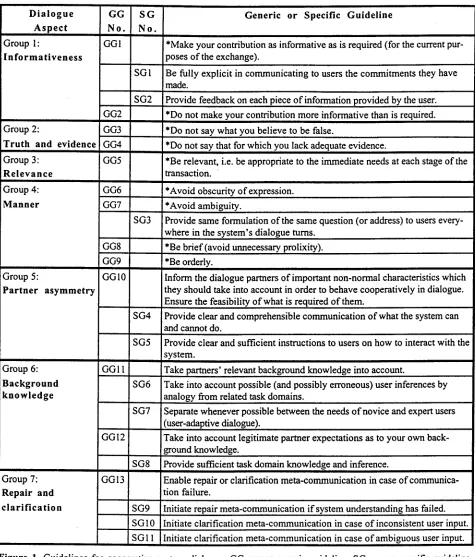
may subsume one or more specific guidelines which specialise the generic guideline to a certain class of phe- nomena. The guidelines are presented in Figure 1.
The consolidated guidelines were then tested as a tool for the diagnostic evaluation o f a corpus o f 57 dialogues collected during a scenario-based, controlled user test of the implemented system. The fact that we had the sce- narios meant that problems o f dialogue interaction could be objectively detected through comparison between expected (according to the scenario) and actual user- system exchanges. Each detected problem was (a) charac-
terised with respect to its symptom, (b) a diagnosis was
made, sometimes through inspection of the log of sys- tem module communication, and (c) one or several cures were proposed. The 'cure' part o f diagnostic analysis suggests ways o f repairing system dialogue behaviour. The diagnostic analysis may demonstrate that new guide- lines of cooperative dialogue design must be added, thus enabling continuous assessment o f the scope of DET. We found that nearly all dialogue design errors in the user test could be classified as violations of our guide-
lines. Two specific guidelines on meta-communication,
SGI0 and SGI 1, had to be added, however. This was no surprise as meta-comrnunication had not been simulated and thus was mostly absent in the WOZ corpus.
3. Generalising the Tool
As pointed out in Section 2, success in early tool devel- opment is not enough if the aim is to be able to rec- ommend the tool to other SLDS developers on a solid basis. The early development phase focused on one SLDS with one particular dialogue structure, in one particular domain of application, designed for a particular type o f task, i.e. reservation, in one particular develop- ment phase, i.e. evaluation o f an implemented system, and in circumstances of controlled user testing where we had available the scenarios used by the subjects as well as the full design specification o f the system. To test and increase the generality o f the tool, we are currently applying DET as a dialogue design guide to a WOZ cor- pus from the Sundial project (Peckham 1993).
Ideally, testing DET on the Sundial corpus will in- crease the generality that can be claimed for the tool in four different ways: (1) the system dialogue is different
from that o f the Danish dialogue system; (2) the task
type is different, i.e. information vs. reservation; (3) the
test type~tool purpose pairs are different: whereas in the case o f the Danish dialogue system, DET was used for diagnostic evaluation in a controlled user test, the tool is being used as an early dialogue design guide in the case
D i a l o g u e GG A s p e c t N o .
Group 1: GG I
I n f o r m a t i v e n e s s
GG2
Group 2: GG3
T r u t h and evidence GG4
Group 3: GG5
Relevance
Group 4: GG6
Manner GG7
i
Group 5:
Partner asymmetry
GG8
GG9
GGI0
Group 6:
Background k n o w l e d g e
GG11
GG12
Group 7:
Repair and
clarification
GGI3
S G Generic or Specific Guideline
N o .
SG6
i
i SG7
*Make your contribution as informative as is required (for the current pur- poses o f the exchange).
SG 1 Be fully explicit in communicating to users the commitments they have
made.
SG2 Provide feedback on each piece o f information provided by the user.
*Do not make your contribution more informative than is required.
*Do not say what you believe to be false.
*Do not say that for which you lack adequate evidence.
*Be relevant, i.e. be appropriate to the immediate needs at each stage of the transaction.
*Avoid obscurity of expression.
*Avoid ambiguity.
SG3 Provide same formulation o f the same question (or address) to users every-
where in the system's dialogue turns.
*Be brief (avoid unnecessary prolixity).
*Be orderly.
Inform the dialogue partners o f important non-normal characteristics which they should take into account in order to behave cooperatively in dialogue. Ensure the feasibility o f what is required o f them.
SG4 Provide clear and comprehensible communication o f what the system can
and cannot do.
SG5 Provide clear and sufficient instructions to users on how to interact with the
system.
Take partners' relevan! background knowledge into account.
Take into account possible (and possibly erroneous) user inferences by analogy from related task domains.
Separate whenever possible between the needs o f novice and expert users (user-adaptive dialogue).
Take into account legitimate partner expectations as to your own back- ground knowledge.
SG8 Provide sufficient task domain knowledge and inference.
Enable repair or clarification meta-communication in case of comrnunica- tion failure.
SG9 Initiate repair meta-communication if system understanding has failed.
SG 10 Initiate clarification meta-communication in case of inconsistent user input.
SG 11 Initiate clarification meta-communication in case o f ambiguous user input.
Figure 1. Guidelines for cooperative system dialogue. GG means generic guideline. SG means specific guideline. The generic guidelines are expressed at the same level o f generality as are the Gricean maxims (marked with an *). Each specific guideline is subsumed by a generic guideline. The left-hand column characterises the aspect o f dialogue addressed by each guideline.
we do not have the scenarios used in Sundial and do not have access to the early design specification o f the Sun- dial system. I f D E T works well under circumstances (4), we shall know more on how to use it for the analysis of corpora produced without scenarios, such as in field tests, or without the scenarios being available.
[image:3.612.78.553.46.603.2]classifications o f the identified problems. When, as in many realistic cases in which DET might be used, no scenarios exist or are available, an additional problem arises of whether the corpus analysers are actually able
to detect the same problems in a dialogue prior to classi-
fying them. If not, DET will not necessarily be useless but will be less useful in circumstances in which the objective number o f dialogue design errors matters. In the test case, objectivity of detection will have to be based on the empirical fact, if it is a fact, that developers who are well-versed in using the tool actually do detect the same problems.
4. T h e S i m u l a t e d S y s t e m
The Sundial dialogues are early WOZ dialogues in which subjects seek time and route information on British Airways flights and sometimes on other airline flights as well. The emerging system seems to understand the following types o f domain information:
1. Departure airport including terminal. 2. Arrival airport including terminal. 3. Time-tabled departure date. 4. Time-tabled departure time. 5. Time-tabled arrival date. 6. Time-tabled arrival time. 7. Flight number.
8. Actual departure date (not verified). 9. Actual departure time.
10. Actual arrival date (not verified). 11. Actual arrival time.
12.Distinction between BA flights which it knows about, and other flights which it does not know about but for which users are referred to airport help desks, sometimes by being given the phone numbers of those desks.
By contrast with the Danish dialogue system, the Sun- dial system being developed through the use o f the ana-
lysed corpus uses a delayed feedback strategy. Instead of
providing immediate feedback on each piece o f informa-
tion provided by the user, the system waits until the user has provided the information necessary for execut- ing a query to its database. It then provides implicit
feedback through answering the query. Until the user has
built up a flail query, which o f course may be done in a single utterance but sometimes takes several utterances to d o - the system would only respond by asking for more information or by correcting errors in the informa- tion provided by the user. The delayed feedback strategy is natural in human-human communication but might be considered somewhat dangerous in SLDSs because of the risk of accumulating system misunderstandings which the user will only discover rather late in the dia- logue. We would not argue, however, that the delayed feedback strategy is impossible to implement and sue- cessflally use for flight information systems of the com- plexity of the intended Sundial system. Still, this com- plexity is considerable, in particular, perhaps, due to the
20
intended ability of the system of distinguishing between timetabled and actual points in time. It is not an easy design task to get the system's dialogue contributions right at all times when this distinction has to be trans- parently present throughout.
Another point about the corpus worth mentioning is that the simulated system understands the user amaz- ingly well and in many respects behaves just like a hu- man travel agent. The implication is that several of the guidelines in Figure 1, such as G G l l / S G 6 / S G 7 on background knowledge, and GG13, SG9/SG10/SGI 1 on meta-communication are not likely to be violated in the transcribed dialogues. It should be added that it is not accidental that exactly these guidelines are not likely to be violated in the transcribed dialogues. The reason is that it is difficult to realistically simulate the limited
meta-communication and background-understanding
abilities o f implemented systems. As to the nov- ice/expert distinction (SG7), this is hardly relevant to sophisticated flight information systems such as the present one. A final guideline which is not likely to be violated in the transcriptions, is SG I on user commit- ments. The reason simply is that users seeking flight information do not make any commitments: they merely ask for information.
5. M e t h o d o l o g y a n d R e s u l t s
The Sundial WOZ corpus comprises approx. 100 flight travel information dialogues concerning British Airways flights. The corpus was produced by 10 subjects who each performed 9 or 10 dialogues based on scenarios selected from a set o f 24 scenarios. We do not have these scenarios. The transcriptions came with a header which identifies each dialogue, markup o f user and system ut- terances, consecutive numbering o f the lines in each dialogue transcription, and markup o f pauses, ahs, hmms and coughs. For the first generality test of DET, we have selected 33 dialogues. Three dialogues were used for initial discussions among the two analysers. The remaining 30 dialogues were split into two sub-corpora o f 15 dialogues each. Each sub-corpus was analysed by the two analysers. Methodologically, we analysed each system utterance in isolation as well as in its dialogue context to identify violations of the guidelines. Utter- ances which reflected one or more dialogue design prob- lems were annotated with indication o f the guideline(s) violated and a brief explanation o f the problem(s). Using TEI, we have changed the existing markup o f utterances to make each utterance unique across the entire corpus. In addition, we have a&led markup for guideline viola- tion. An example is shown in Figure 2.
Having independently analysed the two sub-corpora of 15 dialogues each, the analysers discussed each o f the 384 claimed guideline violations and sought to reach consensus on as many classifications-by-guideline as
possible. This lead to the following 10 status descriptors
<u id="U 1:7-1">
(0.4) #h yes I'm enquiring about flight number bee ay two eight six flying in later today from san fran- cisco (0.4) could you tell me %coughs% 'souse me which airport and terminal it's arriving at and what time (9) %coughs% (2) %coughs%
, . .
<u id="S 1:7-6">
(I 0) flight two eight six from san francisco arrives at london heathrow terminal four at thirteen ten
<violation ref="Sl:7-6" guideline="SG2"> Date not mentioned. The tabled arrival time is probably al- ways the same for a given flight number but there may be days on which there is no flight with a given number.
<violation ref="Sl:7-6" guideline="GG7"> It is not clear if the time provided is that o f the timetable or the actual (expected) arrival time of the flight.
F i g u r e 2, Markup o f part of a dialogue from the Sun- dial corpus. The excerpt contains a user question and the system's answer to that question. The user's query was first misunderstood but this part of the dialogue has been left out in the figure (indicated as: .... ). The system's answer violates two guidelines, SG2 and GG7, as indi- cated in the markup.
(id) Identity = The same design error case identified by both annotators.
(c) Complementarity = A design error case identified by one annotator..
(cv) Consequence violations = Design error cases that would not have arisen had a more fundamental design error been avoided.
(us) User symptoms = Symptoms o f design errors as evidenced from user dialogue behaviour.
(a) Alternatives = Alternative classifications o f the same design error case by the two annotators.
(re) Reclassification = Agreed reclassification o f a de- sign error case.
(roe) Reclassification to already identified case = Agreed reclassification o f a design error case as being identical to one that had already been identified.
(ud) Undecidable = Agreed undecidable design error clas- sification.
(deb) Debatable = The annotators disagreed on a higher- level issue involved in whether to classify a system ut- terance as a design error case.
( r e j ) Rejects = Agreed rejections o f attributed design
e r r o r c a s e s .
Based on the consensus discussion, the analysers cre- ated two tables, one for each sub-corpus. The tables were structured by guideline and showed the violations o f a particular guideline that had been identified by one o f the
Guide l i n e
G G 1
N O B - NOB
$8:1-6i
$8:6-3
$8:9-4
$9:I-3 $9:6-2
$9:9-3 $9:10-2
S10:1-3
;10:1-4
S10:6-3
C o m m e n t s NOB- LD
ud: 2 different interpretations $8:1-5 possible o f $8:1-5
id+deb: offer/give phone no. $8:1-6
c+deb: offer/give phone no. $8:3-3
c: scheduled not stated
e+deb: offer/give phone no. $8:9-2
c: scheduled not stated c: actual not stated a: actual not stated + GG7
c: S should specify desired $9:9-2 information
c: actual not stated
a: scheduled not stated + GG7
I
id+deb: offer/give phone no. ! S 10:I-3
i
+ re: from SG8
id+deb: offer/give phone no. S10:1-4 + re: from SG8
c+deb: offer/give phone no. S 10:1-5
id+deb: offer/give phone no. S10:1-9 + re: from SG8
rej: no need to mention arri- S10:6-2 val airport
a: failed S clarification + GG5
l id+deb: offer/give phone no. SI0:9-2 + re: from SG8
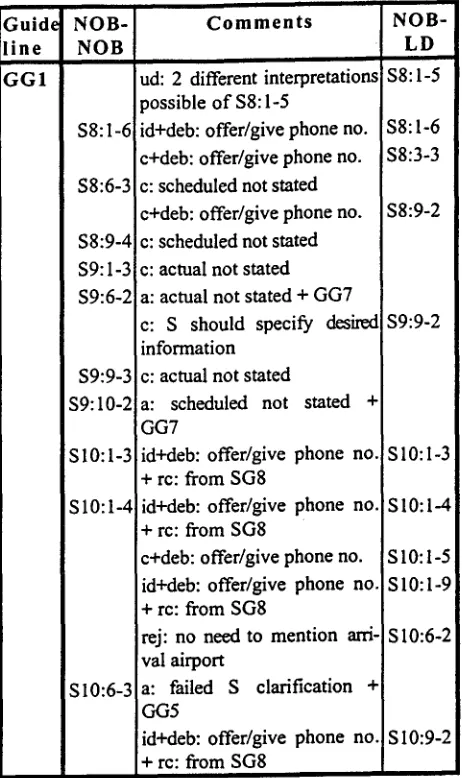
F i g u r e 3. Table o f claimed violations o f GGI. NOB- NOB is NOB's annotation o f the NOB sub-corpus. LD- NOB is LD's annotation o f that sub-corpus. The table contains 18 cases o f which 16 are agreed violations of GG1 (id, c and a), one is undecidable (ud) and one was rejected (rej). The table shows that 4 cases were reclassi- fied (re), that the two cases o f alternative classifications involved GG1 and GG7, and that an agreed classification involved a debate on a component issue (id/c+deb).
two analysers, each violation being characterised, in addition, by its unique utterance identifier, its status descriptor and a brief description (Figure 3).
O f the 384 claimed guideline violations, 344 were agreed upon as constituting actual guideline violations, comprising the status descriptors identity, complemen- tarity, consequence violations, user symptoms, altema- tives, reclassification (re) and reclassification (rce). 40 claimed guideline violations were undecidable, not agreed upon or jointly rejected by the analysers. These figures are not very meaningful in themselves, however, be- cause many identified design guideline violations were identical. This is illustrated in Figure 3 in which the
case of offer/give phone no. recurs no less than 8 times.
[image:5.612.323.554.47.436.2] [image:5.612.74.312.49.288.2]the phone number o f an alternative information service when it was not itself able to provide the desired infor- mation, instead of merely telling users to ring that alter- native service. The analysers disagreed, however, on whether the system should start by offering the phone number or provide the phone number right away (of. deb in Figure 3), What we need as SLDS developers is not a tool which tells us many times of the same dialogue design error but a tool which helps us find as many dif- ferent dialogue design errors as quickly as possible. We take this to mean that w h e n a n n o t a t i n g s p o k e n dialogue transcriptions, it c a n b e w a s t e o f t i m e a n d e f f o r t to a n n o -
tate the s a m e design error t w i c e . A single annotation,
once accepted, will lead to a different and improved de,-
Guide- No. of agreed No. of
l i n e v i o l a t i o n s t y p e s
i
G G I 16+11 6
' :~"~" G
~,~S ,1 Not relevant in information Svs2!:,, /~;: :,?,~,~
S G 2
G G 2
6+10 3
2+1 3
G G 3 8+7 I
G G 4 1+0 1
G G 5 8+5 6
G G 6 I+2 2
G G 7 I 7+9 7
S G 3 30+39!' 1
. . . r e s p e c t ... . . . . ,,:: ~ ... ~: : , . : ii~:",i.~5!:Y '<::~:/
The:~sys,.eFm Is Suceessful~in thiSg <~;.,,a,**:,~
G G 10 Massively violated in SG4 and
SG5
I
S G 4 21+18 1
S G 5 15+20 1
. . . . r< ;.;=.,~C>~:
G G 12 Violated in SG8 I
S G 8 6+3 1
T h e system~ understands >: .:: : ; ~ :' :~ :~ :~:: "~
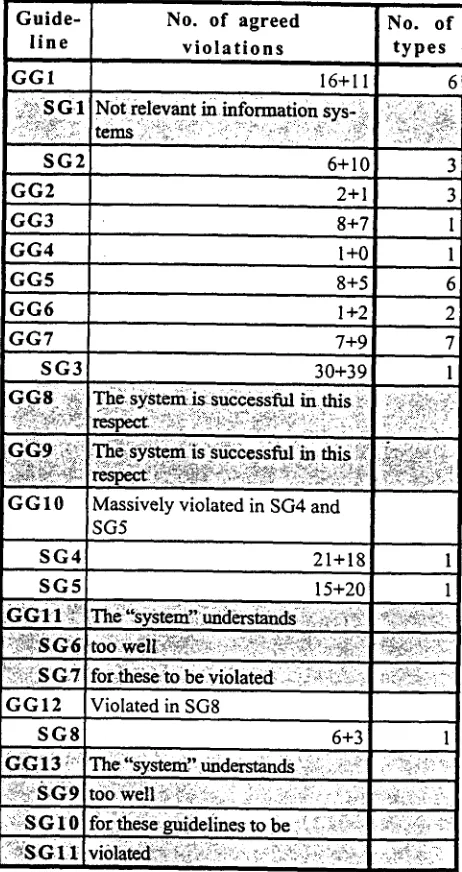
F i g u r e 4. Cases and types o f dialogue design errors sorted by guideline violated. Note that Figure 4 does not include the cases and types that were either undecidable, disagreed, or rejected (see Figure 5).
sign. However, if resource limitations enforce restric- tions on the number o f dialogue design errors which can be repaired, the number and severity o f the different dia- logue design errors will have to be taken into account.
Following the reasoning o f the preceding paragraph, the analysers proceeded to distil the different types of guideline violations or dialogue design errors identified in the corpus. This led to a much simpler picture, as shown in Figure 4.
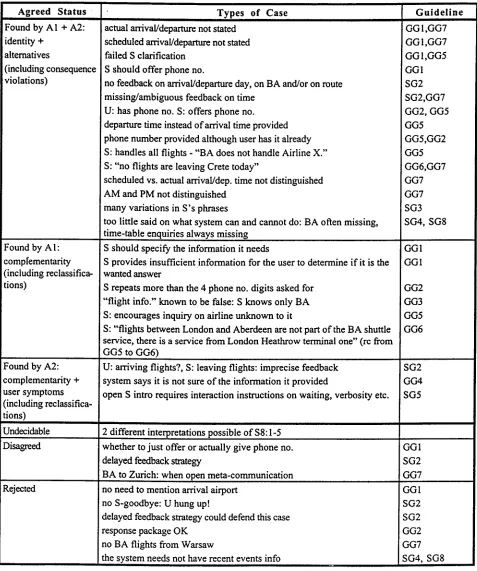
Figure 5 shows the nature o f the types o f guideline violation referred to in Figure 4 as well as the types that were undecidable, disagreed upon or rejected. It should be noted that the term "type" is in this context rather vague. Some o f the types o f guideline violation in Fig- ure 5 are very important to the design o f a habitable human-system spoken dialogue, such as the demand for a more informative opening presentation o f what the system can and cannot do, others are of less importance because they appear to be rather special cases, such as when the system offers a phone number to a user who already told the system that s/he had this phone number; some types cover a wealth o f different individual cases, such as the many differences in phrasing the same mes- sage to the user, others cover just a single case or a number of identical cases; and, o f course, some types are more difficult to repair than others. However, common to all these guideline violations is that they should be remedied in the implemented system if at all possible.
Jointly, Figures 4 and 5 show that 15 guideline vio- lation types were found by both analysers, 9 types were found by one analyser only, one type, in fact, a single case, was undecidable on the evidence provided by the transcription, 3 types were disagreed upon, and 6 types were rejected during the consensus discussion, No types were found that demanded revision or extension o f the guidelines. The Sundial corpus was analysed by two of the DET tool developers. It cannot be excluded, there- fore, that others might in the corpus have found types that demanded revision or extension of the guidelines. This will have to be tested in a future exercise. How- ever, on the evidence provided, the guidelines generalise well to a different d i a l o g u e and t a s k t y p e (el. Section 3). We also found that the guidelines generalise well to the different test type~tool p u r p o s e pair of the Sundial cor- pus. In fact, it is not much different to use the guide- lines for early evaluation during WOZ and using the guidelines for diagnostic evaluation of an implemented system. In both cases, one works with transcribed data to which the guidelines are then applied.
[image:6.612.81.312.238.674.2]A g r e e d S t a t u s
Found by AI + A2: identity +
alternatives
(including consequence violations)
F o u n d by A 1: complementarity (including reclassifica- tions)
Found by A2: complementarity + user symptoms (including reclassifica- tions)
Undecidable
Disagreed
• T y p e s o f Case
actual arrival/departure not stated scheduled arrival/departure not stated failed S clarification
S should offer phone no.
no feedback on arrival/departure day, on BA and/or on route missing/ambiguous feedback on time
U: has phone no. S: offers phone no.
departure time instead of arrival time provided phone number provided although user has it already S: handles all flights - "BA does not handle Airline X." S: "no flights are leaving Crete today"
scheduled vs. actual arrival/dep, time not distinguished AM and PM not distinguished
many variations in S's phrases
too little said on what system can and cannot do: BA often missing, time-table enquiries always missing
S should specify the information it needs
S provides insufficient information for the user to determine if it is the wanted answer
S repeats more than the 4 phone no. digits asked for "flight info." known to be false: S knows only BA S: encourages inquiry on airline unknown to it
S: "flights between London and Aberdeen are not part of the BA shuttle service, there is a service from London Heathrow terminal one" (rc from GG5 to GG6)
U: arriving flights?, S: leaving flights: imprecise feedback system says it is not sure o f the information it provided
open S intro requires interaction instructions on waiting, verbosity etc.
2 different interpretations possible o f $8:1-5
whether to just offer or actually give phone no. delayed feedback strategy
BA to Zurich: when open meta-cornrnunication
Rejected no need to mention arrival airport
no S-goodbye: U hung up!
delayed feedback strategy could defend this case response package OK
no BA flights from Warsaw
the system needs not have recent events info
Figure 5. Cases and types o f dialogue design errors sorted by guideline violated.
G u i d e l i n e
GGI,GG7 GG1,GG7 GGI,GG5 GG1 SG2 SG2,GG7 GG2, GG5 GG5 GG5,GG2 GG5 GG6,GG7 GG7 GG7 SG3 SG4, SG8
GG1 GGI
GG2 GG3 GG5 GG6
SG2 GG4 SG5
GG1 SG2 GG7
GGI SG2 SG2 GG2
I
G G 7 SG4, SG8
As to (a), the comparatively high number o f guideline violation types found by one analyser but not by the other, i.e. 9 types compared to the 15 types found by both analysers, either shows that we are not yet experts in applying the guidelines to novel corpora, or that the tool is inherently only "62.5 % objective". This needs further investigation. However, a different consideration
[image:7.612.77.554.55.626.2]other. In the present case, this number would be 4.5 guideline violation types. A single expert in using the tool would then find 19.5/24 or 8 1 % of the guideline violation types found by two analysers together. Still, we don't know how many new guideline violations a third expert might find and whether we would see rapid convergence towards zero new guideline violations. It would of course be encouraging if this proved to be the case. The 3 types disagreed upon and the 6 rejected types illustrate, we suggest, that dialogue design is not an exact science! Taken together, however, the 4.5 guide- line violation types added by the second analyser and the 9 disagreed or rejected types suggest the usefulness of having two different developers applying the tool to a transcribed corpus. Finally, the single undecidable case was one in which the (non-transcribed) prosody of what the user said might have made the difference. Following the system's statement that " I ' m sorry there are no flights leaving Crete today", the user asked "did you say there aren't any flights leaving Crete today?" One ana- lyser took the user's question to be a simple request to have the system's statement repeated, in which case no guideline violation would have been committed by the system. The other analyser took the user's question to be an incredulous request for more information ("did you say there A R E N ' T ANY flights leaving Crete today?"), in which case the system's subsequent reply "Yes" would have been a violation of GG 1.
As to (b), Figure 5 shows that the two analysers produced several alternative classifications. It should be noted, however, that the number o f these disagreements has been exaggerated by the data abstraction that went into the creation o f a small number of types as shown in Figures 4 and 5. In fact, alternative classifications were only made in 7 cases. It appears to be a simple fact that there will always be data on guideline violation which legitimately may be classified in different ways. Depend- ing on the context, the fact that the system says too little about what it can and cannot do can be a violation o f either SG4 or SG8. I f it says so up front, this is an SG4 but if it later demonstrates that it has said too lit- tle, this should be an SG8 but it is comparatively in- nocuous if an analyser happens to classify the violation as an SG4. GG1 (say enough) and GG7 (don't be am- biguous) are sometimes two faces of the same coin: if you don't say enough, what you say may be ambiguous. Similarly G G I (say enough) and GG5 (be relevant), may on occasion be two faces o f the same coin: if you don't say enough, what you actually do say may be irrelevant. The same applies to GG2 (superfluous information) and GG5 (relevance): superfluous information may be irrele- vant information. SG2 (provide feedback) and GG7 (don't be ambiguous) may also overlap in particular cases: missing feedback on, e.g., time may imply that the utterance becomes ambiguous. Finally, GG6 (avoid obscurity) and GG7 (don't be ambiguous) may on occa- sion be difficult to distinguish: obscure utterances some- times lend themselves to a variety of interpretations.
6. Conclusion and F u t u r e W o r k
We find the results reported in this paper encouraging. The tool has generalised well to the Sundial corpus and some amount of objectivity has been demonstrated with respect to type identification and classification. As this was out first attempt at using the tool independently of one another, we intend to repeat the exercise using the insights gained. Two times 15 Sundial dialogues will be used for the purpose. Following that, we plan to repeat the experiment with a small sub-corpus o f the Philips corpus which comprises 13.500 field test dialogues con- ceming train timetable information (Aust et al. 1995). This will add a new dialogue and task type, as well as the new circumstances o f a field trial to the generality test of the tool. If and when convincing generality and a satisfactory degree of objectivity in using DET have
been achieved, a final transfer problem must be ad-
dressed. This problem concerns how to transfer DET to other developers in some "packaged" form which does not assume person-to-person tuition. This should enable other SLDS developers to quickly and efficiently learn to use DET at the same level o f objectivity as has been achieved during the tests o f the tool. Only then will DET be ready for inclusion among the growing number o f dialogue engineering best practice development and evaluation tools. As a first step in addressing the transfer problem, we have recently included a DET novice in the team. He is an experienced computational linguist but with little experience in SLDS development. We are investigating what it takes to make him an expert in using DET by having him analyse the same Sundial sub-corpus as was reported on above and we hope that he will participate in the planned second Sundial sub- corpus exercise. Following these steps, the final task will be to define an explicit and simple training scheme for how to become an expert in using the tool.
R e f e r e n c e s
Aust, H., Oerder, M., Seide, F. and Steinbiss, V.: The Phil- ips Automatic Train Timetable Information System.
Speech Communication 17, 1995, 249-262.
Bernsen, N.O., Dybkj~er, H. and Dybkj~r, L.: Cooperativ- ity in human-machine and human-human spoken dia- logue. Discourse Processes, Vol. 21, No. 2, 1996, 213-
236.
Bernsen, N.O., Dybkjaer, H. and Dybkj~er, L.: What should your speech system say to its users, and how? Guide- lines for the design of spoken language dialogue sys-
tems. To appear in IEEE Computer, 1997a.
Bemsen, N.O., Dybkj~er, H. and Dybkja~r, L.: Designing Interactive Speech Systems. From First Ideas to User Testing. Springer Verlag, to appear, 1997b.
Grice, P.: Logic and conversation. In Cole, P. and Morgan, J.L., Eds. Syntax and Semantics, Vol. 3, Speech Acts,
New York, Academic Press, 1975, 41-58.