E x t e n d i n g a thesaurus by classifying words
Tokunaga
T a k e n o b u F u j i i A t s u s h iSakurai Naoyuki
T a n a k a H o z u m iD e p a r t m e n t o f C o m p u t e r S c i e n c e T o k y o I n s t i t u t e o f T e c h n o l o g y
take~cs, t i t ech. ac. j p
I w a y a m a M a k o t o
A d v a n c e d R e s e a r c h L a b . H i t a c h i L t d .
A b s t r a c t
This paper proposes a method for extending an existing thesaurus through classification of n e w words in terms of that thesaurus. N e w words are classified on the basis of relative probabili- ties of.a word belonging to a given word class, with the probabilities calculated using noun- verb co-occurrence pairs. Experiments using the Japanese
Bunruigoihy5
thesaurus on about 420,000 co-occurrences showed that new words can be classified correctly with a m a x i m u m ac- curacy of more than 80%.1 I n t r o d u c t i o n
For most natural language processing (NLP) systems, thesauri comprise indispensable linguistic knowledge.
Roger's International Thesaurus [Chapman, 1984] and
WordNet [Miller et al., 1993] are typical English the- sauri which have been widely used in past NLP re- search [Resnik, 1992; Yarowsky, 1992]. They are hand- crafted, machine-readable and have fairly broad cover- age. However, since these thesauri were originally com- piled for human use, they are not always suitable for computer-based natural language processing. Limita- tions of handcrafted thesauri can be summarized as fol- lows [Hatzivassiloglou and McKeown, 1993; Uramoto, 1996; Hindle, 1990].
• limited vocabulary size • unclear classification criteria
• building thesauri by hand requires considerable time and effort
The vocabulary size of typical handcrafted thesauri ranges from 50,000 to 100,000 words, including general words in broad domains. From the viewpoint of NLP systems dealing with a particular domain, however, these thesauri include many unnecessary (general) words and do not include necessary domain-specific words.
The second problem with handcrafted thesauri is that their classification is based on the intuition of lexicogra- phers, with their classification criteria not always being clear. For the purposes of NLP systems, their classifi- cation of words is sometimes too coarse and does not provide sufficient distinction between words, or is some times unnecessarily detailed.
Lastly, building thesauri by hand requires significant amounts of time and effort even for restricted domains. Furthermore, this effort is repeated when a system is ported to another domain.
This criticism leads us to automatic approaches for building thesauri from large corpora [Hirschman et al., 1975; Hindle, 1990; Hatzivassiloglou and McKeown, 1993; Pereira et al., 1993; Tokunaga et aL, 1995; Ush- ioda, 1996]. Past attempts have basically taken the fol- lowing steps [Charniak, 1993].
(1) extract word co-occurrences
(2) define similarities (distances) between words on the basis of co-occurrences
(3) cluster words on the basis of similarities
The most crucial part of this approach is gathering word co-occurrence data. Co-occurrences are usually gath- ered on the basis of certain relations such as predicate- argument, modifier-modified, adjacency, or mixture of these. However, it is very difficult to gather sufficient co-occurrences to calculate similarities reliably [Resnik, 1992; Basili et al., 1992]. It is sometimes impractical to build a large thesaurus from scratch based on only co-occurrence data.
Based on this observation, a third approach has been proposed, namely, combining linguistic knowledge and co-occurrence data [Resnik, 1992; Uramoto, 1996]. This approach aims at compensating the sparseness of co~ occurrence data by using existing linguistic knowledge, such as WordNet. This paper follows this line of research and proposes a method to extend an existing thesaurus by classifying new words in terms of that thesaurus. In other words, the proposed method identifies appropriate
word classes of the thesaurus for a new word which is not included in the thesaurus. This search process is fa- cilitated based on the probability that a word belongs to a given word class. The probability is calculated based on word co'occurrences. As such, this method could also suffer from the data sparseness problem. As Resnik pointed out, however, using the thesaurus struc- ture (classes) can remedy this problem [Resnik, 1992].
2 C o r e t h e s a u r u s
Bunruigoihy$
(BGH for short) [Hayashi, 1966] is a typ- ical Japanese thesaurus, which has been used for much NLP research on Japanese. BGH includes 87,743 words, each of which is assigned an 8 digit class code. Some words are assigned more than one class code. The cod- ing system of BGH has a hierarchical structure, that is, the first digit represents the part(s) of speech of the word (1: noun, 2:verb, 3: adjective, 4: others), and the second digit classifies words sharing the same first digit and so on. Thus BGH can be considered as four trees, each of which has 8 levels in depth (see figure 1), with each leaf as a set of words.1 2 3 4
. 1 . 1 . . ~ r b ) (a~) (otheO
11 12 13 14 15
! | ! | ~
/ f i f ~ x x ~. 158
8levels !
1500 ... 1509
15000 °°° 15004
150040 °.. 150049
words words
Fig. 1 Structure of Bunruigoihy6 (BGH)
This paper focuses on classifying only nouns in terms of a class code based on the first 5 digits, namely, up to the fifth level of the noun tree. Table 1 shows the number of words (#words) and the number of 5 digit class codes (#classes) with respect to each part of speech.
T a b l e 1 Outline of Bunruigoihy3 (BGH)
POS noun I verb adj other total #words 55,443 i 21,669 9,890 741 87,743
~classes 544 165 190 24 842
3 C o - o c c u r r e n c e d a t a
Appropriate word classes for a new word are identi- fied based on the probability that the word belongs to different word classes. This probability is calculated
based on co-occurrences of nouns and verbs. The co- occurrences were extracted from the RWC text base RWC-DB-TEXT-95-1 [Real World Computing Partner- ship, 1995]. This text base consists of 4 years worth of Mainiti Shimbun [Mainichi Shimbun, 1991-1994] news- paper articles, which have been automatically annotated with morphological tags. The total number of mor- phemes is about 100 million. Instead of conducting full parsing on the texts, several heuristics were used in or- der to obtain dependencies between nouns and verbs in the form of tuples (frequency, noun, postposition, verb). Among these tuples, only those which include the post- position "WO" (typically marking accusative case) were used. Further, tuples containing nouns in BGH were se- lected. In the case of a compound noun, the noun was transformed into the maximal leftmost string contained in BGH 1. As a result, 419,132 tuples remained includ- ing 23,223 noun types and 9,151 verb types. These were used in the experiments described in section 5.
4 I d e n t i f y i n g a p p r o p r i a t e w o r d c l a s s e s
4.1 P r o b a b i l i s t i c m o d e l
The probabilistic model used in this paper is the SVMV model [Iwayama and Tokunaga, 1994]. This model was originally developed for document categorization, in which a new document is classified into certain prede- fined categories. For the purposes of this paper, a new word (noun) not appearing in the thesaurus is treated as a new document, and a word class in the thesaurus corresponds to a predefined document category. Each noun is represented by a set of verbs co-occurring with that noun. The probability P(c, Iw) is calculated for each word class c,, and the proper classes for a word w are determined based on it. The SVMV model formalizes the probability P(clw ) as follows.
Conditioning P(clw ) on each possible event gives
P(clw) = ~ P(clw, V = v,)P(V = v, lw).
(1)O,
Assuming conditional independence between c and V = v, given w, that is P(clw, V = %) = P(clV = v,), we obtain
P(clw) = Z
P(c]V = vOP(V = %[w).
(2)Using Bayes' theorem, this becomes
P(clw ) = P(c) E P ( V = v, lc)P(V
= v, lw)~, P ( V = v,) (3)
All the probabilities in (3) can be estimated from train- ing data based on the following equations. In the follow- ing, fr(w, v) denotes the frequency that a noun w and a verb v are co-occurring.
[image:2.612.43.281.310.490.2] [image:2.612.44.270.606.666.2]P ( V = v~lc ) is the probability that a randomly ex- tracted verb co-occurring with a noun is v~, given that the noun belongs to word class c. This is estimated from the relative frequency of v~ co-occurring with the nouns in word class c, namely,
E eo/r(w,v,)
(4)
P ( v =
,lc) = E, Ewe°
P ( V = v, lw ) is the probability that a randomly ex- tracted verb co-occurring with a noun w is vs. This is estimated from the relative frequency of v, co-occurring with noun w, namely,
P(V =
=
(5)
P ( V = v,) is the prior probability that a randomly ex- tracted verb co-occurring with a randomly selected noun is v~. This is estimated from the relative frequency of v~ in the whole training data, namely,
(6)
P(v
P(c) is the prior probability that a randomly selected noun belongs to c. This is estimated from the relative frequency of a verb co-occurring with any noun in class c 2, namely,
P(c) =
EwEoE
Eo E eo
(7)
4 . 2 S e a r c h i n g t h r o u g h t h e t h e s a u r u s
As is documented by the fact that we employ the proba- bilistic model used in document categorization, classify- ing words in a thesaurus is basically the same as docu- ment categorization 3. Document categorization strate- gies can be summarized according to the following three types [Iwayama and Tokunaga, 1995].
• the k-nearest neighbor (k-nn) or Memory based rea- soning (MBR) approach
• the category-based approach
• the cluster-based approach
The k-nn approach searches for the k documents most similar to a target document in training data, and as- signs that category with the highest distribution in the k documents [Weiss and Kulikowski, 1991]. Although the
2This calculation seems be counterintuitive. A more straight- forward calculation would be one based on the relative frequency of words belonging to class c. However, the given estimation is nec- essary in order to normalize the sum of the probabilities P(clw ) to
one.
3As Uramoto mentioned, this task is also similar to word sense disambiguation except for the size of search space [Uramoto, 1996].
k-nn approach has been promising for document catego- rization [Masand et al., 1992], it requires significant com- putational resources to calculate the similarity between a target document and every document in training data. In order to overcome the drawback of the k-nn ap- proach, the category-based approach first makes a clus- ter for each category consisting of documents assigned the same category, then calculates the similarity between a target document and each of these document clusters. The number of similarity calculations can be reduced to the number of clusters (categories), saving on computa- tional resources.
Another alternative is the cluster-based approach, which first constructs clusters from training data by using some clustering algorithm, then calculates simi- larities between a target document and those clusters. The main difference between category-based and cluster- based approaches resides in the cluster construction. The former uses categories which have been assigned to documents when constructing clusters, while the latter does not. In addition, clusters are structured in a tree when a hierarchical clustering algorithm is used for the latter approach. In this case, one can adopt a top-down tree search strategy for similar clusters, saving further computational overhead.
In this paper, all these approaches are evaluated for word classification, in which a target document corre- sponds to a target word and a document category corre- sponds to a thesaurus class code.
5 E x p e r i m e n t s
In our experiments, the 23,223 nouns described in sec- tion 3 were classified in terms of the core thesaurus, BGH, using the three search strategies described in the previous section. Classification was conducted for each strategy as follows.
k - n n Each noun is considered as a singleton cluster, and the probability that a target noun is classified into each of the non-target noun clusters is calculated.
c a t e g o r y - b a s e d 10-fold cross validation was conducted for the category-based and cluster-based strategies, in that, 23,223 nouns were randomly divided into 10 groups, and one group of nouns was used for test data while the rest was used for training. The test group was rotated 10 times, and therefore, all nouns were used as a test case. The results were averaged over these 10 trials. Each noun in the training data was categorized according to its BGH 5 digit class code, generating 544 category clusters (see Table 1). The probability of each noun in the test data being classified into each of these 544 cluster was calcu- lated.
the 5 digit class categories 4. For the cluster-based approach, the nouns were also categorized into the intermediate class categories, that is, the 2 to 4 digit class categories. Since we use the BGH hierarchy structure instead of constructing a duster hierarchy from scratch, in a strict sense, this does not coincide with the cluster-based approach as described in the previous section. However, searching through the BGH tree structure in a top down manner still en- ables us to save greatly on computational resources.
A simple top down search, in which the cluster with the highest probability is followed at each level, al- lows only one path leading to a single leaf (5 digit class code). In order to take into account multi- ple word senses, we followed several paths at the same time. More precisely, the difference between the probability of each cluster and the highest prob- ability value for that level was calculated, and clus- ters for which the difference was within a certain threshold were left as candidate paths. The thresh- old was set to 0.2 in this experiments.
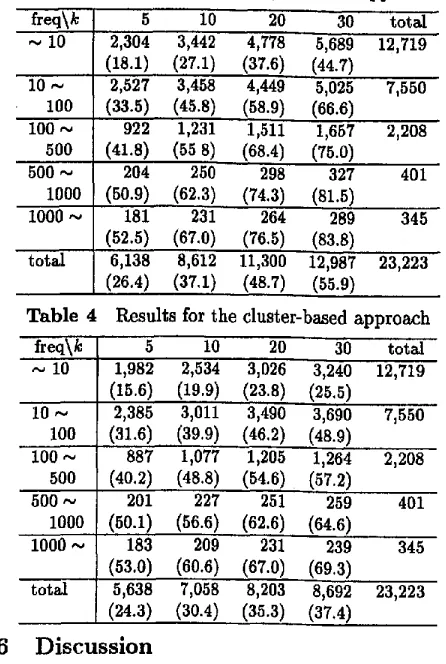
The performance of each approach was evaluated on the basis of the number of correctly assigned class codes. Tables 2 to 4 show the results of each approach. Columns show the maximum number of class codes assigned to each target word. For example, the column "10" means that a target word is assigned to up to 10 class codes. If the correct class code is contained in these assigned codes, the test case is considered to be assigned the cor- rect code. Rows show the distribution word numbers on the basis of occurrence frequencies in the training data. Each value in the table is the number of correct cases with its percentage in the parentheses.
T a b l e 2 Results for the k-nn approach
freq\k 5 I0 20 30 total
,.~ 10 1,733 2 , 5 8 1 3 , 9 3 4 4 , 9 0 2 12,719 (13.6) (20.3) (30.9) (38.5)
10 N 1,817 2 , 6 3 8 3 , 5 9 4 4 , 2 3 1 7,550 100 ( 2 4 . 1 ) (34.9) (47.6) (56.0)
100 ,,~ 658 949 1 , 2 6 0 1 , 4 5 5 2,208 500 ( 2 9 . 8 ) (43.0) (57.1) (65.9)
500 N 132 199 254 300 401
1000 (32.9) (49.6) (63.3) (74.8)
1000 ~ 149 187 236 264 345
(43.2) (54.2) (68.4) (76.5)
total 4,489 6 , 5 5 4 9 , 2 7 8 11,152 23,223 (19.3) (28.2) (40.0) (48.0)
4Note that we ignore lower digits, and therefore, lea] means the categories formed by 5 digit class code.
Table 3 Results for the category-based approach ~eq\k
,,~ I0
I0 I00 100 ,.~
500 500
i000 1000
total
5 10 20 30 total
2,304 3,442 4 , 7 7 8 5,689 12,719 (18.1) (27.1) (37.6) (44.7)
2,527 3,458 4 , 4 4 9 5 , 0 2 5 7,550 (33.5) (45.8) (58.9) (66.6)
922 1,231 1 , 5 1 1 1 , 6 5 7 2,208 (41.8) (55 8) (68.4) (75.0)
204 250 298 327
(50.9) (62.3) (74.3) (81.5)
181 231 264 289
(52.5) (67.0) (76.5) (83.8) 401
345
6,138 8,612 11,300 12,987 23,223 (26.4) (37.1) (48.7) (55.9)
Table 4 Results for the cluster-based approach
~eq\k 10
10 N 100 100 N 500 500 N
1000 1000 ,.~
5 10 20 30 total
1,982 2,534 3,026 3,240 12,719 (15.6) (19.9) (23.8) (25.5)
2,385 3,011 3,490 3 , 6 9 0 7,550 (31.6) (39.9) (46.2)(48.9)
8877 1,077 1,205 1 , 2 6 4 2,208 (40.2) (48.8) (54.6) (57.2)
201 227 251 259
(50.1) (56.6)(62.6) (64.6)
401
183 209 231 239
(53.0) (60.6) (67.0) (69.3)
345
total 5,638 7,058 8,203 8,692 23,223
(24.3) (30.4)
(35.3)
(37.4)
6
D i s c u s s i o n
Overall, the category-based approach shows the best per- formance, followed by the cluster-based approach, k-nn shows the worst performance. This result contradicts past research [Iwayama and Tokunaga, 1995; Masand
et al., 1992]. One possible explanation for this contra- diction may be that the basis of the classification for BGH and our probabilistic model is very different. In other words, co-occurrences with verbs may not have captured the classification basis of BGH very well.
The performance of k-nn is noticeably worse than that of the others for low frequent words. This may be due to data sparseness. Generalizing individual nouns by constructing clusters remedies this problem.
When b is small, namely only categories with high probabilities are assigned, the category-based and duster-based approaches show comparable performance. When k becomes bigger, however, the category-based approach becomes superior. Since a beam search was adopted for the cluster-based approach, there was a pos- sibility of falling to follow the correct path.
7 R e l a t e d w o r k
[image:4.612.301.524.54.386.2] [image:4.612.50.272.495.662.2]• The core thesaurus is different. Uramoto used ISAMAP [Tanaka and Nisina, 1987], which contains about 4,000 words.
• We adopted a probabilistic model, which has a sounder foundation than the Uramoto's. He used several factors, such as similarity between a target word and words in each classes, class levels and so forth. These factors are combined into a score by calculating their weighted sum. The weight for each factor is determined by using held out data.
• We restricted our co-occurrence data to that in- cluded the "WO" postposition, which typically marks the accusative case, while Uramoto used sev- eral grammatical relations in tandem. There are claims that words behave differently depending on their grammatical role, and that they should there- fore be classified into different word classes when the role is different [Tokunaga et al., 1995]. This viewpoint should be taken into account when we construct a thesaurus from scratch. In our case, however, since we assume a core thesaurus, there is room for argument as to whether we should con- sider this claim. Further investigation on this point is needed.
• Our evaluation scheme is more rigid and based on a larger dataset. We conducted cross validation on nouns appearing in BGH and the judgement of correctness was done automatically, while Uramoto used unknown words as test cases and decided the correctness on a subjective basis. The number of his test cases was 250, ours is 23223. The performance of his method was reported to be from 65% to 85% in accuracy, which seems better than ours. How- ever, it is difficult to compare these two in an ab- solute sense, because both the evaluation data and code assignment scheme are different. We identified class codes at the fifth level of BGH, while Uramoto searched for a set of class codes at various levels.
Nakano proposed a method of assigning a BGH class code to new words [Nakano, 1981]. His approach is very different from ours and Uramoto's. He utilized charac- teristics of Japanese character classes. There are three character classes used in writing Japanese, Kanzi, Hira- gana and Katakana. A Kanzi character is an ideogram and has a distinct stand-alone meaning, to a certain ex- tent. On the other hand, Hiragana and Katakana char- acters are phonograms. Nakano first constructed a Kanzi meaning dictionary from BGH by extracting words in- cluding a single Kanzi character. He defined the class code of each Kanzi character to the code of words includ- ing only that Kanzi. He then assigned class codes to new words based on this Kanzi meaning dictionary. For ex- ample, if the class codes of Kanzi Ks and K s are ~ 1 , c~2} and {c31 , c32 , c~3} respectively, then a word including K,
and K~ is assigned the codes
{Ctl,Cs2,C31,C32,C33 }.
We applied Nakano's method on the data used in section 55, obtaining the accuracy of 54.6% for 17,736 words. The average number of codes assigned was 5.75. His method has several advantages over ours, such as:• no co-occurrence data is required,
• not so much computational overhead is required.
However, there are obvious limitations, such as:
• it can not handle words not including Kanzi,
• ranking or preference of assigned codes is not ob- tained,
• not applicable to languages other than Japanese.
We investigated the overlap of words that were as- signed correct classes for our category-based method and Nakano's method. The parameter k was set to 30 for our method. The number of words that were assigned correct classes by both methods was 5,995, which repre- sents 46% of the words correctly classified by our method and 62% of the words correctly classified by Nakano's method. In other words, of the words correctly clas- sifted by one method, only about half can also be also classified correctly by the other method. This result sug- gests that these two methods are complementary to each other, rather than competitive, and that the overall per- formance can be improved by combining them.
8 C o n c l u s i o n
This paper proposed a method for extending an ex- isting thesaurus by classifying new words in terms of that thesaurus. We conducted experiments using the Japanese Bunruigoihy5 thesaurus and about 420,000 co- occurrence pairs of verbs and nouns, related by the WO
postposition. Our experiments showed that new words can be classified correctly with a maximum accuracy of more than 80% when the category-based search strategy was used.
We only used co-occurrence data including the WO re- lation (accusative case). However, as mentioned in com- parison with Uramoto's work, the use of other relations should be investigated.
This paper focused on only 5 digit class codes. This is mainly because of the data sparseness of co-occurrence data. We would be able to classify words at deeper lev- els if we obtained more co-occurrence data. Another approach would be to construct a hierarchy from a set of words of each class, using a clustering algorithm.
R e f e r e n c e s
[Basili
et al.,
1992] Basili, R., Pazienza, M., and
Velardi, P. Computational lexicons: The neat examples
and the odd exemplars. In
Proceedings of third
conference on Applied Natural Language Processing,
pp.
96--103.
[Chapman, 1984] Chapman, L. R.
Roger's International
Thesaurus (Fourth Edition).
Harper & Row.
[Charniak, 1993] Charniak, E.
Statistical Language
Learning.
MIT Press.
[Hatzivassiloglou and McKeown, 1993] Hatzivassiloglou,
V., and McKeown, K. R. Towards the automatic
identification of adjectival scales: Clustering adjectives
according to meaning. In
Proceedings of 31st Annual
Meeting of the Association for Computational
Linguistics,
pp. 172-182.
[Hayashi, 1966] Hayashi, O.
Bunruigoihy&
Syueisyuppan. (In Japanese).
[Hindle, 1990] Hindle, D. Noun classification from
predicate-argument structures. In
Proceedings of 28th
Annual Meeting of the Association for Computational
Linguistics,
pp. 268-275.
[Hirschman
et al.,
1975] Hirschman, L., Grishman, R.,
and Sager, N. Grammatically-based automatic word
class formation.
Information Processing 8I
Management, 11,
39-57.
[Iwayama and Tokunaga, 1994] Iwayama, M., and
Tokunaga, T. A probabilistic model for text
categorization: Based on a single random variable with
multiple values. In
Proceedings of 4th Conference on
Applied Natural Language Processing.
[Iwayama and Tokunaga, 1995] Iwayama, M., and
Tokunaga, T. Cluster-based text categorization: A
comparison of category search strategies. In
Proceedings of A CM SIGIR'95,
pp. 273-280.
[Masand
et aL
1992] Masand, B., Linoff, G., and Waltz,
D. Classifying news stories using memory based
reasoning. In
Proceedings of ACM SIGIR '9~,
pp.
59-65.
[Miller
et al.,
1993] Miller, G. A., Bechwith, R.,
Fellbaum, C., Gross, D., Miller, K., and Tengi, R. Five
Papers on WordNet. Tech. rep. CSL Report 43,
Cognitive Science Laboratory, Princeton University.
Revised version.
[Nakano, 1981] Nakano, H. Word classification support
system.
IPSJ-SIGCL, 25.
[Pereira
et al.,
1993] Pereira, F., Tishby, N., and Lee, L.
Distributional clustering of English words. In
Proceedings of 31st Annual Meeting of the Association
for Computational Linguistics,
pp. 183-190.
[Real World Computing Partnership, 1995] Real World
Computing Partnership. RWC text database.
http ://www. rwcp. or. j p/wswg, html.
[Resnik, 1992] Resnik, P. A class-based approach to lexical discovery. In
Proceedings
of 30th Annual
Meeting of the Association for Computational
Linguistics,
pp. 327-329.
[Mainichi Shimbun, 1991-1994] Mainichi Shimbun
CD-ROM '91-'94.
[Tanaka and Nisina, 1987] Construction of a thesaurus
based on superordinate/subordinate relations.
IPSJ-SIGNL, NL64-~,
25-44. (In Japanese).
[Tokunaga et
aL,
1995] Tokunaga, T., Iwayama, M.,
and Tanaka, H. Automatic thesaurus construction
based on grammatical relations. In
Proceedings off
IJCAI '95,
pp. 1308-1313.
[Uramoto, 1996] Uramoto, N. Positioning unknown
words in a thesaurus by using information extracted
from a corpus. In
Proceedings of COLING '96,
pp.
956-961.
[Ushioda, 1996] Ushioda, A. Hierarchical clustering of
words. In
Proceedings off COLING '96,
pp. 1159-1162.
[Weiss and Kulikowski, 1991] Weiss, S. M., and
Kulikowsld, C.
Computer Systems That Learn.
Morgan
Kaufmann.
[Yarowsky, 1992] Yarowsky, D. Word-sense
disambiguation using statistical models of Roget's
categories trained on large corpora. In
Proceedings of