Simple Large-scale Relation Extraction from Unstructured Text
Christos Christodoulopoulos, Arpit Mittal
Amazon Research Cambridge{chrchrs, mitarpit}@amazon.co.uk
Abstract
Knowledge-based question answering relies on the availability of facts, the majority of which cannot be found in structured sources (e.g. Wikipedia info-boxes, Wikidata). One of the major components of extracting facts from unstructured text is Relation Extraction (RE). In this paper we propose a novel method for creating distant (weak) supervision labels for training a large-scale RE system. We also provide new evidence about the effectiveness of neural network approaches by decoupling the model architecture from the feature design of a state-of-the-art neural network system. Surprisingly, a much simpler classifier trained on similar features performs on par with the highly complex neural network system (at 75x reduction to the training time), suggesting that the features are a bigger contributor to the final performance.
Keywords:relation extraction, distant supervision, unstructured text
1.
Introduction
Knowledge-based question answering relies on the avail-ability of facts – usually in the form of triples, stored in large-scale knowledge bases (KBs) e.g. Freebase (Bol-lacker et al., 2008), DBPedia (Auer et al., 2007). There are two main sources of facts for such a KB: structured data (e.g. Wikipedia info-boxes, Wikidata) or unstructured text. Undeniably, the former type of knowledge extraction is very accurate and has been the main source of knowledge behind the major industrial knowledge bases. However, the facts extracted from structured sources cover a limited set of high-importance relations, leaving a large number of them implicitly (or explicitly) mentioned in unstructured text (McCallum, 2005).
In order to ground the following presentation, we will present a typical problem from the factual knowledge ex-traction domain with the following unstructured text from a Wikipedia page:
“Carrie Fisher wrote several
semi-autobiographical novels, including Postcards from the Edge.”
The purpose of a fact extraction system is to extract the fol-lowing facts of the form ofpredicate(subject,object):
instance of (postcards from the edge, novel), and au-thor of (postcards from the edge, carrie fisher), where the first part is arelation, and the other parts are the left and rightentitiesparticipating in that relation.
Typically three tasks are involved in generating facts: En-tity Recognition, EnEn-tity Resolution (or EnEn-tity Linking), and Relation Extraction (RE). Entity Recognition and Resolu-tion deal with the task of translating surface strings to KB entities. This includes nominal or pronominal coreference resolution: we should be able to extract the same entity even if the text stated that ‘Fisher wrote. . . ’ (instead of resolving e.g. to Bobby Fisher) or ‘She wrote. . . ’ (pro-vided that Carrie Fisher’s name was mentioned in a previ-ous sentence). Relation Extraction extracts relation triples (or facts) involving those entities with appropriate relations (also part of the KB schema). Each of these components
could be built and operated in isolation, but they affect the performance of each other.
In this paper, we examine the task of RE focusing on ex-tracting knowledge to enrich a large-scale KB (∼billions of facts). We consider a state-of-the-art model that has been applied to hyponymy detection and present a thorough anal-ysis of its application to datasets derived from Wikidata and Alexa KB, a proprietary large-scale triple KB that powers Amazon’s Alexa. We also present a new way of generating distant supervision for relation extraction with a simple yet effective way of reducing the noise for the entity resolution.
2.
Related work
Relation Extraction is the NLP task of extracting struc-tured semantic relations between entities from natural (un-structured) text. Formally, it can be defined as identify-ing semantic relations between (resolved) entities and nor-malise these relations by mapping them to a predefined KB schema. In the NLP community, the RE task evolved out of the Information Extraction projects like MUC in the 1990s (see Chinchor et al. (1993) for an overview) and ACE in the 2000s (Doddington et al., 2004). In both projects the main focus was the automatic extraction of events rather than relations (the main difference being that an event is a special type of fact that involves actor entities and occurs at a specific time point) in a limited set of domains (e.g. bombings, company mergers, etc.). This meant that in both projects the number of relations marked for extraction was very limited (3 relations in MUC and 24 in ACE with 7k relation instances for 40k entity mentions).
of an SVM-based RE system. The work of Shwartz et al. (2016), that we closely follow, is also using both semantic and syntactic features, by combining the dependency paths between entities, with word embedding representations of both the entities and the lemmas in the dependency paths. Another related area is relation extraction for Open Infor-mation Extraction (OpenIE). Some of the more represen-tative projects in the area, like Reverb (Fader et al., 2011) and more recently ClauseIE (Del Corro and Gemulla, 2013) use syntactic information (PoS tagging / chunking, and de-pendency parsing respectively) to extract entity and relation phrases. However, unlike OpenIE, we are interested in nor-malized entities and relations (i.e. that map to a knowledge base).
In this work, we follow a common way of producing train-ing examples for RE is to usedistant supervision(Craven et al., 1999; Mintz et al., 2009): the assumption is that if any sentence mentions two entities which we know (from a KB) participate in a specific relation, that sentence must be evidence for that relation. In the area of distant supervi-sion, there are two relevant research directions. The first is to use it for directly enriching KBs from unstructured text, as well as leverage the KBs to generate the distant super-vision labels (Poon et al., 2015; Parikh et al., 2015). The second direction attempts to reduce the noise in distant su-pervision labels. A first line of approaches, starting with Data Programming (Ratner et al., 2016), uses generative models to combine multiple sources of weak supervision (e.g. automatically extracted from a KB, rules generated by experts etc.) in order to predict disagreements and over-laps between them and create a noise-aware posterior dis-tribution of predictions. An extension of this approach is Socratic Learning (Varma et al., 2017) which uses the dif-ferences in the predictions of the generative model and the main classification system to discover discriminating fea-tures and add them back to the generative model. As these approaches require multiple sources of weak supervision, we examine another line of projects which works by aggre-gating the support sentences1for each entity pair (Riedel et
al., 2010; Hoffmann et al., 2011). This is the approach that Shwartz et al. (2016) and the current work follow.
2.1.
HypeNET
A recent paper (Shwartz et al., 2016) proposed HypeNET, a new method for RE that integrated dependency path infor-mation with distributional semantic vector representation of the entities. The authors applied this method to extract hy-ponyms (i.e. instance of relations) and also made a new version of their system publicly available.2 The training
examples used (entity/relation triples) come from a num-ber of sources like WordNet (Miller, 1995), Yago (Hoffart et al., 2013), DBPedia and Wikidata, and the source of the linguistic features (part-of-speech tags, dependency paths, noun phrases) was the 2015 dump of Wikipedia, processed using the spaCy system3. Their proposed system achieved by far the best results on their dataset. Sinceinstance ofis
1
By support sentences we mean any sentence in the dataset that contains both entities.
2
https://github.com/vered1986/LexNET
3https://spacy.io
one of the most often used relations (most of the uses are implicit, during inference), we decided to investigate Hy-peNET as the base of our RE system.
The training examples used by the authors of HypeNET consisted of facts about only one relation. We wanted to build a system that works on multiple relations at a very large scale. Hence, in this work we use two different dataset sources: Wikidata, a publicly-available large-scale KB to aid reproducibility, as well as the larger Alexa KB, built by combining a hand-curated ontology with publicly avail-able data from Wikidata, Wikipedia, Freebase, DBPedia, and other sources.
3.
Distant supervision
Following the technique presented in Mintz et al. (2009), and the implementation in HypeNET, we needed to gener-ate training examples where entitiesXandY are connected by a relation in the KB and also appear together in the same sentence. When we applied the distant supervision tech-nique presented in HypeNET to our datasets (both Wikidata and Alexa KB) we got poor annotations (see Figure 4(top) for some examples from Alexa KB and section 6.1. for evaluation on both datasets). This could be attributed to the large volume of entities and their corresponding deno-tations in the KBs, which resulted in a number of ambigu-ous situations. For instance, “Chicago” could denote both thecityand thebroadway musical show. In the following section we present our new technique of filtering denota-tions used for Entity Resolution. This method allows our RE system to scale much better than the original method.
3.1.
Page-specific gazetteers
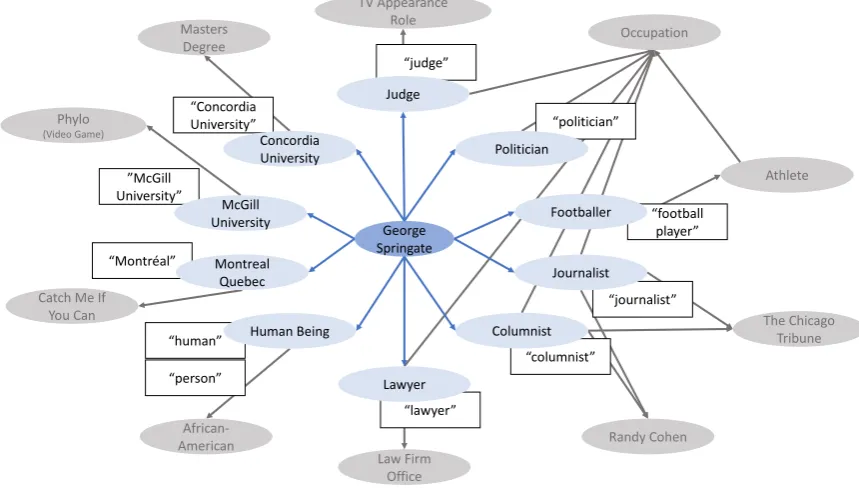
We created a new type of entity gazetteer, based on the main entity of a Wikipedia page, and the knowledge about that entity we have in the KB. The new system, presented on the top dashed box in Figure 1, starts with a Wikipedia URL, retrieves its corresponding ID from the KB for that URL (the main entity), and then extracts entities that are connected directly to the main entity (one-hop distance in the KB graph), by going through all the relations the main entity is involved in (except those involving string literals) and returning the entities on the other side of those rela-tions. For each of the related entities, we collect its denota-tional strings into a purpose-built gazetteer. Figure 2 shows an example KB subgraph for a target entity (in this case George Springate); it contains all the entities immediately connected to it with relations such as graduate ofor in-stance of. Also appearing in the graph, are the denotation strings for each one of the related entities.
Wikipedia
page KB
Main entity (KB ID) URL àKB ID
lookup Related entities ((KB IDs) x)
rel(x1, main)
rel(main, x2)
KB ID àDenotations
lookup Entity denotations (x+ main strings)
Wikipedia PoS TaggingChunking Entity denotations(surface forms) Gazetteers Entity pairs(KB IDs)
YES
NO
Positive Label
Negative Label Check against KB
(Bloom filters) Ontological
Constraints
Figure 1: The distant supervision pipeline with page-specific gazetteers. The grey box represents the entity resolution system of Shwartz et al. (2016).
George Springate
Occupation
“football player”
The Chicago Tribune
“journalist”
Law Firm Office
“person”
“lawyer” “human”
African-American Catch Me If
You Can
“Montréal”
Phylo
(Video Game)
”McGill University”
Masters Degree
“Concordia University”
“judge”
TV Appearance Role
“politician”
Athlete
“columnist” Montreal
Quebec
Human Being
Lawyer Concordia
University
McGill University
Politician Judge
Footballer
Journalist
Columnist
Randy Cohen
Figure 2: Example KB entry for George Springate. The lightly (blue) shaded ovals represent entities that are within one hop from the main entity and the white boxes are their denotations. The grey ovals represent entities that are two hops away.
3.2.
Annotation pipeline
The bottom half of Figure 1 presents the distant supervi-sion generation process adapted from Shwartz et al. (2016) to work with our data. In the original work, the text is pro-cessed to split and tokenise the sentences, tag the parts of speech and separate the noun phrases (NPs) – these are the candidate entities. They then construct the dependency path between each possible pair of entities. Each noun/NP pair is checked against the KB for distant supervision. keep only
The final step was to generate the annotation labels them-selves. To do that, we examine each possible pair of entities to see if they participate in the target relation. For the Wiki-data KB, we simply checked whether the target relation ex-isted as a property in the data. Considering the large size of Alexa KB, database lookup operations could be very ex-pensive. In order to speed up the lookup for eachX rel Y triple, we used two methods. First, before checking against the KB though, we ensure that the pair conforms with the class signature of the relation (‘Ontological Constraints’). For example, only ageographical locationcan be the left entity in thebirthplace ofrelation. Second, instead of re-lying on database queries, we used Bloom filters (Bloom, 1970) – a memory efficient probabilistic data structure that can be used to test if an entity is a member of a set. The compression value of a Bloom filter is governed by the ac-cepted false positive rate. We set the false positive rate to 0.001 for our experiments.
Since for any given pair of entities it is much more likely that they are not going to be related, we only keep a small fraction of the negative instances. Following Shwartz et al. (2016), we use a 4:1 negative to positive ratio.
4.
Isolating HypeNET features
To discover the effectiveness of the approach of Shwartz et al. (2016), we wanted to separate HypeNET’s neural archi-tecture from its input features and use those features with different (and simpler) classifiers. HypeNET’s main advan-tage is that it integrated dependency path features with dis-tributional information about the word lemmas along the path and left and right entities. As our goal was to generate discrete features to be used with more traditional classifiers, we opted for using Brown clusters (Brown et al., 1992) in-stead of the 50-dimensional GloVe vectors (Pennington et al., 2014) used by Shwartz et al. (2016). The Brown clus-ters were pre-trained on the Reuclus-ters Corpus Vol. 1 (Lewis et al., 2004) using 3,200 clusters.
After evaluating different feature configurations (see section 6.7.), the resulting features were as follows: for each entity pair and for each support, we extracted the de-pendency path between them and concatenated the lemma, 4-bit prefix of Brown cluster of the lemma, part of speech, dependency relation, and path direction information; to that we added the strings and 4-bit Brown cluster prefix of the left and right entities. The features from different supports were concatenated into one feature list. For example, given the following sentences containing the entity pair carrie fisher, star wars: “In 1977, Fisher starred in George Lucas’ film Star Wars”, and “Fisher became known for playing Princess Leia in the Star Wars film series”. The following is the full list of discrete features extracted, where each space-separated token is a distinct feature, and X and Y are used to replace the left and right entities:
Carrie Fisher/0111 X/0000/NOUN/nsubj/>
star/0011/VERB/ROOT in/1101/ADP/prep/<
film/0010/NOUN/pobj/< Y/0000/NOUN/appos/<
X/0000/NOUN/nsubj/> become/1111/VERB/ROOT
know/1111/VERB/acomp/< for/1101/APD/prep/<
play/1111/VERB/pcomp/< in/1101/APD/prep/<
Y/0000/NOUN/pobj/< Star Wars/0011
X/NOUN/nsubj/> be/VERB/ROOT/- Y/NOUN/attr/<
X/NOUN/dobj/> define/VERB/ROOT/- as/ADP/prep/< Y/NOUN/pobj/<
average
Figure 3: The HypeNET model architecture, reproduced from Shwartz et al. (2016).
4.1.
Using a MaxEnt classifier
In the first set of experiments, we used a standard Maxi-mum Entropy classifier from MALLET toolkit (McCallum, 2002) with the discrete features described above. The pa-rameters and settings were kept to their defaults (LBFGS optimizer, with a Gaussian prior variance of 1).
4.2.
Using the fastText model
Joulin et al. (2016) recently introduced fastText: a very ef-ficient classifier composed of a simple linear model with a rank constraint. The architecture of the system is very similar to that of Mikolov et al. (2013) except that instead of predicting the middle word in a window, the classifier is predicting a label. For fastText, the input features are token ngrams which are embedded into a single hidden value and fed into a hierarchical softmax classifier. For our experi-ments, we used fastText’s default settings, except for the number of ngrams, which we set to 4.
4.3.
Using the HypeNET model
The original version of HypeNET (Figure 3) combines the dependency path-based features with the distributional in-formation in its neural net architecture: for each entity pair, each support (dependency path) token is encoded by a set of embedding layers – one for each linguistic component – and passed into an LSTM layer. The LSTM layers for the whole path are merged by an average pooling layer and the distributional representation of the entities (via embedding layers) is added. Finally, a softmax layer makes a binary classification decision.
We implemented our own version of HypeNET code us-ing Keras (Chollet, 2015) and optimized the learnus-ing ob-jective using the Adam optimizer. We modified the basic HypeNET model by making the following changes: i) we allowed the training of word embeddings for lemmas (after initializing them with GloVe embeddings), ii) we replaced the uni-directional LSTM with bi-directional LSTM4.
5.
Evaluation
We want to examine a varied set of connections between the left and right entities, so in addition to theinstance of
relation (P31 in Wikidata) that connects objects to classes, we will examinebirthplace of(P19) that connects a loca-tion entity to a person entity, andpart of(P527) which links objects to their meronyms. When evaluating against Alexa
4The performance of the resulting model was slightly better on
His studies were interrupted by army service and at theendof thewarhe was forced to return. . .
instance of (the second world war, cause of death)
In theintroto thesong, Fred Durst makes reference to. . .
instance of (intro 15367, song)
Turner also released onealbumand severalsinglesunder the moniker Repeat.
instance of (the singles the 2011 album, album)
Call Your Girlfriendwas written by Robyn, Alexander Kronlund and Klas ˚Ahlund, with the latter producing thesong.
instance of (call your girlfriend 3, song)
Forget Heris asongby Jeff Buckley.
instance of (forget her, song)
TheSubei Mongol Autonomous Countyis an autonomouscountywithin the prefecture-level city of Jiuquan in the northwestern Chinese province of Gansu.
instance of (subei mongol autonomous county, chinese county)
Figure 4: Entity resolution results for the distant supervision training data using Alexa KB and the original pre-processing system of Shwartz et al. (2016) (top), and the new page-specific gazetteers (bottom). The matched strings in the original sentences arehighlighted.
HypeNET fastText MaxEnt
Relation µ(F-score) σ µ(F-score) σ F-score
W
ikidata
instance of 93.90 0.21 96.44 0.01 58.45
birthplace of 92.06 0.90 93.05 0.07 66.72
part of 48.73 2.59 72.87 0.16 45.13
Ale
xa instance ofbirthplace of 94.2985.57 0.210.26 94.3187.63 0.030.01 83.9380.83
applies to 81.98 1.78 86.17 0.01 65.27
Table 1: Mean and standard deviation of the F-score values at 0.5 threshold across three trials for the Wikidata and Alexa KBs, using the MaxEnt, fastText, and HypeNET (our Keras implementation with word embeddings training and bi-directional LSTMs). The MaxEnt model did not have any variance across the trials.
KB, we replaced part of withapplies to, a relation that links an attribute to an object and has no correspondence in Wikidata. We will use the Wikidata KB as a first source of evaluation, and switch to the Alexa KB for a more in depth exploration.
We evaluate all models on a sample of 50K examples for training, 10K examples for validation and test respectively for all relations (except part offor which we could only collect 22K training examples). Each example is the col-lection of all the sentences supporting aX rel Y triple that have been annotated by the distant supervision system of section 3.. We examine the effect of grouping supports in section 6.4..
6.
Results and discussion
We ran each of the following experiments three times (with random initialization) to obtain a measure of variance for their results.
6.1.
Distant supervision
The goal of the method presented in section 3.1. was to reduce the number of false positives at the cost of
introduc-ing some amount of false negatives (due to missintroduc-ing enti-ties, missing denotations, or missing KB facts). In order to quantify the effect of the new method, we manually anno-tated 1,000instance ofdistant supervision examples pro-duced by our new method and the original method used by Shwartz et al. (2016). The original method yielded 67% false positive and 3% false negative examples; the page-specific gazetteer solution returned only 1% false positives and 39% false negatives. After more analysis, 62% of the false negatives (or 24% of the total examples) were cases were the KB contained thesubclass ofrelation, which we consider a separate relation (although in the data collected by Shwartz et al. (2016) from Yago and Wikidata it is con-flated withinstance of). The results are similar when using the Wikidata KB: around 1% false positives but only 5% false negatives5 of which 89% were cases where the KB
contained similar relations (likeoccupationfor people, or
taxonfor species).
Figure 4 presents a qualitative comparison of the two meth-ods on our KB. We can see that the two problems of
spuri-5The lower rate of false negatives can be partially attributed to
80 85 90 95
0 10000 20000 30000 40000 50000
Train Data Size
F−Score
Classifier HypeNET++ fastText classifier MaxEnt classifier
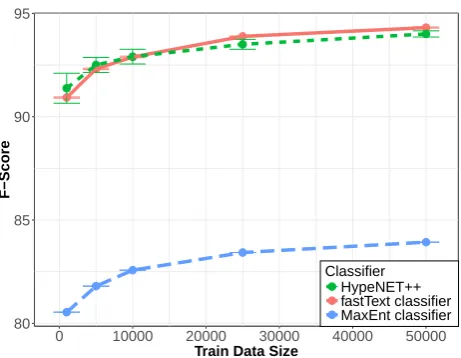
Figure 5: Effect of training data size on the Alexa KB dataset for theinstance ofrelation for HypeNET and fast-Text models at 0.5 confidence threshold.
ous entity matching (e.g. “end” tocause of death) and non-standard noun-phrase entities (e.g. “call your girl-friend”) have been successfully addressed by the page-specific gazetteer.
6.2.
Model comparison
The results comparing the performance and generalizabil-ity of the models (over the three relations) are shown in Table 1. The main takeaway from these results is that the more advanced architecture of HypeNET does not offer a significant advantage over that of fastText when used with (almost) the same input features. As an added benefit, the fastText classifier is dramatically faster than the HypeNET model, with a reduction of training time from around 75 minutes to less than a minute. However as the results of the MaxEnt model show, the features alone are not enough. It is fastText’s (and HypeNET’s) ability to create higher-dimensional representations of these discrete features that provide the best results.
6.3.
Training data size
Another parameter we wanted to explore was the impact of size of the training data since we plan to target relations with fewer training examples in the future. We evaluate the F-scores of the HypeNET, fastText, and MaxEnt models for theinstance ofrelation on the Alexa KB dataset.
The results are shown in Figure 5. Note that the numbers in the figure refer to entity pairs, not individual supports (sentences). As expected, the performance of all systems keeps increasing when more training examples are used, but there are two interesting observations to be made. The first is the relative variance of the fastText versus the HypeNET model, especially for the case of fewer than 25k examples. The second is that even with 1,000 training examples, the F-score of both HypeNET and fastText models is above 90%.
6.4.
Grouping supports
We also wanted to investigate the effect of grouping the supports (sentences) for each entity pair. As mentioned earlier (Section 2.), this had been proposed as a method
inst. of appl. to bp of
grouped 94.31 86.17 87.63
ungrouped 93.85 80.90 85.09
Table 2: Effect of grouping supports for eachX rel Y triple using the fastText classifier on the Alexa KB data (threshold of 0.5).
inst. of appl. to bp of
satellites 94.31 86.17 87.63
w/o satellites 93.69 85.85 84.42
Table 3: Effect of using dependency path satellite nodes for eachX rel Y triple using the fastText classifier on the Alexa KB data (threshold of 0.5).
to reduce noise in the distant supervision labels (Hoffmann et al., 2011). In Shwartz et al. (2016), the grouping was performed by the mean pooling layer; in the case of the fastText-based system, we simply concatenate the feature tokens from all the supports and feed them into the single hidden layer.
For each of the three relations, we ran the fastText model with and without grouping each entity pair’s supports, us-ing exactly the same features in both cases. The Table 2 presents the results. Interestingly, the effect oninstance of
is much smaller than on the other two relations. One pos-sible explanation could be that the page-specific gazetteer method is producing fewer false positives for that relation; more likely, the supports forbirthplace ofandapplies to
are more diverse than those ofinstance of, making their grouping more useful to the classifier.
6.5.
Using satellite nodes
We also looked at the role of the dependency pathsatellite nodes(words to the left and right of the entities). This type of features has also been adopted by various systems in-cluding Mintz et al. (2009) and Shwartz et al. (2016), and we wanted to establish a basis for its effectiveness across multiple relations. The results, shown in Table 3, show that the clearest advantage of the satellite nodes is for the birth-place ofrelation; for the other two the performance without satellite notes is marginally different. This suggests that the immediate context of the left and right entities is less infor-mative for theinstance ofandapplies torelations, possi-ble because of the more limited ways that the expression of these relations are syntactically constructed.
inst. of appl. to bp of
(1) 5 supports 94.55 86.26 87.56
all supports 94.33 85.92 87.63
inst. of appl. to bp of
(1)-Brown 94.20 85.93 87.51
(1)-lemma 94.17 84.15 86.65
(1)-POS 94.15 85.93 87.71
(1)-dep 93.59 85.42 86.53
(1)-X/Y entities 93.63 83.89 86.95
X/Y only 91.15 74.20 81.15
full sentence 86.70 77.77 87.09
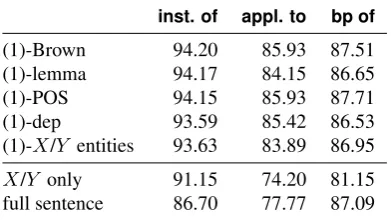
Table 5: F-score results for the three relations on the Alexa KB dataset. The baseline system (1) is the fastText classi-fier using the 5 most frequent supports for eachX rel Y triple, (1)-dep refers to the system with both the depen-dency relation and direction features removed, the last sys-tem uses all the (lowercased) words in each support as fea-tures.
6.6.
Using all supports
A comparison is made for the fastText models trained using the 5 most frequent supports for each triple with the ones trained using all available supports. As shown in Table 4, reducing the supports to the most frequent ones slightly in-creases the performance (except in the case ofbirthplace of) even though on average more than 18K training exam-ples, and more than 3K test examples contain more than 5 supports.
6.7.
Feature ablation
As a final step in our exploration, we wanted to mea-sure the impact of each of the features used by the system of Shwartz et al. (2016). Table 5 presents the feature abla-tion results on the Alexa KB data using the fastText classi-fier. We compare the full set of features presented in sec-tion 4. against feature sets without the Brown clusters, word lemmas, POS tags, dependency information, and theXand Y entities (and their Brown cluster). We also show the re-sults of the system using only theXandY entities and just the words of the supporting sentences (without extracting the dependency path between entities).
The main takeaway is that for theinstance ofandapplies torelations, the structure induced by the dependency parser is critical for the system’s performance. One explanation is that these relations are not always lexically defined (some-times expressed with just the verb ‘to be’ across long sub-ordinate clauses). For thebirthplace ofrelation, the system using the full sentence is on par with the best dependency-supported version suggesting that there are strong lexical cues that signify them (like ‘born in’, or just the presence of a city name).
7.
Conclusion
In this paper, we have explored the feature design and net-work architecture of the HypeNET RE system, and pre-sented a new mechanism for extracting distant supervision data based on our large-scale KB. We found that by re-placing HypeNET network architecture with a simple fast-Text model similar performance is achieved. The main dif-ference between these two architectures is the mechanism
of producing the high-dimensional representations: in Hy-peNET, LSTMs are used, which maintain dependency over longer contexts of dynamic length; in fastText, the window size for the ngrams is fixed. From our experiments, we can infer that dynamic-length context modelling did not bring any gains. Furthermore, we evaluated the effect of group-ing of supports and satellites nodes features for various re-lations. The results from these experiments provide a solid ground to build RE systems for more relations. There are obvious extensions to the current approach, such as using a more sophisticated method for grouping the supports (e.g. an ensemble-based method) and we investigate these in fu-ture work.
Beyond architecture improvements, there are two main fo-cus areas for the immediate future: generalising the system to cover very large number (∼1k) of relations, and reduc-ing the sources of noise. The former should be relatively straightforward given the existing architecture for extract-ing the dataset and trainextract-ing the system. The main obstacle will be to combine the results of the multiple RE systems (one for each relation group) into a single classifier. Finally, distant supervision as a method itself introduces some errors since not all sentences that mention both en-tities of a fact express that fact (e.g. the relation is the director ofbetweensteven spielbergandsaving private ryanis not expressed in the sentence “The level of violence in Saving Private Ryan makes sense because Spielberg is trying to show. . . ”). Going further, we would like to ex-pand the manual annotations to the training/validation sets to assist or replace the distant supervision.
8.
Bibliographical References
Auer, S., Bizer, C., Kobilarov, G., Lehmann, J., Cyganiak, R., and Ives, Z. (2007). Dbpedia: A nucleus for a web of open data.The semantic web, pages 722–735. Bloom, B. H. (1970). Space/time trade-offs in hash
cod-ing with allowable errors. Communications of the ACM, 13(7):422–426.
Bollacker, K., Evans, C., Paritosh, P., Sturge, T., and Tay-lor, J. (2008). Freebase: a collaboratively created graph database for structuring human knowledge. In Proceed-ings of the 2008 ACM SIGMOD international conference on Management of data, pages 1247–1250. AcM. Brown, P. F., Desouza, P. V., Mercer, R. L., Pietra, V. J. D.,
and Lai, J. C. (1992). Class-based n-gram models of natural language. Computational linguistics, 18(4):467– 479.
Bunescu, R. C. and Mooney, R. J. (2005). A shortest path dependency kernel for relation extraction. In Proceed-ings of the conference on human language technology and empirical methods in natural language processing, pages 724–731. Association for Computational Linguis-tics.
Chinchor, N., Lewis, D. D., and Hirschman, L. (1993). Evaluating message understanding systems: an analysis of the third message understanding conference (MUC-3). Computational linguistics, 19(3):409–449.
Chollet, F. (2015). Keras. https://github.com/
Craven, M., Kumlien, J., et al. (1999). Constructing bio-logical knowledge bases by extracting information from text sources. InISMB, volume 1999, pages 77–86. Del Corro, L. and Gemulla, R. (2013). ClausIE:
clause-based open information extraction. InProceedings of the 22nd international conference on World Wide Web, pages 355–366. ACM.
Doddington, G. R., Mitchell, A., Przybocki, M. A., Ramshaw, L. A., Strassel, S., and Weischedel, R. M. (2004). The automatic content extraction (ACE) program-tasks, data, and evaluation. InLREC, volume 2, page 1.
Fader, A., Soderland, S., and Etzioni, O. (2011). Identi-fying relations for open information extraction. In Pro-ceedings of the Conference on Empirical Methods in Natural Language Processing, pages 1535–1545. Asso-ciation for Computational Linguistics.
Hoffart, J., Suchanek, F. M., Berberich, K., and Weikum, G. (2013). YAGO2: A spatially and temporally enhanced knowledge base from Wikipedia. Artificial Intelligence, 194:28–61.
Hoffmann, R., Zhang, C., Ling, X., Zettlemoyer, L., and Weld, D. S. (2011). Knowledge-based weak supervision for information extraction of overlapping relations. In Proceedings of the 49th Annual Meeting of the Associ-ation for ComputAssoci-ational Linguistics: Human Language Technologies-Volume 1, pages 541–550. Association for Computational Linguistics.
Jiang, J. and Zhai, C. (2007). A systematic exploration of the feature space for relation extraction. InHLT-NAACL, pages 113–120.
Joulin, A., Grave, E., Bojanowski, P., and Mikolov, T. (2016). Bag of tricks for efficient text classification. arXiv preprint arXiv:1607.01759.
Lewis, D. D., Yang, Y., Rose, T. G., and Li, F. (2004). RCV1: A new benchmark collection for text catego-rization research. Journal of machine learning research, 5(Apr):361–397.
McCallum, A. K. (2002). Mallet: A machine learning for language toolkit. http://mallet.cs.umass. edu.
McCallum, A. (2005). Information extraction: Distilling structured data from unstructured text. Queue, 3(9):48– 57.
Mikolov, T., Chen, K., Corrado, G., and Dean, J. (2013). Efficient estimation of word representations in vector space.arXiv preprint arXiv:1301.3781.
Miller, G. A. (1995). WordNet: a lexical database for En-glish.Communications of the ACM, 38(11):39–41. Mintz, M., Bills, S., Snow, R., and Jurafsky, D. (2009).
Distant supervision for relation extraction without la-beled data. In Proceedings of the Joint Conference of the 47th Annual Meeting of the ACL and the 4th Interna-tional Joint Conference on Natural Language Processing of the AFNLP: Volume 2-Volume 2, pages 1003–1011. Association for Computational Linguistics.
Parikh, A. P., Poon, H., and Toutanova, K. (2015). Grounded semantic parsing for complex knowledge ex-traction. InProceedings of the 2015 Conference of the
North American Chapter of the Association for Compu-tational Linguistics: Human Language Technologies. Pennington, J., Socher, R., and Manning, C. D. (2014).
GloVe: Global vectors for word representation. In Empirical Methods in Natural Language Processing (EMNLP), pages 1532–1543.
Poon, H., Toutanova, K., and Quirk, C. (2015). Distant supervision for cancer pathway extraction from text. In Pacific Symposium on Biocomputing, pages 120–131. Qian, L., Zhou, G., Kong, F., Zhu, Q., and Qian, P.
(2008). Exploiting constituent dependencies for tree kernel-based semantic relation extraction. In Proceed-ings of the 22nd International Conference on Computa-tional Linguistics-Volume 1, pages 697–704. Association for Computational Linguistics.
Ratner, A. J., De Sa, C. M., Wu, S., Selsam, D., and R´e, C. (2016). Data programming: Creating large training sets, quickly. InAdvances in Neural Information Processing Systems, pages 3567–3575.
Riedel, S., Yao, L., and McCallum, A. (2010). Modeling relations and their mentions without labeled text. Ma-chine learning and knowledge discovery in databases, pages 148–163.
Shwartz, V., Goldberg, Y., and Dagan, I. (2016). Improving hypernymy detection with an integrated path-based and distributional method. arXiv preprint arXiv:1603.06076.
Varma, P., Yu, R., Iter, D., De Sa, C., and R´e, C. (2017). Socratic learning: Correcting misspecified generative models using discriminative models. arXiv preprint arXiv:1610.08123.