Japanese Case Structure Analysis
by Unsupervised Construction of a Case Frame Dictionary
Daisuke Kawahara, Nobuhiro Kaji and Sadao Kurohashi
Graduate School of Informatics, Kyoto University Yoshida-Honmachi, Sakyo-ku, Kyoto, 606–8501, Japan
{kawahara,kaji,kuro}@pine.kuee.kyoto-u.ac.jp
Abstract
In Japanese, case structure analysis is very im-portant to handle several troublesome charac-teristics of Japanese such as scrambling, omis-sion of case components, and disappearance of
case markers. However, for lack of a
wide-coverage case frame dictionary, it has been dif-ficult to perform case structure analysis accu-rately. Although several methods to construct a case frame dictionary from analyzed corpora have been proposed, they cannot avoid data sparseness problem. This paper proposes an un-supervised method of constructing a case frame dictionary from an enormous raw corpus by us-ing a robust and accurate parser. It also pro-vides a case structure analysis method based on the constructed dictionary.
1 Introduction
Syntactic analysis, or parsing has been a main objective in Natural Language Processing. In case of Japanese, however, syntactic analysis cannot clarify relations between words in sen-tences because of several troublesome character-istics of Japanese such as scrambling, omission of case components, and disappearance of case markers. Therefore, in Japanese sentence analy-sis, case structure analysis is an important issue, and a case frame dictionary is necessary for the analysis.
Some research institutes have constructed Japanese case frame dictionaries manually (Ike-hara et al., 1997; Information-Technology
Pro-motion Agency, Japan, 1987). However, it is
quite expensive, or almost impossible to con-struct a wide-coverage case frame dictionary by hand.
Others have tried to construct a case frame dictionary automatically from analyzed corpora (Utsuro et al., 1998). However, existing
syntac-tically analyzed corpora are too small to learn a dictionary, since case frame information consists of relations between nouns and verbs, which mul-tiplies to millions of combinations.
Based on such a consideration, we took the following unsupervised learning strategy to the Japanese case structure analysis:
1. At first, a robust and accurate parser is de-veloped, which does not utilize a case frame dictionary,
2. a very large corpus is parsed by the parser,
3. reliable noun-verb relations are extracted from the parse results, and a case frame dic-tionary is constructed from them, and
4. the dictionary is utilized for case structure analysis.
2 Characteristics of Japanese language and necessity of case structure analysis
In Japanese, postpositions function as case markers (CMs) and a verb is final in a sentence. The basic structure of a Japanese sentence is as follows:
(1) kare ga coat wo kiru.
he nominative-CM coat accusative-CM wear (he wears a coat)
A clause modifier is left to the modified noun as follows:
(2) kare ga kite-iru coat
he nom-CM wear coat
(the coat he wears)
(3) boushi no iro wa kite-iru
hat of color topic-marker wear
coat ni awaseru.
coat dative-CM harmonize
(φharmonizes the color of his/her hat with
the coat he/she wears)
In terms of automatic analysis, the problem-atic characteristics of Japanese sentences can be summarized as follows:
1. Case components are often scrambled or omitted.
2. Case-marking postpositions disappear when case components are accompanied by
topic-markers or other special postpositions
meaning ‘just’, ‘also’ and others.
ex)kare wa coat mo kite-iru.
he topic-marker coat also wear
(He wears a coat also)
3. A noun modified by a clause is usually a case component for the verb of the modifying clause. However, there is no case-marker for their relation. In case of sentence 3, there is
no case-marker for coat in relation to
kite-iru‘wear’. Note thatni (dative-CM) ofcoat
ni does not show the case tokite-iru ‘wear’,
but to awaseru ‘harmonize’.
4. Sentence 3 exhibits a typical structural
am-biguity in a Japanese sentence. That is,
iro wa ‘color topic-marker’ possibly modi-fieskite-iru ‘wear’ or awaseru ‘harmonize’.
In English, sentence structure is rather rigid, and word order (the position in relation to the verb) clearly defines cases. In Japanese, how-ever, the problem 1 above makes word order use-less, and CMs constitute the only information for detecting cases.
Nevertheless, CMs often disappear because of the problems 2 and 3, which means that sim-ple syntactic analysis cannot clarify cases suffi-ciently. For example, given an input sentence:
(4) kare wa Deutsch-go mo hanasu.
he topic-marker German also speak
(he speaks German also)
a simple syntactic analysis just detects bothkare
‘he’ and Deutsch-go ‘German’ modifies hanasu
‘speak’, but tells nothing about which is subject and object. This analysis result is not sufficient
for subsequent NLP applications like Japanese to English machine translation.
Then, what we need to do is a case structure analysis based on a case frame dictionary, or a subcat, of each verb as follows:
hanasu ‘speak’:
ga (nom) kare ‘he’,hito ‘person’
wo (acc) eigo ‘English’,kotoba ‘language’
kiru ‘wear’:
ga (nom) kare ‘he’,hito ‘person’
wo (acc) fuku ‘cloth’, coat ‘coat’
awaseru ‘harmonize’:
ga (nom) kare ‘he’,hito ‘person’
wo (acc) iro ‘color’
ni (dat) fuku ‘cloth’
Consultation of such a dictionary can easily find
thatkare ‘he’ is a nominative case and
Deutsch-go‘German’ is an accusative case in the sentence
4.
Furthermore, a case frame dictionary can solve the problem 4 above, that is, some part of struc-tural ambiguity in sentences. In case of sentence
3, a proper head foriro wa ‘color topic-marker’
can be selected by consulting case slots of kiru
‘wear’ and those ofawaseru ‘harmonize’.
3 Unsupervised construction of a case frame dictionary
This section explains how to construct a case frame dictionary from corpora automatically.
As mentioned in the introduction section, it is quite expensive, or almost impossible to con-struct a wide-coverage case frame dictionary by hand. In Japanese, some noun + copula works
like an adjective. For example, sansei da
‘posi-tiveness + copula’ can take ga case andni case.
However, such case frames are rarely covered by
the existing handmade dictionaries1.
Furthermore, existing handmade dictionaries
cover typical obligatory cases like ga
(nomina-tive), wo (accusative), ni (dative), but do not
cover compound case markers such asni-kanshite
‘in terms of’, wo-megutte ‘concerning’ and
oth-ers.
Then, we tried to construct an example-based case frame dictionary from corpora, which
de-1Our method collects case frames not only for verbs,
Table 1: The accuracy of KNP.
ga
nom.
wo
acc.
ni
dative
kara
from
made
to
yori
from
wa, mo
topic-marker
clause modifying verbs
clause modifying nouns
Total
91.2% 97.7% 94.2% 83.8% 85.3% 82.8% 88.0% 84.3% 95.5% 91.3%
scribes what kind of cases each verb has and what kind of nouns can fill a case slot. Very large syntactically analyzed corpora could be useful to construct such a dictionary. However, corpus an-notation costs very much and existing analyzed corpora are too small from the view point of case frame learning. For example, in Kyoto Univer-sity Corpus which consists of about 40,000 ana-lyzed sentences of newspaper articles, very basic
verbs like tetsudau ‘help’ or uketsukeru ‘accept’
appear only 10 times or 15 times respectively. It is obvious that such small data are insufficient for automatic case frame learning. That is, case frame learning must be done from enormous
un-analyzed corpora, in unsupervised way2.
3.1 Good parser
NLP research group at Kyoto University has been developing a robust and accurate parsing system, KNP, over the last ten years (Kurohashi and Nagao, 1994; Kurohashi and Nagao, 1998). This parser has the following advantages:
• Japanese is an agglutinative language, and
several function words (auxiliary verbs, suf-fixes, and postpositions) often appear to-gether and in many cases compositionality
does not hold among them. KNP treats
such function words carefully and precisely.
• KNP detects scopes of coordination
struc-tures well based on their parallelism.
• KNP employs several heuristic rules to
pro-duce unique parses for the input sentences.
The accuracy of KNP is shown in Table 1, which counted whether each phrase modifies a proper head or not. The overall accuracy was around 90%, and the accuracy concerning case components varies from 82% to 98%.
2In English, several unsupervised methods have been
proposed (Manning, 1993; Briscoe and Carroll, 1997). However, as mentioned in Section 3, automatic Japanese case analysis is much harder than English.
We can collect pairs of verbs and case compo-nents from the automatic analyses of large cor-pora by KNP.
3.2 Coping with two problems
The quality of automatic case frame learning could be negatively influenced by the following two problems:
Word sense ambiguity: A verb sometimes
has various usages and possibly has several case frames depending on its usages.
Structural ambiguity: KNP performs fairly
well, but automatic parse results inevitably contain errors.
The following sections explain how to solve these problems.
3.2.1 Word sense ambiguity
If a verb has two or more meanings and their case frame patterns differ, we have to disam-biguate the sense of each occurrence of the verb in a corpus first, and collect case components for each sense respectively. However, unsupervised word sense disambiguation of free texts is one of the most difficult problems in NLP. At the very beginning, even the definition of word senses is open to question.
To cope with this problem, we made a very simple but useful assumption: a light verb has different case frames depending on its main case component; an ordinary verb has a unique case frame even if it has two or more meanings. For
example, the case frame of the verb naru
‘be-come’ differs depending on its ni (dative) case
as follows:
· · · ga byouki ni naru
nom. become ill
· · · ga · · · to tomodachi ni naru
nom. with become a friend
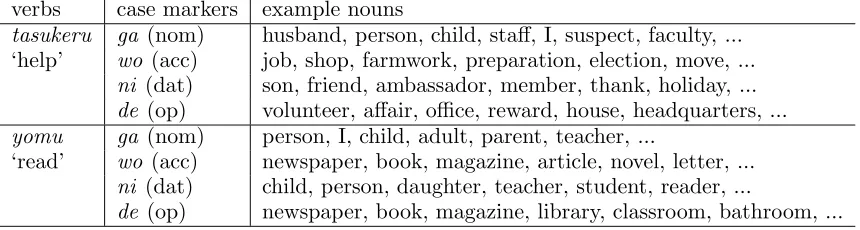
Table 2: Examples of the constructed case frames.
verbs case markers example nouns
tasukeru ga (nom) husband, person, child, staff, I, suspect, faculty, ...
‘help’ wo (acc) job, shop, farmwork, preparation, election, move, ...
ni (dat) son, friend, ambassador, member, thank, holiday, ...
de (op) volunteer, affair, office, reward, house, headquarters, ...
yomu ga (nom) person, I, child, adult, parent, teacher, ...
‘read’ wo (acc) newspaper, book, magazine, article, novel, letter, ...
ni (dat) child, person, daughter, teacher, student, reader, ...
de (op) newspaper, book, magazine, library, classroom, bathroom, ...
reliably. Therefore, as for five major and
trou-blesome light verbs (suru ‘do’, naru ‘become’,
aru ‘is· · ·’,iu ‘say’,nai ‘not’), their case frames are distinguished depending on their left neigh-bouring case components. For other verbs, we assume a unique case frame.
3.2.2 Structural ambiguity
As shown in Table 1, KNP detects heads of case
components in fairly high accuracy. However,
in order to collect much reliable data, we dis-carded modifier-head relations in the automati-cally parsed corpora in the following cases:
• When CMs of case components disappear
because of topic markers or others.
• When the verb is followed by a causative
auxiliary or a passive auxiliary, the case pat-tern is changed and the trace in KNP is not so reliable.
Based on the conditions above, case compo-nents of each verb are collected from the parsed corpora, and the collected data are considered as case frames of verbs. However, if the frequency of a CM is very low compared to other CMs, it might be collected because of parse errors. So, we set the threshold for the CM frequency as
2√mf, where mf means the frequency of the
most found CM. If the frequency of a CM is less than the threshold, it is discarded. For example,
suppose the most frequent CM for a verb iswo,
100 times, and the frequency of ni CM for the
verb is 16, ni CM is discarded (since it is less
than the threshold, 20).
3.3 Constructed case frame dictionary
We applied the above procedure to Mainichi Newspaper Corpus (7 years, 3,600,000 sen-tences). From the corpus, case frames of 23,497
verbs are constructed; the average number of case slots of a verb is 2.8; the average number of example nouns in a case slot is 33.6. Table 2 shows examples of constructed case frames.
Although the constructed data look appropri-ate in most cases, it is hard to evaluappropri-ate a dictio-nary statically. In the next section, we use the dictionary in case structure analysis and eval-uate the analysis result, which also implies an evaluation of the dictionary itself.
4 Case structure analysis using the constructed case frame dictionary
4.1 Matching of an input sentence and
a case frame
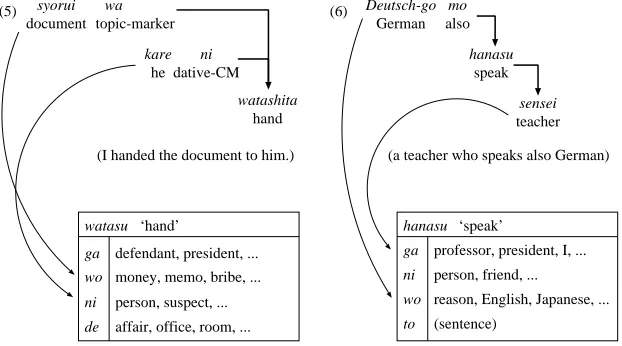
The basic procedure in case structure analysis is to match an input sentence with a case frame, as shown in Figure 1.
The matching of case components in an input and case slots in a case frame is done on the following conditions:
1. When a case component has a CM, it must be assigned to the case slot with the same CM.
2. When a case component does not have a
CM, it can be assigned to the ga,wo, or ni
CM slot.
3. Only one case component can be assigned to a case slot (unique case assignment con-straint).
ga professor, president, I, ... ni person, friend, ...
wo reason, English, Japanese, ... to (sentence)
hanasu ‘speak’ ga defendant, president, ...
ni person, suspect, ... wo money, memo, bribe, ...
de affair, office, room, ... watasu ‘hand’
(I handed the document to him.)
(5) wa
topic-marker syorui
document
watashita hand ni
dative-CM kare
he
(6)
(a teacher who speaks also German) Deutsch-go
German mo also
hanasu speak
[image:5.612.156.467.25.198.2]sensei teacher
Figure 1: Matching of an input sentence and a case frame.
Even though a 3,600,000 sentences corpus was used for learning, examples in case slots are still sparse, and an input noun mostly does not match exactly an example in the dictionary. Then, a thesaurus is employed to solve this problem.
In our experiments, NTT Semantic Feature Dictionary (Ikehara et al., 1997) is employed as a thesaurus. Suppose we calculate the
similar-ity between w1 and w2, their depth isd1 andd2
in the thesaurus, and the depth of their lowest
(most specific) common node isdc, the similarity
score between them is calculated as follows:
sim(w1, w2) = (dc×2)/(d1+d2).
If w1 and w2 are in the same node of the
the-saurus, the similarity is 1.0, the maximum score
based on this criteria. Ifw1 andw2 are identical,
the similarity is 1.0, of course.
The score of case assignment is the best sim-ilarity between the input noun and examples in the case slots. The score of a matching pattern is the sum of scores of case assignments in it. If two or more patterns meet the above conditions, one which has the best score is selected as a final result.
In the case of sentence 5 in Figure 1, kare ni
‘he dative-CM’ is assigned to the ni case slot.
Then,syorui wa ‘document topic-marker’ can be
assigned to thegaorwocase slot. By calculating
similarity between syorui and ga-slot examples
and wo-slot examples, it is considered to be
as-signed to thewo slot.
In case of sentence 6, none of the case compo-nents has a CM. Based on similarity calculation,
Deutsch-go is assigned to wo, sensei is assigned toga.
4.2 Parsing with case structure analysis
A complex sentence which contains a clausal modifier exhibits a typical structural ambiguity of Japanese; case components left to a verb of
a clausal modifier, Vc, possibly modify Vc or a
matrix verb Vm.
For example, in sentence 3, iro wa ‘color
topic-marker’ possibly modifieskite-iru ‘wear’ or
awaseru ‘harmonize’.
KNP, a rule-based parser, handles this type of ambiguity as follows. If a case component is
fol-lowed by a comma, it is treated as modifyingVm;
if not, it is treated as modifying Vc. Although
this heuristic rule usually explains real data very well, sentence 3 will be analyzed incorrectly.
Parsing which utilizes a case frame dictionary
can consider which is a proper head, Vc or Vm,
for an ambiguous case component by comparing
examples in the case slots of Vc and Vm. Such
a consideration must be done considering what
other case components modifyVc andVm, since
the assigned case slot of a case component might differ depending on the candidate structure of the sentence due to the unique case assignment constraint.
Therefore, it is necessary to expand the struc-tural ambiguity and consider all the possible
structures for an input. So, we calculate the
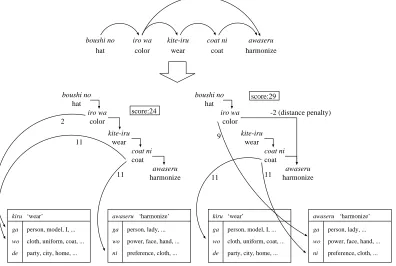
ga person, lady, ...
ni preference, cloth, ...
wo power, face, hand, ...
awaseru ‘harmonize’
ga person, model, I, ...
wo cloth, uniform, coat, ...
de party, city, home, ...
kiru ‘wear’
ga person, lady, ...
ni preference, cloth, ...
wo power, face, hand, ...
awaseru ‘harmonize’
ga person, model, I, ...
wo cloth, uniform, coat, ...
de party, city, home, ...
kiru ‘wear’
11 9
11 11
2
11 boushi no
hat
kite-iru wear
coat ni coat
awaseru harmonize iro wa
color
boushi no hat
-2 (distance penalty)
kite-iru wear
coat ni coat
awaseru harmonize iro wa
color score:24
score:29 boushi no
hat
iro wa color
kite-iru wear
coat ni coat
awaseru harmonize
Figure 2: Parsing with case structure analysis.
sum of the matching scores in it.
Since the heuristic rule employed in KNP is actually very useful, we incorporate it, that is, penalty score is imposed to the modifier-head re-lation depending on the distance between a mod-ifier and a head. If a modmod-ifier is not followed by
a comma, the penalty score, 0,−2,−4,−6, ... is
imposed when a modifier modifies the first (near-est), second, third, fourth, ... verbs in a sentence respectively; if with a comma, the penalty score,
−2,0,−2,−4, ... is imposed.
For example, sentence 3 was analyzed by our method as shown in Figure 2. Since the
simi-larity score between iro ‘color’ and the wo-slot
ofawaseru ‘harmonize’ is much larger than that
betweeniro ‘color’ and thega-slot ofkiru ‘wear’,
the correct structure of the sentence was de-tected (the right-hand parse of Figure 2). Note
that, furthermore, both the case of iro in
rela-tion toawaseru‘harmonize’, and the case ofcoat
in relation to kite-iru ‘wear’ were detected
cor-rectly.
[image:6.612.116.512.26.292.2]Structural ambiguities often cause a combina-torial explosion when a sentence is long. How-ever, by detecting the scopes of coordinate struc-tures beforehand, which often appear in long
Table 3: The accuracy of case detection.
correct case detection
incorrect case detection
Parsing error
topic-marker 82 13 5
clausal modifier 73 18 9
sentences, we can reasonably limit the possible structures of the sentence.
The average analysis speed of the experiments described in the next section was about 50 sen-tences/min. The time-out of one min. was only employed to 7 out of 4,272 test sentences.
4.3 Experiments and discussion
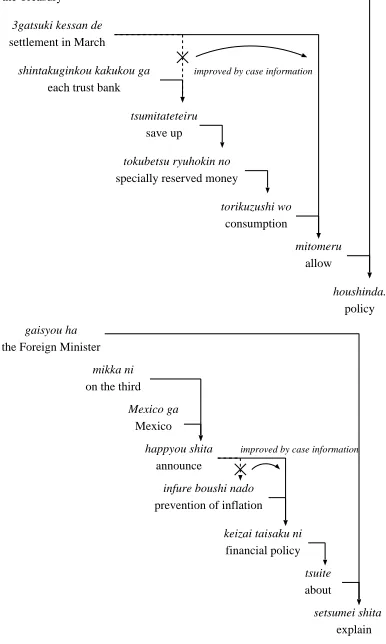
We used 4,272 sentences of Kyoto University cor-pus as a test set. We parsed them by our new method (Figure 3 shows several examples) and checked two points: case detection of ambiguous case components and syntactic analysis.
ookurasyo ha
the Treasury
3gatsuki kessan de
settlement in March
shintakuginkou kakukou ga
each trust bank
tsumitateteiru
save up
tokubetsu ryuhokin no
specially reserved money
torikuzushi wo
consumption
mitomeru
allow
houshinda.
policy
improved by case information
gaisyou ha
the Foreign Minister
mikka ni
on the third
Mexico ga
Mexico
happyou shita
announce
infure boushi nado
prevention of inflation
keizai taisaku ni
financial policy
tsuite
about
setsumei shita
explain
[image:7.612.90.283.37.359.2]improved by case information
Figure 3: Examples of the analysis results.
modifiers, and checked whether their cases were correctly detected or not. As shown in Table 3, the accuracy of the analysis was fairly good: that for topic-markers was 82% and that for clausal modifiers was 73%.
Then, we compared the parse results of our method with those of the original KNP. As a re-sult, 565 modifier-head relations differed; in 260 cases, our method was correct and the original KNP was incorrect (by considering the struc-tures in the Kyoto University Corpus as a golden
standard); in 224 cases, vice versa. That is,
our method was superior to KNP by 36 cases, and increased the overall accuracy from 89.8% to 89.9%. Since the heuristic rule used in KNP is very strong, the improvement was not big. The improvement of the accuracy, though small, is valuable, because the accuracy around 90% seems close to the ceiling of this task.
5 Conclusion
We proposed an unsupervised construction method of a case frame dictionary. We obtained a large case frame dictionary, which consists of 23,497 verbs. Using this dictionary, we can detect ambiguous case components accurately. Also since our method employs unsupervised dic-tionary learning, it can be easily scaled up.
References
Ted Briscoe and John Carroll. 1997. Automatic extraction of subcategorization from corpora. In Proceedings of ANLP-97.
Satoru Ikehara, Masahiro Miyazaki, Satoshi Shirai, Akio Yokoo, Hiromi Nakaiwa, Ken-tarou Ogura, and Yoshifumi Oyama
Yoshi-hiko Hayashi, editors. 1997. Japanese
Lexi-con. Iwanami Publishing.
Information-Technology Promotion Agency,
Japan. 1987. Japanese Verbs : A Guide to
the IPA Lexicon of Basic Japanese Verbs. S. Kurohashi and M. Nagao. 1994. A
syntac-tic analysis method of long japanese sentences based on the detection of conjunctive
struc-tures. Computational Linguistics, 20(4).
S. Kurohashi and M. Nagao. 1998.
Build-ing a japanese parsed corpus while
improv-ing the parsimprov-ing system. InProceedings of The
First International Conference on Language Resources & Evaluation, pages 719–724. Christopher D. Manning. 1993. Automatic
ac-quisition of a large subcategorization
dictio-nary from corpora. InProceedings of ACL-93.
Takehito Utsuro, Takashi Miyata, and Yuji Mat-sumoto. 1998. General-to-specific model se-lection for subcategorization preference. In