Verb Temporality Analysis using Reichenbach’s Tense System
And r
´
e Ken ji HORI E
1Kumiko TANAKA
−
ISH I I
2M itsuru ISH I ZUKA
1 (1) UNIVERSITY OF TOKYO, 7-3-1 Hongo, Bunkyo-ku, Tokyo, Japan(2) KYUSHU UNIVERSITY, 744 Motooka, Nishi-ku, Fukuoka, Japan
❛♥❞r❡❅♠✐✳❝✐✳✐✳✉✲t♦❦②♦✳❛❝✳❥♣✱ ❦✉♠✐❦♦❅❛✐t✳❦②✉s❤✉✲✉✳❛❝✳❥♣✱ ✐s❤✐③✉❦❛❅✐✳✉✲t♦❦②♦✳❛❝✳❥♣
A
BSTRACTThis paper presents the analysis process of verb temporality using Reichenbach’s tense system, a language-independent system which describes tense as relations among linguistic and extra-linguistic temporal entities. Several difficulties arise from the deep analysis required for classification into Reichenbach’s categories. They regard establishing the logical sequence of clauses in the skeletal structure of the discourse, and modeling the behavior of temporal markers according to this sequence. A dependency clause anchoring algorithm is then proposed and compared to other anchoring methods, and sequential supervised learning is used for abstracting surrounding context in order to determine temporal marker behavior. Experimental results show that the proposed approach is able to better abstract verb temporality than statistical ones, suggesting that analytical interlingual translation can complement existing SMT techniques by providing an additional layer of semantic information.
T
ITLE ANDA
BSTRACT INP
ORTUGUESEAnálise de Tempo Verbal Utilizando o Sistema de Reichenbach
Este artigo apresenta o processo de análise de temporalidade de verbos utilizando o sistema proposto por Reichenbach, que descreve tempos verbais como relações entre entidades temporais linguísticas e extra-linguísticas. De tal análise, são observadas diversas dificuldades relacionadas ao estabelecimento de uma sequência lógica de orações na estrutura esquelética do texto e à modelagem do comportamento de marcadores temporais de acordo com esta sequência. Um algoritmo de ancoragem de orações é então proposto, sendo comparado com outros métodos de ancoragem, e aprendizado supervisionado sequencial é utilizado para abstrair o contexto de forma a determinar o posicionamento temporal desses marcadores. Resultados experimentais mostram que a abordagem proposta é capaz de melhor abstrair a temporalidade verbal quando comparada a abordagens estatísticas, o que sugere que tradução automática baseada em interlíngua pode complementar técnicas estatísticas já existentes, provendo uma camada adicional de informação semântica.
K
EYWORDS:
Verb tense, Interlingual Machine Translation.1 Synopsis in Portuguese
Tempo verbal é o aspecto da língua responsável por expressar a localização de uma eventuali-dade (evento, estado, processo ou ação) no tempo, sendo regida por regras gramaticais bem definidas. Em Tradução Automática Estatística, os modelos probabilísticos utilizados impõem diversas limitações quanto à abstração dessas regras. O uso de Tradução Automática baseada em Interlíngua provê uma ferramenta incremental para a descrição do texto de entrada por se utilizar de uma representação de conhecimento independente de linguagem, o que indica um melhor suporte para tradução no domínio de tempo verbal. Este trabalho propõe, portanto, usar como interlíngua o sistema de descrição de tempo verbal sistematicamente consolidado por (Reichenbach, 1947).
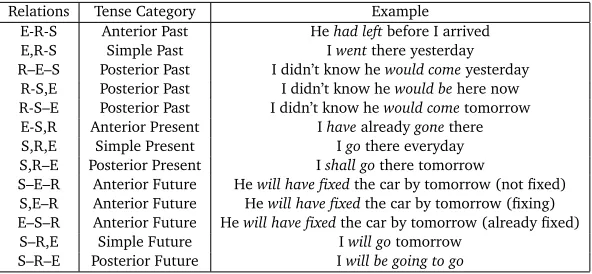
Neste sistema, os tempos verbais são descritos como relações entre três marcadores temporais: o tempo de referência R, o tempo da fala S e a eventualidade E. As relações possíveis são as de simultaneidade (,) ou precedência (–) e formam as categorias observadas na tabela 1.
Relations Tense Category Example
E-R-S Anterior Past Hehad leftbefore I arrived E,R-S Simple Past Iwentthere yesterday R–E–S Posterior Past I didn’t know hewould comeyesterday
R-S,E Posterior Past I didn’t know hewould behere now R-S–E Posterior Past I didn’t know hewould cometomorrow E-S,R Anterior Present Ihavealreadygonethere S,R,E Simple Present Igothere everyday S,R–E Posterior Present Ishall gothere tomorrow
S–E–R Anterior Future Hewill have fixedthe car by tomorrow (not fixed) S,E–R Anterior Future Hewill have fixedthe car by tomorrow (fixing) E–S–R Anterior Future Hewill have fixedthe car by tomorrow (already fixed) S–R,E Simple Future Iwill gotomorrow
[image:2.420.55.351.214.351.2]S–R–E Posterior Future Iwill be going to go
Table 1: Reichenbach’s tense system/Sistema de tempos verbais de Reichenbach
Inerente aos métodos analíticos, esta representação semântica profunda também requer um processo de análise não trivial, com as principais dificuldades (Moulin and Dumas, 1994) descritas abaixo:
1.Ancoragem de orações: Determina a sequência de orações através da qual se observa continuidade do tempo verbal
2.Composição de marcadores com expressões temporais: Relaciona-se com o modo que expressões temporais modificam o tempo verbal
Clause Anchoring Feature Extraction
Classi-fication
Anno-tated
text Anchor
parsing Raw
text
Tempexes Verb forms Clause classes
...
[image:3.420.79.354.70.130.2]Bound-ary de-tection
Figure 1: Components of the proposed system/Componentes do sistema proposto
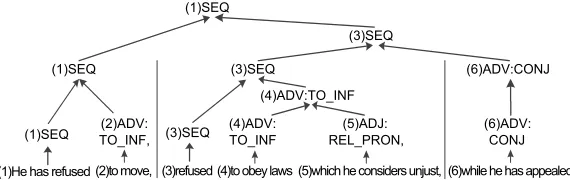
Em relação à sequência de orações, sua determinação depende da construção sintática do dis-curso e de diversos fenômenos linguísticos tais como utilização plano de fundo (backgrounding). Dois esquemas de ancoragem são apresentados neste artigo: ancoragem linear, para a qual âncoras são formadas na ordem em que orações aparecem no texto, trocando acurácia por sim-plicidade de implementação; e ancoragem baseada em dependências, que utiliza coordenação e subordinação para formação de uma árvore de orações (figura 2). Um algoritmo baseado em análise de deslocamento e redução (shift-reduce) é proposto para tal esquema, sendo ele comparado com ancoragens linear e manual.
(1)He has refused (2)to move, (3)refused (4)to obey laws (5)which he considers unjust, (6)while he has appealed...
(1)SEQ (2)ADV: (3)SEQ (4)ADV: (5)ADJ: (6)ADV:
(1)SEQ (3)SEQ
(4)ADV:TO_INF
(6)ADV:CONJ (1)SEQ
(3)SEQ
TO_INF REL_PRON,
TO_INF, CONJ
Figure 2: Clause dependency anchoring/Ancoragem baseada em dependências
Os resultados experimentais obtidos mostram que a utilização de classificadores sequenciais apresenta melhores resultados que os não-sequenciais. Além disso, o proposto algoritmo de ancoragem baseada em dependências abstrai melhor o comportamento dos marcadores temporais que a ancoragem linear e que a tradução estatística, a base de comparação. Isso sugere que o uso de interlíngua pode prover uma camada de informação semântica complementar para TA estatística.
Para finalizar, as principais contribuições deste trabalho são:
•Demonstrar como interlíngua pode complementar TA estatística no domínio de tempo verbal provendo uma camada de informação semântica adicional
•Propor o sistema de Reichenbach como essa interlíngua, com resultados que sugerem melhor acurácia se comparado a abordagens estatísticas
•Abordar as dificuldades resultantes da análise profunda baseada em interlíngua •Apresentar e comparar métodos de ancoragem de orações, avaliando como formas
[image:3.420.71.356.250.340.2]2 Introduction
Tense is the aspect of language responsible for expressing the location of an eventuality (event, state, process or action) in time. This paper studies the deep analysis of verb tense into a language independent representation, providing a proof of concept as to how Interlingual Machine Translation can support current statistical techniques.
In Statistical Machine Translation (SMT) (Koehn, 2010), highly grammatical aspects of language such as tense are not properly addressed due to its limitation in abstracting well-defined linguistic rules. Thetranslation modelmay not be able to provide proper lexical disambiguation in cases in which there is a word form with very high probability, and thelanguage model may not be able to penalize ungrammatical sentences if the error occurs outside of the n-gram window, as shown respectively in the following examples.
• “He is running in tomorrow’s race”. Futurate “is running” translated as the more probable present continuous
• “I could have easily, although maybe more cumbersomely, made it”. The 5-gram model does not associate “could have” with “made”, resulting in an incorrect simple past
The presented problems in tense translation can be alleviated by analyzing temporal semantics of verb. As a result, using Interlingual MT (Dorr et al., 2004), a paradigm that uses language-independent intermediate representation of knowledge, seems a natural approach. This research presents a study on the analysis of verb using as interlingua a representation of tense which has been systematically theorized by (Reichenbach, 1947). The resulting difficulties of the required deep analysis, observed by (Moulin and Dumas, 1994) and avoided in older transfer-based approaches, are described below:
1.Clause anchoring: Given an observed tendency of tense continuity across sequential clauses (unless there is an indication of change), the task ofclause anchoringaims to determine this sequence
2.Composition of tense markers with temporal expressions that modify the verb: Concerns how surrounding temporal expressions modify verb tense
3.Determination and interpretation of the temporal point of reference in respect to the point of speech: Relates to how eventualities are structured and perceived in the time axis according to an extra-linguistic point of reference
In this work, the three mentioned difficulties are addressed by analyzing the linguistic phenom-ena that determine the behavior of temporal markers used in Reichenbach’s system, modeling it using sequential supervised learning. This deep tense analysis has not yet been attempted, to the best of the authors’ knowledge. Experimental results show an improvement over state-of-the-art statistical methods, which potentially demonstrates how SMT could co-exist with Interlin-gual MT by conceptualizing the interlingua as an additional information layer for improving translation in the tense domain. The main contributions of this work are the following:
• Showing how SMT can possibly be complemented by the interlingua in the verb tense domain by providing an additional information layer
• Proposing Reichenbach’s tense system as this interlingua, with results suggesting an increase in accuracy for this task when compared to SMT
• Addressing difficulties arising from deep analysis required in the interlingual approach • Presenting and comparing methods for clause anchoring, evaluating how different ways
3 Reichenbach’s Tense System
The proposed interlingua for the verb tense translation task is Reichenbach’s system, the most widely accepted theory for describing tense. It provides a rich language-independent description of eventualities by logically structuring them in the time axis according to a reference point. These temporal interactions among semantic entities thus accomodate differences in culture-specific time perception of eventualities.
This system describes tense using relations among three temporal markers: S, E and R. The point of speech S indicates time of the utterance, the eventuality E represents the time location of the verb, and the reference point R is an extra-linguistic reference. There are 13 marker combinations considering concurrence (,) and precedence (–) relations, resulting in the 9 tense categories stated in table 1. It is observed that the semantic value of relation S::R defines if the tense category is a present, past or future – in the special case in which E::R is concurrent, R::S defines the absolute tense; and the semantic value of R::E defines if the tense is simple, anterior or posterior, being primarily responsible for defining relative tense.
Reichenbach’s system has a number of extensions which try to better accomodate observed phenomena. To mention some, (Dowty, 1979) proposes R as an interval rather than a point, and (Comrie, 1985) proposes a second R. However, since there is no consensus as to the best representation of tense, the original system is used in this work.
In order to classify an eventuality into one of Reichenbach’s categories, deeper semantic understanding of temporal structure is necessary. A variety of linguistic phenomena are used for interpreting the behavior of the markers according to surrounding context, and thus for inferring the relative positions of S, E and R. In the example, a grammaticaly correct sentence would employ the simple past “reached” in the second clause (c2) because it maintains asequence of tense(SOT); using “reach” disrupts the timely order of eventualities, abruptly changing R from R–S inc1to R,S inc2.
“The train had left(E–R-S) |before we{reach(E,R,S)/reached(E,R-S)}the station.”
This behavior of R is explained by theTemporal Discourse Interpretation Principle(TDIP) (Dowty, 1979). Under this principle, R is (a) at a time consistent with the temporal expressions (‘tempex’ for short) related to the given verb. This indicates that tempexes have preference in determining changes in R, being directly related to previously mentioned difficulty (2). The extraction task for tempexes, as well as the modeling of how they affect R, is presented in section 4.2. According to TDIP, in the absence of tempexes, R is (b) at a time which follows the reference time of the previous clause. This is further explained by thePermanence of the Reference Point Principle(PRPP) (Reichenbach, 1947), which states a tendency of R to remain unchanged across sequential clauses. Nevertheless, this clause sequence is not purely linear (i.e. in the order they appear in text), but instead depends on coordination and subordination, resulting in difficulty (1). Computational methods for clause anchoring are explained in section 4.1.
Finally, although PRPP properly explains the behavior of R in many situations, it has proven to fail in some cases, leading to difficulty (3). Two of these cases are presented:
Ex.: In “I talked to John, who is in charge of the event, and we agreed on the issue”, the adjective clause introduces a present between two past clauses, but is not ungrammatical. • Shift of perspective(Binnick, 1991): Perspective is shifted from the speaker to that of a
subject, implicating change in S. It is observed in quoted and free indirect speech. Ex.: In “He said he is not talking to you”, S is moved by the free indirect speech. The computational interpretation of R is done via supervised learning, as explained in section 4.2. By using features representing tempexes, among others, a sequential classifier is responsible for abstracting the behavior of R, outputting a Reichenbach category for each clause.
4 Interlingual Verb Tense Analysis
This section presents the analysis process (figure 1), which classifies each verb in text into a tense category. In contrast with traditional analytical approaches, which employed manually tailored rules, this work uses supervised learning for obtaining the interlingua.
4.1 Clause Anchoring
The process ofclause anchoringdetermines the sequence of clauses in a text. By analyzing the anchoring structure, it is possible to model the behavior of temporal markers across a sequence of clauses which is consistent to SOT.
The first part of clause anchoring is boundary detection, which was the target of CoNLL-2001 (Tjong et al., 2001) and consists of finding the position that delimits two clauses. The proposed analysis process uses the best performing system of CoNLL-2001 (Carreras and Márquez, 2003) (F-value of 84.36%) with some rule-based post-processing.
The second part is the anchoring itself. A pre-processing step is first carried in order to identify the type of coordination/subordination. Using heuristics based on its first words and the last words of the previous clauses, each clause is categorized as coordinated (COORD), subordinated nominal (NOUN), subordinated adjective (ADJ), subordinated adverbial clause (ADV) or none (NONE), and then further subcategorized. For example, in the sentence below, the second clause is adverbial starting with a to-infinitive.
He has frequently refused(NONE) | (...)to obey local laws(ADV:TO_INF) |which he considers unjust (...)(ADJ:REL_PRON)
Given separated and categorized clauses, two types of anchoring are then presented: linear and dependency anchoring. They propose different ways of establishing sequential clauses:
• Linear anchoring: Anchoring clauses in the order they appear in the text, not modeling backgrounding. Accuracy is traded off for simplicity, as most anchors are linear. • Dependency anchoring: Parses a clause tree using coordination and subordination (figure
2). An automatic approach based on shift-reduce is detailed next.
Dependency Anchoring
• H→H T(direct order): “He has refused|to move”
• H→T H(reverse order): “After the fruit is harvested,|it is sold at the market” • H→H T1T2(middle positioning): “The car,|which was red,|belonged to him” Using these production rules, the clauses are then linked using a parsing algorithm. Shift-reduce has been applied for the extraction of temporal dependencies, such as in ordering events on the time axis (Kolomiyets et al., 2012). GivenC= (c1. . .cn)linear clauses from the text, this algorithm either pushes a clause onto the stack (shift) or inversely applies a production rule to the top of the the stack (reduce). This is done until only one symbol remains in this stack. In the context of tense analysis, however, the problem of clause cascading is observed. If a sentence(c1c2c3c4)is produced byc1→c1c2c4andc2→c2c3, the algorithm has to analyze if c3→c3c4is valid or not before reducingc2, which is solved withn-lookahead. However, due to clause cascading, there is no formal limit to the growth ofc2(no limit ton), resulting in difficulty in the decision between shifting or reducing. This motivates a modification in the algorithm, using a multiple pass approach as shown in algorithm 1.
Algorithm 1Dependency anchoring algorithm for a group of clauses Input:C= (c1. . .cn)linear clauses
1: functionDEPENDENCY-ANCHORING(C) 2: whilet ruedo
3: forcursor←1 tondo
4: if!Is-Linked(C,cursor)thenPreferential-Link(C,cursor)
5: Reduce-Farthest-Linked-Clauses(C)
6: ifsize(C) =1then returnC[0]
For each pass, the algorithm first moves a cursor to each position (shift), applying preferential linking in the clauses to the right of the cursor if they are not yet linked. Preferential linking removes ambiguities in the formation fules. When the cursor reaches the final position, the algorithm will have linked all adjacent clauses that should be linked (as in linear anchoring). Leaf reduction is then performed, removing the clauses that have already been linked and which stand farthest away from the root. This guarantees to completely reducec2, which may cascade, before reducingc1→c1c2c4. This process is iterated until only the root for this tree is left. In order to further simplify the problem, clauses in a sentence are divided into groups, arranged according to punctuation symbols such as commas (figure 2), since clauses within the same group are usually anchored first. The algorithm is then applied to each group, obtaining a group root clause, and is then run again using these group roots, finally obtaining the sentence root. The backbone of the text is then formed by linking the last clause of the sentence which is connected to the root only by NONEand COORDanchors to the first clause of the next sentence.
4.2 Feature Selection and Tense Classification
depends largely on the feature selection, which must be able to address the linguistic phenomena presented in section 3, allowing the classifier to abstract the relations among tense markers. The first feature type relates to difficulty (2), since R is primarily defined by surrounding tempexes. The extraction of such expressions has been extensively researched – it was the target of ACE 2004 TERN Evaluation and TARSQI, a project which addresses timestamping, ordering and reasoning of events, automatically annotating text under the TimeML (Pustejovsky et al., 2003) specification language. In this work, the TARSQI tempex extraction module (Mani and Wilson, 2000) is used. It is complemented with a CRF-based extractor, as some tense-related tempexes such as “often” and “ever” were not extracted.
Aside from tempexes, other extracted features are given below. They are extracted using TARSQI and Stanford CoreNLP, and are also illustrated by an example in figure 3.
• Verb form: English tense (present, past, future, infinitive, etc.), aspect (perfect, progressive, perfect progressive) and modality (modal verbs) provide information for determining Reichenbach’s tense category
• Verb POS: Complementary information when verb form is not properly identified • Verb lemma: Utterance verbs from surrounding clauses are useful for identifying indirect,
quoted and free indirect speech clauses
• Clause link: Adjective and nominal clauses provide background information (section 4.1) • Eventuality type: A break in the SOT by a eventuality of type ‘state’ is one indication of
background independent clause
• Quotation: Verb between quotation marks indicate quoted speech
He has frequently refused
Clause Link: SEQ
Tense, Aspect, Modality: PRES PERF
[image:8.420.61.343.300.355.2]Temporal Expression: FREQUENTLY Eventuality Type: OCCURRENCE Verb Lemma: REFUSE Verb POS: VBZ_VBN
Figure 3: Example of extracted features for the clause “He has frequently refused”
In many cases, background independent clauses and free indirect speech have no apparent differentiation from regular clauses except for pragmatic information. The solution for these cases requires further investigation.
5 Verb Tense-Annotated Dataset
For this task, a dataset has been manually annotated according to Reichenbach’s tense categories. The chosen corpus is a subset of the Brown Corpus (Kuˇcera and Francis, 1967) and contains 8 texts from each of Reportage (news), Belles Lettres (essays, biographies) and Adventure (fiction) genres, totaling over 6,700 clauses. An example of annotation is given below:
Table 2 provides the percentage of clauses in the dataset for each categories. The majority of cases are past (60.82%) and simple tenses (48.97%). This dataset has also been manually annotated for clause dependency anchoring. It was observed that 26.89% of the anchors are not linear, i.e. the head and tail of a coordinated or subordinated clause do not occur consecutively. Moreover, in terms of SOT, both S::R and E::R relations remained the same across sequential clauses in 59.69% of the cases; only S::R remained in 24.82%; and S::R changed in 15.50%.
Simple Anterior Posterior Subtotal Present 24.29% 3.30% 9.45% 37.04% Past 48.97% 3.69% 8.17% 60.82% Future 1.86% 0.03% 0.25% 2.14% Subtotal 75.12% 7.02% 17.86%
Table 2: Percentage of clauses for each tense category (excluding clauses with no verbs) Since tense theory might still evolve, eventual changes in the model would affect only the anno-tated data for classification. As a result, the annotation effort by (Derczynski and Gaizauskas, 2011) might greatly contribute to this work, especially if it is integrated to the TimeML effort. The baseline considered for tense translation is Google Translate for the language pairs EN→PT and EN→JP. When evaluating the statistical translation, only the correctness according to Reichenbach’s categories was assessed. In other words, errors concerning verb choice, passive voice usage, etc. were disregarded. In the example, the first translation would be considered correct from the tense perspective, whereas the second would not.
•Correct:He runs everyday(present)→Kare wa mainichi jikk¯o saremasu, lit.He is put into execution everyday(present)
•Incorrect:He is running tomorrow(future)→Kare wa ashita jikk¯o sareteiru, lit.He is being put into execution tomorrow(present continuous)
In open domain, EN→PT produces satisfactory translation, whereas EN→JP does not. However, in tense translation, accuracy values are 83.98% and 81.83% respectively. Although at first counterintuitive, these values indicate that tense translation is largely dependent on the source language. It is expected that for source languages whose tenses present ambiguity in verb form according to the target language, translation accuracy is lower.
6 Evaluation and Discussion
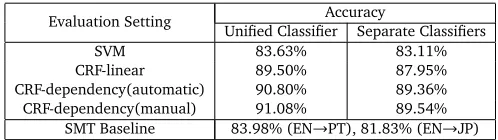
The evaluation regards the accuracy of the tense analysis into Reichenbach’s categories, com-pared against the SMT baseline. The proposed method is evaluated using 4-cross validation. The following settings are compared: (1) non-sequential classifier SVM; (2) CRF using linear anchoring; and CRF using (3) proposed automatic and (4) manual dependency anchoring. The software packages CRFSuite (Okazaki, 2007) and LibSVM (Chang and Lin, 2011) were used. Under all settings, two combinations were compared: using only one classifier for classifying the nine tenses (simple present, anterior past, etc.); or using two separate classifiers, one for present/past/future, and the other for simple/anterior/posterior. From the results in table 3, it is observed that using separate classifiers has lower accuracies in all cases, indicating that they are not able to properly model the interaction between S::R and E::R.
Evaluation Setting Unified ClassifierAccuracySeparate Classifiers
SVM 83.63% 83.11%
CRF-linear 89.50% 87.95%
CRF-dependency(automatic) 90.80% 89.36% CRF-dependency(manual) 91.08% 89.54%
[image:10.420.77.326.70.140.2]SMT Baseline 83.98% (EN→PT), 81.83% (EN→JP)
Table 3: Accuracy of analysis according to Reichenbach’s tenses
linear anchoring as expected, with accuracies of 90.80% and 89.50% respectively. Considering that the two anchoring structures differ only in 26.89% of the clauses as previously stated, this difference of 1.30% is substantial. Moreover, counting only the clauses in which there is a break in SOT (40.31% of all clauses), the accuracies become 88.66% and 85.34%. This demonstrates that the proposed anchoring provides better modeling of the behavior of temporal markers, with accuracy values comparable to manual anchoring (difference of 0.28%), the theoretical maximum using a fixed feature set and training data.
Most of the obtained errors concern changes in R and S in cases when there is no explicit context from which to infer the new position of the markers. In the first example below, there is no indication of the simple present in “No telling”. Other errors occurred because of component failure. In the second example, the shift of perspective is not properly addressed because the verb form inc2is not identified. However, component errors in clause boundary detector are not propagated when verbs and tempexes are consistently grouped within the same clause, as tense is inherited from the previous clause in 59.69% of the cases due to SOT.
• “... Mike lifted him (...).|‘No telling |how good this horse is’” Obtained: SIMPLEPAST; Expected: SIMPLEPRESENT
• “... he believed| there are a number of qualified city residents...” Obtained: POSTERIORPAST; Expected: SIMPLEPRESENT
The obtained results indicate that this interlingua may improve SMT, using hybrid approaches such as modular interlingual generation systems (Singh et al., 2007) and factored models for source information (Avramidis and Koehn, 2008). In the latter, translation accuracy from morphologically poor to rich languages, which is often the case of tense, is shown to improve.
Conclusion
This paper studied the interlingual analysis of verb tense using Reichenbach’s system, which describes tense in a language-independent manner. Several difficulties arise from the required deep analysis: the behavior of temporal markers were modeled by supervised learning and proper feature selection; concerning the phenomenon of SOT, different clause anchoring methods were compared regarding their effect on tense analysis, with the proposed algorithm providing considerably higher accuracy than linear anchoring.
References
Avramidis, E. and Koehn, P. (2008). Enriching morphologically poor languages for statistical machine translation.Proceedings of ACL-08: HLT, pages 763–770.
Behrens, H. (2001). Cognitive-conceptual development and the acquisition of grammatical morphemes: The development of time concepts and verb tense. Language Acquisition and Conceptual Development, 3:450.
Binnick, R. I. (1991).Time and the Verb: A guide to tense and aspect. Oxford University Press. Carreras, X. and Márquez, L. (2003). Phrase recognition by filtering and ranking with perceptrons. InProceedings of RANLP-2003, pages 205–216.
Chambers, N. (2012). Labeling documents with timestamps: Learning from their time expressions. InProceedings of ACL-2012. ACL.
Chang, C. and Lin, C. (2011). LIBSVM: A library for Support Vector Machines.ACM Transactions on Intelligent Systems and Technology (TIST), 2(3):27.
Comrie, B. (1985).Tense. Cambridge University Press.
Derczynski, L. and Gaizauskas, R. (2011). An annotation scheme for Reichenbach’s verbal tense structure. InWorkshop on Interoperable Semantic Annotation, page 10.
Dorr, B., Hovy, E., and Levin, L. (2004). Machine translation: Interlingual methods.Natural Language Processing and Machine Translation Encyclopedia of Language and Linguistics. Dowty, D. (1979).Word Meaning and Montague Grammar: The semantics of verbs and times in generative semantics and in Montague’s PTQ, volume 7. Springer.
Hinkel, E. (1992). L2 tense and time reference.TESOL Quarterly, 26(3):557–572. Hopper, P. (1979). Aspect and foregrounding in discourse.Discourse and Syntax.
Koehn, P. (2010).Statistical Machine Translation. Cambridge University Press, New York, NY, USA, 1st edition.
Kolomiyets, O., Bethard, S., and Moens, M. (2012). Extracting narrative timelines as temporal dependency structures. InProceedings of ACL-2012. ACL.
Kuˇcera, H. and Francis, W. (1967).Computational Analysis of Present-Day American English. Dartmouth Publishing Group.
Mani, I. and Wilson, G. (2000). Robust temporal processing of news. InProceedings of ACL-2000, pages 69–76. ACL.
Moulin, B. and Dumas, S. (1994). The temporal structure of a discourse and verb tense determination.Conceptual Structures: Current Practices, pages 45–68.
Reichenbach, H. (1947).Elements of Symbolic Logic.
Saurí, R., Knippen, R., Verhagen, M., and Pustejovsky, J. (2005). Evita: A robust event recognizer for QA systems. InProceedings of HLT/EMNLP-2005, pages 700–707. Association for Computational Linguistics.
Singh, A., Husain, S., Surana, H., Gorla, J., Sharma, D., and Guggilla, C. (2007). Disam-biguating tense, aspect and modality markers for correcting machine translation errors. In Proceedings of RANLP-2007.
Tjong, E., Sang, K., and Déjean, H. (2001). Introduction to the CoNLL-2001 Shared Task: Clause identification. InProceedings of ACL-2001 Workshop on Computational Natural Language Learning (CoNLL), page 8. ACL.
Tomlin, R. (1985). Foreground-background information and the syntax of subordination. Text-Interdisciplinary Journal for the Study of Discourse, 5(1-2):85–122.