SentTopic-MultiRank: a novel ranking model for
multi-document summarization
Wenpeng Y in Yulong Pei Fan Zhang Lian
′en Huang
The Shenzhen Key Lab for Cloud Computing Technology & Applications (SPCCTA) Shenzhen Graduate School
Peking University, Shenzhen 518055, P.R. China
{mr.yinwenpeng,paul.yulong.pei,fan.zhgf}@gmail.com, [email protected]
A
BSTRACTExtractive multi-document summarization is mostly treated as a sentence ranking problem. Existing graph-based ranking methods for key-sentence extraction usually attempt to compute a global importance score for each sentence under a single relation. Motivated by the fact that both documents and sentences can be presented by a mixture of semantic topics detected by Latent Dirichlet Allocation (LDA), we propose SentTopic-MultiRank, a novel ranking model for multi-document summarization. It assumes various topics to be heterogeneous relations, then treats sentence connections in multiple topics as a heterogeneous network, where sentences and topics/relations are effectively linked together. Next, the iterative algorithm of MultiRank is carried out to determine the importance of sentences and topics simultaneously. Experimen-tal results demonstrate the effectiveness of our model in promoting the performance of both generic and query-biased multi-document summarization tasks.
1 Introduction
Multi-document summarization (MDS), having been intensively studied in past decades, is the process of automatically creating a compressed version of a given document collection that provides useful information for a user. It could be mainly classified into two categories: generic MDS and query-focused MDS. The goal of generic MDS is to produce a summary of multiple documents about the same but unspecified topic, while query-focused task requires the generated summary could not only convey the main content of target corpus, but also bias to the information needs of a specific query/topic. Commonly, both of them are treated as a sentence ranking problem.
In most existing summarization systems, sentence ranking was conducted under a single rela-tion assumprela-tion. Taking for instance the famous LexPageRank proposed in (Erkan and Radev, 2004). In that model, a sentence connectivity matrix was constructed based on cosine similar-ity. Then PageRank (Page et al., 1999) algorithm was directly applied to the cosine similarity graph to find the most prestigious sentences in a document. Another compelling example is (Wan et al., 2007), where a weighted network was formed on the sentences by using stan-dard cosine similarity, then authors utilized manifold-ranking algorithm (Zhou et al., 2004) to spread ranking scores from a query to remaining sentences. Apparently, both above literatures were based on the assumption that all sentences existed under a unified relation.
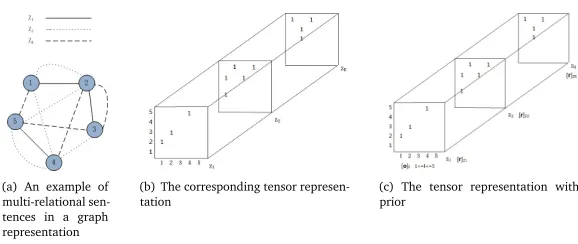
Inspired by some work involving topic decomposition as well as multi-relational data where objects have interactions with others based on different relations, we attempt to map sentence relatedness within multiple topics to heterogeneous relations in this work. More specifically, we assume each topic as a single relation type, and construct an intra-topic sentence network for each relation type. There are many Information Retrieval and Data Mining tasks addressing multi-relational data. For instance, scholars cite other scholars in various conferences, and based on different academic fields, publications cite other publications on the basis of content analysis such as authorship, title, abstract and keywords, web pages link to each other via different anchor texts (Kolda and Bader, 2006). Such a complicated link structure can provide a way of incorporating multiple relations among objects into the derivation of object prestige or popularity. In Figure 1(a), we show an example of multi-relational sentence representation based on our SentTopic-MultiRank model. There are five sentences andK relations among them (Kdenotes the topic number in LDA, and we only provide three topicsz1,z2andzKas
an illustration). We can also represent such multi-relational objects in a tensor shape which is a multi-dimensional array. In the Figure 1(b), a three-way array is provided, where each two-dimensional plane represents an adjacency matrix for one type of relation. The network can be depicted as a tensor of size 5×5×Kwhere(i,j,k)entry is nonzero if theithsentence
is related to thejthsentence underkthrelation.
(a) An example of multi-relational sen-tences in a graph representation
(b) The corresponding tensor
represen-tation (c) The tensor representation withprior
Figure 1: Illustration of SentTopic-MultiRank
is to imagine infinite random surfers in a multi-relational network, and derive a stationary probability distribution of objects and relations as evaluation scores for objects and relations, respectively. We integrate topic decomposition via LDA with MultiRank to produce a novel framework named SentTopic-MultiRank specifically for multi-document summarization. For generic multi-document summarization, we directly make use of MultiRank algorithm to determine the ranking scores of sentences and topics/relations. While in query-oriented MDS, query bias must be considered. We creatively integrate LDA with generation probability be-tween sentences to design query-oriented prior distributions for sentences and topics, respec-tively. Motivated by topic-sensitive PageRank (Haveliwala, 2003), as well as HAR (Xutao et al., 2012) which modified MultiRank based on HITS (Kleinberg, 1999) principle for query search, we embed acquired prior distributions into the SentTopic-MultiRank iterative process so that the final ranking results are more desirable for the query statement. Figure 1(c) gives an ex-ample for tensor representation of SentTopic-MultiRank with prior knowledge. We apply our approach to generic and query-biased multi-document summarization on standard datasets, experimental results show its good performance in generating high-quality summaries. The rest of this paper is organized as follows: Section 2 introduces related work. Details of constructing and applying SentTopic-MultiRank model in multi-document summarization task are presented in Section 3. Section 4 gives the process of selecting sentences to generate summary. Finally, experiments and results are showed in Section 5.
2 Related work
query-focused summarization, in (Saggion et al., 2003), a simple query-based scorer by computing the similarity value between each sentence and the query was incorporated into a generic sum-marizer to produce the query-based summary. (Erkan, 2006) came up with biased LexRank by incorporating prior knowledge into random walk for query summarization task. (Wan et al., 2007) exploited manifold-ranking process proposed in (Zhou et al., 2004) to implement the propagation of ranking scores from the query to remaining sentences, based on a weighted sentence connection network. The spread process was repeated until a global stable state was achieved, and all sentences obtained their final ranking scores. Recently, unsupervised deep learning was first investigated in (Liu et al., 2012) to deal with query summarization.
Furthermore, supervised learning approaches have also been successfully applied in document summarization, where the training data is available or easy to build. The most straightforward way is to regard the sentence extraction task as a binary classification problem. (Kupiec et al., 1995) developed a trainable summarization system which adopted various features and used a Bayesian classifier to learn the feature weights. The system performed better than other systems using only a single feature. (Zhou and Hovy, 2003) applied a HMM-based model and (Shen et al., 2007) proposed a conditional random field based framework. (Ouyang et al., 2007) designed methods for constructing training data based on human summaries and train-ing sentence scortrain-ing models based on support vector regression (SVR). (Shen and Li, 2011) introduced a cost sensitive loss to improve ranking SVM, a type of learning-to-rank method, for extractive query-focused multi-document summarization.
Especially, we are mainly inspired by following pioneering work. In recent years, two algo-rithms were proposed to rank web pages by incorporating topic information within PageRank (Haveliwala, 2003; Nie et al., 2006). The method in (Haveliwala, 2003) decomposed PageR-ank into various topics, setting the preference values using some conditional probabilities. (Nie et al., 2006) proposed a more complicated ranking framework, where topical PageRanks were performed together. The rationale of (Nie et al., 2006) was, when surfing following a graph link from vertexwitowj, the ranking score on topiczofwiwould have a higher
proba-bility to pass to the same topic ofwjand have a lower probability to pass to a different topic of
wj. When the inter-topic jump probability was 0, this method was identical to the approach in
3 SentTopic-MultiRank model
3.1 Topic decomposition of corpus via Latent Dirichlet Allocation (LDA)
In our work, topic model LDA (Blei et al., 2003) is utilized to represent document collection with a mixture of semantic topics. In LDA, it is assumed that observed words in each document are generated by a document-specific mixture of corpus-wide latent topics. We define our corpus of lengthW with the flat word vector w= w1,· · ·,wW. At corpus position i, the
elementdiind=d1,· · ·,dWdesignates the document containing observed wordwi. Similarly,
the vectorz=z1,· · ·,zW defines the hidden topic assignments of each observed word. The
number of latent topics is fixed to someK, and each topicz=1,· · ·,Kis associated with a topic-word multinomialϕzover theW-word vocabulary. Eachϕmultinomial is generated by
a conjugate Dirichlet prior with parameterβ. Each documentj=1,· · ·,Dis associated with a multinomialθjoverKtopics, which is also generated by a conjugate Dirichlet prior with
parameterα. The full generative model is then given by
P(w,z,ϕ,θ|α,β,d)∝ Given an observed corpus(w,d)and model hyperparameters(α,β), the typical modeling goal is to infer the latent variables(z,ϕ,θ).
While exact LDA inference is intractable, a variety of approximate schemes have been devel-oped. In this work, we use GibbsLDA++1, a C/C++implementation of LDA using Gibbs Sam-pling, to detect latent topics. This sampling approach iteratively re-samples a new value for each latent topic assignmentzi, conditioned on the current values of all otherzvalues. After
a fixed number of iterations, we estimate the topic-word multinomialsϕand the document-topic mixture weightsθ from the finalzsample, using the means of their posteriors given by
ϕz(w)∝nzw+β
θj(z)∝njz+α
wherenzwis the number of times wordwis assigned to topicz, andnjzis the number of times
topiczis used in documentj, with both counts being taken with respect to the final samplez. The topic-word multinomialsϕzfor each topiczare our learned topics; each document-topic
multinomialθjrepresents the prevalence of topics within documentj.
In experiments, we setα=1 andβ=0.01. There are already some literatures to study their impacts on LDA performance. Since we pay main attentions to SentTopic-MultiRank model, the influences of LDA hyperparametersαandβare not investigated any more.
3.2 Construction of SentTopic-MultiRank graph
In Section 3.1, we have detected various relation types/topics. The thing left to do in con-structing SentTopic-MultiRank is to produce a sentence graph under each relation. Naturally, the sentence similarity should be relation-specific. To capture the similarities of two sentences
1GibbsLDA
(e.g.,xandy) on various latent topics, we represent each sentence as a probability distribu-tion at each topicz(1≤z≤K). Hence, we sample sparse unigram distributions from eachϕz
using the words inxandy. Their probability distributions given topic-word distribution are denoted asPx
z =p(wx|z,ϕz)with the word setwx= (w1,· · ·,w|x|)inx, andPzy=p(wy|z,ϕz)
with the word setwy= (w1,· · ·,w|y|)iny.
The probability distributions per topic are constructed with only the words in x and y, and the probabilities of remaining words in vocabulary W are set to 0. The W dimen-sional word probabilities are the expected posteriors obtained from LDA model. Hence,
px
z= (ϕz(w1),· · ·,ϕz(w|x|), 0, 0,· · ·)∈(0, 1)W,pzy= (ϕz(w1),· · ·,ϕz(w|y|), 0, 0,· · ·)∈(0, 1)W.
Given a topicz, the similarity betweenpx
zandpzyis measured via transformed radius (TR). We
first measure the divergence at each topic usingTRbased on Kullback-Liebler (K L) divergence:
TR(pzx,pzy) =K L(pzx||
Here, we adoptTRrather than the commonly usedK Lfor the reason that withTRthere is no problem with infinite values sincepzx+pzy
2 ̸=0 if eitherpzx̸=0 orpzy̸=0, and it is also symmetric,
i.e.,TR(x,y) =TR(y,x). With the gotten sentence similarities under various topics, we could construct graphs like Figures 1(a) and 1(b) to demonstrate our SentTopic-MultiRank model.
3.3 Sentence ranking using MultiRank algorithm
There are many Data Mining and Machine Learning issues in multi-relational data where ob-jects interact with others under different relations. The work in (Ng et al., 2011) proposed a framework, MultiRank, to determine the importance of both objects and relations simul-taneously based on a probability distribution computed from multi-relational data. In our multi-relational sentence network, we apply MultiRank algorithm to derive the importance of sentences and topics. As we analyze sentences under multiple relations and also consider inter-action between relations based on sentences, we make use of rectangular tensors to represent them as Figure 1(b). First, we introduce the MultiRank iterative algorithm.
LetRbe the real field. We callA= (as1,s2,z1)whereas1,s2,z1∈R, forsi=1,· · ·,n,i=1, 2 and
z1=1,· · ·,K, a real (2,1)th order (n×K)-dimensional rectangular tensor. In this setting, we
refer (s1,s2) to the indices for sentences/objects andz1to be the index for topic/relation. For instance, five sentences (n=5) and three relations (K=3) are demonstrated in Figure 1. First, two transition probability tensorsO = (os1,s2,z1)andR= (rs1,s2,z1)are constructed with
respect to sentences and topics by normalizing the entries ofAas follows:
Then we derive the following probabilities:
desired equilibrium/stationary distributions of sentences and relations, i.e., the SentTopic-MultiRank values of sentences and relations, are given by
¯
As (3) and (4) are coupled together and they involve two joint probability distributions, a product form of individual probability distributions is employed to replace the joint probability distributions in (3) and (4) by assumption:
Prob[Xt−1=s2,Yt=z1] =Prob[Xt−1=s2]Prod[Yt=z1]
Prob[Xt=s1,Xt−1=s2] =Prob[Xt=s1]Prod[Xt−1=s2]
Hence, using the above assumptions and consideringtgoes to infinity, (3) and (4) becomes
¯
Under the tensor operation for (5) and (6), we solve the following tensor (multivariate poly-nomial) equations:
Algorithm 1: The MultiRank Algorithm
Input: Two tensorsO andR, two initial probability distributionsx0
andy0( ∑n
s1=1[x0]s1=1 and ∑K
z1=1[y0]z1=1) and the toleranceε
Output: Two stationary probability distributions ¯xand ¯y Procedure:
1. Sett=1;
2. Computext=Oxt−1yt−1;
3. Computeyt=Rx2t;
4. If∥xt−xt−1∥+∥yt−yt−1∥<ε, then stop, otherwise sett=
t+1 and goto Step 2.
In Algorithm 1, the setting of initial probability distributions does not influence the finally generated stationary probability distributions. We simply set uniform distribution for those sentences while with regard to topics, we set their initial distribution using the topic distribu-tion of the entire corpus. Obviously, above algorithm has nothing to do with any query, so it does not apply to biased summarization task, which is further discussed in subsequent section.
3.4 Prior configuration in query-focused multi-document summarization
Query summarization requires that generated summary could not only express the salient con-tent of target document collection, but also bias to the information needs of query. Then, how to exert the query information to the MultiRank process? Motivated by the idea of topic-sensitive PageRank (Haveliwala, 2003) and random walk with restart (Tong et al., 2008), we consider this issue by assigning desired limiting probability distributions towards sentences and topics, respectively. More specifically, we modify the tensor equations in (7) as follows:
(1−µ)O¯x¯y+µo=¯x (9)
(1−ν)R¯x2+νr=¯y (10)
with Equation 8, whereoandrare two devised prior probability distributions for sentences and topics/relations, respectively. Here, (∑ni=1[o]i=1 and
∑K
j=1[r]j=1), and 0≤µ,ν <1, are
two parameters for controlling the influence degree of two prior probability distributions. In experiments, we setµ=0.5 andν=0.9 simply as (Xutao et al., 2012) indicated. Accordingly, the new iterative algorithm could be presented as Algorithm 2.
Noting that (Xutao et al., 2012) has ever provided a similar solution framework for their pro-posed HAR model, a modified version of MultiRank on the basis of HITS’s principle, to cope with query search. Nonetheless, for one thing, our Algorithm 2 is designed specifically for Mul-tiRank; for another, we further explicitly give the expressions ofoandrfor our summarization application in following sections.
3.4.1 Sentence prior
Algorithm 2: The MultiRank Algorithm Integrated with Prior Input: Two tensorsO andR, two initial probability distributions x0andy0(
∑n
s1=1[x0]s1=1 and ∑K
z1=1[y0]z1 =1), two prior
distri-butions of sentences and topicsoandr, two weighting parameters 0≤µ,ν <1 and the toleranceε
Output: Two stationary probability distributions ¯xand ¯y Procedure:
1. Sett=1;
2. Computext=(1-µ)Oxt−1yt−1+µo;
3. Computeyt=(1-ν)Rx2t+νr;
4. If∥xt−xt−1∥+∥yt−yt−1∥<ε, then stop, otherwise sett=
t+1 and goto Step 2.
(Kurland and Lee, 2010) as well as (Erkan, 2006). They all defined the sentence relatedness (e.g.,uandv) as the generation probability ofugivenvor ofvgivenu. Naturally, sentence-word distribution, as an initial step, must be acquired. They assumed that the weight of a word in certain sentence mainly depends on the word’s occurrence frequency in that specific sentence. Given a sentences, a straightforward way of computing the weights of words con-tained insis to normalize their term frequency (TF):
PT F(w|s) =cs(w)/|s| (11) wherecs(w)is times of wordwoccurring ins, and|s|is the total number of words ins. However, in our perspectives, it should not be neglected that different words have different degrees of information and instructions, no matter for a document or a sentence. For example, three sentencess1= (A,C),s2= (A: 0.9,B: 0.1)ands3= (D,B), whereA,B,CandDdenote 4
discriminative words, and 0.9, 0.1 mean the weights ofAandBin the second sentences2. Now,
if we are asked to distinguish which one ofs1ands3has more similarity withs2, apparently we
should chooses1. Even though the occurrence frequencies ofAandBare the same in sentence
s2(i.e., their generation probabilities are equal according to Equation 11), they actually have
different importance towardss2. As a result,s1is supposed to be more similar withs2because
it has contents2more concerns.
With model LDA, we propose to derive the weight of wordwwith respect to sentenceswhere
woccurs as follows:
P′(w|s) =∑ P(w|C)
w′∈sP(w′|C)
(12)
whereCmeans the entire corpus, andP(w|C)could be easily acquired by combining
corpus-topic distribution and corpus-topic-word distribution which are both basic outputs of LDA. To account for the unseen words fors, we smooth the above equation like this:
P(w|s) = (1−λ)P′(w|s) +λP(w|C) (13)
the generation probability of sentenceugiven another sentencevas:
gen(u|v) =P(u|v)|1u|= [ ∏
w∈u
P(w|v)]|1u| (14)
We use the length ofu(i.e.,|u|) to conduct normalization so as to avoid the tendency that longer sentences get smaller generation probabilities. Moreover, we use a normalized genera-tion probability to indicate the initial bias of sentences towards the queryq, i.e.,
[o]s1=
gen(q|s1) ∑
sgen(q|s)
1≤s1≤n (15)
We mark cosine measure ascosine−based, mark Equation 11 based generation probability method asT F−based, and label our proposed generation probability approach based on Equation 12 aswei ght−based. In the experimental part, they will be compared with each other to investigate their performance in constructing sentence prior.
3.4.2 Topic prior
When it turns to prior distribution of topics, we must first get the topic distribution of query description, i.e., the conditional probabilityP(z1|q), so
[r]z1=P(z1|q) =
1
|q|
∑
w∈q
P(z1|w) 1≤z1≤K (16)
where|q|means the word number inq, andP(z|w)is derived via Bayesian rule in LDA. In experiments, we also set the two initial probability distributions in Algorithm 2 to equal with their corresponding initial distribution in Algorithm 1. Illustration of SentTopic-MultiRank with prior beliefsoandris given as Figure 1(c).
4 Summary generation
After ranking process, sentences usually have close values if they own similar content. Con-sequently, we perform the modified MMR algorithm, proposed in (Wan et al., 2007), during sentence selection to control the information redundancy of generated summary. The principle of MMR algorithm is to reduce the ranking scores of remaining sentences if they are detected to have a degree of similarities with those sentences having been selected to construct a summary. The algorithm goes as follows:
1. Initiate two setsA=;,B={si|i=1,2,· · ·, n}, and each sentence’s initial value is set to its
SentTopic-MultiRank score obtained in above section, i.e.,value(si)=¯xi.
2. Sort the sentences inBby their current values in descending order.
3. Supposesiis the highest ranked sentence, i.e., the first sentence inB. Move sentencesi
fromBtoAand update the values of the remaining sentence(s) inBas follows: For each sentencesjinB:
value(sj) =value(sj)−ω·S˜i j·value(si) (17)
whereωis set to 5 in our experiments, ˜Sis the normalized sentence similarity matrix. 4. Go to step 2 and iterate until|B|=0.
5 Experiments
5.1 Data sets and evaluation metrics
We validate our algorithm framework in both generic and query-biased multi-document sum-marization. For generic task, we conduct experiments on the data sets DUC20022 and
DUC20043 in which generic multi-document summarization has been one of the
fundamen-tal tasks (i.e., task 2 in DUC2002 and task 2 in DUC2004). For query-related task, experiments are based on the main tasks of DUC20054and DUC20065. Each task has a gold standard data
set consisting of document sets and reference summaries. Table 1 gives a short summary of above data sets. Documents are pre-processed by segmenting sentences and splitting words. Stop words are removed and the remaining words are stemmed using Porter stemmer6.
DUC2002 DUC2004 DUC2005 DUC2006
Task Task2 Task2 the only task the only task
Number of documents 567 500 1593 1250
Number of clusters 59 50 50 50
Data source TREC TDT TREC TREC
Summary length 200 words 665 bytes 250 words 250 words
Table 1: Summary of data sets
We use the ROUGE (Lin, 2004) (version 1.5.5) toolkit7 for evaluation, which is officially
adopted by DUC for evaluating automatic generated summaries. Here we report the average
F-measure scores of ROUGE-1, ROUGE-2 and ROUGE-SU4, which base on Uni-gram match, Bi-gram match, and uniBi-gram plus skip-biBi-gram match with maximum skip distance of 4 between the candidate summary and the reference summary, respectively.
5.2 System comparison
5.2.1 Generic multi-document summarization
As for generic multi-document summarization, we compare our proposed method SentTopic-MultiRank with following algorithms. (1)Lead Baseline: The lead baseline takes the first sen-tences one by one in the last document in a document set, where documents are assumed to be ordered chronologically. (2)Random: The method selects sentences randomly for each doc-ument collection. (3)DUC Best: The system with highest ROUGE scores among all the systems submitted. (4)LexPageRank: The method first constructs a sentence connectivity graph based on traditional cosine similarity and then conducts PageRank algorithm to determine global importance scores of sentences (Erkan and Radev, 2004). (5)ToPageRank: The method, pro-posed in (Pei et al., 2012), decomposes traditional PageRank into multiple PageRank via topic decomposition for generic multi-document summarization.
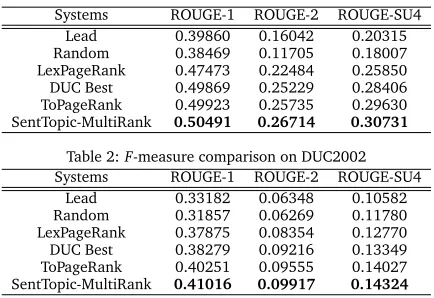
Tables 2-3 show the experimental results. From those statistics, we observe that ToPageRank is better than LexPageRank while our SentTopic-MultiRank outperforms all the competitors.
2http://www-nlpir.nist.gov/projects/duc/data/2002_data.html 3http://www-nlpir.nist.gov/projects/duc/data/2004_data.html 4http://www-nlpir.nist.gov/projects/duc/duc2005/tasks.html 5http://www-nlpir.nist.gov/projects/duc/duc2006/tasks.html 6http://tartarus.org/martin/PorterStemmer/
7http:
Systems ROUGE-1 ROUGE-2 ROUGE-SU4
Lead 0.39860 0.16042 0.20315
Random 0.38469 0.11705 0.18007
LexPageRank 0.47473 0.22484 0.25850
DUC Best 0.49869 0.25229 0.28406
ToPageRank 0.49923 0.25735 0.29630
SentTopic-MultiRank 0.50491 0.26714 0.30731
Table 2:F-measure comparison on DUC2002
Systems ROUGE-1 ROUGE-2 ROUGE-SU4
Lead 0.33182 0.06348 0.10582
Random 0.31857 0.06269 0.11780
LexPageRank 0.37875 0.08354 0.12770
DUC Best 0.38279 0.09216 0.13349
ToPageRank 0.40251 0.09555 0.14027
SentTopic-MultiRank 0.41016 0.09917 0.14324
Table 3:F-measure comparison on DUC2004
It suggests that: (1) the decomposition and analysis of topic information indeed benefit the improvement of summary quality, as ToPageRank and SentTopic-MultiRank systems perform. It might result from the fact that not only does target corpus usually involve multiple topics, but a user commonly wishes to obtain information from various aspects by reading a concise text. Analyzing corpus on topic level could deeply and comprehensively identify user desired content. (2)ToPageRank focuses on sentence interaction within a topic’s range while SentTopic-MultiRank takes three kinds of relations (sentence-sentence, sentence-topic, topic-topic) into consideration wholly. Hence, propagation of impacts among sentences and topics (noting that topics are treated as relation types) is a bonus to determine the saliency score of sentences.
5.2.2 Query-biased multi-document summarization
To validate SentTopic-MultiRank in query-biased task, following systems are implemented as baselines. (1)Random: The same baseline as that in above generic task. (2)Manifold: ranking the sentences according to the manifold ranking scores. (3)Biased LexRank: A modified ver-sion of traditional random walk with prior belief. It was presented in (Erkan, 2006) and the sentence prior knowledge was denoted by sentence’s similarity to the query description. (4)top three systems with the highest ROUGE scores that participated in the DUC2005 (S4, S15, S17) and the DUC2006 (S12, S23, S24) for comparison, respectively. Tables 4 and 5 present the performance of these systems on DUC2005 and DUC2006 data sets, respectively.
Systems ROUGE-1 ROUGE-2 ROUGE-SU4
Random 0.30821 0.03976 0.10625
Biased LexRank 0.37324 0.07113 0.12805
Manifold 0.37497 0.07423 0.12907
S17 0.36933 0.07286 0.12937
S4 0.37584 0.07063 0.12868
S15 0.37656 0.07244 0.13248
SentTopic-MultiRank 0.38803 0.07994 0.13532
Systems ROUGE-1 ROUGE-2 ROUGE-SU4
Random 0.34821 0.05297 0.11908
Biased LexRank 0.36814 0.08074 0.12993
Manifold 0.38867 0.08308 0.13307
S23 0.40973 0.09785 0.16162
S12 0.41053 0.09633 0.16074
S24 0.41081 0.09957 0.15248
SentTopic-MultiRank 0.41567 0.10125 0.16431
Table 5:F-measure comparison on DUC2006
Apparently, our approach SentTopic-MultiRank has the optimal performance, especially out-perform the two representative graph-based methods: Biased LexRank and Manifold. Noting that both the sentence networks of Biased LexRank and Manifold are only based on sentence similarity under a single relation type assumption, so the estimation of their sentence ranking scores is limited compared with SentTopic-MultiRank which skillfully considers query-biased information as well as the interactions between sentences and topics.
5.3 Influence of topic number
K
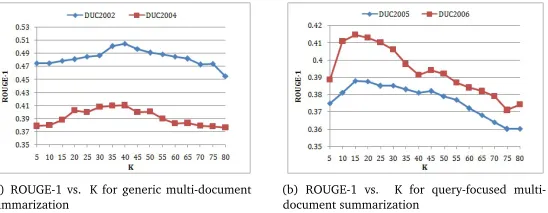
LDA is a crucial tool in devising SentTopic-MultiRank and topic numberK also denotes the amount of different relation types. In order to investigate how the topic numberKexerts influ-ence to system performance,Kis varied from 5 to 80. Figures 2(a)-2(b) show the influence of
Kover ROUGE-1 with respect to generic and query-oriented multi-document summarization, respectively. On the whole, the evaluation scores rise with the increase ofK, and reach their re-spective maximum, then gradually go down whenKcontinues to become larger. Despite some slight fluctuations, they don’t matter to the overall conclusion. We could draw the following two meaningful conclusions. (1)It indicates that topic number indeed influences the algorithm result. In fact, our system would be similar with LexPageRank ifK=1. (2)Interestingly, two tasks do not reach their optimal situations at an approximateKvalue, more exactly, generic task requires a relatively largeK(K≈40) while query-biased prefers smallK(K≈15) (here our adoption of an approximation forKis because that we actually varyKevery 5 from the start valueK=5 in experiments). It may derive from the fact that a query description usually involves few topics, whereas, when applying SentTopic-MultiRank to generic task, we could image the whole corpus as a big query, which concerns about more topics.
(a) ROUGE-1 vs. K for generic multi-document
summarization (b) ROUGE-1 vs.document summarizationK for query-focused
5.4 Comparison of three sentence prior methods
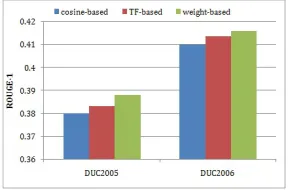
In Section 3.4.1, we namedweight-basedfor our proposed sentence prior method. In order to confirm its advantage in acquiring more favorable sentence prior distribution, we com-pare it with two competitors:cosine-basedandTF-basedusing query-biased summary qualities on DUC2005 and DUC2006. Section 5.3 has indicated that whenK is about 15 the quality of query-oriented summary is optimal. For simplicity, we compare the three methods using ROUGE-1 metric under the same conditionK=15. Figure 3 gives comparison results. For the
space limit, here we give up showing the comparison results on ROUGE-2 and ROUGE-SU4.
Figure 3: Comparison of three sentence prior methods,K=15.
As Figure 3 shows, generation probability methods, includingTF-basedandweight-based, both outperformcosine-based. In addition, system usingweight-basedmethod to generate sentence prior indeed produces summaries with the highest quality. It not only suggests the effective-ness of generation probability methods, but also points out that our method, considering term weights instead of term frequencies to acquire generation probabilities of words given a sen-tence, is more useful to derive sentence affinity.
Conclusion and perspectives
In this study, we exploit LDA to devise a novel model named SentTopic-MultiRank based on MultiRank algorithm for multi-document summarization. Our intention is to map sentence relatedness over various latent topics to heterogeneous network where multiple topics are treated as various kinds of relations. We apply our approach to both generic and query-biased multi-document summarization. In generic task, we use MultiRank algorithm to directly deter-mine the importance of all sentences, while in query-sensitive task, some query-biased prior beliefs are added to sentences and topics of the SentTopic-MultiRank network, so that some top-ranked sentences are supposed to not only demonstrate the core content of target corpus, but also bias to the information needs of a user’s query. Extensive experiments have been performed to prove the effectiveness of our approach in improving the summary quality. In future work, for one thing, we may apply our model to new summarization task, such as updated summarization; for another, integrating manifold-ranking process with SentTopic-MultiRank might be an interesting idea in some query-related applications.
Acknowledgments
References
Blei, D., Ng, A., and Jordan, M. (2003). Latent dirichlet allocation. The Journal of Machine Learning Research, 3:993–1022.
Erkan, G. (2006). Using biased random walks for focused summarization. InProceedings of the 2006 Document Understanding Conference.
Erkan, G. and Radev, D. (2004). Lexpagerank: Prestige in multi-document text summariza-tion. InProceedings of EMNLP, volume 4.
Goldstein, J., Kantrowitz, M., Mittal, V., and Carbonell, J. (1999). Summarizing text docu-ments: sentence selection and evaluation metrics. InProceedings of the 22nd annual inter-national ACM SIGIR conference on Research and development in information retrieval, pages 121–128. ACM.
Haveliwala, T. (2003). Topic-sensitive pagerank: A context-sensitive ranking algorithm for web search.Knowledge and Data Engineering, IEEE Transactions on, 15(4):784–796.
Kleinberg, J. (1999). Authoritative sources in a hyperlinked environment.Journal of the ACM (JACM), 46(5):604–632.
Kolda, T. and Bader, B. (2006). The tophits model for higher-order web link analysis. In
Workshop on Link Analysis, Counterterrorism and Security, volume 7, pages 26–29.
Kupiec, J., Pedersen, J., and Chen, F. (1995). A trainable document summarizer. In Proceed-ings of the 18th annual international ACM SIGIR conference on Research and development in information retrieval, pages 68–73. ACM.
Kurland, O. and Lee, L. (2010). Pagerank without hyperlinks: Structural reranking using links induced by language models.ACM Transactions on Information Systems (TOIS), 28(4):18.
Lin, C. (2004). Rouge: A package for automatic evaluation of summaries. InProceedings of the workshop on text summarization branches out (WAS 2004), volume 16.
Lin, C. and Hovy, E. (2002). From single to multi-document summarization: A prototype system and its evaluation. InProceedings of the 40th Annual Meeting on Association for Com-putational Linguistics, pages 457–464. Association for Computational Linguistics.
Liu, Y., Zhong, S., and Li, W. (2012). Query-oriented multi-document summarization via unsupervised deep learning. InTwenty-Sixth AAAI Conference on Artificial Intelligence.
Liu, Z., Huang, W., Zheng, Y., and Sun, M. (2010). Automatic keyphrase extraction via topic decomposition. InProceedings of the 2010 Conference on Empirical Methods in Natural Language Processing, pages 366–376. Association for Computational Linguistics.
Manning, C., Schutze, H., and MITCogNet (1999).Foundations of statistical natural language processing, volume 999. MIT Press.
Ng, M., Li, X., and Ye, Y. (2011). Multirank: co-ranking for objects and relations in multi-relational data. InProceedings of the 17th ACM SIGKDD international conference on Knowledge discovery and data mining, pages 1217–1225. ACM.
Nie, L., Davison, B., and Qi, X. (2006). Topical link analysis for web search. In Proceed-ings of the 29th annual international ACM SIGIR conference on Research and development in information retrieval, pages 91–98. ACM.
Ouyang, Y., Li, S., and Li, W. (2007). Developing learning strategies for topic-based sum-marization. InProceedings of the sixteenth ACM conference on Conference on information and knowledge management, pages 79–86. ACM.
Page, L., Brin, S., Motwani, R., and Winograd, T. (1999). The pagerank citation ranking: Bringing order to the web.
Pei, Y., Yin, W., Zhang, F., and Huang, L. (2012). Generic multi-document summarization us-ing topic-oriented information. InProceedings of the 2012 Pacific Rim International Conference on Artificial Intelligence, pages 435–446.
Radev, D., Jing, H., Stys, M., and Tam, D. (2004). Centroid-based summarization of multiple documents.Information Processing & Management, 40(6):919–938.
Saggion, H., Bontcheva, K., and Cunningham, H. (2003). Robust generic and query-based summarisation. InProceedings of the tenth conference on European chapter of the Association for Computational Linguistics-Volume 2, pages 235–238. Association for Computational Lin-guistics.
Shen, C. and Li, T. (2011). Learning to rank for query-focused multi-document summariza-tion. InData Mining (ICDM), 2011 IEEE 11th International Conference on, pages 626–634. IEEE.
Shen, D., Sun, J., Li, H., Yang, Q., and Chen, Z. (2007). Document summarization using conditional random fields. InProceedings of IJCAI, volume 7, pages 2862–2867.
Tong, H., Faloutsos, C., and Pan, J. (2008). Random walk with restart: fast solutions and applications.Knowledge and Information Systems, 14(3):327–346.
Wan, X., Yang, J., and Xiao, J. (2007). Manifold-ranking based topic-focused multi-document summarization. InProceedings of IJCAI, volume 7, pages 2903–2908.
Xutao, L., Michael, K., and Yuming, Y. (2012). Har: Hub, authority and relevance scores in multi-relational data for query. InProceedings of the 2012 SIAM International Conference on Data Mining, pages 141–152.
Zhou, D., Weston, J., Gretton, A., Bousquet, O., and Schlkopf, B. (2004). Ranking on data manifolds.Advances in neural information processing systems, 16:169–176.