A Character-Based Joint Model for Chinese Word Segmentation
Kun Wang
and
Chengqing Zong
National Laboratory of Pattern Recognition
Institute of Automation, Chinese Academy of Science
{kunwang,cqzong}@nlpr.ia.ac.cn
Keh-Yih Su
Behavior Design Corporation
[email protected]
Abstract
The character-based tagging approach is a dominant technique for Chinese word segmentation, and both discrimi-native and generative models can be adopted in that framework. However, generative and discriminative charac-ter-based approaches are significantly different and complement each other. A simple joint model combining the character-based generative model and the discriminative one is thus proposed in this paper to take advantage of both approaches. Experiments on the Sec-ond SIGHAN Bakeoff show that this joint approach achieves 21% relative error reduction over the discriminative model and 14% over the generative one. In addition, closed tests also show that the proposed joint model outperforms all the existing approaches reported in the literature and achieves the best F-score in four out of five corpora.
1
Introduction
Chinese word segmentation (CWS) plays an important role in most Chinese NLP applica-tions such as machine translation, information retrieval and question answering. Many statis-tical methods for CWS have been proposed in the last two decades, which can be classified as either word-based or character-based. The word-based approach regards the word as the basic unit, and the desired segmentation result is the best word sequence found by the search process. On the other hand, the character-based approach treats the word segmentation task as a character tagging problem. The final
segmen-tation result is thus indirectly generated ac-cording to the tag assigned to each associated character. Since the vocabulary size of possible tag-pairs is limited, the character-based models can tolerate out-of-vocabulary (OOV) words and have become the dominant technique for CWS in recent years.
On the other hand, statistical approaches can also be classified as either adopting a genera-tive model or adopting a discriminative model. The generative model learns the joint probabil-ity of the given input and its associated label sequence, while the discriminative model learns the posterior probability directly. Gen-erative models often do not perform well be-cause they make strong independence assump-tions between features and labels. However, (Toutanova, 2006) shows that generative mod-els can also achieve very similar or better per-formance than the corresponding discrimina-tive models if they have a structure that avoids unrealistic independence assumptions.
In terms of the above dimensions, methods for CWS can be classified as:
1) The word-based generative model (Gao et al., 2003; Zhang et al., 2003), which is a well-known approach and has been used in many successful applications;
2) The word-based discriminative model (Zhang and Clark, 2007), which generates word candidates with both word and character features and is the only word-based model that adopts the discriminative approach;
4) The character-based generative model (Wang et al., 2009), which adopts a character-tag-pair-based n-gram model and achieves comparable results with the popular character-based discriminative model.
In general, character-based models are much more robust on OOV words than word-based approaches do, as the vocabulary size of char-acters is a closed set (versus the open set of that of words). Furthermore, among those character-based approaches, the generative model and the discriminative one complement each other in handling in-vocabulary (IV) words and OOV words. Therefore, a character-based joint model is proposed to combine them.
This proposed joint approach has achieved good balance between IV word recognition and OOV word identification. The experiments of closed tests on the second SIGHAN Bakeoff (Emerson, 2005) show that the joint model significantly outperforms the baseline models of both generative and discriminative ap-proaches. Moreover, statistical significance tests also show that the joint model is signifi-cantly better than all those state-of-the-art sys-tems reported in the literature and achieves the best F-score in four of the five corpora tested.
2
Character-Based Models for CWS
The goal of CWS is to find the corresponding word sequence for a given character sequence. Character-based model is to find out the corre-sponding tags for given character sequence.
2.1 Character-Based Discriminative Model
The character-based discriminative model (Xue, 2003) treats segmentation as a tagging problem, which assigns a corresponding tag to each character. The model is formulated as:
1 now on) to indicate the corresponding position of character ck in its associated word. For
ex-ample, the word “北京市 (Beijing City)” will be assigned with the corresponding tags as: “北 /B (North) 京/M (Capital) 市/E (City)”.
Since this tagging approach treats characters as basic units, the vocabulary size of those possible character-tag-pairs is limited.
There-fore, this method is robust to OOV words and could possess a high recall of OOV words (ROOV). Although the dependency between
ad-jacent tags/labels can be addressed, the de-pendency between adjacent characters within a word cannot be directly modeled under this framework. Lower recall of IV words (RIV) is
thus usually accompanied (Wang et al., 2009). In this work, the character-based discrimina-tive model is implemented by adopting the fea-ture templates given by (Ng and Low, 2004), but excluding those ones that are forbidden by the closed test regulation of SIGHAN (e.g., Pu(C0): whether C0 is a punctuation). Those
feature templates adopted are listed below:
1
For example, when we consider the third character “奥” in the sequence “北京奥运会”, template (a) results in the features as following: C-2=北, C-1=京, C0=奥, C1=运, C2=会, and
tem-plate (b) generates the features as: C-2C-1=北京,
C-1C0=京奥, C0C1=奥运, C1C2=运会, and
tem-plate (c) gives the feature C-1C1=京运.
2.2 Character-Based Generative Model
To incorporate the dependency between adja-cent characters in the character-based approach, (Wang et al., 2009) proposes a character-based generative model. In this approach, word wi is
first replaced with its corresponding sequence of [character, tag] (denoted as [c, t]), where tag is the same as that adopted in the above char-acter-based discriminative model. With this representation, this model can be expressed as:
1 1 1 1
various candidates, only should be considered. It can be further simplified with Markov Chain assumption as:
1
宿 Gold and Discriminative Tag: M Generative Trigram Tag: E Tag probability: B/0.0333 E/0.2236 M/0.7401 S/0.0030
Feature
Tag C-2 C-1 C0 C1 C2 C-2C-1 C-1C0 C0C1 C1C2 C-1C1 B -1.4375 0.1572 0.0800 0.2282 0.7709 0.2741 0.0000 0.0000 -0.6718 0.0000 E 1.3558 0.1910 0.7229 -1.2696 -0.5970 0.0049 0.0921 0.0000 0.8049 0.0000 M 1.1071 -0.5527 -0.3174 2.9422 0.4636 -0.1708 0.0000 0.0000 -0.9700 0.0000 S -1.0254 0.2046 -0.4856 -1.9008 -0.6375 0.0000 0.0000 0.0000 0.8368 0.0000 者 Gold and Discriminative Tag: E Generative Trigram Tag: S
Tag probability: B/0.0009 E/0.8138 M/0.0012 S/0.1841 Feature
Tag C-2 C-1 C0 C1 C2 C-2C-1 C-1C0 C0C1 C1C2 C-1C1 B 0.3586 0.4175 0.0000 -0.7207 0.4626 0.0085 0.0000 0.0000 0.0000 0.0000 E 0.3666 0.0687 4.5381 2.8300 -0.0846 0.0000 0.0000 -1.0279 0.6127 0.0000 M -0.5657 -0.4330 1.8847 0.0000 -0.0918 0.0000 0.0000 0.0000 0.0000 0.0000 S -0.1595 -0.0532 2.7360 1.8223 -0.2862 -0.0024 0.0000 1.0494 0.7113 0.0000
Table 1: The corresponding lambda weight of features for “露宿者” in the sentence “[該] [處] [的] [露宿者] [只] [有] [數] [人]”. In the Feature column and Tag row, the value is the corresponding lambda weight for the feature and tag under ME framework. The meanings of those features are explained in Section 2.1.
characters is now directly modeled. This will give sharper preference when the history of assignment is given. Therefore, this approach not only holds robust IV performance but also achieves comparable results with the discrimi-native model. However, the OOV performance of this approach is still lower than that of the discriminative model (see in Table 5), which would be discussed in the next section.
3
Problems with the Character-Based
Generative Model
The character-based generative model can handle the dependency between adjacent char-acters and thus performs well on IV words. However, this generative trigram model is de-rived under the second order Markov Chain assumption. Future character context (i.e., C1
and C2) is thus not utilized in the model when
the tag of the current character (i.e., t0) is
de-termined. Nevertheless, the future context would help to select the correct tag when the associated trigram has not been observed in the training-set, which is just the case for those OOV words. In contrast, the discriminative one could get help from the future context in this case. The example given in the next para-graph clearly shows the above situation.
At the sentence “該(that) 處(place) 的(of) 露 宿者(street sleeper) 只(only) 有(have) 數(some) 人(person) (There are only some street sleepers in that place)” in the CITYU corpus, “露/B宿
/M者/E(street sleeper)” is observed to be an OOV word, while “露/B宿/E(sleep on the street)” is an IV word, where the associated tag of each character is given after the slash sym-bol. The character-based generative model wrongly splits “露宿者” into two words “露/B 宿/E” and “者/S (person)”, as the associated trigram for “露宿者” is not seen in the training set. However, the discriminative model gives the correct result for “宿/M” and the dominant features come from its future context “者” and “只”. Similarly, the future context “只” helps to give the correct tag to “者/E”. Table 1 gives the corresponding lambda feature weights (un-der the Maximum Entropy (ME) (Ratnaparkhi, 1998) framework) for “露 宿 者” in the dis-criminative model. It shows that in the column of “C1” below “宿”, the lambda value
associ-ated with the correct tag “M” is 2.9422, which is the highest value in that column and is far greater than that of the wrong tag “E” (i.e., -1.2696) assigned by the generative model. Which indicates that the future feature “C1” is
errors will be fixed if we let the model scans from both directions, and then combine their results. Unfortunately, it is observed that these two scanning modes share over 90% of their errors. For example, in CITYU corpus, the left-to-right scan generates 1,958 wrong words and the right-to-left scan results 1,947 ones, while 1,795 of them are the same. Similar be-havior can also be observed on other corpora.
To find out what are the problems, 10 errors that are similar to “露宿者” are selected to ex-amine. Among those errors, only one of them is fixed, and “露宿者” still cannot be correctly segmented. Having analyzed the scores of the model scanning from both directions, we found that the original scores (from left-to-right scan) at the stages “者” and “宿” indeed get better if the model scans from right-to-left. However, the score at the stage “露” deteriorates because the useful feature “者” (a past non-adjacent character for “露” when scans form right-to-left) still cannot be utilized when the past con-text “宿者” as a whole is unseen, when the re-lated probabilities are estimated via modified Kneser-Ney smoothing (Chen and Goodman, 1998) technique.
Two scanning modes seem not complement-ing each other, which is out of our original ex-pectation. However, we found that the charac-ter-based generative model and the discrimina-tive one complement each other much more than the two scanning modes do. It is observed that these two approaches share less than 50% of their errors. For example, in CITYU corpus, the generative approach generates 1,958 wrong words and the discriminative one results 2,338 ones, while only 835 of them are the same.
The statistics of the remaining errors re-sulted from the generative model and the dis-criminative model is shown in Table 2. As shown in the table, it can be seen that the gen-erative model and the discriminative model complementeach other on handling IV words and OOV words (In the “IV Errors” column, the number of “G+D-” is much more than the “G-D+”, while the behavior is reversed in the “OOV Errors” column).
4
Proposed Joint Model
Since the performance of both IV words and OOV words are important for real applications,
IV Errors OOV Errors
G+D- G-D+ G-D- G+D- G-D+
G-D-12,027 4,723 7,481 2,384 6,139 3,975
Table 2: Statistics for remaining errors of the char-acter-based generative model and the discriminative one on the second SIGHAN Bakeoff (“G+D-” in the “IV Errors” column means that the generative model segments the IV words correctly but the dis-criminative one gives wrong results. The meanings of other abbreviations are similar with this one.).
we need to combine the strength from both models. Among various combining methods, log-linear interpolation combination is a sim-ple but effective one (Bishop, 2006). Therefore, the following character-based joint model is proposed, and a parameter α is used to weight the generative model in a cross-validation set.
1 2 2 2
( ) log( ([ , ] [ , ] ))
(1 ) log( ( ))
k
k k
k k k
Score t P c t c t
P t c
α α
− −
+ −
= × + − ×
k
(4)
Where tk indicates the corresponding position
of character ck, and α (0.0≤ ≤α 1.0) is the
weight for the generative model. Score(tk) will
be used during searching the best sequence. It can be seen that these two models are inte-grated naturally as both are character-based.
Generally speaking, if the “G(or D)+” has a strong preference on the desired candidate, but the “D(or G)-” has a weak preference on its top-1 incorrect candidate, then this combining method would correct most “G+D- (also G-D+)” errors. On the other hand, the advantage of combining two models would vanish if the “G(or D)+” has a weak preference while the “D(or G)-” has a strong preference over their top-1 candidates. In our observation, these two models meet this requirement quite well.
5
Weigh Various Features Differently
For a given observation, intuitively each feature should be trained only once under the ME framework and its associated weight will be automatically learned from the training cor-pus. However, when we repeat the work of (Jiang et al., 2008), which reports to achieve the state-of-art performance in the data-sets that we adopt, it has been found that some fea-tures (e.g., C0) are unnoticeably trained several
Corpus Abbrev. Encoding Training Size (Words/Type)
Test Size
(Words/Type) OOV Rate
Academia Sinica (Taipei) AS Unicode/Big5 5.45M/141K 122K/19K 0.046
City University of Hong Kong CITYU Unicode/Big5 1.46M/69K 41K/9K 0.074
Microsoft Research (Beijing) MSR Unicode/CP936 2.37M/88K 107K/13K 0.026
PKU(ucvt.) Unicode/CP936 1.1M/55K 104K/13K 0.058
Peking University
PKU(cvt.) Unicode/CP936 1.1M/55K 104K/13K 0.035
Table 3: Corpus statistics for the second SIGHAN Bakeoff
appears twice, which is generated from two different templates Cn (with n=0, generates C0)
and [C0Cn] (used in (Jiang et al., 2008), with
n=0, generates [C0C0]). The meanings of
fea-tures are illustrated in Section 2.1. Those re-petitive features also include [C-1C0] and
[C0C1], which implicitly appear thrice. And it
is surprising to discover that its better perform-ance is mainly due to this implicit feature repe-tition but the authors do not point out this fact. As all the features adopted in (Jiang et al., 2008) possess binary values, if a binary feature is repeated n times, then it should behave like a real-valued feature with its value to be “n”, at least in principle. Inspired by the above dis-covery, accordingly, we convert all the binary-value features into their corresponding real-valued features. After having transformed bi-nary features into their corresponding real-valued ones, the original discriminative model is re-trained under the ME framework.
This new implementation, which would be named as the character-based discriminative-plus model, just weights various features dif-ferently before conducting ME training. Af-terwards, it is further combined with the gen-erative trigram model, and is called the charac-ter-based joint-plus model.
6
Experiments
The corpora provided by the second SIGHAN Bakeoff (Emerson, 2005) were used in our ex-periments. The statistics of those corpora are shown in Table 3.
Note that the PKU corpus is a little different from others. In the training set, Arabic num-bers and English characters are in full-width form occupying two bytes. However, in the testing set, these characters are in half-width form occupying only one byte. Most research-ers in the SIGHAN Bakeoff competition per-formed a conversion before segmentation (Xiong et al., 2009). In this work, we conduct
the tests on both unconverted (ucvt.) case and converted (cvt.) case. After the conversion, the OOV rate of converted corpus is obviously lower than that of unconverted corpus.
To fairly compare the proposed approach with previous works, we only conduct closed tests1. The metrics Precision (P), Recall (R), F-score (F) (F=2PR/(P+R)), Recall of OOV (ROOV) and Recall of IV (RIV) are used to
evaluate the results.
6.1 Character-Based Generative Model and Discriminative Model
As shown in (Wang et al., 2009), the character-based generative trigram model significantly exceeds its related bigram model and performs the same as its 4-gram model. Therefore, SRI Language Modeling Toolkit2 (Stolcke, 2002) is used to train the trigram model with modi-fied Kneser-Ney smoothing (Chen and Good-man, 1998). Afterwards, a beam search de-coder is applied to find out the best sequence.
For the character-based discriminative model, the ME Package3 given by Zhang Le is used to conduct the experiments. Training was done with Gaussian prior 1.0 and 300, 150 it-erations for AS and other corpora respectively.
Ta
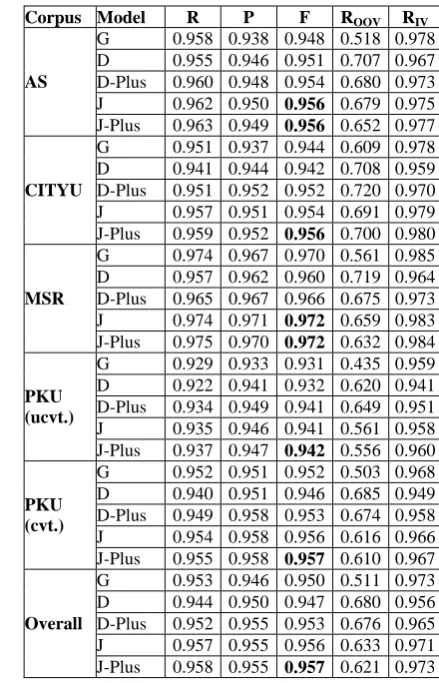
ble 5 gives the segmentation results of both the character-based generative model and the discriminative model. From the results, it can be seen that the generative model achieves comparable results with the discriminative one and they outperform each other on different corpus. However, the generative model ex-ceeds the discriminative one on RIV (0.973 vs.
0.956) but loses on ROOV (0.511 vs. 0.680). It
illustrates that they complement each other.
1
According to the second Sighan Bakeoff regulation, the closed test could only use the training data directly pro-vided. Any other data or information is forbidden, includ-ing the knowledge of characters set, punctuation set, etc. 2
http://www.speech.sri.com/projects/srilm/
3
Joint model performance on Development sets
Figure 1: Development sets performance of Charac-ter-based joint model.
Corpus Set Words OOV NumOOV Rate
Development 17,243 445 0.026
AS
Testing 122,6105,308/5,3110.043/0.043 Development 17,324 355 0.020
MSR
Testing 106,8732,829/2,8330.026/0.027 Development 12,075 537 0.044
CITYU
Testing 40,936 3,028/3,0340.074/0.074 Development 13,576 532 0.039 Testing (ucvt.) 104,3726,006/6,0540.058/0.058
PKU
Testing (cvt.) 104,3723,611/3,6610.035/0.035
Table 4: Corpus statistics for Development sets and Testing sets. A “/” separates the OOV number (or OOV rate) with respect to the original training sets and the new training sets.
6.2 Character-Based Joint Model
For the character-based joint model, a devel-opment set is required to obtain the weight α for its associated generative model. A small portion of each original training corpus is thus extracted as the development set and the re-maining data is regarded as the new training-set, which is used to train two new parameter-sets for both generative and discriminative models associated.
The last 2,000, 600, 400, and 300 sentences for AS, MSR, CITYU, and PKU are extracted from the original training corpora as their cor-responding development sets. The statistics for new data sets are shown in Table 4. It can be seen that the variation of the OOV rate could be hardly noticed. The F-scores of the joint model, versus different α , evaluated on four development sets are shown in Figure 1. It can be seen that the curves are not sharp but flat near the top, which indicates that the character-based joint model is not sensitive to the α value selected. From those curves, the best suitable α for AS, CITYU, MSR and PKU are found to be 0.30, 0.60, 0.60 and 0.60,
respec-Corpus Model R P F ROOV RIV
tively. Those alpha values will then be adopted to conduct the experiments on the testing sets.
G 0.958 0.938 0.948 0.518 0.978 D 0.955 0.946 0.951 0.707 0.967 D-Plus 0.960 0.948 0.954 0.680 0.973 J 0.962 0.950 0.956 0.679 0.975
AS
J-Plus 0.963 0.949 0.956 0.652 0.977 G 0.951 0.937 0.944 0.609 0.978 D 0.941 0.944 0.942 0.708 0.959 D-Plus 0.951 0.952 0.952 0.720 0.970 J 0.957 0.951 0.954 0.691 0.979
CITYU
J-Plus 0.959 0.952 0.956 0.700 0.980 G 0.974 0.967 0.970 0.561 0.985 D 0.957 0.962 0.960 0.719 0.964 D-Plus 0.965 0.967 0.966 0.675 0.973 J 0.974 0.971 0.972 0.659 0.983
MSR
J-Plus 0.975 0.970 0.972 0.632 0.984 G 0.929 0.933 0.931 0.435 0.959
J-Plus 0.937 0.947 0.942 0.556 0.960 G 0.952 0.951 0.952 0.503 0.968
J-Plus 0.955 0.958 0.957 0.610 0.967 G 0.953 0.946 0.950 0.511 0.973 D 0.944 0.950 0.947 0.680 0.956 D-Plus 0.952 0.955 0.953 0.676 0.965 J 0.957 0.955 0.956 0.633 0.971
Overall
J-Plus 0.958 0.955 0.957 0.621 0.973
Table 5: ent e
based m n t G
ificantly outperforms both the character-ba
Segm odels o
ation r sults of various character-he second SI HAN Bakeoff, tcharacter-he generative trigram model (G), the discriminative model (D), the discriminative-plus model (D-Plus), the joint model (J) and the joint-plus model (J-Plus).
As shown in Table 5, the joint model sig-n
sed generative model and the discriminative one in F-score on all the testing corpora. Com-pared with the generative approach, the joint model increases the overall ROOV from 0.510 to
0.633, with the cost of slightly degrading the overall RIV from 0.973 to 0.971. This shows
that the joint model holds the advantage of the generative model on IV words. Compared with the discriminative model, the proposed joint model improves the overall RIV from 0.956 to
0.971, with the cost of degrading the overall ROOV from 0.680 to 0.633. It clearly shows that
6.3 Weigh Various Features Differently
Inspired by (Jiang et al., 2008), we set the real-d
Although Table 5 has shown that the proposed all the value of C0 to be 2.0, the value of C-1C0 an
C0C1 to be 3.0, and the values of all other
fea-tures to be 1.0 for the character-based dis-criminative-plus model. Although it seems rea-sonable to weight those closely relevant fea-tures more (C0 should be the most relevant
fea-ture for assigning tag t0), both implementations
seem to be equal if their corresponding lambda-values are also updated accordingly. However, Table 5 shows that this new dis-criminative-plus implementation (D-Plus) sig-nificantly outperforms the original one (overall F-score is raised from 0.947 to 0.953) when both of them adopt real-valued features. It is not clear how this change makes the difference. Similar improvements can be observed with two other ME packages. One anonymous re-viewer pointed out that the duplicated features should not make difference if there is no regu-larization. However, we found that the dupli-cated features would improve the performance whether we give Gaussian penalty or not.
Afterwards, this new implementation and the generative trigram model are further com-bined (named as the joint-plus model). Table 5 shows that this joint-plus model also achieves better results compared with the discrimina-tive-plus model, which illustrates that our joint approach is an effective and robust method for CWS. However, compared with the original joint model, the new joint-plus approach does not show much improvement, regardless of the significant improvement made by the discrimi-native-plus model, as the additional benefit generated by the discriminative-plus model has already covered by the generative approach (Among the 6,965 error words corrected by the discriminative-plus model, 6,292 (90%) of them are covered by the generative model).
7
Statistical Significance Tests
joint (joint-plus) model outperforms
baselines mentioned above, we want to know if the difference is statistically significant enough to make such a claim. Since there is only one testing set for each training corpus, the bootstrapping technique (Zhang et al., 2004) is adopted to conduct the tests: Giving an
Models
A B AS CITYU MSR
PKU (ucvt.)
PKU (cvt.)
G D < ~ > ~ > D-Plus G > > < > > D-Plus D > > > > > J G > > > > > J D > > > > > J-Plus G > > > > > J-Plus D-Plus > > > ~ > J-Plus J ~ > ~ > >
Table 6 atistic sign anc est F- e
v er-b d m ls.
f T0) will
be generated by repeatedly re-sampling data
the dis-he
confi-the pro-po
e-ng
d.
tegory includes (Asahara et al., 2005) (denoted as
: St al ific e t of scor
among arious charact ase ode
testing-set T0, additional M-1 new testing-sets
T0,…,TM-1 (each with the same size o
from T0. Then, we will have a total of M
testing-sets (M=2000 in our experiments).
7.1 Comparisons with Baselines
We then follow (Zhang et al., 2004) to m ure the 95% confidence interval for crepancy between two models. If t
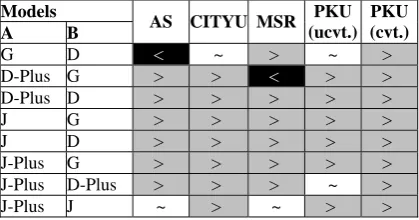
dence interval does not include the origin point, we then claim that system A is significantly different from system B. Table 6 gives the re-sults of significant tests among various models mentioned above. In this table, “>” means that system A is significantly better than B, where as “<” denotes that system A is significantly worse than B, and “~” indicates that these two systems are not significantly different.
As shown in Table 6, the proposed joint model is significantly better than the two base-line models on all corpora. Similarly,
sed joint-plus model also significantly out-performs the generative model and the dis-criminative-plus model on all corpora except on the PKU(ucvt.). The comparison shows that the proposed joint (also joint-plus) model in-deed exceeds each of its component models.
7.2 Comparisons with Previous Works
The above comparison mainly shows the sup riority of the proposed joint model amo those approaches that have been implemente However, it would be interesting to know if the joint (and joint-plus) model also outperforms those previous state-of-the-art systems.
A
-sets. In-st
th
sahara05) and (Tseng et al., 2005) 4 (Tseng05). (Asahara et al., 2005) achieves the best result in the AS corpus, and (Tseng et al., 2005) performs best in the remaining three corpora. Besides, those systems that are re-ported to exceed the above two systems are also selected. This category includes (Zhang et al., 2006) (Zhang06), (Zhang and Clark, 2007) (Z&C07) and (Jiang et al., 2008) (Jiang08). They are briefly summarized as follows. (Zhang et al., 2006) is based on sub-word tag-ging and uses a confidence measure method to combine the sub-word CRF (Lafferty et al., 2001) and rule-based models. (Zhang and Clark, 2007) uses perceptron (Collins, 2002) to generate word candidates with both word and character features. Last, (Jiang et al., 2008)5 adds repeated features implicitly based on (Ng and Low, 2004). All of the above models, ex-cept (Zhang and Clark, 2007), adopt the char-acter-based discriminative approach.
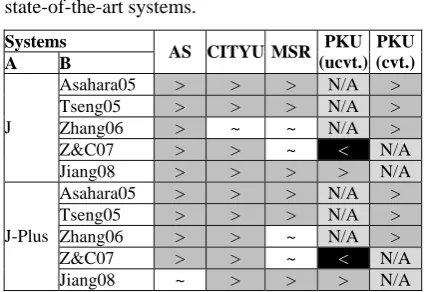
All the results of the systems mentioned above are shown in Table 7. Since the systems are not re-implemented, we cannot generate paired samples from those M testing
ead, we calculate the 95% confidence inter-val of the joint (also joint-plus) model. After-wards, those systems can be compared with our proposed models. If the F-score of system B does not fall within the 95% confidence in-terval of system A (joint or joint-plus), then they are statistically significantly different.
Table 8 gives the results of significant tests for those systems mentioned in this section. It shows that both our joint-plus model and joint model exceed (or are comparable to) almost all e state-of-the-art systems across all corpora, except (Zhang and Clark, 2007) at PKU(ucvt.). In that special case, (Zhang and Clark, 2007)
4
We are not sure whether (Asahara et al., 2005) and (Tseng et al., 2005) performed a conversion before seg-mentation in PKU corpus. In this paper, we followed previous works, which cited and compared with them. 5
The data for (Jiang et al., 2008) given at Table 7 are different from what were reported at their paper. In the communication with the authors, it is found that the script for evaluating performance, provided by the SIGHAN Bakeoff, does not work correctly in their platform. After the problem is fixed, the re-evaluated real performances reported here deteriorate from their original version. Please see the announcement in Jiang’s homepage (http://mtgroup.ict.ac.cn/~jiangwenbin/papers/error_corre ction.pdf).
Corpus
Participants AS CITYU MSR
PKU (ucvt.)
PKU (cvt.)
Asahara05 0.952 0.941 0.958 N/A 0.941 Tseng05 0.947 0.943 0.964 N/A 0.950 Zhang06 0.951 0.951 0.971 N/A 0.951 Z&C07 0.946 0.951 0.972 0.945 N/A Jiang08 0.953 0.948 0.966 0.937 N/A Our Joint 0.956 0.954 0.972 0.941 0.956 Our Joint-Plus 0.956 0.956 0.972 0.942 0.957
Table 7: Compari r p u e two models complement dling IV words and OOV
e-nomenon.
8: Statistic ign anc st F-score fo
previous state-o -art em
rforms t int s 0 on
F- score (0.4% for the joint model). However, our joint-plus model exceeds it more over AS and CITYU corpora by 1.0%
spectively (1.0% and 0.3% for the joint model). Thus, it is fair to say that both our joint model and joint-plus model are superior to the state-of-the-art systems reported in the literature.
8
Conclusion
From the error analysis of the character-based generative model and the discriminative o we found that thes
each other on han
words. To take advantage of these two ap-proaches, a joint model is thus proposed to combine them. Experiments on the Second SIGHAN Bakeoff show that the joint model achieves 21% error reduction over the dis-criminative model (14% over the generative model). Moreover, closed tests on the second SIGHAN Bakeoff corpora show that this joint model significantly outperforms all the state-of-the-art systems reported in the literature.
A
Generic-Beam-Search code and o Ms. Nanyan Kuo for eric-Beam-Search code.
m
optimum entation. In Proceedings of GHAN Workshop on Chinese
Lan-St
ction using conditional random fields.
Ad
MNLP, pages
Hu
ld Word Segmenter
Ku d Keh-Yih Su, 2009.
2006. Subword-based Tagging for
Con-Yi
scores: How much
im-Yu
f ACL, pages 840-847,
cknowledgement
The authors extend sincere thanks to Wenbing Jiang for his helps with our experiments. Also, we thank Behavior Design Corporation for using their
show special thanks t her helps with the Gen
The research work has been partially funded by the Natural Science Foundation of China under Grant No. 60975053, 90820303 and 60736014, the National Key Technology R&D Program under Grant No. 2006BAH03B02, and also the Hi-Tech Research and
Develop-ent Program (“863” Program) of China under Grant No. 2006AA010108-4 as well.
References
Masayuki Asahara, Kenta Fukuoka, Ai Azuma, Chooi-Ling Goh, Yotaro Watanabe, Yuji Ma-tsumoto and Takashi Tsuzuki, 2005. Combina-tion of machine learning methods for
Chinese word segm
the Fourth SI
guage Processing, pages 134–137, Jeju, Korea.
Christopher M. Bishop, 2006. Pattern recognition
and machine learning. New York: Springer
anley F. Chen and Joshua Goodman, 1998. An empirical study of smoothing techniques for
lan-guage modeling. Technical Report TR-10-98,
Harvard University Center for Research in
Computing Technology.
Michael Collins, 2002. Discriminative training methods for hidden markov models: theory and experiments with perceptron algorithms. In
Pro-ceedings of EMNLP, pages 1-8, Philadelphia.
omas Emerson, 2005. The second international
Chinese word segmentation bakeoff. In
Proceed-ings of the Fourth SIGHAN Workshop on
Chi-nese Language Processing, pages 123-133.
nfeng Gao, Mu Li and Chang-Ning Huang, 2003. Improved Source-Channel Models for Chinese
Word Segmentation. In Proceedings of ACL,
pages 272-279.
enbin Jiang, Liang Huang, Qun Liu and Yajuan Lu, 2008. A Cascaded Linear Model for Joint Chinese Word Segmentation and Part-of-Speech Tagging. In Proceedings of ACL, pages 897-904. hn Lafferty, Andrew McCallum and Fernando
Pereira, 2001. Conditional Random Fields: Prob-abilistic Models for Segmenting and Labeling
Sequence Data. In Proceedings of ICML, pages
282-289.
ee Tou Ng and Jin Kiat Low, 2004. Chinese part-of-speech tagging: one-at-a-time or
all-at-once? word-based or character-based. In
Pro-ceedings of EMNLP, pages 277-284.
chun Peng, Fangfang Feng and Andrew McCallum, 2004. Chinese segmentation and new word dete
In Proceedings of COLING, pages 562–568.
wait Ratnaparkhi, 1998. Maximum entropy models for natural language ambiguity resolu-tion. University of Pennsylvania.
Andreas Stolcke, 2002. SRILM-an extensible
lan-guage modeling toolkit. In Proceedings of the
International Conference on Spoken Language
Processing, pages 311-318.
Kristina Toutanova, 2006. Competitive generative models with structure learning for NLP
classifi-cation tasks. In Proceedings of E
576-584, Sydney, Australia.
ihsin Tseng, Pichuan Chang, Galen Andrew, Daniel Jurafsky and Christopher Manning, 2005. A Conditional Random Fie
for Sighan Bakeoff 2005. In Proceedings of the
Fourth SIGHAN Workshop on Chinese
Lan-guage Processing, pages 168-171.
n Wang, Chengqing Zong an
Which is more suitable for Chinese word seg-mentation, the generative model or the
discrimi-native one? In Proceedings of PACLIC, pages
827-834, Hong Kong, China.
ng Xiong, Jie Zhu, Hao Huang and Haihua Xu, 2009. Minimum tag error for di
training of conditional random fields.
Informa-tion Sciences, 179 (1-2). pages 169-179.
anwen Xue, 2003. Chinese Word Segmentation as Character Tagging. Computational Linguistics and Chinese Language Proce
29-48.
aping Zhang, Hongkui Yu, Deyi Xiong and Qun Liu, 2003. HHMM-based Chinese lexical
ana-lyzer ICTCLAS. In Proceedings of the
SIGHAN Workshop on Chinese Language
Proc-essing, pages 184–187.
iqiang Zhang, Genichiro Kikui and Eiichiro Sumita,
fidence-dependent Chinese Word Segmentation.
In Proceedings of the COLING/ACL, pages
961-968, Sydney, Australia.
ng Zhang, Stephan Vogel and Alex Waibel, 2004. Interpreting BLEU/NIST
provement do we need to have a better system.
In Proceedings of LREC, pages 2051–2054.
e Zhang and Stephen Clark, 2007. Chinese Seg-mentation with a Word-Based Perceptron
Algo-rithm. In Proceedings o
![Table 1: The corresponding lambda weight of features for “露宿者[” in the sentence “[該] [處] [的] [露宿者] 只] [有] [數] [人]”](https://thumb-us.123doks.com/thumbv2/123dok_us/779265.1090891/3.595.80.514.69.256/table-corresponding-lambda-weight-features-sentence.webp)