Modeling User Leniency and Product Popularity
for Sentiment Classification
Wenliang Gao∗, Naoki Yoshinaga†, Nobuhiro Kaji†and Masaru Kitsuregawa†‡ ∗Graduate School of Information Science and Technology, The University of Tokyo
†Institute of Industrial Science, The University of Tokyo ‡National Institute of Informatics
{wl-gao, ynaga, kaji, kitsure}@tkl.iis.u-tokyo.ac.jp
Abstract
Classical approaches to sentiment classi-fication exploit only textual features in a given review and are not aware of the per-sonality of the user or the public sentiment toward the target product. In this paper, we propose a model that can accurately es-timate the sentiment polarity by referring to the user leniency and product
popular-ity computed during testing. For decoding
with this model, we adopt an approximate strategy called “two-stage decoding.” Pre-liminary experimental results on two real-world datasets show that our method sig-nificantly improves classification accuracy over existing state-of-the-art methods.
1 Introduction
Document-level sentiment classification estimates the sentiment polarity for a given subjective text (hereafter, review). Traditionally, researchers have tried to estimate the sentiment polarity from only the textual content of the review (Pang and Lee, 2004; Li et al., 2011). However, since reviews are written by a user to express his/her emotion toward a particular product, taking the users and products into consideration would play an important role in solving this task.
Recently, the increase of opinionated text within social media, e.g., Twitter, has motivated re-searchers to exploit the user or product informa-tion in the sentiment classificainforma-tion task. Some re-searchers take advantages of the friend relation in a social network because friends are likely to hold common tastes (Tan et al., 2011; Seroussi et al., 2010; Speriosu et al., 2011). Others incorporate user- or product-specificn-gram features (Li et al., 2011; Seroussi et al., 2010). Although these stud-ies have showed that user or product information is useful for sentiment classification, they implicitly
assume that the same users or products appear in both training and testing data. Thus, to train such a model, a large amount of the reviews should be labeled for each user and each product. In a real-world scenario, however, this is unrealistic since new users and products are ceaselessly emerging and labeling reviews written by such users (or on such products) is impractical.
In the real world, different users have different rating standards, while different products receive different rating tendencies. For example, a crit-ical person is likely to point out flaws and gives negative ratings, while a popular product receives more praise than negative feedback. We refer to these user- or product-specific polarity biases as user leniency and product popularity, respectively. A sentiment classifier would resort to these biases when textual features are not reliable enough to estimate the sentiment polarity.
In this study, we build a model that automati-cally computes and uses user leniency and product popularity for sentiment classification. We rep-resent these biases with two types of real-valued global features. Because these features and the la-bels of the test reviews mutually depend on each other, it is challenging to globally optimize a con-figuration of polarity labels for a given set of re-views. We here adopt a two-stage decoding strat-egy (Krishnan and Manning, 2006) for resolving the mutual dependencies in our model.
We evaluated our method on two real-world datasets (Blitzer et al., 2007; Maas et al., 2011). Experimental results demonstrated that the pro-posed method significantly improved the classifi-cation accuracy against the state-of-the-art meth-ods (Dredze et al., 2008; Seroussi et al., 2010).
The remainder of this paper is organized as fol-lows. We first discuss some related work in Sec-tion 2. We describe our method in SecSec-tion 3. We then report experimental results in Section 4. Fi-nally, we conclude our study in Section 5.
2 Related Work
Recently, social media such as Twitter has at-tracted much attention from researchers because it is now apparently the major source of subjective text on the Web. The traditional text-based meth-ods, such as Pang et al. (2002), could not easily handle such short and informal text (Jiang et al., 2011).
Tan et al. (2010) and Speriosu et al. (2011) exploited the user network behind a social media website (Twitter in their case) and assumed that friends give similar ratings towards similar prod-ucts. Seroussi et al. (2010) proposed a frame-work that computes users’ similarity on the ba-sis of their usage of text and their rating histories. They then classify a given review by referring to ratings given for the same product by other users who are similar to the user in question. However, such user networks are not always available in the real world.
Li et al. (2011) incorporate user- or product-dependentn-gram features into a classifier. They argue that users use a personalized language to ex-press their sentiment, while the sentiment toward a product is described by product-specific language. This approach, however, requires the training data to contain reviews written by test users and written for test products. This is infeasible since labeling reviews requires too much manual work.
3 Method
Given a set of reviews, R, our task is to estimate labelyr∈ {+1,−1}for each review,r∈ R, with
estimation functiong(xr):
g(xr) =wTxr, (1)
yr =
+1 if g(xr)>0 −1 otherwise ,
wherexrisr’s feature vector andwis the weight vector.
3.1 Idea
Our interest is to exploit user leniency and product popularity to improve sentiment classification. We encode each of them into two real-valued global features, which are detailed in Section 3.2. Since these global features depend on the labels of the input reviews, we cannot independently estimate the labels of reviews. We then discuss a decoding strategy in Section 3.3.
Note that we assume to know which reviews are written by the same user and which are written on the same product. This assumption is realis-tic nowadays since user information is available in many real-world datasets (Blitzer et al., 2007; Pang and Lee, 2004), while product information can be extracted from text if not available (Qiu et al., 2011). We should emphasize here that our method does not require user profiles, product de-scriptions, or any sort of extrinsic knowledge on the users and products.
3.2 Features
The reviewr’s feature vector, xr, is composed of local features (xlr) and global features (xgr), such that xr = (xlr,xgr). In this study, we use word
n-grams (n = 1, 2) in the textual content of the review as local features, while we encode the user leniency and product popularity into global fea-tures. We introduce four global features to capture the user leniency and product polarity:
xgr ={f u+, f u−, f p+, f p−},
where the first two features,f u+
andf u−, rep-resent the user leniency as the ratio of positive and negative reviews written by the same user of r, while the other two features,f p+
andf p−, rep-resent the product popularity as the ratio of posi-tive and negaposi-tive reviews on the same product of
r. The global features are thereby computed as:
f u+(r) = |{rj|yj = +1, rj ∈Nu(r)}|
|Nu(r)|
,
f u−(r) = |{rj|yj =−1, rj ∈Nu(r)}|
|Nu(r)|
,
f p+(r) = |{rj|yj = +1, rj ∈Np(r)}|
|Np(r)|
,
f p−(r) = |{rj|yj =−1, rj ∈Np(r)}|
|Np(r)|
,
where Nu(r) represents a set of reviews written
by the same user asr and Np(r)represents a set
of reviews written for the same product asr, re-spectively:
Nu(r) ={r′|ur =ur′∧r 6=r′},
Np(r) ={r′|pr =pr′ ∧r 6=r′}.
3.3 Decoding
reviews at once so that they include many reviews for each user or on each product to compute reli-able global features. However, because the pos-sible ways of assigning labels to a given set of reviews, R, is 2|R| and the two types of global features introduce complex label dependencies to be resolved, exact decoding is computationally ex-pensive even with dynamic programming. In this study, we thus resort to an approximate decod-ing strategy called “two-stage decoddecod-ing” (Krish-nan and Manning, 2006). It splits the decoding process into a local decoding stage and a global decoding stage. Each stage takes linear time with respect to the number of reviews processed. This strategy is thereby scalable to a larger number of test reviews.
At the first stage, all the global features are set to
0, and only local features are used to classify the reviews. In the second stage, labels estimated in the first stage are used to compute the values of the global features. The labels are then revised by us-ing both local and global features. In our case, the two-stage decoding at first uses only wordn-gram features to estimate the labels of reviews. The es-timated labels are used to compute user leniency features and product popularity features. Then, the decoding revises the labels considering both the word n-gram features and the user leniency and product popularity features.
3.4 Training
We train a binary classifier as the score estimation function in Eq. 1, considering word n-gram fea-tures, user leniency feafea-tures, and product popular-ity features. The values of global features are com-puted by using the gold labels. We assume that a value of the user leniency feature or product popu-larity feature for a review whose user has no other reviews or whose product has no other reviews is set to 0.
4 Experiments
We evaluated our method in terms of accuracy on two real-world datasets (Blitzer et al., 2007; Maas et al., 2011) for a document-level sentiment clas-sification task.
For each review, we at first use OpenNLP1 to detect sentence boundaries and tokenize each sen-tence in order to obtain wordn-gram features. Fol-lowing Pang et al. (2002)’s settings, we take
nega-1
http://opennlp.apache.org/
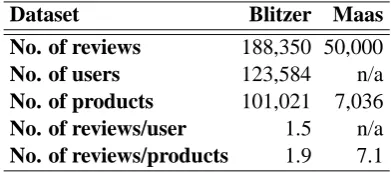
Dataset Blitzer Maas
[image:3.595.318.514.62.148.2]No. of reviews 188,350 50,000 No. of users 123,584 n/a No. of products 101,021 7,036 No. of reviews/user 1.5 n/a No. of reviews/products 1.9 7.1
Table 1: Dataset statistics.
tion (such as n’t and cannot) into consideration. Because features with low frequency are unreli-able, any n-gram that appears less than six times in the training data are ignored.
We adopted a confidence weighted linear clas-sifier (Dredze et al., 2008) as our binary clasclas-sifier. This is because it has been reported to perform best on the sentiment classification task (Dredze et al., 2008).
4.1 Datasets
We used two datasets that were developed by Blitzer et al. (2007) and Maas et al. (2011). The datasets contain user/product and only product in-formation. The statistics of the two datasets are summarized in Table 1.
The original Blitzer dataset contains more than 780,000 reviews (88% positive, 12% negative), which were collected from amazon.com across several domains, such as books, movies and games. We automatically delete reviews written by the same user on the same product, which re-sults in about 740,000 reviews. Then, the re-views are balanced for positive and negative labels (94,175 reviews for each) to maintain consistency with the setting in other existing works.
The Maas dataset has 25,000 positive and 25,000 negative reviews on movies. The dataset provides a URL for each review, which represents the sentiment target, a movie. We thus use the URL as a unique identifier for the movie. The user information cannot be fully recovered, so we only model the product dependency on this dataset.
Method Accuracy (%) Blitzer Maas
Seroussi et al. (2010) 89.37 n/a Maas et al. (2011) n/a 88.893 baseline 90.11 91.35
[image:4.595.316.523.60.204.2]proposed 91.01> 92.68≫
Table 2: Accuracy on review datasets. Accuracy marked with “≫” or “>” was significantly better than baseline (p < 0.01or0.01 ≤ p < 0.05 as-sessed by McNemar’s test).
a 2-fold cross-validation.
4.2 Results
In this section, we report the accuracy of our senti-ment classifier. Accuracy is measured as the num-ber of correctly classified reviews divided by the number of all the reviews. We prepared two base-line classifiers to see the advantage of our clas-sifier. As one baseline, we used a confidence-weighted linear classifier (Dredze et al., 2008) that takes only textual features into account. As an-other baseline, we implemented a user similarity-based method proposed by Seroussi et al. (2010).2 The similarity of users is computed by using a word n-gram Jaccard distance (called “AIT” in Seroussi et al. (2010)). When the user of an in-put review is unseen in the training data, a default classifier, which is trained with all the training re-views, is used to classify the review.
Table 2 shows the experimental results. The proposed method significantly improved the clas-sification accuracies across the two datasets. A larger improvement was acquired on the Maas dataset because the average number of reviews for each product in the dataset was larger than that in the Blitzer dataset.
Impact of size on test reviews In our method, since global features play a key role, acquiring
2We built user-specific classifiers for users who wrote
re-views with positive polarity and negative polarity more than a pre-specified threshold. After several trials, the threshold was set to be 5 to gain the best performance.
3
This result was computed under a different splitting from ours. Under Maas et al. (2011)’s splitting, the accuracy for the baseline and proposed method was 90.83% and 92.29%. The main difference between our baseline and their method is the features. They use only unigram features, while we use unigram and bigram as features. Using only unigram features under their splitting, the accuracy of the baseline method was 87.8%.
103
104
105
90.0 90.5 91.0
1.8 k 3.6 k 9.4 k
18.8 k 47.1 k
94.1 k
baseline
Test review size processed at once
A
cc
u
ra
cy
(%
)
Figure 1: Accuracy when we changed the size of test reviews processed at once by our classifier.
more reliable global features is our major concern to make the improvement more significant.
We thus performed 2-fold cross-validation with the same splitting for the Blitzer dataset, while changing the size of test reviews processed at once to investigate the impact of test review size on classification accuracy. In this experiment, we split the test reviews into equal-sized smaller sub-sets and applied our classifier independently to each of the subsets.
As shown in Figure 1, when we processed a larger number of test reviews at once, the accuracy increased. This result confirms our expectations.
5 Conclusion
We presented a model that captures and uses user leniency and product popularity for sentiment classification. Different from the previous studies that are aware of the user and product of the re-view, our model does not require the training data to contain reviews written by the test users or writ-ten on the test products. To infer labels under our proposed model, we investigated a two-stage de-coding strategy.
We conducted experiments on two real-world datasets to demonstrate the effectiveness of our proposed method. The method performed more accurately than did the baseline method, which only uses n-gram features, and an existing user-aware approach. We also showed that processing more test reviews at once lead to better accuracy.
We plan to publish our code and datasets.4 A detailed exploration of this work will be reported in Gao et al. (2013).
4http://www.tkl.iis.u-tokyo.ac.jp/
References
John Blitzer, Mark Dredze, and Fernando Pereira. 2007. Biographies, bollywood, boom-boxes and blenders: Domain adaptation for sentiment classi-fication. In Proceedings of ACL, pages 440–447, Prague, Czech Republic.
Mark Dredze, Koby Crammer, and Fernando Pereira. 2008. Confidence-weighted linear classification. In
Proceedings of ICML, pages 264–271, New York,
NY, USA.
Wenliang Gao, Naoki Yoshinaga, Nobuhiro Kaji, and Masaru Kitsuregawa. 2013. Collective sentiment classification based on user leniency and product popularity. In Proceedings of PACLIC, Taipei, Tai-wan. to appear.
Long Jiang, Mo Yu, Ming Zhou, Xiaohua Liu, and Tiejun Zhao. 2011. Target-dependent twitter sen-timent classification. In Proceedings ACL-HLT, pages 151–160, Portland, Oregon, USA.
Vijay Krishnan and Christopher D. Manning. 2006. An effective two-stage model for exploiting non-local dependencies in named entity recognition. In
Proceedings of COLING-ACL, pages 1121–1128,
Sydney, Australia.
Fangtao Li, Nathan Liu, Hongwei Jin, Kai Zhao, Qiang Yang, and Xiaoyan Zhu. 2011. Incorporating re-viewer and product information for review rating prediction. In Proceedings of IJCAI, pages 1820– 1825, Barcelona, Catalonia, Spain.
Andrew L. Maas, Raymond E. Daly, Peter T. Pham, Dan Huang, Andrew Y. Ng, and Christopher Potts. 2011. Learning word vectors for sentiment analysis. In Proceedings of ACL-HLT, pages 142–150, Port-land, Oregon, USA.
Bo Pang and Lillian Lee. 2004. A sentimental educa-tion: sentiment analysis using subjectivity summa-rization based on minimum cuts. In Proceedings of
ACL, pages 271–278, Stroudsburg, PA, USA.
Guang Qiu, Bing Liu, Jiajun Bu, and Chun Chen. 2011. Opinion word expansion and target extraction through double propagation. Computational Lin-guistics, 37(1):9–27.
Yanir Seroussi, Ingrid Zukerman, and Fabian Bohnert. 2010. Collaborative inference of sentiments from texts. In Proceedings of UMAP, pages 195–206, Berlin, Heidelberg.
Michael Speriosu, Nikita Sudan, Sid Upadhyay, and Jason Baldridge. 2011. Twitter polarity classifica-tion with label propagaclassifica-tion over lexical links and the follower graph. In Proceedings of EMNLP,
work-shop on Unsupervised Learning in NLP, pages 53–
63, Edinburgh, UK.
Chenhao Tan, Lillian Lee, Jie Tang, Long Jiang, Ming Zhou, and Ping Li. 2011. User-level sentiment anal-ysis incorporating social networks. In Proceedings