Shallow Discourse Parsing with Conditional Random Fields
Sucheta Ghosh Richard Johansson Giuseppe Riccardi Sara Tonelli
Department of Information Engineering and Computer Science, University of Trento FBK-IRST
{ghosh,johansson,riccardi}@disi.unitn.it [email protected]
Abstract
Parsing discourse is a challenging natural language processing task. In this paper we take a data driven approach to iden-tify arguments of explicit discourse con-nectives. In contrast to previous work we do not make any assumptions on the span of arguments and consider parsing as a token-level sequence labeling task. We design the argument segmentation task as a cascade of decisions based on con-ditional random fields (CRFs). We train the CRFs on lexical, syntactic and seman-tic features extracted from the Penn Dis-course Treebank and evaluate feature com-binations on the commonly used test split. We show that the best combination of tures includes syntactic and semantic fea-tures. The comparative error analysis in-vestigates the performance variability over connective types and argument positions.
1 Introduction
Automatic discourse processing is considered one of the most challenging NLP tasks due to its de-pendency on lexical and syntactic features and on the inter-sentential relations. While automatic dis-course processing of structured documents or free text is still in its infancy, a number of applications of this technology in practical NLP systems have been proposed. For instance, Somasundaran et al. (2009) describe the use of discourse structure for opinion analysis. Other applications include con-versational analysis and dialog systems (Tonelli et al., 2010).
In this work we divide the whole task of discourse parsing into two sub-tasks: connec-tive classification and argument segmentation and classification. Several successful attempts have already been made in the direction of automatic
classification of connectives, while token-level argument segmentation has not been explored. Therefore in this paper we will focus on the seg-mentation and labeling of discourse arguments (Arg1 and Arg2) with full spans, as defined in the annotation protocol of the Penn Discourse Treebank (PDTB) (Prasad et al., 2008).
We present a methodology that, given explicit discourse connectives, automatically extracts dis-course arguments by identifyingArg1andArg2 including the corresponding text spans. We call this approach shallow following Prasad et al. (2010) as opposed to tree-like representations of discourse, as in Rhetorical Structure Theory (Mann and Thompson, 1988). Indeed, we provide a flat chunk classification of discourse relations, building a non-hierarchical representation of the relations in a text.
The discourse parser is designed as a cascade of argument-specific CRFs trained on different sets of lexical, syntactic and semantic features. The evaluation is made in terms of exact and partial match of arguments. The partial match condition may be useful in the case of noisy input or for ap-plications that do not require exact alignment.
The paper is structured as follows: in Section 2 we present related work to discourse parsing. In Section 3 we detail argument annotation in PDTB and we report some statistics about the PDTB cor-pus. In Section 4 the pipeline implemented for the argument segmentation and classification task is presented while in Section 5 two different feature sets used for classification are detailed and com-pared. In Section 6 the experimental setup is de-scribed, together with an extensive evaluation and error analysis. Finally, we draw some conclusions in Section 7.
2 Related Work
ex-plicit discourse connectives – has been attempted a number of times. Soon after the initial release of the PDTB, it was realized that sentence-internal arguments may be located and classified using techniques similar to semantic role detection and classification methods. Wellner and Pustejovsky (2007) were the first to carry out such an exper-iment on the PDTB, and Elwell and Baldridge (2008) later improved over their results. However, their task was limited to retrieving the argument heads. In contrast, we integrate discourse segmen-tation in the parsing pipeline because we believe that spans are necessary when using the discourse arguments as input to applications such as opin-ion mining, where attributopin-ions need to be explic-itly marked. Besides, no gold data are available for head-based discourse parsing evaluation and they have to be automatically derived from parse trees with a further processing step. With our approach, instead, we can directly use PDTB argument spans both for training and for testing.
Dinesh et al. (2005) extracted complete argu-ments with boundaries, but only for a restricted class of connectives. The recent work by Prasad et al. (2010) is also limited, since their system only extracts thesentencescontaining the arguments.
In our work, we assume that explicit discourse connectives are given beforehand, either taken di-rectly from a gold standard or automatically iden-tified. The second task based on PDTB was tack-led among others by Pitler et al. (2008) and Pitler and Nenkova (2009).
In addition to the work on finding explicit con-nectives and their arguments, there has been recent work on classification of implicit discourse rela-tions, see for instance Lin et al. (2009). In a sim-ilar classification experiment, Pitler et al. (2009) investigated features ranging from low-level word pairs to high-level linguistic cues, and demon-strated that it is useful to model the sequence of discourse relations using a sequence labeler. Al-though they both outperformed their respective baselines, this task is very difficult and perfor-mances are still very low.
3 The Penn Discourse Treebank (PDTB)
The Penn Discourse Treebank (Prasad et al., 2008) is a resource including one million words from the Wall Street Journal (Marcus et al., 1993), anno-tated with discourse relations.
Based on the observation that “no discourse
connective has yet been identified in any lan-guage that has other than two arguments” (Web-ber et al. (2010), p. 15), connectives in the PTDB are treated as discourse predicates taking two text spans asarguments, i.e. parts of the text that de-scribe events, propositions, facts, situations. Such two arguments in the PDTB are just calledArg1 andArg2 and are chosen according to syntactic criteria:Arg2is the argument syntactically bound to the connective, while Arg1 is the other one. This means that the numbering of the arguments does not necessarily correspond to their order of appearance in text.
In the PDTB, discourse relations can be overtly expressed either by explicit connectives, or by alternative lexicalizations (AltLex). The first group of connectives corresponds primarily to a few well-defined syntactic classes, while alterna-tive lexicalizations are generally non-connecalterna-tive phrases used to express discourse relations, such that the insertion of an explicit connective would lead to redundancy. There is also a third type of re-lations - theimplicitones - which can be inferred between adjacent sentences, even if no discourse connective is overtly realized.
Every kind of relation (i.e. explicit, implicit and AltLex) in the PDTB is assigned a sense la-bel based on a three-layered hierarchy: the top-level classes are the most generic ones and in-clude EXPANSION, CONTINGENCY, COMPARI -SON and TEMPORAL labels (see below resp.
ex-amples from a to d). Then, each class is fur-ther specified attypeandsubtypelevel. Since the state of the art in automatic surface-sense classifi-cation (atclasslevel) has already reached the up-per bound of inter-annotator agreement (Pitler and Nenkova, 2009), we do not include this task in our pipeline. Instead, we use the class label as one of our features, because we can expect to achieve similar performance both with gold standard and with automatically assigned classes.
As for the relations considered, we focus here exclusively on explicit connectives and the iden-tification of their arguments, including the exact spans. This kind of classification is very complex, sinceArg1andArg2can occur in many different configurations. Consider for example the follow-ing explicit relations annotated in the PDTB1:
(a) I never gamble too far.In particularI quit af-ter one try, whether I win or lose.[EXPAN -SION]
(b) Since McDonald’s menu prices rose this year, the actual deadline may have been more.[CONTINGENCY]
(c) As an indicator of the tight grain supply situa-tion in the U.S., market analysts saidthat late Tuesday the Chinese government, which often buys U.S. grains in quantity, turned instead to Britain to buy 500,000 metric tons of wheat.[COMPARISON]
(d) When Mr. Green won a $240,000 ver-dict in a land condemnation case against the State in June 1983, he says, Judge O’Kicki unexpectedly awarded him an addi-tional$100,000. [TEMPORAL]
An explicit connective can occur between two arguments (a) or before them (b). It can also ap-pear inside the argument as shown in (c), where Arg2 is composed of three discontinuous text spans and Arg1 is interpolated. Furthermore, Arg1andArg2need not to be adjacent, as shown in (d), where “he says” does not belong to any ar-gument span. The latter case is annotated as an At-tributionin the PDTB, because it ascribes the as-sertion in text to the agent making it. Attributions occur in 34% of all explicit relations in the PDTB, and represent one of the major challenges in iden-tifying exact argument spans, especially forArg2. However, given the fact thatArg2is syntactically bound to the connective, its identification is gener-ally considered an easier task than the detection of Arg1(Prasad et al., 2010). As shown in Table 1, the position ofArg1w.r.t. the discourse connec-tive is highly variable and, when it does not occur in the same sentence of the connective, it can be very distant fromArg2, even in a preceding para-graph.
Explicit connectives (tokens) 18,459
Explicit connectives (types) 100
Arg1in same sentence as connective 60.9% Arg1in previous, adjacent sentence 30.1%
Arg1in previous, non adjacent sentence 9.0%
Table 1: Statistics about PDTB annotation from Prasad et al. (2008).
Another element increasing the complexity of Arg1andArg2identification is the fact that
dis-course connectives can be expressed by subordi-nating and coordisubordi-nating conjunctions as well as by discourse adverbials, and each type is subject to different discourse constraints. Furthermore, ar-gument spans range from clauses, even single verb phrases, to multiple sentences, and they do not necessarily match single constituents in the syntax because they can be discontinuous. For all these reasons, the identification ofArg1has been only partially addressed in previous works (see for in-stance Prasad et al. (2010).
The PDTB achieved high-valued inter-annotator agreement. Overall agreement for identifying both the arguments (Arg1andArg2) of explicit connectives reached 90.2%, with a
general tendency of lower scores for Arg1 and higher scores for Arg2. When considering a matching technique that gives credit also to partial overlap, the agreement reaches94.5%for explicit
connectives (Wellner, 2009).
4 Processing pipeline
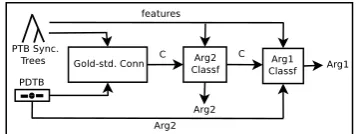
We show that discourse annotation can be per-formedin a pipelinehandling all types of explicit connectives and argument positions. The funda-mental idea is to divide the whole complex task into several small and simpler independent sub-tasks, in order to feed the output of each step into the following one. An overview of the pipeline is given in Fig. 1. Note that, this representation in-cludes data pre-processing, training and testing.
Figure 1: Argument parsing pipeline given Gold-Std Con-nective(C)
In contrast to previous works, our shallow pars-ing strategy combines the identification of non-overlapping sequences as connective arguments and the tagging of such text chunks with Arg1 andArg2labels.
features used by our system. This feature is de-noted as C in Fig. 1. Besides, we also extract from the PTB trees all syntactic features needed by the system for the first parsing subtask, which is the identification ofArg2.
After the identification ofArg2given the con-nective sense label and feature(s) from the gold parse trees, we proceed with the classification of Arg1. This step-by-step methodology is different from previous approaches like the one by Wellner and Pustejovsky (2007), where the authors select pairwisethe best heads ofArg1andArg2in or-der to capture their dependencies, and also by El-well and Baldridge (2008), who additionally de-velop connective-specific models. Our approach is motivated by two intuitions: first, the identifi-cation of Arg2 andArg1 may require different features, since the two arguments have different syntactic and discourse properties, as discussed in Section 3. Second, the identification of Arg2is much easier than the identification of Arg1, be-cause the former is syntactically bound to the con-nective. For this reason, a two-step decision archi-tecture seems more appropriate, because we can start with the easier classification task and then exploit additional output information to tackle the second task.
5 Feature description
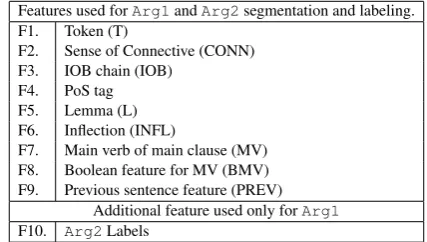
We report in Table 2 the list of all features consid-ered in the argument labeling task and we explain them in the light of the example in Fig. 2.
Despite the complex task, the feature set is quite small for both arguments. For the identification of Arg1, we include one additional features which corresponds to Arg2 gold standard labels. Note that the best performing set of features does not in-clude all those listed in the table (see feature anal-ysis in Tables 4 and 5).
Features used forArg1andArg2segmentation and labeling. F1. Token (T)
F2. Sense of Connective (CONN) F3. IOB chain (IOB)
F4. PoS tag F5. Lemma (L) F6. Inflection (INFL)
F7. Main verb of main clause (MV) F8. Boolean feature for MV (BMV) F9. Previous sentence feature (PREV)
Additional feature used only forArg1 F10. Arg2Labels
Table 2:Feature sets forArg1andArg2segmentation and labeling.
Figure 2:Example sentence with system features
The sense of the connective (F2) refers to one of the four top-level classes in PDTB sense hier-archy, namely TEMPORAL, COMPARISON, CON -TINGENCY and EXPANSION. In the sentence
re-ported in Fig. 2, for example, only “when” bears thetemporal label, while all other tokens are as-signed as a “null”.
The IOB(Inside-Outside-Begin) chain2 (F3) is
extracted from a full parse tree and corresponds to the syntactic categories of all the constituents on the path between the root note and the cur-rent leaf node of the tree. Experiments with other syntactic features proved that IOB chain conveys all deep syntactic information needed in the task, and makes all other syntactic information redun-dant, for example clause boundaries, token dis-tance from the connective, constituent label, etc. In Fig. 2 the path between “flashed” and the root node is highlighted. The corresponding feature would be I-S/E-VP/E-SBAR/E-S/C-VP, where B-, I-B-, E- and C- indicate whether the given token is respectively at the beginning, inside, at the end of the constituent, or a single token chunk. In this case, “flashed” is at the end of every constituent in the chain, except for the last VP, which dominates one single leaf.
In order to extract the morphological features needed, we use the morpha tool (Minnen et al., 2001), which outputs lemma (F5) and inflection information (F6) of the candidate token. The lat-ter is the ending usually added to the word root to convey inflectional information. It includes for ex-ample the-ingand-edsuffixes in verb endings as well as the-sto form the plural of nouns. In our
example sentence, this feature would be for exam-plesfor “traders” and “heads”, etc.
As for features (F7) and (F8), they rely on in-formation about the main verb of the current sen-tence. More specifically, feature (F7) is the main verb token (i.e. shook in our example), extracted following the head-finding strategy by Yamada and Matsumoto (2003), while feature (F8) is a boolean feature that indicates for each token if it is the main verb in the sentence or not.3
The previous sentence feature “Prev” (F9) is a connective-surface feature and is used to capture if the following sentence begins with a connective. Our intuition is that it may be relevant to detect Arg1boundaries in inter-sentential relations. The feature value for each candidate token of a sen-tence corresponds to the connective token that ap-pears at the beginning of the following sentence, if any. Otherwise, it is equal to0.
We also add gold-standard Arg2 labels (F10) as an extra information forArg1identification.
6 Experiments
All data used in our experiments are taken from PTB and PDTB. In particular, folders02−22are
used to train the model, while folders00−01
be-long to the development set, and folders 23 and 24 are meant for testing. Our goal is to classify
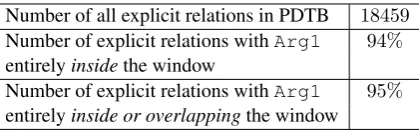
discourse arguments given the connectives by fo-cusing on one relation at time. Since this results in a large search space for the classifier, we prune the search space trying to preserve the relevant con-textual information related to the arguments. For this reason, the data given as input to the classi-fier include a window of two sentences before and after the given connective. This allows us to re-duce the search space by more than90%. In Table
3 we give the statistics of the explicit relation in-stances for the whole PDTB corpus and span limit sets. Most of the explicit relations (95%) occur within the five sentence window (two preceding and two following the sentence including the con-nective token).
We use the CRF++ tool (http://crfpp. sourceforge.net/) for sequence labeling classification (Lafferty et al., 2001), with second-order Markov dependency between tags. Beside the individual specification of a feature in the fea-ture description template, the feafea-tures in various
3We used the head rules by Yamada & Matsumoto (http://www.jaist.ac.jp/˜h-yamada/)
Number of all explicit relations in PDTB 18459
Number of explicit relations withArg1 94%
entirelyinsidethe window
Number of explicit relations withArg1 95%
entirelyinside or overlappingthe window
Table 3:Statistics about explicit relations andArg1 exten-sion.
combinations are also represented. We used this tool because the output of CRF++ is compatible to CoNLL 2000 chunking shared task, and we view our task as a discourse chunking task. On the other hand, linear-chain CRFs for sequence labeling of-fer advantages over both generative models like HMMs and classifiers applied at each sequence position. Also Sha and Pereira (2003) claim that, as a single model, CRFs outperform other models for shallow parsing.
6.1 Evaluation methodology
We present our results using precision, recall and F1 measures. Following Johansson and Moschitti (2010), we use three scoring schemes: exact, in-tersection(orpartial), andoverlapscoring. In the exact scoring scheme, a span extracted by the sys-tem is counted as correct if its extent exactly co-incides with one in the gold standard. However, we also use the two other scoring schemes since exact scoring may be uninformative in some sit-uations where it is enough to have a rough ap-proximation of the argument spans. In the over-lap scheme, an expression is counted as correctly detected if it overlaps with a gold standard argu-ment, i.e. if their intersection is nonempty. The intersection scheme assigns a score between 0 and 1 for every predicted span based on how much it overlaps with a gold standard span, so unlike the other two schemes it will reward close matches.
6.2 Feature analysis
Puste-jovsky (2007) and Elwell and Baldridge (2008) limit their classification to argument heads, thus they may employ features that are not very rele-vant to our approach.
We follow the hill-climbing (greedy) feature se-lection technique proposed by Caruana and Fre-itag (1994). In this optimization scheme, the best-performing set of features is selected on the basis of the best F1 “exact” scores. Therefore, we in-crease the number of features at each step, and re-port the corresponding performance. In order to understand better the contribution of each feature and also to avoid sub-optimal solutions, we also run an ablation test by leaving out one feature in turn from the best-performing set. We use the de-velopment split to generate results for the feature analysis to find the best performing feature set, whereas the train split is used to built model. Final results are generated using only the test split.
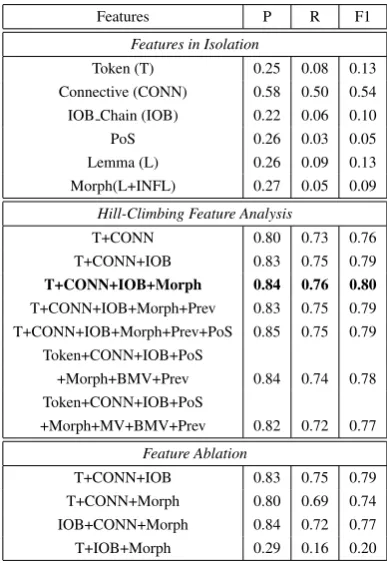
The results of our feature analysis are reported in Table 4 forArg2and Table 5 forArg1. We do not report the scores having zero as F1-measure.
Features P R F1
Features in Isolation
Token (T) 0.25 0.08 0.13
Connective (CONN) 0.58 0.50 0.54
IOB Chain (IOB) 0.22 0.06 0.10
PoS 0.26 0.03 0.05
Lemma (L) 0.26 0.09 0.13
Morph(L+INFL) 0.27 0.05 0.09
Hill-Climbing Feature Analysis
T+CONN 0.80 0.73 0.76
T+CONN+IOB 0.83 0.75 0.79
T+CONN+IOB+Morph 0.84 0.76 0.80
T+CONN+IOB+Morph+Prev 0.83 0.75 0.79 T+CONN+IOB+Morph+Prev+PoS 0.85 0.75 0.79
Token+CONN+IOB+PoS
+Morph+BMV+Prev 0.84 0.74 0.78
Token+CONN+IOB+PoS
+Morph+MV+BMV+Prev 0.82 0.72 0.77
Feature Ablation
T+CONN+IOB 0.83 0.75 0.79
T+CONN+Morph 0.80 0.69 0.74
IOB+CONN+Morph 0.84 0.72 0.77
T+IOB+Morph 0.29 0.16 0.20
Table 4: Results with Single and Combined Features for Arg2
Both the feature-in-isolation procedure and the ablation test show that the connective sense feature is the most relevant feature for Arg1andArg2, whereas the analysis results for Arg1 show that the “Prev” feature is also important.
We observe that the performance of the lemma
increases if integrated with the inflection feature, while inflection in isolation scores a null Pre-cision, Recall and F1. Therefore, we consider lemma and inflection together as a single feature, which we callMorph.
We show that the best performing set forArg1 includes eight features, whereas the best feature combination for Arg2 classification is achieved using only four features, namely token, IOB chain, connective sense andMorph.
Features P R F1
Features in Isolation
Token (T) 0.29 0.03 0.05
Connective (CONN) 0.40 0.08 0.14
IOB Chain (IOB) 0.18 0.04 0.06
PoS 0.14 0.00 0.01
Lemma (L) 0.26 0.03 0.05
Morph(L+INFL) 0.27 0.02 0.03
Prev feat(PREV) 0.57 0.09 0.16
Hill-Climbing Feature Analysis
T+CONN 0.62 0.30 0.40
T+CONN+IOB 0.65 0.32 0.44
T+CONN+IOB+Prev 0.69 0.45 0.55
T+CONN+IOB+Arg2+Prev 0.69 0.50 0.58
T+CONN+IOB+BMV+Arg2+Prev 0.70 0.50 0.58
T+CONN+IOB+BMV
+Arg2+Prev+Morph 0.73 0.50 0.60
T+CONN+IOB+BMV+Prev
+Morph+PoS+Arg2 0.72 0.51 0.59
Token+CONN+IOB+PoS+Prev
+Morph+MV+BMV+Arg2 0.69 0.50 0.58
Feature Ablation
T+CONN+IOB+BMV+Morph+Prev 0.70 0.44 0.54 T+CONN+IOB+BMV+Prev+Arg2 0.70 0.50 0.58 T+CONN+IOB+BMV+Morph+Arg2 0.69 0.38 0.50 T+CONN+IOB+Prev+Morph+Arg2 0.72 0.51 0.60 T+CONN+BMV+Morph+Prev+Arg2 0.69 0.46 0.55 T+IOB+BMV+Morph+Prev+Arg2 0.62 0.36 0.45 CONN+IOB+BMV+Morph+Prev+Arg2 0.70 0.50 0.59
Table 5: Results with Single and Combined Features for Arg1
The best combination for Arg1 classification includes all features from our initial set described in Table 2, except MV and PoS. This is probably due to the fact that PoS information becomes re-dundant for the classifier and BMV and MV con-vey the same kind of information.
6.3 Results
ei-ther intra-sentential or involve two contiguous sen-tences. Thus, Arg2 baseline is computed by la-beling asArg2the text span between the connec-tive and the beginning of the next sentence. The other baseline, on the other hand, is computed by labeling asArg1all tokens in the text span from the end of the previous sentence to the connective position. In case the connective occurs at the be-ginning of a sentence, then the baseline classifier tags the previous sentence asArg1.
P R F1
Arg2 PartialExact 0.83(0.53) 0.75(0.46) 0.79(0.49) 0.93 (0.80) 0.84 (0.85) 0.88 (0.82) Overlap 0.97 (0.98) 0.88 (0.85) 0.92 (0.91) Arg1 PartialExact 0.70(0.19) 0.48(0.19) 0.57(0.19) 0.83 (0.50) 0.62 (0.68) 0.71 (0.58) +Prev Overlap 0.91 (0.70) 0.63 (0.68) 0.74 (0.69) Arg1 PartialExact 0.70(0.19) 0.38(0.19) 0.50(0.19) 0.83 (0.50) 0.49 (0.68) 0.62 (0.58) -Prev Overlap 0.92 (0.70) 0.50 (0.68) 0.65 (0.69)
Table 6: Results ofArg1and Arg2extraction with test dataset. Baseline results between parentheses.
In Table 6 we report for each parsing subtask Precision, Recall and F1 achieved with the best performing feature set (see Section 6.2) using the test split, with the corresponding baseline between parenthesis. Note that before evaluation, all spans were normalized by removing leading or trailing punctuation. The best results and features are highlighted in Table 4 and 5 forArg2andArg1 respectively.
We compute the confidence intervals using a re-sampling method (Hjorth, 1993). ForArg1 iden-tification, we observe that the confidence interval (95%) without “Prev” feature ranges from0.48to 0.52 and the same interval is between 0.55 and
0.59 with “Prev” feature, if the exact F1
mea-sure is taken into account. For Arg2 identifi-cation the confidence interval (95%) is between 0.78and0.81, when the exact F1 measure is taken
into account. A statistical significance test run on previous and current results of Arg1 identifica-tion shows also that the difference is significant (p <0.0001).
We observe in the results that recall is consis-tently lower than precision in all tables. This is probably due to the fact that CRF is more con-servative while tagging data with argument label compared to other classifiers, which may lead to a lower coverage.
As expected, Arg2 parsing subtask achieves a better performance than Arg1subtask because
Arg2position and extension are easier to predict. This is confirmed by the fact that the baseline pre-cision of Arg2 overlapis 0.98. Also, the major improvement w.r.t. the baseline is achieved in the exactsetting.
6.4 Error Analysis
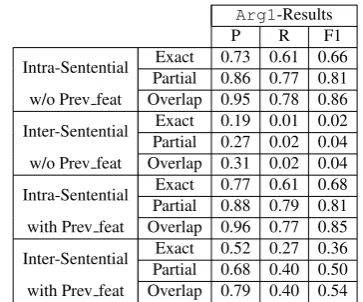
We carry out a further analysis on the test set in order to characterize parser errors on different test set partitions. Since Arg1 may occur in a pre-vious sentence w.r.t. the connective, we want to assess the impact ofArg1position on the parsing task. Therefore, we separately evaluateArg1 pre-cision, recall and F1 on intra-sentential and inter-sentential discourse relations. Results are reported in Table 7. We also show the changes before and after adding the lexical feature targeting inter-sentential cases.
Arg1-Results
P R F1
Intra-Sentential PartialExact 0.73 0.61 0.660.86 0.77 0.81 w/o Prev feat Overlap 0.95 0.78 0.86 Inter-Sentential PartialExact 0.19 0.01 0.020.27 0.02 0.04 w/o Prev feat Overlap 0.31 0.02 0.04 Intra-Sentential PartialExact 0.77 0.61 0.680.88 0.79 0.81 with Prev feat Overlap 0.96 0.77 0.85 Inter-Sentential PartialExact 0.52 0.27 0.360.68 0.40 0.50 with Prev feat Overlap 0.79 0.40 0.54
Table 7: Results ofArg1parsing for intra- and inter- sen-tential partitions. In the test set, the number of intra- and inter- sentential relations are1028and617respectively.
The “Prev” feature is critical to the parser to achieve reasonable baseline Arg1 performance for the inter-sentential partition of the test set.
The evaluation results are presented in Table 8. In previous works, e.g. Elwell and Baldridge (2008), adverbial connectives were usually con-sidered the most difficult connective type to clas-sify. This is confirmed by our results obtained on Arg1, which show that adverbial connectives negatively affect both precision and recall, with a higher impact on recall. As forArg2, the pars-ing results on the three connective types are more homogeneous.
We also observe that the “Prev” feature signifi-cantly improves Arg1 parsing with any connec-tive type because it increases recall, while pre-cision decreases with coordinating and adverbial connectives.
Conn. Type P R F1
Results for Arg2
Coordinating 0.81 0.75 0.78 Subordinating 0.86 0.78 0.82 Adverbial 0.83 0.74 0.78
Results for Arg1(w/o Prev)
Coordinating 0.73 0.42 0.54 Subordinating 0.73 0.45 0.56 Adverbial 0.68 0.26 0.37
Results for Arg1 (with Prev)
Coordinating 0.69 0.59 0.64 Subordinating 0.76 0.50 0.61 Adverbial 0.64 0.34 0.44
Table 8: Exact evaluation for each connective type. Coor-dinating connectives appear in around40%of the relations,
while subordinating and adverbials are respectively25%and 35%of all connectives.
In order to understand the most common mis-takes done by the classifier, we present two exam-ple relations where resp. Arg1(e) andArg2(f) are wrongly identified4. Note that in example (f)
Arg1appears in the previous sentence, which we do not report here.
(e) Many analysts said the September increase was a one-time event, coming as dealers introduced their 1990 models [CONTIN -GENCY]
(f) However, Jeffrey Lane, president of Shearson Lehman Hutton, said that Friday’s plunge is “going to set back” relations with cus-tomers, “because it reinforces the concern of volatility [COMPARISON]
In (e), the classifier tagged the whole text from “the September” to “coming” asArg1instead of
4The examples show the gold standard annotation.
only “coming”, since it takes clausal boundaries as a relevant factor for identifying the argument spans. In (f) the classifier is unable to detectArg2 probably because the argument does not occur im-mediately next to the connective.
A manual inspection of misclassified relations confirms that the parser is more accurate in the identification of the sentences containing the ar-guments rather than in the detection of their exact spans. Also, mistakes concern mostly the classi-fication of inter-sentential relations (especially as regards theArg1classifier), thus we will need to focus on these specific cases for future improve-ments.
7 Conclusions
We cast the complex task of discourse argument parsing as a set of cascading subtasks to be tackled in sequence, and we showed that in this way we achieved a reasonable parser accuracy by handling the whole labeling process in a pipeline.
Since we consider this discourse parsing task as a token-level sequence-labeling task, we were able to detect connective arguments and the corre-sponding boundaries avoiding the computationally complex approaches described in previous works. We trained a CRF classifier with lexical, syn-tactic and semantic features extracted from PDTB and PTB gold annotation. We tested these features both in isolation and in different combinations in order to achieve an optimized performance. To make training time manageable, we pruned the search space by 90%, though leaving out only
around5%of allArg1in PDTB.
We also presented a comparative error analy-sis (subsection 6.4), where we showed thatArg1 classification on intra-sentential relations achieves a performance comparable toArg2classification (Table 6). Since the main open issue in our ap-proach is the correct classification of Arg1 in inter-sentential relations, we plan to improve it through more feature engineering. We already ex-tended our experimental framework by including automatically annotated parse trees and connec-tives in the pipeline (Ghosh et al., 2011).
8 Acknowledgements
References
Rich Caruana and Dayne Freitag. 1994. Greedy attribute selection. In Proceedings of the Eleventh International Conference on Machine Learning.
Nikhil Dinesh, Alan Lee, Eleni Miltsakaki, Rashmi Prasad, Aravind Joshi, and Bonnie Webber. 2005. Attribution and the (non-)alignment of syntactic and discourse argu-ments of connectives. InProceedings of the Workshop on Frontiers in Corpus Annotations II: Pie in the Sky, pages 29–36, Ann Arbor, Michigan, June.
Robert Elwell and Jason Baldridge. 2008. Discourse con-nective argument identification with concon-nective specific rankers. In Proceedings of ICSC-2008, Santa Clara, United States.
Sucheta Ghosh, Sara Tonelli, Giuseppe Riccardi, and Richard Johansson. 2011. End-to-end discourse parser evaluation. InProceedings of 5th IEEE International Conference on Semantic Computing, Palo Alto, CA, USA.
J. S. Urban Hjorth. 1993. Computer Intensive Statistical Methods. Chapman and Hall, London.
Richard Johansson and Alessandro Moschitti. 2010. Syn-tactic and semantic structure for opinion expression de-tection. InProceedings of the Fourteenth Conference on Computational Natural Language Learning, pages 67–76. John Lafferty, Andrew McCallum, and Fernando Pereira. 2001. Conditional random fields: Probabilistic models for segmenting and labeling sequence data. In18th Interna-tional Conf. on Machine Learning.Morgan Kaufmann. Ziheng Lin, Min-Yen Kan, and Hwee Tou Ng. 2009.
Recog-nizing implicit discourse relations in the Penn Discourse Treebank. InProceedings of the 2009 Conference on Em-pirical Methods in Natural Language Processing, pages 343–351, Singapore.
William Mann and Sara Thompson. 1988. Rhetorical struc-ture theory: Toward a functional theory of text organiza-tion.Text, 8(3):243–281.
Mitchell P. Marcus, Beatrice Santorini, and Mary Ann Marcinkiewicz. 1993. Building a Large Annotated Cor-pus of English: the Penn Treebank. Computational Lin-guistics, 19(2):313–330.
Guido Minnen, John Carroll, and Darren Pearce. 2001. Ap-plied morphological processing of English. Natural Lan-guage Engineering.
Emily Pitler and Ani Nenkova. 2009. Using syntax to dis-ambiguate explicit discourse connectives in text. In Pro-ceedings of the 47thAnnual Meeting of the Association for
Computational Linguistics and the 4thInternational Joint
Conference on Natural Language Processing.
Emily Pitler, Mridhula Raghupathy, Hena Mehta, Ani Nenkova, Alan Lee, and Aravind Joshi. 2008. Eas-ily identifiable discourse relations. In Proceedings of the 22nd International Conference on Computational Lin-guistics (Coling 2008), pages 87–90, Manchester, United Kingdom.
Emily Pitler, Annie Louis, and Ani Nenkova. 2009. Au-tomatic sense prediction for implicit discourse relations in text. In Proceedings of the Joint Conference of the 47th Annual Meeting of the ACL and the 4th International Joint Conference on Natural Language Processing of the AFNLP, pages 683–691, Suntec, Singapore.
Rashmi Prasad, Nikhil Dinesh, Alan Lee, Eleni Miltsakaki, Livio Robaldo, Aravind Joshi, and Bonnie Webber. 2008. The Penn Discourse Treebank 2.0. In Proceedings of the 6thInternational Conference on Languages Resources
and Evaluations (LREC 2008), Marrakech, Morocco. Rashmi Prasad, Aravind Joshi, and Bonnie Webber. 2010.
Exploiting scope for shallow discourse parsing. In Pro-ceedings of the Seventh conference on International Lan-guage Resources and Evaluation (LREC’10), Valletta, Malta.
Fei Sha and Fernando Pereira. 2003. Shallow pars-ing with conditional random fields. In Proceedings of HLT/NAACL, pages 213–220.
Swapna Somasundaran, Galileo Namata, Janyce Wiebe, and Lise Getoor. 2009. Supervised and unsupervised methods in employing discourse relations for improving opinion polarity classification. InProceedings of the 2009 Con-ference on Empirical Methods in Natural Language Pro-cessing, pages 170–179, Singapore.
Sara Tonelli, Giuseppe Riccardi, Rashmi Prasad, and Aravind Joshi. 2010. Annotation of discourse relations for con-versational spoken dialogs. InProceedings of the Sev-enth conference on International Language Resources and Evaluation (LREC’10), Valletta, Malta.
Bonnie Webber, Markus Egg, and Valia Kordoni. 2010. Dis-course Structure and Language Technology.Natural Lan-guage Engineering, 1(1):1–49.
Ben Wellner and James Pustejovsky. 2007. Automatically identifying the arguments of discourse connectives. In
Proceedings of the 2007 Joint Conference on Empirical Methods in Natural Language Processing and Compu-tational Natural Language Learning (EMNLP-CoNLL), pages 92–101, Prague, Czech Republic.
Ben Wellner. 2009.Sequence Models and Ranking Methods for Discourse Parsing. Ph.D. thesis, Brandeis University. Hiroyasu Yamada and Yuji Matsumoto. 2003. Statistical