Single and Multi-objective Optimization for Feature Selection in
Anaphora Resolution
Sriparna Saha1 Asif Ekbal1Olga Uryupina2Massimo Poesio3,2 1 Department of Computer Science and Engineering, IIT Patna, India,
{sriparna,asif}@iitp.ac.in
2University of Trento, Center for Mind/Brain Sciences,[email protected] 3University of Essex, Language and Computation Group,[email protected]
Abstract
There is no generally accepted met-ric for measuring the performance of anaphora resolution systems, and the ex-isting metrics—MUC, B3, CEAF, Blanc, among others—tend to reward signifi-cantly different behaviors. Systems op-timized according to one metric tend to perform poorly with respect to other ones, making it very difficult to compare anaphora resolution systems, as clearly shown by the results of theSEMEVAL2010
Multilingual Coreference task. One so-lution would be to find a single com-pletely satisfactory metric, but it’s not clear whether this is possible and at any rate it is not going to happen any time soon. An alternative is to optimize mod-els according to multiple metrics simulta-neously. In this paper, we show, first of all, that this is possible to develop such models using Multi-objective Optimiza-tion (MOO) techniques based on Genetic Algorithms. Secondly, we show that op-timizing according to multiple metrics si-multaneously may result in better results with respect to each individual metric than optimizing according to that metric only.
1 Introduction
In anaphora resolution,1 as in other HLT tasks,
optimization to a metric is essential to achieve good performance (Hoste, 2005; Uryupina, 2010). However, many evaluation metrics have been pro-posed for anaphora resolution, each capturing what seems to be a key intuition about the task: fromMUC (Vilain et al., 1995) to B3 (Bagga and
1
We use the term ’anaphora resolution’ to refer to the task perhaps most commonly referred to as ’coreference resolu-tion,’ which many including us find a misnomer. For the pur-poses of the present paper the two terms could be seen as interchangeable.
Baldwin, 1998), from theACEmetric (Doddington et al., 2004) to CEAF(Luo, 2005) toBLANC (Re-casens and Hovy, 2011). And unlike in other areas ofHLT, none has really taken over. This would not matter so much if those metrics were to reward the same systems; but in fact, as dramatically demon-strated by the results of the Coreference Task at
SEMEVAL2010 (Recasens et al., 2010), the oppo-site is true—almost every system could come on top depending on which metric was chosen.
It seems unlikely that the field will converge on a single metric any time soon. Given that many of the proposed metrics do capture what would seem to be plausible intuitions, it would seem desirable to develop methods to optimize systems according to more than one metric at once—in particular, ac-cording to at least one metric of what we might call the ’link-based’ cluster of metrics (e.g.,MUC) and at least one of what we will call the ’entity-based’ cluster (e.g.,CEAF).
As it happens, techniques for doing just that have been developed in the area of Genetic Al-gorithms: so-called multi-objective optimization (MOO) (Deb, 2001) techniques. In this paper, we
will show how these techniques can be used to op-timize anaphora resolution models (we focused for the time being on feature selection) by looking for a solution in the space defined by a multiplicity of metrics (we usedMUCandCEAF(in two variants) as the optimization functions). Perhaps the most interesting result of this work is the finding that by working in such a multi-metric space it is possible to find solutions that are better with respect to an individual metric than when trying to optimize for that metric alone—which arguably suggests that indeed both families of metrics capture some fun-damental intuition about anaphora, and taking into account both intuitions we avoid local optima.
The structure of the paper is as follows. We first review the literature on using genetic algorithms for both single function and multi function
mization. Next, we discuss the particular method of multi-objective optimization we used in this pa-per, Non-Dominated Sorting Genetic Algorithm II (Deb et al., 2002). After that we discuss how the method was used, and present our results. We then compare our work with other approaches to opti-mization for anaphora found in the literature.
2 Background: Optimizing for Anaphora Resolution
A great number of statistical approaches to anaphora resolution have been proposed in the past ten years. These approaches differ with re-spect to their underlying models (e.g., mention pair model (Soon et al., 2001) vs. tournament model (Iida et al., 2003; Yang et al., 2005), vs. entity-model (Luo et al., 2004)), machine learners (e.g., decision trees vs. maximum entropy vs. SVMs vs. TiMBL) and their parameters, and with respect to feature sets used. There have been, however, only few attempts at explicit optimiza-tion of these aspects, and in those few cases, opti-mization tends to be done by hand.
An early step in this direction was the work by Ng and Cardie (2002), who developed a rich fea-ture set including 53 feafea-tures, but reported no sig-nificant improvement over their baseline when all these features were used with theMUC6 andMUC7 corpora. They then proceeded to manually select a subset of features that did yield better results for the MUC-6/7 datasets. A much larger scale and very systematic effort of manual feature selection over the same dataset was carried out by Uryupina (2007), who evaluated over 600 features.
The first systematic attempt at automatic opti-mization of anaphora resolution we are aware of was carried out by Hoste (2005), who investigated the possibility of using genetic algorithms for au-tomatic optimization of both feature selection and of learning parameters, also considering two dif-ferent machine learners, TiMBL and Ripper. Her results suggest that such techniques yield improve-ments on the MUC-6/7 datasets. Recasens and
Hovy (2009) carried out an investigation of feature selection for Spanish using theANCORAcorpus.
These approaches focused on a single metric only; the one proposal simultaneously to consider multiple metrics, Zhao and Ng (2010) still opti-mized for each metric individually.
The effect of optimization on anaphora resolu-tion was dramatically demonstrated by Uryupina’s contribution to SEMEVAL 2010 Multilingual
Coreference Task (Uryupina, 2010). Uryupina di-rectly optimizes two parameters of her system: the choice of a model (mention-pair vs. ILP with
various constraints) and the definition of mention types for training separate classifiers. The opti-mization is done on the development data in a brute-force fashion, in order to maximize the per-formance according to a pre-defined metric (MUC,
CEAForBLANC). The results on theSEMEVAL-10 dataset clearly show that existing metrics of coref-erence rely on different intuitions and therefore a system, optimized for a particular metric, might show inferior results for the other ones. For ex-ample, the reportedBLANCdifference between the runs optimized forBLANCandCEAFis around 10 percentage points.
This highlights the importance of the multi-objective optimization (MOO) for coreference, that suggests a family of systems, showing reliable per-formance according to all the desired metrics. A form of MOO was applied to coreference by Mun-son et al. (2005). Their general conclusion was negative, stating that “ensemble selection seems too unreliable for use in NLP”, but they did see some improvements for coreference.
3 Optimization with Genetic Algorithms
In this section, we review optimization techniques using genetic algorithms (GAs) (Goldberg, 1989).
We first discuss single objective optimization, that can optimize according to a single objec-tive function, and then multi-objecobjec-tive optimiza-tion (MOO), that can optimize more than one ob-jective function, in particular, a popularMOO tech-nique named Non-dominated Sorting Genetic Al-gorithm (NSGA)-II (Deb et al., 2002).
3.1 Genetic Algorithms
Genetic algorithms (GAs) (Goldberg, 1989) are randomized search and optimization techniques guided by the principles of evolution and natu-ral genetics. In GAs the parameters of the search space are encoded in the form of strings (called
op-erators like crossover and mutation are applied on these strings to yield a new generation of strings. The processes of selection, crossover and mutation continues for a fixed number of generations or till a termination condition is satisfied.
3.2 Multi-objective Optimization
Multi-objective optimization (MOO) can be for-mally stated as follows (Deb, 2001). Find the vec-tors x∗ = [x∗1, x∗2, . . . , x∗n]T of decision variables that simultaneously optimize the M objective val-ues
{f1(x), f2(x), . . . , fM(x)} while satisfying the constraints, if any.
An important concept in MOO is that of
dom-ination. In the context of a maximization
prob-lem, a solution xi is said to dominate xj if
∀k ∈ 1,2, . . . , M , fk(xi) ≥ fk(xj) and ∃k ∈
1,2, . . . , M , such thatfk(xi)> fk(xj).
Among a set of solutionsP, the nondominated set of solutionsP′are those that are not dominated by any member of the set P. The nondominated set of the entire search space S is called the
glob-ally Pareto-optimal set. In general, aMOO algo-rithm usually admits a set of solutions not domi-nated by any solution encountered by it.
3.3 Nondominated Sorting Genetic Algorithm-II (NSGA-II)
Genetic algorithms (GAs) are known to be more
effective than classical methods such as weighted metrics, goal programming (Deb, 2001), for solv-ing MOO primarily because of their population-based nature. A particularly popular GA of this type isNSGA-II (Deb et al., 2002).
InNSGA-II, initially a random parent population P0is created and the population is sorted based on the partial order defined by the non-domination relation. This results in a sequence of nondomi-nated fronts. Each solution is assigned a fitness value which is equal to its non-domination level in the partial order. A child population Q0of size
N is then created from the parent population P0 by using binary tournament selection, recombina-tion, and mutation operators. In general, in the
tthiteration, a combined populationRt=Pt+Qt is formed. The size of Rt is 2N, as the size of bothPtand Qtis N. All the solutions of Rt are sorted according to non-domination. If the total number of solutions belonging to the best non-dominated setF1 is smaller thanN, thenF1is
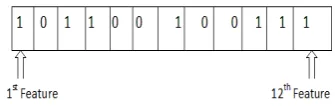
to-Figure 1: Chromosome representation for GA
based feature selection
tally included inP(t+1). The remaining members of the populationP(t+1) are chosen from the sub-sequent nondominated fronts in the order of their ranking. To choose exactlyN solutions, the solu-tions of the last included front are sorted using the crowded comparison operator (Deb et al., 2002) and the best among them (i.e., those with lower crowding distance) are selected to fill in the avail-able slots inP(t+1). The new populationP(t+1) is then used for selection, crossover and mutation to create a populationQ(t+1)of sizeN.
4 Two Algorithms for Feature Selection in Anaphora Resolution
Below we discuss how single and multi-objective optimization techniques can be used feature selec-tion in the anaphora resoluselec-tion task.
4.1 Chromosome Representation and Population Initialization
If the total number of features isF, then the length of the chromosome isF. As an example, the en-coding of a particular chromosome is represented in Figure 1. HereF = 12(i.e., total 12 different features are available). The chromosome repre-sents the use of 7 features for constructing a clas-sifier (first, third, fourth, seventh, tenth, eleventh and twelfth features). The entries of each chro-mosome are randomly initialized to either 0 or 1. Here, if theithposition of a chromosome is 0 then it represents thatithfeature does not participate in constructing the classifier. Else if it is 1 then the
ith feature participates in constructing the classi-fier.
4.2 Fitness Computation
For fitness computation, the following procedure is executed:
[image:3.595.331.499.75.128.2]2. Construct the coreference resolution system (i.e.,BART) with only theseN features.
3. This coreference system is evaluated on the development data. The recall, precision and F-measure values of three metrics are calcu-lated.
In case of single objective optimization (SOO), the objective function corresponding to a particu-lar chromosome is the F-measure value of a sin-gle metric. This objective function is optimized using the search capability of GA. For MOO, the objective functions corresponding to a particular chromosome areFM U C (for theMUCmetric),Fφ3
(for CEAF using theφ3 entity alignment function (Luo, 2005)) andFφ4 (for CEAF using theφ4
en-tity alignment function). These three objective functions are simultaneously optimized using the search capability ofNSGA-II.
4.3 Genetic Operators
In case ofSOO, a single point crossover operation is used with a user defined crossover probability,
µc. A mutation operator is applied to each entry of the chromosome with a mutation probability,
µm, where the entry is randomly replaced by ei-ther 0 or 1. In this approach, the processes of fit-ness computation, selection, crossover, and muta-tion are executed for a maximum number of gen-erations. The best string seen up to the last gener-ation provides the solution to the above feature se-lection problem. Elitism has been implemented at each generation by preserving the best string seen upto that generation in a location outside the popu-lation. Thus on termination, this location contains the best feature combination.
We use crowded binary tournament selection as in NSGA-II, followed by conventional crossover and mutation for the MOO based feature selec-tion. The most characteristic part of NSGA-II is its elitism operation, where the non-dominated so-lutions (Deb, 2001) among the parent and child populations are propagated to the next generation. The near-Pareto-optimal strings of the last gener-ation provide the different solutions to the feature selection problem.
5 Methods
5.1 The BART System
For our experiments, we use BART (Versley et al., 2008), a modular toolkit for anaphora
reso-lution that supports state-of-the-art statistical ap-proaches to the task and enables efficient feature engineering. BART implements different models
of anaphora resolution (mention-pair and entity-mention; best-first vs. ranking), has interfaces to different machine learners (MaxEnt, SVM, deci-sion trees) and provides a large set of linguistically motivated features, along with the possibility to design new ones. It is thus ideally suited for exper-imenting with optimization and feature selection.
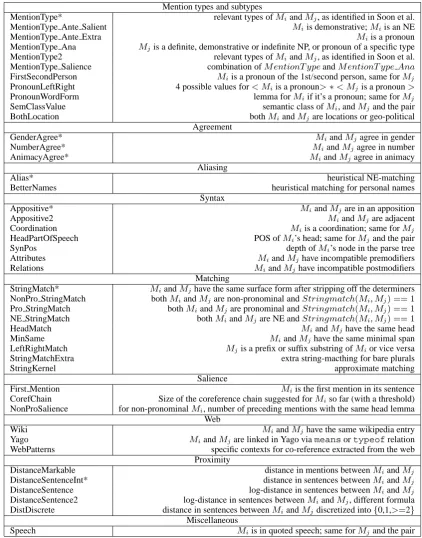
In this study, we specifically focus on feature selection.2 The complete list of features currently implemented inBARTis listed in Table 1; all were considered in the present experiments. We used a simple mention-pair model without ranking as in (Soon et al., 2001). In the mention-pair model, anaphora resolution is recast as a binary classifica-tion problem. Each classificaclassifica-tion instance consists of two mentions, i.e. an anaphor Mj and its po-tential antecedentMi(i < j). Instances are mod-eled as feature vectors (cf. Table 1) and are handed over to a binary classifier that decides, whether the anaphor and its candidate antecedent are mentions of the same entity or not. All the feature values are computed automatically.
We train a maximum entropy classifier and fol-low the approach of (Soon et al., 2001) to parti-tion menparti-tions into coreference sets given the clas-sifier’s decisions.
5.2 The Data Sets
We evaluated our approach on the ACE-02 dataset, which is divided in three subsets: bnews, npaper, and nwire. We provide results for both gold (hand-annotated) versions of the datasets (gbnews, gnpa-per, gnwire) and system mentions extracted with
CARAFE3 (cbnews, cnpaper, cnwire).
Table 2 compares the performance level ob-tained using all the features in Table 1 with that of a loose re-implementation of the system proposed by Soon et al. (2001), commonly used as baseline and relying only on very shallow information. Our reimplementation of the Soon et al. model uses only a subset of features: those marked with an asterisk in Table 1. We also provide in Table 2 typ-ical state-of-the-art figures on the ACE-02 dataset, as presented in an overview by Poon and
Domin-2The choice of the best model and the best machine
learner, along with its parameters, is the main direction of our future work.
3http://sourceforge.net/projects/
Table 1: Features used byBART: each feature describes a pair of mentions{Mi, Mj}, i < j, whereMi is a candidate antecedent andMj is a candidate anaphor
Mention types and subtypes
MentionType* relevant types ofMiandMj, as identified in Soon et al.
MentionType Ante Salient Miis demonstrative;Miis an NE
MentionType Ante Extra Miis a pronoun
MentionType Ana Mjis a definite, demonstrative or indefinite NP, or pronoun of a specific type MentionType2 relevant types ofMiandMj, as identified in Soon et al. MentionType Salience combination ofM entionT ypeandM entionT ype Ana
FirstSecondPerson Miis a pronoun of the 1st/second person, same forMj PronounLeftRight 4 possible values for< Miis a pronoun>∗< Mjis a pronoun>
PronounWordForm lemma forMiif it’s a pronoun; same forMj
SemClassValue semantic class ofMi, andMjand the pair
BothLocation bothMiandMjare locations or geo-political
Agreement
GenderAgree* MiandMjagree in gender
NumberAgree* MiandMjagree in number
AnimacyAgree* MiandMjagree in animacy
Aliasing
Alias* heuristical NE-matching
BetterNames heuristical matching for personal names
Syntax
Appositive* MiandMjare in an apposition
Appositive2 MiandMjare adjacent
Coordination Miis a coordination; same forMj
HeadPartOfSpeech POS ofMi’s head; same forMjand the pair
SynPos depth ofMi’s node in the parse tree
Attributes MiandMjhave incompatible premodifiers
Relations MiandMjhave incompatible postmodifiers
Matching
StringMatch* MiandMjhave the same surface form after stripping off the determiners NonPro StringMatch bothMiandMjare non-pronominal andStringmatch(Mi, Mj) == 1 Pro StringMatch bothMiandMjare pronominal andStringmatch(Mi, Mj) == 1 NE StringMatch bothMiandMjare NE andStringmatch(Mi, Mj) == 1
HeadMatch MiandMjhave the same head
MinSame MiandMjhave the same minimal span
LeftRightMatch Mjis a prefix or suffix substring ofMior vice versa
StringMatchExtra extra string-macthing for bare plurals
StringKernel approximate matching
Salience
First Mention Miis the first mention in its sentence
CorefChain Size of the coreference chain suggested forMiso far (with a threshold) NonProSalience for non-pronominalMi, number of preceding mentions with the same head lemma
Web
Wiki MiandMjhave the same wikipedia entry
Yago MiandMjare linked in Yago viameansortypeofrelation
WebPatterns specific contexts for co-reference extracted from the web
Proximity
DistanceMarkable distance in mentions betweenMiandMj
DistanceSentenceInt* distance in sentences betweenMiandMj
DistanceSentence log-distance in sentences betweenMiandMj
DistanceSentence2 log-distance in sentences betweenMiandMj, different formula DistDiscrete distance in sentences betweenMiandMjdiscretized into{0,1,>=2}
Miscellaneous
Table 2: Baseline performance on the ACE-02 dataset
gold mentions
gbnews gnpaper gnwire
FM U C Fφ3 Fφ4 FM U C Fφ3 Fφ4 FM U C Fφ3 Fφ4
following Soon et al. (2001) 71.6 67.2 69.6 67.8 62.6 67.5 66.7 67.9 69.7 All features (Table 1) 75.8 70.6 74.4 72.5 64.7 67.0 71.2 70.3 72.2
state-of-the-art 65-69 - - 70-72 - - 54-67 -
-system mentions
cbnews cnpaper cnwire
FM U C Fφ3 Fφ4 FM U C Fφ3 Fφ4 FM U C Fφ3 Fφ4
following Soon et al. (2001) 61.3 56.7 55.9 63.3 57.6 54.0 60.8 58.2 57.0 All features (Table 1) 62.3 57.9 57.5 65.5 55.9 52.7 60.6 56.8 55.6
Table 3: Feature vectors identified via single-objective optimization.
DataSet Metric Features Selected FM U C Fφ3 Fφ4
opt.
gbnews MUC 00100110110111100111111000111001001111111010 76.8 71.5 74.5
φ3,φ4 10011000111010110000101101010011011011000001 76.7 71.8† 74.9†
gnpaper MUC 10000001001111110101011101110000101010100111 74.6 67.1 70.1†
φ3 10101001100100110100100000010100010001101100 72.2 67.6 69.1
φ4 11101001100100110100111000100101110010001100 71.4 65.2 70.3
gnwire MUC 10111011011111110010101010011010011011001011 74.0† 70.3† 73.1†
φ3 11011011100001000011110110101111011110001101 71.4 72.3 73.6
φ4 11101001100100110100111000100101110010001100 71.7 72.1 74.4
cbnews MUC,φ3 11111001100101000011011100101101101111001100 64.6 59.7 58.4
φ4 11111001100001000011110100101111101110001101 63.6 59.6 58.8
cnpaper MUC,φ3 01000100100101011001000010111100101100001000 66.5 59.7† 54.7†
φ4 10100101101011100011111110010100100010010011 66.2 59.1 55.6†
cnwire MUC 00101111101110101001100000010101001011001001 63.8 60.0 58.1
φ3,φ4 00011000101110100010000010011000100110000100 63.4 61.2 58.4
gos (2008). The results clearly show that although even larger sets of features have been proposed (Uryupina, 2007; Bengtson and Roth, 2008), the set of features already included in BART is suffi-cient to achieve results well above the state of the art on the dataset we used.
The results in Table 2 also confirm the intu-ition that, contrary to what is suggested by some of the early papers (Soon et al., 2001; Ng and Cardie, 2002) working on smaller datasets, lin-guistic factors do play a crucial role in anaphora resolution and therefore rich feature sets may lead to performance improvements once larger datasets are considered (a similar result was also obtained by Bengtson and Roth (2008)). Such improve-ments, however, come at high costs, as both using
larger datasets and larger sets of features learning a model becomes slower and requires much more memory.
This suggests that automatic feature selection may be essential not just to improve performance but also to be able to train a model—i.e., that an ef-ficient coreference resolution system should com-bine rich linguistic feature sets with automatic fea-ture selection mechanisms.
5.3 Genetic Algorithm Parameter Setting
We set the following parameter values for both sin-gle (i.e.,GA) andMOO(i.e.,NSGA-II): population
size=20, number of generations=30, probability of mutation µm = 0.2 and probability of crossover
[image:6.595.73.537.294.518.2]devel-opment data to determine the optimal feature vec-tor(s). Final results are reported on the test data. It is to be noted that GA is a stochastic approach and outputs different results for trials with differ-ent seeds and initial populations. Initial seeds and population are chosen randomly. Thus for each data set we executed the proposed single and multi objective based approaches 3 times. Finally, we report the maximum values of these 3 runs.
6 Results
6.1 Single Objective Optimization
Single objective GA based feature selection was executed on the six data sets to determine the ap-propriate set of features. For each data set three sets of experiments were carried out by optimizing the F-measure values of the three different evalu-ation metrics. The binary-valued feature vectors identified by the single objectiveGAbased feature selection technique for the six data sets and the corresponding F-measure values are shown in Ta-ble 3. The order of the features in the vector cor-responds to their order in Table 1; the values of 0’s and 1’s represent the absence and presence of the corresponding features. Significant improvements over the classifier based on all the features are in-dicated with†(sign test,p <0.05).
These results show that for all the datasets, the proposed single objectiveGA-based feature selec-tion technique performs better than the baseline approach of using all features. Moreover, the re-sults show that the technique based on SOO (i.e.,
conventionalGA-based method) with different ob-jective functions provides different evaluation fig-ures. Thus, it is meaningful to optimize each ob-jective function separately.
It is also evident from Table 3 that the optimal feature set obtained by optimizing a single objec-tive function may not be optimal with respect to another objective function. Thus, it is not possible to come up with common patterns in the set of op-timal features. For example, in case of gbnews, the F-measure value of the first metric, i.e. ofM U C
corresponding to the optimal feature vector opti-mizing second metric, i.e. φ3 is 76.7. This is ob-viously less than the evaluation figure obtained by optimizing the first metric.
6.2 Multi-objective Optimization
Thereafter we apply our proposedMOObased fea-ture selection technique on the six data sets. The
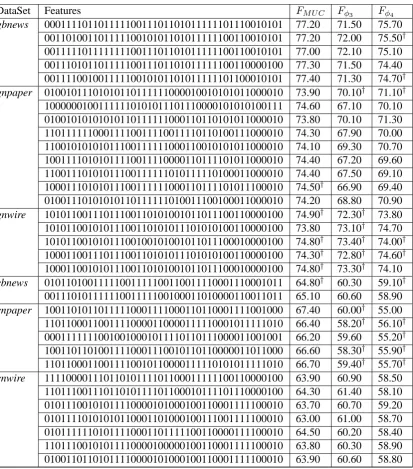
MOO approach provides a set of non-dominated solutions on the final Pareto optimal front. All the solutions are equally important from the algorith-mic point of view. In Table 4, we show the final solutions obtained by theMOObased approach for all the data sets. Significant improvements over the classifier based on all the features are indicated with†(sign test,p <0.05).
The results in Table 4 indicate that the MOO
based technique achieves higher performance than the single objective GA based approach. For the
gbnews data set,MOOachieves 0.6, 0.3 and 0.8 F-measure points increments for three metrics over the single objective GA based technique. For the gnpaper data set, there are increments of 2.5 measure points on second metric and 1.0 F-measure point on third metric over the correspond-ing scorrespond-ingle objective GA based technique. Sim-ilarly, for all other datasets the MOO based
ap-proach attains superior performance over theSOO -based approach.
7 Comparison with Related Work
As discussed in Section 2 most work on optimiza-tion in anaphora resoluoptimiza-tion relies on manual opti-mization; the one significant exception is the work of Hoste (2005).
There are two major differences between the ap-proach of Hoste (2005) and that followed in our study. First, the scope of (Hoste, 2005) is re-stricted to single-objective optimization. As we saw above, this might provide unstable solutions, that are too tailored to a particular scoring met-ric. Second, the feature set of Hoste (2005) is rela-tively small and therefore does not provide an effi-cient test-bed for a feature selection approach. Not surprising, parameter optimization shows a more consistent effect on the overall performance than feature selection in (Hoste, 2005)’s experiments.
8 Discussion and Conclusions
In this paper we showed that it may not be neces-sary to choose one among the existing metrics for anaphora resolution—in fact, that developing sys-tems attempting to optimize according to a combi-nation of them may lead to better results.
Table 4: Feature vectors identified by the MOO based approach.
DataSet Features FM U C Fφ3 Fφ4
gbnews 00011110110111110011101101011111101110010101 77.20 71.50 75.70 00110100110111110010101101011111100110010101 77.20 72.00 75.50† 00111110111111110011101101011111100110010101 77.00 72.10 75.10 00111010110111110011101101011111100110000100 77.30 71.50 74.40 00111100100111110010101101011111101100010101 77.40 71.30 74.70†
gnpaper 01001011101010110111111000010010101011000010 73.90 70.10† 71.10† 10000001001111110101011101110000101010100111 74.60 67.10 70.10 01001010101010110111111000110110101011000010 73.80 70.10 71.30 11011111100011110011110011110110100111000010 74.30 67.90 70.00 11001010101011100111111000110010101011000010 74.10 69.30 70.70 10011110101011110011110000110111101011000010 74.40 67.20 69.60 11001110101011100111111010111110100011000010 74.40 67.50 69.10 10001110101011100111111000110111101011100010 74.50† 66.90 69.40 01001110101010110111111010011100100011000010 74.20 68.80 70.90
gnwire 10101100111011100110101001011011100110000100 74.90† 72.30† 73.80 10101100101011100110101011101010100110000100 73.80 73.10† 74.70 10101100101011100100101001011011100010000100 74.80† 73.40† 74.00† 10001100111011100110101011101010100110000100 74.30† 72.80† 74.60† 10001100101011100110101001011011100010000100 74.80† 73.30† 74.10
cbnews 01011010011111001111100110011110001110001011 64.80† 60.30 59.10† 00111010111111001111100100011010000110011011 65.10 60.60 58.90
cnpaper 10011010110111110001111000110110001111001000 67.40 60.00† 55.00 11011000110011110000110000111110001011111010 66.40 58.20† 56.10† 00011111110010010001011110110111000011001001 66.20 59.60 55.20† 10011011010011110001110010110110000011011000 66.60 58.30† 55.90† 11011000110011110010110000111110101011111010 66.70 59.40† 55.70†
References
Amit Bagga and Breck Baldwin. 1998. Algorithms for scoring coreference chains. In Proc. of the LREC
workshop on Linguistic Coreference, pages 563–
566, Granada.
Eric Bengtson and Dan Roth. 2008. Understanding the value of features for coreference resolution. In Proc.
of EMNLP.
Kalyanmoy Deb, Amrit Pratap, Sameer Agarwal, and T. Meyarivan. 2002. A fast and elitist multiobjective genetic algorithm: NSGA-II. IEEE Transactions on
Evolutionary Computation, 6(2):181–197.
Kalyanmoy Deb. 2001. Multi-objective Optimization
Using Evolutionary Algorithms. John Wiley and
Sons, Ltd, England.
George Doddington, Alexis Mitchell, Mark Przybocki, Lance Ramshaw, Stephanie Strassell, and Ralph Weischedel. 2004. The automatic content extrac-tion (ACE) program–tasks, data, and evaluaextrac-tion. In
Proc. of LREC.
David E. Goldberg. 1989. Genetic Algorithms in Search, Optimization and Machine Learning.
Addison-Wesley, New York.
Veronique Hoste. 2005. Optimization Issues in
Ma-chine Learning of Coreference Resolution. Ph.D.
thesis, Antwerp University.
Ryu Iida, Kentaro Inui, Hiroya Takamura, and Yuji Matsumoto. 2003. Incorporating contextual cues in trainable models for coreference resolution. In Proc.
EACL Workshop on the Computational Treatment of Anaphora.
Xiaoqiang Luo, Abe Ittycheriah, Hongyan Jing, Nanda Kambhatla, and Salim Roukos. 2004. A mention-synchronous coreference resolution algorithm based on the Bell Tree. In Proc. of ACL 2004, pages 136– 143.
Xiaoqiang Luo. 2005. On coreference resolution per-formance metrics. In Proc. NAACL / EMNLP, Van-couver.
Art Munson, Claire Cardie, and Rich Caruana. 2005. Optimizing to arbitrary NLP metrics using ensem-ble selection. In Proceedings of HLT/EMNLP, pages 539–546.
Vincent Ng and Claire Cardie. 2002. Improving ma-chine learning approaches to coreference resolution. In Proceedings of the 40th Annual Meeting on
Asso-ciation for C omputational Linguistics, pages 104–
111.
Hoifung Poon and Pedro Domingos. 2008. Joint unsupervised coreference resolution with Markov logic. In Proceedings of the Conference on
Empiri-cal Methods in Natural Language Processing.
Marta Recasens and Eduard Hovy. 2009. A deeper look into features for coreference resolution. In S. Lalitha Devi, A. Branco, and R. Mitkov, editors,
Anaphora Processing and Applications (DAARC 2009, number 5847 in LNAI, pages 29–42, Berlin
/ Heidelberg. Springer-Verlag.
Marta Recasens and Eduard Hovy. 2011. Blanc: Im-plementing the rand index for coreference evalua-tion. Natural Language Engineering.
Marta Recasens, Lluis M`arquez, Emili Sapena, M. Ant`onia Mart´ı, Mariona Taul´e, V´eronique Hoste, Massimo Poesio, and Yannick Versley. 2010. Semeval-2010 task 1: Coreference resolution in multiple languages. In Proc. SEMEVAL 2010, Upp-sala.
Wee Meng Soon, Hwee Tou Ng, and Daniel Chung Yong Lim. 2001. A machine learning ap-proach to coreference resolution of noun phrases.
Computational Linguistic, 27(4):521–544.
Olga Uryupina. 2007. Knowledge Acquisition for Coreference Resolution. Ph.D. thesis, University of
the Saarland.
Olga Uryupina. 2010. Corry: a system for coreference resolution. In Proceedings of the 5th International
Workshop on Semantic Eval uation (SemEval’10).
Yannick Versley, Simone Paolo Ponzetto, Massimo Poesio, Vladimir Eidelman, Alan Jern, Jason Smith, Xiaofeng Yang, and Alessandro Moschitti. 2008. BART: a modular toolkit for coreference resolution. In Proceedings of the 46th Annual Meeting of the
As-sociation for Computational Linguistics on Human Language Technologies, pages 9–12.
Marc Vilain, John Burger, John Aberdeen, Dennis Con-nolly, and Lynette Hirschman. 1995. A model-theoretic coreference scoring scheme. In Proc. of
the Sixth Message Understanding Conference, pages
45–52.
Xiaofeng Yang, Jian Su, and Chew Lim Tan. 2005. A twin-candidate model of coreference resolution with non-anaphor identification capability. In Proc. of
IJCNLP, pages 719–730.
Shanheng Zhao and Hwee Tou Ng. 2010. Maximum metric score training for coreference resolution. In