Boosting Relation Extraction with Limited Closed-World Knowledge
Feiyu Xu Hans Uszkoreit Sebastian Krause Hong Li
Language Technology Lab
German Research Center for Artificial Intelligence (DFKI GmbH)
{feiyu,uszkoreit,sebastian.krause,lihong}@dfki.de
Abstract
This paper presents a new approach to im-proving relation extraction based on min-imally supervised learning. By adding some limited closed-world knowledge for confidence estimation of learned rules to the usual seed data, the precision of re-lation extraction can be considerably im-proved. Starting from an existing base-line system we demonstrate that utilizing limited closed world knowledge can ef-fectively eliminate ”dangerous” or plainly wrong rules during the bootstrapping pro-cess. The new method improves the re-liability of the confidence estimation and the precision value of the extracted in-stances. Although recall suffers to a cer-tain degree depending on the domain and the selected settings, the overall perfor-mance measured by F-score considerably improves. Finally we validate the adapt-ability of the best ranking method to a new domain and obtain promising results. 1 Introduction
Minimally supervised machine-learning ap-proaches to learning rules or patterns for relation extraction (RE) in a bootstrapping framework are regarded as very effective methods for building information extraction (IE) systems and for adapting them to new domains (e. g., (Riloff, 1996), (Brin, 1998), (Agichtein and Gravano, 2000), (Yangarber, 2001), (Sudo et al., 2003), (Jones, 2005), (Greenwood and Stevenson, 2006), (Agichtein, 2006), (Xu et al., 2007), (Xu, 2007)). On the one hand, these approaches
show very promising results by utilizing minimal domain knowledge as seeds. On the other hand, they are all confronted with the same problem, i.e., the acquisition of wrong rules because of missing knowledge for their validation during bootstrapping. Various approaches to confidence estimation of learned rules have been proposed as well as methods for identifying ”so-called” negative rules for increasing the precision value (e.g., (Brin, 1998), (Agichtein and Gravano, 2000), (Agichtein, 2006), (Yangarber, 2003), (Pantel and Pennacchiotti, 2006), (Etzioni et al., 2005), (Xu et al., 2007) and (Uszkoreit et al., 2009)).
In this paper, we present a new approach to esti-mating or ranking the confidence value of learned rules by utilizing limited closed-world knowl-edge. As many predecessors, our ranking method is built on the “Duality Principle” (e. g., (Brin, 1998), (Yangarber, 2001) and (Agichtein, 2006)). We extend the validation method by an evalu-ation of extracted instances against some lim-ited closed-world knowledge, while also allowing cases in which knowledge for informed decisions is not available. In comparison to previous ap-proaches to negative examples or negative rules such as (Yangarber, 2003), (Etzioni et al., 2005) and (Uszkoreit et al., 2009), we implicitly gener-ate many negative examples by utilizing the pos-itive examples in the closed-world portion of our knowledge. Rules extracting wrong instances are lowered in rank.
base-line system conducted in (Xu, 2007). We employ our system both as a baseline reference and as a platform for implementing and evaluating our new method.
Our first experiments conducted on the same data used in (Xu et al., 2007) demonstrate: 1) lim-ited closed-world knowledge is very useful and ef-fective for improving rule confidence estimation and precision of relation extraction; 2) integration of soft constraints boosts the confidence value of the good and relevant rules, but without strongly decreasing the recall value. In addition, we val-idate our method on a new corpus of newspaper texts about celebrities and obtain promising re-sults.
The remainder of the paper is organized as fol-lows: Section 2 explains the relevant related work. Sections 3 and 4 describeDARE and our exten-sions. Section 5 reports the experiments with two ranking strategies and their results. Section 6 gives a summary and discusses future work. 2 Related Work
In the existing minimally supervised rule learning systems for relation extraction based on bootstrap-ping, they already employ various approaches to confidence estimation of learned rules and differ-ent methods for iddiffer-entification of so-called nega-tive rules. For estimation of confidence/relevance values of rules, most of the approaches follow the so-called “Duality Principle” as mentioned by Brin (1998) and Yangarber (2001), namely, the confidence value of learned rules is dependent on the confidence value of their origins, which can be documents or relation instances. For ex-ample, Riloff (1996), Yangarber (2001), Sudo et al. (2003) and Greenwood and Stevenson (2006) use domain relevance of documents in which pat-terns are discovered as well as the distribution fre-quency of these patterns in those relevant docu-ments as an indication of good patterns. Their methods are aimed at detecting all patterns for a specific domain, but those patterns cannot be applied directly to a specific relation. In con-trast, systems presented by Brin (1998), Agichtein and Gravano (2000), Agichtein (2006), Pantel and Pennacchiotti (2006) as well as our base-line system (Xu et al., 2007) are designed to
learn rules for a specific relation. They start with some relation instances as their so-called ”seman-tic seeds” and detect rules from texts matching with these instances. The new rules are applied to new texts for extracting new instances. These new instances in turn are utilized as new seeds. All these systems calculate their rule confidence based on the confidence values of the instances from which they stem. In addition to the confi-dence value of the seed instances, most of them also consider frequency information and include some heuristics for extra validation. For exam-ple, Agichtein (2006) intellectually defines certain constraints for evaluating the truth value of ex-tracted instances. But it is not clear whether this strategy can be adapted to new domains and other relations. In (Xu et al., 2007) we make use of do-main relevance values of terms occurring in rules. This method is not applicable to general relations. Parallel to confidence estimation strategies, the learning of negative rules is useful for identifying wrong rules straightforwardly. Yangarber (2003) and Etzioni et al. (2005) utilize the so-called Counter-Trainingfor detecting negative rules for a specific domain or a specific class by learning from multiple domains or classes at the same time. Examples of one certain domain or class are re-garded as negative examples for the other ones. Bunescu and Mooney (2007) follow a classifi-cation-based approach to RE. They use positive and negative sentences of a target relation for a SVM classifier. Uszkoreit et al. (2009) exploit negative examples as seeds for learning further negative instances and negative rules. The dis-advantage of the above four approaches is that the selected negative domains or classes or ative instances cover only a subset of the neg-ative domains/classes/relations of the target do-main/class/relation.
3 DAREBaseline System
way,DAREcan handle target relations of varying arity. The following example is a relation instance of the target relation from (Xu, 2007) concerning Nobel Prize awards: <Mohamed ElBaradei,
No-bel, Peace, 2005>. The target relation contains four arguments: WINNER,PRIZE NAME,PRIZE AREA andYEAR. This example refers to an event men-tioned in the sentence in example (1).
(1) Mohamed ElBaradei, won the 2005 Nobel Prize for Peace on Friday because of ....
Figure 1 is a simplified dependency tree of ex-ample (1). DARE utilizes a bottom-up rule dis-covery strategy to extract rules from such depen-dency trees. All sentences are processed with named entity recognition and dependency parsing.
“win”
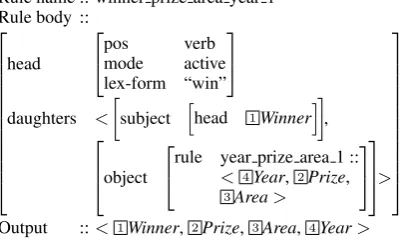
Figure 1: Dependency tree for example (1) From the tree in Figure 1, DARE learns three rules. The first rule is dominated by the prepo-sition “for”, extracting the argument PRIZE AREA (Area). The second rule is dominated by the noun “Prize”, extracting the argumentsYEAR(Year) and PRIZENAME (Prize), and calling the first rule for the argument PRIZEAREA(Area). The rule “win-ner prize area year 1” from Figure 2 extracts all four arguments from the verb phrase dominated by the verb “win” and calls the second rule to handle the arguments embedded in the linguistic argument “object”.
Rule name :: winner prize area year 1 Rule body ::
posmode verbactive lex-form “win”
daughters <
subject hhead 1Winner
i
Figure 2:DAREextraction rule.
We conduct a systematic error analysis based on our experiments with the Nobel Prize award data (Xu, 2007). The learned rules are divided
into four groups: good, useless, dangerous and bad. The good rules are rules that only extract cor-rect instances, while bad ones exclusively produce wrong instances. Useless rules are those that do not detect any new instances. Dangerous rules are dangerous because they extract both correct and wrong instances. Most good rules are rules with high specificity, namely, extracting all or most ar-guments of the target relation. The 14.7% extrac-tion errors are from bad rules and dangerous rules. Other errors are caused by wrong reported con-tent, negative modality, parsing and named entity recognition errors.
4 Our Approach: Boosting Relation Ex-traction
4.1 Closed-World Knowledge: Modeling and Construction
The error analysis of DARE confirms that the identification of bad rules or dangerous rules is important for the precision of an extraction sys-tem. Using closed-world knowledge with large numbers of implicit negative instances opens a possibility to detect such rules directly. In our work, closed-world knowledge for a target rela-tion is the total set of positive relarela-tion instances for entire relations or for some selected subsets of individuals. For most real world applications, closed-world knowledge can only be obtained for relatively small subsets of individuals participat-ing in the relevant relations. We store the closed-world knowledge in a relational database, which we dub ”closed-world knowledge database” (abbr. cwDB). Thus, acwDBfor a target relation should fill the following condition:
A cwDB must contain all correct relation instances (insts) for an instantiation value
(argValue) of a selected relation argument cwArgin the target relation.
Given R (the total set of relation instances of a target relation), acwDBis defined as follows:
4.2 Modified Learning Algorithm
In Algorithm 1, we present the modification of the DARE algorithm (Xu, 2007). The basic idea of DARE is that it takes some initial seeds as input and learns relation extraction rules from sentences in the textual corpus matching the seeds. Given the learned rules, it extracts new instances from the texts. The modified algorithm adds the val-idate step to evaluate the new instances against the closed-world knowledgecwDB. Based on the evaluation result, both new instances and learned rules are ranked with a confidence value.
INPUT:initial seeds
1 i←0 (iteration of bootstrapping) 2 seeds←initial seeds
3 all instances ← {}
4 while(seeds6={})
5 rulesi←getRules(seeds)
6 instancesi←getInstances(rulesi)
7 new instancesi←instancesi−all instances 8 validate(new instancesi,cwDB)
9 rank(new instancesi) 10 rank(rulesi)
11 seeds←new instancesi
12 all instances←all instances+new instancesi 13 i←i+ 1
OUTPUT:all instances
Algorithm 1: ExtendedDARE
4.3 Validation againstcwDB
Given acwDBof a target relation and itsargValue of its selected argument cwArg, the validation of an extracted instance (inst) against the cwDBis
defined as follows.
instcorrect ⇔ inst∈cwDB (1)
instwrong ⇔ inst6∈cwDB∧
cwArg(inst)=argValue
instunknown ⇔ ( inst6∈cwDB∧
cwArg(inst)6=argValue )
∨ ( inst6∈cwDB∧
cwArg(inst) isunspecified ) 4.4 Rule Confidence Ranking withcwDB We develop two rule-ranking strategies for con-fidence estimation, in order to investigate the best way of integrating the closed-world knowl-edge: (a) exclusive ranking: This ranking strat-egy excludes every rule which extracts wrong in-stances after their validation against the closed-world knowledge; (b)soft ranking: This ranking strategy is built on top of the duality principle and
takes specificity and the depth of learning into ac-count.
Exclusive Ranking The exclusive ranking method is a very naive ranking method which estimates the confidence value of a learned rule (e.g., rule) depending on the truth value of its
extracted instances (getInstances(rule)) against
a cwDB. Any rule with one wrong extraction is regarded as a bad rule in this method. This method works effectively in a special scenario where the total list of the instances of the target relation is available as thecwDB.
confidence(rule) =
1 ifgetInstances(rule)⊆cwDB,
0 otherwise. (2)
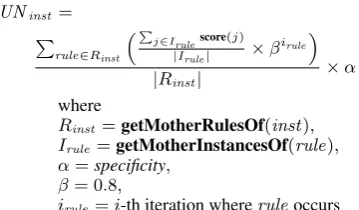
Soft Ranking The soft ranking method works in the spirit of the “Duality Principle”, the con-fidence value of rules is dependent on the truth value of their extracted instances and on the seed instances from which they stem. The confi-dence value of the extracted instances is estimated based on their validation against thecwDBor the confidence value of their ancestor seed instances from which their extraction rules stem. Further-more, thespecificity of the instances (percentage of the filled arguments) and the learning depth (iteration step of bootstrapping) are parameters too. The definition of instance scoring, namely,
score(inst), is given as follows:
score(inst) =
γ >0 ifvalidate(inst,cwDB) =correct,
0 ifvalidate(inst,cwDB) =wrong,
UNinst ifvalidate(inst,cwDB) =unknown.
(3)
As defined above, if a new instance is con-firmed as correct by the cwDB, it will obtain a positive value. In our experiment, we set γ=10
in order to boost the precision. In the case of un-knownabout its truth value, the confidence value of a new instance (inst) is dependent on the
confi-dence values of the seed instances (ancestor seeds) from which its mother rules (Rinst) stem. Below,
the scoring of theunknowncase, namely,UNinst,
is defined, where Rinst are rules that extract the
new instanceinst, whileIrule are instances from
which aruleinRinstis learned andαis the
speci-ficity value ofinst whileβ is utilized to express
UNinst=
P
rule∈Rinst
P
j∈Irulescore(j)
|Irule| ×β
irule
|Rinst| ×
α
where
Rinst =getMotherRulesOf(inst),
Irule=getMotherInstancesOf(rule),
α=specificity, β= 0.8,
irule=i-th iteration whereruleoccurs
(4)
Given the scoring of instanceinst, the confidence
estimation of a rule is the average score of all
insts extracted by this rule:
confidence(rule) =
P
inst∈Iscore(inst)
|I|
whereI=getInstances(rule) (5) 5 Experiments
5.1 Corpora and Closed-World Knowledge
We conduct our experiments with two different domains. We start with the Nobel Prize award do-main reported in (Xu, 2007) and apply our method to the same corpus, a collection from various on-line newspapers. The target relation is the one with the four arguments as mentioned in Sec-tion 3. In this way, we can compare our results with those reported in (Xu, 2007). Furthermore, all Nobel Prize winners can be found fromhttp:
//nobelprize.org, so it is easy to construct
a cwDB for Nobel Prize winners. We take the PRIZEAREA as our selected argument for closing sub-relations and construct various cwDBs with the instantiation of this argument (e.g., all win-ners of Nobel PeacePrize). The second domain is about celebrities. Our text corpus is collected from tabloid newspaper texts, containing 6850 ar-ticles from the years 2001 and 2002. The target relation is the marriage relationship between two persons. We construct acwDBof 289 persons in which we have listed all their (ex-)spouses as well as the time span of the marriage relation.
Table 1 summarizes the size of the corpus data of the two domains.
Domain Space #Doc.
Nobel Prize 18,4 MB 3328 Celebrity Marr. 16,6 MB 6850
Table 1: Corpus data.
5.2 Nobel Prize Domain
We apply the extendedDAREsystem to the Nobel Prize corpus at first and conduct two rule rank-ing strategies with different sizes of the cwDB. We conduct all our experiments with the seed
<Guenter Grass, Nobel, Literature, 1999>. The
DARE-Baseline performance is shown in Table 2.
Precision Absolute Recall Baseline 77.98% 89.01% Table 2: DARE-Baseline Performance
Exclusive Ranking
Given the complete list of Nobel Laureates, we can apply the exclusive ranking strategy to this do-main. OurcwDB is the total list of Nobel Prize winners. The wrong instances will not be used as seed for the next iteration. Rules that extracted at least one wrong instance are marked asbad, the other rules asgood. We utilize only the good rules for relation extraction.
Prec. Rel. Recall Rel. F-Measure 100.00% 82.88% 90.64%
Table 3: Performance of Exclusive Ranking in Nobel Prize award domain.
In comparison to the DARE baseline system, given the same seed setup, this experiment results in a precision boost from 77.98% to 100% (see Table 3). This is not surprising since thecwDB covers all relation instances for the target rela-tion. Nevertheless, this experiment shows that the closed-world knowledge approach is effective to exclude bad rules. However, the recall decreases and is only 82.88% of the one of the baseline sys-tem. As we explain above, not all rules extracting wrong instances are bad rules because wrong ex-tractions can also be caused by other error sources such as named entity recognition. Therefore, even good rules can be excluded because of other er-ror sources. The exclusive ranking strategy is use-ful for application scenarios where people want to learn rules for achieving 100% precision perfor-mance and do not expect high recall. It is espe-cially effective when a bigcwDBis available.
Soft Ranking
the definition in Section 4.4. Rules which extract correct instances, more specific relation instances and stem from high-scored seed instances obtain a better value than others. In our approach, the specificity is dependent on the number of the ar-guments in the extracted instances. For this do-main, the most specific instances contain all four arguments. In the following, we conduct two ex-periments with two different sizes of the cwDB: 1) with the total list of winners (completecwDB) and 2) with only winners in onePRIZEAREA (lim-itedcwDB).
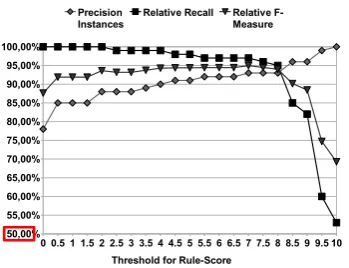
1) Complete closed-world database Figure 3 displays the correlation between the score of rules and their extraction precision performance. Each point stands for a set of rules with the same score and extraction precision. In this setup, the higher the score, the higher the precision. Given the scored rules, Figure 4 depicts precision, re-call and F-Measure for different score thresholds. For a given threshold j we take all rules with
score(rule) ≥ j and use the instances they
ex-tract. The recall value here is the relative recall w. r. t. to theDAREbaseline performance: i. e. the number of correct extracted instances divided by the number of correct instances extracted by the DARE baseline system. The F-Measure value is calculated by using the relative recall values, we therefore refer to it as the relativeF-Measure. If the system takes all rules with score≥7, the sys-tem achieves the best relative F-Measure.
0 1 2 3 4 5 6 7 8 9 10
Figure 3: Rule scores vs. precisions with the complete closed-world database.
2) Limited closed-world database This experi-ment investigates the system performance in cases in which only a limitedcwDBis available. This is the typical situation for most real world RE appli-cations. Therefore, this experiment is much more
0 0.5 1 1.5 2 2.5 3 3.5 4 4.5 5 5.5 6 6.5 7 7.5 8 8.5 9 9.5 10
Relative Recall Relative F-Measure
Threshold for Rule-Score
Figure 4: Performance with the complete closed-world database.
important than the previous one. We construct a smaller database containing only Peace Nobel Prize winners, which is about 1/8 of the previous completecwDB.
Figure 5: Rule score vs. precision with the lim-ited closed-world database
Relative Recall Relative F-Measure
Threshold for Rule-Score
Figure 6: Performance with the limited closed-world database
Thresh. Good Dangerous Bad Baseline 58.94% 26.49% 14.57%
1 64.96% 29.20% 5.84% 2 66.67% 27.91% 5.43% 3 69.23% 26.50% 4.27%
4 73.27% 23.76% 2.97%
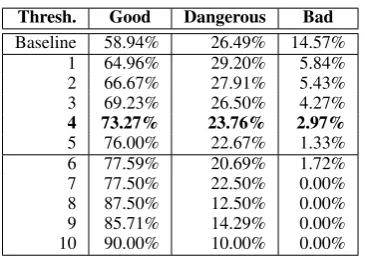
5 76.00% 22.67% 1.33% 6 77.59% 20.69% 1.72% 7 77.50% 22.50% 0.00% 8 87.50% 12.50% 0.00% 9 85.71% 14.29% 0.00% 10 90.00% 10.00% 0.00% Table 4: Quality analysis of rules with the limited closed-world database
the left upper corner. The reason is that many of their extracted instances areunknown, even if their extracted instances are mostly correct.
As shown in Figure 6, even with the limited cwDB, the precision values are comparable with the completecwDB(see Figure 4). However, the recall value drops much earlier than with the com-pletecwDB. With a threshold of score 4, the sys-tem achieves the best modified F-Measure 92,21% with an improvement of precision of about 11 per-centage points compared to the DARE baseline system (89.39% vs. 77.98%). These results show that even with a limitedcwDBthis ranking system can help to improve the precision without loosing too much recall.
We take a closer look on the useful (actively ex-tracting) rules and their extraction performance, using the same rule classification as (Xu, 2007). As shown in Table 4, more than one fourth of the extraction rules created by the baseline system are dangerous ones and almost 15% are plainly wrong. Applying the rule scoring with the limited cwDB increases the fraction of good rules to al-most three quarters and nearly eliminates all bad rules at threshold 4. By choosing higher thresh-olds, surviving good rules raises to 90%. The total remaining set of rules then only consists of rules that at least partially extract correct instances.
5.3 Celebrity Domain
As presented above, the soft ranking method de-livers very promising result. In order to val-idate this ranking method, we choose an ad-ditional domain and decide to learn marriage relations among celebrities, where the target relation consists of the following arguments:
[NAME OF SPOUSE,NAME OF SPOUSE,YEAR].
The value of the marriage year is valid when the year is within the marriage time interval. The motivation of selecting this target relation is the large number of possible relations between two persons leading to dangerous or even bad rules. For example, the rule in Figure 7 is a very dan-gerous rule because ”meeting” events of two mar-ried celebrities are often reported. A good confi-dence estimation method is very useful for boost-ing the good rules like the one in Figure 8. From our text corpus we extract 37.000 sentences that mention at least two persons. The cwDB con-sists of sample relation instances, in which one NAME OF SPOUSE is instantiated, i. e. we manu-ally construct a database which contains all (ex-) spouses of 289 celebrities.
head([SPOUSE<ne_person>]), mod({head(("meet", VB)),
subj({head([SPOUSE<ne_person>])})})
Figure 7: A dangerous extraction rule example
head(("marry", VB)), aux({head(("be", VB))}),
dep({head([SPOUSE<ne_person>]), dep({head([DATE<point>])})}), nsubj({head([SPOUSE<ne_person>])})
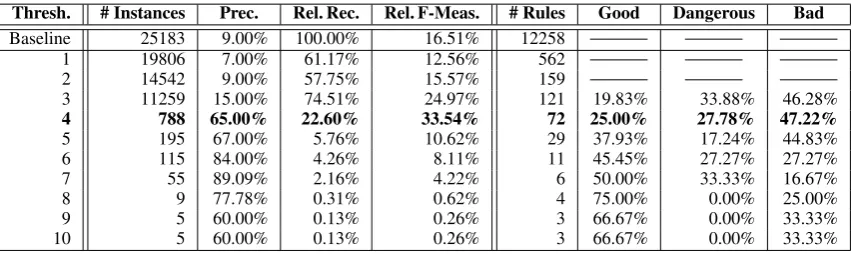
ex-Thresh. # Instances Prec. Rel. Rec. Rel. F-Meas. # Rules Good Dangerous Bad
Baseline 25183 9.00% 100.00% 16.51% 12258
1 19806 7.00% 61.17% 12.56% 562
2 14542 9.00% 57.75% 15.57% 159
3 11259 15.00% 74.51% 24.97% 121 19.83% 33.88% 46.28%
4 788 65.00% 22.60% 33.54% 72 25.00% 27.78% 47.22%
5 195 67.00% 5.76% 10.62% 29 37.93% 17.24% 44.83%
6 115 84.00% 4.26% 8.11% 11 45.45% 27.27% 27.27%
7 55 89.09% 2.16% 4.22% 6 50.00% 33.33% 16.67%
8 9 77.78% 0.31% 0.62% 4 75.00% 0.00% 25.00%
9 5 60.00% 0.13% 0.26% 3 66.67% 0.00% 33.33%
10 5 60.00% 0.13% 0.26% 3 66.67% 0.00% 33.33%
Table 5: Soft ranking for the celebrity marriage domain with a limitedcwDB. ample, the inability to distinguishPrince Charles
(former husband of British princess Diana) from Charles Spencer (her brother) is the reason that DARE crosses the border between the marriage and the sibling relation. In comparison to the Nobel Prize award event, the marriage relation between persons is often used as additional in-formation to a person which is involved in a re-ported event. Therefore, anaphoric references oc-cur more often in their mentionings, as the exam-ple relation in (3).
(3) “My kids, I really don’t like them to watch that much television,” saidCruise, 40, who:::::
adopted Isabella and Connor while::he was
mar-ried to second wife Nicole Kidman. 6 Summary
We propose a new way in which prior knowledge about domains can be efficiently used as addi-tional criteria for confidence estimation of learned new rules or new instances in a minimally su-pervised machine learning framework. By intro-ducing rule scoring on the basis of available do-main knowledge (the cwDB), rules can be eval-uated during the bootstrapping process with re-spect to their extraction precision. The results are rather promising. The rule score threshold is an easy way for users of an extraction system to adjust the precision-recall-trade-off to their own needs. The rule estimation method is also general enough to extend to integration of common sense knowledge. Although the relation instances in the closed-world knowledge database can also be used as seed in the beginning, the core idea of our research work is to develop a general confidence estimation strategy for discovered new informa-tion. As discussed in (Xu, 2007) and (Uszkoreit
et al., 2009), the size of seed is not always rele-vant for the learning and extraction performance, in particular if the data corpus exhibits the small world property. Using all instances in the cwDB as seed, our experiments with the baseline system yield worse precision performance than the modi-fiedDAREalgorithm with only one seed instance. This approach is quite general and easily adapt-able to many domains; the only prerequisite is the existence of a database with relation instances from the target domain with a fulfilled closed-world property on some relational argument. A database of this kind should be easily obtainable for many domains, e. g. by exploiting structured and semi-structured information sources in the In-ternet, such asYAGO(Suchanek et al. (2007)) and DBpedia (Bizer et al. (2009)). Furthermore, in some areas, such as Business Intelligence, there is nearly complete knowledge already present for past years, while the task is to extract informa-tion only from recent news articles. Construct-ing closed-worlds out of the present knowledge to improve the learning of new information is there-fore a straightforward approach. Even the manual collection of suitable data might be a reasonable choice since appropriate closed worlds could be rather small ifcwDBis chosen properly.
Acknowledgments
References
Agichtein, Eugene and Luis Gravano. 2000. Snow-ball: extracting relations from large plain-text col-lections. In DL ’00: Proceedings of the fifth ACM conference on Digital libraries, pages 85–94, New York, NY, USA. ACM.
Agichtein, Eugene. 2006. Confidence estimation methods for partially supervised information extrac-tion. InProceedings of the Sixth SIAM International Conference on Data Mining, Bethesda, MD, USA, April. SIAM.
Bizer, Christian, Jens Lehmann, Georgi Kobilarov, S¨oren Auer, Christian Becker, Richard Cyganiak, and Sebastian Hellmann. 2009. DBpedia - a crys-tallization point for the web of data. Journal of Web Semantics, 7(3):154–165.
Brin, Sergey. 1998. Extracting patterns and rela-tions from the world wide web. In WebDB Work-shop at 6th International Conference on Extending Database Technology, EDBT’98.
Bunescu, Razvan C. and Raymond J. Mooney. 2007. Learning to extract relations from the web using minimal supervision. In Proceedings of the 45th Annual Meeting of the Association for Computa-tional Linguistics.
Etzioni, Oren, Michael Cafarella, Doug Downey, Ana-Maria Popescu, Tal Shaked, Stephen Soderland, Daniel S. Weld, and Alexander Yates. 2005. Un-supervised named-entity extraction from the web: An experimental study. Artificial Intelligence, 165(1):91 – 134.
Greenwood, Mark A. and Mark Stevenson. 2006. Im-proving semi-supervised acquisition of relation ex-traction patterns. InProceedings of the Workshop on Information Extraction Beyond The Document, pages 29–35, Sydney, Australia, July. Association for Computational Linguistics.
Jones, R. 2005. Learning to Extract Entities from La-beled and UnlaLa-beled Text. Ph.D. thesis, University of Utah.
Pantel, Patrick and Marco Pennacchiotti. 2006. Espresso: Leveraging generic patterns for automati-cally harvesting semantic relations. InProceedings of the 21st International Conference on Computa-tional Linguistics and 44th Annual Meeting of the Association for Computational Linguistics, Sydney, Australia, July. The Association for Computer Lin-guistics.
Riloff, Ellen. 1996. Automatically generating extrac-tion patterns from untagged text. In Proceedings of Thirteenth National Conference on Artificial In-telligence (AAAI-96), pages 1044–1049. The AAAI Press/MIT Press.
Suchanek, Fabian M., Gjergji Kasneci, and Gerhard Weikum. 2007. Yago: A Core of Semantic Knowl-edge. In16th international World Wide Web con-ference (WWW 2007), New York, NY, USA. ACM Press.
Sudo, K., S. Sekine, and R. Grishman. 2003. An im-proved extraction pattern representation model for automatic IE pattern acquisition. Proceedings of ACL 2003, pages 224–231.
Uszkoreit, Hans, Feiyu Xu, and Hong Li. 2009. Anal-ysis and improvement of minimally supervised ma-chine learning for relation extraction. In14th In-ternational Conference on Applications of Natural Language to Information Systems. Springer.
Xu, Feiyu, Hans Uszkoreit, and Hong Li. 2007. A seed-driven bottom-up machine learning framework for extracting relations of various complexity. In
Proceedings of ACL 2007, 45th Annual Meeting of the Association for Computational Linguistics, Prague, Czech Republic, June.
Xu, Feiyu. 2007. Bootstrapping Relation Extraction from Semantic Seeds. Phd-thesis, Saarland Univer-sity.
Yangarber, Roman. 2001. Scenarion Customization for Information Extraction. Dissertation, Depart-ment of Computer Science, Graduate School of Arts and Science, New York University, New York, USA.