Relational-Realizational Parsing
Reut Tsarfaty and Khalil Sima’an
Institute for Logic, Language and Computation, University of Amsterdam Plantage Muidergracht 24, 1018TV, Amsterdam, The Netherlands
{rtsarfat,simaan}@science.uva.nl
Abstract
State-of-the-art statistical parsing models applied to free word-order languages tend to underperform compared to, e.g., pars-ing English. Constituency-based mod-els often fail to capture generalizations that cannot be stated in structural terms, and dependency-based models employ a ‘single-head’ assumption that often breaks in the face of multiple exponence. In this paper we suggest that the position of a con-stituent is a form manifestation of its gram-matical function, one among various pos-sible means of realization. We develop the Relational-Realizational approach to pars-ing in which we untangle the projection of grammatical functions and their means of realization to allow for phrase-structure variability and morphological-syntactic in-teraction. We empirically demonstrate the application of our approach to pars-ing Modern Hebrew, obtainpars-ing 7% error reduction from previously reported results.
1 Introduction
Many broad-coverage statistical parsers to date are constituency-based with a Probabilistic Context-Free Grammar (PCFG) or a Stochastic Tree Sub-stitution Grammar (STSG) at their backbone. The majority of such models belong to a Head-Driven paradigm, in which a head constituent is gen-erated first, providing a positional anchor for subsequent (e.g., Markovian) sisters’ generation.
c
2008. Licensed under the Creative Commons Attribution-Noncommercial-Share Alike 3.0 Unported li-cense (http://creativecommons.org/licenses/by-nc-sa/3.0/). Some rights reserved.
Constituency-based models, lexicalized and un-lexicalized alike, demonstrate state-of-the-art per-formance for parsing English (Charniak, 1997; Collins, 2003; Klein and Manning, 2003; Bod, 2003), yet a direct application of such models to parsing less configurational languages often fails to yield comparable results. The parameters of such parsers capture generalizations that are eas-ily stated in structural terms (e.g., subjects linearly precede predicates, VPs dominate objects, etc.) which may not be adequate for parsing languages with less configurational character.
A different vein of research explores data-driven dependency-based parsing methods (e.g., (Mc-Donald et al., 2005)) which seem to be intuitively more adequate for the task. It turns out, how-ever, that even such models fail to provide the desired remedy. Recent reports by (Nivre, 2007) delineated a class of richly-inflected languages with relatively free word-order (including Greek, Basque, and Modern Standard Arabic) for which the parsers performed poorly, regardless of the parsing method used. The need for parsing meth-ods that can effectively cope with such phenomena doesn’t seem to have been eliminated by depen-dency parsing — perhaps quite the contrary.
The essential argument we promote here is that in order to deal with the kind of variation that is empirically observed cross-linguistically an al-ternative view of the generation process is re-quired. Our Relational-Realizational parsing pro-posal, strongly inspired by Relational Grammar (Perlmutter, 1982), takes grammatical relations such as ‘Subject’ and ‘Predicate’ as central, primi-tive notions of the syntactic representation, and re-tains a distinction between the projection of such relations and the means by which they are real-ized. The grammar we develop here, formally
represented as a PCFG, articulates two alternating generation phases: a Relational phase, in which a clause-level category projects a monostratal Rela-tional Network (RN) representation for the clause, and a Realizational phase, in which the projected relations are realized in a certain surface config-uration. Paradigmatic morphosyntactic represen-tations are constructed for all non-terminal nodes, allowing for morphosyntactic interaction at vari-ous levels of the syntactic parse tree.
We illustrate the application of our theoretical reconstruction to the representation of clause-level categories in Modern Hebrew (MH) and their in-teraction with a handful of morphological features. The treebank grammar resulting from our applica-tion yields 13% error reducapplica-tion relative to a tree-bank PCFG which uses the same information in the form of state-splits, and our best result shows a 7% error reduction over the best parsing results for MH so far. Through a quantitative and quali-tative analysis we illustrate the advantages of the Relational-Realizational approach and its poten-tial promise for parsing other “exotic” languages.
2 Background
Recent decades have seen a surge of interest in sta-tistical models using a body of annotated text for learning the distributions of grammatically mean-ingful structures, in order to assign the most likely ones to unseen sentences. Probabilistic Context Free Grammars (PCFGs) have become popular in the articulation of such models, and unlexicalized treebank grammars (or representational variations thereof) were shown to perform reasonably well on English benchmark corpora (Johnson, 1998; Klein and Manning, 2003).
A major leap in the performance of PCFG-based statistical parsers has been introduced by the move towards a Head-Driven paradigm (Collins, 2003; Charniak, 1997), in which syntactic categories are enriched with head information percolated up the tree. The head-driven generation process allows one to model the relation between the information content of a constituent and the information con-tent of its head-marked sister. At the same time, such models introduce a bias with respect to the positioning of a non-head constituent relative to its head-marked sister. The vast improvement in pars-ing results came about not without modelpars-ing costs, e.g., additional ad-hoc modifications for capturing complex structures such as conjunction.
An inherent difficulty with the application of constituency-based parsing models is the implicit assumption that the relation between the posi-tion of a constituent and its grammatical func-tion is fully predictable. For languages with relatively free word-order, this assumption often breaks down. Distinguishing, e.g., “left” and “right” distributions for constituents of the same ‘sort’ implicitly takes the position of a constituent to be a primitive syntactic notion, and their gram-matical function to be a secondary, derived one. Theoretical accounts show that this may be insuf-ficient (Perlmutter, 1982). A subsequent difficulty with the head-driven paradigm, also shared by dependency-based parsing methods, is the stipu-lation that all grammatically relevant properties of a phrase are recovered from a single head. In fact, it is typologically established that grammatically meaningful properties of a constituent may jointly emerge from different surface forms dominated by it (co-heads or multiple exponence (Zwicky, 1993; Blevins, 2008)).1
The task we undertake here is to suggest a sta-tistical generative parsing method which is linguis-tically plausible as well as technologically viable for parsing languages with relatively free word-order and variable means of realization. In what follows we remain within the computationally ef-ficient framework of PCFGs, and propose a varia-tion that draws on insights from syntactic and mor-phological theories that have been explored cross-linguistically.
3 Approach
3.1 Relational Grammars (RGs)
Relational Grammars (RGs) were introduced in the early 80’s when attempts to find a universal def-inition for notions such as a ‘Subject’ in terms of various “behavioral properties” seemed to have failed (Perlmutter, 1982). The unsuccessful at-tempts to recover an adequate definition of gram-matical functions in structural terms led to a revival of a view in which grammatical relations such as ‘Subject’ and ‘Object’ are primitive notions by
1We refrain here from referring to the increasingly popular
which syntactic structures are defined (Postal and Perlmutter, 1977). This view proved useful for de-scriptive purposes, influencing the design of for-malisms such as Arc-Pair grammars (Postal, 1982) and LFG (Bresnan, 1979).
The two main primitive elements used in RGs are (a) a set of nodes representing linguistic ele-ments (which we refer to using upper case letters), and (b) a set of names of grammatical relations (which we refer to as gr1...grn). RGs represent the fact that a linguistic element bears a certain re-lation to another element using a structure called an ‘Arc’, represented as[gri(A, B)]. Arcs are rep-resented as arrows, with A the head of the Arc and B its tail, and a Relational Network (RN) is defined to be a set of Arcs that share a single head.2
Now, a few theoretical observations are due. Firstly, the essential difference between RGs and dependency-based grammars is that RNs take the linguistic element at the head of a network to be a clause-level category, not a particular surface form. The corresponding tails are then the various nom-inals bearing the different grammatical relations to the clause (including a ‘Predicate’, a ‘Subject’, an ‘Object’, etc.). In addition, RNs abstract away from elements such as auxiliary verbs and particles which do not have their own arc representation. RGs also differ from phrase-structure grammars in that their RNs are unordered. Therefore, linear precedence need not play a role in stating general-izations. RGs differ from both constituency- and dependency-based formalisms in that they do not weigh heavily the ‘single-head’ assumption – RNs may delineate a whole chunk as bearing a certain grammatical relation to the clause.
The set-theoretic notion of RNs in RGs abstracts away from surface phenomena crucial for generat-ing phrase-structure trees. Thus, we next turn to modeling how grammatical relations are realized.
3.2 Form, Function and Separation
Morphological phenomena such as suprasegmen-tation, interdigisuprasegmen-tation, reduplication, subtractive morphology, templatic morphology, and methathe-sis demonstrate that it is sometimes impossible to find a direct correspondence between a certain part
2
RGs also define the notion of a stratum, a single level of syntactic representation, and for the current discussion we assume a monostratal representation. We do not claim that our framework is capable of dealing with the full range of phenomena multistratal RNs were shown to account for, yet there is nothing in our proposal that excludes extending the representation into a multistratal framework that does so.
of a word (a ‘morpheme’) and the function it has in altering the word’s meaning (Anderson, 1992). Attempts to model such morphological phenom-ena brought forward the hypothesis that ‘form’ and ‘function’ need not stand in one-to-one correspon-dence, and that one is not necessarily immediately predicted by the other. This hypothesis is known as the “Separation Hypothesis” (Beard, 1988). The problem of modeling certain surface phenomena then boils down to modeling form and function correlations, bearing in mind that these may be quite complex.
Bringing this general notion of separation into the syntactic derivation, we propose to view the position of a constituent in a phrase as its form and the articulated grammatical relation as its function. The task of learning the position of different con-stituents realizing the grammatical relations in an RN is now delegated to a statistical component. A set of parameters which we refer to as “configu-ration” determines the syntactic position in which each of the grammatical relations is to be realized.
3.3 Morphosyntactic Representations
In order to connect the abstract RN representation with the constituents that syntactic parse trees are “made of” we propose to view the internal nodes of a tree as Morphosyntactic Paradigms. Our morphosyntactic representation for constituents, loosely inspired by (Anderson, 1992), is a struc-tured representation of morphological and syntac-tic properties for an internal node in the parse tree. In our model, the morphological features asso-ciated with a syntactic constituent are percolated from its dominated surface forms, and we allow the specification of head (PoS tag) information and structural features such as vertical markovization. Given the grammatical relation an element bears to a clause, it is statistically feasible to learn the morphosyntactic paradigm by which it is realized.
4 The Model
4.1 The Generative Model
• Projection:
Sp → {gri}ni=1@Sp
• Configuration:
{gri}ni=1@Sp → hgr1@Sp. . . grn@Spi
• Realization:
{gri@Sp→Sci}ni=1
In the projection stage we generate the set of gram-matical relations in the RN of a constituent. In the configuration stage we order these grammat-ical relations, and in realization we generate the morphosyntactic representation of each child con-stituent given the relation to its parent. Figure (1) shows the application of this process to two clauses bearing identical RNs that are in turn realized in different possible configurations.
This three-step process does not generate func-tional elements (such as auxiliary verbs and special-purpose particles) that are outside of con-stituents’ RNs. We thus let the configuration stage place obligatory or optional “realizational slots” between the ordered elements (markedgri : grj), signalling periphrastic adpositions and/or modifi-cation. Note that modification may introduce more than one constituent, to be generated in realization.
• Projection:
Sp → {gri}ni=1@Sp
• Configuration:
{gri}ni=1@Sp →
hgr0 :gr1@Sp gr1@Sp. . .grn:grn+1@Spi
• Realization:
{gri@Sp→Sci}ni=1
{gri:gri+1@Sp→ hSci1...Scimii}ni=0
In figure (2), the configuration stage reserves a slot for an obligatory punctuation mark at the end of an affirmative sentence. It further reserves a slot for an optional adverbial modifier at a position com-monly employed in MH for interjections.
In the current framework, grammatical rela-tions may be realized in a certain surface position via configuration, or using explicit morphological marking per grammatical relation independently of linear context. Figure (3) demonstrates how the realization phase models the correlation between grammatical relations and morphological informa-tion percolated from dominated surface forms. In particular, our model can capture the interaction between marked features, e.g., the ‘exclusive or’ relation between definiteness and accusativity in marking direct objects in MH (Danon, 2001).
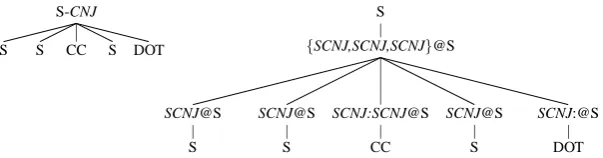
Finally, a conjunction structure in our model is simply an RN representation of multiple mor-phosyntactically equivalent conjuncts, as illus-trated in figure (4). This modeling choice avoids the need to stipulate a single head for such struc-tures (cf. head-driven processes) and allows the different conjuncts to share a realization distribu-tion — essentially implying homogeneity in the assignment of heads and morphosyntactic features across conjuncts.
4.2 The Probabilistic Model
Our probablistic model is a PCFG, where CFG rules capture the three stages of generation. Ev-ery time we apply our projection-configuration-realization cycle we replace the rule probability with the probabilities of the three stages, multi-plied (n+Pni=0midaugthers ,gr0=grn+1=null).
P(hSci1, .., ScimiSci-gri, Sci+11, .., Sci+1mi+1ini=0|Sp) =
P({gri}ni=1|Sp)×
P(hgr0 :gr1, g1, . . .i|{gri}ni=1, Sp)×
Qn
i=1P(Sci|gri, Sp)×
P(hSc01, ..., Sc0m0i|gr0:gr1, Sp)×
Qn
i=1P(hSci1, ..., Scimii|gri:gri+1, Sp)
The multiplication implements the independence assumption between form and function underlying the Separation Hypothesis, and the conditioning we articulate captures one possible way to model a systematic many-to-many correspondence.
4.3 The Grammar
(a) S
NP-SBJ VP-PRD NP-OBJ
S
{PRD,OBJ,SBJ}@S
SBJ@S
NP
PRD@S
VP
OBJ@S
NP
(b) S
VP-PRD NP-SBJ NP-OBJ
S
{PRD,OBJ,SBJ}@S
PRD@S
VP
SBJ@S
NP
OBJ@S
NP
Figure 1:Generating Canonical and Non-Canonical Configurations: The CF depictions of the S level constituents at the
LHS of (a) and (b) are distinct, whereas the RR-CFG representations at the RHS of (a) and (b) share the projection of GRs and differs in their configuration — while (a) generates an SVO order, (b) generates a so-called Verb-Initial (VI) construction.
(c) S
VP-PRD ADVP NP-SBJ NP-OBJ DOT
S
{PRD,OBJ,SBJ}@S
PRD@S
VP
PRD:SBJ@S
ADVP
SBJ@S
NP
OBJ@S
NP
OBJ:@S
DOT
Figure 2: Generating Adjunction and Periphrastic Configurations: The CF depiction of S at the LHS of (c) generates
complements, adjuncts, and punctuation in one go, whereas the RR-CFG representation at the RHS generates first the projec-tion of core grammatical elements and then the configuraprojec-tion of a modified affirmative sentence in which they are realized. (Similarly, realising a question configuration using inversion in, e.g., English, naturally follows).
(d) S
VP-PRD
VB
NP[Def+,Acc+]-OBJ
AT[Acc+] NP[Def+]
NNT NN[Def+]
NP[Def+]-SBJ
NN[Def+]
S
{PRD,OBJ,SBJ}@S
PRD@S
VP
VB
OBJ@S
NP[Def+,Acc+]
AT[Acc+] NP[Def+]
NNT NN[Def+]
SBJ@S
NP[Def+]
NN[Def+]
Figure 3: Realizing Grammatical Relations with bounded and unbounded Morphemes: The CF depiction of the S level
constituent at the LHS of (d) shows a strong dependence between the position of syntactic constituents and the morphologically realized features percolated from lower surface forms. In the RR-CFG representation at the RHS the feature distribution among sub constituents is dependent on grammatical relations, independently of their positioning. The realization stage generates a morphosyntactic paradigm in one go, allowing to capture meaningful collocations and idiosyncrasies, e.g., the Xor relation of the Acc+ and def+ features when marking direct objects in MH (Danon, 2001).
S-CNJ
S S CC S DOT
S
{SCNJ,SCNJ,SCNJ}@S
SCNJ@S
S
SCNJ@S
S
SCNJ:SCNJ@S
CC
SCNJ@S
S
SCNJ:@S
DOT
Figure 4: Generating a Conjunction Structure: The conjunction structure in the LHS of (e) is generated by the RR-CFG
5 Experiments
Data The data we use is taken from the Modern Hebrew Treebank (MHTB) (Sima’an et al., 2001) which consists of 6501 sentences from the newspa-per ‘haaretz’ annotated with phrase-structure trees and decorated with various morphological and functional features. We use version 2.0 of the tree-bank3 which we processed and head-annotated as in (Tsarfaty and Sima’an, 2007). We experimented with sentences 1–500 (development set) and sen-tences 501–6001 (training set), and used sensen-tences 6001-6501 (test set) for confirming our best result.
Models Our Plain models use the coarse-level
MHTB category-labels enriched with various mor-phological features. Our mormor-phological represen-tation Base varies with respect to the use of the per-colated features definiteness Def and accusativity
Acc. Constituents’ morphosyntactic representa-tions enriched with their head PoS tag are referred to as Head and grand-parent encodings as Parent. For each combination of morphological and syn-tactic features we experimented with a state-split PCFG and with our RR-PCFG implementation.
Procedure We read off our models’
parame-ters from the decorated phrase-structure trees in the MHTB, and use relative frequency estimation to instantiate their probability distributions. We smooth lexical rules using a PoS-tags distribution we learn for rare-words, where the ‘rare’ threshold is set to 1. We then use BitPar, a general purpose chart parser,4 to find the most likely structures, and we extract the corresponding coarse-grained tree-skeletons for the purpose of evaluation.5 We use PARSEVAL measures to quantitatively evalu-ate our models and perform a qualitative analysis of the resulting parse trees.
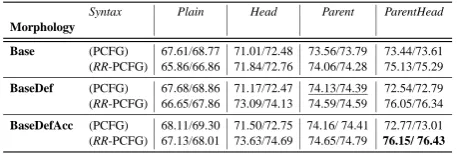
Results Table 1 shows the average F-Measure
value for all sentences of length ≤40 in our development set with/without punctuation. The na¨ıve baseline implementation for our experi-ments, the BasePlain PCFG, performs at the level of 67.61/68.67 (comparable to the baseline re-ported in (Tsarfaty and Sima’an, 2007)). For all
3http://www.mila.cs.technion.ac.il/
english/resources/corpora/treebank/ver2. 0/index.html
4:http://www.ims.uni-stuttgart.de/tcl/
SOFTWARE/BitPar.html
5
Our setup is comparable to English, which means that our surface forms are segmented per PoS tag without specifying their respective PoS tags and morphological features.
Syntax Plain Head Parent ParentHead Morphology
Base (PCFG) 67.61/68.77 71.01/72.48 73.56/73.79 73.44/73.61 (RR-PCFG) 65.86/66.86 71.84/72.76 74.06/74.28 75.13/75.29
BaseDef (PCFG) 67.68/68.86 71.17/72.47 74.13/74.39 72.54/72.79 (RR-PCFG) 66.65/67.86 73.09/74.13 74.59/74.59 76.05/76.34
BaseDefAcc (PCFG) 68.11/69.30 71.50/72.75 74.16/ 74.41 72.77/73.01 (RR-PCFG) 67.13/68.01 73.63/74.69 74.65/74.79 76.15/ 76.43
Table 1: Parsing Results for Sentences of Length< 40 in the Development Set: Averaged F-Measure With/Without
Punctuation. Base refers to coarse syntactic categories, Def indicates percolating definiteness values, Acc indicated per-colating accusativity marking. The underlined results repli-cate previously reported results in similar settings.
models in the Plain column the simple PCFG out-performs the RR-variety. Yet, the contribution of percolated morphological features is higher with the RR-PCFG than with the simple PCFG.
Moving to the Head column, we see that all RR-models already outperform their enriched PCFG counterparts. Again, morphological information contributes more to the RR-variety. The best result for this column, achieved by the BaseDefAccHead RR-model (63.73/64.69), outperforms its PCFG counterpart as well as all two-dimensional models reported by (Tsarfaty and Sima’an, 2007). In the Parent column), our RR-variety continues to out-perform the PCFG albeit in an insignificant rate. (Both results are at the same level as the best model of (Tsarfaty and Sima’an, 2007).)
Finally, for all models in the ParentHead col-umn the RR-models outperform their PCFG coun-terparts to a significant degree. Similarly to the Head column, the more morphological informa-tion is added, the greater the improvement is. Our best RR-model, BaseDefAccParentHead, scores almost 10pt (25% error reduction) more than the Plain PCFG, it is about 3.5pt better (13% error re-duction) than a state-split PCFG using the same information, and almost 2pt (7% error reduction) more than the best results reported for MH so far.
We confirmed the results of our best model on our test set, for which our baseline (BasePlain) obtained 69.63/70.31. The enriched PCFG of DaseDefAccHeadParent yields 73.66/73.86 whereas the RR-PCFG yields 75.83/75.89. The overall performance for PCFGs is higher on this set, yet the RR-model shows a notable improve-ment (about 9% error reduction).
6 Analysis and Discussion
(a) S
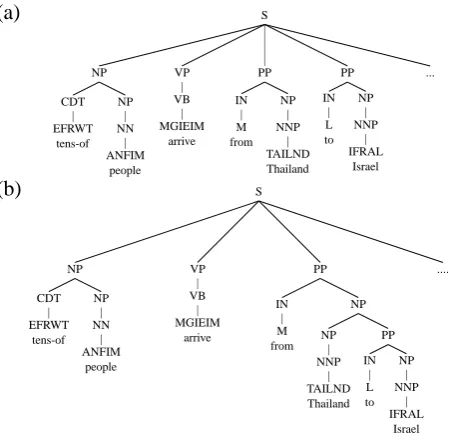
Figure 5: Qualitative Analysis of Sentence (Fragment) #1: (a) is the gold tree fragment, correctly predicted by our
best RR-PCFG model. (b) is the tree fragment predicted by the PCFG corresponding to previously reported results.
trees, be it morphological information coming from dominated surface forms or functional infor-mation on top of syntactic categories.
We have shown that head information, which has very little contribution to parsing accuracy as a mere state-split, turns out to have crucial ef-fects within the RR-models. For state-splits based PCFGs, adding head information brings about a category fragmentation and decreasing perfor-mance. The separation between form and function we articulate in the RR-approach allows us to cap-ture generalizations concerning the distribution of syntactic constituents under heads based on their grammatical function, and use fine-grained fea-tures to predict their morphosyntactic behaviour.
We have further shown that morphological in-formation contributes a substantial improvement when adopting the RR-approach, which is inline with the linguistic insight that there is a correlation between morphological marking on top of surface forms and the grammatical function their domi-nating constituents realize. Morphological infor-mation is particularly useful in the presence of heads. Taken together, head and percolated fea-tures implement a rather complete conceptualiza-tion of multiple exponence.
To wrap up the discussion, we leave numbers aside and concentrate on the kind of structures pre-dicted by our best model in comparison to the ones suggested by previously reported unlexical-ized PCFGs ((Tsarfaty and Sima’an, 2007), un-derlined in our table). Due to lack of space we
(a) S
Figure 6: Qualitative Analysis of Sentence (Fragment) #4: (a) is the gold tree fragment, correctly predicted by our
best RR-PCFG model. (b) is the tree fragment predicted by the PCFG corresponding to previously reported results.
only discuss errors found within the first 10 parsed sentence, yet we note that the qualitative trend we describe here persists throughout our develop-ment set. Figures (5) and (6) show a gold tree (a fragment of sentence #1) correctly predicted by our best RR-model (a) in comparison with the one predicted by the respective PCFG (b). The tree fragment in figure (5) shows that the RR-grammar bracketed and attached correctly all the constituents that bear grammatical relations to the S clause (5a). The corresponding PCFG conflated the “to” and “from” phrases to a rather meaning-less prepositional phrase (5b). For (a fragment of) sentence #4 in our set (figure 6) the RR-model re-covered all grammatically meaningful constituents under the S clause and under the internal VP (6a). Notably, the PCFG in (6b) recovered none of them. Both grammars make attachment mistakes internal to complex NPs, but the RR-model is better at iden-tifying higher level constituents that correlate with meaningful grammatical functions.
Our qualitative analysis suggests that our model is even more powerful than our quantitative analy-sis indicates, yet we leave the discussion of better ways to quantify this for future research.
A Note on Related Work Studies on parsing
2007) examined the contribution of horizontal and vertical conditioning to an unlexicalized MH parser and concluded that head-driven Markoviza-tion performs below the level of vertical condi-tioning enriched with percolated features. We do not know of existing dependency-parsers applied to parsing MH or mildly-context-sensitive broad-coverage parsers applied to parsing a Semitic lan-guage.6 To the best of our knowledge, this is the first fully generative probabilistic framework that models explicitly morpho-syntactic interaction to enhance parsing for non-configrational languages.
7 Conclusion
Projection and Realization are two sides of the same coin. Projection determines which gram-matical relations appear in the syntactic represen-tation, and Realization determines how such rela-tions are realized. We suggest that the Relational-Realizational (RR) approach is adequate for pars-ing languages characteristically different from En-glish, and we illustrate it with an application to parsing MH. We show that our approach to mod-eling the interaction between syntactic categories and a handful of percolated features already yields a notable improvement in parsing accuracy and substantially improves the quality of suggested parses. Incorporating additional functional and morphological information, we expect, will help bridging the gap in performance between Hebrew and configurational languages such as English.
Acknowledgements We thank Remko Scha,
Jelle Zuidema, Yoav Goldberg, and three anony-mous reviewers for comments on earlier drafts. The first author wishes to thank Jim Blevins, Julia Hockenmeir, Mark Johnson, Kevin Knight, Chris Manning, Joakim Nivre and Gerald Penn for stim-ulating discussion. Errors are our own. The work of the first author is funded by the Dutch Science Foundation (NWO), grant number 017.001.271.
References
Anderson, S. R. 1992. A-Morphus Morphology. Cam-bridge University Press.
Beard, R. 1988. The Separation of Derivation and Affixation: Toward a Lexeme-Morpheme Base Mor-phology. Quarderni di semantica, pages 277–287.
6
Parsing MSA has been explored with a treebank three times as large as ours using a head-driven lexicalized parser obtaining around 78% accuracy (http://papers.ldc. upenn.edu/). The input setup assumes gold segmentation as well as PoS tags information and some diacritization.
Blevins, J. P. 2008. Periphrasis as Syntactic Ex-ponence. In Ackerman, F., J.P. Blevins, and G.S. Stump, editors, Patterns in Paradigms. CSLI.
Bod, R. 2003. An Efficient Implementation of a New Dop Model. In Proceedings of EACL.
Bresnan, Joan. 1979. A Theory of Grammatical
Repre-sentation. Duplicated Lecture Notes. Department of
Linguistics and Philosophy, MIT.
Charniak, E. 1997. Statistical Parsing with a Context-Free Grammar and Word Statistics. In AAAI/IAAI.
Collins, M. 2003. Head-Driven Statistical Models for Natural Language Parsing. Comp. Linguistics.
Danon, G. 2001. Syntactic Definiteness in the Gram-mar of Modern Hebrew. Linguistics, 6(39).
Goldberg, Y. and R. Tsarfaty. 2008. A Single Gener-ative Framework for Joint Morphological Segmenta-tion and Syntactic Parsing. In Proceedings of ACL.
Johnson, M. 1998. PCFG Models of Linguistic Tree Representations. Computational Linguistics, 24(4).
Klein, D. and C. Manning. 2003. Accurate Unlexical-ized Parsing. In Proceedings of ACL.
McDonald, R., F. Pereira, K. Ribarov, and J. Hajiˇc. 2005. Non-Projective Dependency Parsing using Spanning Tree Algorithms. In Proceedings of HLT.
Nivre, J. 2007. Data-driven Dependency Parsing Across Languages and Domains; Perspectives from the CoNLL-2007 Shared Task. In Proceedings of
IWPT.
Perlmutter, D. M. 1982. Syntactic Representation, Syntactic levels, and the Notion of Subject. In Ja-cobson, Pauline and Geoffrey Pullum, editors, The
Nature of Syntactic Representation. Springer.
Postal, P. M. and D. M. Perlmutter. 1977. Toward a Universal Characterization of Passivization. In
BLS3.
Postal, P. M. 1982. Some Arc-Pair Grammar Decrip-tions. In Jacobson, P. and G. K. Pullum, editors, The
Nature of Syntactic Representation. Dordrecht.
Sima’an, K., A. Itai, Y. Winter, A. Altman, and N. Na-tiv. 2001. Building a Tree-Bank for Modern Hebrew Text. In Traitement Automatique des Langues.
Tsarfaty, R. and K. Sima’an. 2007. Three-Dimensional Parametrization for Parsing Morphologically Rich Languages. In Proceedings of IWPT.
Tsarfaty, R. 2006. Integrated Morphological and Syn-tactic Disambiguation for Modern Hebrew. In
Pro-ceeding of ACL-SRW.
Zwicky, A. M. 1993. Heads, Bases, and Functors. In Corbett, G.G., N. Fraser, and S. McGlashan, editors,