Hybrid processing for grammar and style checking
Berthold Crysmann♣, Nuria Bertomeu♠, Peter Adolphs♥, Dan Flickinger♦, Tina Kl ¨uwer♣♥
♣Universit¨at Bonn, Poppeldorfer Allee 47, D-53115 Bonn,{bcr,tkl}@ifk.uni-bonn.de ♠Zentrum f¨ur Allgemeine Sprachwissenschaft, Berlin,[email protected]
♥DFKI GmbH, Berlin,{peter.adolphs,kluewer}@dfki.de ♦CSLI, Stanford University,[email protected]
Abstract
This paper presents an implemented hy-brid approach to grammar and style checking, combining an industrial pattern-based grammar and style checker with bi-directional, large-scale HPSG grammars for German and English. Under this ap-proach, deep processing is applied selec-tively based on the error hypotheses of a shallow system. We have conducted a com-parative evaluation of the two components, supporting an integration scenario where the shallow system is best used for error de-tection, whereas the HPSG grammars add error correction for both grammar and con-trolled language style errors.
1 Introduction
With the enormous amount of multilingual techni-cal documentation produced by companies nowa-days grammar and controlled language checking (henceforth: style checking) is becoming an appli-cation highly in demand. It is not only a helpful tool for authors, but also facilitates the translation of documents into foreign languages. Through the use of controlled language by the authors, docu-ments can be automatically translated more suc-cessfully than with the use of free language. Style checking should make authors aware of the con-structions which should not be used, as well as aiding in reformulating them. This can save a lot of translation costs for companies producing large amounts of mulitilingual documentation. Another application of grammar and style checking is the development of tutorial systems for learning a for-eign language, as well as any kind of authoring sys-tem for non-native speakers.
Previous approaches to grammar and style checking can be divided into those based on fi-nite state methods and those based on linguisti-cally motivated grammars. To the former group be-long e.g. the systems FLAG (Bredenkamp et al., 2000a; Bredenkamp et al., 2000b) and MultiLint
c
2008. Licensed under the Creative Commons Attribution-Noncommercial-Share Alike 3.0 Unported
li-cense (http://creativecommons.org/licenses/by-nc-sa/3.0/). Some rights reserved.
(Haller, 1996; Schmidt-Wigger, 1998). The basic approach taken by such systems is the description of error patterns through finite state automata. The automata access the textual input enriched with annotations from shallow linguistic analysis com-ponents, such as part-of-speech tagging, morphol-ogy and chunking. In FLAG, for instance, the an-notation delivered by the shallow components is integrated into a complex feature structure. Rules are defined as finite state automata over feature structures. The great advantages of such systems are their robustness and efficient processing, which make them highly suitable for real-life grammar and style checking applications. However, since shallow modules usually cannot provide a full syn-tactic analysis, the coverage of these systems is limited to error types not requiring a broader (non-local) syntactic context for their detection. There-fore their precision in the recognition of non-local errors is not satisfactory.
Another short-coming of most shallow ap-proaches to grammar checking is that they typi-cally do not provide error correction: owing to the absence of an integrated target grammar, genera-tion of repairs cannot take the syntactic context into account: as a result, some of the repairs sug-gested by shallow systems are not globally well-formed.
Grammar-based error checking constitutes the other main strand in language checking technol-ogy. These systems are typically equipped with a model of target well-formedness. The main prob-lem, when applied to the task of error checking is that the sentences that are the focus of a gram-mar checker are ideally outside the scope of the grammar. To address this problem, grammar-based checkers typically employ robustness techniques (Ravin, 1988; Jensen et al., 1993; Douglas, 1995; Menzel, 1998; Heinecke et al., 1998). The addi-tion of robustness features, while inevitable for a grammar-based approach, has the disadvantage of considerably slowing down runtime performance. Another issue with purely grammar-based check-ing is related to the scarce distribution of actual errors: thus, most effort is spent on the processing of perfectly impeccable utterances. Finally, since coverage of real-world grammars is never perfect, these system also have difficulty to distinguish
tween extragrammatical and truly ungrammatical sentences. Conversely, since grammars often over-generate, a successful parse does not guarantee wellformedness either.
One of the two major robustness techniques used in the context of grammar-based language checking are constraint relaxation (see e.g. (Dou-glas, 1995; Menzel, 1998; Heinecke et al., 1998)), which is typically realised by means of modifica-tions to the parser (e.g. relaxation levels, robust uni-fication). An alternative approach is error anticipa-tion where errors are explicitly modelled by means of grammar rules, so-called MAL-rules (McCoy et al., 1996). This approach has already been inves-tigated with an HPSG grammar, the ERG (Copes-take and Flickinger, 2000), in the scenario of a tu-torial system for language learning by (Bender et al., 2004). We will follow this approach in the part of our hybrid system based on deep processing.
Finite state methods and linguistically motivated grammars are not only compatible, but also com-plementary. Shallow methods are robust and effi-cient, while deep processing based on grammars provides high precision and detail. With the fo-cussed application of deep analysis in finite state based grammar and style checking systems, both coverage and precision can be improved, while the performance remains acceptable for real-world applications. The combination of shallow and deep components, hybrid processing, has already been investigated in several modular architectures, such as GATE (Gaizauskas et al., 1996), White-board (Crysmann et al., 2002) and Heart-of-Gold (Callmeier et al., 2004). Moreover, the improve-ment in efficiency and robustness in deep process-ing together with methods for its efficient applica-tion makes the employment of deep processing in real-world applications quite feasible. Hybrid pro-cessing has been used for applications such as in-formation extraction and question answering. But to the best of our knowledge, the application of hy-brid processing to grammar and style checking has not been previously investigated.
In this paper, we present an implemented proto-type of a hybrid grammar and style checking sys-tem for German and English, called Checkpoint. As the baseline shallow system we have taken an industrial strength grammar and controlled lan-guage style checker, which is based on the FLAG technology. The deep processing platform used in the project is the PET parser (Callmeier, 2000) operating on wide-coverage English and German HPSG grammars, the English Resource Grammar (ERG) (Copestake and Flickinger, 2000) and the German Grammar (GG) (M¨uller and Kasper, 2000; Crysmann, 2005; Crysmann, 2007), respectively. The ERG and the GG have been developed for over 15 years and have already been used as deep cessing engines in the Heart-of-Gold hybrid pro-cessing platform. We have developed an approach
for the selective application of deep processing based on the error hypotheses of the shallow sys-tem. Error detection in the deep system follows a MAL-rule approach. In order to compare the ben-efits of the selective application of deep process-ing with its nonselective application, we have de-veloped two scenarios: one parallel and one inte-grated. While the parallel (nonselective) scenario enables improvement in both recall and precision, the integrated (selective) scenario only enables im-provement in precision. However, the performance of the integrated approach is much better. We have also investigated several possibilities of integrating deep processing in the selective scenario. Since the HPSG grammars are suitable both for parsing and generation, the system can successfully provide both error corrections and paraphrases of stylistic errors. For the purpose of investigation, evaluation and statistical parse ranking, we have collected and annotated several corpora of texts from technical manuals. Finally, the approach has been evaluated regarding error detection and performance.
2 The approach
Checkpoint has two main goals: (a) improving the precision and recall of existing pattern-based gram-mar and style checking systems for error types whose detection requires considering more than the strictly local syntactic context; and (b) gener-ating error corrections for both grammar and style errors. Accordingly, we have chosen to focus on certain error types based on the difficulties of the pattern-based system.
2.1 Anticipation of grammar errors
Grammar errors are detected by means of error anticipation rules, or MAL-rules. MAL-rules ex-actly model errors, so that erroneous sentences can be parsed by the grammar. For this purpose we enlarged two HPSG grammars for German, the GG, and English, the ERG, with MAL-rules for error types that were problematic for the pattern-based shallow system. For German the following phenomena have been handled: subject verb ment (subject verb agreement), NP internal agree-ment (NP internal agreeagree-ment), confusion of the complementiser “dass” with the homophonous pro-noun or determiner “das” (dass das), as well as editing errors, such as local and non local repeti-tion of words (repetirepeti-tions). Here follow some ex-amples (taken from the FLAG error corpus (Becker et al., 2000), and die tageszeitung ‘taz’, a German newspaper):
(1) Auch in AOL gibt es Newsgroups, die
dieses Thema diskutiert [=diskutieren]. (FLAG) Also in AOL are there newgroups, which (Pl) this topic discuss (Sg).
(2) Ich habe dem ganze [=ganzen] Geschehen von meinem Sofa aus zugesehen. (FLAG) I have the whole (wrong adj. form) events from my couch out watched.
‘I have watched the whole events from my couch.’
(3) Vor allem im S¨uden . . . f¨uhrten [=haben] die Liberalen der MR einen heftigen Wahlkampf gegen die PS gef¨uhrt. (taz, June 2007) Above all in the south . . . led (past tense) the liberals of the MR a hard election campaign against the PS led (past participle).
‘Particularly in the south, the liberals of the MR led a hard election campaign against the PS.’
For English, MAL-rules for errors concerning subject verb agreement and missing determiners were implemented.
2.2 Detection of stylistic errors
Stylistic errors are grammatical constructions that are dispreferred in a particular register or type of document. Sometimes certain constructions are not desirable because machine translation systems have problems dealing with them or because they prevent easy understanding. In such cases a con-trolled language approach is taken, where the prob-lematic constructions are paraphrased into equiv-alent less problematic constructions. Since these constructions are grammatical they can be parsed and, thus, detected. A generation of a paraphrase is possible based on the semantic representation obtained through parsing. For German the follow-ing phenomena were handled: passive, future and implicit conditional sentences, as in the following example:
(4) Wartet man zulange, kriegt man keine Karten. Waits one too long, gets one no tickets. ’If one waits too long one gets no tickets.’ Correct: Wenn man zulange wartet, kriegt man keine Karten.
For English we focussed on the following phenom-ena: passive (avoid passive), future (avoid future), modal verbs (avoid modal verbs), subjunctive (avoid subjunctive), stand-alone deictic pro-nouns (use this that these those with noun) and clause order in conditional sentences
(condi-tion must precede ac(condi-tion).
2.3 Integrated vs. parallel scenarios
We have developed two integration scenarios: an integrated one and a parallel one. In the parallel scenario the pattern-based shallow system and the deep processing parser run independently of each other, that is, all sentences are parsed independent of whether the shallow system has found an error in them. In the integrated scenario the deep parser
is only called for those sentences where the shal-low system has detected some error of the type of those which Checkpoint is able to process (enu-merated in subsection 2.1). The parallel scenario allows improvement in the recall of the shallow system, since Checkpoint can find errors that the shallow system has not found. In the integrated scenario, on the contrary, only the precision of the shallow system can be improved, since Checkpoint departs from the hypotheses of the shallow system. The integrated scenario, however, promises to per-form better in time than the parallel scenario, since only a fraction of the whole text has to be scanned for errors. Moreover, the performance of the inte-grated system can also be improved with the se-lective activation of the MAL-rules that model the specific errors found by the shallow system. This greatly reduces the enormous search space of the parsing algorithms and the processing time result-ing from the simultaneous processresult-ing of several MAL-rules.
The integration of the shallow system and the deep parser has been achieved through an exten-sion of the PET parser that allows it to receive any kind of input information and integrate this into the chart. This preprocessing information can be, for example, part-of-speech tagging, morphology and lemmatisation, and already guides the parsing process. It allows, for instance, recognition of un-known words or identification of the correct lexi-cal entry in cases where there is ambiguity. An in-put format in terms of feature structures, the “Fea-ture Struc“Fea-ture Chart” (FSC) format, has been devel-oped for this purpose (Adolphs et al., 2008). The shallow system, thus, produces a feature structure chart, based on the information delivered by the various shallow modules, and this information is given as input to the PET deep parser, which reads it and integrates it into the chart.
equal to the values of the MAL-features in the cor-responding input tokens in the FSC.
The values of the MAL-features are obtained by checking the error report delivered by the low system. For certain errors detected by the shal-low system there is a mapping to MAL-features. The value of a MAL-feature will be set to “+” if the shallow system has found the corresponding error. The rest of the MAL-features can be set to “bool” if we want to allow other MAL-rules to fire (which can improve recall, but increases am-biguity and, consequently, has a negative effect on performance). The values of the rest of the MAL-features can also be set to “-”, if we want to prevent other MAL-rules from firing (which allows im-provement only in precision, but limits ambiguity and, consequently, results in better performance). There is also the possibility of activating the rel-evant MAL-features only for those tokens which are, according to the shallow system, within the er-ror span, instead of activating the MAL-features for all tokens in the erroneous sentence.
2.4 Generation of corrections and paraphrases
One of the advantages of using deep processing in grammar and style checking is the possibility of generating corrections and paraphrases which obey the constraints imposed by the syntactic con-text. Since the HPSG grammars that we are using are suitable both for parsing and generation, this is straightforward. Robust parsing delivers as out-put a semantic representation in the Minimal Re-cursion Semantics formalism (MRS) (Copestake et al., 2006) of the sentence which can be used for generation with the LKB (Carroll et al., 1999).
The MAL-rules directly assign well-formed se-mantic representations from which a correct sur-face string can be generated. In the case of stylis-tic errors, transfer rules are used to generate the desired paraphrase, using MRS-to-MRS mapping rules modelled on the semantic transfer-based ma-chine translation approach of (Lœnning et al., 2004).
We identified two areas where generation of re-pairs will actually provide a considerable added value to a grammar checking system: first, for non-native speakers, simple highlighting of the error location is often insufficient, since the user may not be familiar with the rules of the language. Sec-ond, some areas, in particular stylistic ones may involve considerable rearrangement of the entire sentence. In these cases, generation of repairs and paraphrases can reduce editing cost and also min-imise the issue of editing errors associated with non-local phenomena.
The generator and HPSG grammars we use are able to provide a range of realisations for a given semantic input. As a result, realisation ranking is of utmost importance. In order to select repairs
which are both smooth and maximally faithful to the input, modulo the error site, of course, we com-bined two methods: a discriminative PCFG-model trained on a generation treebank, enhanced by an n-gram language model, cf. (Velldal and Oepen, 2005), and an alignment approach that chooses the most conservative edit from a set of input realisa-tions. As our similarity measure, we employed a variant of BLEU score (NEVA), suggested in (Fors-bom, 2003). The probabilistic ranking models we trained achieve an exact match accuracy of 73% for both English (Velldal and Oepen, 2005) and German (as evaluated on the subset of TiGer the error corpus was based on).
3 Error corpora
In order to learn more about the frequencies of the different error types, to induce statistical models that allow us to obtain the best parse in the do-main of technical manuals and to evaluate our im-plemented approach to grammar and style check-ing, we collected and manually annotated corpora from the domain of technical documentation.
Since errors in pre-edited text tend to be very scarcely distributed, manual annotation is quite costly. As a result, instance of certain well-known error types cannot be tested in a greater variety of linguistic environments. To overcome this problem, we semi-automatically derived an additional error corpus from a treebank of German.
English For purposes of evaluation in a real world scenario, we constructed a corpus for En-glish, consisting of 12241 sentences (169459 words) from technical manuals. The corpus was semi-automatically annotated with several types of grammar and style errors. For this purpose annota-tion guidelines were developed, which contained the description of the errors together with exam-ples of each and their possible corrections. The an-notation took place in two phases. First, we wanted to find out about the precision of the shallow sys-tem, so we ran the shallow system over the data. This resulted in an annotation for each error found consisting of the erroneous sentence, the error span and the type of error. The annotators, who were na-tive speakers, then decided whether the errors had been correctly detected. In the second phase, we aimed to create a gold standard, so as to be able to evaluate both the shallow system and Checkpoint regarding recall and precision. For this purpose, we extracted the errors that had been annotated as cor-rectly detected in the previous phase and the an-notators only had to find the non-detected errors in the rest of the corpus. For the latter, they also marked the span and identified the error type.
first parsing a corpus and recording for each item the alternative analyses (the parse forest) assigned by the grammar, then manually identifying the cor-rect analysis (if available) within that parse forest. This approach provides both a gold standard syn-tactic/semantic analysis for each parsed item, and positive and negative training data for building an accurate statistical model for automatic parse selec-tion.
German For German, we pursued a complemen-tary approach towards corpus construction. Here the focus lay on creating a test and evaluation cor-pus that provided instances of common error types in a variety of linguistic contexts. Since manual error annotation is highly costly, owing to scarce error distributions in pre-edited text, we chose to automatically derive an error corpus from an ex-isting treebank resource. As for the error types, we focussed on those errors which are arguably perfor-mance errors, as e.g. missing final consonants in in-flectional endings, the confusion of homophonous complementiser and relative pronoun, or else, edit-ing errors, such as local and non-local duplicates.
We introduced instances of errors in a sub-corpus of the German TiGer treebank (Brants et al., 2002), nicknamed TiG-ERR, consisting of 77275 words (5652 sentences) from newspaper texts. All the sentences in this subcorpus were parsable, so that an evaluation of Checkpoint in the ideal situation of 100% coverage could be car-ried out. The artificially introduced errors were of the following types: subject verb agreement,
NP internal agreement, dass/das, and repetitions,
all of them already illustrated with examples in sec-tion 2.1.
Additionally, we annotated a corpus of technical documents for these error types to estimate the dis-tribution of these error types in pre-edited text.
4 Error models
In order to construct a statistical parse-ranking model which could determine the intended use of a MAL-rule in the analysis of a sentence where the grammar produced analyses both with and without MAL-rules, the English treebank was constructed using the version of the ERG which included the MAL-rules. 4000 sentences from the English cor-pus were presented to the parser, of which 86.8% could be parsed with the ERG, and of these, the an-notators found an intended analysis for 2500 sen-tences, including some which correctly used MAL-rules. From these annotations, a customised parse selection model was computed and then used in parsing all of the corpus, this time recording only the one analysis determined to be most likely ac-cording to this model. We also compared accu-racy of error detection based on this new model with the accuracy of a pre-existing parse-selection model trained on tourism data for LOGON, and
confirmed that the new model indeed improved over the old one.
For German, we have not created a specific sta-tistical model yet, but, instead, we have used an ex-isting parse selection model (Crysmann, 2008) and combined it with some heuristics which enable us to select the best error hypothesis. The heuristics check for each parsed sentence whether there is an analysis containing no MAL-rule. If there is one and this is not ranked as the best parse, it is moved to the first position in the parse list. As a result, we can eliminate a high percentage of false alarms.
5 Evaluation results
We have evaluated the English and the German ver-sions of Checkpoint against the corpora described in section 3.
German For German we have taken as a test corpus standard the TiG-ERR subcorpus contain-ing the automatically introduced errors, and have parsed all its sentences. The following table shows the frequencies of the different types of handled er-rors in the corpus of technical manuals, the FLAG error corpus (Becker et al., 2000), and in the TiG-ERR corpus. The electronic version of the FLAG corpus consists of 14,492 sentences, containing 1,547 grammar or style errors.
ERROR TYPE MANUALS FLAG TiG-ERR NP internal agr 119 180 2258 subject verb agr 17 63 748
dass/das 1 152 75
repetitions 19 n/a 2571
Table 1: Frequencies of the error types for German
The following charts show the values for recall and precision for the shallow system and Check-point. As you can see, Checkpoint improves the recall for the error types subject verb agreement and NP internal agreement, whereas the precision remains more or less the same. For the error type
dass/das Checkpoint improves both recall and
pre-cision. For the error type repetitions, which is only partially handled by the spell checker in the shal-low system, Checkpoint reaches considerable re-call and precision values.
Deep processing on average improves the recall of the shallow system by 21% and the precision remains equal at 0.83. According to the error fre-quencies in the corpus of technical manuals, deep processing would improve the recall of the shallow system by only 1.7%, since the error types
sub-ject verb agreement, NP internal agreement and dass/das only make up 6.57% of the total amount
Figure 1: Checkpoint values for recall and preci-sion for German
Figure 2: Values for recall and precision for the shallow system for German
Through the MAL-rules the coverage of the GG on the TiG-ERR corpus increased to 85% - 95%, whereas without the MAL-rules the coverage was 10%. This 10% coverage included overgeneration by the grammar, as well as sentences that, after the automatic insertion of errors, still remained gram-matical, although they didn’t express the intended meaning any more.
The performance of the parallel and integrated scenarios was compared. The ambiguity of the MAL-rules, that is, the possibility of applying sev-eral MAL-rules to a unique error, considerably de-teriorates the performance when processing sen-tences containing several errors. In a subcorpus containing NP internal agreement errors, the aver-age processing time per sentence increases from 8.3 seconds with the selective activation of MAL-rules to 31.4 seconds with the activation of all MAL-rules. Particularly the MAL-rules modeling the error subject verb agreement are a source of ambiguity. If these MAL-rules are only selectively activated the average processing time per sentence decreases to 14.9 seconds.
Finally, we have evaluated the performance of the German grammar in the task of error correction, using non-local duplicates and adjectival agree-ment errors as a test bed. For these error types, the German HPSG grammar generated repairs for 85.4% of the detected non-local duplicates and 90% of the detected agreement errors.
English For English we have only implemented and evaluated the parallel scenario. The focus for
English evaluation was the recognition of those stylistic errors whose correction requires a re-structuring of the sentence, and the generation of the corresponding paraphrases. The recognition of such error types is not based on MAL-rules, but on certain already existing rules in the grammar. The approach was evaluated taking the manually annotated English corpus of technical manuals as a gold standard. The following table shows the fre-quencies of the error types handled by Checkpoint.
ERROR TYPE OCCURRENCES avoid future 404 avoid modal verbs 657 avoid passive 213
Table 2: Frequencies of the error types for English
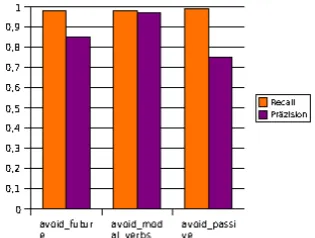
The PET parser with the ERG reached 86.1% coverage on the full corpus. The following charts show the values for recall and precision for Check-point and the shallow system.
Figure 3: Checkpoint values for recall and preci-sion for English
Figure 4: Values for recall and precision for the shallow system for English
As one can see, for the stylistic errors
avoid future and avoid modal verbs, Checkpoint
reaches values which, although relatively high, are lower than the shallow system. In most cases a paraphrase for these errors can be constructed, so the improvement Checkpoint provides here is the generation of corrections. For the error type
avoid passive the precision is not so high, which
not annotated as passives, because the annotators were told to annotate only those stylistic errors for which a paraphrase was possible. The same happens for stylistic errors like avoid subjunctive,
use this that these those with noun and condi-tion must precede accondi-tion. In principle,
Check-point is very good at finding these types of errors, but we cannot yet present a reliable evaluation here, since only those errors were annotated for which a paraphrase was possible. This approach is rea-sonable, since no error alarm should be produced when there is no other possibility of expressing the same. However, since we have not yet developed a method which allows us to automatically distin-guish those cases for which a paraphrase is possi-ble from those for which none is, we would need to annotate all occurrences of a phenomenon in the corpus, and introduce a further annotation tag for the paraphrase potential of the sentence.
Nevertheless, even if the grammar-based re-search prototype cannot beat the industrial pattern-based system in terms of f-measures, we still be-lieve that the results are highly valuable in the con-text of our integrated hybrid scenario: Since the full reversibility of the ERG has already been estab-lished independently by (Velldal and Oepen, 2005), the combined system is able to generate error cor-rection for a great proportion of the errors detected by the shallow component. This includes 80% and above for avoid future and avoid modal verbs.
6 Summary and conclusions
In this paper we have presented an implemented approach to grammar and style checking based on hybrid processing. The hybrid system has two com-ponents: a shallow grammar and style checking system based on the FLAG technology, and the PET deep parser operating on linguistically moti-vated grammars for German and English. The Ger-man version of the hybrid system improves the re-call and in certain cases the precision of the shal-low system and generates error corrections. For English, the hybrid system in most cases success-fully generates paraphrases of sentences contain-ing stylistic errors. Although we only have ex-plored some of the possibilities of integrating deep and shallow processing for the grammar and style checking application, these results speak for the feasibility of using hybrid processing in this task.
We have developed an integrated strategy which forwards the output of the shallow system, includ-ing both the output from several pre-processinclud-ing linguistic modules and the error hypotheses, as in-put to the deep parser. This procedure not only im-proves the robustness of the deep parser with the recognition of unknown words and reduces ambi-guity by instantiating only those lexical items con-sistent with the hypotheses of the POS tagger or the morphology; but it also allows the selective application of grammar rules, which considerably
reduces the search space for parsing and, conse-quently, improves performance. Based on the error hypotheses of the shallow system, the selective ap-plication of grammar rules is achieved by positing features in the Feature Structure Chart whose par-ticular values are a pre-condition for MAL-rules to apply. The improvement in performance sug-gests that this strategy can be extensible to parsing in general based on pre-processing components. Given the output of a chunker, for example, certain syntactic configurations can already be excluded. Having features whose values allow one to switch off certain rules not compatible with these con-figurations would considerably reduce the search space.
On the other hand, we have run the two mod-ules independently from each other to find out how the recall of the shallow system can be im-proved by deep processing. The fact that for sev-eral error types, such as subject verb agreement and NP internal agreement, recall can be consider-ably improved suggests that, in order not to parse all sentences, the shallow system should send an error hypothesis to the deep system when finding particular syntactic configurations which may indi-cate the occurrence of such errors. In this way, such error hypotheses, although not reliably detectable by the shallow system alone, could be confirmed or discarded with a focussed application of deep processing, which would not be as resource con-suming as parsing every sentence.
One of the results of the experiment has been an on-line demonstration system. The running sys-tem shows that the different modules can be eas-ily combined with each other. Our hybrid approach, however, is generic and portable. Although imple-mented for our specific baseline system, it can in principle be used with other shallow systems.
Acknowledgements
The research reported in this paper has been car-ried out as part of the DFKI project Checkpoint, running from February until November 2007. The project was funded by the ProFIT program of the Federal State of Berlin and the EFRE program of the European Union.
References
Adolphs P., S. Oepen, U. Callmeier, B. Crysmann, and B. Kiefer. 2008. Some Fine Points of Hybrid Natural Language Parsing. Proceedings LREC-2008, Mar-rakech, Morocco.
Becker M., A. Bredenkamp, B. Crysmann, and J. Klein. 2003. Annotation of error types for a German news-group corpus. In A. Abeill´e, editor, Treebanks.
Building and Using Parsed Corpora, number 20 in
Bender, E. M., D. Flickinger, S. Oepen, A. Walsh, and T. Baldwin. 2004. Arboretum: Using a preci-sion grammar for grammar checking in call. In
In-STIL/ICALL symposium 2004. NLP and speech tech-nologies in advanced language learning systems.
Venice, Italy.
Brants, T., S. Dipper, S. Hansen, W. Lezius, and G. Smith. 2002. The TIGER Treebank. In Proceedings
of the Workshop on Treebanks and Linguistic Theo-ries. Sozopol.
Bredenkamp, A., B. Crysmann and M. Petrea. 2000. Looking for errors: A declarative formalism for resource-adaptive language checking. In
Proceed-ings LREC-2000. Athens, Greece.
Bredenkamp, A., B. Crysmann and M. Petrea. 2000. Building multilingual controlled language perfor-mance checkers. In Proceedings of the CLAW 2000. Seattle, WA.
Callmeier, U., A. Eisele, U. Sch¨afer, and M. Siegel. 2004. The Deepthought core architecture frame-work. In Proceedings of LREC-2004, 1205–1208, Lisbon, Portugal.
Callmeier, Ulrich. 2000. PET — a platform for ex-perimentation with efficient HPSG processing tech-niques. Natural Language Engineering 6(1):99–
108.
Carroll, John and Ann Copestake and Dan Flickinger and Victor Poznanski. 1999. An efficient chart gen-erator for semi-lexicalist grammars. Proceedings of
ENLG, pp. 86–95.
Copestake, A., and D. Flickinger. 2000. An open-source grammar development environment and broad-coverage english grammar using HPSG. In
Proceedings LREC-2000. Athens, Greece.
Copestake, A., D. Flickinger, C. Pollard, and I. Sag. 2006. Minimal recursion semantics: an introduction.
Research on Language and Computation 3(4):281–
332.
Crysmann, B., A. Frank, B. Kiefer, S. M¨uller, G. Neu-mann, J. Piskorski, U. Sch¨afer, M. Siegel, H. Uszko-reit, F. Xu, M. Becker, and H.-U. Krieger. An inte-grated architecture for shallow and deep processing. In Proceedings of ACL 2002, University of Pennsyl-vania, Philadelphia, 2002.
Crysmann B. 2005. Relative clause extraposition in German: An efficient and portable implementation.
Research on Language and Computation, 3(1):61–
82.
Crysmann B. 2007 Local ambiguity packing and dis-continuity in German. In T. Baldwin, M. Dras, J. Hockenmaier, T. H. King, and G. van Noord, ed-itors, Proceedings of the ACL 2007 Workshop on
Deep Linguistic Processing, pages 144–151, Prague,
Czech Republic.
Crysmann B. 2008. Parse Selection with a German HPSG Grammar. In S. K¨ubler and G. Penn, editors,
Proceedings of the ACL 2008 Workshop on Parsing German (PaGe), pages 9–15, Columbus, Ohio, USA.
Douglas, S. 1995. Robust PATR for error detec-tion and correcdetec-tion. In A. Schoeter and C. Vogel (Eds.)Nonclassical feature systems, Vol. 10, pp. 139-156. Centre for Cognitive Science, University of Ed-inburgh.
Forsbom, E. 2003. Training a Super Model Look-Alike. Proceedings of the MT Summit IX Workshop
“Towards Systemizing MT Evaluation”, pp. 29-36.
Gaizauskas, R., H. Cunningham, Y. Wilks, P. Rodgers and K. Humphreys. 1996. GATE: An environment to support research and development in natural lan-guage engineering. In Proceedings of the 8th IEEE
international conference on tools with artificial in-telligence. Toulouse, France.
Jensen, K., G. E., Heidorn and S. D. Richardson (Eds.). 1993. Natural language processing: The PLNLP ap-proach. Boston - Dordrecht - London.
Haller, J. 1996. MULTILINT: A technical documenta-tion system with multilingual intelligence. In
Trans-lating and the computer 18. London.
Heinecke, J., J. Kunze, W. Menzel, and I. Schroeder. 1998. Eliminative parsing with graded constraints. In Proceedings ACL/Coling 1998, Vol. I, pp. 526-530. Universite de Montreal, Montreal, Quebec, Canada.
Lœnning J. T. , S. Oepen, D. Beermann, L. Hellan, J. Carroll, H. Dyvik, D. Flickinger, J. B. Johannessen, P. Meurer, T. Nordg˚ard, V. Ros´en and E. Velldal. 2004. LOGON. A Norwegian MT effort. In
Pro-ceedings of the Workshop in Recent Advances in Scandinavian Machine Translation. Uppsala,
Swe-den.
McCoy, K. F., C. A. Pennington, and L. Z. Suri. 1996. English error correction: A syntactic user model based on principled “mal-rule” scoring. In
Proceed-ings of UM-96, the Fifth International Conference on User Modeling, pp. 59-66. Kona, Hawaii.
Menzel, W. 1998. Constraint satisfaction for robust parsing of natural language. In Theoretical and
Ex-perimental Artificial Intelligence, 10 (1), 77-89.
M¨uller, S., and W. Kasper. 2000. HPSG analysis of German. In W. Walster (Ed.), Verbmobil:
Foun-dations of Speech-to-Speech Translation, 238–253
Springer, Berlin.
Oepen, S., K. Toutanova, S. Shieber, C. Manning, D. Flickinger and T Brants. 2002. The LinGO Red-woods Treebank. Motivation and Preliminary Appli-cations. In Proceedings of COLING 2002. Taipei, Taiwan.
Ravin, Y. 1998. Grammar errors and style weaknesses in a text-critiquing system. In IEEE Transactions on
Communication, 31 (3)
Schmidt-Wigger, A. 1998. Grammar and style check-ing for German. In Proceedcheck-ings of CLAW 98. Pitts-burgh, PA.
Velldal, E. and S. Oepen. 2005. Maximum entropy models for realization ranking. In Proceedings of